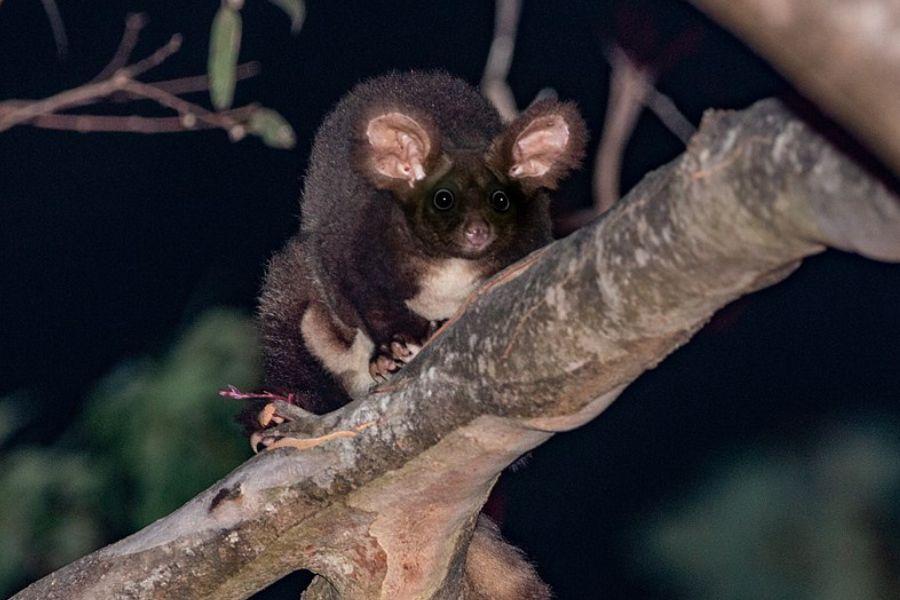
Ecologist 'burst into tears' seeing endangered gliders using boxes designed to save them
A third of the greater gliders' remaining habitat was destroyed in the Australian wildfires, and researchers didn't know if their high-tech box idea would work.

Greater gliders are endangered in Australia and rely on old-growth tree hollows to make their nests.
When a team of Australian researchers started checking the high-tech boxes they'd installed to help save endangered greater gliders, they weren't sure what they were going to find. The hope was that the tree-dwelling marsupials would use them for nesting—a replacement for the tree hollows they normally nest in—but no one knew whether or not the creatures would take to them.
So when Dr. Kita Ashman, Threatened Species and Climate Adaptation Ecologist at WWF-Australia, found a glider in the second box she checked, she was thrilled.
"I just burst into tears, I was so surprised and so happy," she told ABC News Australia.
Greater gliders are nocturnal marsupials that live in old-growth forests of eastern Australia. They have large ears, fluffy fur, long tails, and they can glide up to 100 meters at a time. The species is only found in Australia.
"I grew up looking at greater gliders all throughout the Dandenong Ranges. So they have a really special place in my heart," said Dr. Ashman told ANU.
The special nesting boxes were designed and created through a partnership between Australian National University (ANU), Greening Australia and the World Wide Fund for Nature-Australia after bushfires destroyed a third of the greater gliders' remaining habitat. The tree hollows that greater gliders rely on to nest can take over 100 years to form, according to ANU, so it's not like they can just find some new trees to live in when their homes are destroyed.
Nesting boxes that are commonly used for wildlife aren't a good fit for greater gliders, as the thin walls and lack of thermal protection can result in gliders overheating. (Heat-stressed gliders will slow their eating, which can be life-threatening, according to ANU.) The high-tech boxes in this project are insulated and include a non-toxic, heat-reflective, fire-resistant coating to keep gliders safe.
"I've affectionately been calling this design the Goldilocks box because we hope it will keep greater gliders not too hot and not too cold and will help to increase the species' resilience in a changing climate," Ashman said in July 2022.
"Producing and installing high-quality nest boxes is costly," added ANU research fellow Dr. Kara Youngentob, "so this project is very important because it will help us understand if expensive interventions like nest boxes are the best use of funding in our urgent mission to save greater gliders."
It appears that their efforts are paying off.
"What we didn't know was whether these boxes worked and whether they have an impact on the glider population," Dr. Youngentob told ABC News Australia. "Much to our delight, within a few months of them going up they are already being used by gliders, so we know the individuals themselves like them and use them."
According to Youngentob, greater gliders are the largest gliding marsupial at risk of extinction. More than 200 nesting boxes have been installed in Victoria's East Gippsland and in Tallaganda National Park in New South Wales. Youngentob told ABC News Australia that this project will help researchers learn more about how many of the species are left in the wild.
The quiet, nocturnal marsupial faces threats from climate change and deforestation in addition to the wildfires that ravaged Australia in 2020. Their population has fallen by 80% in the past 20 years and the species reached endangered status in July of 2022.
"They're a treasure for this country." Dr. Youngentob told ANU. "And I think the more people know about them, the more that they will fall in love with them and want to protect them too."
This article originally appeared last year.

- 7 photos of no-longer-endangered humpback whales jumping for joy. ›
- Yes, arsonists started some of Australia's fires. No, it doesn't mean climate change is fake ›
- Wildlife officials throw 3,000 pounds of lettuce a day into the sea to save starving manatees ›
- 90-year-old tortoise becomes first time dad to three babies - Upworthy ›


Student smiling in a classroom, working on a laptop.
Students focused and ready to learn in the classroom.
Fish find shelter for spawning in the nooks and crannies of wood.
Many of these streams are now unreachable by road, which is why helicopters are used.
Tribal leaders gathered by the Little Naches River for a ceremony and prayer.

Communications expert shares the perfect way to gracefully shut down rude comments
Taking the high ground never felt so good.
A woman is insulted at her job.
It came out of nowhere. A coworker made a rude comment that caught you off guard. The hair on the back of your neck stands up, and you want to put them in their place, but you have to stay tactful because you're in a professional setting. Plus, you don't want to stoop to their level.
In situations like these, it helps to have a comeback ready so you can stand up for yourself while making making sure they don't disrespect you again.
Vince Xu, who goes by Lawyer Vince on TikTok, is a personal injury attorney based in Torrance, California, where he shares the communication tips he's learned with his followers. Xu says there are three questions you can ask someone who is being rude that will put them in their place and give you the high ground:
Question 1: "Sorry, can you say that again?"
"This will either make them have to awkwardly say the disrespectful remark one more time, or it'll actually help them clarify what they said and retract their statement," Xu shares.
Question 2: "Did you mean that to be hurtful?"
The next step is to determine if they will repeat the disrespectful comment. "This calls out their disrespect and allows you to learn whether they're trying to be disrespectful or if there's a misunderstanding," Xu continues.
Question 3: "Are you okay?"
"What this does, is actually put you on higher ground, and it's showing empathy for the other person," Xu adds. "It's showing that you care about them genuinely, and this is gonna diffuse any type of disrespect or negative energy coming from them."
The interesting thing about Xu's three-step strategy is that by gracefully handling the situation, it puts you in a better position than before the insult. The rude coworker is likely to feel diminished after owning up to what they said, and you get to show them confidence and strength, as well as empathy. This will go a lot further than insulting them back and making the situation even worse.
Xu's technique is similar to that of Amy Gallo, a Harvard University communications expert. She says that you should call out what they just said, but make sure it comes out of their mouth. "You might even ask the person to simply repeat what they said, which may prompt them to think through what they meant and how their words might sound to others," she writes in the Harvard Business Review.
More of Gallo's suggested comebacks:
“Did I hear you correctly? I think you said…”
“What was your intention when you said…?”
“What specifically did you mean by that? I'm not sure I understood.”
“Could you say more about what you mean by that?”
Ultimately, Xu and Gallo's advice is invaluable because it allows you to overcome a negative comment without stooping to the other person's level. Instead, it elevates you above them without having to resort to name-calling or admitting they got on your nerves. That's the mark of someone confident and composed, even when others are trying to take them down.