Scientists identify 5 types of sleepers, and each has different brain wiring

The real reason you wake up at 3 a.m.

sleepers, sleep, profiles, rest, brain
Photo credit: CanvaWhat type of sleeper are you?

To be honest, most sleep advice sounds like it was written for people who already sleep well. We’re offered platitudes like “Stick to a consistent bedtime.” Revolutionary. Or, “Avoid screens before bed.” Sure. “Try to relax.” Oh, thanks. Never thought of that.

For millions of people, this sort of run-of-the-mill sleep advice feels like being handed a pamphlet about umbrellas in the middle of a tropical storm. The advice isn’t wrong, not really. But it’s basic. Generic. It fails to account for the wildly diverse reasons people struggle with sleep in the first place.

Sleep, however, remains an essential problem for many. Roughly one in three American adults fails to get the recommended 7+ hours of sleep per night. Nearly half report trouble staying asleep on three or more nights a week. A record-high 57% of Americans say they would simply feel better if they could get more sleep.

new study from Concordia University feels radical for a simple reason: Instead of lumping all sleepers into “good” and “bad” categories, researchers identified five distinct sleep profiles, each with its own causes, brain patterns, and emotional fingerprints. Once you know which one sounds like you, the advice actually starts to make sense.

A quick look at the science

Researchers in Montreal studied 770 healthy adults aged 22 to 36. They analyzed a large, diverse group of real people, not statistical abnormalities. Scientists combined MRI brain scans, sleep quality surveys, cognitive tests, mood assessments, and lifestyle data to build the most complete picture of human sleep patterns ever assembled.

What they found: Your sleep isn’t just about what happens when you close your eyes. It’s deeply intertwined with your brain wiring, your emotional life, and how you move through the world during the day. These findings align with the current sleep-deprivation crisis. Six in ten adults aren’t getting enough sleep, according to the National Sleep Foundation, and the Centers for Disease Control and Prevention reports that one in three adults is chronically sleep-deprived. But not all of those sleepers are struggling for the same reasons, and that distinction matters more than previously realized.

Your sleep profile isn’t a quirky, fun fact like an astrological sign. Knowing which profile you belong to could unlock a good night’s rest—not just tonight, but for a lifetime.

The 5 sleep profiles

sleepers, sleep, profiles, rest, brain
Are you a Struggling Sleeper? Photo credit: Canva

Profile 1: The Struggling Sleeper (LC1)

Does this sound familiar? You get into bed exhausted, lie there for an hour, and suddenly your brain wants to review every awkward conversation you’ve had since 2009. When you do sleep, it’s shallow. You wake up wondering why you even bothered.

LC1, known as the Struggling Sleeper, is the most prevalent and clinically significant sleep profile. It is defined by a potent combination: sleep difficulty and underlying mental health struggles, including anxiety, depression, low mood, and poor concentration. These factors are so closely linked that it’s almost impossible to tell which came first. Research has consistently shown that insomnia and anxiety and depression have a bidirectional relationship, with each feeding and amplifying the other in a self-reinforcing cycle. Treating only the sleep without addressing the emotional root is like mopping the floor while the faucet is still running.

Brain scans reveal another neurological layer: Individuals with LC1 exhibit hyperactivity in emotional processing regions and reduced connectivity in areas tied to rumination and focus. The brain gets stuck in a loop. So when it’s 2 a.m. and you’re mentally planning contingencies for catastrophes that haven’t happened, this is your brain’s wiring, not a personal failure.

Somehow, Resilient Sleepers make it through the night. Photo credit: Canva

Profile 2: The Resilient Sleeper (LC2)

This one’s surprising. While Resilient Sleepers often carry real psychological stress—attention difficulties, low mood, pressure that would flatten most people—somehow, they sleep.

This profile offers a fascinating contrast to LC1. People in LC2 experience similar levels of psychological burden as those in Profile 1, but their sleep does not break down under that pressure. Researchers think this may reflect a neural resilience pathway—a different kind of wiring that prevents stress from taking over the sleep system.

Their brain scans reveal something intriguing: strong attention and control networks that act as a buffer, preventing emotional noise from flooding the sleep system at night. You might even underestimate your own sleep quality, thinking it’s worse than it actually is. Researchers believe this profile could be key to understanding what the brain can learn to defend, and whether those defenses can be developed in other sleepers.

sleepers, sleep, profiles, rest, brain
For the Medicated Sleeper, sleeping aids are non-negotiable. Photo credit: Canva

Profile 3: The Medicated Sleeper (LC3)

Melatonin gummies, sleepy tea, a glass of wine, a Benadryl “just this once” that became every night—if sleep aids have quietly become non-negotiable, you probably recognize this profile.

Medicated Sleepers are often doing well by most measures—they’re socially active and physically healthy—but simply can’t fall asleep on their own without a little chemical assist. The trade-off? Mild declines in visual memory and emotional regulation, as sedating medications have been shown to affect both perceptual and emotional processing.

An important note: The researchers found that LC3, LC4, and LC5 were less robust than LC1 and LC2, suggesting these profiles may be more variable across populations and should be interpreted with caution.

sleepers, sleep, profiles, rest, brain
Short Sleepers don’t need less sleep—they’re sleep-deprived. Photo credit: Canva

Profile 4: The Short Sleeper (LC4)

You’re efficient. You’ve adapted. So five and a half hours of sleep is fine—you’ve been running on it for years.

Here’s the hard truth: The brain scans of Short Sleepers look nearly identical to those of people who have pulled a full all-nighter. No, not just tired people—people who literally haven’t slept. As you can imagine, the cognitive costs of this sleeper profile accumulate quickly, often below the threshold of what we can feel but well above what researchers can measure.

LC4 is characterized by regularly sleeping fewer than six to seven hours per night, and the cognitive impacts are measurable: slower reaction times, decreased problem-solving ability, lower emotional patience, and difficulty managing interpersonal frustration. You may pride yourself on needing little sleep, having built an identity around efficiency. But your partner notices you snap more easily. You’ve forgotten three appointments this month. You’re not superhuman. You’re sleep-deprived, and your brain is working overtime to hide it from you.

sleepers, sleep, profiles, rest, brain
Fractured sleep? You might be a Disturbed Sleeper. Photo credit: Canva

Profile 5: The Disturbed Sleeper

You spend eight hours in bed, but you wake up exhausted. Throughout the night, everything in the world seems to keep you from rest—discomfort, noise sensitivity, a partner who snores—and despite spending plenty of time technically “sleeping,” Disturbed Sleepers rarely feel rested. The quality of sleep is just too fractured.

LC5 is characterized by nighttime disturbances and interruptions in physical sleep, and its downstream effects include anxiety, substance use as a coping mechanism, and poor performance across various cognitive domains.

This was the only profile in the study to show a notable gender difference, with women scoring significantly higher—consistent with research showing that women experience greater sleep fragmentation over their lifetimes.

Why your sleep type matters

The stakes go well beyond feeling groggy. Each of these profiles carries unique long-term health risks, and the brain research is truly concerning.

The dementia connection

Every night, while you’re asleep, your brain quietly does something extraordinary. It activates what scientists call the glymphatic system—a built-in janitorial crew of fluid channels that weave between your brain cells. Their job? To flush out toxic proteins that accumulate during the day, including amyloid beta and tau. These are the same proteins that clump and tangle in the brains of people with Alzheimer’s disease.

This cleanup process happens primarily during deep, slow-wave sleep—the kind that disrupted, shortened, or fragmented sleep tends to steal first. And even one night of sleep deprivation measurably impairs that clearance. Not a year of bad habits. One night.

When this system fails over time—as it does in people with the Struggling Sleeper, Short Sleeper, and Disturbed Sleeper profiles—toxic proteins don’t just linger; they build up. They cluster together. They trigger inflammation, worsening the problem. It’s a slow, silent spiral that can develop for years before anyone notices anything wrong.

The anxiety-depression loop

The relationship between sleep and mental health isn’t a one-way street where anxiety causes bad sleep. It’s more like a revolving door. Decades of research have confirmed that insomnia predicts the onset of depression, and depression predicts the worsening of insomnia. Each one fuels the other, back and forth, in a cycle that can go on for years.

If you treat depression alone and ignore sleep, you’ll often get incomplete results. If you treat only the sleep and overlook the underlying anxiety, the same issue occurs. The two are so closely connected that addressing one without the other usually leaves the whole thing unchanged.

sleepers, sleep, profiles, rest, brain
Different sleep problems require different solutions. Photo credit: Canva

Okay, so what can you actually do about it?

The biggest takeaway from the research is the idea that sleep problems don’t all stem from the same place. They can’t all be fixed in the same way. What helps a Struggling Sleeper might do nothing for a Short Sleeper. What a Disturbed Sleeper needs is a completely different conversation from what a Medicated Sleeper needs. Here’s a rundown of what your sleeper profile requires for genuine rest:

If you’re a Struggling Sleeper (Profile 1):

The most important thing to understand is that you can’t just treat the sleep and ignore what’s underneath it. The anxiety and the insomnia are in a relationship, and both of them need to be addressed at the same time. The treatment with the strongest evidence is CBT-I (Cognitive Behavioral Therapy for Insomnia), but it could also help to keep a “worry list.” Before bed, spend 15 minutes writing down everything that’s rattling around in your mind. Getting it on paper moves it out of your brain.

If you’re a Resilient Sleeper (Profile 2):

Congrats! You’re doing something right, even if you’re not sure what it is.

Take a minute to take stock of your stress-management habits; something in your routine is actively protecting your sleep. Jot this down, whatever it is, and try not to trade it away when life gets busy. It’s doing more for your mental health than you realize.

One gentle caution: Resilience isn’t a permanent condition. Major life disruptions—loss, burnout, significant transitions—can shift your profile over time. Keep checking in.

If you’re a Medicated Sleeper (Profile 3):

No judgment here: a lot of people are in this category, and most of them didn’t plan to be.

But it’s worth having an honest conversation with a doctor about whatever you’re taking, because many over-the-counter sleep aids are designed for occasional use, not nightly use. Long-term reliance changes how your brain reaches sleep, and that shift is worth understanding. CBT-I is worth trying here, too: Studies specifically show it reduces dependence on sleep medications while improving overall outcomes.

If you’re a Short Sleeper (Profile 4):

Let’s name the thing directly: The belief that you’ve adapted to six hours is one of the most common and most convincing lies the sleep-deprived brain tells itself.

True Short Sleepers—people who genuinely thrive on less than seven hours due to a rare genetic trait—represent less than 3% of the population. Everyone else who “only needs six hours” has simply stopped noticing the deficit. Treat 7–8 hours the way you treat eating or exercise: a non-negotiable, not a nice-to-have.

If you’re a Disturbed Sleeper (Profile 5):

Sleep hygiene alone probably isn’t going to fix this, because the root is often physical, and physical problems need physical solutions.

If you wake up multiple times a night, snore, or feel unrested despite spending plenty of time in bed, consider getting evaluated for sleep apnea. If chronic pain is disrupting your sleep, address it directly rather than just managing around it at night.

consistent sleep and wake schedule also helps anchor your circadian rhythm, making it easier for your body to build the biological pressure for sleep that actually gets you through the night.
sleepers, sleep, profiles, rest, brain
You deserve genuine rest. Photo credit: Canva

One size doesn’t fit all (and it never did)

Knowing your profile isn’t just interesting self-knowledge. It’s a starting point for solving the problem and finally getting the kind of sleep that makes everything else in life feel a little more possible.

So, which one sounds like you?

  • Professor uses two balls and string to show how far the Moon actually is from Earth
    Photo credit: NASAHow far away is the Moon from Earth, really?
    ,

    Professor uses two balls and string to show how far the Moon actually is from Earth

    The physical demonstration showed it’s farther than most of us imagine.

    On April 6, 2026, the Orion spacecraft officially took four astronauts farther from Earth than any human has gone before. While the Artemis II mission did not include a Moon landing, it did involve making a pass around the Moon (in addition to making the world cry over naming a Moon crater after the late wife of one of the astronauts).

    But how far did they go, exactly? We can look at the historic number of miles the Orion flew from Earth—approximately 252,756—but that distance is a little tough for us to visualize. Thankfully, Professor Anu Ojha’s scientific demonstration at The Royal Institution makes it a lot easier.

    The Moon is farther away from Earth than many people imagine

    First, Ojha explained that the distance between the Earth and Moon varies because the Moon’s orbit around the Earth is elliptical. But very roughly speaking, he said, the Moon’s orbital distance from the Earth is equal to 10 circumferences of the Earth.

    He held up an inflatable globe to represent Earth and explained that he had wrapped a piece of string around it 10 times. At the end of the string, he attached a ball that was the correct scale compared to the Earth.

    “It’s about the same size as Australia or Canada or China,” he explained. “About a quarter of the diameter of the Earth.”

    He showed a graphic that depicted the Earth and Moon in proper scale, but with a totally inaccurate distance between them. Then, holding the globe, he asked a student to take the Moon ball at the end of the string and start walking away from him.

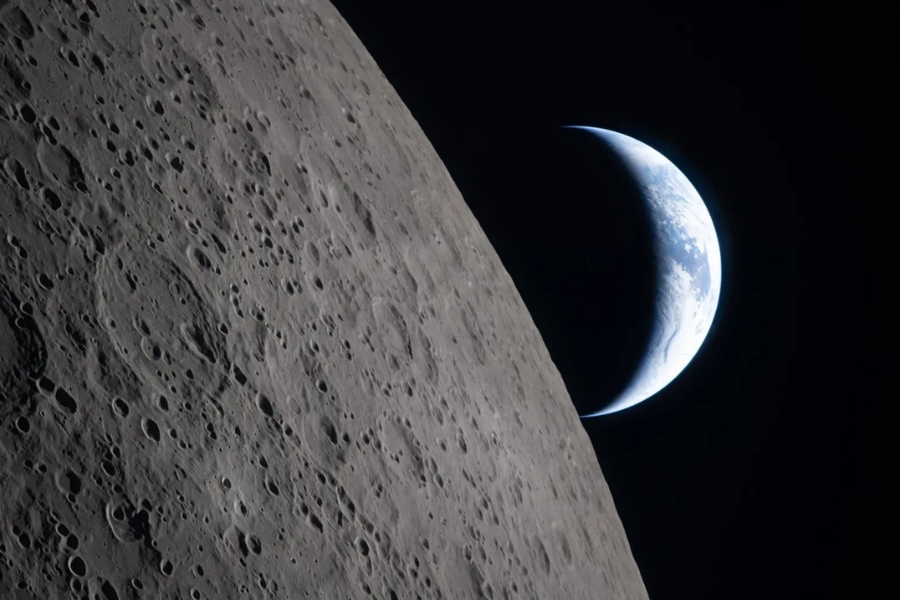
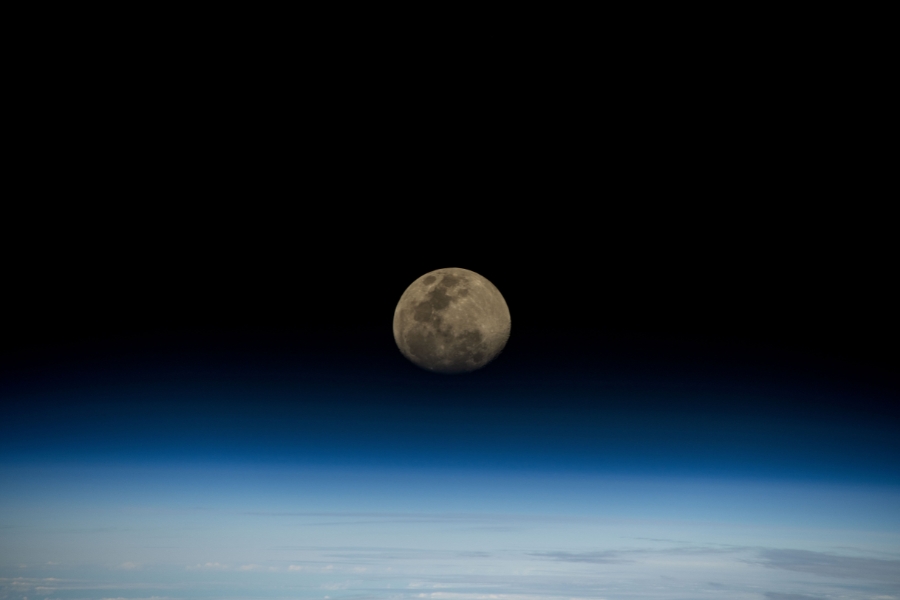
    NASA photo of the moon taken from the International Space Station
    Photo from the ISS of the moon “rising” over the Earth’s atmosphere (Photo credit: NASA)

    After the string unwound about six or seven feet, he asked the student to stop. “That’s the sort of visualization we get from this image,” he explained. “But, you know, there’s a lot of string left here.”

    Ojha had the student keep walking, and keep walking, and keep walking until he had fully unwound the string. We can barely see the student as he walked up a flight of stairs into a darkened area of the classroom, but it’s clear the distance between the Earth and Moon is much farther than we are used to picturing it.

    The International Space Station’s location compared to the Moon drives the point home

    After showing how far the Moon—”our nearest naturally occurring neighbor in space”—is from Earth, Ojha put it into even clearer perspective.

    “How far away did I say the international boundary of space was?” he asked the students, who responded, “100 kilometers.”

    “That’s 1 millimeter on this scale,” Ojha said. “International Space Station (ISS) 400km—a finger width. The Moon is a thousand times the distance to the orbit of the International Space Station.”

    But he wasn’t done. He also said that if we go to the next nearest planet, Venus, we are talking about a distance more than 100 times the distance between the Earth and the Moon.

    “So we start to see the challenges that we are facing in directly exploring even our own solar system, let alone the universe,” he said.

    This demonstration also makes it clearer why space missions to the Moon haven’t been a regular occurrence. Many of us had no idea how much further the Moon was than the ISS. They’re not even close to comparable trips.

    Physical science demonstrations for the win

    People appreciated the old-school science lesson:

    “There is no substitute for physical demonstration in a room.”

    “A lot of people just don’t realise the sheer scale of astronomical units, there’s too much ‘space’ out there to wrap their heads around it.”

    “Most people can only understand what they can GRASP. This kind of physical demo is the most efficient.”

    “I used to do that thing with my elementary school students where we go out to the football field and lay down planets showing how far away everything is from the sun. Blew their minds every time.”

    “Everything I learn about space tends to come with the subtext of ‘It’s big. No, not the scale you’re thinking, bigger.’”

    “Crazy how even with such a distance and small mass the Moon can still have such a massive effect on our water (and other such things).”

    Our understanding of the cosmos is always growing and evolving, of course. But the math that tells us the scale of the objects in space has been around a long time and still has the power to boggle our minds. The universe is awesome, literally. Isn’t it wonderful how the awe that space exploration inspires in us is a reminder of everything that makes us human?

  • 1976 research study confirms science behind ‘urinal etiquette’
    Photo credit: CanvaA fascinating decades-old study revealed the science behind “urinal etiquette.”
    ,

    1976 research study confirms science behind ‘urinal etiquette’

    The “buffer urinal” is more important than we realize.

    There’s a theory that most men, and people in general, intuitively understand “urinal etiquette.” It’s the art and science of where to stand in relation to other men when using a public restroom. Stand too far away, and you risk coming across as standoffish or rude. Stand too close, and you’ll make the other person uncomfortable.

    Most people prefer to have a “buffer” between themselves and strangers, and it’s not limited to urinals or public restroom stalls. When given the option, most of us will sit at least one seat away from the nearest stranger in a movie theater or auditorium. We’ll leave a bench or treadmill between ourselves and a fellow gym-goer.

    The buffer may seem like common decency and consideration for the people around us, but there could be more to it than that, according to a decades-old research study.

    Scientists put theory to the test

    In 1976, a team of researchers actually got the idea to test whether the proximity of a stranger had an effect on the way men urinated. Yes, really.

    More specifically, they wanted to test what happens when someone invades your personal space. Do you just feel awkward or uncomfortable, or are there more measurable things happening in the body?

    men, bathrooms, public restrooms, urinals, urinal etiquette, personal space, public spaces, society, psychology, science, research studies
    Objectively, the worst kind of urinal. Photo Credit: Photo credit: Wikimedia Commons

    For the experiment, researchers began with a pilot study in a men’s public restroom. An observer stood by the sink, appearing to busy himself with washing and grooming, all while secretly keeping tabs on the men who entered. The published study takes it from there:

    “When a potential subject entered the room and walked to a urinal, the observer recorded the selected urinal and the placement of the next nearest user. He also noted (with a chronographic wristwatch) and recorded the micturation delay (the time between when a subject unzipped his fly and when urination began) and the micturation persistence (the time between the onset and completion of urination). The onset an cessation of micturation were signaled by the sound of the stream of urine striking the water in the urinal.”

    Ethical concerns about observing unsuspecting men in a restroom aside, the study found that none of the 48 subjects chose to stand directly next to another “user” at the urinal banks. The data also showed that men urinated longer the farther they were from the nearest person.

    The study was repeated, but this time, confederates were involved. Volunteers were stationed at specific distances from unsuspecting bathroom users, while another observer hid in a nearby stall and used a “periscope” to get a clear sightline of the urine stream.

    The surprising findings

    Once again, the data was extremely conclusive: men who stood directly next to a confederate while urinating took longer to begin and also urinated for longer overall.

    “These findings provide objective evidence that personal space invasions produce physiological changes associated with arousal,” the authors noted in their abstract.

    It was an important, if controversial, study in advancing the field of proxemics—the study of physical space in human nonverbal communication. Research like this unusual bathroom study has helped us understand “intimate distance,” a space very close to our bodies that we reserve for romantic partners, children, and close friends.

    Research in the field has also mapped the “personal bubble,” or “personal distance,” typically reserved for family members and friends. However, when strangers invade this space—in a crowded elevator, a packed subway car, or by standing next to us at the urinal—that’s when things get really interesting.

    Our bodies respond, and MIT Press notes that people often deal with an invasion of personal space by “psychologically removing themselves from the situation” by listening to music or staring blankly at a wall.

    Now we know a little more about the physiological response behind this aversion, and it makes urinal etiquette make much more sense. It’s not just “machismo” or homophobia—it’s a way of avoiding a serious stress and anxiety trigger. Or, at the very least, a way to have a much more satisfying pee.

  • People are finding out firsthand why you ‘can’t’ pour water down the Hoover Dam
    Photo credit: @rarity_eddie/TikTokA guy’s trick at the Hoover Dam went viral on TikTok.

    Most people have a love-hate relationship with social media these days, but it has provided at least one public service. All those rumors and old wives’ tales that have been flying around for years? People around the world can now put them to the test and compare notes on their findings.

    That’s exactly what Eddie, a TikTok user, decided to do on his recent visit to the Hoover Dam.

    Putting the theory to the test

    The Hoover Dam, located on the border between Nevada and Arizona, isn’t just one of the largest dams in the world. It also has a unique design that makes it recognizable around the world.

    And even though the dam can handle some 300,000 gallons of water per second, if you try pouring a bit of your own water over the ledge…well, you can’t. At least, that’s the theory.

    In a recent video shared on social media, Eddie writes, “POV you heard you can’t pour water down the Hoover Dam.” He then proceeds to do just that, or at least attempt it.

    Eddie walks toward the edge of the dam with a cup of water in hand and tips some of it over the side. Immediately, as if by magic, it begins to levitate and break into droplets. The drops scatter along the face of the dam, with some even splashing back onto Eddie, prompting a joyful chuckle.

    @rarity_eddie

    They said it couldn’t be done. So we did it. What else should I try? #hooverdam #waitforit #whatishappening #oddlysatisfyingvideo #traveltok

    ♬ Doin What I Want – Natalie Nunn

    Mystery solved…or is it?

    Other tenacious folks have tested the theory and had no trouble watching their water tumble down the side of the dam.

    Annie, inspired by Eddie’s success, tried it with her boyfriend, and found herself bamboozled:

    And yet, other people had no problem replicating the “viral trick.”

    Here’s Luis, who visited the dam in 2022:

    Science behind the trick

    So, what’s really going on here?

    According to IFLScience, your results in replicating this trick may vary depending on the day, where you’re standing on the dam, and the conditions.

    Simply put, strong winds flow up the wall of the dam, pushing the water upward at high speed and causing it to splash. But it’s not an effect that’s easily replicated at other large, man-made structures. The dam’s design is perfectly suited to this result.

    The Hoover Dam is situated above Black Canyon, whose high walls act as a wind funnel on breezy days. Winds in the valley can reach over 50 miles per hour. Naturally, when the air hits the wall of the dam, it has nowhere to go but up.

    The wind accelerates up the face of the Hoover Dam because the water at the top cools the air.

    So, on windy days, you get an extremely powerful upward draft—sometimes called ridge lift or slope lift—that can make small amounts of water appear to levitate.

    Other places that seem to defy nature

    The Hoover Dam isn’t a magical anti-gravity spot, but it is unique in the way it harnesses natural forces.

    You might have heard of “gravity hills,” which are spots around the world that trick your eyes. These optical illusions make downhill slopes appear to go uphill, leading to some wild experiences—like cars in neutral “rolling uphill.”

    @lovetwb

    This was so creepy! Its called Gravity Hill. Noone knows why this happens here. Personally it reallt freaked us out… we probably won’t go back 🤣🫣. Would you go? Or have you been? #washingtonstate #hauntedhistory #gravityhill #prosserwa #gravityhillwa #travelingwhileblack

    ♬ Spooky, quiet, scary atmosphere piano songs – Skittlegirl Sound

    People lucky enough to swim in the Dead Sea are often amazed at how they seem to magically float, thanks to the water’s extremely high salt content.

    @luisaasim_

    Salt Beach, Dead Sea, in Jordanien 🇯🇴 Wusstet ihr, dass das Tote Meer der tiefste Punkt der Erde ist, etwa 430 Meter unter dem Meeresspiegel, und der Salzgehalt so hoch ist, dass man gar nicht untergehen kann? ✨ Konnte es erst nicht glauben, aber man schwebt wirklich und kann sogar ein Buch lesen 📖 #travel #jordan #deadsea #saltbeach #amman

    ♬ suono originale – Jr Stit

    Like these locales, the Hoover Dam trick isn’t magic. It’s science. Some might say that makes it even cooler.

  • ‘Windfall time’: Why unexpected free time feels so much better than the kind we plan
    Photo credit: CanvaImage of a canceled event in a planner (left) and a relieved woman (right).

    Most of us are familiar with the sudden rush of relief that comes when a work meeting gets canceled. Even if you’re only getting 60 minutes of your time back, it can feel like a huge chunk of the day is suddenly uncharted territory. That feeling is liberating—a rare moment when your schedule loosens its grip, reminding you that not every second of your time is spoken for.

    It turns out there’s a scientific explanation for this wave of euphoria, and it has everything to do with our (very subjective) sense of time. 

    A Rutgers University study, published in the Journal of the Association for Consumer Research, found that when people unexpectedly gain free time, they perceive it as longer than time that was already designated as free. The researchers call this phenomenon “windfall time.”

    “An hour gained feels longer than 60 minutes, and that deviation from expectation creates a unique sense of opportunity,” said Gabriela Tonietto, an associate professor of marketing at the Rutgers Business School and lead author of the study. 

    windfall time, work meeting, psychology
    Computer, clock, and letters spelling “TIME.” Photo credit: Canva

    Tonietto’s past work has explored various aspects of time management and perception, including “time famine” (the persistent feeling of not having enough time) and the benefits of having nothing to do. Her research often highlights how our relationship with time is shaped less by the clock and more by context, expectation, and emotion.

    After conducting seven surveys involving more than 2,300 participants, the team found that windfall time results from the “contrast effect.”

    That surprise hour is inherently judged against the initial expectation of having no free time at all, and thus feels perceptually expanded. In other words, a canceled one-hour meeting gives you 60 more free minutes than you expected to have. That mental comparison alone is what makes the time feel richer, fuller, and more valuable.

    In terms of productivity, the study also found that people were just as likely to use windfall time for work (often longer tasks) as they were for breaks or personal errands. Tonietto cautioned against employers trying to engineer these surprises, especially at the last minute, as it could backfire and create frustration rather than relief.

    Instead, Tonietto suggests that whenever this windfall comes, we should simply “take the gift and make the most of it.”

    productivity, Rutgers, neuroscience
    A man stretching at his desk. Photo credit: Canva

    And really, this discovery hits a little broader than just the workplace.

    Parents, for example, might never know a sweeter bliss than the 45 minutes of free time gained when their child takes a nap. A delayed appointment, an early dismissal, or even a plan that falls through can become an unexpected pocket of possibility. That might mean being productive, or doing nothing at all, without guilt.

    For example, some people find it helpful to use windfall time to start a task that normally feels too big to begin. Because the time feels more expansive, it can lower the mental barrier to getting started, even if only a small portion gets done. Others might choose something genuinely restorative, like stepping outside, taking a short walk, or simply sitting in silence without distractions.

    to-do list, windfall time, psychology
    A woman walking, refreshed. Photo credit: Canva

    It can also help to pause before automatically filling the time. Resisting the urge to default to scrolling or busywork, even briefly, allows you to decide what would actually feel good or useful in that moment. Keeping a loose mental list of things you enjoy or have been meaning to do can make these unexpected pockets of time feel even more rewarding.

    Perhaps the biggest takeaway is to start seeing more of our time as “windfall time,” so we can make the most of it—or at least appreciate it more. Because sometimes it’s not about having more time, but about recognizing the moments when it unexpectedly appears.

  • What it means to look at the ground while walking, according to psychology
    Photo credit: CanvaSilhouette of a man walking.

    So much about a person’s inner world can be revealed without them having to say a single word. Even the smallest gestures can offer clues to their deeper emotions, coping mechanisms, and how they navigate the world.

    For instance, you may have noticed people who keep their eyes on the ground while walking. You might even be one of them yourself. Experts suggest that even this tells a psychological story—but not necessarily the one you might be thinking.

    Walking with one’s eyes down is commonly associated with shyness, depression, social anxiety, and low self-esteem. There does appear to be some science to support this.

    For example, researchers have found that people experiencing social anxiety are more likely to avert others’ gaze, often looking toward the ground rather than making eye contact. Some studies suggest this behavior may stem from a fear of being judged or negatively evaluated, making eye contact feel uncomfortable or even threatening.

    At the same time, psychologists caution against making quick assumptions. Human behavior is rarely driven by a single cause, and the same outward action can reflect very different internal states. In fact, looking down while walking can serve multiple purposes, many of which have little to do with anxiety or emotional distress.

    Cultural context, for instance, is another important factor. In some cultures, lowering one’s gaze is considered a sign of respect, humility, or politeness, especially when encountering elders or authority figures. What might be interpreted as insecurity in one setting could actually be a learned social norm in another.

    There is also a cognitive explanation. Many people use walking as a time to think, process, or problem-solve. Looking down can reduce visual distractions, allowing the brain to focus more fully on internal thoughts. This kind of inward attention may be especially common among creative thinkers or those working through complex ideas.

    @lizroseofficial

    Reposting this bc TikTok decided I’m not getting views on it 😤 What does your walk say about you? #walking #walkthewalk #bodylanguage #movement #communicationskills

    ♬ original sound – Liz Rose

    Another factor is more practical and straightforward: balance and navigation. Researchers at the University of Rochester found that people instinctively spend more time looking at the ground when it’s uneven in an effort to avoid tripping. This behavior is particularly noticeable in unfamiliar environments or places with obstacles where visual attention shifts downward to maintain stability and prevent falls.

    Expanding on this, age can also play a role. Older adults, for example, may be more likely to watch their steps carefully to reduce the risk of injury. Similarly, people recovering from injuries or dealing with mobility challenges might rely more on visual cues from the ground.

    Lastly, we live in a smartphone-dominated world. Many, if not most, of us regularly look down at our devices while walking. Over time, this habit can carry over even when a phone is not in hand. The posture becomes automatic, shaped by repetition rather than emotion.

    Taken together, these perspectives suggest that a downward gaze is not a one-size-fits-all signal. It can reflect anxiety, yes, but it can also point to cultural norms, deep thought, environmental awareness, or simple habit. Like many aspects of human behavior, its meaning depends heavily on context.

  • Instagram post compares Robert De Niro’s face over the years to explain why everyone’s ears change
    Photo credit: Roland GodefroyActor Robert De Niro in 1988.

    Our bodies are miraculous, and much of the time, we don’t even know why. As we age, without any surgical help, our face shapes can change, shoulders can hunch, and teeth can shift. But one of the most obvious (and perhaps odd) differences is the size of our ears and noses.

    In a recent post from the Instagram page Historic Moments, two profile photos of actor Robert De Niro are shown. In the earlier image—likely from his role as Travis Bickle in Martin Scorsese’s 1976 film Taxi Driver—his features appear proportionate. The other photo shows a more recent De Niro, where his ear (and possibly his nose) appears noticeably larger.

    The caption reads, “Robert De Niro is living proof that our ears grow roughly 0.22 millimeters per year.” In the description, they write:

    “Recent side-by-side comparisons of Robert De Niro vividly illustrate the physiological reality that human ears continue to grow throughout our lives. While many believe this is merely sagging skin, studies confirm that ear circumference increases by roughly 0.22 millimeters per year. This phenomenon is primarily due to the continuous growth of cartilage and the relentless effects of gravity over decades. De Niro’s evolving profile is a high-profile example of this unique aspect of the human aging process.”

    The post has gone viral, suggesting that many people have wondered why this change happens. Fortunately, we have answers.

    Doctors weigh in

    Upworthy spoke with Dr. Ari Hoschander, the head plastic surgeon at the Rhinoplasty Center of Long Island, who shared:

    “There are actually two things happening at once, and people conflate them. The nose and ears do genuinely grow, but they also appear larger because the face around them is losing volume. Volume decreases in the cheeks and temples, and the fat pads that used to provide roundness to the face start to descend or just disappear altogether. Suddenly your nose looks disproportionately larger compared to the rest of your face.”

    Hoschander also discussed the cartilage issue:

    “Cartilage also doesn’t behave the way bone does as you age. While bone mostly stops changing once you’re done growing, cartilage continues to slowly deform and lose its structural resilience over your entire life. The ears and nose are mostly cartilage, so the actual structure of your nose and ears continues to change over the course of your life.”

    As for noses and ears?

    “The nasal tip is where I see it most dramatically in practice. Gravity pulls the tip down, the supporting ligaments stretch out, and the skin loses its elasticity. So the tip droops and the nose looks longer and heavier than it did a few decades earlier. For the ears, the lobes are mostly fat and skin, so they elongate just from years of gravity, sometimes accelerated by heavy earrings. The upper ear cartilage is also slowly expanding, which is why older men in particular can end up with ears that look really big.”

    A plastic surgeon explains the change

    Dr. Jeffrey Lisiecki, a board-certified plastic surgeon, also shared similar insight with Upworthy. As for noses, he said they appear to grow for a couple of reasons:

    “The cartilage of your nose essentially stops growing by adulthood, but the ligaments that hold those cartilages together can stretch with age, which can make your nose appear longer and more drooping with age. We also lose fat in our faces as we age, which makes our cheeks appear flatter and our nasolabial folds appear deeper, which can make the nose seem relatively larger.”

    And what about those ears?

    “Ears age in a similar way—the cartilage reaches its mature size before adulthood. The earlobe stretches out and becomes longer with age, which makes the ear appear larger. The earlobe also loses volume with age, and the thinning of it accelerates the process of lengthening.”

  • Chemical engineer breaks down the science behind the ‘impossible’ ice cream transfer trick
    Photo credit: The Action Lab/YouTubeHow do both ice creams transfer equally?
    ,

    Chemical engineer breaks down the science behind the ‘impossible’ ice cream transfer trick

    There’s a “surprisingly deep” explanation for how chocolate and vanilla transfer simultaneously.

    We live in an era of incredible scientific advancements, from genetic editing to immunotherapy to nanotechnology. And yet, even the simplest science experiments using basic materials can still blow our minds.

    People have been sharing what happens when you swipe two ice cream scoops against each other, with an unexpected result. It’s not surprising that some of one flavor transfers to the other. What’s weird is that both scoops transfer to each other, as if there’s an equal exchange of matter. How does that work?

    Dr. James Orgill, a chemical engineer behind The Action Lab, explains the “surprisingly deep” physics principle behind the “impossible” transfer. Part of his explanation gets highly technical, involving quantum mechanics and thermodynamics. But it essentially comes down to the difference between “mixing” and “stirring.”

    Orgill explains that when he first saw the ice cream transfer, he thought the chocolate and vanilla were mixing at the surface. “But the problem is that you can see that it’s not like a chocolatey-vanilla at the contact point,” he says in a YouTube video. “There’s still a clear layer of chocolate and a clear layer of vanilla.” 

    What’s actually happening relates to what Orgill calls “a surprisingly deep idea in physics,” which is how stirring and true mixing differ.

    “This difference at first seems pedantic, but you’ll see that it turns out to be a line between reversibility and irreversibility, between systems that remember their past and systems that forget it forever,” he explains. “And once you see it, it explains not just the ice cream, but everything from fluid flows to entropy itself.”

    Orgill demonstrates how stirring works by injecting blobs of dye into corn syrup suspended between two cylinders. As one cylinder spins, the colors stretch into layers and begin to mix. But when the motion is reversed, the dye blobs go back to their original places and shapes.

    “This tells us something important about stirring,” he says. “It is reversible in principle. As long as material is only being stretched and rearranged into layers, the persistent state still contains a record of the past. Stirred fluids can act like history books.”

    A scientist holds a flask in which blue dye has been dropped into a red liquid
    Stirring is reversible in theory. Mixing, not so much. Photo credit: Canva

    However, true mixing is a different story. The dye demonstration illustrates the principle of reversibility, but when you stir dye into a glass of water, it mixes so thoroughly that the process can’t be physically reversed.

    “Over time, especially when you’ve created lots of thin layers with lots of surface area, diffusion smooths everything out,” Orgill explains. “Diffusion is the random thermal motion of atoms and molecules. Statistically, two initially separate groups of particles will spread out and interpenetrate. Once that happens, there’s no way to reverse the process. True mixing has actually occurred.”

    Orgill then delves into the weeds of entropy, quantum mechanics, Loschmidt’s paradox, the Heisenberg uncertainty principle, and the irreversibility of time. What does that have to do with ice cream? Well, not much, thankfully.

    Two waffle cones, one holding green ice cream and one holding red ice cream
    Swipe two ice creams together and see what happens. Photo credit: Canva

    “Luckily, our original ice cream experiment turns out to be a reversible process,” Orgill says. “What’s happening there is not mixing at the surface.”

    Using two pieces of Play-Doh, Orgill shows that the ice cream scoops are actually “gouging” one another, not mixing.

    “Imagine two spheres sliding past each other,” he explains. “As they pass, each sphere overhangs the edge of the other just a little bit. That overhanging section gets stressed out and torn loose. So instead of atoms diffusing together, the chocolate scoop rips a chunk out of the vanilla. And at the same time, the vanilla rips a chunk out of the chocolate. Those chunks get pressed onto the opposite surface at the same contact location. Both sides lose material and both sides gain material in the same spot. They’re not mixing. They’re taking bites out of each other.”

    He explains and demonstrates that the same thing would happen if two planets were to collide. Bringing it back to a much smaller scale, people in the comments also note that the same thing happens when two cars scrape against each other.

    Seeing Orgill’s models makes it easier to understand how such transfers happen. Essentially, the two objects smear a layer (ice cream, paint, or even planetary material) onto each other from opposite directions at the same time.

    From ice cream cones to quantum mechanics to colliding planets—isn’t science fun?

    You can follow The Action Lab on YouTube for more science explanations.

  • Therapist explains surprisingly scientific reason we never stop loving the songs from our youth
    Photo credit: CanvaThere's a scientific reason you can't stop listening to the songs you loved as a teen.

    If you never seem to get tired of blasting the same handful of early 2000s songs—maybe the emo tones of My Chemical Romance or something a little more upbeat and ’90s like *NSYNC—it’s not just you.

    It’s no longer a mystery why so many of us seem to be “stuck” on the music we listened to as teens. Our musical tastes may evolve over time, and we always have room for new favorites (and a seemingly endless capacity in our brains for catchy lyrics), but there’s something about the songs of our youth that just hits different.

    What’s behind the phenomenon

    A therapist is going viral for explaining this phenomenon perfectly. It’s not just nostalgia, she says. It’s neuroscience.

    music, nostalgia, youth, culture, science, brain science, human behavior, neuroscience, psychology, throwback, millennials, 2000s
    Singing along to your teenage throwback songs is good for your brain. Photo credit: Vitaly Gariev on Unsplash

    Nikki Roy is a therapist from Canada who specializes in helping her clients with “self esteem, confidence, identity, emotion work (lots of anger), living authentically, creating a life of alignment, and breaking free from the oppressive systems the world operates on,” according to an interview with CanvasRebel.

    She uses her vast social media following to break down big, complex topics in bite-sized ways that can reach and help a lot of people.

    Recently, she tackled a concept she calls “neural nostalgia.”

    “This is actually really well-researched,” she says in a recent Instagram Reel. “The research found that the music you listen to as an adolescent or teenager actually imprinted on your brain and nervous system differently than music you’ll ever listen to at any other time in your life.”

    She goes on to explain that when you’re a teenager, the pathways in your brain are still being built. The blueprint is still being developed, and it can be influenced by the music you listen to regularly. When you’re an adult and hear the music that, quite literally, “built you,” a lot of things come rushing to the surface.

    “Dopamine, seratonin, all those things start rushing back,” Roy says. “You literally feel it in your gut. That specific music does something to you.”

    According to Marble Wellness, “When we listen to music from our youth, several brain regions become active.” These include:

    • The hippocampus, where memories are formed and retrieved
    • The amygdala, which regulates emotions
    • The prefrontal cortex, which manages complex cognitive behaviors
    • Reward centers

    It’s no wonder that our entire brain and mood can light up just a few notes into one of our favorite throwback songs.

    “Music is my safe space”

    Roy says she likes to use neural nostalgia as a coping skill in her own life. She uses throwback tunes to boost her mood or process difficult emotions.

    “My car and music is my safe space,” she says. “And the music that got you through an especially hard time during that age, is probably always going to hit.”

    Fellow Millennials are feeling seen in the comments:

    “I have been listening to all the millennial jams lately and it has made my life so much lighter!”

    “When ‘it just hits different’ is backed by science”

    “When I was a kid I used to wonder why old people prefer to listen to their ‘old’ music when there’s so many good new music to listen to, now as and adult I fully get it”

    “yessss, i’ve been catching the sunset by the beach every evening in my ‘95 jeep with the top down blaring 90s R&B & 80s rock. i feel so whole. everything is like a nostalgic hug”

    “play your grandparents tunes from their teenage years too. they’ll light up”

    “Still knew every word”

    Some folks were fascinated by the fact that they could remember the lyrics of songs they hadn’t heard in 20 or 30 years.

    “I turned 38 yesterday and listened to the Space Jam soundtrack while I ran errands,” one commenter noticed. “Still knew every word but couldn’t remember my shopping list I wrote 30 mins before.”

    Song lyrics stick in our brains and are notoriously easy to remember. Musical melodies act as a “scaffolding” that helps us fill in the blanks, and the way music triggers emotions makes the words more memorable than other pieces of information.

    Those songs that imprinted on our brains while they were still developing? Their lyrics are so deeply embedded that they may never leave us, which is pretty incredible.

    In fact, this phenomenon may one day be useful for treating Alzheimer’s disease, dementia, and other memory diseases.

    More generally, neural nostalgia has a ton of benefits, according to Marble Wellness. Listening to the songs you loved as a teen can boost your mood, reduce stress, and even lessen feelings of loneliness. Even more powerfully, it can connect you to a sense of your authentic self—to who you were before the world shaped you, and to all the versions of yourself that came before and after.

    It’s heavy and complicated, but you know it when you feel it.

Wholesome

People are celebrating the mutually beneficial role childless ‘aunties and uncles’ play in raising kids

Culture

Michael J. Fox has the best response after CNN accidentally prompts death scare

Wholesome

11-year-old girl is on the hunt to meet every other ‘Kirsty’ in the world who can help her fight brain cancer

Nostalgia

A failed ‘nugget’ experiment explains why you’ll never find onion rings at McDonald’s