Most people have a love-hate relationship with social media these days, but it has provided at least one public service. All those rumors and old wives’ tales that have been flying around for years? People around the world can now put them to the test and compare notes on their findings.
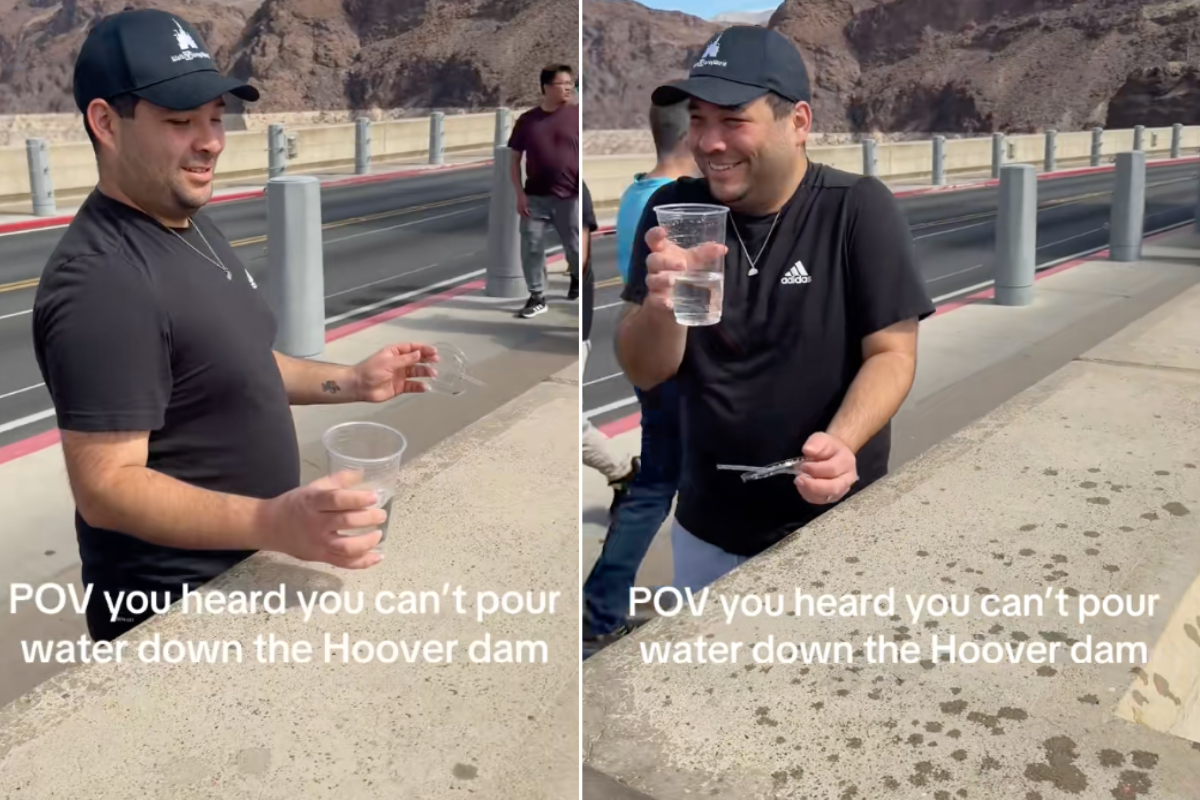
That’s exactly what Eddie, a TikTok user, decided to do on his recent visit to the Hoover Dam.
The Hoover Dam, located on the border between Nevada and Arizona, isn’t just one of the largest dams in the world. It also has a unique design that makes it recognizable around the world.
And even though the dam can handle some 300,000 gallons of water per second, if you try pouring a bit of your own water over the ledge…well, you can’t. At least, that’s the theory.
In a recent video shared on social media, Eddie writes, “POV you heard you can’t pour water down the Hoover Dam.” He then proceeds to do just that, or at least attempt it.
Eddie walks toward the edge of the dam with a cup of water in hand and tips some of it over the side. Immediately, as if by magic, it begins to levitate and break into droplets. The drops scatter along the face of the dam, with some even splashing back onto Eddie, prompting a joyful chuckle.
So is the mystery actually solved?
Other tenacious folks have tested the theory and had no trouble watching their water tumble down the side of the dam.
Annie, inspired by Eddie’s success, tried it with her boyfriend, and found herself bamboozled:
And yet, other people had no problem replicating the “viral trick.”
Here’s Luis, who visited the dam in 2022:
The actual science behind the trick
So, what’s really going on here?
According to IFLScience, your results in replicating this trick may vary depending on the day, where you’re standing on the dam, and the conditions.
Simply put, strong winds flow up the wall of the dam, pushing the water upward at high speed and causing it to splash. But it’s not an effect that’s easily replicated at other large, man-made structures. The dam’s design is perfectly suited to this result.
The Hoover Dam is situated above Black Canyon, whose high walls act as a wind funnel on breezy days. Winds in the valley can reach over 50 miles per hour. Naturally, when the air hits the wall of the dam, it has nowhere to go but up.
The wind accelerates up the face of the Hoover Dam because the water at the top cools the air.
So, on windy days, you get an extremely powerful upward draft, sometimes called ridge lift or slope lift, that can make small amounts of water appear to levitate.
Other places that seem to defy nature
The Hoover Dam isn’t a magical anti-gravity spot, but it is unique in the way it harnesses natural forces.
You might have heard of “gravity hills,” which are spots around the world that trick your eyes. These optical illusions make downhill slopes appear to go uphill, leading to some wild experiences, like cars in neutral “rolling uphill.”
People lucky enough to swim in the Dead Sea are often amazed at how they seem to magically float, thanks to the water’s extremely high salt content.
Like these locales, the Hoover Dam trick isn’t magic. It’s science. Some might say that makes it even cooler.
Nature is stranger than any trick
At the end of the day, none of this is magic, and honestly, that’s the better story. A dam built in the 1930s just happens to sit in exactly the right spot to turn ordinary wind into something that looks impossible. No CGI, no filters, just a canyon shaped the right way and air with nowhere else to go but up.
That’s really what ties the Hoover Dam trick, gravity hills, and the Dead Sea together. They all look like the universe is breaking its own rules, when really, it’s just following them in a way most of us never get to see up close. Sometimes the most convincing magic tricks are the ones nature pulls off without even trying.
This article originally appeared in March. It has been updated.