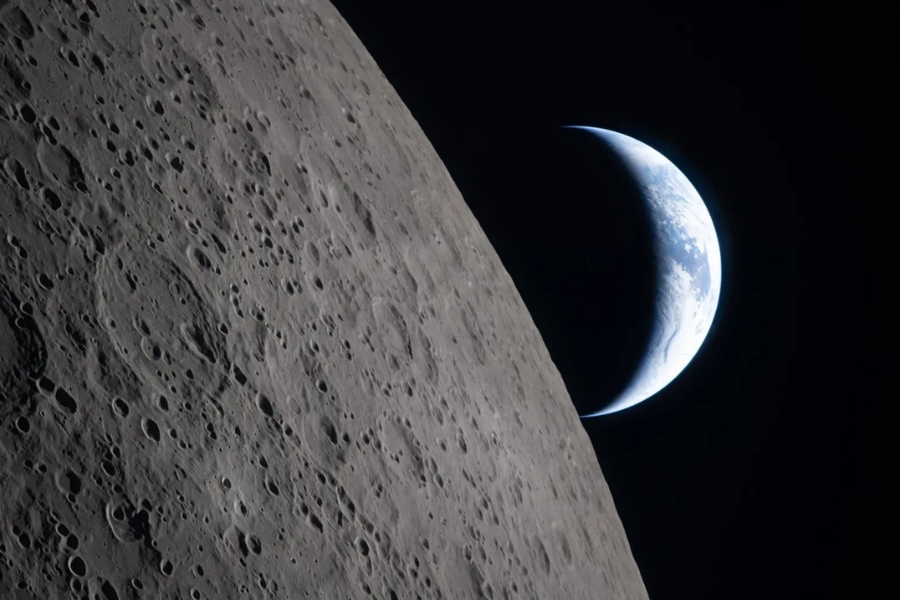
On April 6, 2026, the Orion spacecraft officially took four astronauts farther from Earth than any human has gone before. While the Artemis II mission did not include a Moon landing, it did involve making a pass around the Moon (in addition to making the world cry over naming a Moon crater after the late wife of one of the astronauts).
But how far did they go, exactly? We can look at the historic number of miles the Orion flew from Earth, approximately 252,756, but that distance is a little tough for us to visualize. Thankfully, Professor Anu Ojha’s scientific demonstration at The Royal Institution makes it a lot easier.
The Moon is farther than most people think
First, Ojha explained that the distance between the Earth and Moon varies because the Moon’s orbit around the Earth is elliptical. But very roughly speaking, he said, the Moon’s orbital distance from the Earth is equal to 10 circumferences of the Earth.
He held up an inflatable globe to represent Earth and explained that he had wrapped a piece of string around it 10 times. At the end of the string, he attached a ball that was the correct scale compared to the Earth.
“It’s about the same size as Australia or Canada or China,” he explained. “About a quarter of the diameter of the Earth.”
He showed a graphic that depicted the Earth and Moon in proper scale, but with a totally inaccurate distance between them. Then, holding the globe, he asked a student to take the Moon ball at the end of the string and start walking away from him.
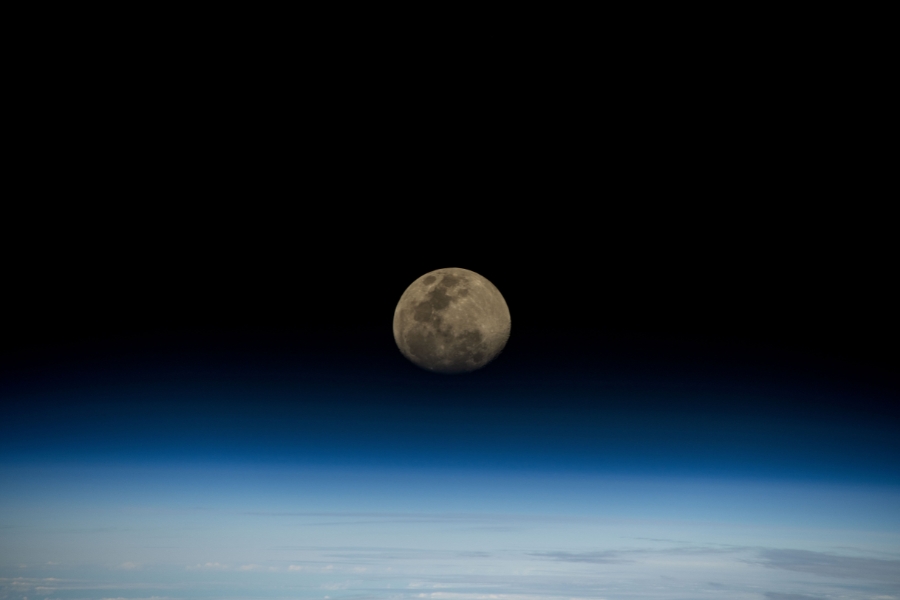
After the string unwound about six or seven feet, he asked the student to stop. “That’s the sort of visualization we get from this image,” he explained. “But, you know, there’s a lot of string left here.”
Ojha had the student keep walking, and keep walking, and keep walking until he had fully unwound the string. We can barely see the student as he walked up a flight of stairs into a darkened area of the classroom, but it’s clear the distance between the Earth and Moon is much farther than we are used to picturing it.
The ISS puts the distance in perspective
After showing how far the Moon, “our nearest naturally occurring neighbor in space,” is from Earth, Ojha put it into even clearer perspective.
“How far away did I say the international boundary of space was?” he asked the students, who responded, “100 kilometers.”
“That’s 1 millimeter on this scale,” Ojha said. “International Space Station (ISS) 400km—a finger width. The Moon is a thousand times the distance to the orbit of the International Space Station.”
But he wasn’t done. He also said that if we go to the next nearest planet, Venus, we are talking about a distance more than 100 times the distance between the Earth and the Moon.
“So we start to see the challenges that we are facing in directly exploring even our own solar system, let alone the universe,” he said.
This demonstration also makes it clearer why space missions to the Moon haven’t been a regular occurrence. Many of us had no idea how much further the Moon was than the ISS. They’re not even close to comparable trips.
Physical science demonstrations for the win
People appreciated the old-school science lesson:
“There is no substitute for physical demonstration in a room.”
“A lot of people just don’t realise the sheer scale of astronomical units, there’s too much ‘space’ out there to wrap their heads around it.”
“Most people can only understand what they can GRASP. This kind of physical demo is the most efficient.”
“I used to do that thing with my elementary school students where we go out to the football field and lay down planets showing how far away everything is from the sun. Blew their minds every time.”
“Everything I learn about space tends to come with the subtext of ‘It’s big. No, not the scale you’re thinking, bigger.’”
“Crazy how even with such a distance and small mass the Moon can still have such a massive effect on our water (and other such things).”
Some math never stops being amazing
Our understanding of the cosmos is always growing and evolving, of course. But the math that tells us the scale of the objects in space has been around a long time and still has the power to boggle our minds. The universe is awesome, literally. Isn’t it wonderful how the awe that space exploration inspires in us is a reminder of everything that makes us human?
This article originally appeared in April. It has been updated.