We live in an era of incredible scientific advancements, from genetic editing to immunotherapy to nanotechnology. And yet, even the simplest science experiments using basic materials can still blow our minds.
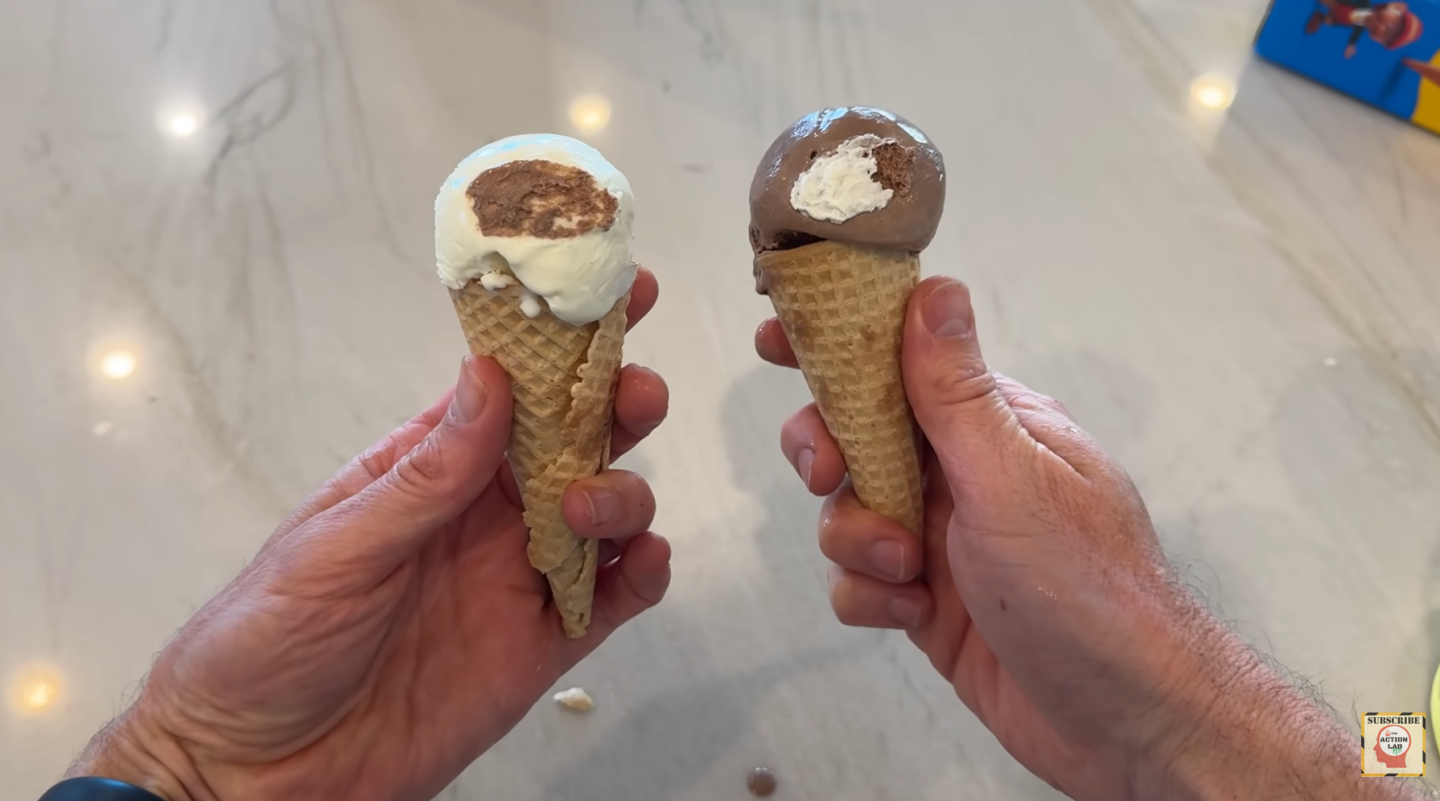
People have been sharing what happens when you swipe two ice cream scoops against each other, with an unexpected result. It’s not surprising that some of one flavor transfers to the other. What’s weird is that both scoops transfer to each other, as if there’s an equal exchange of matter. How does that work?
Dr. James Orgill, a chemical engineer behind The Action Lab, explains the “surprisingly deep” physics principle behind the “impossible” transfer. Part of his explanation gets highly technical, involving quantum mechanics and thermodynamics. But it essentially comes down to the difference between “mixing” and “stirring.”
Orgill explains that when he first saw the ice cream transfer, he thought the chocolate and vanilla were mixing at the surface. “But the problem is that you can see that it’s not like a chocolatey-vanilla at the contact point,” he says in a YouTube video. “There’s still a clear layer of chocolate and a clear layer of vanilla.”
What’s actually happening relates to what Orgill calls “a surprisingly deep idea in physics,” which is how stirring and true mixing differ.
“This difference at first seems pedantic, but you’ll see that it turns out to be a line between reversibility and irreversibility, between systems that remember their past and systems that forget it forever,” he explains. “And once you see it, it explains not just the ice cream, but everything from fluid flows to entropy itself.”
Orgill demonstrates how stirring works by injecting blobs of dye into corn syrup suspended between two cylinders. As one cylinder spins, the colors stretch into layers and begin to mix. But when the motion is reversed, the dye blobs go back to their original places and shapes.
“This tells us something important about stirring,” he says. “It is reversible in principle. As long as material is only being stretched and rearranged into layers, the persistent state still contains a record of the past. Stirred fluids can act like history books.”
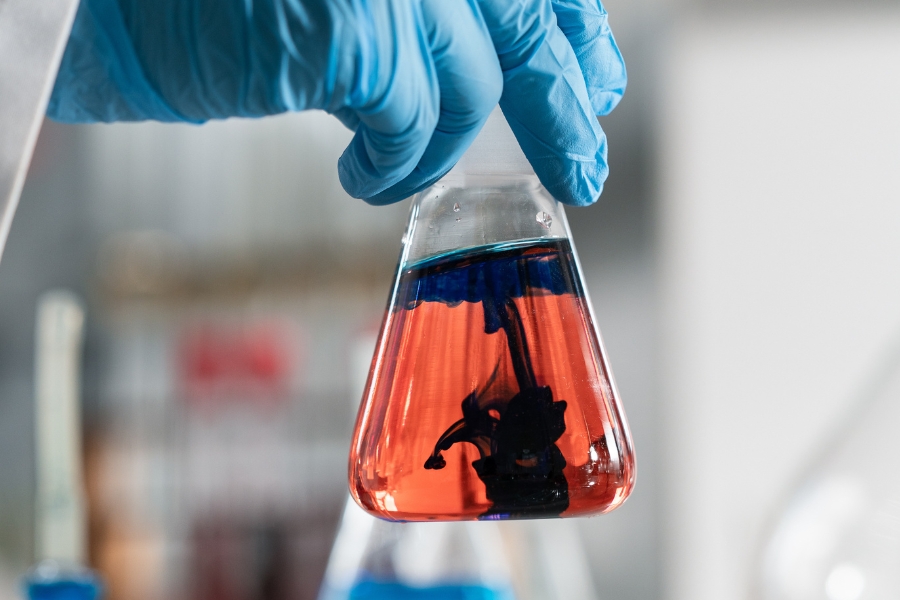
However, true mixing is a different story. The dye demonstration illustrates the principle of reversibility, but when you stir dye into a glass of water, it mixes so thoroughly that the process can’t be physically reversed.
“Over time, especially when you’ve created lots of thin layers with lots of surface area, diffusion smooths everything out,” Orgill explains. “Diffusion is the random thermal motion of atoms and molecules. Statistically, two initially separate groups of particles will spread out and interpenetrate. Once that happens, there’s no way to reverse the process. True mixing has actually occurred.”
Orgill then delves into the weeds of entropy, quantum mechanics, Loschmidt’s paradox, the Heisenberg uncertainty principle, and the irreversibility of time. What does that have to do with ice cream? Well, not much, thankfully.
“Luckily, our original ice cream experiment turns out to be a reversible process,” Orgill says. “What’s happening there is not mixing at the surface.”
Using two pieces of Play-Doh, Orgill shows that the ice cream scoops are actually “gouging” one another, not mixing.
“Imagine two spheres sliding past each other,” he explains. “As they pass, each sphere overhangs the edge of the other just a little bit. That overhanging section gets stressed out and torn loose. So instead of atoms diffusing together, the chocolate scoop rips a chunk out of the vanilla. And at the same time, the vanilla rips a chunk out of the chocolate. Those chunks get pressed onto the opposite surface at the same contact location. Both sides lose material and both sides gain material in the same spot. They’re not mixing. They’re taking bites out of each other.”
He explains and demonstrates that the same thing would happen if two planets were to collide. Bringing it back to a much smaller scale, people in the comments also note that the same thing happens when two cars scrape against each other.
Seeing Orgill’s models makes it easier to understand how such transfers happen. Essentially, the two objects smear a layer (ice cream, paint, or even planetary material) onto each other from opposite directions at the same time.
From ice cream cones to quantum mechanics to colliding planets—isn’t science fun?
You can follow The Action Lab on YouTube for more science explanations.