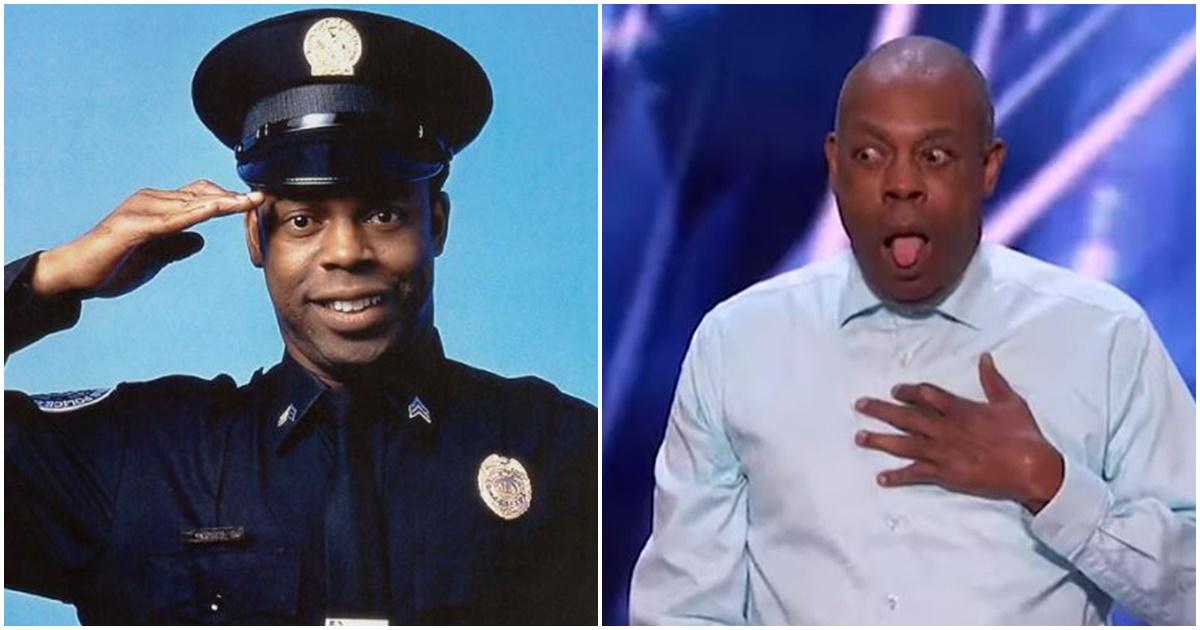
1980s cultural icon Michael Winslow made an emotional comeback on ‘America’s Got Talent’

He walked away at the height of his fame to raise his children after his wife’s sudden death.

Array
Photo credit: via The Nerd Patrol / Flickr Array

Actor, comedian, and self-proclaimed “voicetramentalist,” Michael Winslow was just about everywhere in the ’80s. His incredible ability to make sound effects with his voice and uncanny beatboxing skills landed him the role of officer Larvell Jones in all seven “Police Academy” movies.

He also did voiceover work in “Gremlins” and appeared in Mel Brooks’ “Spaceballs.”

But Winslow was forced to scale back his career in 1993 after the death of his first wife Belinda Church. As a single father, he had to stop appearing in films so he could spend more time with his children.


He continued to star in the occasional commercial, perform stand-up comedy, and make guest appearances, but he didn’t have the profile he once had.

Back in July of 2021, Winslow stepped back in the spotlight with a performance on “America’s Got Talent.” After some prodding from his son, he decided it would be the perfect venue to relaunch his career on television.

In the ’80s, he was known as “The Man of 10,000 Sound Effects,” but things have changed since then, he now claims to have “hundreds of thousands.”

“Now, after raising my two kids, I’m in a different phase. I think this is my time,” Winslow, 62, said on the episode. “And America’s Got Talent is the place for me to show the world I still have something to offer, I still have some sounds to make. There’s still room for a little more.”

Judge Simon Cowell was excited to see Winslow when he took the stage. “We know you!” Cowell exclaimed. “I cannot tell you how thrilled I am that you are here!”

Winslow then gave a stunning performance where he impersonated the chimes on an airplane, beatboxed to Queen’s “Another One Bites the Dust,” and performed Jimi Hendrix’s version of “The Star Spangled Banner.” His performance was proof that after five decades in show business Winslow hasn’t lost a step and, in fact, he may be at his peak.

After his performance, Winslow won a standing ovation from the audience and four “gigantic yeses” from the panel.

“My life has changed again for the better, and I’ve gotten another blessing,” Winslow told Terry Crews after leaving the stage. America’s Got Talent is the place for me to show I still have something to offer. I’ve still got some sounds to make, and there’s still room for a little more.”

Winslow is a great reminder that sometimes when celebrities seem to fade away, it isn’t necessarily because they’re washed up or past their prime. They are humans with real challenges just like the rest of us and real-world events can affect their career trajectories. It’s great to see such a wonderful performer get another shot at the big time.

This article originally appeared on 07.14.21

  • Four guys try a menstrual cramp simulator and can’t remotely handle it
    Men try a period simulator and hilarity ensues.

    They say the best way to understand another person is to walk a mile in their shoes. If you ask most women, though, they’ll tell you to forget about the shoes. They’ve got much bigger problems they wish men could understand.

    Imagine how different the world would be if cis-gendered men had the ability to give birth, for example? Would Roe v. Wade have been controversially overturned in 2022, thus ushering in some truly draconian abortion policies, restrictions, and near total bans in various states? If men needed access to abortions, would they be available on-demand? Would we live in a country without mandatory paid maternity leave? How much more affordable would childcare be? Would there be a tax on period products? Overall, how would we treat people experiencing period pain?

    Well, in 2021, a few men decided to see what life was like for people who have periods in a funny but enlightening video that went viral on TikTok. In fact, the video started a trend that’s still going strong today.

    So some men actually tried it out

    In a video posted by Benz Trap House that has millions of views, a group of guys tried a period simulator to experience what menstrual cramps really feel like. Period simulators are essentially the same as labor simulators. They’re called transcutaneous electrical nerve stimulation (TENS) machines that are designed to relieve pain. But when turned up a notch, they can create intense, debilitating discomfort.

    The group took a semi-scientific approach to the experiment with a woman acting as a control subject. At the beginning of the video, she attaches the simulator to her abdomen and turns it up to ten, the highest setting. In the clip, the group looks impressed as she endures the extreme setting without showing any discomfort.

    The men would not do as well.

    When the first guy tried the simulator, he was shocked by the discomfort. “Is it supposed to hurt like that?” the second guy says before erupting in nervous laughter.

    The third guy said that he felt the pain all the way down to his knee caps.

    The men’s description of the pain certainly seems to indicate that the simulator machine is pretty accurate. According to Mayo Clinic, menstrual cramps are a “throbbing or cramping pain” that radiates to the lower back and thighs. The pain itself, during actual menstruation not simulated by electrical charges, is caused by repeated contractions of the uterus as it sheds its lining.

    The cramps can be much worse for women and menstruating people with certain conditions. In fact, they can be debilitating and excruciating. Despite all this, women are expected to just soldier on as if nothing’s happening. In many male-dominated spaces, pain or other difficulties associated with periods are not considered a valid excuse for needing a day off, taking a break, or even going to the bathroom!

    The side by side comparison says everything

    At one point in the video, the period simulator is attached to a woman and a man at the same time. When the device is turned on, the guy is in extreme pain while the woman stands still, claiming the feelings created by the machine are “not even as bad as a cramp.”

    “Yeah, my cramps hurt worse than this,” she added.

    See, this is exactly what they mean when they say women have a higher pain tolerance than men. Scientifically, that claim may be dubious, but when it comes to this specific kind of reproductive discomfort, women are far more used to sucking it up.

    The comments from women said it all

    A lot of people who menstruate felt validated after seeing the guys experience their first period.

    “‘You feel that in your back, boi?’ every month, friend,” one commenter said.

    One of the most popular comments said: “I’m convinced if men could get pregnant they’d have abortion clinics on every corner and paid maternity leave the whole pregnancy.”

    Another commenter pointed out that women have to go through an entire day in pain without a break. “When he said ‘it’s stabbing me what do I do?’ You go to work, clean the house and continue on bb,” they wrote.

    “Please this needs to be added to every high school health class … cause some guys really don’t understand the pain” another user added.

    This comment took reality up a notch, writing, “Let’s add headaches. And period poops. And bloating. And the feeling of blood leaving you. And the nausea,” she wrote.

    periods, period pain, menstruation, women's health, reproduction
    Woman experiencing cramps. Photo credit: Canva

    If only there were a machine that could simulate all that!

    It remains a good thing that this lighthearted video went viral because it’ll give some people newfound respect for the pain that people who have periods go through. Some who watched the video thought that period simulators should be mandatory in sex ed classes.

    Imagine how different the world would be if everyone experienced menstrual pain just once in their life.

    This article originally appeared five years ago. It has been updated.

  • Watch a 5-yr-old Italian piano prodigy blow away the crowd with his extraordinary ability
    Alberto Cartuccia Cingolani wows audiences with his amazing musical talents.

    Mozart was known for his musical talent at a young age, playing the harpsichord at age four and writing original compositions at age five. So perhaps it’s fitting that a video of five-year-old piano prodigy Alberto Cartuccia Cingolani playing Mozart has gone viral as people marvel at his musical abilities.

    Alberto’s legs couldn’t even reach the pedals, but that didn’t stop his little hands from flying expertly over the keys as incredible music pours out of the piano at the 10th International Musical Competition “Città di Penne” in Italy in 2022. Even if you’ve seen young musicians play impressively, it’s hard not to have your jaw drop. Sometimes a kid comes along who just clearly has a gift.

    Of course, that gift has been helped along by two professional musician parents, but no amount of teaching can create an ability like this.

    How this all got started during lockdown

    Alberto first started playing in 2020 in the early months of the COVID-19 pandemic. Italy was one of the first countries to experience a serious lockdown, and Alberto’s mother used the opportunity to start teaching her son to play piano. Alessia Cingolani and her husband Simone Cartuccia are both music conservatory graduates, and mom Alessia told Italian entertainment website Contra-taque that she and her husband recognized Alberto’s talent immediately.

    She said that although Alberto spends a lot of time at the piano, he also has plenty of time for school and play and television, like a normal kid.

    There’s genuinely nothing “normal” about this kid’s piano playing, though. Watch him playing a piece by Edvard Grieg in front of a crowd in Italy at age five:

    Wow, right? There are countless adults who took years of piano lessons and never got to that level of playing.

    According to Corriere Adriatico, by the time he was four and a half years old, Alberto had participated in seven competitions and won first place in all of them. He has since gone on to collect more than 70 first prizes in national and international competitions. His mother told the outlet that he started out practicing for about 10 minutes a day and gradually increased to three hours.

    “He has a remarkable flair for the piano,” she said. Um, yeah. Clearly.

    Some commenters expressed some concern for the boy based on his seriousness and what looks like dark circles under his eyes in the competition video, but if you check out other videos of Alberto playing at home, he is more relaxed. In interviews, his mother has made it clear that they prioritize normal childhood activities.

    Now watch him at age eight with an orchestra

    Alberto also plays with other musicians. Watch him playing Haydn along with a small orchestra at age eight in 2025:

    Where musical ability comes from continues to be somewhat of a mystery, and experts frequently debate how much is due to nature and how much is due to nurture. Some argue that anyone can develop musical skills with enough practice and a supportive environment, but sometimes a kid clearly displays an innate musical sensibility that defies explanation. Some children are just genuine prodigies, and Alberto certainly seems to fit that bill. Can’t wait to see what kind of musical future awaits him.

    This article originally appeared four years ago and has been updated.

  • A teacher asked 7th graders the worst part of the 80s, and their answers have us howling
    Teacher asks 7th graders about the 80s. Their answers have us howling.

    Gen Zers joke that their parents were born in the 1900s as a way to teasingly make it seem like their parents are much older than they actually are. But the kids coming up behind them are either really good at sarcasm or they actually believe the 80s were more like the 1780s.

    A 7th grade teacher asked her class full of Gen Alphas what they thought the worst part of the 80s was, and no one was prepared for their answers.

    When most people think about the 80s, they think of big hair teased and sprayed to the gods. Bright colors, roller skates, and people walking around with giant boomboxes on their shoulders (as if everyone wanted to hear their music choices) are also at the top of the list for things that represent the 80s. But when thinking of the worst part of that decade, the lack of things like GPS, cell phones, and search engines would probably be at the top of that list.

    Gen Alpha; Gen Z; millennials; life in 80s; 80s life; 1980s; Oregon trail generation
    Retro vibes with bold colors and music! #80sFashion Photo credit: Canva

    Their answers were not what anyone expected

    Gen Alpha has other ideas about the worst part of the 80s. If you lived through that decade, you may want to remove your hat so you can scratch your head. The teacher who goes by Meliciousmo on social media uploaded the prompt and her students’ answers on TikTok, giving viewers a chuckle.

    One kid answers the prompt with, “No electricity. No good food.” It’s starting out pretty questionably, but let’s give him the benefit of the doubt by assuming his family watches a lot of Little House on the Prairie and his centuries are mixed up. The next kid’s response will probably nail it.

    Well, maybe not. Through a few spelling errors, the response explains that the worst part about the 80s is that they didn’t have cars. Yes, this sweet summer child surmised that life was tough because cars didn’t exist, so walking everywhere or riding a horse and buggy was imperative. Obviously, this is false, because there were cars in the 80s. They had seatbelts in them for decoration, and kids would slide across the backseat when their dad turned a corner too fast as their mom reflexively extended a stiff arm to stop them from flying out of the car.

    A few kids actually nailed it

    Clearly, some of the students were exposed to either 80s movies or TV shows because a couple of answers were spot on. One student wrote that running out of hairspray was the worst thing about the 80s, while another said, “People listening to other people’s phone calls.” Yikes. They’re right. There were no cell phones, so there were no Bluetooth devices, so everyone was privy to your private conversation. Another child said nothing was bad about the 80s because “they had cool clothes, music, people, and hair.” Those are big facts, kid.

    But other suggestions included having to walk through rivers because of the lack of buses. (And for what it’s worth, “the Cold War” is actually a pretty accurate answer.)

    The viewers had thoughts about this too

    One person writes, “There’s[sic] like 3 kids who know the 1980s are not the same as the 1780s. LOL.”

    Another laughs, “Gosh I’m still tired from walking through all the rivers to school.”

    Someone else thinks the generational gap between parents has something to do with it, “Some of these are spot on…some think we’re over 100 years old! You can tell who has Gen X parents and who has Millennial parents!”

    Book It pizza party anyone? (Or was that the 90s?) Either way, someone is proposing that iconic classic, writing, “Ok so some good ones, shoulder pads, people listening in to phone calls and hair spary[sic] are all legit. Give those kids a classic 80s pizza paety[sic]!! As for WW2, no tv, cars, and the great depression. Well those kids need a new history book lol.”

    Another person adds a pressure that only those who were adults in the 80s could appreciate, saying, “I didn’t even grow up in the 80s and I KNOW it was writing a check at the grocery store with four people behind you and the person behind you had a full belt. The pressure must have been CRIPPLING.”

    This article originally appeared last year. It has been updated.

  • Episcopal priest beautifully explains patriotism vs. nationalism and what sets them apart
    Two people hold an American flag while standing in a field.

    Patriotism can feel like a loaded term sometimes, as the meaning can range in people’s minds from a basic love of country to a fierce loyalty one is willing to die for. What constitutes “country” can also impact how we perceive of patriotism, as there’s a difference between the land, the people, the ideals, and the current government.

    And then there’s nationalism, which may sound like the same thing but isn’t. So what’s the difference? Episcopal priest Joseph Yoo shared his thoughts on what separates patriotism from nationalism, and people are appreciating having the key differences laid out so clearly.

    “Patriotism is love,” Yoo begins. “It’s gratitude. It’s saying, ‘I care about my country enough to tell the truth about it, to celebrate what’s good and work to fix what’s broken.”

    “Nationalism, that’s idolatry,” he continues. “It says my nation is the nation above critique, above others, God’s favorite. And once you slap God’s seal of approval on your own flag, congratulations, you’ve just made your country a ‘golden calf.’

    He explained that patriotism results in activism like that of John Lewis crossing the Edmund Pettus Bridge to demand that the country live up to its professed ideals. Nationalism results in tragedies like the January 6th invasion of the Capitol, where Confederate flags and crosses were seen in the same mob.

    “Patriotism says, ‘I love my family enough to admit when we’ve messed up, and I will help us grow,” Yoo says. “Nationalism says, ‘My family is perfect, everyone else is trash, and if you disagree you are out.’”

    “One is honest love. The other is toxic possession,” he says. “One builds. One bullies.”

    Yoo concluded with a biblical point: “Jesus never called us to worship a flag, only to love our neighbor.”

    Why the distinction actually matters

    It’s important to differentiate between patriotism and nationalism because the latter has become a bit of a lightning rod in the political discourse. Some use it as a pejorative term, while others have embraced it as something totally acceptable or even positive. When the definitions are muddied, it causes confusion.

    Of course, Yoo is not the sole authority on what these words mean, but his thoughts are aligned with what the neutral arbiters of definitions say they mean.

    Here is what the dictionaries actually say

    Dictionary.com has an entire page discussing the terms, defining patriotism as “devoted love, support, and defense of one’s country; national loyalty,” and nationalism as “the policy or doctrine of asserting the interests of one’s own nation viewed as separate from the interests of other nations or the common interests of all nations,” ultimately leading to how the two words are used:

    Patriotism generally has a positive connotation. It’s used for various positive sentiments, attitudes, and actions involving loving one’s country and serving the great good of all its people.

    Nationalism generally has a negative connotation. It’s used for political ideologies and movements that involve a more extreme and exclusionary love of one’s country, at the expense of foreigners, immigrants, and even people in a country who aren’t believed to belong in some way, often racial and religious grounds.

    flags, countries, world, patriotism, nationalism
    Love of one’s country is nice. But there’s a difference between patriotism and nationalism. Photo credit: Canva

    Britannica also has a whole page about the two words, with this basic synopsis of the differences:

    Patriotism is a feeling of attachment and commitment to a country, nation, or political community, and its conception has roots tracing back to Greek and Roman antiquity. It is associated with the love of law and common liberty, the search for the common good, and the duty to behave justly toward one’s country. Nationalism, on the other hand, is a more modern ideology that emerged in the 18th century, focusing on the individual’s loyalty and devotion to the nation-state, often surpassing other individual or group interests.”

    What some famous voices have said about it

    And then there are some famous takes on patriotism:

    “I love America more than any other country in the world and, exactly for this reason, I insist on the right to criticize her perpetually.”
    – James Baldwin

    “Patriotism is supporting your country all the time and your government when it deserves it.”
    – Mark Twain

    “Patriotism means to stand by the country. It does not mean to stand by the president or any other public official, save exactly to the degree in which he himself stands by the country. It is patriotic to support him insofar as he efficiently serves the country. It is unpatriotic not to oppose him to the exact extent that by inefficiency or otherwise he fails in his duty to stand by the country. In either event, it is unpatriotic not to tell the truth, whether about the president or anyone else.”
    Theodore Roosevelt

    “The difference between patriotism and nationalism is that the patriot is proud of his country for what it does, and the nationalist is proud of his country no matter what it does; the first attitude creates a feeling of responsibility, but the second a feeling of blind arrogance that leads to war.”

    Sydney J. Harris

    There’s nothing wrong with loving your country, but anything taken to excess and exclusion isn’t healthy. Nationalism is excessive and exclusive in its very nature, and while patriotism can be weaponized, when kept in check it’s what keeps people striving to make their homelands the best that they can be for everyone who lives there.

    This article originally appeared last year. It has been updated.

  • At 83, Paul McCartney reveals 10 songs that are the ‘soundtrack to his life’
    Photo credit: via Raph_PH/Wikimedia CommonsPaul McCartney live on stage.

    Sir Paul McCartney, 83, has lived a life that’s full of music, from listening to his father James play dancehall songs on the piano as a child, to joining a skiffle group with John Lennon as a teenager, to becoming the biggest band of all time with The Beatles. Then, he forged a solo career as a member of Wings and under his own name that has yielded more number-one hits than any other songwriter.

    McCartney’s music has been a cornerstone of pop culture for over 60 years, but what are the songs that formed his musical taste? Paul recently revealed the ten songs that have “soundtracked my life” to the BBC’s  Vernon Kay on his show Tracks Of My Years, which premieres on May 25 on BBC Sounds and iPlayer.

    The full episode hasn’t been released, but the BBC revealed the 10 songs that Paul chose, in no particular order.

    John Lennon – “Imagine” 

    In 1971, a year after the breakup of The Beatles, John Lennon released what would become his signature song, a wistful (and slightly acerbic) plea for humanity to envision a world without religion, war, or possessions, and to live in harmony. “When we came to not writing together, I think it was difficult for both of us,” McCartney once said of Lennon. “But, y’know, he still did ‘Imagine.’ He still did one of his best things ever.”

    McCartney has routinely played songs written primarily by Lennon in concert, including “A Day in the Life,” “Give Peace a Chance,” and “Help!”, but he won’t touch “Imagine.” “There’s no shame in doing [Lennon’s] songs,” McCartney said. “In fact, I considered doing a major tribute to John…But then people started saying, ‘Why don’t you do ‘Imagine?” And I thought, ‘F***ing hell, Diana Ross does ‘Imagine’.’ They all do ‘Imagine’. That’s when I backed off the whole thing.”

    The Beach Boys – “God Only Knows” 

    “God Only Knows,” written by Brian Wilson of The Beach Boys and Tony Asher, appeared on the band’s 1966 masterpiece Pet Sounds and is often cited by McCartney as one of his favorites. “I just think it’s a great song—melody, harmonies, words, you know,” Paul said. “I love it, you know. …It’s my favorite Beach Boys song.”

    “Brian Wilson sort of proved himself to be like a really amazing composer,” McCartney added. “And I was into chords and harmonies and stuff at that time, and we ended up [in] kind of like a rivalry. [The Beatles would] put a song out and Brian [would] hear it, and then he’d do one, which is nice. [It was] like me and John [Lennon]. You know, you’d kind of try and top each other all the time.”

    Bob Dylan – “Tambourine Man” 

    Released in 1965 on Dylan’s Bringing It All Back Home, an album that merged his earlier folk sound with his growing interest in rock ‘n roll, “Tambourine Man” is one of his first songs to introduce psychedelic imagery. It’s often believed the song is about a drug dealer, but the tambourine man in the story may actually be Bruce Langhorne, a session guitarist, who brought a giant Turkish drum to a session.

    McCartney recently ribbed Dylan for not playing the song in his live set. “I’ve been to see a couple of shows of Bob’s, and I couldn’t tell what the song was that he was doing,” McCartney said, according to Music Radar. “Now, that’s a bit much because, I mean, I know his stuff and, you know, I get it if he doesn’t want to do ‘Mr Tambourine Man,’ you know, maybe he’s fed up with that, but I would like to hear it. And I’ve paid.”

    Prince – “Kiss” 

    The Purple One had a big hit in 1986 with this cheeky, minimalist funk track about how he doesn’t care if a woman is “rich” or “cool”; he just wants her “extra time” and her “kiss.” The song topped the charts, beating out number two, “Manic Monday” by The Bangles, which was also written by Prince.

    In 2016, shortly after Prince’s death, McCartney snuck Prince’s “Let’s Go Crazy” into his set while performing in his hometown of Minneapolis, Minnesota. 

    The Human League – “Don’t You Want Me” 

    “You were working as a waitress in a cocktail bar….” the song begins, and you either quickly change the station or roll up the car windows and scream, “Don’t you want me, baby? Don’t you want me, Oooooooooooh.” Evidently, McCarney is a roll-up-the-windows-and-belt-it-out kinda guy. Who knew?

    The Kinks – “You Really Got Me” 

    In 1964, The Kinks released a monster with their third single, “You Really Got Me,” which, with its revolutionary distorted guitar sound, helped spark the rock era and served as a blueprint for heavy metal and punk. The song was released at the peak of Beatlemania, and both bands shared several bills in their early years, but didn’t really hit it off. “Paul McCartney was one of the most competitive people I’ve ever met. Lennon wasn’t. He just thought everyone else was sh*t,” Kinks’ frontman, Ray Davies, recalled. 

    Elvis Presley – “All Shook Up” 

    It’s hard to understand how big an impact Elvis’s 1957 hit “All Shook Up” had on a teenage McCartney. He and his friend, Ian James, struck out trying to meet girls at a fairgrounds, and he remembers going back home, and the two listened to the song to cheer themselves up. “The blues had gone. The headache had gone. We were like new people,” McCartney said, according to American Songwriter. “I just love that song so much for being able to do that. There’s just good moments like that, very reminiscent of the kind of moments you had when you were just starting a band.”

    Buddy Holly – “That’ll Be The Day” 

    “That’ll Be the Day” has a big role in the Beatles’ history. It was routinely played by The Quarrymen, their earlier skiffle incarnation, featuring McCartney, Lennon, and George Harrison. It was also the first song they recorded as a demo in 1958 with Lennon on lead vocals. The recording would later be featured on The Beatles’ 1995 release Anthology 1

    Chuck Berry – “Maybelline” 

    Berry greatly influenced the Beatles’ music, especially the way he turned his songs into stories. “From the first minute we heard the great guitar intro to ‘Sweet Little Sixteen,’ we became fans of the great Chuck Berry,” McCartney said, according to Far Out. “His stories were more like poems than lyrics – the likes of ‘Johnny B Goode’ or ‘Maybellene.’”

    It’s no surprise the rock ‘n roll pioneer made it to McCartney’s top 10, although many wondered why a Little Richard song wasn’t in there, too. McCartney routinely sang Little Richard songs in the early Beatles years, including a rousing version of “Long Tall Sally.”

    Gene Vincent – “Be-bop-a-Lula”

    “Be-bop-a-Lula” was the first record McCartney ever purchased, and it would stick with him forever. “Yeah, it was the first record I bought, you know, and in those days, I think this with the Beatles, you know, it made us realize how special it is for people to buy records because we didn’t have much money. And you think about your purchase … so precious, man. It was all your money that week would go on that record,” he recalled in an interview with Ronnie Wood of The Rolling Stones. “It was in the film The Girl Can’t Help It. We finally saw him sing it, you know, with the Blue Caps and stuff, so I just loved it. It’s just such a beautiful record, you know.”

    McCartney has a new album out, May 29, The Boys of Dungeon Road, featuring “Home to Us,” a duet with Ringo Starr.

  • A lucky ‘metal detectorist’ found the Sheriff of Nottingham’s ring, valued at $11,000
    Photo credit: via UnsplashEnglish metal detector hobbyist finds a real treasure near Nottingham.

    If you know the song, sing along!

    “Robin Hood and Little John, walking through the forest/Laughing back and forth at what the other’n has to say/Reminiscing this and that and having such a good time/Oo-de-lally, oo-de-lally, golly, what a day…

    “Never ever thinking there was danger in the water/They were drinking, they just guzzled it down/Never dreaming that a scheming sheriff and his posse/Was a-watching them and gathering around.”

    There never was a greater set of foes than Robin Hood and that evil Sheriff, whose greed was even more legendary than Robin Hood’s archery skills.

    A metal detectorist just found the Sheriff’s ring

    In a deliciously ironic turn of fate, a retired merchant navy engineer in England has found a treasure that would have made his country’s most popular folk hero proud. Graham Harrison, a 65-year-old metal detector enthusiast, discovered a gold signet ring that once belonged to the Sheriff of Nottingham.

    The discovery was made on a farm in Rushcliffe, Nottinghamshire, 26.9 miles from Sherwood Forest. The forest is known worldwide for being the mythological home of Robin Hood and his band of Merry Men. A central road that traversed the forest was notorious in Medieval times for being an easy place for bandits to rob travelers going to and from London.

    Today, the forest is a designated National Nature Reserve. It contains ancient oaks that date back thousands of years, making it an important conservation area.

    “It was the first big dig after lockdown on a glorious day. We were searching two fields. Other detectorists kept finding hammered coins but I’d found nothing,” Harrison said according to the Daily Mail. “Then I suddenly got a signal. I dug up a clod of earth but couldn’t see anything. I kept breaking up the clod and, on the last break, a gold ring was shining at me. I broke out into a gold dance.”

    Harrison sent the ring to the British Museum’s Portable Antiquities Scheme to have it authenticated.

    After doing some research they found that it was once owned by Sir Matthew Jenison, who was the Sheriff of Nottingham between 1683 and 1684.

    The first accounts of Robin Hood, then known as Robyn Hode, first appear as early as the 13th and 14th centuries, a few hundred years before Sir Matthew served as sheriff.

    But there’s no doubt that the archer and leader of Merry Men would have been delighted to know that an everyday guy came into possession of the Sheriff of Nottingham’s ring.

    Sir Matthew was knighted in 1683 and acted as a commissioner to examine decaying trees in Sherwood Forest. He was later elected to Parliament in 1701. However, a series of lawsuits over shady land dealings would eventually be his ruin and he’d die in prison in 1734.

    The gold signet ring bears the coat of arms of the Jenison family, who were known for getting rich off a treasure trove of valuables left for safekeeping during the English Civil War.

    The valuables were never claimed, so the Jenisons took them for themselves.

    Was Robin Hood a real person?

    The whole thing makes you question how much of the legend of Robin Hood is actually true. Experts debate whether Robin Hood stories are based on one person or accounts of multiple different people. Various versions of the mythology begin and end in different time periods, but all share some similarities: Namely, Robin Hood shooting a bow and arrow and being constantly at odds with the evil Sheriff of Nottingham.

    In the end, Robin Hood was said to have been murdered by his aunt. As he bled to death, “Little John placed Robin’s bow in his hand and carried him to a window from where Robin managed to loose one arrow. Robin asked Little John to bury him where the arrow landed, which he duly did. … A mound in Kirklees Park, within bow-shot of the house, can still be seen and is said to be his last resting place,” according to Historic UK.

    Another site, a cemetery in Yorkshire, features a tombstone that reads:

    Here underneath this little stone
    Lies Robert, Earl of Huntingdon
    Ne’er [never] archer was as he so good
    And people called him Robin Hood
    Such outlaws as he and his men
    Will England never see again.

    Believe it or not, that wasn’t the only ring

    What makes the story even more remarkable is that a second ring found at the same site five minutes before Harrison’s discovery was sold at auction in 2023. The circa 1560 posy ring, inscribed with the words “I Meane Ryght,” was found by water company worker Andy Taylor and is also believed to have belonged to a member of the Jenison family.

    What happened to the ring after it was found

    As for Harrison, he decided that he would sell the ring to someone who appreciates its importance.

    “There can’t be many people who’ve found anything like that. I’m only selling it because it’s been stuck in a drawer,” Harrison said. “I hope it will go to someone who will appreciate its historical value.” It was sold at auction by Hansons Auctions for £8,500 ($11,115).

    You can witness the intense final moments of the auction here:

    Let’s hope that the man who sold the ring does what Robin Hood would have done with a piece of jewelry that adorned the hand of a nobleman whose family came into money by taking other people’s loot. Surely, he’d take the proceeds from the auction and give them to the poor.

    This article originally appeared four years ago. It has been updated.

  • A doctor says there’s finally a clear winner in the morning or night shower debate
    Photo credit: @drjasonisfresh/TikTok, Representative Image from CanvaDr. Jason Singh explains the pro and cons of showering at night and in the morning.

    Dr. Jason Singh, who has all kinds of medical insights on TikTok, weighed in on the topic he joked was “more debatable than pineapple on pizza.” That debate would be whether it’s better to shower in the morning, or at night.

    You would think the “right answer” would be largely up to personal preference, much like which way to face while showering and whether or not to snack in the shower…two previous hot button issues online. But according to Singh, there are definitive pros and cons to each option, which could settle the debate once and for all.

    Here is what the doctor actually found

    Singh says in the clip that overnight, “your body can accumulate germs such as bacteria and fungus” through “processes like sweating and shedding skin cells,” all of which help create odor. When you shower off this residue in the AM, it brings your “skin microbiome back to a more hygienic baseline.”

    Makes a pretty compelling case for morning showers, doesn’t it? Just wait.

    Singh went on to say that nighttime showering has three things going for it.

    One, it helps release melatonin to help induce sleep. Plus, when your body adjusts from a warmer temperature to a cooler temperature, that also helps your body prepare for a good night’s rest.

    The second benefit is that it washes away “the entire day’s grime.” Which, let’s be honest, can be very therapeutic sometimes. And lastly, showering at night is the ‘better way to help hydrate your skin,” making it a better option for those with sensitive or dry skin.

    Singh’s bottom line: “Overall night-time showers have more benefits to it but morning showers have really one benefit and that’s better hygiene.”

    The comments had strong feelings about this

    Singh encouraged viewers to weigh in with their own opinions, and they didn’t hold back.

    “You will never convince me to go to bed dirty,’ one person wrote. Another argued “The worst part about night time showers is long, wet hair. I hate going to bed with wet hair!”

    There ended up being some pretty funny responses as well. One person joked that they opted for morning showers since it helps them “Get my head together. Generate a to-do list. Fight with pretend people.”

    Another person noted that timing preferences can be dictated by their schedule, commenting, “night showers during the work week and morning showers on the weekends.”

    shower, hygiene, morning routine, nighttime routine, sleep, skin care, health, wellness, TikTok, doctor
    Woman takes an outdoor shower during the day. Photo credit: Canva

    Some people said two showers was the answer

    Many argued that two showers a day was the actual best option. That way you don’t go to bed dirty, and you’re fresh for the morning.

    Obviously, showering at any time consistently is perfectly fine, but Dr. Singh offered some valuable food for thought.

    Of course, you could always follow in this viewer’s footsteps, who wrote:

    “I prefer to roll around in dust like a chinchilla.”

    This article originally appeared two years ago. It has been updated.

  • Iconic writer Kurt Vonnegut’s simple graphs show how to write the 3 stories everyone loves
    Photo credit: via David Comburg/YouTubeKurt Vonnegut explains the shapes of stories.
    ,

    Iconic writer Kurt Vonnegut’s simple graphs show how to write the 3 stories everyone loves

    “There’s no reason why the simple shapes of a story can’t be fed into computers.”

    To be a great fiction writer requires understanding basic story structures and being clever enough to disguise them so your audience doesn’t know they’re watching or reading something they’ve seen before. Academics suggest that there are only a finite number of plots and structures, but that number varies based on who’s doing the talking.

    Writer Kurt Vonnegut, best known for his satirical works on American politics and culture, including “Slaughterhouse-Five,” “Cat’s Cradle” and “Sirens of Titan,” was obsessed with the shapes of stories and summed up his views in one powerful sentence: “The fundamental idea is that stories have shapes which can be drawn on graph paper and that the shape of a given society’s stories is at least as interesting as the shape of its pots or spearheads.”

    What are the shapes of stories?

    In the video below, Vonnegut explains the shapes of three different types of stories. The first one he starts with is “person gets into trouble.”

    The first question is where the main character or protagonist starts their journey. Are they in a state of good or bad fortune, and how does that change from beginning to end? The arc of this story is simple, someone starts off in good fortune, they get into trouble, and then find their way out. “Somebody gets into trouble, then gets out of it again. People love that story. They never get tired of it,” Vonnegut says with a smirk.

    The second is called “boy gets girl,” which is the basics of the story: someone finds something “wonderful,” their life is on an upward trajectory, then they trail downwards until they can get the girl or boy back. He finishes with the “most popular story” of Western civilization, and that is “Cinderella.”What’s interesting about the story is that it’s about a poor little girl whose mother has died, and her life is pure misery. But her story has a massive upswing when she meets her fairy godmother and can go to the ball. But once the clock strikes midnight, her life crashes down in a matter of seconds.

    Vonnegut’s eerie prediction about AI

    What’s interesting is that at the beginning of the video, Vonnegut notes that stories are relatively “simple” and that they should be able to be plugged into computers that could then regurgitate the same story over and over again. It almost feels like an eerie predictor of artificial intelligence. “There’s no reason why the simple shapes of a story can’t be fed into computers. They are beautiful shapes,” Vonnegut says. “Now this is an exercise in relativity, really. It’s the shape of the curves are what matters, and not their origins.”

    After seeing Vonnegut map out the basic plotlines of stories, it’s hard not to see them every time you watch a movie or TV show. It is amazing that, because there are so few characters and plot arcs in modern storytelling, anyone can create anything that feels new.

    This story originally appeared three years ago. It has since been updated.

Family

Daughter surprises her dad with ‘prized possession’ he sold 30 years ago to help the family

Pop Culture

Watch a 5-yr-old Italian piano prodigy blow away the crowd with his extraordinary ability

Pop Culture

A teacher asked 7th graders the worst part of the 80s, and their answers have us howling

Culture

Episcopal priest beautifully explains patriotism vs. nationalism and what sets them apart