10 things that made us smile this week

We can all use more reasons to smile, and thankfully there is no shortage of them. Here we’ve gathered ten snippets of delight, joy, and hope to help you sail into the weekend with a happy heart. Enjoy. Good dog becomes VERY concerned when his owner jumps into the lake. Don’t worry, hooman, I come…

Array
Photo credit: Upworthy/Instagram, Buitengebieden/TwitterFrom dedicated dads to delightful donkeys, here are some reasons to smile.

We can all use more reasons to smile, and thankfully there is no shortage of them. Here we’ve gathered ten snippets of delight, joy, and hope to help you sail into the weekend with a happy heart.

Enjoy.


Good dog becomes VERY concerned when his owner jumps into the lake.

Don’t worry, hooman, I come save you! The way the doggo went around to get into the water instead of jumping in leads me to believe maybe it was even a little scared to go in. But doggone it, there was a life to save! Sweet puppers.

Yikes on bikes, this kiddo is a great little actor.

First of all, fun costume. Second of all, the kid is ALL IN. Terrifyingly good.

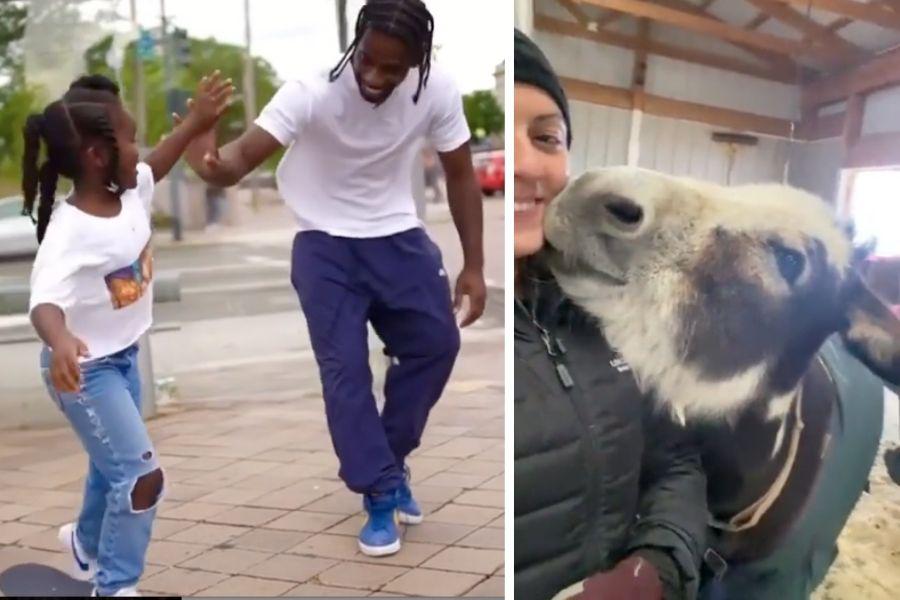
Love this dad teaching his daughter a tricky skateboarding move.

Three cheers for awesome dads.

Speaking of skating, how often do we see a news anchor reporting WHILE skateboarding?

You just know this guy has been waiting for the opportunity to show off his skating skills his whole broadcast news career. Congratulations, dude!

Librarians are superheroes and this “Tough Topics” guide proves it.

Some people don’t want to go up to a librarian and ask where to find a book about [fill in somewhat embarrassing/stigmatized/uncomfortable topic here]. This “Tough Topics” guide uses the Dewey decimal system, so it’s actually universal to all libraries.

This donkey adores this human and it’s so dang cute.

I love you. I love you. I loooovvvveee yoooouuuu. (Could live without kissing a donkey’s nostril, but that’s just me.)

This flower carpet in Belgium is absolutely stunning.

Every other summer, volunteers create an elaborate flower carpet in the center square of Brussels. 500,000 Dahlias and Begonias went into this carpet, which was made in 2018. Absolutely stunning.

Miles Bonham is a wickedly talented 5-year-old.

It’s the zoom-in on the sippy cup that really drives the point home here. This kid is incredible. Read more about Miles and his musical talents here.

Kind kiddo gives his coat to a classmate who he noticed didn’t have one.

Click the right arrow to see the sweet message from the kid’s teacher. What a stand-up little guy!

The Rock is every parent with a kid in the backseat singing a neverending song.

Hilarious. We parents have alllll been there. But this patience is impressive, and the encouragement he gives his daughter despite having endured the same song over and over and over and over is just so sweet. Read more about The Rock singing along with his kiddos here.

Hope that brightened up your week! Tune in again next weekend for more reasons to smile.

  • Former KKK Grand Wizard shares the life-changing moment when he knew he was being lied to
    Photo credit: TEDx Talks/YouTubeDr. Richard Harris in a TEDx Talk.
    ,

    Former KKK Grand Wizard shares the life-changing moment when he knew he was being lied to

    “The Klan has been lying to me. They’ve been twisting the scriptures.”

    Dr. Richard Harris is an associate professor at Southeastern University in Lakeland, Florida. He’s also the first white pastor in the 140-plus-year history of Good Hope Missionary Baptist, a historically Black church in Bartow, Florida. However, if you met him in the late ‘70s, you would have no idea his life would take such a turn. From the age of 16 to 20, he was a member of the Ku Klux Klan, and for the final two years, he served as the youngest Grand Dragon north of the Mason-Dixon Line.

    Harris was a lonely child in elementary school and was bullied by his classmates. In the late 1960s, when desegregation began at his Indiana school, Harris decided to take out his frustrations on the new students

    Harris is indoctrinated into the Ku Klux Klan

    “I got to sixth grade, and all of a sudden my school has changed,” Harris told the Herald-Tribune in 2021. “It was the first time I had ever spoken to a person of color … they’re in my school. I looked at the African-Americans in my school, and I realized that they were displaced. I thought, ‘Maybe I could be the bully for once.’ And that’s exactly what I did.”

    kkk, klu klux klan, muncie indiana, klan members, racists
    The Ku Klux Klan in Muncie, Indiana. Credit: William Arthur Swift/Wikimedia Commons

    Harris’ behavior caught the attention of the KKK, who indoctrinated him into their violent hate group by offering family and protection. He was groomed to be a leader in the organization and, after just two years in 1976, he became the Grand Dragon, the highest-ranking member of the Indiana KKK.

    In a recent interview with LADBible, Harris shared how he was able to get out of the terrorist organization. It began with a life-changing realization: the Klan was lying to him. After learning one of his guards was plotting to kill him, he realized he needed better protection. So, he turned to God. 

    “I didn’t know what to do. And in my 20-year-old mind at that time, all I could think of was, ‘I need better security,’” he told LADBible. So, he began reading the gospels and came to the story of the Samaritan woman. He realized that the Klan had completely changed the message to be one of division rather than acceptance.

    Harris realized he was being lied to by the Klan

    “The whole point of the Samaritan woman at the well story was Jesus accepted Samaritans, race mixers,” he said. “And he loved them, and they believed in him. That’s when the light bulb went on. ‘The Klan has been lying to me. They’ve been twisting the scriptures.”

    Harris then called the Imperial Wizard and quit the KKK. “We’re gonna let you out. We’re gonna let you live. If you keep your mouth shut,” he was told with a gun pressed to his head. 

    Harris then did a complete 180 and began working for racial justice. In 2012, he documented his time in the KKK in his award-winning book, One Nation Under Curse, and would go on to serve as a senior pastor in the Free Methodist Church for 31 years in churches in Illinois, Indiana, and Florida.

    “I changed,” he said in a 2023 TEDx Talk in which he explained his transformation from racist to antiracist and discussed his R.A.C.E. framework. “I’m not that guy anymore, thank God. But I know that I caused pain and hurt to so many that today, my life’s purpose is to help others radically reduce racial bias.”

    Watch his TEDx Talk below:

  • Four guys try a menstrual cramp simulator and can’t remotely handle it
    Men try a period simulator and hilarity ensues.

    They say the best way to understand another person is to walk a mile in their shoes. If you ask most women, though, they’ll tell you to forget about the shoes. They’ve got much bigger problems they wish men could understand.

    Imagine how different the world would be if cis-gendered men had the ability to give birth, for example? Would Roe v. Wade have been controversially overturned in 2022, thus ushering in some truly draconian abortion policies, restrictions, and near total bans in various states? If men needed access to abortions, would they be available on-demand? Would we live in a country without mandatory paid maternity leave? How much more affordable would childcare be? Would there be a tax on period products? Overall, how would we treat people experiencing period pain?

    Well, in 2021, a few men decided to see what life was like for people who have periods in a funny but enlightening video that went viral on TikTok. In fact, the video started a trend that’s still going strong today.

    So some men actually tried it out

    In a video posted by Benz Trap House that has millions of views, a group of guys tried a period simulator to experience what menstrual cramps really feel like. Period simulators are essentially the same as labor simulators. They’re called transcutaneous electrical nerve stimulation (TENS) machines that are designed to relieve pain. But when turned up a notch, they can create intense, debilitating discomfort.

    The group took a semi-scientific approach to the experiment with a woman acting as a control subject. At the beginning of the video, she attaches the simulator to her abdomen and turns it up to ten, the highest setting. In the clip, the group looks impressed as she endures the extreme setting without showing any discomfort.

    The men would not do as well.

    When the first guy tried the simulator, he was shocked by the discomfort. “Is it supposed to hurt like that?” the second guy says before erupting in nervous laughter.

    The third guy said that he felt the pain all the way down to his knee caps.

    The men’s description of the pain certainly seems to indicate that the simulator machine is pretty accurate. According to Mayo Clinic, menstrual cramps are a “throbbing or cramping pain” that radiates to the lower back and thighs. The pain itself, during actual menstruation not simulated by electrical charges, is caused by repeated contractions of the uterus as it sheds its lining.

    The cramps can be much worse for women and menstruating people with certain conditions. In fact, they can be debilitating and excruciating. Despite all this, women are expected to just soldier on as if nothing’s happening. In many male-dominated spaces, pain or other difficulties associated with periods are not considered a valid excuse for needing a day off, taking a break, or even going to the bathroom!

    The side by side comparison says everything

    At one point in the video, the period simulator is attached to a woman and a man at the same time. When the device is turned on, the guy is in extreme pain while the woman stands still, claiming the feelings created by the machine are “not even as bad as a cramp.”

    “Yeah, my cramps hurt worse than this,” she added.

    See, this is exactly what they mean when they say women have a higher pain tolerance than men. Scientifically, that claim may be dubious, but when it comes to this specific kind of reproductive discomfort, women are far more used to sucking it up.

    The comments from women said it all

    A lot of people who menstruate felt validated after seeing the guys experience their first period.

    “‘You feel that in your back, boi?’ every month, friend,” one commenter said.

    One of the most popular comments said: “I’m convinced if men could get pregnant they’d have abortion clinics on every corner and paid maternity leave the whole pregnancy.”

    Another commenter pointed out that women have to go through an entire day in pain without a break. “When he said ‘it’s stabbing me what do I do?’ You go to work, clean the house and continue on bb,” they wrote.

    “Please this needs to be added to every high school health class … cause some guys really don’t understand the pain” another user added.

    This comment took reality up a notch, writing, “Let’s add headaches. And period poops. And bloating. And the feeling of blood leaving you. And the nausea,” she wrote.

    periods, period pain, menstruation, women's health, reproduction
    Woman experiencing cramps. Photo credit: Canva

    If only there were a machine that could simulate all that!

    It remains a good thing that this lighthearted video went viral because it’ll give some people newfound respect for the pain that people who have periods go through. Some who watched the video thought that period simulators should be mandatory in sex ed classes.

    Imagine how different the world would be if everyone experienced menstrual pain just once in their life.

    This article originally appeared five years ago. It has been updated.

  • Watch a 5-yr-old Italian piano prodigy blow away the crowd with his extraordinary ability
    Alberto Cartuccia Cingolani wows audiences with his amazing musical talents.

    Mozart was known for his musical talent at a young age, playing the harpsichord at age four and writing original compositions at age five. So perhaps it’s fitting that a video of five-year-old piano prodigy Alberto Cartuccia Cingolani playing Mozart has gone viral as people marvel at his musical abilities.

    Alberto’s legs couldn’t even reach the pedals, but that didn’t stop his little hands from flying expertly over the keys as incredible music pours out of the piano at the 10th International Musical Competition “Città di Penne” in Italy in 2022. Even if you’ve seen young musicians play impressively, it’s hard not to have your jaw drop. Sometimes a kid comes along who just clearly has a gift.

    Of course, that gift has been helped along by two professional musician parents, but no amount of teaching can create an ability like this.

    How this all got started during lockdown

    Alberto first started playing in 2020 in the early months of the COVID-19 pandemic. Italy was one of the first countries to experience a serious lockdown, and Alberto’s mother used the opportunity to start teaching her son to play piano. Alessia Cingolani and her husband Simone Cartuccia are both music conservatory graduates, and mom Alessia told Italian entertainment website Contra-taque that she and her husband recognized Alberto’s talent immediately.

    She said that although Alberto spends a lot of time at the piano, he also has plenty of time for school and play and television, like a normal kid.

    There’s genuinely nothing “normal” about this kid’s piano playing, though. Watch him playing a piece by Edvard Grieg in front of a crowd in Italy at age five:

    Wow, right? There are countless adults who took years of piano lessons and never got to that level of playing.

    According to Corriere Adriatico, by the time he was four and a half years old, Alberto had participated in seven competitions and won first place in all of them. He has since gone on to collect more than 70 first prizes in national and international competitions. His mother told the outlet that he started out practicing for about 10 minutes a day and gradually increased to three hours.

    “He has a remarkable flair for the piano,” she said. Um, yeah. Clearly.

    Some commenters expressed some concern for the boy based on his seriousness and what looks like dark circles under his eyes in the competition video, but if you check out other videos of Alberto playing at home, he is more relaxed. In interviews, his mother has made it clear that they prioritize normal childhood activities.

    Now watch him at age eight with an orchestra

    Alberto also plays with other musicians. Watch him playing Haydn along with a small orchestra at age eight in 2025:

    Where musical ability comes from continues to be somewhat of a mystery, and experts frequently debate how much is due to nature and how much is due to nurture. Some argue that anyone can develop musical skills with enough practice and a supportive environment, but sometimes a kid clearly displays an innate musical sensibility that defies explanation. Some children are just genuine prodigies, and Alberto certainly seems to fit that bill. Can’t wait to see what kind of musical future awaits him.

    This article originally appeared four years ago and has been updated.

  • A teacher asked 7th graders the worst part of the 80s, and their answers have us howling
    Teacher asks 7th graders about the 80s. Their answers have us howling.

    Gen Zers joke that their parents were born in the 1900s as a way to teasingly make it seem like their parents are much older than they actually are. But the kids coming up behind them are either really good at sarcasm or they actually believe the 80s were more like the 1780s.

    A 7th grade teacher asked her class full of Gen Alphas what they thought the worst part of the 80s was, and no one was prepared for their answers.

    When most people think about the 80s, they think of big hair teased and sprayed to the gods. Bright colors, roller skates, and people walking around with giant boomboxes on their shoulders (as if everyone wanted to hear their music choices) are also at the top of the list for things that represent the 80s. But when thinking of the worst part of that decade, the lack of things like GPS, cell phones, and search engines would probably be at the top of that list.

    Gen Alpha; Gen Z; millennials; life in 80s; 80s life; 1980s; Oregon trail generation
    Retro vibes with bold colors and music! #80sFashion Photo credit: Canva

    Their answers were not what anyone expected

    Gen Alpha has other ideas about the worst part of the 80s. If you lived through that decade, you may want to remove your hat so you can scratch your head. The teacher who goes by Meliciousmo on social media uploaded the prompt and her students’ answers on TikTok, giving viewers a chuckle.

    One kid answers the prompt with, “No electricity. No good food.” It’s starting out pretty questionably, but let’s give him the benefit of the doubt by assuming his family watches a lot of Little House on the Prairie and his centuries are mixed up. The next kid’s response will probably nail it.

    Well, maybe not. Through a few spelling errors, the response explains that the worst part about the 80s is that they didn’t have cars. Yes, this sweet summer child surmised that life was tough because cars didn’t exist, so walking everywhere or riding a horse and buggy was imperative. Obviously, this is false, because there were cars in the 80s. They had seatbelts in them for decoration, and kids would slide across the backseat when their dad turned a corner too fast as their mom reflexively extended a stiff arm to stop them from flying out of the car.

    A few kids actually nailed it

    Clearly, some of the students were exposed to either 80s movies or TV shows because a couple of answers were spot on. One student wrote that running out of hairspray was the worst thing about the 80s, while another said, “People listening to other people’s phone calls.” Yikes. They’re right. There were no cell phones, so there were no Bluetooth devices, so everyone was privy to your private conversation. Another child said nothing was bad about the 80s because “they had cool clothes, music, people, and hair.” Those are big facts, kid.

    But other suggestions included having to walk through rivers because of the lack of buses. (And for what it’s worth, “the Cold War” is actually a pretty accurate answer.)

    The viewers had thoughts about this too

    One person writes, “There’s[sic] like 3 kids who know the 1980s are not the same as the 1780s. LOL.”

    Another laughs, “Gosh I’m still tired from walking through all the rivers to school.”

    Someone else thinks the generational gap between parents has something to do with it, “Some of these are spot on…some think we’re over 100 years old! You can tell who has Gen X parents and who has Millennial parents!”

    Book It pizza party anyone? (Or was that the 90s?) Either way, someone is proposing that iconic classic, writing, “Ok so some good ones, shoulder pads, people listening in to phone calls and hair spary[sic] are all legit. Give those kids a classic 80s pizza paety[sic]!! As for WW2, no tv, cars, and the great depression. Well those kids need a new history book lol.”

    Another person adds a pressure that only those who were adults in the 80s could appreciate, saying, “I didn’t even grow up in the 80s and I KNOW it was writing a check at the grocery store with four people behind you and the person behind you had a full belt. The pressure must have been CRIPPLING.”

    This article originally appeared last year. It has been updated.

  • Episcopal priest beautifully explains patriotism vs. nationalism and what sets them apart
    Two people hold an American flag while standing in a field.

    Patriotism can feel like a loaded term sometimes, as the meaning can range in people’s minds from a basic love of country to a fierce loyalty one is willing to die for. What constitutes “country” can also impact how we perceive of patriotism, as there’s a difference between the land, the people, the ideals, and the current government.

    And then there’s nationalism, which may sound like the same thing but isn’t. So what’s the difference? Episcopal priest Joseph Yoo shared his thoughts on what separates patriotism from nationalism, and people are appreciating having the key differences laid out so clearly.

    “Patriotism is love,” Yoo begins. “It’s gratitude. It’s saying, ‘I care about my country enough to tell the truth about it, to celebrate what’s good and work to fix what’s broken.”

    “Nationalism, that’s idolatry,” he continues. “It says my nation is the nation above critique, above others, God’s favorite. And once you slap God’s seal of approval on your own flag, congratulations, you’ve just made your country a ‘golden calf.’

    He explained that patriotism results in activism like that of John Lewis crossing the Edmund Pettus Bridge to demand that the country live up to its professed ideals. Nationalism results in tragedies like the January 6th invasion of the Capitol, where Confederate flags and crosses were seen in the same mob.

    “Patriotism says, ‘I love my family enough to admit when we’ve messed up, and I will help us grow,” Yoo says. “Nationalism says, ‘My family is perfect, everyone else is trash, and if you disagree you are out.’”

    “One is honest love. The other is toxic possession,” he says. “One builds. One bullies.”

    Yoo concluded with a biblical point: “Jesus never called us to worship a flag, only to love our neighbor.”

    Why the distinction actually matters

    It’s important to differentiate between patriotism and nationalism because the latter has become a bit of a lightning rod in the political discourse. Some use it as a pejorative term, while others have embraced it as something totally acceptable or even positive. When the definitions are muddied, it causes confusion.

    Of course, Yoo is not the sole authority on what these words mean, but his thoughts are aligned with what the neutral arbiters of definitions say they mean.

    Here is what the dictionaries actually say

    Dictionary.com has an entire page discussing the terms, defining patriotism as “devoted love, support, and defense of one’s country; national loyalty,” and nationalism as “the policy or doctrine of asserting the interests of one’s own nation viewed as separate from the interests of other nations or the common interests of all nations,” ultimately leading to how the two words are used:

    Patriotism generally has a positive connotation. It’s used for various positive sentiments, attitudes, and actions involving loving one’s country and serving the great good of all its people.

    Nationalism generally has a negative connotation. It’s used for political ideologies and movements that involve a more extreme and exclusionary love of one’s country, at the expense of foreigners, immigrants, and even people in a country who aren’t believed to belong in some way, often racial and religious grounds.

    flags, countries, world, patriotism, nationalism
    Love of one’s country is nice. But there’s a difference between patriotism and nationalism. Photo credit: Canva

    Britannica also has a whole page about the two words, with this basic synopsis of the differences:

    Patriotism is a feeling of attachment and commitment to a country, nation, or political community, and its conception has roots tracing back to Greek and Roman antiquity. It is associated with the love of law and common liberty, the search for the common good, and the duty to behave justly toward one’s country. Nationalism, on the other hand, is a more modern ideology that emerged in the 18th century, focusing on the individual’s loyalty and devotion to the nation-state, often surpassing other individual or group interests.”

    What some famous voices have said about it

    And then there are some famous takes on patriotism:

    “I love America more than any other country in the world and, exactly for this reason, I insist on the right to criticize her perpetually.”
    – James Baldwin

    “Patriotism is supporting your country all the time and your government when it deserves it.”
    – Mark Twain

    “Patriotism means to stand by the country. It does not mean to stand by the president or any other public official, save exactly to the degree in which he himself stands by the country. It is patriotic to support him insofar as he efficiently serves the country. It is unpatriotic not to oppose him to the exact extent that by inefficiency or otherwise he fails in his duty to stand by the country. In either event, it is unpatriotic not to tell the truth, whether about the president or anyone else.”
    Theodore Roosevelt

    “The difference between patriotism and nationalism is that the patriot is proud of his country for what it does, and the nationalist is proud of his country no matter what it does; the first attitude creates a feeling of responsibility, but the second a feeling of blind arrogance that leads to war.”

    Sydney J. Harris

    There’s nothing wrong with loving your country, but anything taken to excess and exclusion isn’t healthy. Nationalism is excessive and exclusive in its very nature, and while patriotism can be weaponized, when kept in check it’s what keeps people striving to make their homelands the best that they can be for everyone who lives there.

    This article originally appeared last year. It has been updated.

  • Why college graduates are booing out-of-touch commencement speakers off the stage

    Photo Credit: Canva Photos

    Gen Z is done pretending to look up to millionaires and billionaires.
    ,

    Why college graduates are booing out-of-touch commencement speakers off the stage

    Gen Z faces stiff challenges post-graduation. They’re up for the fight.

    Gen Z takes a lot of criticism. They’re called antisocial, emotionally immature, and phone-obsessed. They’re even called lazy.

    But there’s one thing you can’t deny about Gen Z: that, as a whole, they’re done pretending they’re willing to just go along with the status quo. Young people are challenging everything, from pop culture to work culture, and nothing reflects the tide they’re working to change better than this year’s graduation ceremonies.

    2026 commencement speakers totally miss the mark with young grads

    First up was Gloria Caulfield, Vice President of Strategic Alliances for Tavistock Development Company. She spoke at a commencement ceremony at the University of Central Florida (UCF) and got off to a rough start when she proclaimed, “The rise of artificial intelligence is the next industrial revolution.”

    A shower of boos from graduating students began raining down on her. It took Caulfield off guard and, after a chuckle, she needed a moment to gather her thoughts. “OK, I struck a chord. May I finish?”

    “Only a few years ago, AI was not a factor in our lives,” she continued. For this, the students cheered. As the speech went on, the boos only grew louder every time Caulfield mentioned the exciting capabilities of AI. She was visibly flustered by the response.

    Ex-Google CEO fares even worse in controversial address

    Then there was Eric Schmidt, who delivered remarks to graduates at the University of Arizona.

    The 71-year-old tech billionaire, and former CEO of Google, was already in the students’ poor graces due to recent allegations of sexual abuse. When he, too, began extolling the exciting virtues of artificial intelligence, the stadium full of grads let him have it.

    In part of his monologue, he said: “There is a fear in your generation that… the machines are coming, the jobs are evaporating, that the climate is breaking, that politics is fractured, and that you are inheriting a mess that you did not create.”

    He then blamed social media for amplifying the fear and uncertainty, and advocated for young people to help shape artificial intelligence in order to solve these problems—to yet another chorus of boos.

    Schmidt and Caulfield did not appear to get the memo that Gen Z is not thrilled with AI, overall. Though a good number of young people do admit to using it from time to time, negative sentiment among Gen Zers has risen sharply in recent years.

    Many feel anxious or even flat-out angry about the advancements of artificial intelligence. To them, it’s not an exciting tool to boost the bottom line the way it is for CEOs and VPs. It’s a real threat to their futures. In that sense, the speeches from this year’s commencement speakers have been shockingly tone deaf.

    Best-selling author booed for criticizing younger generations

    Jonathan Haidt, the massively best-selling author behind The Anxious Generation, has been a leading voice in the movement to protect kids from phones, social media, and technology; and to give them more independence as they grow up.

    He’s even gone so far as to call Gen Z coddled, soft, and fragile. Haidt has also attacked universities, claiming they insulate students from challenging ideas with ‘safe spaces and trigger warnings,’ and been vocally against diversity and inclusion initiatives.

    It turns out, Gen Z graduates weren’t super excited to hear him speak at their graduation. They let him know exactly how they felt with loud boos during his address at NYU graduation.

    The boos represent a fascinating shift

    Multi-millionaires and billionaires used to represent the pinnacle of the American Dream. Tech CEOs and Silicon Valley bigshots have been popular choices at commencement ceremonies for years. They’re able to speak as people who “made it” and reached ultimate success.

    But young people aren’t falling for it. Gen Z is not impressed with wealth. They’re acutely aware of the growing wealth gap between the older generations and themselves. They don’t face an easy path coming out of school, with huge inflation, stagnant wages, skyrocketing house prices, and growing personal debt.

    AI, for whatever positive advances it has made, has largely been a main driver of layoffs that have put more money into the pockets of the 1%. It’s hard to blame young people for not wanting to listen to a billionaire lecture them on the importance of hard work, or for not wanting to cheer a technology that might make their dream job obsolete.

    You also have to respect that Gen Z isn’t willing to sit there politely and clap for a man who called them coddled and emotionally fragile.

    As they prepare to embark into the next phase of adulthood, Gen Z faces tough—seemingly impossible—challenges. But if these viral moments have taught us anything, it’s that the kids will go down swinging.

  • Middle schoolers in New Hampshire created an adorable mini boat that sailed all the way to Norway
    Photo credit: FacebookThe Rye Riptide washed up on the shores of Norway.
    ,

    Middle schoolers in New Hampshire created an adorable mini boat that sailed all the way to Norway

    The project was part of a very unique program designed to “connect students around the world.” Mission accomplished.

    This story brings a whole new meaning to the word friendship.

    In October 2020, the middle schoolers of Rye Junior High, in Rye, New Hampshire, bid a bon voyage to their handmade mini-boat, which set sail off the coast of New Hampshire to who-knows-where.

    Measuring only 5.5 feet, the “Rye Riptides” was indeed a small ship. It ran crewless, but carried a bountiful cargo of colorful artwork made by students, along with a GPS tracking device that reported the boat’s location … sometimes.

    Cut to 462 days and 8,300 miles later, and what started out as a simple science project became a surprise discovery for some Norwegian sixth graders, and a fun new connection across the Atlantic.

    Rye Junior High had partnered with Educational Passages, a nonprofit organization that aims to connect students around the world to the ocean and each other. Once the kit arrived, the kids started building while learning about ocean currents, science and math. However, science teacher Sheila Adams shares that the more artistic, right-brained activities equally found their way into the curriculum. “The students needed to use their writing skills to inform others about their mini-boat project, describe our school and town to people of other languages, just in case, and write requests to get the boat deployed,” she said in a release.

    Then the pandemic nearly derailed the whole thing

    COVID-19 nearly threatened to knock the Rye Riptides off its course. The boat had been constructed, but not yet decorated, when students were moved to taking class online. Then, there was the matter of launching the boat. Which Cassie Stymiest, Executive Director of Educational Passages, noted was “challenging with all the restrictions in place.”

    Luckily, creativity, resourcefulness and a little technology saved the day. Working remotely, each piece of art was done at home, then scanned, printed and made into a collage. Then, Ms. Stymiest connected with the Sea Education Association (SEA), which set the Rye Riptides on its journey.

    Would the boat make it to Europe? Rye student Solstice Reed wasn’t so sure. “Honestly, I thought it would sink,” she admitted to the Portsmouth Herald. Considering the boat was cruising the ocean waters during hurricane season, the skepticism was well-founded. During the more tumultuous periods, the GPS signal only came in intermittently. And for a long while, there was nothing but radio silence.

    The little boat that did

    But then, at long last, on the small Norwegian island of Smøla, the Rye Riptides successfully made it to dry land. Sure, it was a bit dismantled and covered in barnacles, but inside, all the adorable trinkets remained intact. The Smøla students peered with wonder into their bounty of photos, signed facemasks, fall leaves, acorns and state quarters, gifts sent out almost two years ago.

    Isn’t your inner child just squealing with delight right now?

    The voyage of the small boat went viral in a big way, sailing across social media, and making headlines.

    Human connection found its way across the sea in the most wholesome and magical way. It’s really cool to see that educational programs like this exist, impacting both the hearts and minds of young students. Mission, successful.

    To help support Educational Passages on even more wholesome adventures just like this one, consider donating here.

    This article originally appeared four years ago. It has been updated.

  • At 83, Paul McCartney reveals 10 songs that are the ‘soundtrack to his life’
    Photo credit: via Raph_PH/Wikimedia CommonsPaul McCartney live on stage.

    Sir Paul McCartney, 83, has lived a life that’s full of music, from listening to his father James play dancehall songs on the piano as a child, to joining a skiffle group with John Lennon as a teenager, to becoming the biggest band of all time with The Beatles. Then, he forged a solo career as a member of Wings and under his own name that has yielded more number-one hits than any other songwriter.

    McCartney’s music has been a cornerstone of pop culture for over 60 years, but what are the songs that formed his musical taste? Paul recently revealed the ten songs that have “soundtracked my life” to the BBC’s  Vernon Kay on his show Tracks Of My Years, which premieres on May 25 on BBC Sounds and iPlayer.

    The full episode hasn’t been released, but the BBC revealed the 10 songs that Paul chose, in no particular order.

    John Lennon – “Imagine” 

    In 1971, a year after the breakup of The Beatles, John Lennon released what would become his signature song, a wistful (and slightly acerbic) plea for humanity to envision a world without religion, war, or possessions, and to live in harmony. “When we came to not writing together, I think it was difficult for both of us,” McCartney once said of Lennon. “But, y’know, he still did ‘Imagine.’ He still did one of his best things ever.”

    McCartney has routinely played songs written primarily by Lennon in concert, including “A Day in the Life,” “Give Peace a Chance,” and “Help!”, but he won’t touch “Imagine.” “There’s no shame in doing [Lennon’s] songs,” McCartney said. “In fact, I considered doing a major tribute to John…But then people started saying, ‘Why don’t you do ‘Imagine?” And I thought, ‘F***ing hell, Diana Ross does ‘Imagine’.’ They all do ‘Imagine’. That’s when I backed off the whole thing.”

    The Beach Boys – “God Only Knows” 

    “God Only Knows,” written by Brian Wilson of The Beach Boys and Tony Asher, appeared on the band’s 1966 masterpiece Pet Sounds and is often cited by McCartney as one of his favorites. “I just think it’s a great song—melody, harmonies, words, you know,” Paul said. “I love it, you know. …It’s my favorite Beach Boys song.”

    “Brian Wilson sort of proved himself to be like a really amazing composer,” McCartney added. “And I was into chords and harmonies and stuff at that time, and we ended up [in] kind of like a rivalry. [The Beatles would] put a song out and Brian [would] hear it, and then he’d do one, which is nice. [It was] like me and John [Lennon]. You know, you’d kind of try and top each other all the time.”

    Bob Dylan – “Tambourine Man” 

    Released in 1965 on Dylan’s Bringing It All Back Home, an album that merged his earlier folk sound with his growing interest in rock ‘n roll, “Tambourine Man” is one of his first songs to introduce psychedelic imagery. It’s often believed the song is about a drug dealer, but the tambourine man in the story may actually be Bruce Langhorne, a session guitarist, who brought a giant Turkish drum to a session.

    McCartney recently ribbed Dylan for not playing the song in his live set. “I’ve been to see a couple of shows of Bob’s, and I couldn’t tell what the song was that he was doing,” McCartney said, according to Music Radar. “Now, that’s a bit much because, I mean, I know his stuff and, you know, I get it if he doesn’t want to do ‘Mr Tambourine Man,’ you know, maybe he’s fed up with that, but I would like to hear it. And I’ve paid.”

    Prince – “Kiss” 

    The Purple One had a big hit in 1986 with this cheeky, minimalist funk track about how he doesn’t care if a woman is “rich” or “cool”; he just wants her “extra time” and her “kiss.” The song topped the charts, beating out number two, “Manic Monday” by The Bangles, which was also written by Prince.

    In 2016, shortly after Prince’s death, McCartney snuck Prince’s “Let’s Go Crazy” into his set while performing in his hometown of Minneapolis, Minnesota. 

    The Human League – “Don’t You Want Me” 

    “You were working as a waitress in a cocktail bar….” the song begins, and you either quickly change the station or roll up the car windows and scream, “Don’t you want me, baby? Don’t you want me, Oooooooooooh.” Evidently, McCarney is a roll-up-the-windows-and-belt-it-out kinda guy. Who knew?

    The Kinks – “You Really Got Me” 

    In 1964, The Kinks released a monster with their third single, “You Really Got Me,” which, with its revolutionary distorted guitar sound, helped spark the rock era and served as a blueprint for heavy metal and punk. The song was released at the peak of Beatlemania, and both bands shared several bills in their early years, but didn’t really hit it off. “Paul McCartney was one of the most competitive people I’ve ever met. Lennon wasn’t. He just thought everyone else was sh*t,” Kinks’ frontman, Ray Davies, recalled. 

    Elvis Presley – “All Shook Up” 

    It’s hard to understand how big an impact Elvis’s 1957 hit “All Shook Up” had on a teenage McCartney. He and his friend, Ian James, struck out trying to meet girls at a fairgrounds, and he remembers going back home, and the two listened to the song to cheer themselves up. “The blues had gone. The headache had gone. We were like new people,” McCartney said, according to American Songwriter. “I just love that song so much for being able to do that. There’s just good moments like that, very reminiscent of the kind of moments you had when you were just starting a band.”

    Buddy Holly – “That’ll Be The Day” 

    “That’ll Be the Day” has a big role in the Beatles’ history. It was routinely played by The Quarrymen, their earlier skiffle incarnation, featuring McCartney, Lennon, and George Harrison. It was also the first song they recorded as a demo in 1958 with Lennon on lead vocals. The recording would later be featured on The Beatles’ 1995 release Anthology 1

    Chuck Berry – “Maybelline” 

    Berry greatly influenced the Beatles’ music, especially the way he turned his songs into stories. “From the first minute we heard the great guitar intro to ‘Sweet Little Sixteen,’ we became fans of the great Chuck Berry,” McCartney said, according to Far Out. “His stories were more like poems than lyrics – the likes of ‘Johnny B Goode’ or ‘Maybellene.’”

    It’s no surprise the rock ‘n roll pioneer made it to McCartney’s top 10, although many wondered why a Little Richard song wasn’t in there, too. McCartney routinely sang Little Richard songs in the early Beatles years, including a rousing version of “Long Tall Sally.”

    Gene Vincent – “Be-bop-a-Lula”

    “Be-bop-a-Lula” was the first record McCartney ever purchased, and it would stick with him forever. “Yeah, it was the first record I bought, you know, and in those days, I think this with the Beatles, you know, it made us realize how special it is for people to buy records because we didn’t have much money. And you think about your purchase … so precious, man. It was all your money that week would go on that record,” he recalled in an interview with Ronnie Wood of The Rolling Stones. “It was in the film The Girl Can’t Help It. We finally saw him sing it, you know, with the Blue Caps and stuff, so I just loved it. It’s just such a beautiful record, you know.”

    McCartney has a new album out, May 29, The Boys of Dungeon Road, featuring “Home to Us,” a duet with Ringo Starr.

Pets

Man ordering steak for dog’s last meal is stunned by restaurant staff’s kind response

Family

Daughter surprises her dad with ‘prized possession’ he sold 30 years ago to help the family

Pop Culture

Watch a 5-yr-old Italian piano prodigy blow away the crowd with his extraordinary ability

Pop Culture

A teacher asked 7th graders the worst part of the 80s, and their answers have us howling