Photographer David Jay specializes in fashion and beauty, stuff that’s “beautiful and sexy — and completely untrue,” as he puts it. But that’s not all he photographs.
Three years ago, Jay began to take pictures of young, severely wounded soldiers returning home from the wars in Iraq and Afghanistan.
Trigger warning: These portraits don’t shy away from wounded bodies.
Be prepared. I found them shocking at first. But keep looking. The more I looked, the more beauty and humanity I found reflected here. (The photo captions are from the Jay’s Unknown Soldier Project Facebook page. All images used with permission.)

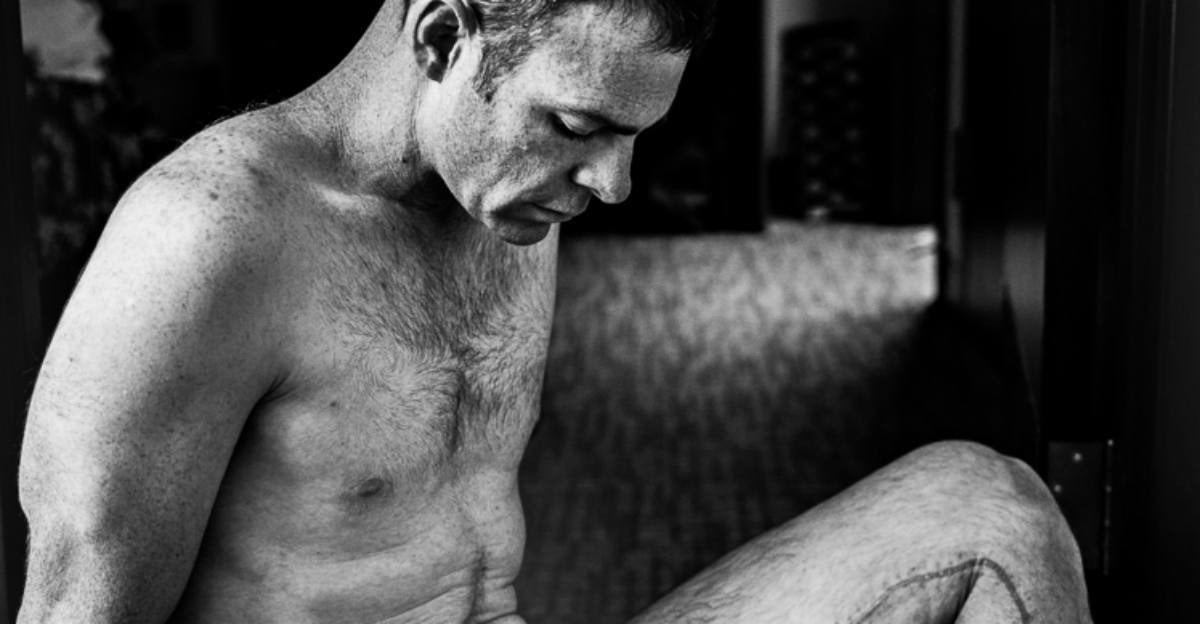
Lt. Nicholas John Vogt, U.S. Army Image by David Jay/ <a href="https://farm.upworthy.com/nuggets/5564a2bd633239000c2f0100/www.davidjayphotography.com">David Jay Photography</a>.
This is 1st Lt. Nicholas John Vogt, U.S. Army. On Nov. 12, 2011, he was severely injured by an IED while on a foot-patrol in Panjwaii, Afghanistan. We took these pictures this past weekend in the swimming pool at Walter Reed Medical Center. I asked Nicholas for his permission to post these images and this was his response: “The only thing that I want to pass on is this: Losing limbs is like losing a good friend. We wish we could still be with them, but it wasn’t ‘in the cards.’ Then we get up, remember the good times, and thank God for whatever we have left.” Image by David Jay/ David Jay Photography. All images used with permission.
In a National Public Radio interview about his project, Jay said, “You can imagine how many times each of these men and women have heard a parent tell their child, ‘Don’t look. Don’t stare at him. That’s rude.’”
“I take these pictures so that we can look; we can see what we’re not supposed to see. And we need to see them because we created them.” — David Jay

Taking a swim. Image by David Jay/ <a href="https://farm.upworthy.com/nuggets/5564a2bd633239000c2f0100/www.davidjayphotography.com">David Jay Photography</a>.
Jay wants us to see, to become even a little familiar with the tragic loss of limbs and burned skin of wounded vets — his portraits are 4 feet wide — but he also wants us to see them as people and to think about their experiences and those of people in their lives.
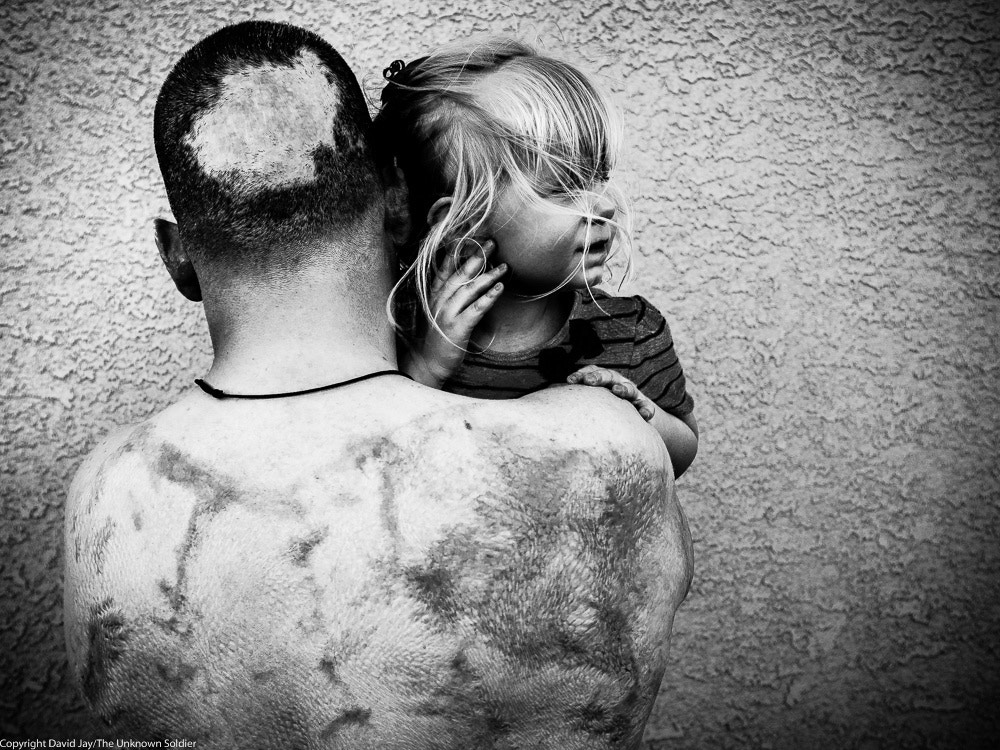
Bobby Bernier with daughter Layla. Image by David Jay/ <a href="https://farm.upworthy.com/nuggets/5564a2bd633239000c2f0100/www.davidjayphotography.com">David Jay Photography</a>.
This past week, I went to San Antonio, Texas. There I had the privilege of photographing both Daniel Burgess and Bobby Bernier. They are friends. Daniel stepped on a IED, losing one leg and destroying the other. Bobby was hit by incoming artillery, sustaining burns over 60% of his body. He is pictured here with his daughter Layla.

Maj, Matt Smith at Walter Reed Medical Center in Bethesda, Maryland. Image by David Jay/ <a href="https://farm.upworthy.com/nuggets/5564a2bd633239000c2f0100/www.davidjayphotography.com">David Jay Photography</a>.
This is Maj. Matt Smith. This past week, Matt allowed me to photograph him in his room at the Walter Reed Medical Center in Bethesda, Maryland. Less than three months ago, on June 8, 2013, in Paktika province, Afghanistan, Matt was shot along with five others by a member of the Afghan National Army. The bullet severed his femoral artery, resulting in the amputation of his leg. A private and soulful man, it was an honor to photograph him. Thank you, Maj. Smith.

Spc. Marissa Stock injured by an IED. Image by David Jay/<a href="https://farm.upworthy.com/nuggets/5564a2bd633239000c2f0100/www.davidjayphotography.com">David Jay Photography</a>.Jerral Hancock survived a roadside bomb. Image by David Jay/ <a href="https://farm.upworthy.com/nuggets/5564a2bd633239000c2f0100/www.davidjayphotography.com">David Jay Photography</a>.
This is Jerral Hancock. He was driving a tank in Iraq. A roadside bomb pierced the armor, breaching the interior. We shot these pics two weeks ago at his home in Lancaster, California, where Jarral lives with his two beautiful children. We ended up hanging out into the night, smokin’ ciggys … so I kept taking pictures.
“To the men and women of The Unknown Soldier, I can’t thank you enough for your courage and sacrifice … both on and off the battlefield. It is an honor to photograph you.” — David Jay

SFC Cedric King floats in the pool. Image by David Jay/<a href="https://farm.upworthy.com/nuggets/5564a2bd633239000c2f0100/www.davidjayphotography.com">David Jay Photography</a>.
On July 25, 2012, SFC Cedric King, an Airborne Ranger, was severely injured by an IED while serving his country in Afghanistan. Due to the explosion, Cedric sustained a multitude of internal and external injuries, losing both his legs. Cedric was doing his laps while I was photographing 1st Lt. Nicholas Vogt in the pool at Walter Reed Medical Center last week. Cedric kept watching, so I had to ask. Cedric said, “That man (Nicholas) doesn’t know it, but he changed my life. There was a point when I was so down that I thought I couldn’t go on. And then one day I saw him swimming … and I just thought, wow … if he can go on like that, then I can go on too.” Cedric will also change people’s lives. Already has.

Michael Fox, 27-year-old Marine. Image by David Jay/<a href="https://farm.upworthy.com/nuggets/5564a2bd633239000c2f0100/www.davidjayphotography.com">David Jay Photography</a>.
This is Michael Fox, a 27-year-old Marine and an amazing man. On Nov. 15, 2011, Michael was on foot-patrol in the Helmand province of Afghanistan. His is the first picture of “The Unknown Soldier.”

Staff Sgt. Shilo Harris in Houston, Texas. Image by David Jay/<a href="https://farm.upworthy.com/nuggets/5564a2bd633239000c2f0100/www.davidjayphotography.com">David Jay Photography</a>.
This past weekend, I photographed Staff Sgt. Shilo Harris in Houston, Texas. He came up from San Antonio to see one of my other exhibitions, The SCAR Project (www.thescarproject.org). Shilo was severely burned on Feb. 19, 2007, by a roadside bomb estimated at 700 pounds. He lost three men out of a crew of five. Only Shilo and his driver survived the blast. Shilo has a book coming out soon. He is truly an amazing man, and I am honored to call him a friend.
“The Unknown Soldier is about neither war or politics … but rather something infinitely simpler and more powerful.” — David Jay

Thomas Young in Kansas City, MO. Image by David Jay/ <a href="https://farm.upworthy.com/nuggets/5564a2bd633239000c2f0100/www.davidjayphotography.com">David Jay Photography</a>.
The Library of Congress has acquired images from Jay’s The Unknown Soldier project as part of its documentation of the wars in Iraq and Afghanistan. This speaks to the power of these images in capturing war’s aftermath. But they are so much more than documentation.
Pictures like these help those of us who remain at home to begin to comprehend the true human cost of war.
From Pakistan to Tanzania, the most effective education solutions are community-led. Here’s how local leaders, in partnership with Malala Fund and supported by Pura, are mobilizing entire communities.
When asked to describe what Tanzania smells like, Grace Isekore closes her eyes and breathes in deep. For a moment, she’s somewhere else entirely. Tanzania is a rich tapestry of sights and scents, from the smell of sea mist that permeates the coastline to the earthy cardamom and cloves she cooks with in her kitchen. But when Grace emerges from her reverie, her answer is unexpected.
“Tanzania smells like peace,” she says, her eyes still closed. “I see a beautiful country where we are free to move, free to speak. And there is peace within the community.”
For Grace, that sense of peace isn’t just something she smells; it’s something she works toward every day. As a project coordinator with Pastoral Women’s Council (PWC), a women-led organization that empowers pastoralist communities in northern Tanzania, she has seen firsthand how girls flourish when they have the opportunity to attend school. Like scent, education not only connects girls to their own culture, but also helps broaden their horizons, realizing new possibilities for themselves and others. That transformation reshapes entire communities and ripples outward, with the potential to change countries and transform the world for the better.
Different scents, different approaches, and communities driving change
Spices in Tanzania. Captured by James Roh for Pura
For Grace and others around the world, education is freedom, as well as a pathway to a stronger community. Rooted in that shared belief, Pura, a home fragrance company, was inspired to build on their four-year partnership with Malala Fund to create something truly unique: a fragrance collection that connects people through scent to communities in Tanzania, Nigeria, Pakistan, and Brazil, where barriers to girls’ education are among the highest.
Using ingredients from each region, the new Pura x Malala Fund Collection uses scent to transport people to these regions directly. “Future in Bloom,” for example, invokes Pakistan’s lush valleys through notes of jasmine, cedarwood, and mango; while Tanzania’s fragrance, “Heart on Fire,” evokes the spirit and joyfulness of the girls who live there through cardamom, lemon, and green tea.
The new Collection honors the work Malala Fund does every day, partnering with locally-led organizations in these four countries to ensure every girl can access and complete 12 years of education. Each scent celebrates the joy, tenacity, and courage of the women and girls driving change on the ground, while also augmenting Pura’s annual grant to Malala Fund by donating eight percent of net revenue from the Pura x Malala Fund Collection to Malala Fund directly.
Just as each country’s scent is unique, so too are their needs related to education. But with support from Malala Fund and Pura, local leaders are coming up with creative ways to mobilize entire communities (parents, teachers, elders, and the students themselves, in their pursuit of solutions, understanding that educating girls helps everyone thrive. Here’s how their efforts are creating real, durable impact in Tanzania and Pakistan, and creating a ripple effect that changes the world for the better.
Parent-teacher associations help Maasai girls and their communities in Tanzania problem-solve
A girl’s school in Tanzania. Captured by James Roh for Pura
Northern Tanzania, Grace’s home, is home to pastoralist communities like the Maasai, a nomadic people who have moved with the seasons to nurture the land and care for their livestock for centuries. The nomadic nature of this lifestyle creates significant and unique barriers to girls’ education. Longstanding gender roles have enabled Maasai to survive in the harsh environment and have placed great value on both women and men. Over time, as nomadic life has been threatened by the privatization of land and stationary education models have been implemented, the reality of pastoralist livelihood has shifted and introduced new complexities. Now, the sheer distance to schools is both a practical challenge and one that often comes with danger from the landscape, predators, and potential exposure to assault along the journey. Girls shoulder the responsibility of household chores and there is often cultural pressure around early marriage – both leading to boys’ education being prioritized over girls’.
“There are very, very good [pastoralist] cultural practices, which are passed from generation to generation,” says Janet Kimori, an English teacher at Lekule Girls Secondary School in Longido, Tanzania. But when cultural practices act as educational barriers, “you have to sit down and look for where you are going to assist. As a school, as an individual, the school administration—all of us will chip in and know how we are going to deal with this problem.”
PWC works to ensure girls are able to exercise their right to an education while also preserving pastoralist culture. One successful approach, the organization found, has been the formation of Parent Teacher Associations (PTAs), created with help from Malala Fund. In PTA meetings, students, parents, teachers, elders, and government officials meet, discuss educational barriers, and come up with community-led solutions that preserve and honor their culture while advancing educational outcomes.
PTA meeting in Tanzania. Captured by James Roh for Pura
One recent PTA meeting highlights how these community-led solutions are often the most effective. At Lekule Girls Secondary School, the lack of fresh water forces girls to walk long distances to collect water for the school’s kitchen during the school day, and these long journeys not only disrupt class time but can leave girls vulnerable to sexual assault in isolated areas. Through facilitated discussion, PTA members landed on a solution: installing a borehole to pipe in fresh water to the school. Reliable access to water creates a better learning environment for the girls, but it also benefits the community at large, as local governments are then more likely to invest in health clinics and other community resources nearby.
With a solution in place, the PTA was then able to discuss ideas and map out a course of action. The women would raise money for the cost of the borehole, while the men would recruit workers to dig the hole and lay the pipe. Together, they would ask government officials to match their investment.
The benefits of PTA meetings within the pastoralist communities are undeniable. “The girls are talking and addressing issues in a confident way, and parents feel they are part of the resource team to solve challenges happening at school,” Grace says. One unexpected benefit: The larger cultural impact these PTA meetings have created. Thanks to the success of PTAs within pastoralist communities, the models are now being endorsed on a national level, and schools across Tanzania are starting to use them to solve problems in their own communities. When a community creates opportunities for girls to learn, everyone benefits.
Safe spaces in rural Pakistan help students and their parents connect, then drive change
Safe space for girls meeting in Pakistan. Captured by Insiya Syed.
A continent away in Pakistan, the country’s northernmost region of Gilgit-Baltistan seems like a land untouched by time. The region’s looming mountains, snow-capped peaks, lush valleys and crystalline lakes draw nature lovers and landscape photographers from around the world, but living among this kind of breathtaking scenery has its drawbacks. Schools in the region are few and far between, and the area’s harsh climate often makes roads inaccessible for travel. Poverty and gender-based discrimination are additional obstacles, making school even further out of reach, and girls are affected disproportionately. Going up against these barriers requires a persistent, quiet strength that’s found in the women who live there and reflected in Pakistan’s signature scent.
Saheli Circles are how local leaders in Gilgit-Baltistan are bridging the gap between girls and education. An Urdu term for “female friend,” Saheli Circles are after-school safe spaces where girls explore subjects like art and climate change, while also developing skills that help them manage emotions, set goals, and build positive relationships. Girls study in groups, visit the library, play sports, and tackle filmmaking and photography projects, all designed to develop self confidence and teach the girls how to advocate for issues that matter to them. But the work doesn’t stop there.
“What we’re trying to achieve here will only be impactful if it trickles down to the home environment and the school environment,” says Marvi Sumro, founder and program director of Innovate, Educate, and Inspire Pakistan (IEI), the local organization that developed the Saheli Circles model and partnered with Malala Fund in 2021 to make it a reality. Ever since, Saheli Circles have grown to involve teachers, elders, and parents to encourage relationship building that’s essential for young girls and adolescents. “Our spaces can give mothers and daughters an opportunity to interact a little differently—do an art activity, or have a cup of tea together, or some good conversation,” Marvi says.
The relationship building is what makes the biggest positive impact throughout the community. Recently, one Saheli Circle was able to bring together parents, teachers, and administrators to advocate for better education at their local school, and together they convinced the department of education to hire a science teacher. Another Saheli Circle organized a fund where members of the community can contribute monthly to pay for uniforms, books, and other school expenses for the girls in their village, eliminating those small, hidden costs that are often a barrier to education for many. A third Saheli Circle was able to produce a short film about how gender-based household chores can take away valuable study time from girls, leaving them at a disadvantage. “The girls put the film together and showed it to the mothers, and the response from the mothers was just beautiful,” Marvi says.
Girls smiling in Pakistan. Captured by Insiya Syed.
The education and relationship building that the girls receive in Saheli Circles connects them to larger opportunities and economic freedom that are not possible in their hometown. “For girls in Gilgit-Baltistan, education is extremely important because of the fact that we’re so far away from where the economy is, where the opportunity is. Education becomes this bridge for us, for our girls, to access all the opportunity and economy that exists in [larger cities].”
From rural Tanzania to remote Pakistan, local organizations prove every day that prioritizing girls’ education benefits everyone. Communities that lift up girls are able to secure resources like clean water and well-staffed schools, as well as build stronger relationships.
These outcomes are only possible because of the women and girls who work tirelessly in these regions to overcome barriers and drive progress. The Pura x Malala Fund Collection is a way to honor them, celebrate their achievements, and unite people the world over around a shared belief that education is freedom. Like scent, that belief can build, travel, and has the possibility to transform the world.
Experience the Pura x Malala Fund Collection here, and connect with the stories of real girls leading change across the globe.
When the holidays roll around, it’s time for families to decide where they will meet to celebrate. For the most part, parents with younger kids dread packing their bags and traveling to a family member’s house where things aren’t set up for young children. You fumble around setting up the pack ‘n plays, can’t find your bottle brush, and freak out because the electrical sockets aren’t child-proof.
However, many grandparents aren’t keen on enduring the mental and physical strain of traveling at an older age. So, who’s right? Grandma Jan, founder of Grandma Camp and a TikTok influencer who shares fun ideas for grandparents and grandkids, argued that parents should pack up their kids and visit Grandma.
“Okay, so, here’s the debate: families say, ‘Grandma, why don’t you come visit us?’ But let’s be honest, Grandma’s house is where the traditions are, the cookies are, and all of the toys are,” Grandma Jan begins. “But if grandma is driving, flying, hauling all the gifts, and packing up her car to come see you, maybe it’s time to flip the script. When did it become normal for Grandma to pack up all her stuff and come see you? Should the kids pile into the car, bring all their toys, and just go visit grandma? Bring all that love and chaos to her?”
So she asked her followers: “Should grandmas be the one on the road or should families pick everything up and drive to her?” Just about everyone in the comments said that grandparents should have to travel to see their grandchildren.
“Nope. I want Christmas morning in pajamas with my family. I want my traditions. My parents and in-laws (the grandparents) got all of this how they wanted. It’s my turn now,” Maggie wrote. “Gramma is retired and now has a shit ton of time. Kids and parents have a very finite amount of time off in the holidays that they do not want to spend on the road,” Mrs. Wright added.
Some grandparents also checked in to disagree with Grandma Jan. “Why would I put that on my kids and grandkids? It’s so hard traveling with kids, not to mention expensive to fly for more than one person,” Populustultus wrote. “What a weird way to think about that. Why wouldn’t you help your kids create magic in their home? Signed a grandma,” LifestylebyKat added.
The response inspired Grandma Jan to release a follow-up video clarifying her opinion. She admits she came up with the idea after seeing older people having a hard time getting through the airport. “[I saw] older grandparents struggling their way through airports carrying their own heavy bags while managing a walker or a plane or a wheelchair, struggling through all on their own with no one to assist,” Grandma Jan said. “And as an occupational therapist, that actually broke my heart. For younger, healthier grandparents, travel can be fun, but for the older generation, it can be quite a struggle.”
Ultimately, Grandma Jan didn’t intend to put anyone out; she just wanted to have a conversation about what’s best for families as a whole. “And Grandma Camp by Grandma Jan is about having those conversations, not making rules. And at the end of the day, it’s about connection, not distance,” she concluded her video.
This article originally appeared last year. It has been updated.
But making your house smell good without using artificial air fresheners or sprays can be challenging.
“Keeping a home smelling fresh can be difficult because odors do not just enter and leave–they accumulate in fabrics, carpets, upholstery, garbage bins, and places with moisture,” Marla Mock, president of Molly Maid, tells Upworthy. “You have to address the underlying problem, rather than just spraying a perfume to cover it up. Plug-ins, and sprays mask an odor rather than remove it.”
Plus, keeping your home smelling good for an extended period of time can also be difficult, as many underlying odors are caused by mold, mildew, and bacteria, Kathy Cohoon, operations director at Two Maids, tells Upworthy.
Here are seven expert tips to help you stave off odors and keep your home smelling fresh:
1. Routinely clean specific areas
Eliminate odors by staying on top of cleaning certain areas in your home.
“For instance, empty your trash and clean the bins regularly, routinely check and clean areas where moisture is prone to accumulate such as dishwashers, laundry rooms and bathrooms to avoid mildew odors,” Mock explains. “You will eliminate the source of odors, and therefore your home will smell better because of that alone.”
2. Bake some fresh scents
Your pantry and refrigerator can help your home smell delicious.
“I bake a quick tray of sliced lemons with a little water, or simmer a pot with citrus peels, cinnamon sticks, and cloves,” says Jessica Randhawa, owner and head chef at The Forked Spoon. “I keep it at the barest simmer and top off the water as needed. Cooking these fresh scents replaces stale odors with a light, natural kitchen smell.”
3. Neutralize lingering kitchen odors with a vinegar simmer
The kitchen is full of sources for bad smells that stick around your home.
“If you have strong odors from cooking dishes like fish or spices, mix a cup of water and three tablespoons of white vinegar in a pot and bring it to a boil,” explains Cohoon. “Let it simmer uncovered. The acid in the vinegar neutralizes the odors in the air. For a natural fragrant boost, you can create an aromatic stove simmer by boiling water with additions like mint leaves, a lemon, and a few orange rinds.”
Which one will you try first? 🌻 #5 is a gamechanger in our home 🙌 make your home look + smell amazing with these 5 easy and inexpensive tricks 1. Place 2 tbs vanilla extract in the oven to make your home smell like cookies 2. Place essential oils on cotton balls and inside your vacuum to make your whole home smell fresh 3. And you can also place them under your bin liner to rid odours 4. Run 1 cup baking soda in your dishwasher to rid musty odours 5. And neutralise bathroom odours by mopping floors with shaving cream Hope these were helpful lovelies x #hometips#homehacks#homefragrance#homesweethome#cleantok#cleaningtiktok#cleaningtips#cleaninghacks
Fresh air is an important part of a good-smelling home.
“Air out rooms by opening windows and/or using fans; launder or replace soft goods such as curtains, throws and mats, as they absorb odors,” Mock shares. “This also prevents odors from soaking into the fabrics and keeps your home odor free.”
5. Deep clean and deodorize fabrics with baking soda
A simple pantry staple will get your fabric smelling fresh.
“Baking soda is a fantastic, non-fragranced deodorizer because its alkaline properties help absorb and kill acidic odors, grease, and oils,” says Cohoon. “To tackle smelly carpets and rugs, I recommend mixing equal parts of borax and baking soda. Sprinkle the mixture liberally over the surface and let it sit for up to 30 minutes before vacuuming thoroughly. For strong smells in enclosed spaces, I suggest putting some baking soda in a vented jar and refreshing the powder every month or so.”
6. Eliminate sneaky odor sources like smelly shoes
Shoes can be a major source of odor inside your home.
“To refresh smelly shoes, I recommend sprinkling Borax generously inside them and letting the powder sit overnight to absorb the stink,” says Cohoon. “In the morning, wipe out or vacuum the Borax powder to remove the odors.”
7. Try essential oils
Essential oils are a natural way to make your home smell good.
“A few drops of an essential oil can be great as well to give some fragrance,” adds Mock. “They neutralize odors instead of covering them up, so the space smells fresh, not scented.”
This article originally appeared last year. It has been updated.
Childhood dishes can take you straight back to your seat at the family dinner table. Comfort meals that were served there are uber nostalgic. And there is one dish represents the epitome of Gen X and baby boomer childhoods: casseroles.
These one-dish wonders were loaded with flavor and baked to perfection. Pulled straight from the oven to the dinner table, casseroles filled the house with the smell of unique home-cooked recipes.
“Fancy Fast Chicken is delicious and so simple. Line up chicken breasts in a casserole dish. Dump uncooked stuffing over top the chicken breasts. Pour Cream of Mushroom (Onion or chicken works too) and incorporate it into the stuffing. Top with cheese of your choice, and fried onions if you’re inclined. Bake at 350 for 45min or until chicken is thoroughly cooked.” – Applepoisoneer
Chicken Curry Divan casserole
“My favorite is Chicken Curry Divan. A friend made it for me in college 40 years ago and it is a favorite to this day. Never disappoints. Many people have asked me for the recipe over the years. My best friends kids now that they are grown have each approached me for it.
1 1/2 lbs chicken breast tenders cooked and cut into bite sized pieces 3 cups broccoli in bite sized pieces 2 cans Cream of Chicken soup 1 cup mayonnaise (must be Mayo) 2 tsp curry Juice of 1 lemon Shredded sharp cheddar (use the amount you like o like a nice even cover of the top) 3/4 cup crushed Ritz crackers 3 tbsp melted butter In 9×13” baking pan layer chicken then broccoli.
Mix the soup, Mayo, lemon juice and curry together well, pour over chicken broccoli mixture evenly and smooth out. Sprinkle cheese over top evenly. Crush crackers fine, mix in melted butter well and sprinkle evenly over top. Cook at 375° for 25-30 minutes until bubbly and top brown. Serve with rice.” – karinchup
Chicken and Rice casserole
“This baked rice & cheese casserole has become a staple in our house! It’s great as a side dish, or I’ll add rotisserie chicken and serve it as a main dish.” – anchovypepperonitoni
Chicken & Dumplings casserole
“The secret of this is not to stir anything. That’s what makes your dumplings. When you dish it out, you have your dumplings on top. 2 chicken breasts, cooked and shredded; 2 cups chicken broth; 1/2 stick of butter; 2 cups Bisquick mix; 2 cups whole milk; 1 can cream of chicken soup; 1/2 medium onion, minced; 1 cup frozen peas; 3 tsp chicken Better Than Bouillon; 1/2 tsp dried sage; 1 tsp black pepper; 1/2 tsp salt.
(1) Preheat oven to 350 degrees (2) Layer 1 – In 9×13 casserole dish, melt 1/2 stick of butter. Spread shredded chicken over butter. Sprinkle black pepper and dried sage over this layer. Do not stir. (3) Layer 2 – Sprinkle minced onions and peas over chicken (4) Layer 3 – In small bowl, mix milk and Bisquick. Slowly pour all over chicken. Do not stir. (5) Layer 4 – In medium bowl, whisk together 2 cups of chicken broth, chicken bouillon, and soup. Once blended, slowly pour over the Bisquick layer. Do not stir. (6) Bake casserole for 30-40 minutes, or until the top is golden brown.” – Superb_Yak7074
Chicken broccoli casserole
“I made chicken broccoli casserole last week and that’s a favorite here. This is pretty close to how I do it.” – gimmethelulz
“Tater tot casserole. My mom made this at least once a week when I was growing up, but she added a quart of green beans to make it a meal. If you brown your ground beef in a good size cast iron skillet, you only dirty up one pan to make it!” – hcynthia1234, upperwareParTAY
Breakfast casserole
“I’m making a breakfast casserole this morning for brunch later—a bag of frozen hash brown potatoes thawed, a pound of sausage sauteed with peppers and onions, a brick of cheese grated, eight eggs beaten with a bit of milk and cream and some salt and pepper. Layer in a casserole, ending with cheese. Bake around an hour at 375.” – CWrend
Hamburger pie casserole
“One of my childhood favorites. Did not add vegetables or cheese though. This was an end of the month struggle meal that everyone loved.” – DarnHeather
Shepherd’s pie casserole
“Shepherd’s pie : brown 1.5 lbs ground beef with half a chopped onion, salt and pepper, drain it and then spread into a 13×9 and stir a can of cream of mushroom soup into it. Spread a drained family size can of corn on top, use a container of prepared mashed potatoes for the top layer. Bake for a half hour at 350.” – ExplanationLucky1143
Noodle casseroles
Tuna casserole
“Love my mom’s tuna noodle casserole: 1 bag broad egg noodles, 1 can cream of mushroom soup, 2 cans tuna, 1 cup frozen corn or 1 can kernel corn, 2 cups shredded sharp cheddar cheese, 1/2 cup seasoned bread crumbs, 1 tbsp celery salt Cook noodles per package directions, drain, then place in a 13×9 casserole dish. Mix in cream of mushroom soup, tuna, corn, 1 cup of the cheddar cheese, and celery salt. Top the casserole with the remaining cheese and bread crumbs. Bake at 350 for 20 minutes or until done enough for you.” – Pinkleton
Mock Stroganoff casserole
“Mock stroganoff – brown 1lb ground chuck. Mix in 8 oz sour cream and 1 can cream of mushroom. Add to 1 lb of cooked egg noodles. Season with black pepper. Extras – fresh mushrooms and/or onion cooked with the beef. Any precooked veggies of your choice, peas or broccoli work well. Splash of Worcestershire, soy sauce, or fish sauce. Garlic or onion powder. Parsley, thyme, or cilantro.” – Nathan_Saul
Cabbage noodle casserole
“I have a quick cabbage and noodles that uses bagged cole slaw. Cook a bag of noodles. Put aside. Cut up a lb of bacon and a med onion. Cook in pan until bacon is slightly fried and onions are clear. Add cabbage(without carrots) let sit 10 min or so. Add to noodles. It’s so easy.” – conjas11
Thanksgiving prep class is now in session! 🍂🧑🏫 If there’s one thing you need to nail on the big day (other than the turkey, of course), it’s Green Bean Casserole. This recipe tastes just like the one your grandmother used to make, if not even better! 😋 Continue reading or click the link in the @allrecipes bio to get the full recipe. Ingredients: 2 (15-ounce) cans cut green beans, drained 1 (10.5-ounce) can condensed cream of mushroom soup ¾ cup milk 1 (2.8-ounce) can French fried onions salt and ground black pepper to taste Directions: Gather all ingredients. Preheat the oven to 350 degrees F (175 degrees C). Mix green beans, condensed cream of mushroom soup, milk, and 1/2 of the fried onions in a 1.5-quart casserole dish. Bake in the preheated oven until heated through and bubbly, about 25 minutes. Sprinkle remaining onions on top and return to the oven for 5 minutes. Season with salt and pepper to taste. Let rest for a few minutes before serving. 🧑🍳: Nicole #thanksgiving#greenbeancasserole#greenbeans#thanksgivingsides
“This is the best green bean casserole recipe, it does use the canned onions but you make your own cream of mushroom and it’s soooo good. I’ve made it on random weekends, it’s not just a Thanksgiving food. I don’t know much about older foods, I just really wanted to share that recipe.”
Corn casserole
“Our family Corn custard doesn’t have crackers but we double the recipe and there’s never any left over. 2 eggs, 1 cup of sweetened condensed milk, 1/2 flour, 2 T soft butter, 1 tsp sugar, 1 can of creamed corn, 1 can of whole corn. Mix all together and bake in a 8×8 about 45 min at 350. Gotta have that!” – Psychological_Bat890
This article originally appeared last year. It has been updated.
Photo credit:
Franklin D. Roosevelt Presidential Library and Museum, Wikimedia – A Thanksgiving dinner in the Great Depression was anything but depressing.
Thanksgiving is right around the corner, and in a year when grocery prices feel like a jump-scare every time we glance at a receipt, many are looking for ways to celebrate without blowing the budget. Luckily, this isn’t the first time Americans have had to get creative in the kitchen.
During the Great Depression, families all over the country still hosted Thanksgiving dinners, often with barely anything in the pantry. Yet what they managed to whip up wasn’t dreary or depressing. Quite the opposite. These resourceful dishes would be just as flavorful and comforting today as they were decades ago.
Here are some Depression-era dishes and tricks that still deserve a spot on a modern Thanksgiving table.
Turkey was wildly expensive in the 1930s, costing more than 10 hours’ worth of wages, per archived reports from The Beaumont Enterprise. Many families simply couldn’t justify buying one, so they reached for one of the cheapest roaster birds available: an old hen. As in, past their laying prime, or even roosters. Cooked low and slow with plenty of moisture, it becomes tender and surprisingly rich.
Given today’s smaller gatherings and tighter budgets, downsizing the bird might make sense again.
One of the most legendary Depression dishes was “mock duck.” Instead of an actual duck, spread flank steak with stuffing, roll it tight, sear it, and roast it until it tastes like something far fancier than it actually is.
It’s comfort food cosplay, and it absolutely works.
Despite the prickly name, porcupine meatballs contain no porcupine. Instead, rice is mixed directly into the meat so it sticks out like little quills. The rice also bulks up the dish so a small amount of meat could feed a crowd. It’s frugal genius.
The long-running radio program Aunt Sammy’s Homemaker’s Half Hour taught home cooks how to stretch every penny. Among their most beloved suggestions: creamed pearl onions, candied sweet potatoes, and simple vegetable dishes built from affordable staples.
These sides check every Thanksgiving box: warm, creamy, sweet, and budget-friendly.
Potatoes were one of the most affordable ingredients of the era, and potato pancakes made frequent holiday appearances. They’re crispy, filling, and perfect for scooping up gravy or topping with applesauce.
Chestnut stuffing, apple-and-raisin stuffing, and even spiced cranberry stuffing were Depression-era favorites. Sure, some recipes required extra labor—like pressing boiled chestnuts through a sieve—but the flavor payoff was worth it then and now.
Many families filled their tables with whatever grew nearby. Dandelion greens—now a fancy “superfood”—were a Depression staple. Paired with citrus, eggs, or leeks, they made a fresh, bright starter salad.
Fresh pumpkin pie was the go-to, though cooks often used whole pumpkins to avoid the cost of canned puree. And if pumpkins were scarce, families turned to Indiana’s beloved sugar cream pie, sometimes also called a “Hoosier cream pie,” which dates all the way back to the 1800s. It’s simple, silky, and made from pantry basics. What’s not to like?
One thing worth noting: perhaps the even bigger takeaway here is not the recipes themselves, but the mindset of getting back to basics and making the most out of what’s available. And maybe that’s the real inspiration for today. A Thanksgiving table doesn’t need extravagance to be satisfying…or meaningful.
This article originally appeared last year. It has been updated.
TikTok user alexxx1915 recently posted a short video with the caption: “I just learned the term ‘living room family’ and I never understood why my kids never played in their rooms when I always did as a kid.” She briefly shows her kids hanging out in the living room with their pet dog and some toys scattered around the floor, before panning to her own face and giving a sort of sentimental look. The simple, ten-second clip struck a huge nerve with parents, racking up over 25 million views and thousands of heartfelt comments.
What are ‘living room families’ and ‘bedroom families’?
This idea has been going around for a while on social media.
Simply put, a living room family is a family that congregates in the living room, or any common space in the household. Kids play in the same space where the adults relax and things are often messy, as a result. Everyone interacts with each other and spends lots of time together. Bedrooms are reserved mostly for sleeping and dressing.
A bedroom family, on the other hand, is where the kids spend more time in their rooms. They play there, watch TV, and maybe even eat meals. Typically, the main rooms of the house are kept neat and tidy. You won’t find a lot of toys scattered about, and family time spent together is more structured and planned ahead rather than casual.
A living room family is more communal
A family congregates in their living room. Canva Photos
In my household, we’re definitely a living room family. We’re around each other constantly, and the house is often a mess because of it. Learning about this term makes me feel a little better that my kids want to be around us and feel comfortable enough to get their ‘play mess’ all over the living room. The mess is a sign of the love and comfort we all share together.
There’s so much that’s great about having a family that lives out in the open, especially if you were raised feeling like you had to hide in your room.
“I thought my kids hated their rooms turns out they like me more” said another. “You broke a generational curse. Good job mama!” said yet another.
The implication of being a bedroom family, or having ‘room kids’, is that perhaps they don’t feel safe or comfortable or even allowed to take up room in the rest of the house, or to be around the adults. “I remember my brother coming round once and he just sat in silence while watching my kids play in the living room. After a while he looked at me and said ‘It’s so nice that your kids want to be around you’” one commenter said on alexxx1915’s video.
A bedroom family enjoys some alone time
A boy in his bedroom playing a guitar. Canva Photos
Being a bedroom family is by no means a bad thing. In fact, alone time is important for parents and kids alike, and everyone needs different amounts of it to thrive. Kids with certain special needs, like being on the autism spectrum, may be absolutely thrilled to spend lots of time in their rooms, for example.
But it really doesn’t have to be one or the other, and neither is necessarily better. Making your kids feel relegated to their room is, obviously, not great. It’s not a good thing if they feel like they’re not allowed to exist in and play in the rest of the house. But if they just like hanging out in their room? Nothing wrong with that at all. And same goes for parents.
In 2023, there was a similar debate on TikTok where parents sounded off on whether they were bedroom parents or living room parents. In this situation, the parents spent the majority of the time in their bedroom, while the kids were in the living room, or they spend time in the living room with their kids. According to Marissa Kile, the video’s creator, this made the parents’ bedroom feel like a “scared space” where the kids didn’t feel comfortable.
Of course, every household is different and the right answer is the one that works for them. And if you feel like living on the edge, you can always just be both.
This article originally appeared 2 years ago. It has been updated.
Even for the parents who prioritize showing up for their kids, missing a child’s event now and then might be unavoidable. But certain occasions are more painful than others when a parent can’t show up, and fatherless father-daughter dances undoubtedly fall into this category.
In June 2024, a work commitment kept Harper’s dad from attending her dance studio’s annual summer showcase, which meant the six-year-old was at risk of missing out on the father-daughter dance entirely.
An act of brotherly love
Thankfully, her brother Micah, who was 14 at the time, is the coolest brother in the world and stepped up to take her dad’s place so she wouldn’t miss out.
In a mega-viral video posted to Instagram by Harper and Micah’s mom, Patrice Thompson, we see the duo having a blast as they twirl in circles, fist bump, and end with an adorable lift for their “Barbie and Ken” themed routine.
“Core memory for the team today,” Thompson wrote in the caption. “I don’t know if he knows what an impact he’s making as her big brother, but she’ll never forget this.”
Micah didn’t just have an impact on Harper. So many people left comments sharing how impressed and moved they were by his kindness.
“In a world of boys he is a gentleman,” one person wrote, referencing a Taylor Swift lyric.
Another offered a touching truth, writing, “As a man whose dad walked away from me, this makes me so emotional. You are raising your son to be the cycle breaker. He won’t end up repeating cycles of toxic masculinity like so many of the men we see today. He will be a better man. And his little sister will grow up knowing what a real man should be like, because she has her big brother to show her.”
One comment commended Micah for stepping out of his comfort zone, saying, “Bless his sweet heart. I know how big that is for a 14 year old to put himself out there. Major props!”
“Watching him lift her up at the end got me i can’t lie i teared up ” another shared.
“As a girl who had my older brother participate in my “father-daughter” dances for drill team in high school, this made me soo emotional! this is a special moment they will remember forever,” reminisced another.
And perhaps the best (and truest) comment of them all, was this one: “Does your son know he’s a legend?”
Good Morning America sure does.
Mom is proud but not surprised
In an interview with Newsweek, Thompson shared that while she is “so proud” of her son, especially since most boys his age “would rather do anything else than perform a routine in front of their peers and during summer when he could be off with friends.” However, she is “not super surprised” by what he did. “That’s the young man he is!” she exclaimed, adding “he truly understands the meaning of being selfless.”
Here’s the family all together: Mom, Dad, Micah, Harper, and the newest addition born earlier this year, baby Christian. Hopefully the new baby boy knows he won the sibling lottery.
To all the brothers who would show up for their siblings in this way – thank you. Your generosity and compassion really do help make the world a better place, and it doesn’t go unnoticed.
This article originally appeared two years ago. It has been updated.
Even for those who enjoy the thrill of making vacation itineraries…it’s work. And obviously when the planning has to be done for an entire family, there’s even more effort needed to be put in. Imagine going through all the rigamarole of booking flights, hotels, rental cars, restaurant reservations, entertainment venues, last minute store runs for toiletries…without getting so much as a “thank you.”
Odds are you’d be a little miffed, even if planning is your thing. This was the scenario that a mom Alexis Scott found herself in after planning a summer vacation for her husband and two teen children. Thankfully, the now-viral TikTok post venting her frustrations inspired several folks to give her some much deserved support.
In the video, Scott began, “I’m on a family vacation right now with my two teenagers and my husband. We flew in late last night. We think we got in at like 12:15 a.m. and headed to get a rental car and then got to our Airbnb. And I am frustrated.”
Scott had tried and tried to get any input from her family about what they might want to do, and each time got the same reply: “‘Whatever you want, mom. I don’t care. Okay. I don’t care.’”
“Great. Glad I’m planning this vacation for everybody to not care,” Scott lamented.
Still, she did the planning because someone had to do it. But as soon as the vacation started, all her decisions were met with complaints. From being called “cheap” for getting too small of an SUV rental car to being told “Mom is never going to be in charge of booking the Airbnb again. She can’t even this, that and the other,’” after the family found out their AirBnb was three stories with quite a few stairs.
“Then this morning, we wake up and it’s an urban setting. We live in a very quiet suburban setting and my husband’s saying how he barely slept and this and that. And I’m just like, enough!” she said.
All of this happened within the first 24 hours of the trip. It’s easy to see why Scott needed to vent.
Her video concluded with:
I have been the only one to put in all the effort in planning this trip. And I know there’s videos on mental load, but this is prime time example of me. I’m shouldering the mental load for my entire family and everybody has something to say about it. So, yeah, I’m frustrated. Please pray for me that we can all turn our attitudes around and have a great day.”
A family enjoying a vacation together. Photo Credit: Canva
The internet had her back immediately
Down in the comments, viewers could totally empathize with Scott for feeling burnt out and disappointed.
“Oh gosh the mental load of planning every detail and then knowing if something goes wrong or isn’t perfect it’s all on you. Been there,” one person shared.
Another added, “I tell my husband that I haven’t been on vacation since I was a child and he’s alway confused bc to him, ‘we’ go on vacation every year. Only other moms would understand what I mean.”
Many suggested that she do something for herself instead.
“Just Irish goodbye one morning, go to brunch alone, hit the spa or a pool and come home after dinner,” one person wrote.
“Go and do whatever you want to do!! Spa day sounds perfect and take yourself out for fabulous meals!!” echoed another.
On a positive note: this story does have a happy ending. In a follow-up video, Scott shared how she showed her family the TikTok video she made, and it did turn things around.
“We have actually had a really, really great day today,” she said. “Everyone has had positive attitudes. I’ve heard a lot of thank you’s and my kids have been buying their little side purchases with their own money and not even asking me to pay for it… but they have been really self-sufficient in that space.”
All in all, Scott recognizes that her family is “human,” and a big part of being human is apologizing when a mistake is made and moving forward.
“We love each other. This was a learning experience.”
How to make family vacation planning actually work
The thing is, when families do the travel planning together, it often ends up being a more rewarding experience for everyone. There are lots of ways to go about it, like watching movies featuring the upcoming locale, having every family member choose one activity, selecting lodging as a group, voting from a handful of selected excursions, etc.
Of course, this requires willing participation for every family member, which is what Scott (like many other moms) certainly did not have. But hopefully other moms facing this same laissez-faireness can whip up this video to inspire some gumption into their vacation companions.
This article originally appeared two years ago. It has been updated.
Living abroad is a dream many people have, whether it’s spending a summer in a foreign country or packing up their entire life to make the permanent move. In fact, according to a 2025 Harris Poll, more than half of Americans believe they could have a higher quality of life abroad, and many say they’d move if they had the means. Some estimates show that an estimated 5.5 million Americans live abroad, according to the Association of Americans Resident Overseas.
But life is funny, and sometimes these expats come back to the United States for a variety of reasons like family or career, which gives them an extremely interesting perspective when they begin their re-entry.
Take American-born TikTok user Kayleigh Donahue, for example. She’s going viral on the platform because of her unflinching take on why it was a mistake for her to move back to the U.S. after spending 4 years in Ireland.
Moving to the U.S. was a step backwards
Kayleigh moved back to the Boston area from Ireland to make more money, but that didn’t go as planned.
Even though she got paid more, the cost of living was so much higher that she saved less money than she did in Ireland. She also missed the generous number of vacation days she got in Europe as compared to America.
“I have been bamboozled,” she begins in the now viral clip with over 600 thousand views.
Many people like Kayleigh move abroad, especially to European countries, for a slower way of life, better work-life balance, more opportunity for travel, or just to see something different. But America is the land of opportunity, right? For some, that promise always beckons, no matter where they go. So even though Kayleigh had an amazing life in Ireland, she wound up moving home to advance her career and make more money.
The real cost of the American Dream
“Basically, I really got sucked into the American Dream way of living when I was abroad, which is funny because I loved living abroad,” Kayleigh said. “But you know, making more money, that’s enticing. Good job, that’s enticing. It’s not true. It used to be. It definitely used to be. You could come here and make a ton of money, make a great life for yourself. But the younger generation today, in this country – screwed. It’s literally all a lie that is sold to you. It’s such a struggle, and the older generation doesn’t seem to see how much of a struggle it is for the younger generation here.”
In the end, who wants to work harder for a lower quality of life?
“Needless to say, I will most likely be moving back to Europe where 20-plus days of paid vacation a year is literally the law, and I will make less money, but somehow, you know, the cost of living is lower there and I can save more,” Kayleigh concluded the video.
The comments support Kayleigh
Viewers applauded Kayleigh for coming to the realization:
“Yep, I made the same mistake. Then I realized that people and quality of life are more important than income. Enjoy life!” one wrote.
“Get that. We moved back to US and it was horrible. We moved back to the UK. Happier now was 6 weeks off a year” said another.
“I think there are actually very few people who derive their enjoyment and self-worth from their job. Quality of life is so much more important,” another user added.
Kayleigh made good on her promise. As of January 2025, she now lives in Amsterdam with her Dutch husband, and they seem to be loving their life abroad.
A Mercer survey in 2024 put Amsterdam as the sixth best city in the world for quality of life. It’s a place with rich culture, amazing public transportation, and a reasonable cost of living to earning potential ratio.
Young Americans really aren’t asking for that much. They just want to be able to afford and enjoy their life, and they’re willing to work hard for it. America should be giving them those opportunities instead of losing more and more talented young people to other countries.
This article originally appeared two years ago. It has been updated.