When the Olympics roll around, it’s an amazing treat. Unlike most sports worldwide that feature a new season each year, we only get to see the best of the best athletes on the Olympic stage a handful of times in our life. It’s no wonder the games are so wildly popular around the globe, with about five billion people tuning in to the most recent 2024 summer games in Paris.
The history of the Olympic games goes all the way back to ancient Greece, with the first official games being held sometime in the 8th century BC and the final event occurring in the 4th century AD. The competition took place in Olympia, Greece and consisted of sports like wrestling and horse racing.
After a 1500 year draught, the Olympic Games were revived in 1896 and held in Athens. Stunningly, someone brought along a video camera.
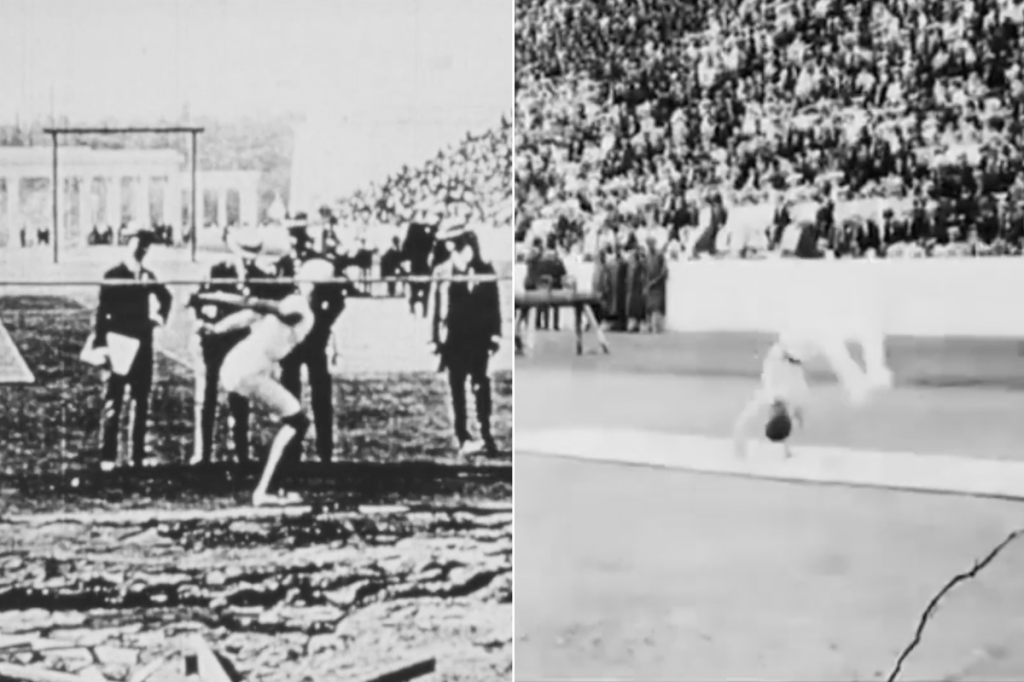
In 2016, the British Film Institute published a 37-second clip that purports to show footage from the very first modern Olympic Games. What’s absolutely staggering about the video clip from 1896 is that what’s widely considered to be the oldest preserved “moving picture” is from just eight years earlier: a short, two-second clip called the “Roundhay Garden Scene” that showed four people gleefully walking around a garden.
For reference, the modern film camera had just been invented in 1888 by George Eastman. The Kodak camera was the first “You press the button, we do the rest,” camera in the world. When the 1896 Olympics were held, even still photography was just beginning to catch on with the masses.
Here are a few other notable facts that put the age of this footage into greater context:
- The Civil War ended in 1865. In 1896, the United States was still coming out of its extended Reconstruction period and healing its divided nation.
- F. Scott Fitzgerald had just been born in 1896. He wouldn’t go on to write The Great Gatsby for nearly 30 years.
- Vincent van Gogh had just died a few years earlier in 1890.
- America had received the Statue of Liberty as a gift from France merely a decade earlier.
- Bubonic plague was still around, and was devastating parts of India as the games commenced.
Simply put, there is not much existing video footage from this time period in the world, so it’s truly amazing to behold even these short clips from the very first modern Olympic Games.
(BFI states that it’s possible some of the footage may be from the 1906 Intercalated Games.)
A few things stand out from the near-ancient footage.
First, we see an opening ceremony held at the Panathenaic Stadium. Other footage reportedly taken at the time shows a crowd gathering, including royal figures like George I, the King of Greece at the time, and British king Edward VII.
Athletes then take place in a standing high jump event. Again, some of the footage may be from the 1906 games, but according to the Olympic committee, the high jump was performed at the 1896 event. The United States swept the podium.
The lack of fanfare at the time is noticeable. As athletes step up to the jumping bar, a handful of men in suits loaf around and write things down in notebooks. There’s no high-tech instant replay or television production. Just regular, athletic people who came from thousands of miles away to do their very best.
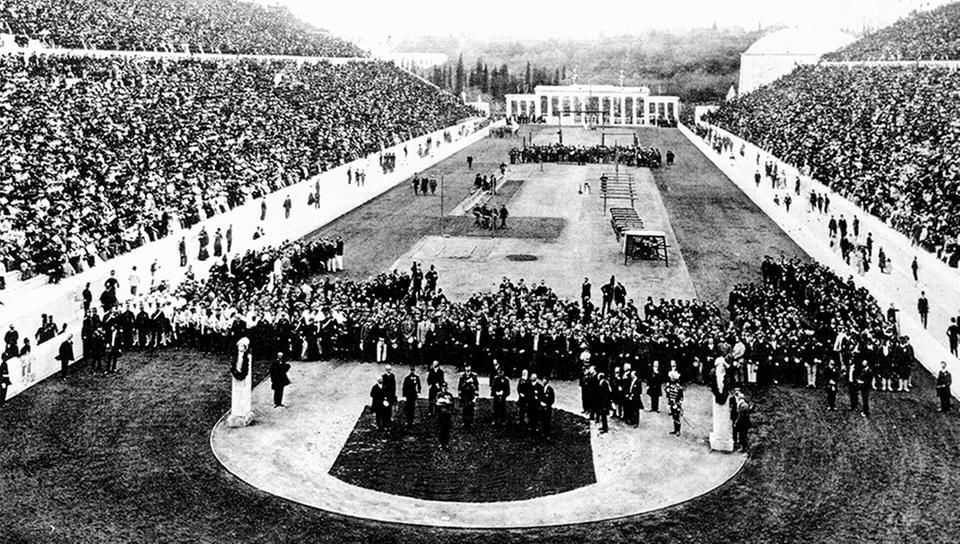
Over 200 athletes from 14 different countries gathered to take place in the first Olympic Games. The event was monumentally important for the future of organized athletics. Here are a few notable happenings from the groundbreaking event:
The marathon, a 26.2 mile race that’s become a running staple today, was invented for the 1896 games. It was dreamt up to honor the “legend of Pheidippides, who is said to have run 40 km from Marathon to Athens in around 490 BC,” according to Olympic history.
Swimming events were held in the open waters of the Mediterranean Sea. Funnily enough, in the 2008 Beijing Olympics, open-water swimming was reintroduced as a standalone event.
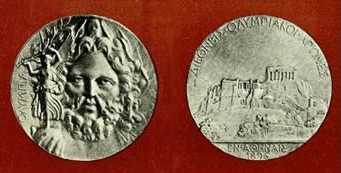
Gold medals for first place winners had not been invented yet. Champions received a silver medal and an olive branch, while runners-up received bronze. The gold medal didn’t come around until the 1904 Games, although winners were later posthumously awarded Gold medals from the committee.
Long before age-limits and strict committee requirements, a 10-year-old boy named Dimitrios Loundras of Greece competed in gymnastics during the 1896 Olympics. He performed well in the parallel bars and his team placed third. To this day, he is the youngest competitor and medalist in Olympic history.
The Olympics have become a mass spectacle, chock full of sponsorships, commercials, and world-class professional athletes. But they were initially created to celebrate cultural exchange and peaceful cooperation between nations.
There’s even a myth that all countries who participated in the ancient Games would suspend wars and conflicts until after the Olympics were over. That’s not strictly true, but it speaks to the spirit of the games and what they mean both to people who compete in them and watch them.
That’s still why we love watching. The athletic feats are incredible, but it’s the parade of nations, human stories, and learning about the culture of the host country that keeps us tuning in every two-four years. We’re extremely fortunate to have video evidence of where it all began over 100 years ago.