As much as we’d like to pretend every phrase we utter is a lone star suspended in the space of our own genius, all language has a history. Unfortunately, given humanity’s aptitude for treating each other like shit, etymology is fraught with reminders of our very racist world.Since I have faith that most of you reading want to navigate the world with intelligence and empathy, I figured it’d be useful to share some of the everyday phrases rooted in racist etymology. Knowledge is power, and the way we use and contextualize our words can make a huge difference in the atmospheres we create. According to Meriam-Webster’s dictionary definition, a thug is “a violent criminal.” Obviously, this definition leaves the word open to define people of all ethnicities. However, given the frequent ways this word has been used to describe Black Lives Matter protesters, the 17-year-old murder victim Trayvon Martin, and sadly, almost every black victim of police brutality — there is an undeniable racial charge to the word. When you consider the people who are called thugs — groups of black protesters, victims of racist violence, teenagers minding their own business, and flip the racial element, you’d be hard-pressed to find examples of white people being called thugs in earnest by the media (or really by anyone).
Several prominent activists and black writers have written about the phenomenon of thug replacing the n-word in modern culture. In a popular press conference back in 2014, the Seattle Seahawks player Richard Sherman explained his feelings about the word. “The reason it bothers me is because it seems like it’s an accepted way of calling somebody the N-word now. It’s like everybody else said the N-word and then they say ‘thug’ and that’s fine. It kind of takes me aback and it’s kind of disappointing because they know,” Sherman said.
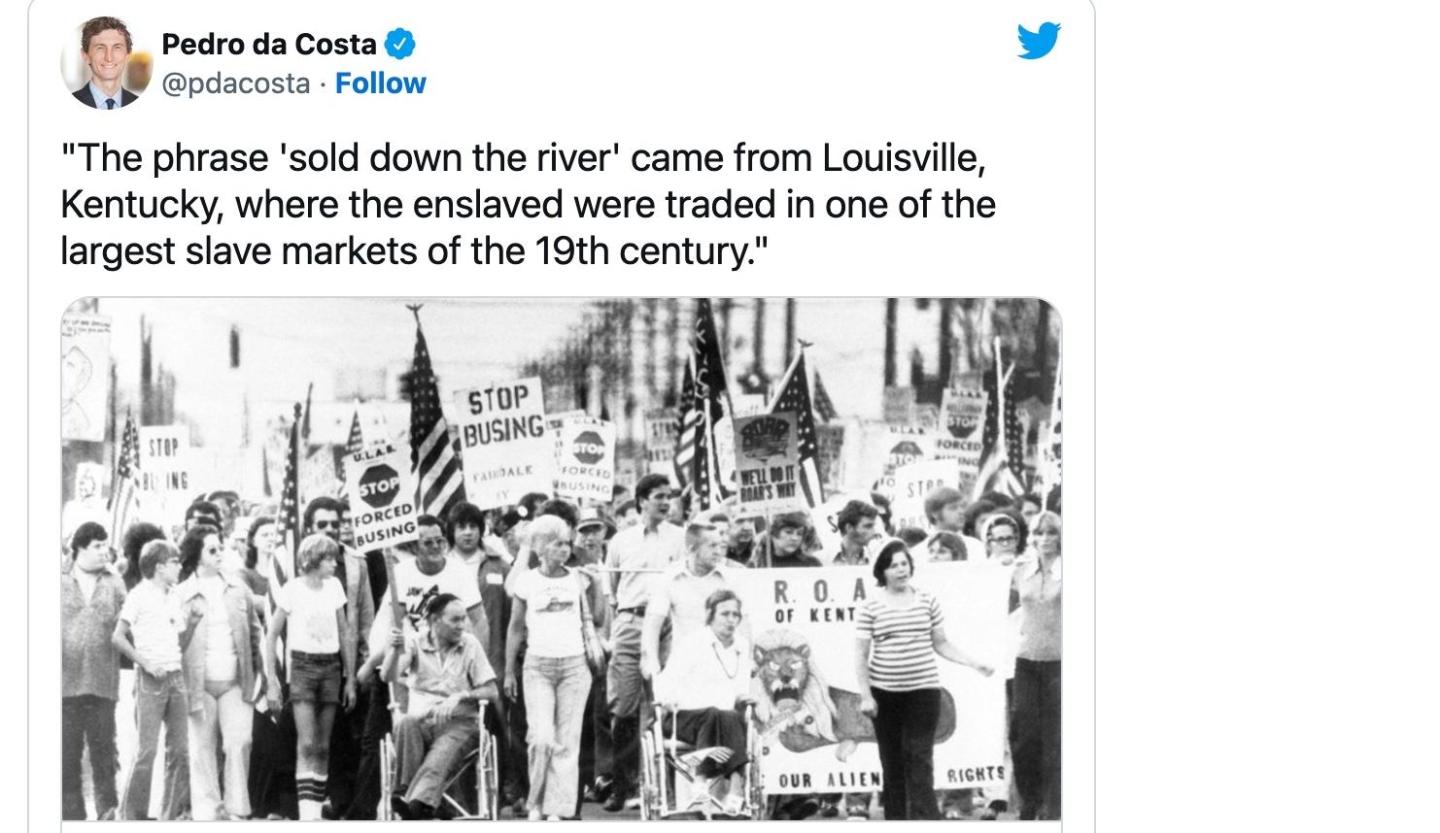
When most of us hear the term “grandfather clause” we just think of the generalized description: a person or entity that is allowed to continue operating over now expired rules. But the literal meaning reveals the “grandfather clause” was a racist post-Reconstruction political strategy. This is the historical definition, according to Encyclopedia Britannica: In modern speak, this basically meant the Grandfather Clause let white people off the hook for new voting requirements because their ancestors were already registered voters. Meanwhile, black people were required to fill out impossible literacy tests and pay exorbitant poll taxes to vote. This in turn, meant many black people were unable to vote, while white people weren’t held to the same standard. The word “Gypsy” was (and is) a racial slur referring to the Roma people. The Roma people are descendants of Northern India who, due to severe marginalization and threats of violence by others, lived a nomadic lifestyle of forced migration for centuries. During a fraught history, Roma people were taken as slaves in Romania and were targeted for genocide by the Nazis. In a similar vein, the term “Gyp” or “getting gypped” means to cheat or get conned, and many connect this meaning as another racist extension of Gypsy. According to the Oxford Dictionary, the very common phrase “no can do” was originally made popular as a way to make fun of Chinese immigrants. Upon first hearing, many people associate the phrase “sold down the river” with the notion of being betrayed, lied to, or otherwise screwed over. While these definitions all technically apply to the origin, the root of this phrase is much more bleak. “River” was a literal reference to the Mississippi or Ohio rivers. For much of the first half of the 19th century, Louisville, Ky., was one of the largest slave-trading marketplaces in the country. Slaves would be taken to Louisville to be “sold down the river” and transported to the cotton plantations in states further south. This heavy connotation sadly makes sense, but also makes casual use of the phrase feel way more cringe-inducing. This straw woman in Reagan’s campaign served as a racially-charged exaggeration of one minor case of real welfare fraud used to pedal his platform for welfare reform. Needless to say, the term has sadly lived on as a racially-charged vehicle used to undermine the importance of welfare programs, while peddling gross stereotypes about black women. On top of all the other offenses, this stereotype is of course ignoring the fact that poor white Americans receive the most welfare out of any economically-disadvantaged demographic. The term shuck and jive is both common and very obviously rooted in the language of slavery. According to the Online Etymology Dictionary, the phrase shuck and jive refers to: Likewise, the modern usage of this phrase refers to pandering, selling out, or instances in which black people go along with racist white people’s wishes. Again, not a phrase to be thrown around lightly. The very commonly used greeting “long time no see” first became popular as a way to make fun of Native Americans. The phrase was used as a way to mock a traditional greeting exchanged between Native Americans. This is the official definition, according to the Oxford Dictionary: The act of committing genocide is not limited to human lives, but also translates to a normalized cultural violence. Deconstructing, mocking, and erasing someone’s language contributes to this pattern of colonialism. Originally, this term referred to the balconies in segregated theaters where black people were forced to sit. The nickname “peanut” was given due to the fact that peanuts were introduced to America at the same time as the slave trade. Because of this, there was a connection drawn between black people and peanuts. As of now, the word “uppity” is often used as a synonym for “stuck up” or “pretentious” or “conceited.” But the roots of the word are far more specific and racist. So, basically, any black person who overtly stood up to racism. Given the heaviness of this origin, it seems best to leave this word at home when looking to describe a pretentious acquaintance. Sadly, given our ugly history, there are many more words and phrases I could add to this list. In the meantime, hopefully this list is helpful for navigating the racism innate in our language. The article was originally published by our partners at someecards and was written by Bronwyn Isacc. It originally appeared on 02.04.191. Thug
If you’re talking about an actual criminal, there are so many descriptive words to invoke besides “thug.” Given its current use as a negative, racially-coded word, avoiding its use seems like an easy and obvious move.
2. Grandfather Clause
“Grandfather clause, statutory or constitutional device enacted by seven Southern states between 1895 and 1910 to deny suffrage to African Americans. It provided that those who had enjoyed the right to vote prior to 1866 or 1867, or their lineal descendants, would be exempt from educational, property, or tax requirements for voting. Because the former slaves had not been granted the franchise until the adoption of the Fifteenth Amendment in 1870, those clauses worked effectively to exclude black people from the vote but assured the franchise to many impoverished and illiterate whites.”
3. Gypsy or “Gyp”
The word “Gypsy” is a slang word perpetuating stereotypes of Roma people as “thieves, rowdies, dirty, immoral, con-men, asocials, and work-shy” according to the Council of Europe.
4. No Can Do
“The widespread use of the phrase in English today has obscured its origin: what might seem like folksy, abbreviated version of I can’t do it is actually an imitation of Chinese Pidgin English. The phrase dates from the mid-19th to early-20th centuries, an era when Western attitudes towards the Chinese were markedly racist.”
5. Sold Down The River
According to a report from NPR, being “sold down the river” was a literal reference to slavery, and the families that were torn apart in the south.
6. Welfare Queen
The term “welfare queen” was first popularized by Ronald Reagan’s 1976 presidential campaign in which he repeatedly painted a picture of a Cadillac-driving welfare queen.
7. Shuck And Jive
“The fact that black slaves sang and shouted gleefully during corn-shucking season, and this behavior, along with lying and teasing, became a part of the protective and evasive behavior normally adopted towards white people in ‘ traditional’ race relations.”
8. Long Time No See
“Long Time No See was originally meant as a humorous interpretation of a Native American greeting, used after a prolonged separation. The current earliest citation recorded in the Oxford English Dictionary (OED) comes from W.F. Drannan’s book Thirty-one Years on Plains (1901): ‘When we rode up to him [sc. an American Indian] he said: ‘Good mornin. Long time no see you’.”
9. The Peanut Gallery
Most modern uses of the term “the peanut gallery” is in reference to a group of people who needlessly criticize or mocking another person. However, the historical roots of this term are much more racist and painful.
10. Uppity
The word Uppity was first used by Southerners to refer to slaves who did not fall into line, or acted as if they “didn’t know their place.”

Tags
More for You
-
Once a refugee seeking safety in the U.S., Anita Omary is using what she learned to help others thrive.
Even in divided times, small acts of friendship help create vibrant communities where everyone feels safe.
In March 2023, after months of preparation and paperwork, Anita Omary arrived in the United States from her native Afghanistan to build a better life. Once she arrived in Connecticut, however, the experience was anything but easy.
“When I first arrived, everything felt so strange—the weather, the environment, the people,” Omary recalled. Omary had not only left behind her extended family and friends in Afghanistan, she left her career managing child protective cases and supporting refugee communities behind as well. Even more challenging, Anita was five months pregnant at the time, and because her husband was unable to obtain a travel visa, she found herself having to navigate a new language, a different culture, and an unfamiliar country entirely on her own.
“I went through a period of deep disappointment and depression, where I wasn’t able to do much for myself,” Omary said.
Then something incredible happened: Omary met a woman who would become her close friend, offering support that would change her experience as a refugee—and ultimately the trajectory of her entire life.
Understanding the journey
Like Anita Omary, tens of thousands of people come to the United States each year seeking safety from war, political violence, religious persecution, and other threats. Yet escaping danger, unfortunately, is only the first challenge. Once here, immigrant and refugee families must deal with the loss of displacement, while at the same time facing language barriers, adapting to a new culture, and sometimes even facing social stigma and anti-immigrant biases.
Welcoming immigrant and refugee neighbors strengthens the nation and benefits everyone—and according to Anita Omary, small, simple acts of human kindness can make the greatest difference in helping them feel safe, valued, and truly at home.
A warm welcome

Dee and Omary's son, Osman Anita Omary was receiving prenatal checkups at a woman’s health center in West Haven when she met Dee, a nurse.
“She immediately recognized that I was new, and that I was struggling,” Omary said. “From that moment on, she became my support system.”
Dee started checking in on Omary throughout her pregnancy, both inside the clinic and out.
“She would call me and ask am I okay, am I eating, am I healthy,” Omary said. “She helped me with things I didn’t even realize I needed, like getting an air conditioner for my small, hot room.”
Soon, Dee was helping Omary apply for jobs and taking her on driving lessons every weekend. With her help, Omary landed a job, passed her road test on the first attempt, and even enrolled at the University of New Haven to pursue her master’s degree. Dee and Omary became like family. After Omary’s son, Osman, was born, Dee spent five days in the hospital at her side, bringing her halal food and brushing her hair in the same way Omary’s mother used to. When Omary’s postpartum pain became too great for her to lift Osman’s car seat, Dee accompanied her to his doctor’s appointments and carried the baby for her.
“Her support truly changed my life,” Omary said. “Her motivation, compassion, and support gave me hope. It gave me a sense of stability and confidence. I didn’t feel alone, because of her.”
More than that, the experience gave Omary a new resolve to help other people.
“That experience has deeply shaped the way I give back,” she said. “I want to be that source of encouragement and support for others that my friend was for me.”
Extending the welcome

Omary and Dee at the Martin Luther King, Jr. Vision Awards ceremony at the University of New Haven. Omary is now flourishing. She currently works as a career development specialist as she continues her Master’s degree. She also, as a member of the Refugee Storytellers Collective, helps advocate for refugee and immigrant families by connecting them with resources—and teaches local communities how to best welcome newcomers.
“Welcoming new families today has many challenges,” Omary said. “One major barrier is access to English classes. Many newcomers, especially those who have just arrived, often put their names on long wait lists and for months there are no available spots.” For women with children, the lack of available childcare makes attending English classes, or working outside the home, especially difficult.Omary stresses that sometimes small, everyday acts of kindness can make the biggest difference to immigrant and refugee families.
“Welcome is not about big gestures, but about small, consistent acts of care that remind you that you belong,” Omary said. Receiving a compliment on her dress or her son from a stranger in the grocery store was incredibly uplifting during her early days as a newcomer, and Omary remembers how even the smallest gestures of kindness gave her hope that she could thrive and build a new life here.
“I built my new life, but I didn’t do it alone,” Omary said. “Community and kindness were my greatest strengths.”
Are you in? Click here to join the Refugee Advocacy Lab and sign the #WeWillWelcome pledge and complete one small act of welcome in your community. Together, with small, meaningful steps, we can build communities where everyone feels safe.
This article is part of Upworthy’s “The Threads Between U.S.” series that highlights what we have in common thanks to the generous support from the Levi Strauss Foundation, whose grantmaking is committed to creating a culture of belonging.
-
Man shares how not getting a wedding invite made him end a 10-year friendship, and it struck a chord
“I went through so much with this person that I thought I had made the cut.”
As many are in the habit of doing, a man recently took to TikTok to “vent.” His “story time” was about his choice to end a 10-year friendship after not getting invited to said friend’s wedding. It soon became undeniably clear that he wasn’t alone in having an experience like this.
In the now-viral clip, the creator, @yonosoyasi5, explained that he understood that weddings are special, expensive moments, and therefore “not everyone can go.”
However, he admitted that “I went through so much with this person that I thought I had made the cut.”
This blow ultimately caused @yonosoyasi5 to accept that the friendship as he knew it had come to a close. There was no animosity, but there wasn’t any effort, either.
“I wish him the best. I never wish him ill. But to say that I wanna be a part of his life now, it would be very fake. I just don’t care anymore,” he said.
Even when confronted by a member of that shared friend group, @yonosoyasi5 was upfront about his stance, saying, “What am I gonna hang out with him for? What’s the objective of me putting energy into this friendship?”
TikTok reacts
The video soon got an onslaught of comments from people who had similarly heartbreaking experiences—and developed similar mindsets.
“One of my BEST guy friends for 8+ years did not invite me to his wedding. I introduced him to his wife. They went out because of me. I have never been more hurt in my life. I cut off the relationship …and they always try to pull me back closer…I can never pull the knife out of my back.”
“It’s not actually the wedding invite, it’s finding out the person doesn’t see you as a close friend.”
“Once you exclude me from important moments, I will exclude you from my entire life.”
“I think at our age we want to get back what we put into friendships/relationships. You love with your whole heart, so to not have it reciprocated is hurtful. I feel ya.”
“Crazy…this happened to me…20 years of growing up down the drain.”
Lastly, one person even said, “friendship breakups are WORSE than romantic breakups.”

Woman sitting alone on a bench overlooking the water. – Photo credit: Canva Photos Many experts seem to agree with this notion. Or, at the very least, that friendship loss triggers what’s known as “ambiguous grief,” which is the feeling of anguish that comes from losing someone physically while they are psychologically present (e.g., missing person, mental illness, divorce). Our stress responses are triggered, our feel-good chemicals get depleted, our sleep gets disrupted—which is all a science-based way of saying it hurts. Really bad.
This level of ambiguous grief really depends on what the friendship personally meant to a person. In @yonosoyasi5’s case, it meant a great deal. Thankfully, there are ways to navigate these difficult transitions.
Coping strategies for friendship loss
1. Allow yourself to grieve
Even once you’ve reached acceptance and found other meaningful relationships, waves of yearning for what’s past may still creep up. Allow space for those feelings. They will pass.
2. Use it as a learning opportunity
Without assigning blame, you can get curious about what might have caused the relationship to end. This way, you can set clear friendship intentions moving forward.
3. Engage in self-care
Journal, meditate, reclaim old passions, exercise, and get outdoors. These things tend to help with grief of all kinds.
4. Appreciate the support systems you still have
Taking stock of the good friends that remain in your life can help offset any feelings of loneliness and reinforce a sense of belonging, experts say.
Bottom line: cutting someone out of our lives hurts, but that pain might truly be the lesser evil in the long run. May we all have the foresight to know the difference and seek out those who do give us such grace.
-
Woman on a mission to bring back lost Black American recipes has people gasping at vinegar pie
Most of the recipes were created out of poverty to provide families with a sweet treat.
People get very creative when it comes to cooking with limited ingredients and no budget. This combination is something people who lived through the Great Depression were very familiar with. It’s also something Black Americans experienced frequently in the 1800s, but time has stolen many of the ingenious recipes. Until now.
One woman is on a mission to dig up these lost recipes for Black History Month. All February, Sonja Norwood, who runs the social media page for Wick’d Confections and owns Sonja Norwood Custom Cookies, has been baking up long-lost Black American recipes. Though the ingredients have folks scratching their heads, her videos clear things up by sharing each dish’s history.
One particular recipe caused the former Food Network contestant to give a disclaimer before tasting it, saying, “Before I try this, we understand that there’s a reason this pie exists, right? It’s genius. Very creative. That does not mean I have to like it.”
A unique recipe
Norwood tried her hand at vinegar pie, and just like viewers of the video, the baker was unsure how the dessert would turn out:
“Vinegar pie, also known as desperation pie, is classified as a pantry or make-do pie. As you can tell, this pie was born out of necessity, when fruit or citrus lemons were hard to come by. Home cooks used what they had on hand. Simple pantry staples to make something sweet, like sugar, eggs, butter, flour, and salt. A lot of people associate vinegar pie with the Great Depression, when fresh fruit was super expensive and scarce, but recipes go back much further. As early as 1855.”
For the recipe, the custom cookie maker used vanilla, honey, and apple cider vinegar in the runny mixture. At first glance, it’s hard to see how this could turn into a pie meant to be cut and eaten with a fork, as it has the consistency of French toast batter. But once it’s poured into a pie pan and popped into the oven, it begins to look like a pie.
“Black cooks in the South and the Midwest adapted pantry-based dishes like this into their family food culture,” Norwood shares while mixing ingredients. “So you were going to see this pie at Sunday dinner and on special occasions, and it doesn’t taste the way you think a vinegar pie would taste. The acidity cuts through the sweetness and mimics lemon pie without the fruit.”
Viewers were shocked at how good the pie looked when it was done. Some even plan to give the Black American recipe a try. One person writes, “I[t] looks good and it was way less vinegar than my mind thought lol.”
Another says, “This looks so good! My grandma is 93 born & raised in Georgia and she swears by this pie & buttermilk pie. She watched this & just kept saying ‘yup, yup’ so I know it’s good.”
This person appreciates the history: “I appreciated acknowledging that it came out of necessity and that you don’t have to like it. Sometimes people have to make due with what they have and it’s not always what you necessarily want.”
“This is brilliantly done,” someone else writes. “Showing the ingenuity and innovation of Black folks is beautiful! This video is information and funny! I’m glad you actually liked the pie. Def going to ask my 90 year old granny about this recipe. Thanks for posting this.”
Vinegar Pie Recipe (9-inch pie):
4 eggs
½ cup sugar
½ cup brown sugar
½ tsp vanilla
6 tbsp butter, melted
2 tbsp apple cider vinegar
2 tbsp honey
2 tbsp flour
¾ tsp salt
Unbaked 9-inch pie crustBlind bake crust at 350°F (175°C). Whisk remaining ingredients until smooth, pour into crust, and bake 35–45 minutes. The center should still wobble slightly when gently shaken. Cool completely and dust with powdered sugar.
-
Inside a Dutch ‘dementia village,’ where the whole neighborhood is designed for memory loss
The Hogeweyk provides a sense of “normalcy” for people living with dementia.
No matter how much caregivers may want to keep a loved one with dementia in their home, it’s not always feasible. Living with dementia is not easy, nor is living with someone who has dementia. But moving a loved one with dementia into a traditional care facility isn’t always ideal, either. It can be difficult to find a suitable living situation that ticks all the boxes for what a family and their loved one would want.
That’s where a “dementia village” comes in as an alternative. Instead of trying to fit a person with dementia into a living situation that either isn’t designed for them or is overly focused on their limitations, a dementia village is an environment designed specifically to help people with severe dementia feel safe and free and live as normal a life as possible.
The Hogeweyk was the world’s first dementia village, founded in 2009. Since then, the idea has been replicated in dozens of locations all over the world. The concept is quite simple: A full, self-contained neighborhood where people with dementia can walk around freely without fear of getting lost, where everyone from shopkeepers to restaurant servers to salon workers are trained in dementia care, and where people who are losing their memory to dementia diseases are treated as people who still have aspirations.
Eloy van Hal, one of the founders of the Hogeweyk, explained to Vox how the guiding principle of the village is “normalcy.” Traditional nursing homes keep all residents under one roof, and they are subject to do whatever program the institution provides for them. In the Hogeweyk, people live in small groups of six or seven in apartments with furnishings like they’d have at home. Distinct landmarks in the public space help residents know where they are, and putting a theater, grocery store, barber shop, etc. in separate buildings encourage movement through the neighborhood.
“It’s about choice, choice, choice, where you want to be during the whole day and with whom,” said van Hal. The idea is to balance safe design with controlled risk, allowing for as much of a normal life as possible.

Every worker in a dementia village is trained in dementia care. Photo credit: Canva The one downside to the village concept, of course, is cost. Without adequate funding assistance from governments, living in a dementia village can be prohibitively expensive.
Does it really make a difference for residents, though? Has it been proven that outcomes are better than traditional care models? With dozens of villages now being used around the world, research is ongoing, but the data from the Hogeweyk is promising. People in the comments of Vox’s by Design video shared how such facilities have been life-changing for their loved ones and how traditional care doesn’t always meet the needs of people with dementia.
“My grandmother had dementia and when her caretaker who was my grandfather (her husband) passed unexpectedly we had to scramble to get her into a memory care facility in the US. The first place she was in temporarily was so sad, I could see her spirit drain but after about a year we were able to get her into a “village” and the quality of life difference is nothing short of ASTOUNDING! She could function in a way that was familiar and comfortable to her and not be in a foreign hospital setting. The abrupt change from a home where they are familiar, to a clinical setting must be very disorienting and upsetting to these people. That side of my family had mental health issues and memory loss starts early, so I know it will happen to me to some extent and I only hope I can have people take care of me as well as in this Hogeweyk.”
“I’ve worked in a nursing home through high school and college. While I can’t say it was the worst place for dementia patients, it certainly did not work well for all of them. One patient once tried to wedge herself through the door begging to go outside with me and I even had patients confide in me that they hated being institutionalized, they missed being able to live a normal life, being part of a real community, and being able to come and go as they pleased. This concept is probably the closest thing possible to a normal life a dementia patient could ever have.”

In a dementia village, residents can live somewhat Photo credit: Canva “A relative of mine used to get aggressive, violent and angry when she would encounter a locked door in the institution she was in. She couldn’t understand why there would be a locked room in what she understood to be ‘her home’, this would take a lot of calming down and management, only for her to discover another locked door, and kick off again. I love these village based models as they allow autonomy for residents, and have an individual experience. Just because someone has a brain disease doesn’t mean they aren’t entitled to the very best care. I hope the govt spends far more on these establishments in the future.”
“As he said at the end, people with dementia are still people—even if there is proven to be no benefits to this model over a care home, I would much prefer to have dignity in my final days than live in a clinical trap. Love all the incredible ideas the Netherlands come up with.”

A dementia village is a self-contained neighborhood with shops and places for people to go like a normal neighborhood. Photo credit: Canva Dementia care is something Americans are going to have to look at closely. According to The Alzheimer’s Association, the number of people living with Alzheimer’s is set to nearly double from seven million to 13 million by the year 2050. As more of our elders require full-time care, the more we’ll have to consider prioritizing putting resources into things like dementia villages.
Everyone deserves safety and a good quality of life. The Hogeweyk is a great example of what it looks like to view people with dementia as people first and to care for them accordingly.
This article originally appeared last year. It has been updated.
-
Americans share 11 funny times Europeans couldn’t comprehend the size of the United States
Wake up in LA and have lunch in San Francisco?
A few years ago, there was an online trend in which Americans posted things the “European mind can’t comprehend,” a series of memes featuring photos of vast spaces, incredibly huge restaurant portions, and Costco shopping sprees, to name a few. It was basically a joke about American grandiosity, which contrasts with more modest European sensibilities.
A significant difference between the European Union and the United States is size. Europe comprises 47 countries spread across 3,837,083 square miles, and the United States is one country covering 3,796,742 square miles. Therefore, in the U.S., the distance between major cities, especially in the west, is hundreds, if not thousands, of miles. Europeans may casually think that the U.S. is the size of a single country, such as Germany, when in reality, each state is the size of a European country.
The difference in distance and size leads to some rather funny moments in which Europeans assume they can travel from one coast to another in the same day. Or, at least, to different destinations in the same state in an hour or two. However, this couldn’t be further from the truth.
A Reddit user on the Casual Conversations subforum shared a funny story about a friend from the UK who thought they could wake up in Los Angeles, drive to the Grand Canyon for a quick hike, and then have dinner back in West Hollywood. In reality, even on a weekend, this round trip would take about 17 hours in the best-case scenario. That’s without factoring in time to hike the canyon. The story inspired other Americans to share funny stories about friends in Europe who seriously underestimated the size of the U.S.

A tourist takes out their map. viau00a0Canva/Photos Here are 11 funny stories about Europeans who misjudged the size of the U.S.
1. Detroit for the afternoon?
“Not me, but my grandparents. They’d emigrated from Germany to the US in the late 1920’s while in their 20s. Lived in the NY metro area. Somewhere in the 1960 or 70s or so, they had friends or relatives (I don’t remember which) visiting from the old country who asked if they could perhaps drive to visit other friends of theirs, maybe for afternoon coffee one day… in Detroit. They politely explained that wouldnt work and how far it was…. but chuckled about it for decades after the visit.”
“Detroit for coffee?! That is a 600-mile latte run.”
2. Stop by Seattle?
“Distant relative from Austria was visiting his friend in Connecticut. Asked if he could stop by and see me on his week-long trip. I live in Seattle.”
3. Stop by Dallas for dinner?
“My mom speaks Italian and on her way home one year, her plane was about to land in Chicago when she heard the two Italian men behind her excitedly talking about their plans. One said to the other, ‘Okay. We’ll pick up the rental car and then we’ll drive to Dallas for dinner.’ My mom eventually got them to realize that they’d be spending two full days in the car just getting to Dallas if all they did was drive. She suggested they find some food in Chicago instead.”

The freeway leading into Dallas. via Canva/Photos 4. Shopping in San Francisco?
“My uncle is from Hawaii. He thought we could drive from LA to San Francisco to shop that morning and then maybe hit Venice Beach before dinner.”
5. San Francisco for dinner?
“Fellow Angeleno here. When I was still in my last retail job, we got a lot of overseas tourists, and it wasn’t unusual for them to not realize how BIG the USA is. One customer asked me ‘We’re thinking about going to San Francisco for dinner. What time should we leave?’ He was so shocked when I explained that San Francisco was about an 8-hour drive with afternoon traffic.”
It is about 380 miles to get from Los Angeles to San Francisco.
6. LA, DC, Miami in a single day?
“I had a group of EU friends who wanted to visit the US for a week. By the time I got out of that 5hr group call, they cancelled the whole trip. They wanted to land in Seattle, spend about 3 hours with me giving them a tour of the city, get a rental car, and explore LA, DC, and Miami all in a single day. The next day, hit up Yellowstone, the Grand Canyon, and mt rainer. The day after, hit up a Buckees for breakfast in Texas, eat lunch in NYC, and have dinner at my place in Seattle with my family, then go to Las Vegas after dinner to go party… Oh, and they only had $500 each (2k total), with plans to individually pay their own way, no travel insurance, and no temporary “travel” phone plans (meaning no phone service OR insured hospital visits if something went wrong). First thing i did when i got added to the call was pull up a pic of the US overlayed on top of Europe, and pointed out where seattle was, and all the other places they wanted to go, in comparison to Europe. Instantly deflated in excitement, then i went into cost of living for each state they wanted to visit.”
7. 9/11 worries
“A Scottish family we knew lived in the States during 9/11. They got several concerned calls from friends and family wanting to make sure if they were okay and asking if they could see the Towers. They were in Michigan.”
8. Why American’s ‘don’t travel’
“I think this misunderstanding is at the root of a lot of how Europeans can judge Americans for “not traveling.” If it takes someone two hours to get to a different country and it takes me more than two hours to drive across Massachusetts, then the cost and time burdens aren’t equivalent.”
9. How close is Florida to California?
“I was in Belfast earlier this year. The woman at the hotel front desk asked how the ‘long drive’ from Dublin was. As Americans, we were like, Oh, it wasn’t bad at all. Everything is a long drive in America. And she said, ‘Yeah, it’s probably like twelve hours from Florida to Cali.’”
In reality, it would take about 45 hours to drive from San Francisco to Miami.
10. Walk from Syracuse to NYC?
“Years ago, a friend in the former Czechia was thinking of going to art school in NY. They were excited that they would be able to study, and have fun in the NYC clubs at night. The school was in Syracuse. It broke both his heart and brain when I told him it would be a 4.5-hour drive to NYC. He was under the impression he could ‘just walk there.’”
11. Disney to Disney in 6 hours?
“Had a friend who wanted to rent a car and drive from Disneyland to Disney World. When they told me I immediately started laughing.They had no idea of how big the USA is and thought it might be a 6-hour drive tops.”
In reality, it would take around 40 hours to drive from Disneyland in Anaheim, California, to Disney World in Orlando, Florida.
-
‘Boomer panic’ is a real phenomenon, and the reason for it is heartbreaking
This isn’t just young generations bashing the old.
If you have Boomers in your life, you may have noticed a tendency that seems a bit baffling. Despite being older and theoretically wiser, our elders can sometimes become anxious over seemingly small things.
In a video posted in September 2023, TikToker @myexistentialdread used the phrase “Boomer panic” to explain how Baby Boomers (1946 to 1964) can quickly become unhinged when faced with the most minor problems. It all started when she visited a Lowe’s hardware store and encountered a Boomer-aged woman working at the check-out stand.
“I had a dowel that didn’t have a price tag on it, whatever, so I ran back and took a photo of the price tag. And as I was walking back towards her, I was holding up my phone… because I had multiple dowels and that was the one that didn’t have the price tag on it,” she said in the video. “And she looks at me and she goes, ‘I don’t know which one that is,’ and she starts like, panicking.” The TikToker said that the woman was “screechy, panicking for no reason.”

Older people can become frustrated over seemingly small things. Photo credit: Canva Many people raised by Boomers understood what she meant by “Boomer panic.” “Boomer panic is such a good phrase for this! Minor inconvenience straight to panic,” the most popular commenter wrote. And while there was some unfortunate boomer-bashing in the comments, some younger people tried to explain why the older folks have such a hard time regulating their emotions: “From conversations with my mother, they weren’t allowed to make mistakes and were harshly punished if they did.” The TikToker responded, “A lot of people mentioned this, and it breaks my heart. I think you’re right,” Myexistentialdread responded.
A follow-up video by YourTango Editor Brian Sundholm tried to explain Boomer panic in an empathetic way.
“Well, it’s likely that there actually was a reason the woman started panicking about a seemingly meaningless problem,” Sundholm said. “Most of us nowadays know the importance of recognizing and feeling our emotions.” Sundholm then quoted therapist Mitzi Bachman, who says that when people bottle up their emotions and refuse to express them, it can result in an “unhinged” reaction.
TikToker Gabi Day shared a similar phenomenon she noticed with her Boomer mom; she called the behavior “anxiety-at-you.”
Day’s Boomer mother was “reactive,” “nervous,” and “anxious” throughout her childhood. Now, she is still on edge with Day’s children. “She’s immediately like gasping and just really like exaggerated physical reactions, and then, of course, that kind of startles my kid,” Day said. “Again, I know that this comes from a place of care. It’s just a lot,” she continued.
There is a significant difference in emotional intelligence and regulation between how Boomers were raised and how younger generations, such as Gen X, millennials, and Gen Z, were brought up. Boomers grew up when they had to bottle up their feelings to show their resilience. This can lead to growing anger, frustration with situations and people, chronic stress, and anxiety—all conditions that can lead to panicky, unhinged behavior.
Ultimately, Sundholm says that we should sympathize with Boomers who have difficulty regulating their emotions and see it as an example of the great strides subsequent generations have made in managing their mental health. “It may seem a little harsh to call something ‘Boomer panic,’ but in the context of how many of them were raised, it makes a lot of sense,” Sundholm says. “It also underlines the importance of emotional regulation skills and teaching them to future generations. And maybe most important, having compassion for those who never had a chance to learn them.”

Having compassion for older generations can go a long way. Photo credit: Canva Psychotherapist Jennifer Gerlach LCSW writes about the emotional reality of how Boomers were brought up and why they deserve our compassion:
“The progeny of the Greatest Generation. Their youth was a time of prosperity where appearances, ‘keeping up with the Joneses,’ was quite important. Although many of the years following are graced by stereotypes of openness and expression, parenting practices reflected more of a ‘toughness’ than most used today. Phrases like ‘quit crying or I’ll give you something to cry about’ reflected negative reactions to emotional expression. The concept of trauma only reached some ‘capital T’ traumas—sexual assault and war. Many things that we know can be traumatic today were not treated as such. Psychotherapy was stigmatized and kept secret.”
When we know more about where people from other generations came from, it’s easier to understand and find compassion for them.
This article originally appeared in March.
-
Woman without arms shares the 3 ‘compliments’ she wished people would stop saying to her
“I could never.”
When she was three years old, Jackie Lopez lost her arms in an accident. Growing into adulthood without those appendages, she has learned and trained to use her legs as arms and her feet as her hands to feed herself, make meals, play video games, wrap Christmas gifts, and any other activity a person could do. Throughout her life, people have remarked about how tough her circumstances are and how strong she is, and to all of those people she has one request: Please stop.
“Because I don’t have arms, I get these comments a lot and a lot of people think it’s a compliment when it really isn’t. It’s so annoying and irritating to see and hear all the time,” Lopez explained on social media.
In her video, Lopez shared the three most common comments she receives as a disabled person that aren’t outwardly or intentionally mean, but annoy and actually hurt her. She prefaced her video saying that, while these comments are mostly her pet peeve and other disabled folks may not mind them, it might be a good idea to not say these things to other disabled people either.
“I could never…”
Lopez shared how hearing people say “I could never be like you/use my feet like you/live like you/etc.” really annoyed her because she had no other option but to use her feet as her hands. Saying “I could never” can be interpreted as a form of othering, even though the intention of the comment was good.
“Oh, my problems are suddenly small.”/ “I should stop complaining about my life.”
Lopez shared that this type of comment made her feel guilty, both for herself and for those who say it to her. She explains that just because an able-bodied person’s problems are different, it doesn’t invalidate them. Her having no arms doesn’t make the able-bodied person’s problems go away or mean those problems should be unaddressed.
“Girl, just complain,” said Lopez. “If I were you and I had hands, best believe I would complain, too.”
“God gives the hardest struggle to the strongest people.”
This comment really annoyed and hurt Lopez, especially when she was growing up in the church. Aside from the presumption of faith with a comment like this, the framing of it makes it seem like Lopez’s disability was destined or given as some form of divine “test” after going through a life-altering experience.
“Keep your belief to yourself and don’t put it on me,” she asked. “I went through this, not you.”
Other comments and thoughts
Commenters noted how impressed they were by what Lopez could do with her feet, while other commenters immediately replied to them with versions of, “This is the type of stuff she’s talking about.” In spite of that, several other commenters cosigned Lopez’s feelings with some of them sharing “kind” comments that bothered them:
“While you’re sitting commenting that you ‘couldn’t imagine’ living her life, she’s eating soup and making a TikTok like any other person.”
“I hate when people say ‘You’re such an inspiration’ like in what way have I inspired you? Are you trying to become disabled?”
“‘Suddenly my problems are small’, translation ‘I’m happy that I’m not like you and I see you as your struggles.’”
“‘You’re so strong, I just would’ve died’ Like, oh, okay, so you’d rather choose death than what I went through? What should I do with that information?”
“Those are very valid points. People need to be more considerate about what they say.”
“‘I could never.’ Well yeah, it didn’t happen to you, it happened to her and as we can all see she could and can. You aren’t obliged to make fantasy scenarios to be horrified at.”
“I get so annoyed for you. Even in this current comment section people are saying similar-ish things.”
“Some of them come from a place of kindness, but like you said, it gets to a point where you need to stop infantilizing and pitying every single disabled person you meet by reminding them that their life and their normal is different to everyone else’s.”
Lopez’s video went viral, encouraging her to make a second one with even more “compliments” or “nice” comments that she frequently hears that aren’t boosting or helpful at all.
She ends her video saying that those types of comments have formed into a type of ableism—and she has a point based on anecdotes from others who are blind, paralyzed, or are otherwise differently-abled. Based on hearing these experiences, it’s best for everyone to stop, slow down, and take an intentional beat to consider their words before saying them—even if they have the best intentions.