
Reusable cloth Christmas bags are all the rage, saving wrapping time, money and the planet

They’re also way cozier than the 2 million pounds of wrapping paper that ends up in landfills every year.

cloth christmas present bags
People are moving to cloth gift bags as a lot of wrapping paper can't be recycled. Photo credit: Amazon

As an Amazon Associate, Upworthy may earn proceeds from items purchased that are linked to this article, at no additional cost to you.

Wrapping paper is a delightful invention, with all of its fun patterns and colors and wrapping methods, all in service of keeping gifts a surprise.

It’s also a total environmental blight, unfortunately. Most wrapping paper is one-time use only, as what makes it pretty and shiny and durable are usually plastics that can’t be separated from the paper for recycling. So into the landfill it goes, to the tune of 2.3 million pounds a year, according to Popular Science.

You can try to reuse wrapping paper, of course, but have you ever seen a kid tear into a Christmas present? You can try wrapping with simple brown paper, which is recyclable, but doesn’t feel particularly festive. You could buy eco-friendly wrapping paper, shelling out a pretty penny for something that’s still going to have to be purchased again and again.

OR you can go a whole new route by ditching the paper altogether and going for the truly old-fashioned, easy peasy solution of cloth gift bags that you either purchase or make yourself. If you think that sounds like a bit of a stretch, hold the judgment until you see how utterly adorable these bags are.


Cloth bags save so much time and headache compared to paper wrapping. Weirdly shaped gifts no longer matter as long as they fit in the bag. They also save you money over time if you use them for your household’s gifts and store them away with your holiday decorations each year. If you make them yourself, you can choose any color or pattern theme you want, but there are plenty of readymade coordinated options out there now to go with any decor.

And no, kids don’t care—in fact, they will probably appreciate the fact that their gift wrap is eco-friendly and they may even get nostalgic about seeing the familiar wrappings each year. (Our family has used cloth to wrap for presents for years, and our kids have actually developed favorites.)

Here’s a simple example—a mix of classic red-and-white patterns in assorted sizes for a bright, classic look. How lovely would a stash of these look all gathered under the tree?

red and white cloth gift bags
Red and white always works for Christmas. <a href="https://amzn.to/3v7H1fh">Amazon</a>

What if you went with a classy gold theme for this year’s decor and want the presents under the tree to match for a perfectly Instagrammable Christmas morning? Here’s a similar set in a gold-and-white pattern.

gold and white gift bags
Go for the gold with this set of Christmas gift bags. <a href="https://amzn.to/3RN1miF">Amazon</a>

Maybe you’re going for more of a cozy, casual, log cabin-y feel for your holiday. Plenty of plaid in Christmas colors right here.

plaid christmas gift bags
Cozy, cozy flannel bags with Christmas sayings on them <a href="https://amzn.to/41uzwuX">Amazon</a>

If you’re more drawn to the classic, Norman Rockwell, Christmases-of-yore vibe, check out these nostalgic Christmas prints:

vintage christmas cloth bags
These gift bags look like a throwback to "It's a Wonderful Life." <a href="https://amzn.to/3GRMMjP">Amazon</a>

Maybe you’re a modern maven with monochromatic merry-making methodologies. Or perhaps you’d like to be able to reuse your bags at other times of the year, too. These black-and-white babies might just do the trick.
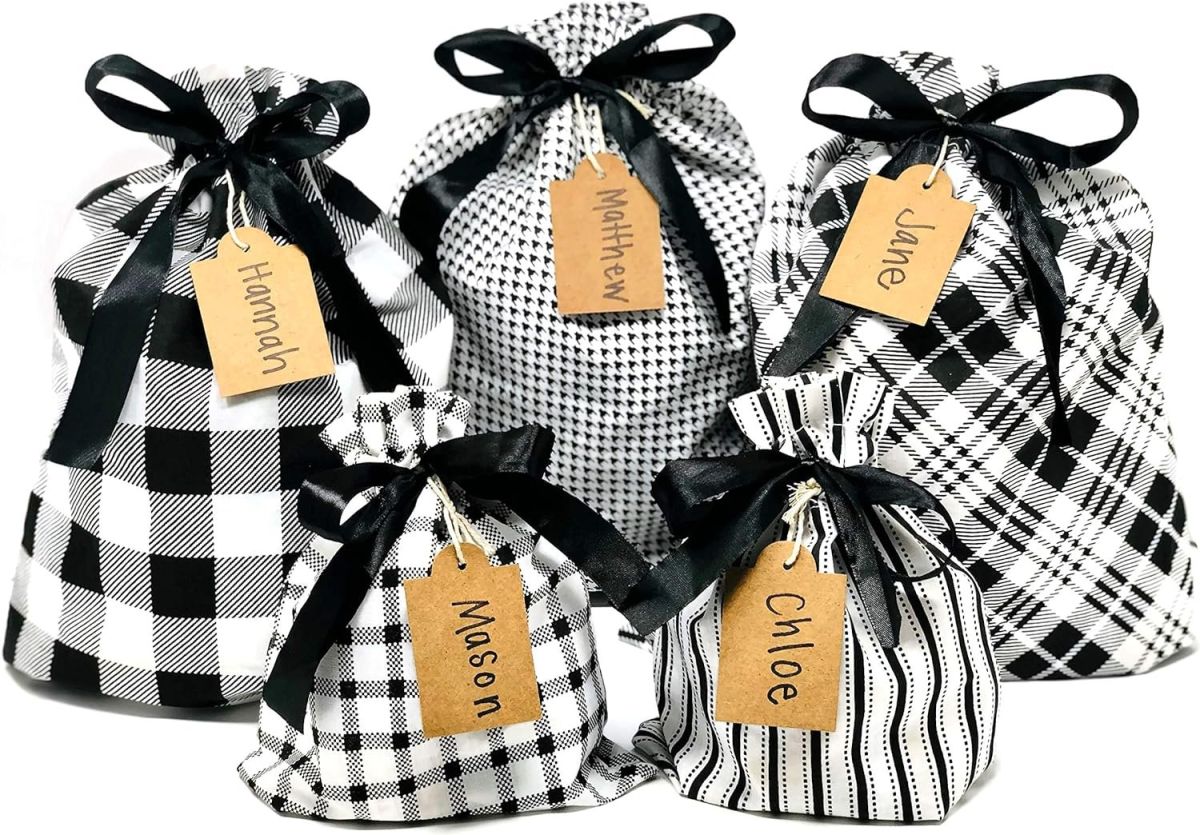
black and white gift bags
These black-and-white bags could be used for any occasion. <a href="https://amzn.to/3RNXj5O">Amazon</a>

How about a standard-Christmas-wrapping-paper look, only as cloth Christmas gift bags instead?

mix of colorful Christmas bags
Get your colorful Christmas on. <a href="https://amzn.to/41wgTHa">Amazon</a>

Or maybe you don’t want a distinctively Christmas feel at all, but rather a mix of pretty, festive bags that could be used for the holidays or any time of year. There’s a whole assortment to choose from here to go with whatever your particular color theme might be.
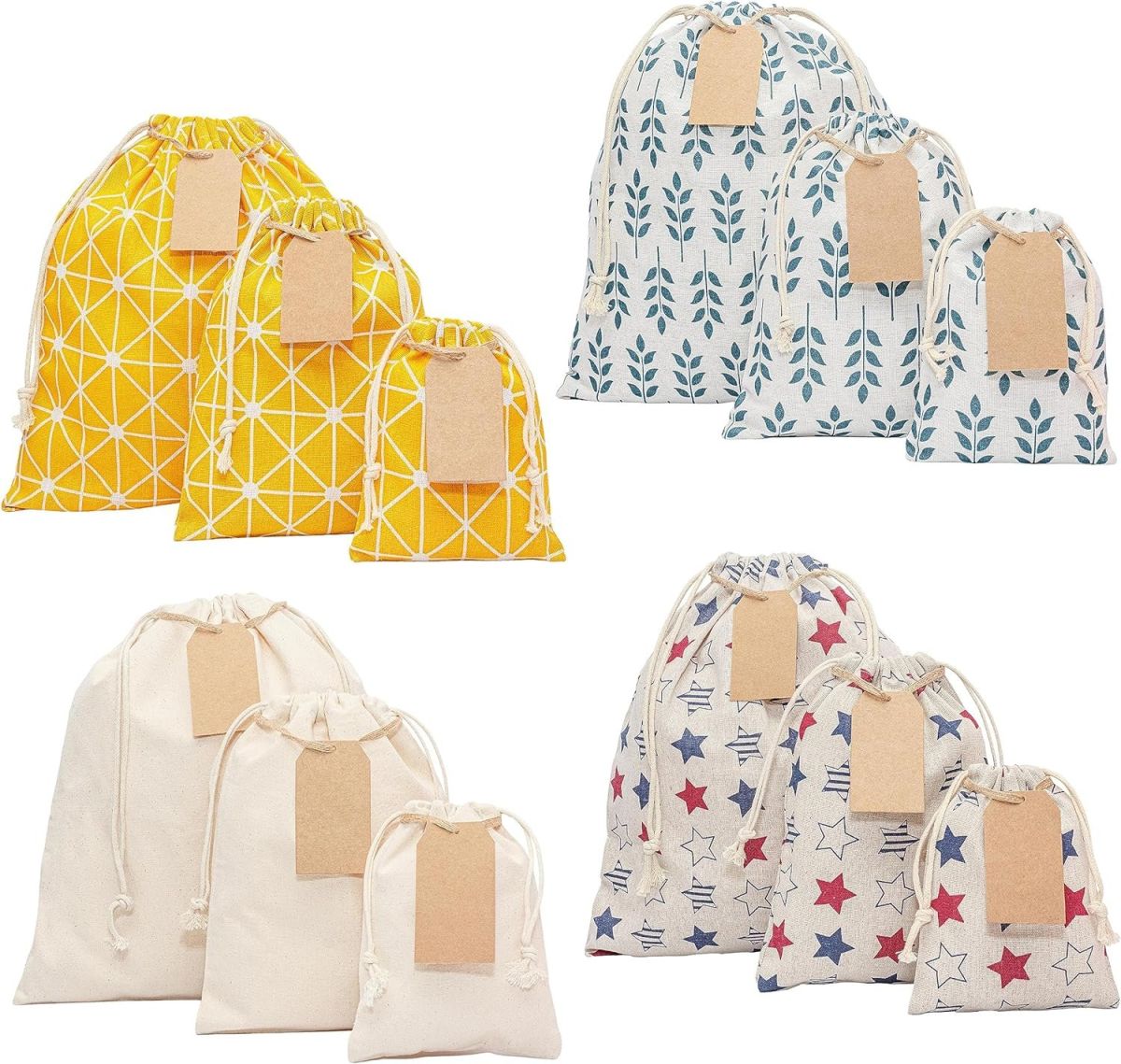
mix of cloth bag patterns
Christmas bags don't have to be Christmas-themed.. <a href="https://amzn.to/3NABeVY">Amazon</a>

Or maybe you want the opposite—just blatantly Christmas-y images in bright, bold colors plastered all over everything. Here ya go:

assortment of colorful christmas gift bags
So many Christmas gift bag options <a href="https://amzn.to/3Rw8VsI">Amazon</a>

There’s just no shortage of options for cloth gift bags that are worth investing in to save time, money and the environment. Just be sure to check sizes so there are no surprises, grab a wide assortment and then revel in the fact that you’ll never get a paper cut or have to search for another roll of tape while wrapping presents for your family again.


  • Job recruiter says people will never get hired if they keep getting this easy interview question wrong
    A career coach warns against relying on AI to answer job interview questions.Photo credit: Canva

    As workers struggle to land good jobs and employers struggle to find ideal candidates in the ever-changing job market, a new trend is emerging. Many applicants are turning to artificial intelligence to give them an edge—with mixed results at best. Because interviews are one of the most stressful parts of the job search, it’s become common for folks to input questions into ChatGPT to find the “perfect” response. However, a former recruiter warns that this is a bad idea, noting that you end up “sounding so fake” when using it.

    Former recruiter turned career coach Madeline Mann showed an example of why ChatGPT shouldn’t be used to answer written interview questions. In a TikTok video, Mann shared a ChatGPT response to the question, “Why did you leave your last role?” ChatGPT replied with the following:

    “I decided to move from independent work to a team environment so I can build deeper lifecycle expertise and learn from a strong mission-driven leadership team.”

    @selfmademillennial

    It is common to use AI to help write your job interview answers, but often they are sounding too verbose and not human. If you are reading your interview answers from a script, you are likely to be rejected in the job interview and not get the job offer. Here is an example of how to sound more normal and like a coworker during a hiring process. Follow for more job interview tips, and job search strategies! #jobsearch #jobsearchtips #jobinterviewtips #jobinterview

    ♬ original sound – Madeline Mann

    Did that sound like something a human would say? Mann argued that ChatGPT used so much professional jargon that it sounded like a robot wrote it (because it did). Mann said that in interviews, it’s best to “sound like a coworker.”

    “If you do not already sound like their coworker, they will have trouble picturing you as their coworker, and they won’t give you the job offer,” said Mann.

    Mann said that a better response would be a quick and simple: “After freelancing for X years, I really missed being on a team.” She said that a reply like that is sincere, direct, and more like how a person would normally speak to a coworker. She added that if you were to use AI for interview responses, you should edit them down and remove any “bungle” to “talk like a person.”

    AI experts and employers weigh in

    Upworthy spoke to AI pros, business leaders, and recruiters about using artificial intelligence for job interviews. The majority arrived at the same conclusion: If you choose to use AI, it can be a useful tool for interview preparation. However, it shouldn’t sub in to do the actual interview for you.

    “AI can be a useful tool for preparing for an interview,” said Megan Sweeney, public relations director at the American Staffing Association. “However, at the end of the day, the interviewer still needs to know you’re capable of doing the job.”

    “If a company requests written interview questions, then using AI as a starting point is fair game in my book,” said Russell Taris, an expert on how managers can best use AI in the workplace. “The key statement, though, is ‘as a starting point.’”

    “Candidates should use AI to organize their thoughts and firm up their language, but the examples and experiences need to be their own,” said Taris. “Managers can now tell right away when someone submits a response straight from ChatGPT without any editing. Smart candidates use AI the way you’d use a good friend who happens to be a great editor.”

    Authenticity is key

    “The problem is being authentic,” said Magical Brands CEO Mark Coffie. “Candidates who prepare and deliver scripted, overly polished answers tend to fail when asked questions spontaneously. You can use AI to outline your ideas but speak and answer questions in your own voice. That’s different from reading something generated. Interviews are a testing of judgment, communication, and problem-solving…Technology cannot substitute for that.”

    “Using AI to pressure test your answers ahead of time can truly benefit candidates,” said Taris. “Run your ‘Why did you leave your last role?’ answer through it and ask it to poke holes, or practice your ‘greatest weakness’ answer until it’s specific and honest. The best answers I hear in interviews aren’t the most polished; they’re the ones where the candidate clearly thought it through beforehand and can go deeper, if needed. AI is one of the best prep tools available right now, and most candidates aren’t taking advantage of it.”

    “Using AI for interview prep is helpful, but you will be the one being evaluated,” concluded Sweeney.

  • Expert shares the simple small talk mistake almost everyone makes—and how to fix it
    A group of friends having a chat.Photo credit: via Canva/Photos
    ,

    Expert shares the simple small talk mistake almost everyone makes—and how to fix it

    “It’s a natural impulse—we want to relate, to show we understand.”

    You might be shocked to learn that many people don’t like making small talk. Surprise, right? They either believe it’s beneath them to talk about mundane subjects or don’t see the benefit of discussing the weather, sports, or television with people they hardly know.

    However, these folks are missing a very valuable form of interaction that can help them with their love lives, friendships, and careers. They also remove themselves from situations where they can elevate small talk to something more valuable and meaningful.

    Jefferson Fisher, a Texas personal injury attorney and communications expert, has become massively popular on Instagram—with nearly 6 million followers—for sharing tips “to help people argue less and talk more.” While promoting his new book, The Next Conversation: Argue Less, Talk More, Fisher discussed the number one problem people have while making small talk.

    What’s the biggest mistake people make during small talk?

    “They unknowingly turn the conversation back to themselves too quickly,” Fisher tells Parade. “It’s a natural impulse—we want to relate, to show we understand. But what often happens is that we hijack the conversation.”

    “For example, someone says, ‘I just got back from a trip to Italy,’ and instead of asking about their experience, we jump in with, ‘Oh, I’ve been to Italy several times, it’s great.’ It’s well-meaning, but it can come across as dismissive,” Fisher said. “Instead, focus on them. Ask open-ended questions like, ‘That’s wonderful, what was your favorite part?’ Small talk isn’t about impressing people, it’s about making them feel seen and heard.”

    Fisher’s advice echoes that of the great Dale Carnegie, author of the 1936 classic How to Win Friends and Influence People. In the book, Carnegie says, “To be interesting, be interested.” Carnegie’s advice is counterintuitive because we are taught to believe that being likable means dominating conversations and entertaining the other person. However, Carnegie thinks that people who are generous listeners tend to make a better first impression.

    How to be more likable

    Researchers at Harvard University found that when you ask someone a question, people will like you more if, after they answer, you ask them two more follow-up questions. So, if you ask, “Where did you go last summer?” And they reply, Italy, you can follow that up with two questions about their favorite city and the restaurant they’ll never forget. Then, you can tell them that you’ve been there, too.

    “We identify a robust and consistent relationship between question-asking and liking,” the study’s authors write. “People who ask more questions, particularly follow-up questions, are better liked by their conversation partners.”

    conversation, small talk, chatting, discussion, communication
    Two people have a conversation. Credit: Fauxels/Pexel

    People will take a shine to you after you ask a few questions because it shows that you are listening and interested in what they say. “Follow-up questions are an easy and effective way to keep the conversation going and show that the asker has paid attention to what their partner has said,” the researchers write.

    While at first, it may take a little practice to ask follow-up questions instead of turning the conversation to your experiences and opinions, it should take some pressure off the need to be interesting. Now, instead of trying to wow people with your stories, all you have to do is listen to theirs, and they’ll like you all the more for it.


    This article originally appeared last year. It has been updated.

  • Body language expert explains how the winner of ‘The Traitors’ spotted liars and how to do it yourself
    Rob Rausch and Vanessa Van Edwards.Photo credit: Peacock on YouTube/Wikimedia Commons

    In the latest season of the popular reality game show The Traitors, Rob Rausch emerged as the winner and the sole surviving Traitor. One reason he won was because he was able to see through the lies of his fellow competitors. A body language expert explained how Rausch was able to read people and win the entire cash prize.

    Vanessa Van Edwards said that Rausch was able to discern who was lying to him and who was telling the truth while showing a clip from the show. In the Traitors clip, Rausch explained his strategy for trying to win the dagger prize through a game that required him to find who had it by asking questions.

    @vvanedwards

    Is Rob Rausch really a human lie detector? A human lie detector reacts! 👀 #robrausch #traitors #liedetector #react #behavioralscience

    ♬ Pick (Blowout, pop-up, adsorption) 2(819462) – Koi

    What is baselining?

    Rausch explained that he was able to be a “human lie detector.” He would ask questions that he already knew the answers to and monitor his competitors’ responses. He would then ask whether the person had the dagger, watching how they responded to determine whether they were lying. After observing competitor Natalie Anderson’s responses, Rausch concluded that she was lying and had the dagger.

    On TikTok, Van Edwards explained that Rausch was using a technique called “baselining.” Baselining involves making mental notes of a person’s baseline behaviors when they are speaking comfortably and truthfully. If you notice a person displaying atypical behavior when answering a question, it could be a sign that they’re lying, uncomfortable, or conveying a specific nonverbal response.

    For example, if a person who doesn’t normally touch others when speaking to them suddenly touches you, that could indicate extra interest. In contrast, if someone who is known for touching people while speaking to them doesn’t touch you, they could be hiding something. In the case of The Traitors, Van Edwards said Rausch interpreted Anderson’s lip purse in response to his question as an indication that she was lying.

    How baselining can help day-to-day life

    Being able to baseline a person’s behavior can be helpful both professionally and personally. Professionals consider it one of the cornerstones of negotiation in business because both sides of a deal are likely withholding information. Much like in a game of poker, business professionals aren’t showing their “full hand” and are looking for “tells” before contracts are signed.

    In terms of home life, baselining a family member can be especially helpful when communicating with children. This isn’t in a business negotiation or interrogation sense, though. Noticing a loved one’s common behaviors when speaking and seeing aberrations could indicate that something is wrong. You could approach them privately to ask if anything is making them feel uncomfortable and offer help. This way, you’re spotting their lies not to confront them, but to let them know they’re seen and that you’re someone they can trust.

    Whatever your reasoning, baselining is a useful skill for reading people. In Rausch’s case, it helped him win hundreds of thousands of dollars.

  • The surprising best temperature for drinking water, according to experts
    Could you be more effective with your water intake?Photo credit: Canva

    Here’s something we all know but rarely think about: 75% of the human body is made up of water. Essentially, we’re water balloons with legs, or whatever the heck Flubber was.

    To maintain that internal reservoir, humans need to drink 15 cups of water (for men) and 11 cups of water (for women) daily. It doesn’t take a math whiz to realize that’s a lot of water. To put that into perspective, according to the Omni Calculator (a great online tool that determines a person’s total body water volume using a formula developed by Dr. P.E. Watson), beloved character actor Steve Buscemi is currently carrying around 83.74 pounds of water in his body, or approximately 10 gallons.

    But what if you’ve been drinking water, that sweet elixir of life, all wrong? Or, at the very least, ineffectively? Just as every plant has its ideal growing conditions, according to doctors and medical professionals, the temperature of the water we drink matters a lot more than you might think.

    Room-temperature, ice-cold and straight from the fridge, slightly warm for no reason at all: when it comes to drinking water, everyone has their own unique methods of getting the job done. But while we continue to chug our preferred water temperatures without question, we might be missing out on some serious health benefits—or even causing ourselves unnecessary discomfort.

    Medical experts have discovered that water temperature, when used at the right time, can significantly improve your wellbeing, affecting everything from how we digest our food to how well we perform during workouts. All water hydrates, but the temperature at which you drink it can make all the difference.

    Room-temperature water is your digestive system’s best friend

    water, temperature, drinking, h20, health, wellness
    A woman drinking room-temperature water. Photo Credit:u00a0Andrea Piacquadio/Pexels

    When to drink

    Good morning! Many dieticians and wellness experts recommend drinking room-temperature water (about 68°F) first thing in the morning to gently activate your gastrointestinal tract (It also promotes regular bowel movements, FYI). This gentle approach is often referred to as “Japanese water therapy,” and encourages sipping 4-5 glasses (about ¾-cup each) upon waking then waiting 45 minutes before breakfast. It’s also great for everyday hydration, since room-temperature water is often easier to gulp.

    Why it works

    “In Chinese medicine we advocate drinking warm water because of its effect on the digestive system,” Dr. Jill Blakeway, a licensed doctor of acupuncture and Chinese medicine, explains. “Drinking cold water can congeal the fats in food and because of that can make the digestive system sluggish.”

    Your body absorbs room-temperature water more easily, causing minimal disruption to the digestive system, making it the go-to option for sensitive stomachs.

    Ice-cold water is perfect for workouts and hot days

    water, temperature, drinking, h20, health, wellness

    A glass of water with ice. Photo Credit:u00a0Cottonbro Studio/Pexels

    When to drink

    This one is for the athletes and fitness gurus: Cold water (around 41°F from the fridge or 60°F from the tap) is your new best friend. Like a refreshing summer breeze, cold water has a natural way of cooling the body down during or after an exercise. It also gives your metabolism a tiny boost: according to research, your body expends about five calories per ounce of ice while warming the water to body temperature.

    Why it works

    Studies show that drinking cold water triggers a special reflex that helps you to stop sweating sooner, effectively lowering your core temperature and enhancing overall performance.

    “It turns out that sweating stops before fluid can completely be incorporated into the body,” says gastroenterologist Dr. Brian Weiner. “There’s some kind of reflex that acknowledges liquid intake, and studies have shown that it kicks in more at the cold tap water level.”

    Hot water soothes what ails you

    water, temperature, drinking, h20, health, wellness

    A woman drinks hot water. Photo Credit:u00a0Andrea Piacquadio/Pexels

    When to drink

    Hot water (130-160°F) can be incredibly soothing when you’re under the weather. So, if you’re feeling congested or battling a sore throat, a nice mug of hot water might be just what the doctor ordered. A 2008 study found that hot drinks work like a natural remedy, providing quick, lasting relief from runny noses, coughing, sore throats, and fatigue.

    Why it works

    Like a warm summer rain, hot water creates steam that helps clear sinus congestion, while its pacifying warmth relaxes the gastrointestinal and digestive muscles. In fact, a small study showed that warm water worked wonders for patients recovering from surgery, improving their comfort and digestive health.

    Warm or hot water can also literally melt away stress, as long as temperatures are kept comfortably warm: water above 160°F can scald your esophagus or damage your taste buds.

    When to avoid certain water temperatures

    water, temperature, drinking, h20, health, wellness

    This goes beyond personal preference. Photo Credit:u00a0Mauru00edcio Mascaro/Pexels

    • Migraines. Do not drink cold water! Research from 2001 found that the refreshing drink can trigger—or even exacerbate—headaches in those who are already prone to them.
    • Achalasia. If your esophagus is compromised, cold water can worsen symptoms. Try swapping in warm water instead, which can help soothe and relax the lower esophageal sphincter.
    • Hot, sweaty days. Surprisingly, despite what old wives’ tales might say, warm water can actually make you feel less thirsty, which registered dietician Vanessa Rissetto warns “can be dangerous on days when your body is losing water through sweating to try to keep cool.”

    We all know drinking water is important, but just as a garden thrives with the right care at the right time, you can optimize and customize that all-essential water you drink throughout the day. Whether that’s out of a Stanley tumbler, Owala water bottle, or Yeti flask, is up to you.

    This article originally appeared last year. It has been updated.

  • Social skills expert shares the ‘similarity-attraction effect’ that makes you instantly likable
    A man and a woman laughing together.Photo credit: Canva

    There seem to be two different ways of thinking about who we are attracted to, whether it’s in a romantic or a social relationship. Is it that opposites attract, or do birds of a feather flock together? The evidence overwhelmingly shows that likability has much more to do with what we share with others than with the traits that set us apart.

    In fact, a 2023 study from the University of Colorado Boulder found that historically, romantic couples tend to share between 82% and 89% of the same personality traits.

    “Our findings demonstrate that birds of a feather are indeed more likely to flock together,” said study author Tanya Horwitz, a doctoral candidate in the Department of Psychology and Neuroscience and the Institute for Behavioral Genetics, in a press release.

    friends, two girls, similar girls, look the same, heart,
    Two friends who are similar. Photo credit: Canva

    Knowing that people tend to like those who are similar to them, you should focus on amplifying what you share in common when you meet someone new.

    Vanessa Van Edwards, founder of The Science of People and author of Captivate: The Science of Succeeding with People, shared a three-step process to increase your likability that taps into a psychological phenomenon known as the “similarity-attraction effect.”

    How to be more likable

    “How can we use the similarity-attraction effect to be more likable? Easy. You want to highlight your similarities. Here’s how to do this in an authentic way,” Van Edwards says in her video before sharing her three-step process:

    Step 1: Search for similarities

    “When you first meet someone, you should constantly be on the lookout for similarities. Are you both drinking red wine? Do you both know the host from work? Do you both love Thai food? Orient your first few conversational topics to find mutual likes and dislikes.”

    Step 2: Capitalize on similarities

    “Once you find a similarity, don’t let it pass you by. For example, if they think cilantro tastes like soap—because it does—share in the grossness. Double down on that disgusting little herb by saying, ‘Oh yeah, cilantro is the silent food killer. I’m totally on the same page.’ I’m a big fan of the high five, too. If I hear someone also loves Seinfeld, I’m like, ‘High five.’”

    Step 3: Extend similarities

    “This means using the similarity as a conversational diving board. If you both love watching soccer, ask if they’ve ever played. If they’re big into hiking, ask for their favorite trail and maybe throw out an option to go hike together. This builds on the similarity-attraction effect and creates rapport.”

    hiking, hikers, two people hiking, hiking ger, summit
    Two people hiking together. Photo credit: Canva

    It’s also important that when we meet people, we ask them about their likes and dislikes, because one of the quickest tricks to being likable when you meet someone new is to ask plenty of questions. Harvard University performed a study and found that after you ask someone the first question, ask two follow-ups, and they’ll be much more likely to like you. Studies show that the most likable people like others.

    Now, for a tongue-twister takeaway from this likability story: We like people who are like us, and we also like people who like us. “So get real on what you love, and then highlight that love in other people,” Van Edwards says at the end of her video.

  • Behavioral investigator shares 14 social skills that can help people struggling to make authentic connections
    Behavioral researcher shares 14 social skills for more effective communication.Photo credit: Canva

    Building healthy relationships starts with having good social skills. Feeling confident jumping into casual conversations and small talk can take practice—especially for people dealing with social anxiety.

    But mastering social skills at work and with friends can help you better engage with people and connect in an authentic way, avoiding feelings of awkwardness and self-consciousness.

    To help people struggling with their social skills, self-described “recovering awkward person” and behavioral investigator Vanessa Van Edwards shared her best advice in a YouTube video. Van Edwards describes social skills as the “tools we use to communicate, relate, and build relationships.”

    She explains the 14 different types of social skills to help people better understand where their strengths lie and how to capitalize on them to make interactions with others feel natural and effortless.

    “I want you to think of social skills differently,” says Van Edwards. “Not all social skills are created equal. There are 14 different ways we can be likable, authentic, and charismatic.”

    Skill #1: Linchpin

    Van Edwards describes the Linchpin social skill as “the gatherer.”

    “You are the social glue,” she says. “What’s really great about you is that typically you are a bridge.”

    These are the characteristics of a Linchpin:

    • I am the glue that holds my social group together.
    • As a team member, I’m involved in lots of projects, bringing ideas and people together.
    • I am the only person who talks to everyone in my family.

    Skill #2: Conversationalist

    Van Edwards describes the Conversationalist social skill as someone with the “gift of gab” who is good at small talk.

    These are the characteristics of a Conversationalist:

    • You have been told you are a great conversationalist.
    • You are good at both leading and facilitating deep conversations.
    • You speak articulately and can easily express yourself.

    Skill #3: Comedian

    Van Edwards notes that the Comedian is great at presenting, leading meetings, being a host, and “making people feel at ease.”

    These are the characteristics of a Comedian:

    • I am funny.
    • I love to make people laugh.
    • I can always see the bright side of any situation.
    @vvanedwards

    My Secret To Building Social Skills

    ♬ original sound – Vanessa Van Edwards

    Skill #4: Speaker

    “What we don’t realize is that we are speaking all the time,” says Van Edwards—from giving directions to telling a story.

    These are the characteristics of a Speaker:

    • I can captivate an audience.
    • I love being on stage or leading a meeting (even on video!).
    • I love writing speeches, giving toasts, and delivering presentations.

    Skill #5: Influencer

    Van Edwards says the Influencer social skill is especially helpful in business.

    “You have no problem talking about who you are and what you do,” she says, adding that Influencers are good at expressing ideas and getting people to agree with them.

    These are the characteristics of an Influencer:

    • People typically listen to what I have to say.
    • I can be very persuasive.
    • I am good at pitching myself.

    Skill #6: Listener

    Van Edwards notes that this is the social skill she struggles with most, adding that she is highly “neurotic.”

    “I’m always so worried there is going to be an awkward silence,” she says. “So the moment there is any kind of break, I try to hop in and make sure people are okay.”

    To help with this, she took an eight-day “vow of silence,” which she says helped her become a better Listener.

    These are the characteristics of a Listener:

    • People always come to you to vent, complain, or talk about their problems.
    • You tend to listen more than you talk.
    • You are very good at being fully present with people and giving them your full attention.

    Skill #7: Magnet

    “Very few people have this social skill. They’re just attractors,” says Van Edwards. “The moment they walk into a room, people are just drawn to them.”

    These are the characteristics of a Magnet:

    • People usually like you.
    • You are charismatic and authentic.
    • People find you approachable and warm.

    Skill #8: Storyteller

    Van Edwards says that people who are good at storytelling can leverage this skill into toasts, presentations, and speeches.

    These are the characteristics of a Storyteller:

    • I always have a story to share.
    • I save and remember good stories.
    • People always ask me to give toasts or introduce people.

    Skill #9: Nurturer

    “When you are a Nurturer, you cannot help it,” says Van Edwards. “You want to nurture everyone and everything. You’re always worried about others more than yourself.”

    She adds that the danger of this includes “having trouble saying no. You probably have trouble setting boundaries. And you might have difficult or toxic people in your life that you have trouble getting rid of.”

    These are the characteristics of a Storyteller:

    • You love taking care of people.
    • You tend to be a people-pleaser and have trouble saying “no.”
    • You are very empathetic and compassionate.

    Skill #10: Decoder

    “Decoders are sleuths,” says Van Edwards. “You’re super perceptive. You’re typically good at reading between the lines.”

    These are the characteristics of a Decoder:

    • I am very perceptive.
    • I can usually tell what people are thinking and feeling.
    • I am very good at decoding body language.
    @vvanedwards

    How To Use Curiosity To Be More Sociable

    ♬ original sound – Vanessa Van Edwards

    Skill #11: Leader

    “Leaders typically are good at influencing, but they’re even better at seeing an entire team or family or group and taking the pulse of [it] and trying to guide to one direction,” says Van Edwards.

    These are the characteristics of a Leader:

    • I like to empower others.
    • People often come to me for guidance.
    • I am better at giving directions than following them.

    Skill #12: Connector

    “Connectors are good at knowing who should know who, and are very good at building a very robust network that you can rely on,” says Van Edwards.

    These are the characteristics of a Connector:

    • I spend a lot of time and effort networking with others.
    • I am good at building relationships with influential people.
    • I have developed a large network of colleagues and associates whom I can call on for support when I really need to get things done.

    Skill #13: Dreambuilder

    “Dreambuilders are often cheerleader types, so they’re really positive and really optimistic,” says Van Edwards. “You’re really good at encouraging and appreciating people.”

    These are the characteristics of a Dreambuilder:

    • You are great at solving people’s problems.
    • You love to encourage people.
    • You are known as a fixer.

    Skill #14: Chameleon

    “If you are a Chameleon, you are great at adapting yourself,” says Van Edwards. “You’re probably the person who has a little bit of everything [social skills].”

    These are the characteristics of a Chameleon:

    • You can get along with anyone.
    • You are a floater socially or professionally.
    • You have a variety of friends and interests.
  • How to improve any speech with this 6-word framework by Stanford professor Matt Abrahams
    85% of people feel nervous in high-stakes communication situations. Photo credit: Canva
    ,

    How to improve any speech with this 6-word framework by Stanford professor Matt Abrahams

    Abrahams introduces the “Calm, Unlock, Redefine, Listen, Structure, and Focus” method.

    Visualize this: your boss suddenly turns to you in a meeting and asks, “What do you think?” Your mind goes blank. You were paying attention, but being put on the spot feels intense. Your heart pounds. You try to respond, unsure of what to say, and then replay the moment in your mind for the next hour.

    Situations like this happen to almost everyone. Matt Abrahams, who teaches organizational behavior at Stanford University’s Graduate School of Business, says that up to 85% of people feel nervous in high-stress communication moments. As he jokes, “Quite frankly, I think the other 15% are lying.”

    Luckily, Abrahams has spent his career studying what happens in these high-pressure moments and, more importantly, how we can handle them well. He’s not only an academic; he also coaches some of the world’s top speakers, including executives, Nobel Prize presenters, and TED Talk headliners.

    Let’s look at how this six-step system works in real situations.

    Mindset: How to stop holding yourself back

    The first four steps of Abrahams’ system are about what happens in your mind before you say anything.

    Step 1: Calm–Tame your anxiety

    Anxiety isn’t a personal weakness; it’s part of being human. Abrahams explains that our fear of speaking in front of others comes from evolution. It’s a reaction that started when our place in a group was important for survival. Knowing this may not stop your sweaty palms, but it can help you see the experience differently.

    breathing, techniques, anxiety, public, speaking
    Breathing intentionally can help fight anxiety. Photo credit: Canva

    Still, anxiety feels very real. To help with it, Abrahams tackles both the symptoms and the causes. For the symptoms, he suggests deep belly breathing, making your exhale twice as long as your inhale. He calls this the “rule of lung.” For example, breathe in for three counts and out for six. Try this a few times before an important meeting or when you expect questions. The longer exhale helps your body relax.

    Anxiety comes from worrying about what might happen. The best way to fight it is to stay present. Abrahams suggests using tongue twisters, counting backward from 100 by 17s, or greeting people before you speak. These tricks keep you focused on the moment, so there’s less room to worry about what could go wrong.

    Step 2: Unlock–Aim for “good enough”

    This part often surprises people. Abrahams tells his Stanford MBA students to “strive for mediocrity so that you can achieve greatness.” Most of them are shocked when they hear this.

    His reason makes sense. When you try to speak perfectly, part of your mind is talking while another part is judging you. This inner critic uses up your mental energy. Abrahams borrows from improv and says to “dare to be dull.” Lowering the pressure helps you get unstuck. Once you start talking, your confidence and momentum grow.

    Step 3: Redefine–See problems as opportunities

    For most people, public speaking feels like a test you either pass or fail. Abrahams suggests a new way to look at it: “We have to see these situations as opportunities, not threats.”

    Changing your mindset makes a big difference. A question from the audience becomes an occasion to connect. An unexpected follow-up in a meeting is an opportunity to show what you know. Abrahams also cites the “Yes, And” idea from improv, which means accepting what’s happening and building on it instead of fighting it.

    Step 4: Listen–Pace, space, grace

    Listening well before you respond is one of the most overlooked communication skills. Abrahams uses a framework from his colleague, Collins Dobbs, called “pace, space, grace.”

    listening, skills, anxiety, communication, speaking
    Listening well before you respond is one of the most overlooked communication skills. Photo credit: Canva

    Pace explains the benefits of holding back before answering. Most of us start thinking of our answer before the other person is done talking. Space is about giving yourself a moment, maybe by asking a clarifying question or repeating what you heard before you reply. Grace is about trusting your gut. Sometimes, people don’t need an answer—they need to be acknowledged, supported, or just have a different kind of conversation. Learning to detect this is a valuable skill.

    Messaging: Deciding what to say and how to say it

    Once you have the right mindset, the next two steps help you figure out what to say.

    Step 5: Structure – Organize your thoughts on the fly

    This is where Abrahams’ approach gets really useful. He believes that if you know the basic outline of your answer ahead of time, you can focus on incorporating details that matter to you.

    To help you speak off the cuff, he suggests a simple three-part structure: “What? So what? Now what?” This method helps you organize your thoughts clearly, even when you’re caught off guard.

    • First, state your main idea, position, or key information. (What?)
    • Next, explain why it matters to your audience. (So what?)
    • Finally, suggest what should happen next or what action to take. (Now what?)

    This structure isn’t a script—it’s sort of like a recipe. You bring the ideas, and the framework helps you put them together.

    Step 6: Focus – Get to the point

    Be explicit and direct about your purpose. Abrahams shares his mother’s advice: “Tell me the time, don’t build me the clock.” In other words, when someone asks a question, they want the answer, not the whole backstory.

    To stay on track, Abrahams suggests asking yourself before you speak: What do I want this person to understand? How do I want them to feel? What do I want them to do? This three-part goal—”know, feel, do”—helps you avoid rambling. When you have a clear goal, you get to the point faster.

    How to actually get better at this

    But Abrahams points out that frameworks alone aren’t enough. “The only way to get good at communication is the same way we get good at anything else,” he says. “Repetition, reflection, and feedback.”

    Keep practicing—you will get better at public speaking. Photo credit: Canva

    This means practicing out loud, not just in your head. It also helps to record yourself and watch the video, since there’s often a difference between how we think we sound and how others see us. Ask for honest feedback, not just reassurance.

    He recommends building a “communication pantry“—a set of stories, examples, and facts you can use when you need them. The more you have ready, the easier it is to respond on the spot.

    Improving one discussion at a time

    What’s great about Abrahams’ approach is that you don’t have to pretend to be someone else. Instead, use what you already have—your knowledge, experience, and real desire to connect—so you can rely on those strengths even when you’re under pressure.

    Abrahams often says “connection over perfection,” which is a helpful signal of what really matters. The goal of speaking off the cuff isn’t to be perfect—it’s to be present, helpful, and real. When you stop worrying about performing and focus on the person you’re talking to, you actually get better at it.

    Start small. Before your next meeting, take three deep breaths. Pick a simple structure, like “what, so what, now what,” and give it a try. Notice what happens. Like any skill, you’ll get better with practice, one discussion at a time.

  • 15 hard truths that people swear made their lives so much better
    A woman learns a harsh truth about her friends. Photo credit: via Liza Summer/Pexels

    A significant part of adulthood is realizing that many uncomfortable truths are indeed real, even if we wish they weren’t. At first, these harsh truths may dampen our spirits and make us feel that the world is a bit colder. However, understanding some of life’s hard lessons opens us up to greater possibilities and can help us overcome the obstacles holding us back.

    Harsh truths help us realize when relationships aren’t as great as they can be. They also prevent us from having too much faith in people and institutions that will ultimately disappoint us. Knowing dark truths can also help us appreciate the things that are truly beautiful, honest, and good. A Redditor named Rare_Can_5418 asked the AskReddit forum, “What difficult truths, the sooner you accept them, the better your life will be?” and received over 6,500 responses. Many of them were centered around harsh truths about relationships and the fact that even if we do our best in life, we can still end up with the short end of the stick.

    The key is to keep going and never let failure get you down.

    Here are 15 of the “difficult truths” that made people’s lives a lot better.

    1. Stop comparing yourself

    “There will always be someone better looking, better educated, younger, more experienced, more intelligent or wealthier than you. Do your best, live without regret, have empathy and kindness, give when you can, expecting nothing in return. Focus on your heart value more than what others have.”

    “Comparison is the thief of joy.”

    Research shows we have a tendency to compare ourselves to highly visible and highly skilled people, which makes us feel worse. We wonder why we can’t cook as well as our foodie friend or why we’re not as organized and put-together as our Type A neighbor. No wonder comparisons make us feel like crap!

    harsh truths, hard truths, life lessons, reality, adult life, adulting, psychology, imposter syndrome, askreddit, life hacks
    Comparison is the thief of joy. Giphy

    2. Some people won’t like you

    “You can be sweetest, juiciest peach on the tree. But some people don’t like peaches.”

    “In Spanish, there’s a saying: ‘Nadie es moneda de oro para que lo quiera todo el mundo,’ which translates to something like nobody is a gold coin to be liked/wanted by everyone else.”

    Worrying too much about making everyone like you is a quick path to becoming a people pleaser, an impossible task that takes a serious toll on your mental health.

    3. Things are just things

    “They don’t have feelings. They don’t care if you give them away or sell them or throw them out. If a thing is useful, keep it. If not, get rid of it.”

    Psychologists refer to perceiving that inanimate objects have feelings as anthropomorphizing. Psych Central says that humans project feelings onto objects to relate to them more deeply. “People generally anthropomorphize to make sense of events and behaviors they experience. Further, attributing emotions, attitudes, mental states, faces, and values to non-human things can help you feel connected to something,” Sarah Barkley writes in a PhD-reviewed article.

    harsh truths, hard truths, life lessons, reality, adult life, adulting, psychology, imposter syndrome, askreddit, life hacks

    Things don’t care if you throw them away. Giphy

    4. Not all friendships last

    “Surprisingly though, the ones that last are not necessarily the best (or even good) ones.”

    “Most friendships are based on convenience, I’ve found. Unless two people are willing to put in a lot of effort, time and distance will do more to end a friendship than any disagreement.”

    It’s natural and OK to outgrow friendships. If you’ve put in a solid effort and it’s not working the way it used to, being comfortable with letting the relationship go will do wonders for your guilt and stress levels.

    5. You may be the bad guy

    “You can do your best with someone and still be the villain in their story.”

    “One of my current favourite memes is: I don’t care if I’m the villain in your story, you’re the clown in mine.”

    The truth is we’re all just people doing our best, even the people who have wronged you.


    harsh truths, hard truths, life lessons, reality, adult life, adulting, psychology, imposter syndrome, askreddit, life hacks

    You might be the villain in someone’s story. Giphy

    6. You can’t change people

    “You can only help people who actually want it. If they’re not ready to change or put in the effort, there’s not much you can do. Realizing this can save you a lot of frustration and help you focus on people who actually appreciate your help.”

    “It’s always tough having those friends who are constantly complaining but doing nothing to address what they are complaining about. But as an adult, you just have to sit there and listen. No point in offering help to someone who isn’t asking for it. Kinda like how it’s really tough to teach someone who isn’t interested in being taught.”

    Expecting others to change is bound to lead to disappointment. There’s a saying that goes, “When people show you who they are, believe them.” Hoping and wishing and working to make them somewhere else, more often than not, gets you nowhere.

    7. How we judge ourselves and others

    “We judge ourselves by our intentions. We judge others by their actions.”

    “In psychology, this is called fundamental attribution error.”

    The Fundamental Attribution Error is a psychological phenomenon where we assume someone’s actions reflect their personality without considering the situation. It’s like when we blame someone’s driving skills for being in an accident instead of the curvy road.

    harsh truths, hard truths, life lessons, reality, adult life, adulting, psychology, imposter syndrome, askreddit, life hacks

    We judge others differently than how we judge ourselves. Giphy

    8. Depending on people

    “Once you’re an adult, there really isn’t anyone you can 100% depend on except yourself. There will still be people in your life to lean on, but everyone has their limits in how they can help you.”

    Perhaps one of the harshest truths of all, but once you accept it, the path forward becomes extremely clear. It’s up to you to make everything happen, and there’s really no one else to blame if you don’t.

    9. Nice doesn’t equal good

    “Nice people aren’t always good people.”

    “One of my bosses doesn’t greet/make small talk and is known for being quite firm. He’s been the most helpful throughout my most difficult period dealing with tragedy. Some people with that personality type simply get things done when you need them done without the chattering.”

    Niceness can even be toxic when it’s not coming from a place of genuine authenticity. Sometimes hard conversations and conflict are necessary, and avoiding them is not healthy.

    10. Everything is temporary

    “You can suddenly lose anything and anyone at any time…and maybe all at once or in quick succession without so much warning.”

    11. Nobody is thinking about you

    “In general, people in the real world are oblivious to you. You’re not even a blip on their radar. If you’re insecure about something you wear or how you look, remember: nobody cares.”

    Worried about something small like how the sleeves on your shirt fit you? It’s OK if you care, but no one else will. People are far too consumed with their own lives and problems to remember the minutiae of some stranger they saw in passing. Accepting this is incredibly freeing!

    harsh truths, hard truths, life lessons, reality, adult life, adulting, psychology, imposter syndrome, askreddit, life hacks

    Nobody is paying attention to you (and that’s a good thing). Giphy

    12. No one is coming to save you

    “No one is coming to save you, so you have to do it all yourself.”

    “And once you internalize this and do it, your self-esteem will be through the roof.”

    13. Nobody knows what they’re doing

    “Before i graduated high school I thought, thank god, I finally won’t have to deal with annoying obnoxious kids and I’ll be treated like an adult, I come to find out 95% of adults are worse then the actual kids, nobody knows what they’re actually doing and life is actually a big joke.”

    This realization could help cure your Imposter Syndrome. Most people are just making it up as they go along and so you shouldn’t feel ashamed of doing the same.

    14. Love is reciprocal

    “If a romantic interest is not giving you the same attention/respect you give them, they don’t really care about or want you, and you’re in for a world of hurt if you keep telling yourself otherwise.”


    harsh truths, hard truths, life lessons, reality, adult life, adulting, psychology, imposter syndrome, askreddit, life hacks

    We accept the love we think we deserve. Giphy

    15. Who’s good for you?

    “People who are good for you will make you feel happy, joyful, accepted, cared for, and filled with fun times, despite any differences. People who are not good for you will make you feel anxious, sad, down, slighted, judged, and never check in on you if you’re not okay, and won’t even bother noticing when you’re not okay. Genuine people will never let you suffer in silence or watch you suffer. Stay away from those who make you feel negative emotions and thoughts.”

    These are called harsh or hard truths for a reason. It’s human nature to feel self-conscious, feel like an imposter, try to change people, or worry if other people like us. But the more of these you can free yourself from, the better you’ll feel.

    This article originally appeared last year. It has been updated.

People Skills

Expert shares the simple small talk mistake almost everyone makes—and how to fix it

Nature

Beavers were brought to the desert to save a dying river. 6 years later, here are the results.

Culture

3-year-old ventures outside in the pitch black to save his great-grandma after scary fall

Popular

Teachers share the tell-tale signs they know a parent truly cares about their kid