
Reusable cloth Christmas bags are all the rage, saving wrapping time, money and the planet

They’re also way cozier than the 2 million pounds of wrapping paper that ends up in landfills every year.

cloth christmas present bags
People are moving to cloth gift bags as a lot of wrapping paper can't be recycled. Photo credit: Amazon

As an Amazon Associate, Upworthy may earn proceeds from items purchased that are linked to this article, at no additional cost to you.

Wrapping paper is a delightful invention, with all of its fun patterns and colors and wrapping methods, all in service of keeping gifts a surprise.

It’s also a total environmental blight, unfortunately. Most wrapping paper is one-time use only, as what makes it pretty and shiny and durable are usually plastics that can’t be separated from the paper for recycling. So into the landfill it goes, to the tune of 2.3 million pounds a year, according to Popular Science.

You can try to reuse wrapping paper, of course, but have you ever seen a kid tear into a Christmas present? You can try wrapping with simple brown paper, which is recyclable, but doesn’t feel particularly festive. You could buy eco-friendly wrapping paper, shelling out a pretty penny for something that’s still going to have to be purchased again and again.

OR you can go a whole new route by ditching the paper altogether and going for the truly old-fashioned, easy peasy solution of cloth gift bags that you either purchase or make yourself. If you think that sounds like a bit of a stretch, hold the judgment until you see how utterly adorable these bags are.


Cloth bags save so much time and headache compared to paper wrapping. Weirdly shaped gifts no longer matter as long as they fit in the bag. They also save you money over time if you use them for your household’s gifts and store them away with your holiday decorations each year. If you make them yourself, you can choose any color or pattern theme you want, but there are plenty of readymade coordinated options out there now to go with any decor.

And no, kids don’t care—in fact, they will probably appreciate the fact that their gift wrap is eco-friendly and they may even get nostalgic about seeing the familiar wrappings each year. (Our family has used cloth to wrap for presents for years, and our kids have actually developed favorites.)

Here’s a simple example—a mix of classic red-and-white patterns in assorted sizes for a bright, classic look. How lovely would a stash of these look all gathered under the tree?

red and white cloth gift bags
Red and white always works for Christmas. <a href="https://amzn.to/3v7H1fh">Amazon</a>

What if you went with a classy gold theme for this year’s decor and want the presents under the tree to match for a perfectly Instagrammable Christmas morning? Here’s a similar set in a gold-and-white pattern.

gold and white gift bags
Go for the gold with this set of Christmas gift bags. <a href="https://amzn.to/3RN1miF">Amazon</a>

Maybe you’re going for more of a cozy, casual, log cabin-y feel for your holiday. Plenty of plaid in Christmas colors right here.

plaid christmas gift bags
Cozy, cozy flannel bags with Christmas sayings on them <a href="https://amzn.to/41uzwuX">Amazon</a>

If you’re more drawn to the classic, Norman Rockwell, Christmases-of-yore vibe, check out these nostalgic Christmas prints:

vintage christmas cloth bags
These gift bags look like a throwback to "It's a Wonderful Life." <a href="https://amzn.to/3GRMMjP">Amazon</a>

Maybe you’re a modern maven with monochromatic merry-making methodologies. Or perhaps you’d like to be able to reuse your bags at other times of the year, too. These black-and-white babies might just do the trick.

black and white gift bags
These black-and-white bags could be used for any occasion. <a href="https://amzn.to/3RNXj5O">Amazon</a>

How about a standard-Christmas-wrapping-paper look, only as cloth Christmas gift bags instead?

mix of colorful Christmas bags
Get your colorful Christmas on. <a href="https://amzn.to/41wgTHa">Amazon</a>

Or maybe you don’t want a distinctively Christmas feel at all, but rather a mix of pretty, festive bags that could be used for the holidays or any time of year. There’s a whole assortment to choose from here to go with whatever your particular color theme might be.
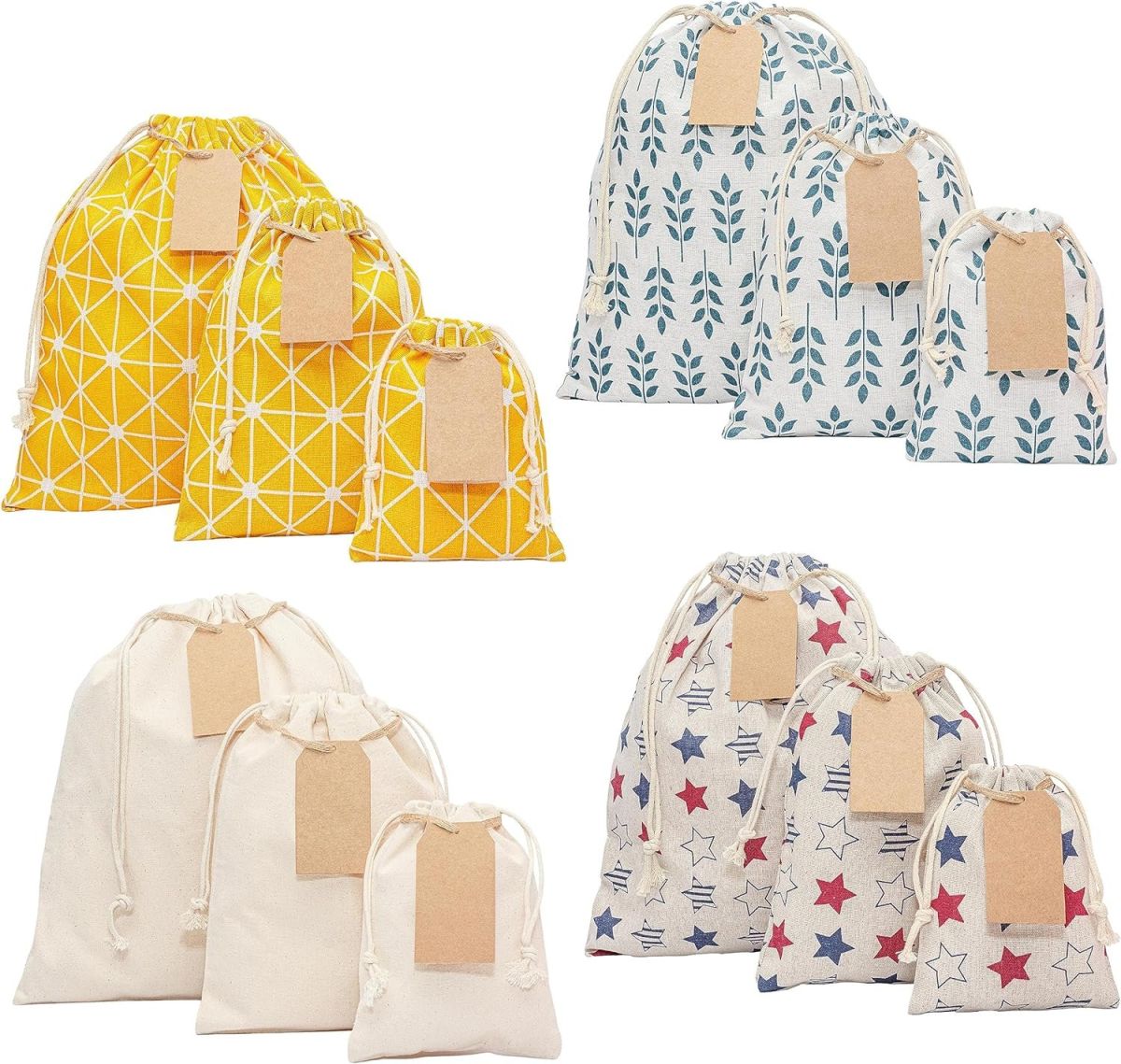
mix of cloth bag patterns
Christmas bags don't have to be Christmas-themed.. <a href="https://amzn.to/3NABeVY">Amazon</a>

Or maybe you want the opposite—just blatantly Christmas-y images in bright, bold colors plastered all over everything. Here ya go:

assortment of colorful christmas gift bags
So many Christmas gift bag options <a href="https://amzn.to/3Rw8VsI">Amazon</a>

There’s just no shortage of options for cloth gift bags that are worth investing in to save time, money and the environment. Just be sure to check sizes so there are no surprises, grab a wide assortment and then revel in the fact that you’ll never get a paper cut or have to search for another roll of tape while wrapping presents for your family again.


  • People are finding out firsthand why you ‘can’t’ pour water down the Hoover Dam
    A guy’s trick at the Hoover Dam went viral on TikTok.Photo credit: @rarity_eddie/TikTok

    Most people have a love-hate relationship with social media these days, but it has provided at least one public service. All those rumors and old wives’ tales that have been flying around for years? People around the world can now put them to the test and compare notes on their findings.

    That’s exactly what Eddie, a TikTok user, decided to do on his recent visit to the Hoover Dam.

    Putting the theory to the test

    The Hoover Dam, located on the border between Nevada and Arizona, isn’t just one of the largest dams in the world. It also has a unique design that makes it recognizable around the world.

    And even though the dam can handle some 300,000 gallons of water per second, if you try pouring a bit of your own water over the ledge…well, you can’t. At least, that’s the theory.

    In a recent video shared on social media, Eddie writes, “POV you heard you can’t pour water down the Hoover Dam.” He then proceeds to do just that, or at least attempt it.

    Eddie walks toward the edge of the dam with a cup of water in hand and tips some of it over the side. Immediately, as if by magic, it begins to levitate and break into droplets. The drops scatter along the face of the dam, with some even splashing back onto Eddie, prompting a joyful chuckle.

    @rarity_eddie

    They said it couldn’t be done. So we did it. What else should I try? #hooverdam #waitforit #whatishappening #oddlysatisfyingvideo #traveltok

    ♬ Doin What I Want – Natalie Nunn

    Mystery solved…or is it?

    Other tenacious folks have tested the theory and had no trouble watching their water tumble down the side of the dam.

    Annie, inspired by Eddie’s success, tried it with her boyfriend, and found herself bamboozled:

    And yet, other people had no problem replicating the “viral trick.”

    Here’s Luis, who visited the dam in 2022:

    Science behind the trick

    So, what’s really going on here?

    According to IFLScience, your results in replicating this trick may vary depending on the day, where you’re standing on the dam, and the conditions.

    Simply put, strong winds flow up the wall of the dam, pushing the water upward at high speed and causing it to splash. But it’s not an effect that’s easily replicated at other large, man-made structures. The dam’s design is perfectly suited to this result.

    The Hoover Dam is situated above Black Canyon, whose high walls act as a wind funnel on breezy days. Winds in the valley can reach over 50 miles per hour. Naturally, when the air hits the wall of the dam, it has nowhere to go but up.

    The wind accelerates up the face of the Hoover Dam because the water at the top cools the air.

    So, on windy days, you get an extremely powerful upward draft—sometimes called ridge lift or slope lift—that can make small amounts of water appear to levitate.

    Other places that seem to defy nature

    The Hoover Dam isn’t a magical anti-gravity spot, but it is unique in the way it harnesses natural forces.

    You might have heard of “gravity hills,” which are spots around the world that trick your eyes. These optical illusions make downhill slopes appear to go uphill, leading to some wild experiences—like cars in neutral “rolling uphill.”

    @lovetwb

    This was so creepy! Its called Gravity Hill. Noone knows why this happens here. Personally it reallt freaked us out… we probably won’t go back 🤣🫣. Would you go? Or have you been? #washingtonstate #hauntedhistory #gravityhill #prosserwa #gravityhillwa #travelingwhileblack

    ♬ Spooky, quiet, scary atmosphere piano songs – Skittlegirl Sound

    People lucky enough to swim in the Dead Sea are often amazed at how they seem to magically float, thanks to the water’s extremely high salt content.

    @luisaasim_

    Salt Beach, Dead Sea, in Jordanien 🇯🇴 Wusstet ihr, dass das Tote Meer der tiefste Punkt der Erde ist, etwa 430 Meter unter dem Meeresspiegel, und der Salzgehalt so hoch ist, dass man gar nicht untergehen kann? ✨ Konnte es erst nicht glauben, aber man schwebt wirklich und kann sogar ein Buch lesen 📖 #travel #jordan #deadsea #saltbeach #amman

    ♬ suono originale – Jr Stit

    Like these locales, the Hoover Dam trick isn’t magic. It’s science. Some might say that makes it even cooler.

  • Happiness expert shares 3-step cformula to build deeper connections
    Two women have a pleasant conversation. Photo credit: Canva
    ,

    Happiness expert shares 3-step cformula to build deeper connections

    “If you only share, it’s a monologue. If you only listen, it’s an interview.”

    The key to finding happiness has been widely researched. The data on happiness suggest that it comes down to our connections with others.

    Dr. Sonja Lyubomirsky, a professor of psychology at the University of California, Riverside, explained that her research has identified one key factor in happiness—and it comes down to conversation and deeper connection with others.

    During a TEDNext 2025 presentation, Lyubomirsky explained that she has been a happiness researcher for more than 30 years. In her lab, she has conducted experiments on “happiness interventions” since 1998.

    These “interventions” include exercises such as writing letters of gratitude, performing acts of kindness, and “acting” extroverted—all of which led people to feel happier. Her research suggests these activities increase happiness because “they help us feel more connected to and loved by others.”

    How to connect with others

    Lyubomirsky’s next challenge was to determine how humans can connect most with one another. From touch to dance to eye contact, she noted that these are all valid ways people connect.

    But in Western culture, connection often happens through conversation. Still, simply talking with others doesn’t always lead to connection because of the “walls around us.”

    “We build those walls to protect ourselves, yet they also keep us from ever letting anyone in,” said Lyubomirsky. “They keep us from becoming truly known.”

    To feel more loved, you have to be more known—which means taking down those walls when talking with others.

    The 3-step conversation formula

    Connecting more deeply with others starts with approaching conversations differently, according to Lyubomirsky. She offers a three-step formula to follow:

    Step 1: Share from the heart

    “You take down your walls by sharing something real about yourself, not just your highlight reel,” said Lyubomirsky.

    The goal is to share deeply and be brave enough to let others see the real you. To do so, she encourages people to pace themselves and start small.

    “Don’t immediately share your deepest secret or trauma,” she explained. “If you go deep too fast, everyone’s walls will come right back up again.”

    Instead, say something honest—something like, “I’ve had a rough day,” instead of “I’m fine,” she said.

    Step 2: Help others lower their walls

    This is achieved by listening to learn, not to respond.

    “Quiet your voice so theirs can be heard,” explained Lyubomirsky.

    To do this, she encourages people to listen as if there’s going to be a quiz tomorrow on what the other person shares.

    Step 3: Ask one more question than you usually do

    This final step helps build deeper connection. For example, she suggests asking the person you’re speaking with, “How did that really feel?” Such questions signal that you’re right there with them, Lyubomirsky said.

    She added, “When was the last time someone asked you a real question about your life? It’s rare. Yet research shows people yearned to be asked, and those who ask questions are better liked.”

    Her final note is to keep in mind that sharing and listening go hand in hand. “If you only share, it’s a monologue. If you only listen, it’s an interview,” Lyubomirsky said. “But when you do both, that’s when the magic happens.”

  • Trainer shows how a simple 45-degree hand shift makes push-ups easier and more effective for women
    Fitness educator Kayla Lee.Photo credit: @kaylaleephysio/Instagram (used with permission)

    Many women have a hard time doing traditional push-ups. Instead, they opt for “girl push-ups,” where the knees are placed on the ground to accommodate less upper body strength.

    But what if this exercise actually took female anatomy into consideration? 

    That’s the question behind a viral fitness trend on TikTok where women are making one small shift to their arm placement and suddenly realizing they could do full push-ups all along.

    What is a “women’s anatomy” push-up?

    As explained by Kayla Lee, a women’s anatomy and biomechanics educator, women tend to have a naturally greater “carrying angle” than men, meaning their elbows angle more outward when the arm is straightened. Traditional push-ups, where the elbows are tucked in and the wrists are stacked under the shoulders, don’t always accommodate this, which can lead to difficulty with the exercise, or even joint pain.

    However, turning the hands outward at about 45 degrees and placing them slightly wider than shoulder-width accommodates this anatomical difference, making the exercise more doable while also reducing wrist and elbow strain and improving stability.

    The reaction

    So far, the reaction has been overwhelmingly positive, with many women hailing it as a game changer.

    @nourishwithelisa

    Pivot those hands outwards ladies 🧚🏽‍♂️!!!!!! #pushups #women #strengthtraining

    ♬ original sound – Nourish with Elisa

    “Now I can so easily do push-ups,” one TikTok user said. “Honestly, mind blown.”

    @jwaterhouse21

    Form for woman’s anatomy pushups… I have never heard about this before 😩 #womansanatomypushup #girlpushups #pushups #trending

    ♬ sonido original – Carly Mata

     Another wrote, “POV: You tried the ‘form for women’s anatomy push-ups’ and suddenly now you’re questioning everything.”

    Of course, not everyone saw instant benefits. Some felt no difference, while others found that traditional push-ups actually worked better.

    But, regardless, the real takeaway is that there’s no one-size-fits-all approach. We should aim for good form, but it has to be a form that works with your body.

    Historically speaking

    It’s also worth noting that, historically, women haven’t always been taken into account in the fitness industry, or the health industry overall.

    Fitness programs either drew a stark divide between men’s and women’s fitness—remember when it was unheard of for women to lift weights at all?—or neglected women’s structural differences, hormonal fluctuations, and need for pelvic floor health.

    So it wouldn’t be surprising if push-ups, an exercise believed to have originated with ancient Indian warriors and later popularized by the military, were also shaped through a male-centric lens.

    Thankfully, this is changing. For example, equipment manufacturers are redesigning machines with narrower grip spacing and more comfortable chest pad designs. Women are increasingly prioritizing muscle gain to help stave off osteoporosis and age-related muscle loss. There’s also greater awareness of hormonal health and pelvic floor strength, especially postpartum.

    And trainers like Kayla Lee offer more female anatomy-friendly exercise alternatives—from bicep curls to dumbbell rows to lateral raises, just to name a few.

    In other words, sometimes it’s not about “getting stronger” in the way we’ve been told, but about finally having the tools that work with our bodies instead of against them. If a small shift in hand placement can unlock that kind of confidence, imagine what else becomes possible when fitness truly starts including everyone.

  • Surprising 16-year-long ADHD study proves researchers’ hypothesis totally wrong
    (L) A young boy takes a break from studying; (R) Brain scansPhoto credit: Canva
    ,

    Surprising 16-year-long ADHD study proves researchers’ hypothesis totally wrong

    The findings from first-of-their-kind, long-term ADHD studies keep rolling in and surprising researchers along the way.

    Our understanding of ADHD has come a long way in just a few short years. Though it wasn’t even formally recognized as a medical condition until the 1960s, by the time the 90s rolled around, diagnoses and stimulant prescriptions were extremely prevalent. (Raise your hand if you grew up in the era of “Anyone who struggles in school gets Ritalin!”) Today, diagnoses and treatment are a lot more thoughtful and individualized, and there are more options for treatment and therapy including but not limited to stimulants like the well-known Ritalin. Even with all these advancements, though, we still have more to learn.

    A new long-term study published in the Journal of Clinical Psychiatry has proven to be an excellent next step in getting a better understanding of the disorder, showing that a lot of what’s commonly believed or assumed about ADHD is incomplete or just flat-out wrong.

    Researchers studied 483 participants who were diagnosed with ADHD in childhood and continued to assess them for a period of 16 years. The study’s authors wanted to get a sense of how ADHD symptoms might change over time.

    ADHD, Mental Health, Productivity, Research, Parenting
    A doctor looks at an MRI. Photo credit: Canva

    What the researchers found surprised them. In most participants, symptoms of ADHD fluctuated greatly over the years rather than staying consistent. What surprised them even more were the environmental factors that seemed to play a role in those fluctuations.

    Researchers expected that greater life demands—like more responsibility at work, a heavier workload at school, major life changes, etc.—would exacerbate ADHD symptoms. What they found was the opposite.

    It makes sense that a person that struggles with inattention or hyperactivity might have more trouble focusing when they have more “going on” and more distractions to pull them in different directions. It was a huge surprise to the researchers that, actually, people’s ADHD symptoms seemed to ease up when life got hectic.

    “We expected the relationship between environmental demands and ADHD symptoms to be the opposite of what we found,” study author, professor, and clinical psychologist Margaret H. Sibley explained. “We hypothesized that when life demands and responsibilities increased, this might exacerbate people’s ADHD, making it more severe. In fact, it was the opposite. The higher the demands and responsibilities one was experiencing, the milder their ADHD.” 

    I have a 4-year-old with ADHD and the findings totally track for me based on what I’ve witnessed in our own life.

    We find it’s actually easier to be in perpetual motion sometimes (out running errands, doing activities, visiting friends and family) versus staying put too long. When we’re just relaxing at home, that’s when she tends to start bouncing off the walls! Her ADHD tendencies come out strong in these quiet periods, including what we sometimes playfully refer to as her “hoarding” dozens of coloring sheets or surrounding herself in giant piles of toys, blankets, and stuffed animals; thereby making a huge mess in the house.

    Doing nothing or doing very little is not often a restful state for people with ADHD. Typically, people with ADHD experience more background noise than neurotypical brains, so a quiet, seemingly restful environment can sometimes amplify racing thoughts, negative self-talk, and impulsive behavior versus dampening it. You know how kids sometimes act out in school not because they’re not smart, but because the material is actually too easy for them and they’re bored? Something similar is at play in both of these scenarios.

    Of course, as always in science, you have to be careful assuming causation from the findings.

    It’s important to note that the results of the study don’t definitively prove that being busy causes a decrease in ADHD symptoms.

    “This might mean that people with ADHD perform their best in more demanding environments (perhaps environments that have stronger immediate consequences, like needing to put food on the table for a family or pay rent monthly). It also might mean that people with ADHD take more on their plate when their symptoms are relatively at bay,” Sibley says. Either way, the correlation is certainly strong and worthy of more study.

    In the meantime, the study’s authors think the results could be viewed in a hopeful light for people just learning to manage their ADHD. “If you’re a doctor talking with a patient who is first getting diagnosed with ADHD, it’s a huge help for that person to hear the message that, ‘You’re going to have good years and not-so-good years, but things can go really well for you if you can get the right factors in place,’” Sibley said. As a parent, I can imagine how reassuring that would have been to hear early on in our own process.

    With ADHD diagnoses on the rise, more and more research is being conducted. For example, a recent long-term study out of Sweden was just published linking use of ADHD medication with a reduction in traffic crashes, general injuries, and criminal behavior. That’s a strong argument for continuing to hone in on accurate diagnoses and treatment for people who need it, as it clearly benefits society as a whole when done properly!

    We’re learning more and more about what the factors that affect positive ADHD outcomes are, like what might exacerbate symptoms and what types of things can help, and we’re starting to get a clearer picture of how people can manage this challenging disorder.

    This article originally appeared last year.

  • ‘Windfall time’: Why unexpected free time feels so much better than the kind we plan
    Image of a canceled event in a planner (left) and a relieved woman (right).Photo credit: Canva

    Most of us are familiar with the sudden rush of relief that comes when a work meeting gets canceled. Even if you’re only getting 60 minutes of your time back, it can feel like a huge chunk of the day is suddenly uncharted territory. That feeling is liberating—a rare moment when your schedule loosens its grip, reminding you that not every second of your time is spoken for.

    It turns out there’s a scientific explanation for this wave of euphoria, and it has everything to do with our (very subjective) sense of time. 

    A Rutgers University study, published in the Journal of the Association for Consumer Research, found that when people unexpectedly gain free time, they perceive it as longer than time that was already designated as free. The researchers call this phenomenon “windfall time.”

    “An hour gained feels longer than 60 minutes, and that deviation from expectation creates a unique sense of opportunity,” said Gabriela Tonietto, an associate professor of marketing at the Rutgers Business School and lead author of the study. 

    windfall time, work meeting, psychology
    Computer, clock, and letters spelling “TIME.” Photo credit: Canva

    Tonietto’s past work has explored various aspects of time management and perception, including “time famine” (the persistent feeling of not having enough time) and the benefits of having nothing to do. Her research often highlights how our relationship with time is shaped less by the clock and more by context, expectation, and emotion.

    After conducting seven surveys involving more than 2,300 participants, the team found that windfall time results from the “contrast effect.”

    That surprise hour is inherently judged against the initial expectation of having no free time at all, and thus feels perceptually expanded. In other words, a canceled one-hour meeting gives you 60 more free minutes than you expected to have. That mental comparison alone is what makes the time feel richer, fuller, and more valuable.

    In terms of productivity, the study also found that people were just as likely to use windfall time for work (often longer tasks) as they were for breaks or personal errands. Tonietto cautioned against employers trying to engineer these surprises, especially at the last minute, as it could backfire and create frustration rather than relief.

    Instead, Tonietto suggests that whenever this windfall comes, we should simply “take the gift and make the most of it.”

    productivity, Rutgers, neuroscience
    A man stretching at his desk. Photo credit: Canva

    And really, this discovery hits a little broader than just the workplace.

    Parents, for example, might never know a sweeter bliss than the 45 minutes of free time gained when their child takes a nap. A delayed appointment, an early dismissal, or even a plan that falls through can become an unexpected pocket of possibility. That might mean being productive, or doing nothing at all, without guilt.

    For example, some people find it helpful to use windfall time to start a task that normally feels too big to begin. Because the time feels more expansive, it can lower the mental barrier to getting started, even if only a small portion gets done. Others might choose something genuinely restorative, like stepping outside, taking a short walk, or simply sitting in silence without distractions.

    to-do list, windfall time, psychology
    A woman walking, refreshed. Photo credit: Canva

    It can also help to pause before automatically filling the time. Resisting the urge to default to scrolling or busywork, even briefly, allows you to decide what would actually feel good or useful in that moment. Keeping a loose mental list of things you enjoy or have been meaning to do can make these unexpected pockets of time feel even more rewarding.

    Perhaps the biggest takeaway is to start seeing more of our time as “windfall time,” so we can make the most of it—or at least appreciate it more. Because sometimes it’s not about having more time, but about recognizing the moments when it unexpectedly appears.

  • What it means to look at the ground while walking, according to psychology
    Silhouette of a man walking. Photo credit: Canva

    So much about a person’s inner world can be revealed without them having to say a single word. Even the smallest gestures can offer clues to their deeper emotions, coping mechanisms, and how they navigate the world.

    For instance, you may have noticed people who keep their eyes on the ground while walking. You might even be one of them yourself. Experts suggest that even this tells a psychological story—but not necessarily the one you might be thinking.

    Walking with one’s eyes down is commonly associated with shyness, depression, social anxiety, and low self-esteem. There does appear to be some science to support this.

    For example, researchers have found that people experiencing social anxiety are more likely to avert others’ gaze, often looking toward the ground rather than making eye contact. Some studies suggest this behavior may stem from a fear of being judged or negatively evaluated, making eye contact feel uncomfortable or even threatening.

    At the same time, psychologists caution against making quick assumptions. Human behavior is rarely driven by a single cause, and the same outward action can reflect very different internal states. In fact, looking down while walking can serve multiple purposes, many of which have little to do with anxiety or emotional distress.

    Cultural context, for instance, is another important factor. In some cultures, lowering one’s gaze is considered a sign of respect, humility, or politeness, especially when encountering elders or authority figures. What might be interpreted as insecurity in one setting could actually be a learned social norm in another.

    There is also a cognitive explanation. Many people use walking as a time to think, process, or problem-solve. Looking down can reduce visual distractions, allowing the brain to focus more fully on internal thoughts. This kind of inward attention may be especially common among creative thinkers or those working through complex ideas.

    @lizroseofficial

    Reposting this bc TikTok decided I’m not getting views on it 😤 What does your walk say about you? #walking #walkthewalk #bodylanguage #movement #communicationskills

    ♬ original sound – Liz Rose

    Another factor is more practical and straightforward: balance and navigation. Researchers at the University of Rochester found that people instinctively spend more time looking at the ground when it’s uneven in an effort to avoid tripping. This behavior is particularly noticeable in unfamiliar environments or places with obstacles where visual attention shifts downward to maintain stability and prevent falls.

    Expanding on this, age can also play a role. Older adults, for example, may be more likely to watch their steps carefully to reduce the risk of injury. Similarly, people recovering from injuries or dealing with mobility challenges might rely more on visual cues from the ground.

    Lastly, we live in a smartphone-dominated world. Many, if not most, of us regularly look down at our devices while walking. Over time, this habit can carry over even when a phone is not in hand. The posture becomes automatic, shaped by repetition rather than emotion.

    Taken together, these perspectives suggest that a downward gaze is not a one-size-fits-all signal. It can reflect anxiety, yes, but it can also point to cultural norms, deep thought, environmental awareness, or simple habit. Like many aspects of human behavior, its meaning depends heavily on context.

  • Philosophy expert reveals the character trait that shows someone is highly intelligent 
    A man playing chess and philosopher Bertrand Russell. Photo credit: Canva & Rijksmuseum/Wikimedia Commons

    Julian de Medeiros, a philosophy expert who’s popular on TikTok and Substack, has built a reputation for sharing some of the world’s most important philosophical ideas about life, love, ethics, and intelligence. Recently, he shared wisdom from Bertrand Russell on the character trait that highly intelligent people tend to have: they see the world as it really is, not as they want it to be.

    Russell, a British philosopher and founding figure of the analytic movement in philosophy, won the Nobel Prize in Literature in 1950. His work in logic, epistemology, and mathematics made him one of the most important minds of the 20th century. As they say, it takes one to know one, and if Russell says someone is intelligent, chances are he’s right.

    What’s a sign someone is highly intelligent?

    “Here’s how you know that someone is intelligent, and this goes back to the philosopher Bertrand Russell, who wrote, ‘You see the world as it is, not as you would like it to be, is the beginning of all wisdom,’” de Medeiros shared on TikTok.

    To put it simply, an intelligent person wants to get things right, while an unintelligent person wants to be right. Smart people look at the facts and form their opinions based on reality. Those who aren’t as bright tend to be more dogmatic, trying to see the world in ways that align with their beliefs.

    Bertrand Russell, philsophy, great minds, pipe, Nobel Prize winner
    Bertrand Russell. Photo credit: Rijksmuseum/Wikimedia Commons

    “What [Russell] meant is that an intelligent person tries to be a realist,” de Medeiros continued. “Like, they try to measure, examine, and test their own belief systems against reality. But an unintelligent person tends to be dogmatic. Like they don’t change their mind when confronted with the facts. In fact, you could show them the evidence, and they would simply double down.”

    What is the “backfire effect”?

    What de Medeiros is referring to is what’s known as the “backfire effect.” It’s a psychological phenomenon in which, when people are presented with credible facts that challenge their beliefs, they may hold on to those beliefs even more strongly than before.

    “Once something is added to your collection of beliefs, you protect it from harm,” author David McRaney wrote in You Are Not So Smart. “You do this instinctively and unconsciously when confronted with attitude-inconsistent information. Just as confirmation bias shields you when you actively seek information, the backfire effect defends you when the information seeks you, when it blindsides you.”

    politicians, debate, argument, speech, fight
    Politicians debating. Photo credit: Canva

    It can sting to change your mind, because it can feel like you’ve invalidated a big part of your sense of self. However, it becomes much easier if you begin to change how you see yourself. Instead of identifying with a specific worldview, you can think of yourself as someone who embraces the truth, no matter how difficult that may be.

    “Bertrand Russell believed that true intelligence was when you were open to the possibility that you might be wrong,” de Medeiros said. “When you sought to test your own belief systems and when you had a rational and inquisitive mindset, that is true intelligence. When the facts change, you change.”

  • A man planted tomato seeds from two McDonald’s burgers. Three months later, whoa.
    What happens when you plant tomato seeds from a McDonald's burger?Photo credit: The Gardening Channel with James Prigioni/YouTube
    ,

    A man planted tomato seeds from two McDonald’s burgers. Three months later, whoa.

    “I expected this tomato to grow,” James Prigioni said, “but I did not expect this.”

    In many ways, fast-food restaurants feel like the opposite of a backyard vegetable garden. But one gardener has tied a McDonald’s hamburger directly to a garden harvest in a way that even surprised him.

    James Prigioni makes popular gardening videos on YouTube. In one, he wanted to see if he could grow a whole tomato plant by planting the seeds from a tomato on a McDonald’s burger. He picked up a Deluxe Quarter Pounder with cheese, pulled out a tomato slice, and removed two seeds. After rubbing the seeds on a paper towel to remove the protective coating, which can inhibit sprouting, they were ready to plant.

    Trying out different seed-planting methods

    But like any good scientist, Prigioni wanted to try a different method for testing McDonald’s tomato seeds. So he pulled a slice of tomato from a second Quarter Pounder and, instead of extracting the seeds, planted the entire slice.

    With the help of a heat mat and a grow lamp, both sets of seedlings germinated and sprouted in soil-filled red Solo cups in about a week. After they were fully established, Prigioni separated the plants so they could thrive individually before being planted outside.

    He planted one of the plants in the ground outside and another in a 5-gallon bucket. He then showed how he culled the lower leaves as they developed blight and used a tomato cage to support the plants as they produced fruit and grew heavier. He also added extra fertilized soil and mulch to the bucket plant.

    A person transplanting a small tomato plant outside in a garden
    Transplanting a tomato plant outside. Photo credit: Canva

    The harvest was unexpected

    After three months, the plants were producing abundant fruit. The bucket plant didn’t perform as well as the in-ground plant, which Prigioni said was due to insufficient watering during very hot days. The bucket plant also ripened faster, likely due to the stress it had been under. Still, it was an impressive harvest, especially for a plant that started on a McDonald’s burger.

    The in-ground McDonald’s plant was even more incredible, with dozens of tomatoes dripping from it.

    “I expected this tomato to grow,” Prigioni said, “but I did not expect this.”

    A close-up photo of red, ripe sliced tomatoes.
    Sliced-up tomatoes. Photo credit: Canva

    The fruit from both plants tasted good and sweet, he said. By the fourth month, the in-ground plant was starting to struggle with its health, but not with its fruit production.

    “The plant had so many tomatoes on it that it seemed like it was having a little difficulty ripening that much fruit at one time,” Prigioni said. “I mean, I have had some plants with a lot of tomatoes on them, but never in my life have I seen a single tomato plant with this much fruit on it. I was completely blown away.”

    How the McDonald’s tomatoes compared

    He said one of his favorite parts of the experiment was seeing what kind of tomatoes would grow from the seeds. He thought it might be a beefsteak variety, but it turned out to be a Roma type. However, he surmised that the McDonald’s tomato was likely a hybrid, based on its ripening characteristics.

    Prigioni also shared how the McDonald’s tomato plants compared with his other tomato plants.

    “In another area of the garden, I grew Roma tomatoes that I got from Lowe’s, and I planted them at the same time as the McDonald’s tomatoes,” he said. “The harvest from them wasn’t quite as large, but the fruit ripened way more evenly, and I was able to harvest a lot more fresh fruit right off the vine that was ripe.”

    A ripe harvest of Roma tomatoes growing in a garden
    There’s nothing like a tomato right off the vine. Photo credit: Canva

    “Overall, I was shocked with the level of production,” he continued. “And this is probably my favorite experiment that I’ve ever done. I mean, to be able to take a cheeseburger, grab a tomato from it, then grow a tomato plant, and then harvest pounds and pounds of tomatoes from it is just such a unique and refreshing experience.”

    Perhaps an unexpected result, but a great way to challenge our assumptions and demonstrate the power of nature, even in the context of fast food.

    You can follow The Gardening Channel with James Prigioni on YouTube for more gardening education.

Pets

Elderly cats are being saved from being euthanized with adorable cat retirement village

Pop Culture

Watch the tense moment Lucille Ball tells a host to take his hands off female audience members

Pop Culture

Singer stuns Boy George with bold take on ‘Do You Really Want to Hurt Me’

Culture

Woman says photos prove that office air changes her appearance