You can try to reuse wrapping paper, of course, but have you ever seen a kid tear into a Christmas present? You can try wrapping with simple brown paper, which is recyclable, but doesn’t feel particularly festive. You could buy eco-friendly wrapping paper, shelling out a pretty penny for something that’s still going to have to be purchased again and again.
OR you can go a whole new route by ditching the paper altogether and going for the truly old-fashioned, easy peasy solution of cloth gift bags that you either purchase or make yourself. If you think that sounds like a bit of a stretch, hold the judgment until you see how utterly adorable these bags are.
Cloth bags save so much time and headache compared to paper wrapping. Weirdly shaped gifts no longer matter as long as they fit in the bag. They also save you money over time if you use them for your household’s gifts and store them away with your holiday decorations each year. If you make them yourself, you can choose any color or pattern theme you want, but there are plenty of readymade coordinated options out there now to go with any decor.
And no, kids don’t care—in fact, they will probably appreciate the fact that their gift wrap is eco-friendly and they may even get nostalgic about seeing the familiar wrappings each year. (Our family has used cloth to wrap for presents for years, and our kids have actually developed favorites.)
Here’s a simple example—a mix of classic red-and-white patterns in assorted sizes for a bright, classic look. How lovely would a stash of these look all gathered under the tree?

Red and white always works for Christmas. <a href="https://amzn.to/3v7H1fh">Amazon</a>
What if you went with a classy gold theme for this year’s decor and want the presents under the tree to match for a perfectly Instagrammable Christmas morning? Here’s a similar set in a gold-and-white pattern.Go for the gold with this set of Christmas gift bags. <a href="https://amzn.to/3RN1miF">Amazon</a>
Maybe you’re going for more of a cozy, casual, log cabin-y feel for your holiday. Plenty of plaid in Christmas colors right here.Cozy, cozy flannel bags with Christmas sayings on them <a href="https://amzn.to/41uzwuX">Amazon</a>
If you’re more drawn to the classic, Norman Rockwell, Christmases-of-yore vibe, check out these nostalgic Christmas prints:These gift bags look like a throwback to "It's a Wonderful Life." <a href="https://amzn.to/3GRMMjP">Amazon</a>
Maybe you’re a modern maven with monochromatic merry-making methodologies. Or perhaps you’d like to be able to reuse your bags at other times of the year, too. These black-and-white babies might just do the trick.

These black-and-white bags could be used for any occasion. <a href="https://amzn.to/3RNXj5O">Amazon</a>
How about a standard-Christmas-wrapping-paper look, only as cloth Christmas gift bags instead?

Get your colorful Christmas on. <a href="https://amzn.to/41wgTHa">Amazon</a>
Or maybe you don’t want a distinctively Christmas feel at all, but rather a mix of pretty, festive bags that could be used for the holidays or any time of year. There’s a whole assortment to choose from here to go with whatever your particular color theme might be.
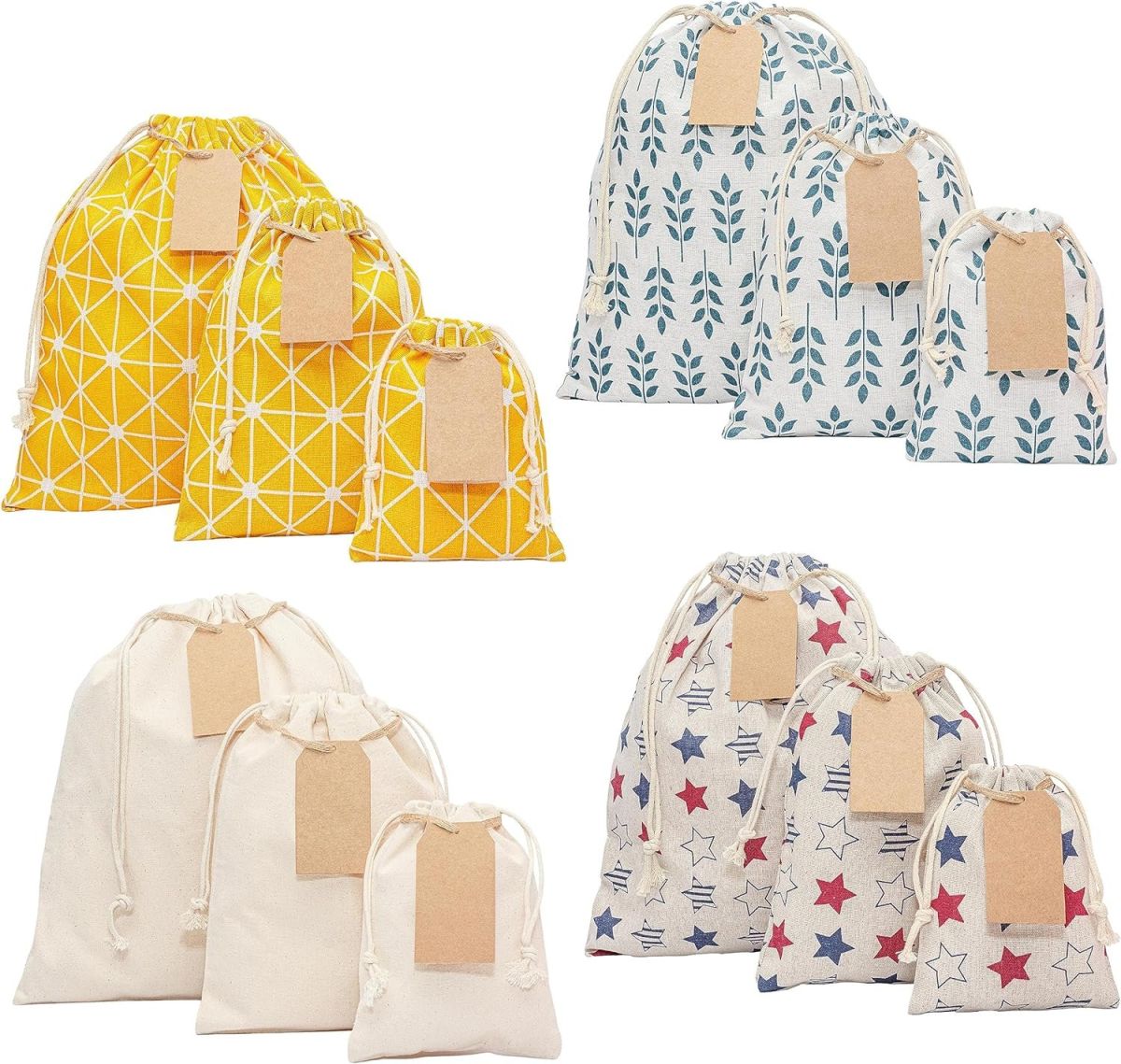
Christmas bags don't have to be Christmas-themed.. <a href="https://amzn.to/3NABeVY">Amazon</a>
There’s just no shortage of options for cloth gift bags that are worth investing in to save time, money and the environment. Just be sure to check sizes so there are no surprises, grab a wide assortment and then revel in the fact that you’ll never get a paper cut or have to search for another roll of tape while wrapping presents for your family again.

A single door can open up a world of endless possibilities. For homeowners, the front door of their house is a gateway to financial stability, job security, and better health. Yet for many, that door remains closed. Due to the rising costs of housing, 1 in 3 people around the world wake up without the security of safe, affordable housing.
Since 1976, Habitat for Humanity has made it their mission to unlock and open the door to opportunity for families everywhere, and their efforts have paid off in a big way. Through their work over the past 50 years, more than 65 million people have gained access to new or improved housing, and the movement continues to gain momentum. Since 2011 alone, Habitat for Humanity has expanded access to affordable housing by a hundredfold.
A world where everyone has access to a decent home is becoming a reality, but there’s still much to do. As they celebrate 50 years of building, Habitat for Humanity is inviting people of all backgrounds and talents to be part of what comes next through Let’s Open the Door, a global campaign that builds on this momentum and encourages people everywhere to help expand access to safe, affordable housing for those who need it most. Here’s how the foundation to a better world starts with housing, and how everyone can pitch in to make it happen.
Volunteers raise a wall for the framework of a new home during the first day of building at Habitat for Humanity’s 2025 Carter Work Project.
Globally, almost 3 billion people, including 1 in 6 U.S. families, struggle with high costs and other challenges related to housing. A crisis in itself, this also creates larger problems that affect families and communities in unexpected ways. People who lack affordable, stable housing are also more likely to experience financial hardship in other areas of their lives, since a larger share of their income often goes toward rent, utilities, and frequent moves. They are also more likely to experience health problems due to chronic stress or environmental factors, such as mold. Housing insecurity also goes hand-in-hand with unstable employment, since people may need to move further from their jobs or switch jobs altogether to offset the cost of housing.
Affordable homeownership creates a stable foundation for families to thrive, reducing stress and increasing the likelihood for good health and stable employment. Habitat for Humanity builds and repairs homes with individual families, but it also strengthens entire communities as well. The MicroBuild® Initiative, for example, strengthens communities by increasing access to loans for low-income families seeking to build or repair their homes. Habitat ReStore locations provide affordable appliances and building materials to local communities, in addition to creating job and volunteer opportunities that support neighborhood growth.
Marsha and her son pose for a photo while building their future home with Southern Crescent Habitat for Humanity in Georgia.
Everyone can play a part in the fight for housing equity and the pursuit of a better world. Over the past 50 years, Habitat for Humanity has become a leader in global housing thanks to an engaged network of volunteers—but you don’t need to be skilled with a hammer to make a meaningful impact. Building an equitable future means calling on a wide range of people and talents.
Here’s how you can get involved in the global housing movement:
Speaking up on social media about the growing housing crisis
Volunteering on a Habitat for Humanity build in your local community
Travel and build with Habitat in the U.S. or in one of 60+ countries where we work around the globe
Join the Let’s Open the Door movement and, when you donate, you can create your own personalized door
Every action, big and small, drives a global movement toward a better future. A safe home unlocks opportunity for families and communities alike, but it’s volunteers and other supporters, working together with a shared vision, who can open the door for everyone.
Most self-help advice gets one major aspect wrong: the habits that actually change your life aren’t the dramatic ones. They’re not 5 a.m. cold plunges or 75-day fitness challenges. They’re much more subtle, and almost embarrassingly ordinary. But that’s the point.
The ideas are simple: create bite-sized routines that fit seamlessly into your day, and build different versions of those systems for different days, whether good or chaotic. The goal is to stick with these practices, daily or weekly, even on turbulent days when nothing seems to go right. They write:
“Traditional productivity advice assumes perfect conditions. This system assumes chaos is inevitable and builds protocols for bad days. You’re not trying to be perfect. You’re trying to be unbreakable.”
Here are 14 deceptively simple habits worth trying, courtesy of Ideas to Thrive:
Jump-starting a healthier lifestyle doesn’t require a gym membership. You don’t need a plan, a new playlist, or special gear. You just need a dedicated block during the day to move: a short walk, five squats while the coffee brews in the morning, or committing to taking the stairs instead of the elevator.
A 10-minute workout done three times a week has been shown to boost endurance by nearly 20%. Importantly, it’s the intensity, not the duration, that drives measurable health benefits. You don’t need an hour per week, just minutes.
2. Drink water before anything else
Before your morning coffee, juice, or that special loose-leaf tea your father-in-law got you (thanks, Perry!), drink a glass of water. Then have another about 30 minutes before your first meal.
This one’s tricky. What about your morning alarm? (Buy one. It’s good to know the time without constantly checking your phone.) What about that nightly Sudoku game you have to do? (Try a book of puzzles, or the one printed in the newspaper.) The research on this topic is extensive and clear: smartphones in the bedroom disrupt sleep. By removing your phone, you eliminate both the temptation to scroll and the device lighting up with notifications during the night.
According to the Indian Journal of Medical Research, 87% of Americans sleep with their phones in the bedroom, despite consistent evidence linking the habit to poorer sleep outcomes. A randomized controlled trial found that restricting bedtime phone use improved sleep quality, shortened sleep onset, and enhanced mood. Luckily, the fix isn’t a fancy gadget. It’s as simple as leaving your phone on the kitchen counter.
4. While you’re at it, write down tomorrow’s one task before bed
Before you sleep, jot down the single most important thing you need to do the next day. That’s it: one thing. Psychologists call the anxiety caused by unfinished tasks the Zeigarnik Effect, first identified by Russian psychologist Bluma Zeigarnik in 1927. It explains how unfinished tasks stay active in our working memory, using up mental energy and potentially disrupting sleep.
Writing down a plan to complete them can help ease these restless thoughts, reassuring your brain that it’s okay to let go because a clear plan is in place. Further research shows that having a written plan boosts productivity, as the act of planning helps lighten your mental load.
The takeaway? Your brain can’t file away a task until it trusts there’s a plan. Give it one sentence tonight.
5. Take a 10-minute walk after lunch
That 2 p.m. slump? It’s not just because of the family-style Jersey Mike’s hoagie you wolfed down (no judgment, though it didn’t help). Afternoon sleepiness is real, but a short walk can actually help tremendously.
A study in the Journal of Experimental Psychology found that taking a few moments to jot down a quick to-do list before bed can help you fall asleep faster. Gratitude journaling, done specifically before bed, has also been shown to improve sleep onset and reduce nighttime disturbances. Your brain wasn’t designed to hold everything. Three sentences are enough to start letting go.
7. Track your habits with color
Find a visual tracker that works for you, whether on paper or in a digital app, and assign yourself colors:
Green for done
Yellow for partially complete
Red for skipped
Yes, it may sound like an elementary school exercise (what’s next, a pizza party for finishing your books?), but there’s real science behind it. Research on digital behavior change interventions shows that visual tools illustrating the gap between current behavior and a goal, such as a green bar for steps completed and a red line for the daily target, can boost motivation through clear, visual feedback. The idea is that color-coded systems tap into these feedback loops, with the brain processing color patterns faster than text or numbers.
Visual feedback can be powerful. Soon, you’ll start noticing patterns you didn’t even realize were there.
8. Set aside 20 minutes on Sunday for a quick self-review
No one’s under fire; this isn’t a productivity audit. You are not in trouble. But a little self-reflection never hurt, did it?
Without deliberate reflection, it’s easy to stay on autopilot. Reviews create the feedback loop necessary for intentional progress. During these sessions, ask yourself:
What went well this week?
What didn’t?
What does next week look like?
Should I adjust my self-improvement expectations?
Reviewing the week allows you to “bank” wins, process setbacks, and make small, purposeful improvements (a strategy shown to reduce burnout). David Allen, the productivity researcher behind Getting Things Done, notes that the weekly review “will sharpen your intuitive focus on your important projects as you deal with the flood of new input and potential distractions coming at you the rest of the week.”
By spending 20 minutes looking back each week, you can avoid going 20 weeks in the wrong direction.
9. Close all your browser tabs at the end of the day
Every open tab is an unfinished thought. Research from Princeton University and the University of California, Los Angeles shows that visual clutter—digital or physical—overloads the brain and elevates stress. Closing your tabs at the same time each day creates a shutdown ritual that helps separate work from rest, a clear boundary that prevents lingering anxiety during off-hours. This distinction is especially important for those who work from home. Productivity experts also note that fewer digital distractions means fewer choices and less noise, which in turn reduces decision fatigue and increases the likelihood that tasks get done.
Your browser is not a filing cabinet. Close those tabs. Start fresh tomorrow.
10. Read 10 pages per day
That’s it: 10 pages. That’s about 15 minutes of active reading. Do that every day, and you’ll finish between 12 and 18 books a year (unless you’re working your way through the Dune series. Those books are seriously hefty). It’s good for you, too: a landmark study in Personality and Social Psychology Bulletin found that just six minutes of reading can reduce stress levels by up to 68%.
Ten pages a day is more than just a light reading habit; it’s an insurance policy for your brain’s health.
Despite the wisdom in Year of Yes by Shonda Rhimes, treating “no” as a weekly maintenance habit isn’t an act of selfishness; it’s an act of self-preservation. Chronic people-pleasing drains the same mental and emotional resources that support creativity, focus, and recovery. Research consistently shows that excessive stress—the kind caused by overcommitting—is a major trigger for depression, anxiety disorders, and burnout.
Psychology Todaynotes that saying no “can create more mental health stability by helping with self-care and building your self-esteem and confidence by setting boundaries.” This is a deliberate practice. Decline at least one request, invitation, or obligation each week that doesn’t align with your priorities. When you set limits on what drains you, you create space for restorative activities.
12. Send one thoughtful message a week
Every week, send one intentional message to someone in your life—a text, email, or note that’s personal, specific, and sincere. Social connection is one of the strongest predictors of health and longevity. A landmark study cited by Stanford University’s Center for Compassion and Altruism Research and Education found that a lack of social connection is more harmful to health than obesity, smoking, and high blood pressure.
A study published in Communication Research, involving 900 participants across five university campuses, found that even a single intentional outreach to a friend or loved one on any given day can significantly improve well-being, reduce stress, enhance connection, and lessen loneliness. Importantly, the research showed that no particular type of message—whether catching up, showing care, joking, or giving a compliment—was more effective than another. The key factor was the act of reaching out with intention.
Dishes in the sink. Clothes on the chair. Scattered envelopes on the dining room table. Spend two minutes before bed restoring basic order to your space: reset surfaces, return items to their places, and clear clutter.
Research conducted by UCLA, involving 32 dual-income families, found that individuals who described their homes as cluttered or full of unfinished projects showed elevated cortisol patterns linked to chronic stress, especially among women.
Allen’s Getting Things Done methodology helps explain why the two-minute rule works so well. As he explains, any task that can be completed in under two minutes should be done immediately rather than delayed, preventing small messes from building into overwhelming chaos.
One small step at a time
None of these habits will change your life overnight. You won’t wake up with a different bank account. Your apartment won’t magically become more organized; you’ll probably still lose focus around 3:33 p.m. each day. But that’s not really how change works, is it? It happens in the small, consistent moments that may not look impressive on paper but add up to real momentum.
You don’t need to overhaul your entire life. Ideas to Thrive recommends starting with a handful of habits, then slowly adding more. Pick a few and see where they take you.
But how far did they go, exactly? We can look at the historic number of miles the Orion flew from Earth—approximately 252,756—but that distance is a little tough for us to visualize. Thankfully, Professor Anu Ojha’s scientific demonstration at The Royal Institution makes it a lot easier.
The Moon is farther away from Earth than many people imagine
First, Ojha explained that the distance between the Earth and Moon varies because the Moon’s orbit around the Earth is elliptical. But very roughly speaking, he said, the Moon’s orbital distance from the Earth is equal to 10 circumferences of the Earth.
He held up an inflatable globe to represent Earth and explained that he had wrapped a piece of string around it 10 times. At the end of the string, he attached a ball that was the correct scale compared to the Earth.
“It’s about the same size as Australia or Canada or China,” he explained. “About a quarter of the diameter of the Earth.”
He showed a graphic that depicted the Earth and Moon in proper scale, but with a totally inaccurate distance between them. Then, holding the globe, he asked a student to take the Moon ball at the end of the string and start walking away from him.
Photo from the ISS of the moon “rising” over the Earth’s atmosphere (Photo credit: NASA)
After the string unwound about six or seven feet, he asked the student to stop. “That’s the sort of visualization we get from this image,” he explained. “But, you know, there’s a lot of string left here.”
Ojha had the student keep walking, and keep walking, and keep walking until he had fully unwound the string. We can barely see the student as he walked up a flight of stairs into a darkened area of the classroom, but it’s clear the distance between the Earth and Moon is much farther than we are used to picturing it.
The International Space Station’s location compared to the Moon drives the point home
After showing how far the Moon—”our nearest naturally occurring neighbor in space”—is from Earth, Ojha put it into even clearer perspective.
“How far away did I say the international boundary of space was?” he asked the students, who responded, “100 kilometers.”
“That’s 1 millimeter on this scale,” Ojha said. “International Space Station (ISS) 400km—a finger width. The Moon is a thousand times the distance to the orbit of the International Space Station.”
But he wasn’t done. He also said that if we go to the next nearest planet, Venus, we are talking about a distance more than 100 times the distance between the Earth and the Moon.
“So we start to see the challenges that we are facing in directly exploring even our own solar system, let alone the universe,” he said.
This demonstration also makes it clearer why space missions to the Moon haven’t been a regular occurrence. Many of us had no idea how much further the Moon was than the ISS. They’re not even close to comparable trips.
Physical science demonstrations for the win
People appreciated the old-school science lesson:
“There is no substitute for physical demonstration in a room.”
“A lot of people just don’t realise the sheer scale of astronomical units, there’s too much ‘space’ out there to wrap their heads around it.”
“Most people can only understand what they can GRASP. This kind of physical demo is the most efficient.”
“I used to do that thing with my elementary school students where we go out to the football field and lay down planets showing how far away everything is from the sun. Blew their minds every time.”
“Everything I learn about space tends to come with the subtext of ‘It’s big. No, not the scale you’re thinking, bigger.’”
“Crazy how even with such a distance and small mass the Moon can still have such a massive effect on our water (and other such things).”
Our understanding of the cosmos is always growing and evolving, of course. But the math that tells us the scale of the objects in space has been around a long time and still has the power to boggle our minds. The universe is awesome, literally. Isn’t it wonderful how the awe that space exploration inspires in us is a reminder of everything that makes us human?
It’s a parent’s worst nightmare: Taking your child to the doctor and receiving a life-changing diagnosis. It only adds to the heartbreak when they find out there may be no effective treatment at all, and that all they can do is hope for the best.
Few diagnoses strike fear in the heart of parents and doctors more than a cancer called diffuse intrinsic pontine glioma, or DIPG. Primarily found in children, DIPG is a highly aggressive brain tumor that is uniformly fatal, with less than 10 percent of children surviving longer than two years after diagnosis. The tumors grow fast and on extremely vital areas like the spine and brain stem, making them exceptionally hard to remove. Though young patients have been treated with radiation, chemotherapy, and surgeries, no one had ever been cured of the fatal cancer.
But for the first time ever, a 13-year-old boy from Belgium named Lucas Jemeljanova has beaten the odds.
Various brain scans. Photo credit:
Diagnosed with DIPG at age six, Lucas’ doctor Jacques Grill told Lucas’ parents, Cedric and Olesja, that he was unlikely to live very long. Instead of giving up hope, Cedric and Olesja flew Lucas to France to participate in a clinical trial called BIOMEDE, which tested new potential drugs against DIPG.
Lucas was randomly assigned a medication called everolimus in the clinical trial, a chemotherapy drug that works by blocking a protein called mTOR. mTOR helps cancer cells divide and grow new blood vessels, while everolimus decreases blood supply to the tumor cells and stops cancer cells from reproducing. Everolimus, a tablet that’s taken once per day, has been approved in the UK and the US to treat cancers in the breast, kidneys, stomach, pancreas, and others—but until the BIOMEDE clinical trial, it had never before been used to treat DIPG.
Lucas Jemeljanova poses with his mother. Photo credit: Lesja Jemeljanova via Facebook
Though doctors weren’t sure how Lucas would react to the medication, it quickly became clear that the results were good.
“Over a series of MRI scans, I watched as the tumor completely disappeared,” Grill said in an interview. Even more remarkably, the tumor has not returned since. Lucas, who is now thirteen, is considered officially cured of DIPG.
Even after the tumor was gone, Grill, who is the head of the Brain Tumor Program in the Department of Child and Teenage Oncology at Gustave Roussy cancer research hospital in Paris, was reluctant to stop Lucas’ treatments. Until about a year and a half ago, Lucas was still taking everolimus once every day.
“I didn’t know when to stop, or how, because there was no other reference in the world,” Grill said.
While Lucas is the only one in the clinical trial whose tumor has completely disappeared, seven other children have been considered “long responders” to everolimus, meaning their tumors have not progressed for more than three years after starting treatment.
Lucas with his mother. Photo credit: Lesja Jemeljanova via Facebook
So why did everolimus work so well for Lucas? Doctors think that an extremely rare genetic mutation in Lucas’ tumor “made its cells far more sensitive to the drug,” Grill said, while the drug worked well in other children because of the “biological peculiarities” of their tumors.
While everolimus is by no means a cure, the trial has provided real hope for parents and families of children diagnosed with DIPG. Doctors must now work to better understand why Lucas’ tumor responded so well to the drug and how they can replicate those results in tumor “organoids”—artificially-grown cells that resemble an organ. After that, said Marie-Anne Debily, a researcher in the BIOMEDE trial, “the next step will be to find a drug that works as well on tumor cells.”
A more recent clinical trial tested a new immunotherapy treatment on young DIPG patients and showed promising results. Many of the patients’ tumors shrank and several participants saw functional improvements in their symptoms and day-to-day lives. But only one of the 11 patients has seen success that rivals Lucas’ — a young man identified only as Drew, who has been thriving tumor-free for over four years after receiving treatment.
Once considered a definitive death sentence, there is real hope for the first time. But there’s much more research and work to be done. Until then, however, Lucas’ doctors are thrilled.
“Lucas’ case offers real hope,” said Debily.
Lucas with his parents and sister. Photo credit: Lesja Jemeljanova via Facebook
This article originally appeared two years ago. It has been updated.
Towards the end of The Beatles’ illustrious but brief career, Paul McCartney wrote Let it Be, a song about finding peace by letting events take their natural course. It was a sentiment that seemed to mirror the feeling of resignation the band had with its imminent demise.
The bittersweet song has had an appeal that has lasted generations, and that may be because it reflects an essential psychological concept: the locus of control. “It’s about understanding where our influence ends and accepting that some things are beyond our control,” Jennifer Chappell Marsh, a marriage and family therapist, told The Huffington Post. “We can’t control others, so instead, we should focus on our own actions and responses.”
The ‘Let Them’ theory, explained
This idea of giving up control (or the illusion of it) when it does us no good was perfectly distilled into two words that everyone can understand: “Let Them.” This is officially known as the “Let Them” theory. Podcast host, author, motivational speaker and former lawyer Mel Robbins explained this theory perfectly in a vial Instagram video posted in May 2023.
“I just heard about this thing called the ‘Let Them Theory,’ I freaking love this,” Robbins starts the video.
“If your friends are not inviting you out to brunch this weekend, let them. If the person that you’re really attracted to is not interested in a commitment, let them. If your kids do not want to get up and go to that thing with you this week, let them.” Robbins says in the clip. “So much time and energy is wasted on forcing other people to match our expectations.”
“If they’re not showing up how you want them to show up, do not try to force them to change; let them be themselves because they are revealing who they are to you. Just let them – and then you get to choose what you do next,” she continued.
Put the ‘Let Them’ theory into practice
The phrase is a great one to keep in your mental health tool kit because it’s a reminder that, for the most part, we can’t control other people. And if we can, is it worth wasting the emotional energy? Especially when we can allow people to behave as they wish and then we can react to them however we choose?
Stop wasting energy on trying to get other people to meet YOUR expectations. Instead, try using the “Let Them Theory.” 💥 Listen now on the melrobbinspodcast!! “The “Let Them Theory”: A Life Changing Mindset Hack That 15 Million People Can’t Stop Talking About” 🔗 in bio #melrobbins#letthemtheory#letgo#lettinggo#podcast#podcastepisode
How you respond to their behavior can significantly impact how they treat you in the future.
It’s also incredibly freeing to relieve yourself of the responsibility of changing people or feeling responsible for their actions. As the old Polish proverb goes, “Not my circus, not my monkeys.”
“Yes! It’s much like a concept propelled by the book The Subtle Art of Not Giving a F**k. Save your energy and set your boundaries accordingly. It’s realizing that we only have “control” over ourselves and it’s so freeing,” one viewer wrote.
Finding Peace Through Acceptance
“Let It Be” brought Paul McCartney solace as he dealt with losing his band in a very public breakup. The same state of mind can help all of us, whether it’s dealing with parents living in the past, friends who change and you don’t feel like you know them anymore, or someone who cuts you off in traffic because they’re in a huge rush to go who knows where.
The moment someone gets on your nerves and you feel a jolt of anxiety run up your back, take a big breath and say, “Let them.”
This article originally appeared two years ago.It has been updated.
Like it or not, AI technology is almost certainly here to stay. While that might bring new conveniences we never thought possible, it still causes many to stress out over range of topics from our careers to existential level threats.
In a segment for New Normal entitled, “Is Human Connection the New Job Security?” for BBC Global, journalist Katty Kay delves into the idea of job security in this new age. She first recalls a chat she had in 2023 with her old pal, Dermalogica Skincare founder Jane Wurwand.
High touch vs. high tech
In just two words, the corporate mogul had the antidote to “high tech,” and it was really quite simple. She told Kay, “The equal and opposite reaction to ‘high tech’ is ‘high touch.’” She explains that it’s “service-oriented businesses where humans are doing things that humans do best. Cooking. Caring. Touching. Kindness. Compassion. Talking. I’m not just in the business of skincare products. I’m in the business of human connection.”
Kay reconnects with Wurwand over a video chat a few years later to find out if she still feels the “high touch” concept is possible now that AI has advanced. “It’s not confined to physical touch, your concept of high tech/high touch. It’s also about this broader idea of just having a human voice when you call.” (Kay gives the example of having to call tech support if your Wi-Fi has gone out.)
The human being industry
Kay then asks, “Give us some tangible thoughts on which are the high-touch jobs and areas of employment you think survive this rapidly growing technology that may take other jobs away?”
Wurwand replies confidently, “The jobs that I see that are going to be booming…and really can’t be replaced. Hospitality. Travel. Anything in the human being industry.”
She discusses the importance of true empathy, something that can’t be substituted by a robot. “If you are receiving a cancer diagnosis, goodness forbid, an AI bot might have found or detected that rogue cell, but you certainly don’t want that bot talking to you or giving you that diagnosis. You want someone with kindness, empathy, and to hold your hand and literally say, ‘We’ve got a plan. We’re going to execute on it.’”
A doctor consults with his patient. Photo credit: Unsplash
Wurwand gives other examples, as well, essentially suggesting “high touch” can be applied anywhere, including tech jobs. “Whether you’re working in retail, whether you’re working in an industry that is full of technology, what we can bring as humans that makes the workplace, that business, that space kind, empathetic, that you feel seen, you feel heard, that you matter, that somebody knows a little bit about your life so that you can chat and talk.
A new social contract
Kay brings up the insightful point that many, especially younger people in today’s society, feel threatened and disillusioned. “Many felt there was this kind of social contract, where you get educated, you pay an enormous amount of money to go to a university or tertiary education, and then you come out and actually there aren’t jobs because the jobs have been taken.”
She also points out the frustration some might feel from having been told if they’d only learned to “code” they’d be fine. They then entered the workforce to find out lots of those jobs have been taken over, as well. Kay asks, “What do you say to the graduate who has a degree in accounting or coding?”
Wurwand reiterates that “high touch” is still important, even in accounting or coding jobs. “You’re not gonna compete with a robot. We don’t have those same skills. We don’t have that ‘code’ in our head. You have everything else that is needed by other humans. So we have to take the strength and move with it.”
She points out that we shouldn’t be so quick to label. “We shouldn’t box things into that’s ‘tech’ and this is ‘human.’ There has to be this connection.”
Genuine empathy
They both agree that those interpersonal skills—the ones that only human beings can truly have—must be nurtured in order to survive this AI flux. Wurwand gives the example: “Your first message of branding is that voice that answers the phone. And it doesn’t have to be in an office at a desk. It can be obviously remote. However, it has to be a double-down, delicious sort of person who sounds great and is kind and genuinely has empathy because we can hear or spot a fake in 30 seconds.”
Of course, the idea of good customer service isn’t exactly new. But it seems extra important right now given it’s seemingly being forgotten by so many major corporations.
In the article “9 Examples of High Touch,” for Simplicable, writer and IT tech John Spacey writes that it comes down to simply being human: “High touch is any business process that requires extensive human attention. These are typically areas where automation reduces the value of a process because humans add significant value to it.”
Aside from the aforementioned client services, Spacey also discusses the importance of having “personalized attention with every customer.” This includes, of course, listening to their needs and tailoring the experience directly to them when possible.
Aging is weird. You’re trucking along, enjoying your middle-aged life, finally feeling like a real adult, when you look in the mirror one day and gasp. “Where did those wrinkles come from?” “Is that skin on my arm…crepey?!?” “Why am I aching like that?”
Somewhere in your mid-40s, you start noticing obvious signs of aging that seem to arrive overnight. You assumed it was a gradual process that you just hadn’t noticed, but it sure as heck felt like it happened really fast.
The science behind the ‘overnight’ changes
New research indicates that may very well be the case. A 2024 study from researchers at Stanford tracked thousands of different molecules in people age 25 to 75 and found that people tend to make two big leaps in aging—one around age 44 and another around age 60. These findings indicate that aging can actually happen in bursts.
“We’re not just changing gradually over time. There are some really dramatic changes,” said senior study author Michael Snyder, Ph.D., a geneticist and director of the Center for Genomics and Personalized Medicine at Stanford University. “It turns out the mid-40s is a time of dramatic change, as is the early 60s. And that’s true no matter what class of molecules you look at.” The researchers assumed the mid-40s changes would be attributed to menopausal or perimenopausal changes in women influencing the overall numbers, but when they separated the results by sex they saw similar changes in men in their 40s.
“This suggests that while menopause or perimenopause may contribute to the changes observed in women in their mid-40s, there are likely other, more significant factors influencing these changes in both men and women. Identifying and studying these factors should be a priority for future research,” said study author Xiaotao Shen, PhD, a former Stanford Medicine postdoctoral scholar who now teaches at Nanyang Technological University in Singapore.
Aging happens in bursts, scientists find. Canva Photos
What’s behind these ‘bursts?’
The study included 108 participants who submitted blood and other samples every few months for several years. The scientists tracked age-related changes in 135,000 different molecules—nearly 250 billion distinct data points—to see how aging occurs.
The study may shed light on the reasons for jumps in certain diseases and maladies at certain ages. For the 40-somethings, scientists found significant changes in molecules related to alcohol, caffeine, and lipid metabolism, cardiovascular disease, and skin and muscle. For those in their 60s, changes related to carbohydrate and caffeine metabolism, immune regulation, kidney function, cardiovascular disease, and skin and muscle were found.
Lifestyle is a factor
The study authors did note that lifestyle might play a role in some of these changes. For instance, alcohol metabolism may be influenced by people drinking more heavily in their 40s, which tends to be a period of higher stress for many people. However, the researchers added that these bursts of aging in the mid-40s and early 60s indicate that people may want to pay closer attention to their health around those ages and make lifestyle changes that support greater overall health, such as increasing exercise or limiting alcohol.
The research team plans to study the drivers of these aging bursts to find out why they happen at these ages, but whatever the reasons, it’s nice to know that the seemingly sudden onset of age-related woes isn’t just in our imaginations.
It’s understandable that we worry about aging, as physical signs of aging remind us of our own mortality. We also have all kinds of social messaging that tells us youth is ideal and beautiful and old is bad and ugly, so of course we give aging the side-eye. But none of us can avoid aging altogether, so the more positive and healthy we are in our approach to aging, the better off we’ll be, no matter when and to what degree aging hits us.
This story originally appeared two years ago. It has been updated.
There’s a great line in Who Framed Roger Rabbit?, where the sultry Jessica Rabbit is asked why she loves her husband, Roger, a manic comedian with a penchant for mischief, who’s half her size. Her answer: “He makes me laugh.”
Although that may seem like an exaggeration, there’s a lot of truth to Jessica’s perspective; heterosexual women consistently rank sense of humor as one of the most attractive traits that a man can have. Heterosexual men also find women with a sense of humor attractive, but to a lesser extent.
A new research paper by Wayne State University linguist Ljiljana Progovac suggests that when it comes to human evolution, the phrase “survival of the fittest” could be replaced by “survival of the wittiest.” Her research shows that in the caveman era, humans shifted from a might-makes-right tribal culture, where physically dominant people had the most opportunities to reproduce, to one where a sense of humor was the sexiest trait you could have.
Why did cavedwellers find a sense of humor sexy?
The big changes came when early humans realized that inter-tribal violence did more harm than good. Therefore, being a physical threat was out of style as it was more advantageous to be “groupish.” Those who could cooperate within their tribe to ensure they could compete with other tribes then started getting all the action.
Even though early humans treated those in their tribe with greater civility, within this friendly society, those who were verbally fluent became dominant and more attractive to potential mates.
“From the very first moment that our ancestors started combining two words together, those combinations opened up a new kind of competition. Not physical. Verbal,” the Science Blog writes. “The ability to coin a devastating nickname, to skewer a rival with a phrase, to make the tribe laugh at someone else’s expense; these skills, she argues, were subject to sexual selection just as surely as the peacock’s tail or the bowerbird’s elaborate stick construction.”
It seems that even though language developed over a hundred thousand years ago, things haven’t changed all that much since.
Progovac posits that early humans could insult one another or express their sense of humor by using simple two-word verb-noun compounds such as “killjoy” or “pickpocket.” According to the author, people who knew how to throw around those compounds in clever ways had higher reproductive fitness than those who weren’t as adept. The children born to witty individuals could then go on to create even more complicated grammatical rules to show off their wit. This, in turn, led to the evolution of more complex languages.
Progovac’s paper also notes that, on one hand, being quick-witted is an advantage when it comes to sexual selection, while those who aren’t as funny are less likely to be selected.
“In addition to positive selection due to superior language skills and eloquence, it is also important to acknowledge the role of negative selection with respect to these skills, as even minor language disturbances or ‘disorders’ can have a detrimental effect on selection,” Progovac writes. “Especially damning seem to be insults that directly refer to such skills, such as dim-witted, half-witted, f**kwit, slow, and dull, indicating the value that is still placed on wit and quick-wittedness. This suggests that quick-wittedness plays a role both in positive and negative selection in humans, even today.”
This study is a wonderful example of two inspiring ideas. The first is that even if you aren’t genetically blessed with traditionally great looks, a sense of humor can go a long way towards helping you find a romantic partner. Second, humans evolved an incredible sense of humor because it was better to make fun of each other than to beat them with a club.
In a since-deleted story posted on Reddit last year, one woman showed how sometimes trusting your gut can be the best thing you can do, even if following it will seriously impact your friendships. It all started when a 24-year-old woman with the username @Yslbabycat went to a bachelorette party with five other friends in Italy.
For brevity’s sake, we’ll call our main character “YBC.” One night, the six girls went bar and club hopping and met some new friends. “We met some young people, and they invited us to a party. We went and danced and met more people. The night kept going on longer, and we were very far from our lodgings. These young men with 2 women in their group told us to stay with them for the night,” she wrote.
Men and women dancing at the club. Photo credit: Canva
“I wasn’t feeling this situation. It felt unsafe, but the group voted and I was in the minority,” she continued. ”I didn’t trust these men. Something seemed wrong. But I was at a loss as I could not split from my group and didn’t feel safe separating from them in the middle of the night.”
Even though the girls locked their doors that night, the men could enter their rooms. Despite this the girls, besides YBC, all wanted to stay another day because the men promised to show them around Italy.
Women hanging out by the pool during a bachelorette trip. Photo credit: Canva
“I didn’t want to get into a car with them because I found them creepy. There were women in their group but it didn’t matter. They seemed even more suspicious to me, being overly friendly,” she continued. “The whole morning, I found the men staring at me a lot and also making some comments about my ethnicity—I am Korean and they could tell and it seemed that they were interested in me because of my ethnicity, asking me strange questions …including if I’m a virgin or not.. so in my head I could only think of perverted reasons for these questions because I thought these guys were sketchy and sizing us all up for some reason I couldn’t figure out yet.”
YBC’s friends tried to tell her that it was just cultural differences and that the men weren’t being creepy, but she decided that she wanted to leave. So, she called her boyfriend, who was a few hours’ drive away in France, to come get her. She met him at a local store where YBC called the bride-to-be and informed her she was leaving. The bride-to-be screamed at her on the phone, chastised her for spoiling the “mood of the trip,” and told YBC to, essentially, “F*** off.”
After YBC left, the other five girls went on a boat with the men who all tried to get them “extremely” intoxicated. They then began to aggressively pressure the girls into having sex. At the night’s end, the girls got away from the men and found another hotel. Even though YBC’s suspicions were confirmed, the bride-to-be was still upset with her and YBC did not attend her friend’s wedding.
In the end, Reddit commenters overwhelmingly thought that YBC did the right thing by trusting her gut:
“So all the other girls but the bachelorette confirmed that you were right and the guys were super creepy and yet the bachelorette is still pissed at you for getting yourself out of there?” user @YouSayWotNow wrote. “All of them are very lucky nothing really bad happened, and frankly, they should be embarrassed they didn’t take you seriously at the time.”
“You may have saved the entire group by leaving early, as the men realized that you knew where they lived and could ID them,” user @RobinC1967 added. “Please don’t ever feel bad for getting yourself out of a sketchy situation. Stay Smart!”
Most would agree that YBC did the right thing by trusting her gut and trying to lead her friends out of a potentially dangerous situation. Science supports her actions, too. According to a 2015 Psychology Todayarticle entitled, “3 Reasons Why You Have to Trust Your Gut,” philosopher and writer Susanna Newsonen says that your intuition is encoded in your brain like “a web of fact and feeling” and is helpful because it’s “shaped by your past experiences and the existing knowledge that you gained from them.”
Following your intuition can be hard, especially when there’s no concrete “evidence” for why you feel the way you do. In a 2024 article for VeryWellMind, writer and instructor LaKeisha Fleming helps identify the times when your gut is trying to tell you something and the top times you really need to listen. First, Fleming walks the reader through the signs of intuition—the physical and emotional cues that your body has something important to say:
Tension in the body or a thought that won’t go away
Heaviness like a “pit” in your stomach
A strong feeling that you should or shouldn’t do something (go somewhere, talk to someone, avoid some place, etc.)
The hairs on the back of your neck stand upright before something frightening happens
An illustration portraying the brain listening. Photo credit: Canva
Of course, Fleming notes, anxiety, trauma, and regular old overthinking can skew our intuition, so how do you know when to trust it? She notes the top four times you shouldn’t ignore your gut:
1. When it comes to your and others’ safety:
Does something seem off? Err on the side of caution and just listen to yourself. It could save you from danger like in YBC’s case.
2. When you body is sending signals about your health:
If your body is experiencing persistent symptoms like headaches and migraines, sudden weight change, nagging pains, unusual sensations, or digestive issues, they could be signs something is wrong internally or externally. Do you get a stomachache around a certain person? Does being in someone’s company make you feel nervous? Do you feel mostly fine except for this nagging pain that won’t go away? Pay attention to these cues.
3. When something feels “off” in a relationship:
Sure, it could be nothing, but it doesn’t hurt to check in if your romantic partner or friend is acting strangely, making you feel uneasy, or arousing suspicion. Gauge the severity of your feelings and plan how to respectfully connect, confront, or question the other person to understand what’s really going on.
4. When you doubt yourself:
A lot of times, self-doubt is the ever-pesky imposter syndrome rearing its head. Sometimes you may be picking up on legitimate shortcomings within yourself that you need more time to identify and improve (signed up for a marathon but haven’t trained or practiced much at all? Yeah, maybe listen to your body and sit the race out this time), but most other times, self-doubt is insecurity, which can be overcome. If you know you’re trained, educated, and skilled in a certain area, there’s a good chance you know what you’re doing and will do it well.
In short, your gut will seldom steer you wrong. If you’ve got a bad feeling like YBC did, trust yourself and act accordingly. It could save your life.
This article originally appeared two years. It has been updated.