Heroic woman who tried to stop Travis Scott’s concert when it turned deadly shares her story

When you cram a mass of humanity onto a stadium floor, and those humans are fans of the performer on stage in front of them, anything can happen. People have been crushed in mosh pits before—the Who and Pearl Jam concerts have seen multiple fans trampled to death in a concert, for example. So when…

concert, Astroworld, Travis Scott
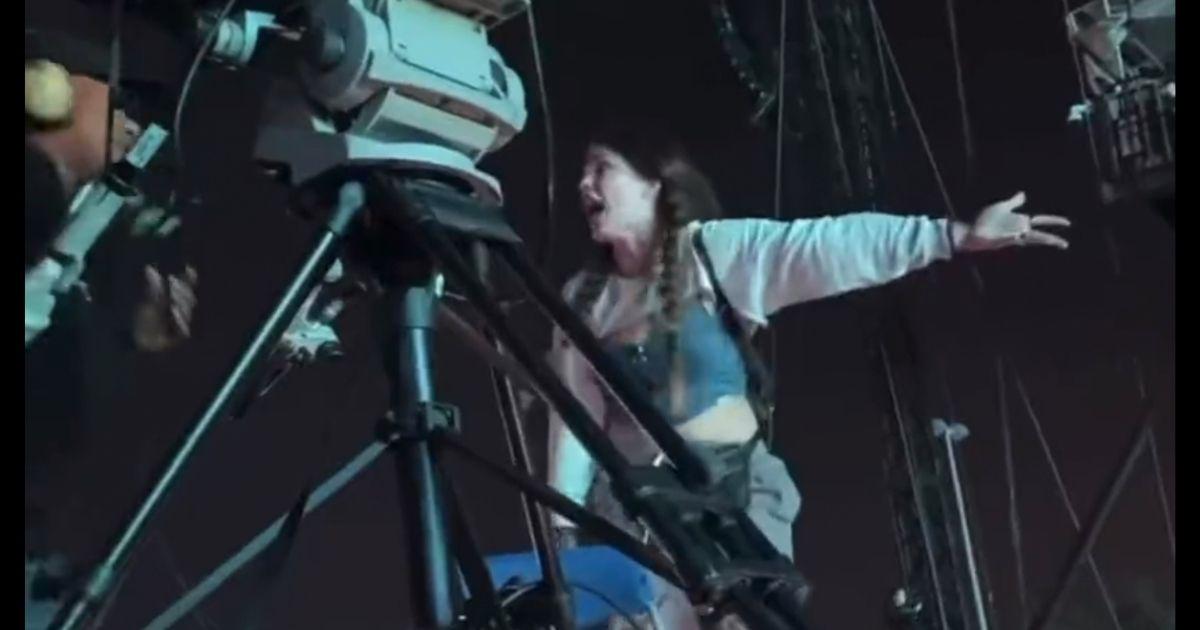
Seanna Faith McCarty screamed at a cameraman that people in the crowd were dying.Photo credit: @Ashmelym/Twitter

When you cram a mass of humanity onto a stadium floor, and those humans are fans of the performer on stage in front of them, anything can happen. People have been crushed in mosh pits before—the Who and Pearl Jam concerts have seen multiple fans trampled to death in a concert, for example.

So when eight people were killed and dozens more injured at rapper Travis Scott’s Astroworld Musical Festival in Houston last Friday, it was definitely tragic but not totally unprecedented. What was hard for people to grasp was how the tragedy was handled in real time by the people with power to do something about it.

Viral video shows two young concertgoers desperately trying to get a cameraman to stop the show because people were dying. One of them, Seanna Faith McCarty, pleaded with him to tell someone to stop the show, pointing toward the crowd and saying that people were dying. Another concertgoer, identified on Twitter as Ayden Cruz, stood on the ladder of the camera platform and also yelled at the cameraman to stop the show.

Watch:


https://twitter.com/Ashmelym/statuses/1457001681376452608

Here’s another angle of the attempt to alert the crew member to the deadly situation on the ground.

However, no one stopped the show. According to Insider, at one point, Scott can be heard over the loudspeaker saying: “Who asked me to stop? You all know what you came here to do.” Insider also reports that concertgoer Cody Hartt said he alerted security that people were being crushed, and they allegedly responded, “We already know, and we can’t do anything to stop the show. They’re streaming live.”

McCarty detailed the story of how she ended up on the camera platform, desperately trying to get someone to stop the show and do something about the deadly conditions in the crowd.

She described how she and her friend had wanted to be close to the stage, but ended up a ways back, on the side near a walkway. They were surrounded by chest-high metal barriers, and she said after waiting two hours for the concert to start, “Every gap was filled. Where your feet were placed was where they stayed.” The energy of the crowd rose as the start time neared.

“Within 30 seconds of the first song, people began to drown—in other people,” she wrote.

“There were so many people. Tall men, women. Women and men where the only thing they could see was the back of the person in front of them. The rush of people became tighter and tighter. Breathing became something only a few were capable of. The rest were crushed or unable to breathe in the thick, hot air. My friend began to gasp for breath, and she told me we needed to get out. We tried. There was nowhere to go. The shoving got harder and harder. If someone’s arms had been up, it was no longer a possibility to put it down. So, people began to choke one another as the mass swayed. It became more and more violent.”

She went on to describe how people were screaming for help and begging security for help.

“None of that came,” she wrote. “We continued to drown. More and more. One person fell, or collapsed, it doesn’t matter how it started. Once one fell, a hole opened in the ground. It was like watching Jenga tower topple. Person after person were sucked down. You could not guess from which direction the shove of hundreds of people would come next. You were at the mercy of the wave. I watched my friend be dragged away from me and lost sight of her. I began to realize in that moment that there is a way to die that no many people know about. Being trampled to death.”

McCarty described the “shrieks of animals” and “sinkholes of people” all around her. She was shoved toward the ground and saw the body of a man, followed by “layers of fallen people.”

“I felt a primal fear rip through me, and I’m not sure anyone understood the magnitude of the situation below,” she wrote. “I screamed there were people on the floor. There were people. Unconscious. Being trampled by every foot that slammed into the ground as each individual tried to keep themselves upright.”

A man finally grabbed her and pulled her out and away from the sinkhole of people. She was able to make her way to the back of the crowd, where she found people “just standing there. Like nothing was happening. Like people weren’t dead a few feet from them.”

She spotted the cameraman on the platform and climbed the ladder to get his attention. She pointed to the hole, telling him people were dying. He told her to get off the platform.

“I screamed over and over again,” she wrote. “He wouldn’t even look in the direction, so I pushed the camera so it pointed toward where I had just come from. He became angry. He called someone else up. I told him the same thing. People were dying, we needed to stop the music, we needed help, we needed attention towards the mass because I thought if only these people were aware, maybe they would do something. The other man grabbed my arm, and told me he would push me off the 15ft platform with no sides if I didn’t get down. I told him to help. I told him people were dying. I showed him where. He wouldn’t look in the direction either. I was in disbelief. Here were two people that could actually do something. Had the power to do something. Cut the camera, call in backup, pause something. They did nothing.”

Then the crowd started booing at her. “They pointed their fury at me, unleashed a rage,” she wrote. “I screamed people were dying over and over. No one would listen.”

Finally, she climbed down from the platform and called 911. The operator told her they were calling the medical team in. She told them over and over that the concert needed to be paused to give the crowd light and awareness of the deaths. Nothing happened.

Two medical workers arrived and McCarty explained what she’d seen. They said they’d gone in and seen nothing. Two girls who had also been in the pit were nearby and explained what and where it was and they all led them to it. They climbed over the barrier and went through the people.

In her post, McCarty reassured readers that her friend made it out okay. But at least eight concert-goers were killed in the melee and 25 were taken to the hospital, including a 10-year-old in critical condition, according to USA Today. The names of the victims has been released: Mirza Danish Baig, 27; Rodolfo Peña, 23; Madison Dubiski, 23; Axel Acosta Avila, 21; Franco Patino, 21; Jacob Jurinek, 20; Brianna Rodriguez, 16; and John Hilgert, 14.

Here’s to the people like Seanna McCarty who did everything in their power to get help for the people trapped in and trampled by the crowd. In the face of a frenzied mob, keeping your head and having the courage to take action is admirable, especially considering how many people neglected their basic sense of humanity in this situation.
  • Pop music’s most famous phone number now connects callers to a cancer support helpline
    Jenny's number can now help cancer patients.Photo credit: TutoneJJ/YouTube & Canva

    Since the 1980s, one particular phone number has earwormed its way into pop culture’s collective memory. That number? 867-5309 (which you probably just sang in your head). Today, however, that memorable number doesn’t belong to Jenny anymore. Thanks to Tommy Tutone’s frontman, dialing it now connects cancer patients to a support group.

    Tommy Heath, the lead singer of Tommy Tutone, teamed up with the Cancer Support Community to secure the number for its free support helpline. In an exclusive interview with People, Heath shared how cancer has affected him as he’s gotten older, noting that he is dealing with “minor” skin cancer himself.

    “I have some family members who are struggling with cancer,” he told People. “I’m out on tour with a lot of bands and suddenly somebody’s not there.” 

    The song’s prank-filled past

    The song “867-5309/Jenny” reached No. 4 on the Billboard Hot 100 in 1982. However, its catchy, memorable chorus led to a wave of stories beyond music. It also sparked years of prank calls, with people asking for “Jenny” whenever they dialed the number—both during the song’s heyday in the 1980s and decades later.

    The Cancer Support Community’s hotline provides expert support from trained specialists who offer personal guidance, information, and a listening ear for cancer patients. Having such a recognizable phone number helps ensure people know exactly which number to dial for help. After learning this, Heath stepped in, wanting to give back after getting so much from the number that made him famous.

    “I need to give back to the community, the people who have supported me all these years,” he told People. “I’m going to do what I can…I’d be happy if this was an enduring legacy, and made people smile and give them hope.”

    Now, when someone dials the number using the 272 area code (or “CSC,” for “Cancer Support Community”), it connects them to a professional who can help people with cancer.

    At 78, Heath is still going strong, performing live. And yes, he still happily plays and sings “867-5309/Jenny” for the crowds that support him.

    If you need additional or specialized support in your battle against cancer, visiting the American Cancer Society’s website can help. Searching for and connecting with professionals there can provide patients with additional resources, including in-person, local support.

  • Grocery store’s produce section concerts give indie musicians a live venue. People want more.
    A band plays in the produce section of Fiesta Fresh Market. Photo credit: Fiesta Fresh Market/YouTube
    ,

    Grocery store’s produce section concerts give indie musicians a live venue. People want more.

    “We need this right now in the world…Real humans doing real human things.”

    On the outside, Fiesta Fresh Market looks like just another neighborhood grocery store in New Castle, Delaware. Inside the produce section, however, customers can listen to local bands perform their latest songs live and in person. These “Mercadito Sessions” have since evolved from a simple community offering into a full-fledged live music event.

    While grocery stores and live music don’t typically mix, at Fiesta Fresh Market, it’s part of the family. The Aguilar Garcia family, who run the store, have music in their roots—especially co-owner José Luis Aguilar Garcia, who works in the music industry.

    In the hope of helping Mexican American bands gain more exposure, José and his family offered their produce section as a space for Latin musicians to perform for customers. They were inspired by National Public Radio’s “Tiny Desk Concerts,” which feature artists performing live in a confined space.

    These produce section mini-concerts, dubbed “The Mercadito Sessions,” initially puzzled customers. Over time, however, shoppers came to welcome and enjoy the live music, with some even visiting just for the performances. Then, posts on the store’s social media featuring the bands began to go viral.

    “The idea is to highlight independent artists from the area,” José told CBS Philadelphia. “Because it’s getting more attention online, people are excited. They’ll ask when we’re doing the next one.”

    Commenters on the store’s Instagram celebrated the market’s concert concept:

    “This is so cool. Not everyone wants to go to bars and/or have to stay up late to hear live music. I love this so much.”

    “Honestly this is the absolute coolest thing ever.”

    “Amazing music scenes going on everywhere, love the magic being shared.”

    “We need this right now in the world…Real humans doing real human things.”

    “Such an innovative and creative idea! 🥹💫”

    @fiestafreshmarket

    Just put the bananas in the bag bro @erre6ixx

    ♬ original sound – Fiesta Fresh Market

    While the Mercadito Sessions showcase Mexican regional music, they are open to any genre. As the series gained attention online, many bands reached out to Fiesta Fresh Market to get booked. Several acts have come to perform and record as customers pick out fresh fruits and vegetables.

    Concerts for the community, by the community

    Musicians and customers alike say these concerts provide a sense of community among Latin Americans living in Delaware. They not only celebrate their culture, but also showcase it to others in New Castle.

    “It gives us a platform to portray who we really are,” musician Jesús Beltran Méndez told CBS Philadelphia. “There’s a lot of misconceptions about who we are. There are bad people. There are good people. We are just human.”

    @fiestafreshmarket

    @Los K-Bros “Ya No Me Llames” (Unreleased) live desde Fiesta Fresh Market

    ♬ original sound – Fiesta Fresh Market

    Demand for the music has grown so much that the grocery store is now hosting and promoting a full-fledged concert event. What was once a place to buy groceries has become a spotlight for the community—all by offering a small space in an aisle.

  • A ‘gentleman’ reveals 4 reasons why men suddenly stopped wearing fancy hats in the ’60s
    Men wearing hats speak in the 1930s.Photo credit: Mitchell Library, State Library of New South Wales/Wikimedia Commons
    ,

    A ‘gentleman’ reveals 4 reasons why men suddenly stopped wearing fancy hats in the ’60s

    Men and women once went out wearing hats, and then suddenly, they disappeared.

    One of the most striking things about real-life footage of Americans from the advent of the camera until around 1970 is that nearly all men, and many women, are wearing hats. In footage from the 1940s, for example, men boarding the subway to go to work are almost always seen in fedoras, trilbys, or homburgs. Earlier clips show them in bowlers and top hats.

    It’s as if, before TV turned color, Americans were a nation of conformists who all dressed the same way. So how did men across the Western world go from wearing hats every day for decades to suddenly going bareheaded? Preston Schlueter of the Gentleman’s Gazette outlines four reasons in a YouTube video with more than 2 million views.

    Four reasons why men stopped wearing hats

    1. Climate control

    “One of the biggest reasons for the loss of hat-wearing is likely that we now have better control over our indoor climate than we used to,” Schlueter says. “This is also why men can now go in and out of doors wearing sometimes fewer than two layers of clothing, and why things like gloves and scarves aren’t as popular as they used to be.”

    2. Social class

    “Social class was an incredibly important aspect of Western society, and people were absolutely expected to know their place,” Schlueter says. “But, after the horrors of war brought every social class just a bit closer, we began to focus more on the individual, rather than on the class in which they resided. As a result, then, the practice of wearing clothing and, particularly, hats to signify yourself as part of a distinct group has become largely extinct.”

    hats, vintage hats, old-timey fashion, top hat
    A man and woman wearing hats at the turn of the century. Photo credit: Adományozó/Wikimedia Commons

    3. Highways and cars

    Back in the day, when transportation consisted of subway cars, trolley cars, horse-drawn buggies, or horseback travel, there was plenty of headroom, even for someone wearing a top hat. However, with the advent of the automobile, headroom in vehicles changed drastically.

    “Look up at the ceiling in your own car. How much headroom do you have there? The answer is probably not much, perhaps even for a relatively soft or short hat style,” Schlueter says. “Simply put, modern cars aren’t built to accommodate the hat styles of old.”

    bogart, bacall, the big sleep, classic films, movie stills
    Lauren Bacall and Humphrey Bogart in The Big Sleep. Photo credit: Warner Bros./Wikimedia Commons

    4. The Internet

    “In the last decade and a half or so, hats like the fedora and trilby have gained an increasingly negative reputation thanks to Internet memes from websites like 4chan, Reddit, and Tumblr,” Schlueter says. “Indeed, for some younger members of our audience, when we mention fedoras, they might first think of the infamous ‘tips fedora’ meme. Because there are now thousands of these easily spreadable memes all over the Internet, the fedora, in recent years, took on a decidedly less-than-cool reputation.”

    Hats are due for a comeback

    In the end, there are many reasons people stopped wearing fancy hats every day. It appears to be a confluence of historical events, technological progress, and social pressures that influenced this major shift in fashion. But that doesn’t mean the era of the hat is gone forever. If one thing is certain, what goes out of fashion is always bound to come back.

  • Comedian Jack Shep steals new ‘SNL UK’ scene with impeccable Princess Diana impression
    Comedian Jack Shep as Princess Diana in a "Saturday Night Live UK" sketch. Photo credit: Sky TV/YouTube

    Saturday Night Live UK debuted over the weekend on Sky TV (and Peacock in America), and already, one performer is a fan favorite.  In a skit titled “David Attenborough’s Last Supper,” the famed naturalist, played by George Fouracres, invites several of “history’s greatest Britons,” who have been resurrected thanks to his brother Richard Attenborough’s “Jurassic Park technology.”

    Naturally, the sketch featured a slew of impressive celebrity impersonations, from Freddie Mercury to Winston Churchill to Agatha Christie. But even in a sea of notable performances, it was comedian Jack Shep’s Princess Diana who really stole the show.

    Watch:

    While Shep’s Diana does speak here and there—thanking Attenborough for the invitation and reassuring Freddie Mercury that if a menu item “has an asterisk next to its name, then it comes with free rice”—most of the laugh-out-loud moments come from her coy, flirtatious glances at the camera while others are speaking. The People’s Princess has, after all, long been a queer icon. But this takes things to a whole new level.

    Reactions

    One leisurely scroll through the YouTube comments makes it clear that Shep was a fan favorite. Many are eager for Diana to become an SNL UK staple.

    @gaytimes

    Saturday Night Live UK premiered last night and we can’t stop thinking about Jack Shep’s impersonation of gay icon Princess Diana! The British version of the long-running US sketch show debuted with host Tina Fey and musical guest Wet Leg. ‘The Last Supper with David Attenborough’ saw a dinner party featuring a number of resurrected British icons, including Princess Di, Freddie Mercury and Elizabeth I 👏 #snl #princessdiana #diana #tinafey #saturdaynightlive

    ♬ original sound – GAY TIMES

    “The way he was eyeing the camera was hilarious.”

    I hope that Diana becomes a regular that randomly pops up in episodes to steal the show as she/he does here.”

    “Princess Di was to die for.”

    “I loved Princess Di but that Jack Shep impression was the funniest thing I’ve seen in ages.”

    “Hope she’s a recurring visitor…”

    “The Diana impression is an instant classic. Absolutely spot on.”

    “The star of this show is definitely the person that played Princess Diana.”

    Perhaps this comment says it best:

    “Princess Di was uniquely special in real life and this actor does do her memory justice even though it’s a silly comedy skit. I feel she might have had a good laugh about the whole thing and it’s not disrespectful at all.”

    Though Shep undoubtedly helped win favor among viewers, the overall reaction to an across-the-pond version of SNL has been mixed.

    Some things, like host Tina Fey’s opening monologue and the edgier “Weekend Update” segment, have been mostly well-received.

    However, some critics have lambasted the show as a “tepid cosplay” of its American predecessor, arguing that it copies the format without adding a unique touch. Still, even those critics seem to agree that certain elements need time to develop before the show can be fully assessed.

    One promising sign is that, much like SNL in the U.S., SNL UK can give relatively unknown comedians like Shep a chance to share their gifts with the world. That certainly seems like a win-win for everyone.

  • Brit shares the one-word ‘dead giveaway’ that American actors can’t do in an English accent
    Peter Dinklage on "Game of Thrones"Photo credit: Warner Bros Discovery
    ,

    Brit shares the one-word ‘dead giveaway’ that American actors can’t do in an English accent

    “There is one word that is a dead giveaway that an English character in a movie or a TV show is being played by an American.”

    When it comes to actors doing accents across the pond, some Americans are known for their great British accents, such as Natalie Portman (“The Other Boleyn Girl”), Robert Downey, Jr. (“Sherlock Holmes”), and Meryl Streep (“The Iron Lady”). Some have taken a lot of heat for their cartoonish or just plain weird-sounding British accents, Dick Van Dyke (“Mary Poppins”), Kevin Costner (“Robin Hood: Prince of Thieves”) and Keanu Reeves (“Bram Stoker’s Dracula”).

    Some actors, such as Tom Hardy (“The Drop”) and Hugh Laurie (“House”), have American accents so good that people have no idea they are British. Benedict Townsend, a London-based comedian and host of the “Scroll Deep” podcast, says there is one word that American actors playing characters with a British accent never get right.

    And no, it’s not the word “Schedule,” which British people pronounce the entire first 3 letters, and Americans boil down to 2. And it’s not “aluminum,” which British and American people seem to pronounce every stinking letter differently.

     
    @benedicttown

    The one word American actors aways get wrong when doing an English accent

    ♬ original sound – Benedict Townsend

    What word do American actors always get wrong when they do British accents?

    “There is one word that is a dead giveaway that an English character in a movie or a TV show is being played by an American. One word that always trips them up. And once you notice it, you can’t stop noticing it,” Townsend says. “You would see this lot in ‘Game of Thrones’ and the word that would always trip them up was ‘daughter.’”

    Townsend adds that when British people say “daughter,” they pronounce it like the word “door” or “door-tah.” Meanwhile, Americans, even when they are putting on a British accent, say it like “dah-ter.”

    “So, top tip if you are an actor trying to do an English accent, daughter like a door. Like you’re opening a door,” Townsend says.

    Townsend later confirmed in a follow-up video that he and his wife identified the American actor in Netflix’s “A Good Girl’s Guide to Murder” within moments of hearing her speak. He also noted in an interview that “America” itself may be one of the hardest words for non-Americans to pull off convincingly in an American accent — which adds a pleasing layer of irony to the whole thing.

    As it turns out, the problem runs both ways.

    Some American commenters returned the favor by sharing the word that British actors never get right when using American accents: “Anything.”

    “I can always tell a Brit playing an American by the word anything. An American would say en-ee-thing. Brits say it ena-thing,” Dreaming_of_Gaea wrote.

    “The dead giveaway for English people playing Americans: ‘Anything.’ Brits always say ‘EH-nuh-thin,’” marliemagill added. “I can always tell an actor is English playing an American when they say ‘anything.’ English people always say it like ‘enny-thin,’” mkmason wrote.

    What is the cot-caught merger?

    One commenter noted that the problem goes back to the cot-caught merger, when Americans in the western US and Canadians began to merge different sounds into one. People on the East Coast and in Britain pronounce them as different sounds.

    “Depending on where you live, you might be thinking one of two things right now: Of course, ‘cot’ and ‘caught’ sound exactly the same! or “There’s no way that ‘cot’ and ‘caught’ sound the same!” Laura McGrath writes at DoYouReadMe. “As a result, although the different spellings remain, the vowel sounds in the words cot/caught, nod/gnawed, stock/stalk are identical for some English speakers and not for others.” For example, a person from New Jersey would pronounce cot and catch it as “caht” and “cawt,” while someone from Los Angeles may pronounce them as “caht” and “caht.”

    To get a better idea of the big difference in how “caught” and “cot” are pronounced in the U.S., you can take a look at the educational video below, produced for a college course on linguistics.

    American actors owe Townsend a debt of gratitude for pointing out the one thing that even the best can’t seem to get right. For some actors, it could mean the difference between a great performance and one that has people scratching their heads. He should also give the commenters a tip of the cap for sharing the big word that British people have trouble with when doing an American accent. Now, if we could just get through to Ewan McGregor and tell him that even though he is fantastic in so many films, his American accent still needs a lot of work.

    This article originally appeared last year.

  • One seemingly simple question stumped all three Final Jeopardy contestants in 1984
    "Jeopardy!" contestants ready to competePhoto credit: Rosemaryetoufee
    ,

    One seemingly simple question stumped all three Final Jeopardy contestants in 1984

    It was only Alex Trebek’s second day on the job when all three contestants gave the same wrong answer and all ended up with $0.

    The popular game show “Jeopardy!” originated in 1964, and for six decades it has stumped contestants and viewers with tough trivia questions and answers (or answers and questions, to be more accurate). Competing on “Jeopardy!” is practically synonymous with being a smartypants, and champions win lifelong bragging rights along with whatever monetary winnings they take home.

    To win “Jeopardy!,” you place a wager in the Final Jeopardy round with whatever money you’ve collected through the first two rounds. All three contestants write down their wagers based solely on the category given, then they have 30 seconds to write down the question for the same answer after it’s revealed. Very rarely do all three contestants get the Final Jeopardy wrong.

    But in 1984, on Alex Trebek’s second day hosting the show, a deceptively simple Final Jeopardy answer resulted in all three contestants making the same wrong guess and ending the round with $0 each.

    The category was “The Calendar,” and after the contestants placed their bets, the answer was revealed: “Calendar date with which the 20th century began.”

    The 20th century was the 1900s, as most of us are aware, and all three contestants wrote down identical responses: “What is January 1, 1900?” But they were all incorrect. And unfortunately, all three had wagered their entire amount, leaving them with nothing across the board.

    “Oh, I don’t believe it!” exclaimed one of the contestants as they all laughed at the absurdity. “I’m at a loss for words,” said Trebek.

    A member of the audience asked what the correct answer–or question— was, and Trebek shared that the correct response would have been “What is January 1, 1901?”

    If that seems confusing, it’s probably because we all made a huge deal about the year 2000, marking it as the end of the 20th century as well as the turn of the millennium. But basically, we were wrong. Some people did point it out at the time, but the excitement and momentum of celebrating Y2K had us all in a frenzy and no one was going to wait until January 1, 2001 to celebrate the new millennium.

    jeopardy!, alex trebek, jeopardy! host, uso gala, trebek
    “Jeopardy!” host Alex Trebek at the 2016 USO Gala. Credit: Jim Greenhill/Wikimedia Commons


    Why should we have? It all comes down to the fact that in the Gregorian calendar, the first year wasn’t 0 A.D., it was 1 A.D. The first century spanned from 1 to 100 A.D., the second century from 101 to 200 A.D. and so on, leading up to the 20th century officially being from 1901 to 2000. So January 1, 1901 is actually the date that the 20th century began, despite how unintuitive it feels.

    To be fair, you’d think a “Jeopardy!” contestant might recognize that the question seemed awfully simple for a Final Jeopardy round, but only having 30 seconds to think under pressure is tough. And it’s not like these people lived in the internet era where random trivia questions like this regularly go viral, making us more aware of them. And this episode aired over a decade before the “Seinfeld” episode where Jerry explains the “no year zero” thing to Newman, who had planned a millennium party.

    As one person pointed out, the calendar answer is technically correct, but it’s not the way the average person thinks of centuries, just as a tomato is technically fruit but the average person thinks of it (and uses it) as a vegetable. Even though there were some sticklers about the year 2000, most of us just went along with seeing it as the turn of the millennium because it felt like that’s how it should be. It’s kind of wild how most of us can think of something incorrectly but we just sort of collectively accept our wrongness about it.

    The 1984 episode, making a viral comeback, also prompted people to share how much they missed Alex Trebek. The beloved, long-time “Jeopardy!” host died in 2020 at age 80 after an 18-month battle with pancreatic cancer. He worked up until the point where he couldn’t anymore, even while undergoing chemotherapy. His final episode included a touching tribute honoring his 37 seasons with the game show, the end of an illustrious and iconic era.

    Ken Jennings, former “Jeopardy!” champion with the record for the longest winning streak, has been the sole host of the show since late 2023, after previously sharing hosting duties with Mayim Bialik.

    This article originally appeared last year.

  • When an autistic 12-year-old showed up to back his mom in court, his reactions to her violations stopped the room
    A judge presiding over the courtPhoto credit: Canva

    A clip from Caught in Providence, the nationally syndicated courtroom show that made Judge Frank Caprio one of the most beloved figures on the internet, captured a hearing that stopped the room cold in the best possible way.

    A woman named Michelle Verdayo had come to the Providence Municipal Court to answer for four red light violations. She brought her 12-year-old son Arion, who is on the autism spectrum and has ADHD. Arion introduced himself the moment they arrived.

    “I am Arion. A-R-I-O-N. I am 12 years old, I’m in the seventh grade.”

    Caprio, already won over, asked what Arion wanted to do after school. The boy said he was still deciding, but that he definitely wanted to be successful. “It’s hard to decide,” he told the judge. “When you’re at that age, you don’t know what you wanna do. At some points you wanna do what you wanna do but you don’t want to disappoint your family in any way.” Caprio looked at him for a moment. “You are speaking with the maturity of an adult,” he said.

    Then they pulled up the footage.

    As Caprio walked through each violation, Arion watched alongside his mom, offering live commentary. Some of the red lights, he allowed, seemed fairly minor. Then came the clip of his mom nearly hitting another car. Arion gasped. “How dare you!?” The courtroom broke.

    “You think you know your mom,” he said, shaking his head, “and she goes out and blatantly does that.”

    Caprio turned to Michelle with a grin. “You are being chastised right now, and rightfully so. You’ve got a great kid.”

    A woman testifies in court. Photo credit: Canva

    When Caprio asked about Arion’s autism, Michelle was candid. It had been hard, she said, especially with his father out of the picture. As she spoke, Arion stepped in, not to deflect but to reframe it entirely. He told Caprio that despite being teased, he had never seen his diagnosis as a problem.

    “I’m proud to have my autism because it makes me who I am now.”

    Caprio paused. “I am so impressed.”

    He invited Arion up to the bench, shook his hand, and asked for his verdict. The boy picked up the gavel, brought it down, and announced: “Case dismissed.”

    (L) 12-year-old Arion Verdayo speaks to the judge. (R) Judge Frank Caprio speaks during hearing. Photo course: Facebook | Caught In Providence

    “You won your case,” Caprio told Michelle. “Your boy presented you well.” He closed by echoing something Arion had said earlier: “Just because you’re different doesn’t mean that you should be treated differently, because we’re all human beings.”

    Judge Frank Caprio presided over the Providence Municipal Court for nearly four decades and built a YouTube following of close to three million subscribers through Caught in Providence. He died on August 20, 2025, at 88, after a battle with pancreatic cancer. He was remembered widely as the nicest judge in the world. It is not hard to see why.

    This article originally appeared two years ago.

Pop Culture

Comedian Jack Shep steals new ‘SNL UK’ scene with impeccable Princess Diana impression

Pop Culture

Brit shares the one-word ‘dead giveaway’ that American actors can’t do in an English accent

Pop Culture

One seemingly simple question stumped all three Final Jeopardy contestants in 1984

Culture

When an autistic 12-year-old showed up to back his mom in court, his reactions to her violations stopped the room