Video: Resilient reporter gets hit by a car and keeps doing her job

Former “Saturday Night Live” star Tina Fey once said that live television will “never be perfect, but perfect is overrated. Perfect is boring on live TV.” Who knows that better than TV reporters, who are sent out to brave extreme weather events, interview members of the general public and get quotes from sweaty athletes on…

wsaz tv, tori yorgey, reporter hit by car
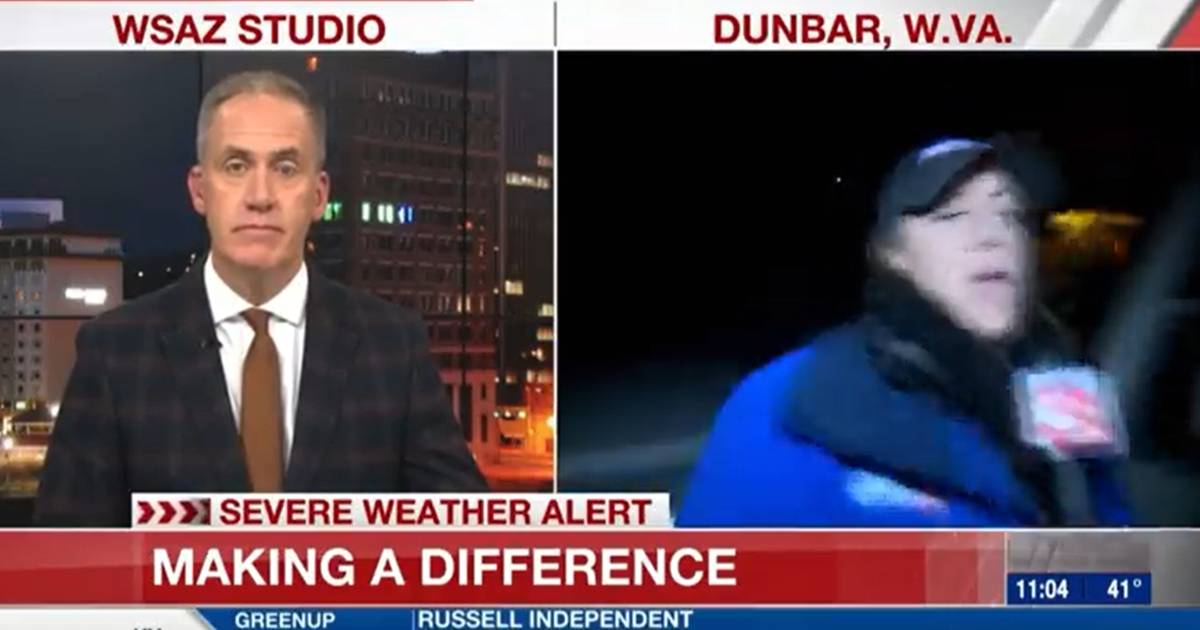
WSAZ's Tim Irr and Tori Yorgey.Photo credit: via Lee K. Howard / Twitter

Former “Saturday Night Live” star Tina Fey once said that live television will “never be perfect, but perfect is overrated. Perfect is boring on live TV.”

Who knows that better than TV reporters, who are sent out to brave extreme weather events, interview members of the general public and get quotes from sweaty athletes on the sidelines.

TV reporters are trained to handle just about anything that comes their way, but I’m sure none of them have ever been trained to stay on the air after being blindsided by a car.


Tori Yorgey of NBC affiliate WSAZ was reporting about a water main break on the side of the road in Dunbar, West Virginia when she was struck by a car on live television. “Oh, my God! I just got hit by a car, but I’m OK,” Yorgey told anchor Tim Irr.

Yorgey was knocked out of frame for a while but she regained composure and bragged that it wasn’t the first time it’s happened. “I actually got hit by a car in college just like that,” she explained.

What makes Yorgey even more resilient is that she was all alone when it happened. She set up her own camera and had to put the shot back in order after the car plowed through.

Some people who saw the video thought that Irr’s reaction to his coworker being struck by a car was a little cold. But he later cleared things up by saying he wasn’t able to see her get hit by the car.

After finishing her report, Yorgey went to the hospital to be checked out and she’s said to be doing fine.


  • 21 years ago, Halle Berry made history by turning a Razzie into one of her most iconic performances
    Halle Berry made history by turning a Razzie into one of her most iconic performances.Photo credit: Razzie Channel/YouTube & Canva

    In 2004, the film Catwoman (directed by a French visual effects supervisor known simply as Pitof) was unleashed on the world, and it did not go well. The movie received scathing reviews, landing at 8% on Rotten Tomatoes (with an audience score of 18%). This didn’t go unnoticed by the Golden Raspberry committee, which bestowed seven nominations on the film, including Worst Picture, Worst Screenplay, and Worst Actress for Halle Berry.

    Did this stop Berry from having a good time? Absolutely not. In 2005, she created one of the most iconic power moves Hollywood has ever seen.

    For those unaware, the Golden Raspberry Awards (better known as the Razzies) began in 1981 as a satirical antithesis to the Oscars. The idea was that if filmmakers received prizes for “good work,” they should also have to accept awards for the “best worst” movies.

    So when Berry “won,” she didn’t just take it in stride. She used it as a reminder that she’s one of the entertainment business’ most incredible performers.

    Posted on the Razzie YouTube page, we see two presenters announce her name: “Halle Berry for Catwoman.” The crowd claps and laughs as we see a clip of Berry in the film, sniffing catnip manically.

    “Ladies and gentlemen—Halle Berry.” The crowd erupts as Berry, clad in a beautiful black dress, comes roaring onto the stage holding both her Razzie and her Oscar, which she received in 2002 for her work in Monster’s Ball. She feigns shock and excitement as the crowd jumps to its feet for a standing ovation.

    Berry’s speech

    “Oh my gosh,” she yells into the mic while milking every cheer. She pretends to hyperventilate, perhaps even tearing up a bit. “Thank you, guys! Thank you so much! I never in my life thought I’d be up here winning a Razzie.” The crowd laughs uproariously. “I mean, it’s not like I ever aspired to be here, but thank you!”

    What she does next is on another level. She holds up her Oscar and screams, “And no, I don’t have to give this back—it’s got my name on it!” Now the audience knows she’s in charge. She composes herself and says, “Ya know? I’ve got so many people to thank, because you won’t win a Razzie without a lot of help from a lot of people. So please indulge me and let me go through this.”

    Spoofing an Academy Award acceptance speech, she begins her list of “gratitude.” “First of all, I want to thank Warner Bros. Thank you for putting me in a piece-of-s–t, God-awful movie! It was just what my career needed, ya know? I was at the top, and then Catwoman just plummeted me to the bottom. Love it!”

    She pauses, then says, “It’s hard being on top. It’s much better being on the bottom.” The list continues. “I want to thank my manager, Vincent Cirrincione,” she says, and ushers him onto the stage. Cirrincione humbly listens while she kids, “This guy loves me. He loves me so much that he tells me I’m the greatest actress who ever was. He loves me so much that he convinces me to do projects even when he knows they’re s–t!”

    He humbly nods and plays along. “My only advice to you, Vinnie, is next time I do a movie—if I get a chance to do another movie—maybe you should read the script? Just counting the zeroes behind the one really isn’t enough. You’ve really got to read the script. Love you, man. Love you!”

    Berry is far from done.

    “I want to thank my agent and lawyers, who obviously don’t give a s–t. They’re not here tonight, but love you guys! I want to thank the writers—all twenty of them—for thinking this was a good idea.” She adds, “You tried, hey.”

    She couldn’t do it alone

    Now it’s time for her fellow actors to receive some love.

    “I want to thank the cast. You know, it’s really important. In order to give a bad performance like I did, you need a lot of bad actors around. So I want to thank all of them for being bad right along with me! One of them is here—Alex Borstein. Come on out!”

    Borstein, who played Sally, the “sassy best friend,” mugs and chews the scenery onstage as she stumbles out with fake tears. The crowd cheers. After they calm down a bit, Berry gets more serious. “One of the best things about Catwoman is I got to make some really wonderful lifelong friendships, and this lady is one of them.”

    Borstein composes herself and gazes into Berry’s eyes. She continues, “And you know what? I want to thank you for every single day looking up at me and telling me I was doing a great job—that I was the best Catwoman you ever saw. I want to thank you for lying straight to my face every day. You know, in Hollywood they lie behind your back, but she lied straight to my face!”

    Again, the crowd goes wild as Berry refocuses her energy. “I also want to thank our director, Pitof—you know, that one-name French guy? Thank you very much.” She admits his accent made it hard to take direction. “I mean, I didn’t know what the hell he was saying, but I’m sure it showed in my performance. But it was truly a joy and a pleasure.”

    Her acting coach is now on deck: “I want to thank my acting coach, Ivana Chubbuck. She just wrote a book called The Power of the Actor. You all should rush to get it. It could change your life too.”

    Berry ends on a serious note, saying, “When I was a kid, my mother told me that if you could not be a good loser, then there’s no way you could be a good winner. If you weren’t able to take criticism, then you were not worthy of getting your praise.”

    She then shares a story of having begun in beauty pageants and learning to control her rage when she lost. “So as you can imagine, I wanted to slap the s–t out of the Razzie people that brought me here tonight. But I won’t do that. I’ll do what my mother taught me and I’ll stand here graciously. I’ll take the criticism—take it as a lesson learned—and hope to God I never see these people ever again. Thank you all!”

    The response

    The audience claps with joyous applause. So did the comment section. On the official YouTube page, there are over 4,000 comments, with one reading, “This lady is classy as hell! Anyone who accepts their Razzie in person has my respect, and the delivery was absolutely priceless!”

    Another comment references the time Adrien Brody gave a six-minute speech for his Best Actor win for the film The Brutalist. The YouTuber jokes, “This speech is longer than Adrien Brody’s 6-minute speech, and hers is undeniably not a second wasted.”

    A clip circulating on Instagram has nearly 18,000 likes and a heap of support for her talent and her sense of humor. One person jokes, “The fact that she brought her Oscar…”

  • Texan who moved to the UK shares 3 ‘mortifying’ experiences that almost made her want to leave
    A woman in a cowboy hat and a woman in a phone booth in the UK. Photo credit: Canva

    If you’re looking to move abroad from the United States, the United Kingdom seems like a natural candidate on its face. After all, moving to the UK means you’ll already speak the language, be relatively familiar with the country’s political structure, and exist within a similar pop culture and media ecosystem.

    But many people who move to London or its surrounding areas are stunned to learn just how different American and British cultures can be.

    Ashley Jackson recently moved from Amarillo, Texas, to South Manchester. She’s been documenting her journey acclimating to the new culture on her TikTok channel. Recently, she shared three “mortifying” experiences that almost made her rethink her new life in the UK.

    texas, london, uk, america, americans, living abroad, UK culture, american culture, cultural differences
    London at night. Photo credit: barnyz/Flickr

    In the tongue-in-cheek post, she reiterates that despite the difficulties and hilarious flops that have arisen from her new life, she’s still having a great time living in Manchester. But things were certainly touch-and-go for a while at first.

    “One, I’ve had a full-on conversation with a person and I didn’t understand a lick of it. She had a very different accent I couldn’t understand,” Jackson says.

    Accents and regional dialects in the UK are among the most diverse and wide-ranging in the world. In the U.S., there are subtle differences between Southern, Cajun, and Northeastern accents, for example. But that’s nothing compared to what even locals encounter in the UK. Even they sometimes have a hard time understanding more niche or obscure dialects like Glaswegian or Devonian. Most Americans are woefully unprepared for the accents they encounter there.

    Issue number two for Jackson? “It hailstoned. While on a hike up a hill, it rained, hailstone, my daughter was crying. Everyone was wet, soggy, feet muddy. Quite traumatizing for all of us, but we’re still here.”

    Weather in the UK can be all over the map, but one thing the region is famous for is rain and hail. Heatwaves and climate change have only contributed to hailstones becoming larger and more frequent. In another video, Jackson says acclimating to the weather in the UK has been a challenge, noting that she had to “toughen up.”

    And finally, issue number three: “I was cut off by my GP (general practitioner) after the 10-minute mark. I didn’t realize there were 10-minute time slots for doctor’s appointments. Learned that one the hard way.”

    One big appeal of living in the UK is the mostly free healthcare provided through the NHS. However, appointments can be hard to come by, and many doctors are strict about keeping visits under 10 minutes so they can manage their patient load. Jackson was stunned to be “cut off” in the middle of a visit, but for locals, that’s just the way it goes.

    Americans moving to the UK often experience extreme culture shock. We sometimes expect the cultures to be so similar that the small differences that do exist catch us completely off guard.

    The language, though fundamentally similar, can take Americans a while to pick up on. British culture is full of slang, regional dialects, and colloquialisms that can be confusing for outsiders. One American who moved there, for example, was baffled when everyone kept calling her cookies “biscuits.”

    A lot of American daily conveniences either don’t exist in the UK or are far more rare. Air conditioning and garbage disposals, for example, are hard to come by. Houses and living quarters in general are much smaller than what most Americans are used to as well.

    Work culture is very different in the UK as well. Citizens usually have a stronger work-life balance and a government-mandated minimum of five weeks of paid vacation.

    In short, moving from America to the UK won’t necessarily be easy just because of the common language. Whether you ultimately enjoy American or British culture more is a matter of taste, but it will take some getting used to—that’s for sure.

    As for Jackson, she says in her videos that even if the adjustment wasn’t easy, she loves the rain, the NHS, and the walkability of life in the UK. She just had to stick it out through a few embarrassing faux pas before she could start enjoying all the perks.

  • 15 things tourists notice in the U.S. that Americans totally miss
    A family poses in front of a home with an American flag.Photo credit: Canva
    , ,

    15 things tourists notice in the U.S. that Americans totally miss

    “I’ve lived in the US my whole life. Somehow, I’ve never noticed this before.”

    Tourists see new places with fresh eyes and fresh observations. In 2024, 72.4 million tourists visited the United States, according to the National Travel and Tourism Office. (That’s a lot of eyes seeing America in a new light.)

    Tourists to the States have pointed out that Americans really do like to put ranch dressing on everything. They’ve also noted that in the U.S., squirrels seem to run rampant.

    While these are insightful observations, most Americans would say they already know them to be true. On Reddit, Americans shared the shocking realizations they had about the U.S. that were only revealed to them by tourists.

    As one American noted, “I’ve lived in the US my whole life. Somehow, I’ve never noticed this before.”

    These are 15 eye-opening things tourists brought to Americans’ attention that truly blew their minds:

    Culture

    “We sure do have a lot of flags everywhere.” – myfourmoons

    “American coins don’t have numbers on them.  Some of the coins will say ‘One Cent’ or ‘Quarter Dollar’ but I don’t think that’s helpful if your English is not so good. And sometimes that labeling is just not in a place that easy to see on a coin.” – chocotacogato

    Michael White, a former spokesman for the United States Mint, told The Gainesville Sun that the reason coins in the U.S. don’t have numbers is simple: “It is an artistic choice in the majority of instances.”

    White added that certain coins in the past in the U.S. have used numerical notations, including the dime, nickel, and quarter. The article notes, “From 1809 to 1836, there was a half dollar imprinted with ’50 C.’ That was changed to ’50 cents’ for two years and then, in 1838, artistic choice deemed it should be called ‘half dollar.’”

    “The gap around the stall doors in public restrooms. It’s weird, and I hate it.” – SidheRa

    “So. Many. Insurance. Commercials.” – Reddit_Talent_Coach

    “Bank drive-thru lanes. I was told ‘why don’t you just get out of your car and walk in the bank?’” – JWilsn_Art

    According to Wells Fargo, “motor banks” (aka drive-in and drive-thru banks) were invented in the U.S. and came into existence in the 1930s.

    “That every morning, all American children from kindergarten to 12th grade, stand before the US flag (found in every classroom, ofc) and recite “the pledge of allegiance” to the country in unison, with their right hands over their hearts. Upon learning this universal American school experience, my Russian colleague said: ‘That is the most Comm*nist thing over ever heard!’” – jzzdancer2

    The Pledge of Allegiance, written by Francis Bellamy, debuted in 1892, according to the American Legion. Over the years, it went through various edits until it was recognized by Congress and included in the U.S. Flag Code on June 22, 1942.

    “How much daily life revolves around cars. In many cities, if you don’t drive, you basically don’t exist. It’s convenience on steroids.” – Prior_Bank7992

    Mannerisms

    “That Americans switch between hands when eating with silverware, cutlery, etc.” – BasilRevolutionary38

    Called the “cut-and-switch” table habit, it’s described by NPR as when you “hold your fork in your left hand and cut with your right and then put down your knife so you can switch your fork to your right hand before you take a bite.”

    Americans actually adapted this use of cutlery from the French. Writer Mark Vanhoenacker explained to NPR, “Americans got it from France in the 19th century even as France was giving it up, and no one knows why France gave it up. Maybe just convenience or another change of fashion.”

    “We smile too much. To the point where foreigners, specifically Asians (Korean and Chinese) have pointed out that our smiles feel disingenuous and mean nothing. Really hit home, but despite that, I still smile ‘too much’.” – BMdabbleU

    “How much casual socializing we do with strangers. From small talk to things people in other places consider weirdly intimate (like talking about health problems).” – Practical-Water-9209

    “The lean! The fact that people from the U.S. tend to lean on things while standing, no matter how inappropriate a place or circumstance. I’ve thought about it, and I think its because the U.S. (for the most part) isn’t walkable, so we aren’t used to standing for as along as other countries.” – Lobstertales143

    The Central Intelligence Agency has deemed the “American Lean” a dead giveaway that someone is an American. In 2019, Jonna Mendez, the CIA’s former chief of disguise, and Gina Haspel, former CIA director, told NPR that Europeans can easily spot Americans in a crowd.

    “They think that we are slouchy, a little sloppy,” Mendez said. “And they think that they can almost see that in our demeanor on the street because they stand up straight. They don’t lean on things.”

    Food

    “Root beer tastes like medicine. It’s still my favorite soda but… yeah it tastes mediciney.” – TheNerdNugget

    “Had a German foreign exchange student and she said ‘All American breakfast is dessert. Pancakes, donuts, Cinnabon, muffins, French toast…’ I was like yea you have a point lol.” – dom954

    Words

    “Apparently Americans use the word ‘awesome’ a lot. I’ve had people in other countries tease us for how we think everything is awesome lol. But to be fair, tons of things ARE awesome, and also you’re talking to me on vacation when I’m in the best mood of my life lol.” – Gold_Telephone_7192

    “‘Yeah’ ‘Yeah no’ ‘Yeah right’ ‘Oh yeah’ ‘Hell yeah!’ All mean different things!” – zippy_97

  • Italian exchange student ‘forced’ to try Olive Garden for the first time. His reaction has people rolling.
    Olive Garden breadsticks and a perturbed boy wearing glasses.Photo credit: Olive Garden & Canva

    Oh, Olive Garden. The hold you have on our American souls. We know it’s about as authentic to Italian food as Taco Bell is to Mexican food, but does that make the breadsticks and Alfredo sauce any less addictive? No, certainly not.

    Still, one cannot expect an actual Italian person to hold the same fondness. And yet, one American host mom insisted on introducing her Italian exchange student to it anyway.

    In a hilarious three-part series, we see Rhonda, an American, tell Alessandro, an Italian, “Today’s your lucky day! We are taking you to dinner at a very special place!” She then does her best to coax Alessandro out of the car and into the Olive Garden where they’re currently parked.

    Alessandro was “not mentally ready” for Olive Garden

    @italiangirl1130

    @alessandro.salimei trying @Olive Garden for the first time @It’s the one and only Jade 🙃 @Lou Pimber @Muahdp #foreignexchangestudent #olivegarden #foryoupage #funnyvideo #fyp

    ♬ original sound – Italiangirl1130

    Alessandro, however, is NOT feeling it and even asks if there was a McDonald’s nearby where they could go instead. He then declares, “I’m not going anywhere.”

    After several pleas, all to no avail, Alessandro eventually gives in. Though he clarifies, “This is something against my will, just so you know,” as he passes the “Benvenuto!” sign.

    Scouring the menu, poor Alessandro can’t help but exclaim, “Mamma mia! Why am I here?!” When Rhonda suggests getting the fettuccine Alfredo, he looks downright appalled. You can actually catch his nostrils flaring.

    @italiangirl1130

    @alessandro.salimei @Olive Garden Part two taking our foreign exchange student to Olive Garden… #houston #italy #foryoupage #funnyvideo #foreignexchangestudent

    ♬ original sound – Italiangirl1130

    The real history behind the very American fettuccine Alfredo

    As Rhonda points out in the video, Alfredo sauce would not be found in Italy—at least not the thick, cream-laden version we know here in the United States. The original Roman dish, made by Alfredo di Lelio around 1908, was simply butter and Parmesan tossed with hot pasta water to create a silky coating.

    As legend has it, silent film stars Mary Pickford and Douglas Fairbanks—one of Hollywood’s first power couples—tasted the dish while in Rome and loved it so much they popularized it back home. With the American mentality often being “more is more,” the recipe eventually evolved into the heavier, cream-based sauce known today. Another theory is that Italian immigrants adapted the recipe to American tastes. Either way, American sensibilities are to blame.

    Back to Olive Garden…

    Holding his head in his hand, Alessandro eventually orders the fried mozzarella and calamari (honestly, solid choices), which he seems to enjoy well enough. He also tries the fried ravioli. Though he cannot quite comprehend why ravioli needed to be fried in the first place, he graciously labels it “interesting,” which feels like the international diplomatic way of saying, “I only tolerate this.”

    But you know what? He absolutely DEVOURS those breadsticks and Alfredo.

    “I feel like I’m betraying Italy right now,” he says, clearly enjoying the salty, creamy, oh-so American indulgence. Alfredo di Lelio must be rolling in his grave!

    The series ends with Alessandro being forced to reconcile with what we Americans know to be true: Olive Garden is in no way, shape, or form authentic, but it is super tasty nevertheless. He may never admit this back home, but in that booth, surrounded by unlimited carbs and a very pleased host mom, he cannot deny the appeal.

    Wonder if he’ll ever be brave enough to try the chicken parm…

  • 3-year-old ventures outside in the pitch black to save his great-grandma after scary fall
    A 3-year-old rescued his grandma after she fell and hit her head.Photo credit: Canva

    A lot of parents feel guilty about letting their kids watch TV. But a little bit of screentime isn’t always a bad thing. There are shows with legitimate educational value like Ms. Rachel or Sesame Street. Educational programming can be an amazing way for kids to accelerate their learning of counting, the alphabet, and social behaviors.

    In some rare cases, they can learn even more than that from their favorite TV shows: Like bravery and strength. Just take it from 3-year-old Bridger Peabody.

    Bridger is just three years old but the toddler is already adding “hero” to his resume before he even starts preschool.


    toddler hero, Denver boy saves grandma, heroes, grandma, grandma babysitting, grandparents, family, 911
    Not all heroes wear capes; some wear blankies. Giphy

    Bridger is a huge fan of the show Paw Patrol, which came in handy when an emergency took place while he was being babysat by his great-grandmother Sharon Lewis, 77.

    The two were home alone when the unthinkable happened, “Gigi,” which is what Bridger calls his grandma, suffered a terrifying and violent fall. Lewis uses a walker to get around and must’ve become unsteady on her feet while maneuvering the wheeled walker inside.

    The pair were outside enjoying some playtime before everything went south. As they were making their way inside from playing in the backyard, Lewis fell—but it wasn’t just a normal trip and fall. The great-grandma didn’t land on her knees, bottom, or even her hands—which probably would caused enough damage. When Lewis fell, she forcefully hit her head on the cement steps and blood quickly rushed from her wound—but that wasn’t the end of her problem.

    The two were alone, and there was no one else around to help.

    “I tripped over something and fell and hit my head on the concrete step,” Lewis tells Inside Edition.

    The elderly woman was unable to move and her cell phone was not with her. Since she was home alone with the toddler, she realized he was the only one there who could help her.

    So, she instructed him to get her phone from her car. Bridger may be young, but he knew his grandmother was hurt and needed his help. There were a couple of stumbling blocks for Bridger to overcome, though, the first one being that the phone was in the car, not inside the house. The second was that the sun had set and the toddler is afraid of the dark. Venturing out into the darkness alone to get his great-grandma’s cellphone was a monumental task for the little guy.

    This is where Paw Patrol comes in. The show is popular with toddlers and preschoolers, and depicts cartoon dogs of different breeds donning uniforms from various help and service professions (firefighter, police, construction, etc.) to rescue different fictional animals. It shows kids the importance of bravery, team work, and kindness—which Bridger clearly picked up on.

    The little guy knew that it was dark outside, but he also knew he needed to help his great-grandmother—so he braved the dark channeling his inner Paw Patrol character.

    The whole thing was captured on the Peabody’s security camera and it’s just as amazing and adorable as you would expect.

    Bridger even gives himself a little pep talk as he navigates the nighttime darkness to retrieve the cell phone so Gigi can call 911. You can see Bridger holding his blankie in the night vision security camera as he walks to the car repeating, “Don’t be afraid.”

    The boy opens the car door and excitedly exclaims, “YAY! I did it!” when he gets inside the car.

    When the interior light turned on in the car, Bridger could clearly see the phone and was able to grab it and bring it back to his grandmother, allowing her to call 911.

    The ambulance came to take Lewis to the hospital where she received 22 staples in her head. She’s now home safely recovering all thanks to the bravery of her three-year-old great grandson.

    Social media users couldn’t get enough of the story of bravery, and it quickly went viral. Commenters chimed in with their admiration:

    “Not all hero’s wear capes, some of them hold blankies.”

    “Grandma’s hope in Bridger overcame his fear! May they always be bonded, and continue to make lasting memories together!”

    “him telling himself dont be scared is one of the cutest and bravest things i have seen that was special.”

    “Paw Patrol company needs to give that young warrior something special.”

    “Yay!! I did it!!” My heart melted. What an adorable little boy, and so strong. He saved his Gigi’s life that day. Bless him!!!”

    Gigi is doing well and, with the media frenzy dying down, Bridger is returning to life as a normal 3-year-old. But he and his Gigi will be bonded for life over what happened, that much is for sure. The young man might have a bright future in helping others ahead of him with the bravery he’s displayed so far in his short life.

    This article originally appeared last year. It has been updated.

  • The real-life love story of Maria and Georg Von Trapp we didn’t see in ‘The Sound of Music’
    Maria Von Trapp was not in love with Georg when they got married, but that changed.Photo credit: Public domain

    The Sound of Music has been beloved for generations, partially for the music (and Julie Andrews’ angelic voice), partially for the historical storyline, and partially for the love story between Maria and Georg Von Trapp. The idea of a nun-in-training softening the heart of a curmudgeonly widower, falling in love with him, and ultimately becoming a big, happy family is just an irresistible love story.

    But it turns out the real love story behind their union is even more fascinating.

    maria von trapp, georg von trapp, the sound of music, love story, history
    Maria Von Trapp (left) was played by Julie Andrews and her husband Georg was played by Christopher Plummer in Photo credit: Public domain

    The National Archives has collected information about what’s fact and what’s fiction in The Sound of Music, which is based on a real family in Austria named Von Trapp. The film was generally based on the first section of Maria Von Trapp’s 1949 autobiography, The Story of the Trapp Family Singers, with some of the details being true and others fictionalized for a movie audience.

    For instance, Maria was actually hired on as a tutor for just one of Georg’s children, not as a governess for all of them. The children, whose names, ages and sexes were changed, were already musically inclined before Maria arrived. Georg was not the cold, grumpy dad he was portrayed as in the beginning of the film, but rather a warm and involved parent who enjoyed making music with his kids. Maria and Georg were married 11 years before leaving Austria, not right before the Nazi takeover. The Von Trapps left by train, not in a secret excursion over the mountains.

    But perhaps the most intriguing detail? Maria was not in love with Georg at all when they got married.

    gif, the sound of music, von trapp family, movie, true events

    Sound Of Music Flag GIF by The Rodgers & Hammerstein Organization Giphy

    It doesn’t initially make for a great Hollywood romance, but the Von Trapp love story began with marriage for other reasons and evolved into a genuine love story. Maria wrote that she fell in love with Georg’s children at first sight, but she wasn’t sure about leaving her religious calling when Georg asked her to marry him. The nuns urged her to do God’s will and marry him, but for Maria it was all about the children, not him. When Georg proposed, he asked her to stay with him and become a second mother to his children. “God must have made him word it that way,” Maria wrote, “because if he had only asked me to marry him I might not have said yes.”

    “I really and truly was not in love,” she wrote. “I liked him but didn’t love him. However, I loved the children, so in a way I really married the children.”

    However, she shared that her feelings for Georg changed over time. “…[B]y and by I learned to love him more than I have ever loved before or after.”

    The idea of marrying someone you don’t love is antithetical to every romantic notion our society celebrates, yet the evolution of Maria’s love for Georg has been a common occurrence across many cultures throughout history. Romantic love was not always the primary impetus for marriage. It was more often an economic proposition and communal arrangement that united families and peoples, formed the basis of alliances, and enabled individuals to rise through social ranks. Some cultures still practice arranged marriage, which limited research has found has outcomes identical to love-first marriage in reports of passionate love, companionate love, satisfaction, and commitment. The idea of marrying someone you don’t already love is anathema to modern Western sensibilities, but the reality is that people have married over the centuries for many reasons, only one of which is falling in love.

    Maria’s marriage to Georg actually was about falling in love, but not with him. She loved his children and wanted to be with them. It definitely helped that she liked the guy, but she wasn’t swept off her feet by him, there were no moonlit confessions of love a la “Something Good,” and their happily ever after love story didn’t come until much later.

    Ultimately, Maria and Georg’s love story was one for the ages, just not one that fits the Hollywood film trope. And it’s a compelling reminder that our unwritten rules and social norms determining what love and marriage should look like aren’t set in stone. Do marriages for reasons other than love always evolve into genuine love? No. Do marriages based on falling in love first always last? Also no. Should a marriage that starts with “like” and develops into to a genuine, deep love over years be considered “true love” in the way we usually think of it? Who can say? Lots to ponder over in this love story.

    But Maria’s description of learning “to love him more than I have ever loved before or after” is a pretty high bar, so clearly it worked for them. The Von Trapps were married for 20 years and had three more children together before Georg died of lung cancer in 1947. Maria would live another four decades and never remarried. She died in 1987 at age 82 and is buried next to Georg on the family’s property in Vermont.


    This article originally appeared last year It has been updated.

  • 20 forgotten foods and drinks from the 1980s that Gen Xers are still hankering for
    Foods from the 1980s that Gen X is nostalgic for.Photo credit: Reddit/algebramclain/dannyhogan200

    In the 1980s, food was entering a new era of convenience. A big reason was more women continuing to enter the workforce throughout the ’80s—a trend that began in the 1960s and peaked in the late 1990s, according to the U.S. Bureau of Labor Statistics.

    With more women working jobs outside the home, convenience and frozen foods became more popular. Thus, the 1980s marked the height of microwave cooking.

    By the mid-1980s, microwaves had become standard kitchen appliances, notes the Henry Ford Museum. Cooking was all about saving time.

    “The act of eating—once a leisurely undertaking synonymous with pleasure and social interaction—has been reduced to a necessary function not unlike shaving or refueling a car,” wrote New York Times reporter Dena Kleiman, according to The International Wine & Food Society.

    While homemade meals were becoming more rare, they made way for a robust processed and snack foods market. Many of these foods defined Gen X childhoods and are now making a comeback in 2026 with the “newstalgic” food trend: modern consumers are craving nostalgic flavors, according to Food Dive.

    On Reddit, Gen Xers got nostalgic about the foods that filled their pantries, fridges, freezers (and stomachs) back in the 1980s. From microwave meals to sweets and drinks, these are the ’80s foods and drinks they miss most.

    Microwave meals

    “Soggy fries [from MicroMagic] while staying home sick from school and watching either The Price is Right or Gilligan’s Island.” – CompleteTruth

    “Chef Boyardee Smurf pasta. DEEEEEP memory unlocked!” – sevnthcrow, ButIAmYourDaughter

    “I miss Pepperidge Farm Broccoli & Cheese Puff Pastries.” – pixietulip

    “Weaver chicken croquettes.” – Klutzy-Reporter4223

    “Yes! Jeno’s Pizza [Rolls] Snacks. They were, like, dollar coin size and there was a row of cheese, a row of pepperoni, and a row of crumbled italian sausage. And anyone who comments with anything regarding bagel bites OBVIOUSLY never had Pizza Snacks. I would LOVE for them to come back. Bagel Bites SUCK!” – Accomplished-Push190

    “Chef Boyardee Roller Coasters.” – Chef Boyardee Roller Coasters

    Snacks

    “Hot buttered Cheerios. When I told people I grew up eating buttered Cheerios, they thought I was nuts.” – electric_pole_6

    “Fruit Wrinkles fruit snacks. These were so good!” – JenaPet02

    “Pizzarias pizza chips.” – LittleWhiteFuzzies

    “I occasionally crave the Peanut Butter Boppers. I think I convinced my mother they were heathy since they were created by Nature Valley granola.” – jfdonohoe

    Sweets

    “Pudding pops! They were so good. They finally discontinued them several years ago.” – Adelaide_Farmington

    “Giggle cookies. I KNEW there was a reason why Trader Joe’s pumpkin Oreos were bringing back memories!!!! I just couldn’t remember what!!” – laurenishere, Altruistic-Win9651

    “Hostess Teenage Mutant Ninja Turtles pies. Man we’re these tasty. I remember exactly what shelf they were on at my neighborhood convenience store, I can see it now. Lol. Good memories!” – The_OtherGuy_99, Ok_Owl5141

    “Nestle Alpine White— sweet dreams you can’t resist.” – Metzger4Sheriff

    “PB Max bars.” – my-coffee-needs-me

    Drinks

    “I remember BRIM coffee. ‘Fill it to the rim with BRIM’.” – User Unknown

    “Hi-C Peach.” – LdyWarner

    “I lived on Five Alive juice as a kid. Damn do I miss it.” – kardde

    “I miss Slice soda.” – wookie_opera_singer

    “I also liked Like cola.” – DiscoSprinkles

  • Non-Americans share the 13 dead giveaways a tourist is American
    A group of Americans looking at a map. Photo credit: via SoStark/Flickr
    ,

    Non-Americans share the 13 dead giveaways a tourist is American

    “Americans recognize other Americans in most countries because they smile at strangers on the street.”

    It’s wonderful to go on vacation and learn all about other people’s cultures. But when you travel to another country, you also learn a lot about your own. When you’re a fish out of water, it’s easy to see the ways you stand out in a foreign environment. It’s especially noticeable when you’re an American, because your culture is known around the world.

    A big way Americans stand out overseas is through their fashion. Wearing a New York Yankees cap, cargo shorts, and white New Balance sneakers may be camouflage in America, but in Paris, you stick out like peanut butter on a baguette.

    americans, american tourists, americans aborad, americans on holiday, tourists,
    Americans looking at a map. Photo credit: tAlex Bikes/Flickr

    To reveal the many ways Americans stand out while traveling, a Reddit user asked non-Americans a simple question: “Besides their accent, what’s one way you know a tourist is American?” The post received over 18,000 responses. Evidently, there are a lot of ways to spot an American abroad.

    Here are 13 of the best responses:

    1. They wait to be seated

    “When visiting Paris, my wife and I learned they don’t seat you at restaurants. You just walk in and sit down at an available table. We figured it out after standing around at the entrance a few times. Then we started noticing other American tourists doing the same.”

    2. They start conversations with everyone

    “Saying ‘hi, how are you?’ to the barista, servers, retail workers. My country doesn’t quite have that culture so I find it really sweet.”

    “I’m fascinated with Norway and remember watching a vlog from an American who had moved there. She said one of the biggest differences was the lack of politeness, because people view it as fake. I would love to live somewhere that’s more introverted than the US.”

    “The absolute fearlessness of asking anyone on the street about anything.”

    “This is something i still don’t understand after being in Europe for a few years. Why are people so afraid of other people just like them?”

    “I’ll literally talk to anyone that wants to chat me up, never thought that was uniquely American.”

    americans, american tourists, americans aborad, americans on holiday, tourists,
    Americans filming on a city street. Photo credit: Joseph Tame/Flickr

    3. The smile is a dead giveaway

    “When I went to Italy with a friend, I couldn’t figure out why everyone greeted me in English before I said a word. I don’t wear running shoes outside of the gym, I dress pretty posh, I can’t remember the last time I owned a baseball cap, and I try to have a basic grasp on the local language. How can they tell I’m American? My friend told me, ‘it’s because you’re smiling at them.’”

    “It’s not so much about the fact that Americans smile, it’s how you smile. Nobody here smiles with their teeth. Maybe if they heard a really funny joke or are trying to look happy in a picture, but that’s about it. When I visited America, my family literally spent hours trying to learn how to properly smile with all your teeth showing. I still can’t do it correctly, it looks weird. I remember the first times I saw pictures from a highschool yearbook on the internet. I thought, ‘What is wrong with them? Why are they smiling so much?’ If you smile with your teeth at someone in Europe, it’s either your job, or you’re American.”

    “Americans recognize other Americans in most countries because they smile at strangers on the street.”

    “I live in New York, I don’t understand this smiling thing.”

    Why do Americans smile so much? It’s because they come from a diverse country. A study of 32 different countries found that emotional expressiveness is correlated with diversity. When people are around others from diverse cultures, they are more likely to use a smile to build trust and cooperation.

    4. Americans are very polite

    “Some of yous are way more polite than expected. Whenever I hear someone say ‘ma’am’ I know they’re American. Like one time I was in Lidls and there was an American family asking someone who worked there if they sold ‘cell phones’ and when the woman said they didn’t they were all ‘oh okay, thank you for your time ma’am! Have a great day!’ which is mucb more cheery than the average Scot.”

    “Yes, sir, that’s southern manners.”

    “I’m gonna piggyback the Midwest in here, too. If you just walk away without putting something like this in Kansas, you might as well have slapped them.”

    americans, american tourists, americans aborad, americans on holiday, tourists,
    American tourists. Photo credit: Canva

    5. Americans are friendly

    “Most American tourists I’ve come across are really friendly and talkative. They always seem to be genuinely stoked to be here haha.”

    “Let’s put it this way: in the Eurozone, you can make a day trip of going to another country. For most of the US, getting to literally any other country is a massive ordeal with a huge price tag, so when we get to go, it’s a really special occasion that we have to make the most of because a lot of us have no idea when or if we’ll ever get to do it again.”

    6. They are amazed by old things

    “Girlfriend used to work on a farm and an estate in the U.K. and would often have Americans in awe of the old buildings. One once said ‘some of these buildings are older than my country.’”

    “Reminds me of that old saw ‘Americans think a hundred years is a long time, Europeans think a hundred miles is a long way.’”

    7. They need to find a trash can

    “If you see an American in Japan, they will frantically look for public trash cans. The absence of trash receptacles is something unfounded in the US, and we become confused at the idea of having to hold it for extended periods of time.”

    “EXACTLY!! Im American, went last year and i ended up having half of my backpack filled with trash until i found a trashcan, it didnt help it was mid summer so we would buy drinks from vending machines a lot, not all the vending machines had trashcans.”

    americans, american tourists, americans aborad, americans on holiday, tourists,
    An urban dumpster. Photo credit: Canva

    8. They won’t stop tipping

    “Tipping. Americans will try to tip everyone, even in countries where tipping isn’t a thing/is considered a serious insult.”

    “True. I used to work in a bar in the UK, and American customers would insist on tipping me even after I declined. The relief on their faces when I took the money was hilarious.”

    9. They shop late at night

    “They’re looking for a store open at like 11 pm. Even if in most European countries stores close at like 7-8 pm.”

    “Yeah, I’m italian but live in the US right now. One of my coworkers went to Italy on vacation and she was texting me stuff like ‘there’s no circle k here?’ Lmao.”

    10. Just look at their feet

    “Americans will be wearing sneakers.”

    “Yep. I walked into a museum in Germany, and the woman selling tickets greeted us in English. We were dressed conservatively, and hadn’t said a word, yet she knew. I asked her how, and she said, ‘It’s your shoes.’ Indeed, I was wearing running shoes.”

    Although there is no specific reason why Americans tend to wear sneakers more often than people in other countries, a major factor is car culture. When you don’t walk much, you value comfort and style over everything else. Plus, America is a country based on individuality, which breeds a culture that’s more casual than in other developed countries.

    11. They take off their shoes in the airport

    “I hear that us Americans can easily be spotted in the airport by the fact usually were use to taking off our shoes in TSA.”

    “Dude when we landed in Japan a couple of years ago I started to take my shoes off to go through customs and I’ll never forget, one of the agents there just completely froze and looked at me like I had frogs coming out of my ears. He then motioned for me to put my shoes back on. I was very embarrassed.”

    12. It’s how Americans dress

    “Baseball caps, University spirit wear, cargo shorts, free t-shirts from events with ads and text all over them, and for the older Americans, they always seem to just kinda stand in the middle of everything looking around.”

    “People may mock Americans for wearing shirts with ads on them but Europeans and their soccer (ahem, football) gear is just as questionable.”

    “As opposed to football jerseys with ads prominently featured on the design that the wearer paid good money for.”

    “For the longest time, I thought that there was a soccer team named Fly Emirates.”

    americans, american tourists, americans aborad, americans on holiday, tourists,
    A peanut butter sandwich. Photo credit: Canva

    13. They’re looking for peanut butter

    “If they buy peanutbutter. It sounds very weird, but everyone who buys peanut butter where I work, turns out to be American.”

    “I was desperately homesick while living in Belfast and had a quiet cry in the grocery store because I wanted it and couldn’t find it. I eventually did, made a peanut butter and jelly sandwich, and felt better. Not seeing the sun for three months was doing my head in.”

    Interestingly, although Americans are stereotyped as the biggest consumers of peanut butter in the world, it’s actually much more popular in developing nations such as Burkina Faso, Myanmar, and Chad, where it is used as a nutritional supplement and an ingredient in soups and stews.

Kids

Mississippi church posts new ‘loud kid policy’ on Facebook and people are raving

Life Hacks

Happiness researcher shares 4 ‘big habits’ the world’s happiest people engage in daily

Identity

15 things tourists notice in the U.S. that Americans totally miss

Wholesome

Italian exchange student ‘forced’ to try Olive Garden for the first time. His reaction has people rolling.