upworthy
Add Upworthy to your Google News feed.
Google News Button
Men's Health

These men bravely shared their own harrowing abusive-relationship stories

This is what being a real man looks like.

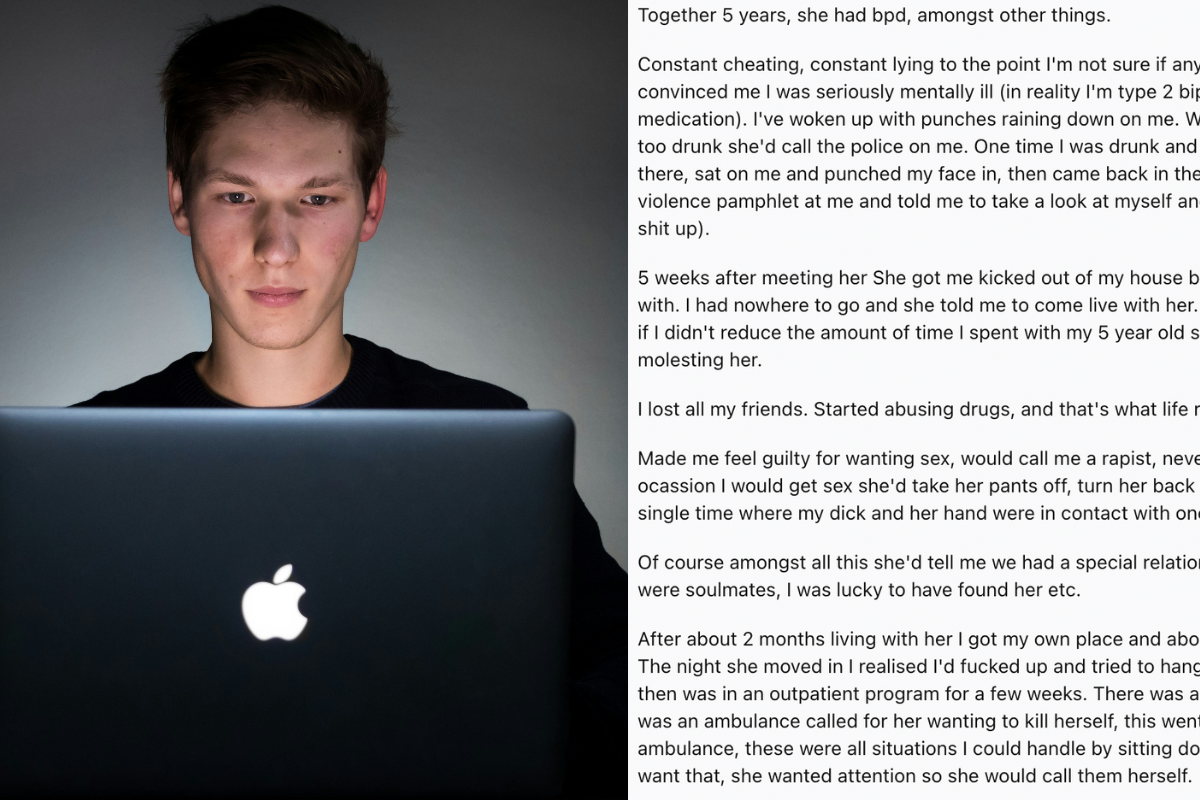
Man typing on computer splitscreen with long block of text
Grzegorz Walczak/Unsplash & Reddit

Many of us are familiar with the signs of an abusive relationship.

Physical violence is only one of many. Extreme jealousy, verbal insults, controlling behavior, and victim blaming are all hallmark signs that someone is an abusive partner, according to the National Coalition Against Domestic Violence.

What we rarely talk about, though, is that for as often as men are the perpetrators of abuse, they can just as easily be victims.


Hundreds of men recently took to Reddit to share their own harrowing stories of abusive relationships.

As many as 1 in 4 men have been victims of some form of physical abuse by a partner. For women, it's as many as 1 in 3.

That's a staggering percentage of people.

The grim and heartbreaking thread helped shed some light on an under-recognized reality: Abuse is abuse, and it has no gender.

Here are some of the main takeaways from the powerful thread, which is worth a full-read.

Note: Last names have been left out to protect victims of abuse.

1. The support system for men who are victims of abuse is extremely poor.

Robert, who shared his story of an abusive relationship in the thread, wrote that his ex would threaten him and lash out physically, but no one would ever take his complaints seriously.

"She would throw knives at stuff and wreck the house," he wrote. "I went through 16 police calls before one of them finally gave her a charge for assault."

When the two were finally separated (he writes that she was arrested on a separate charge), he had to turn to information meant for battered women for help putting his life back together.

The sad truth is that the shelters and groups out there dedicated to helping men in abusive relationships are depressingly scarce.

2. Men can be victims of physical abuse too. Often at the detriment of their "manhood."

a man looking at his cell phone in the dark

Photo by Richard Stachmann on Unsplash

It's hard enough for many men being abused to find people who'll believe them. It's made even tougher that they might be made out to look like less of a man if they come clean.

"It's like I was supposed to just take it because I was a man," Robert wrote.

Tom, another man who shared his story, wrote that he was "embarrassed" when his ex would hit him during arguments, in public, but that he never even considered it abuse until long after they broke up.

Research supports the idea that men might be even less likely than women to report physical abuse. And we wonder why phrases like, "Man up!" are so harmful.

3. The patterns of abusive behavior are consistent whether abusers are men or women.

Another Reddit user, William, said he wasn't allowed to hang out with certain people his partner didn't like, and the controlling and manipulative behavior took a heavy toll on him.

"I knew deep down no matter what I did to try and make her happy it was never good enough. I never felt so useless," he wrote.

Many men in the thread, like Richie, wrote that the psychological trauma from their abusive relationship was the most difficult thing to reconcile and recover from.

Mood swings, illogical fights, and suicidal threats from Richie's partner pushed him to a breaking point.

"It wore me down to the bone," he wrote. "I was a shell of myself at one point."

The original thread on Reddit makes one thing abundantly clear: The problem of partner violence and abuse is likely much bigger than many people realize.

Over 10 million men and women in the United States are victims of physical domestic abuse every year; a number that doesn't include behaviors like lying, threats, and manipulation.

Toxic concepts of masculinity can sometimes lead to men becoming abusers, but as this thread shows, they can also paralyze men who need help.

Fixing our culture's broken idea of what makes a man could be a crucial step toward ending domestic violence and abuse for both men and women.

In the meantime, we can listen to the victims' stories. Everyone, man or woman, deserves to be heard.

If you or someone you know is in an abusive relationship and wants to seek help, start by contacting the National Domestic Violence Hotline, which offers support for men, women, and children.


This article originally appeared on 4.12.17

Planet

Our favorite giveaway is back. Enter to win a free, fun date! 🌊 💗

It's super easy, no purchase or donation necessary, and you help our oceans! That's what we call a win-win-win. Enter here.

Our favorite giveaway is back. Enter to win a free, fun date! 🌊 💗
True

Our love for the ocean runs deep. Does yours? Enter here!

This Valentine’s Day, we're bringing back our favorite giveaway with Ocean Wise. You have the chance to win the ultimate ocean-friendly date. Our recommendation? Celebrate love for all your people this Valentine's Day! Treat your mom friends to a relaxing spa trip, take your best friend to an incredible concert, or enjoy a beach adventure with your sibling! Whether you're savoring a romantic seafood dinner or enjoying a movie night in, your next date could be on us!

Here’s how to enter:


  • Go to upworthy.com/oceandate and complete the quick form for a chance to win - it’s as easy as that.
  • P.S. If you follow @oceanwise or donate after entering, you’ll get extra entries!

Here are the incredible dates:

1. Give mom some relaxation

She’s up before the sun and still going at bedtime. She’s the calendar keeper, the lunch packer, the one who remembers everything so no one else has to. Moms are always creating magic for us. This Valentine’s Day, we’re all in for her. Win an eco-friendly spa day near you, plus a stash of All In snack bars—because she deserves a treat that’s as real as she is. Good for her, kinder to the ocean. That’s the kind of love we can all get behind.


Special thanks to our friends at All In who are all in on helping moms!

2. Jump in the ocean, together

Grab your favorite person and get some much-needed ocean time. Did you know research on “blue spaces” suggests that being near water is linked with better mental health and well-being, including feeling calmer and less stressed? We’ll treat you to a beach adventure like a surfing or sailing class, plus ocean-friendly bags from GOT Bag and blankets from Sand Cloud so your day by the water feels good for you and a little gentler on the ocean too.

Special thanks to our friends at GOT Bag. They make saving the ocean look stylish and fun!

3. Couch potato time

Love nights in as much as you love a date night out? We’ve got you. Have friends over for a movie night or make it a cozy night in with your favorite person. You’ll get a Disney+ and Hulu subscription so you can watch Nat Geo ocean content, plus a curated list of ocean-friendly documentaries and a movie-night basket of snacks. Easy, comfy, and you’ll probably come out of it loving the ocean even more.

4. Dance all day!

Soak up the sun and catch a full weekend of live music at BeachLife Festival in Redondo Beach, May 1–3, 2026, featuring Duran Duran, The Offspring, James Taylor and His All-Star Band, The Chainsmokers, My Morning Jacket, Slightly Stoopid, and Sheryl Crow. The perfect date to bring your favorite person on!

We also love that BeachLife puts real energy into protecting the coastline it’s built on by spotlighting ocean and beach-focused nonprofit partners and hosting community events like beach cleanups.

Date includes two (2) three-day GA tickets. Does not include accommodation, travel, or flights.

5. Chef it up (at home)

Stay in and cook something delicious with someone you love. We’ll hook you up with sustainable seafood ingredients and some additional goodies for a dinner for two, so you can eat well and feel good knowing your meal supports healthier oceans and more responsible fishing.

Giveaway ends 2/15/26 at 11:59pm PT. Winners will be selected at random and contacted via email from the Upworthy. No purchase necessary. Open to residents of the U.S. and specific Canadian provinces that have reached age of majority in their state/province/territory of residence at the time. Please see terms and conditions for specific instructions. Giveaway not affiliated with Instagram. More details at upworthy.com/oceandate

arthur c. brooks, harvard, psychology, happiness research, bucket list

Harvard researcher Arthur C. Brooks studies what leads to human happiness.

We live in a society that prizes ambition, celebrating goal-setting, and hustle culture as praiseworthy vehicles on the road to success. We also live in a society that associates successfully getting whatever our hearts desire with happiness. The formula we internalize from an early age is that desire + ambition + goal-setting + doing what it takes = a successful, happy life.

But as Harvard University happiness researcher Arthur C. Brooks has found, in his studies as well as his own experience, that happiness doesn't follow that formula. "It took me too long to figure this one out," Brooks told podcast host Tim Ferris, explaining why he uses a "reverse bucket list" to live a happier life.


bucket list, wants, desires, goals, detachment Many people make bucket lists of things they want in life. Giphy

Brooks shared that on his birthday, he would always make a list of his desires, ambitions, and things he wanted to accomplish—a bucket list. But when he was 50, he found his bucket list from when he was 40 and had an epiphany: "I looked at that list from when I was 40, and I'd checked everything off that list. And I was less happy at 50 than I was at 40."

As a social scientist, he recognized that he was doing something wrong and analyzed it.

"This is a neurophysiological problem and a psychological problem all rolled into one handy package," he said. "I was making the mistake of thinking that my satisfaction would come from having more. And the truth of the matter is that lasting and stable satisfaction, which doesn't wear off in a minute, comes when you understand that your satisfaction is your haves divided by your wants…You can increase your satisfaction temporarily and inefficiently by having more, or permanently and securely by wanting less."

Brooks concluded that he needed a "reverse bucket list" that would help him "consciously detach" from his worldly wants and desires by simply writing them down and crossing them off.

"I know that these things are going to occur to me as natural goals," Brooks said, citing human evolutionary psychology. "But I do not want to be owned by them. I want to manage them." He discussed moving those desires from the instinctual limbic system to the conscious pre-frontal cortex by examining each one and saying, "Maybe I get it, maybe I don't," but crossing them off as attachments. "And I'm free…it works," he said.

- YouTube www.youtube.com

"When I write them down, I acknowledge that I have the desire," he explained on X. "When I cross them out, I acknowledge that I will not be attached to this goal."

The idea that attachment itself causes unhappiness is a concept found in many spiritual traditions, but it is most closely associated with Buddhism. Mike Brooks, PhD, explains that humans need healthy attachments, such as an attachment to staying alive and attachments to loved ones, to avoid suffering. But many things to which we are attached are not necessarily healthy, either by degree (over-attachment) or by nature (being attached to things that are impermanent).

"We should strive for flexibility in our attachments because the objects of our attachment are inherently in flux," Brooks writes in Psychology Today. "In this way, we suffer unnecessarily when we don't accept their impermanent nature."

What Arthur C. Brooks suggests that we strive to detach ourselves from our wants and desires because the simplest way to solve the 'haves/wants = happiness' formula is to reduce the denominator. The reverse bucket list, in which you cross off desires before you fulfill them, can help free you from attachment and lead to a happier overall existence.

This article originally appeared last year.

og talk buttons, australian shepherd, dogs, dog intelligence, animals, pets, animal intelligence, funny, viral videos
@letsgoripley/TikTok, used with permission

What a smart doggo: Australian Shepherd Ripley uses talk buttons to warn family of a pending disaster.

Dogs seem to intuitively understand human emotions, and they can be trained to understand and respond to a nearly unlimited number of words, phrases, or commands. Some experts say smarter breeds can learn hundreds of different prompts! It makes you wonder how far off they really are from truly communicating with us using something resembling language.

People have been wondering and experimenting with the idea for a long time. Speech-language pathologist Christina Hunger and her dog, Stella, were the first to experiment with talking buttons in 2019, in which Stella could press a button with her nose to activate a word sound, thereby speaking, in a sense. Since then, there has been a surge of online content showing other pet parents using similar kits to communicate with their own pups.


The most fascinating aspect of this phenomenon is whether canines can understand full-blown, complex sentences beyond “treat” and “outside.” While the overall jury is still out on that, scientifically speaking, dogs like Ripley, a 2-year-old Australian Shepherd, seem to make an incredibly compelling case for believing the hype.


 australian shepherd, dogs, dog intelligence, animals, pets, animal intelligence, funny, viral videos An Australian Shepherd. via Canva/Photos

Ripley is a great example of a dog using talking buttons to communicate

Ripley has an entire TikTok account documenting his impressive talk button journey, along with 85,000 followers. But a video posted on March 28, 2024, feels next-level.

In the clip, Ripley presses the “smell” button as his parents eat lunch. When that doesn’t get their attention, he begins to bark.

“What do you smell?” a voice finally asks. To which Ripley replies “outside,” followed by “gardens.” Confused, someone asks, “It smells like the gardens outside?” Ripley’s parents had apparently just started a load of laundry before making lunch, and the detergent had been spilling all over the floor from the washing machine. Ripley had been smelling the detergent, which was reminiscent of the gardens outside.

Unfortunately, they didn’t put two and two together until after they went back to the laundry room and saw the rapidly worsening mess. Hence, the moral of the story: “You should always listen to your dog.”


@letsgoripley

He’s so freakin’ smart! #Talkingdog #letsgoripley #ripleytalks #fluentpet #australianshepherd #dogs

Ripley’s amazing feat prompted lots of praise from over a million viewers

“All of the treats,” one person wrote.

Another added, “I’ve said this before, and I’ll say it again, he is brilliant.”

"He was so mad y'all weren't moving," someone joked.

"This is amazing!!! It’s a good thing it wasn’t an emergency like a fire or something dangerous!!!! You both seemed a little slow to realize that she was trying to warn you of something off/strange!!!" said another.

Others were quick to compliment the breed. And rightfully so, as Australian Shepherds are known for their remarkable intelligence, as well as their strong drive and exuberance, according to the American Kennel Club. They thrive when they have a job, and the way Ripley jumped into action is a pretty great example of this characteristic.

australian shepherd, dogs, dog intelligence, animals, pets, animal intelligence, funny, viral videos An Australian Shepherd. via Canva/Photos

Although we aren't 100% sure whether dogs can learn complex sentences, studies show they can distinguish among human languages. A 2023 study found that dogs can distinguish familiar human languages from unfamiliar ones and can even determine real human words from gibberish.

The whole account is pretty remarkable. In another popular video, Ripley uses the buttons to demand to see his grandma (who, no doubt, gives him lots of treats). In another, he can be seen asking for water and alerting his humans that he smells food. His owners insist that he understands what they're saying to him and uses the buttons to communicate, not just for rewards and praise.


@letsgoripley

Ripley really loves his Grandma! This happened multiple times this day. This was the first time. Stay tuned… 🐶 #australianshepherd #fluentpet #talkingdog #dogswhotalk #dogmom #dogdad #puppy #doglover #grandma #smartdog #aussiesoftiktok #puppylove

So, while we might not have definite evidence for the efficacy of talk buttons, one thing remains abundantly clear—our dogs are trying to communicate with us in whatever way they can. All we need to do is listen.

Check out even more of Ripley's talk button shenanigans on TikTok.

This article originally appeared last year. It has been updated.

Learning

27 English words people have a hard time enunciating properly, even native speakers

"The word I notice people struggle with is 'vulnerable'. Something about that N following an L is tricky."

enunciate, enunciation, english, words hard to say, hard to pronounce
Image via Canva/Povozniuk

English words that are difficult to enunciate.

The English language is hard to master, even for native speakers. With over an estimated one million words in the language, not only are English words hard to memorize—they can be hard to properly pronounce and enunciate. Getting tripped up with pronunciation can make your communication unclear, or worse—make you sound uneducated.

As American English teacher Vanessa explains, many mispronounced words are common and used in daily conversation due to tricky consonants and vowels in English words. But by knowing the proper pronunciation, it can help you become a more confident speaker, which is why she shared 33 words that are hard for English language learners to pronounce, such as "probably," "drawer," and "sixth."


On the subreddit r/words, a person posed the question: "What's a word you've noticed many native English speakers have difficulty enunciating even though the word is used fairly often?"

Turns out, there are a menagerie of words people notoriously stumble over. These are 27 English words that people say are the hardest to enunciate.

- YouTube www.youtube.com

Tricky 'R' words

"The word I notice people struggle with is 'vulnerable'. Something about that N following an L is tricky." - common_grounder

"Rural." - Silent-Database5613

“'Nucular' for nuclear." - throwawayinthe818

"Remuneration v renumeration (first one is correct)." - RonanH69

"February. It sounds like you're pronouncing it like it's spelled Febuary. But it's spelled February." - SDF5-0, ShadedSpaces

"Mirror. Some people pronounce it 'meer'." - weinthenolababy, diversalarums

"Anthropomorphize is a word I have to use semi-frequently with limited success each attempt." - ohn_the_quain

"I can’t say the phrase 'rear wheel' without considerable effort." - ohn_the_quain

"Eraser (erasure, but they're talking about the pink rubber thing)." - evlmgs

- YouTube www.youtube.com

Multiple syllables

"Exacerbated vs exasperated." - SNAFU-lophagus

"'Asterisk'. A lot of people wind up inadvertently name-checking Asterix. I think it's best for those who struggle to use the alternative name for that punctuation mark, the 'Nathan Hale', after the American patriot who famously declared, 'I can only regret that I have but one asterisk for my country!'" - John_EightThirtyTwo

"I realized recently I have always mispronounced mischievous. It's mis-chiv-us, not mis-chee-vee-us. I don't know if I've ever heard anyone pronounce that correctly." - callmebigley"

'Supposebly' [supposedly]. Drives me up the wall." - BlushBrat

"Library. My coworker knows I hate it, so he’ll say Liberry every time." - Jillypenny"ET cetera, not 'ect' cetera. I think people are used to seeing the abbreviation etc and since there is no diphthong tc in English their mind bends it into ect." - AdFrequent4623

"The amount of people who say Pacific when they're trying to stay specific is pretty alarming. I'm not even sure if they know it's a different word sometimes." - Global-Discussion-41

"Then there was my old boss who would confidently and consistently use the word tenant when he meant tenet." - jaelith"

"Probably." - Rachel_Silver

"Contemplate. It's one of those word I hear people stumble over more than anything, often it comes out as Comtemplate, Contempate or a combination of both." - megthebat49

- YouTube www.youtube.com

Foods

"Turmeric. People drop the first R. It drives me nuts!" - Jillypenny

"Oh, and it’s espresso, no X [ex-presso]." - Jillypenny

"Also cardamom with an N." - nemmalur

"Pumpkin (punkin)." - evlmgs

espresso, espresso gif, sipping espresso, espresso drink, drinking espresso sipping modern family GIF Giphy

Awkward vowels

"Crayon 👑. My ex pronounced it 'cran'. Drove me up a wall." - rickulele, premeditatedlasagna

'Mute' for moot. A good friend of mine, who's extremely intelligent and articulate otherwise, says that. Unfortunately, it's a word she likes to use. I haven't had the heart to tell her she's pronouncing it incorrectly, and it's been three decades." NewsSad5006, common_grounder

"Jewelry." - weinthenolababy

"I hear grown adults calling wolves woofs and they're not doing it to be funny." - asexualrhino


This article originally appeared last year.

carl sagan, cosmos ,4th dimension, 3-D, 4-D, 2-D, physics, theoretical physics, math, science, space, spacetime, einstein

Carl Sagan used a sliced apple to perfectly explain the fourth dimension.

How do you explain the concept of a fourth dimension to humans who are only able to see in 3-D? Physical space can be measured in height, width, and depth. What is there beyond or in addition to those three dimensions? How can we understand the existence of a dimension we cannot picture?

Thankfully, we had Carl Sagan, one of the greatest science communicators of his time, to help us visualize a fourth dimension. Perhaps best known for his research into extraterrestrial life, Sagan was among the first to demonstrate that life could have existed on Mars. Sagan possessed a unique gift for demystifying complex scientific concepts, making them accessible and thrilling for the general public. He could be described as a scientific Mister Rogers: friendly, a wonderful storyteller, and able to distill difficult lessons into their simplest form.


In 1980, on Episode 10 of the groundbreaking PBS show “Cosmos,” Sagan embarked on a mission to explain the seemingly impossible fourth dimension. It's a hypnotic, entertaining, and incredibly enlightening watch:

- YouTube youtu.be

Many of us have commonly heard of time being considered the fourth dimension. That's not so hard to understand — in order to locate an object in the universe, you'd need to know three dimensions of its spatial location and also the time during which it exists.

But there is also a more theoretical and harder to understand place, where all four dimensions are spatial. It is nearly impossible for any of us to comprehend... without the help of a gifted teacher.

What’s excellent about Sagan’s explanation is that he uses simple and relatable objects: an apple and a Tesseract, or hypercube.

"In discussing the large-scale structure of the cosmos, astronomers sometimes say that space is curved. Or that the universe is finite but unbound," Sagan begins. "Whatever are they talking about?"

Yeah, this guy gets it.

Sagan then explains how a two-dimensional being living in a flat world would perceive a three-dimensional object like an apple.

apple slices, apple, carl sagan, dimensions, 4th dimension, 3-dimensional Sagan used an apple to help explain the fourth dimension.Photo credit: Canva

“Imagine we live in this ‘Flatland’/2-D plane with no concept of ‘up’ or ‘down.’ Then along comes a 3-D object like an apple. We do not even notice it until it crosses our plane of existence — and even then, we have no idea what the apple is,” Sagan explains. “We see only a fragment as it passes through our plane. There is no way we can comprehend the 3-D quality/dimension of the apple, because it is beyond our understanding. We only have the evidence of what has passed through our plane.”

To further demonstrate, Sagan stamps the apple into an inkpad and then onto the surface in front of him, which represents Flatland and all of its inhabitants. Inside Flatland, the apple exists only as its points of contact on the paper; or four small dots. He adds that as the apple passes through the 2-dimensional Flatland, its cross-section changes. So someone living in that plane of existence would experience the apple as an ever-shifting and rearranging set of shapes or objects. Wild!

Sagan then related this two-dimensional experience of the third dimension to how we might try to understand the fourth. To do so, he used the Tesseract, a four-dimensional cube, to demonstrate how difficult it is for us to perceive or visualize dimensions beyond our own three.

tesseract, cube, 4-dimensional, 3-dimensional, hypercube A hypercube is used to represent four dimensions.Photo credit: Canva

Sagan explains that the tesseract is a cube expanded into a 4th dimension, but "I cannot show you a tesseract because I, and you, are trapped in three dimensions." But what he can do is show us a 3-dimensional rendering of one. Just like a cube can be drawn and approximated (or cast a shadow) onto a piece of paper, a 4-dimensional tesseract can be imperfectly represented in 3-dimensional space. Still following?

At this point, Sagan is asking the viewer to expand their minds to understand the fourth dimension metaphorically. Though we cannot see it or even properly visualize it, that doesn't mean that the things we can see can't offer clues and lessons about the fourth dimension.

carl sagan, science, cosmos, scientist, 4-dimensional Carl Sagan gave many popular lectures. Kenneth C. Zirkel/Wikimedia Commons

Studying 4-dimensional space can help us understand the universe around us. Just because we see and experience only three dimensions doesn't mean that's all that exists. It's critical for physicists and mathematicians to be able to understand and map these theoretical spaces to better comprehend things we otherwise can not explain. Remember the ever-changing, rearranging set of shapes as the apple passes through Flatland?

Sagan’s demonstration of the fourth dimension isn’t just a wonderful explanation of a scientific idea that many of us find difficult to comprehend; it’s also a great example of how to teach complex ideas by combining clear explanations, everyday concepts everyone can understand, and brilliant storytelling.

You can check out more of Carl Sagan's brilliant scientific explanations on the carlsagan.com YouTube channel.

This article originally appeared two years ago. It has been updated.

Education

For the 50th year in a row, a group of linguists chose 10 English words that need to be banned

Some of it is Gen Z slang, but Gen Xers and Millennials took a hit, too.

banned words, linguists, cooked, tape on mouth, can't talk, bad words

A woman has tape over her mouth.

Words can go in and out of fashion, just like clothing, music taste, and hairstyles. A phrase may start out funny or clever, but overuse will render it meaningless, cringe-inducing, and most likely, annoying.

A recent example is “6-7,” a verbal meme popularized in schoolyards that quickly evolved into a popular 2025 Halloween costume for parents and is now one of the most grating phrases. It even has an accompanying singsong delivery that one can hear just by reading it.


The good news is that, in cases where some phrases are overused, a group of linguists at Lake Superior State University (LSSU) has maintained a Banned Words List for the past 50 years, a tradition that highlights the “importance and evolution of language.” This year, over 1400 words were submitted to LSSU from all 50 states and as far away as Uzbekistan. The linguists selected 10 words this year for banishment and added a rationale for each selection. Number one should not come as a shock to anyone.

@vipervm5

The “6-7” meme kid that started it all #67 #67kid #sixseven #meme #viral

LSSU's list of banned words for 2026

6-7

“There are six or seven reasons why this phrase needs to be stopped,” says Paul E. from WI. The volume of submissions for this one could have taken up the whole list, or at least slots 6-7. The top banishment this year, Scott T. from UT, adds, “it’s time for '6-7' to be 86’ed.”

Demure

“It’s very said more than very done, and we’re all very done hearing it!” remarks Tammy S. Often used in the phrase ‘very demure, very mindful,’ Madison C. shares that the overuse “waters down the real meaning.”

“Demure” took off in popularity in 2024 after TikTok influencer Jools Lebron discussed how her makeup and hair were very modest, respectful, and understated when she goes to work. "See how I do my makeup for work? Very demure, very mindful,” she says in the TikTok video with over 56 million views.

The word would go on to become 2024's Word of the Year for Dictionary.com.

@joolieannie

#fyp #demure


Cooked

“Hearing it…my brain feels ‘cooked,” groans Zac A. from VA. Parents and guardians led the charge on this one, but some felt it wasn’t enough. James C. from WA suggests a ban of “all forms of the word cook,” hoping that hearing them will become rare.

Massive

“Way overused! (often incorrectly),” exclaim Don and Gail K. from MN. This word’s massive overuse has secured its place on this year’s list.

Incentivize

In the longstanding effort to turn nouns into verbs, this is another culprit. Two separate submissions likened hearing this word to “nails on a chalkboard.” Patricia from TX asks, “What’s wrong with motivate?”

incentivize, motivate, monetize, cash, bonus, pay day A boss giving an employee money.via Canva/Photos

Full stop

“For the same reason ‘period’ was banished…redundant punctuation,” explains Marybeth A. from OR.

Perfect

“There are very few instances when the word actually applies,” notes Jo H. from CA. Often heard during customer service interactions, Char S. from OH wonders: “How do they know it’s perfect…what does that mean?”

Gifted (as a verb)

“I found this on the 1994 list, but it will make me feel better to recommend that it be included once again,” reveals James S. from OK. Another case of a noun being used as a verb.

My Bad

In the 1998 banishment, Elizabeth P. from MI suggested, “students and adults sound infantile when using this to apologize.” The phrase hasn’t matured in credibility since then. Andrea R. from OH shared, “It does not convey much meaning in the way of an apology.”

Although no one is 100% sure where the phrase “my bad” originated, some say it started with 7’7” Sudanese basketball player Manute Bol. Instead of saying my fault after an errant pass, he’d say “my bad.” This caught on like wildfire, and no one has been able to put it out.


Reach Out

First banished in 1994, this saying has strayed from the positive message it once intended to deliver. “What started as a phrase with emotional support overtones has now become absurdly overused,” asserts Kevin B. from the United Kingdom.

LSSU has spoken with their 10 worlds that should be banished for 2026, but after 50 years, their work will never cease. Once we ban another 10 phrases, 10 more will surely show up this year, starting as clever but eventually annoying the heck out of us. Be vigilant, folks, and if you find any words that need to be banned, be sure to send them to LSSU for next year’s list.