The very real story of how one woman prevented a national tragedy by doing her job
Frances Oldham Kelsey believed thorough research saves lives. She was so right.

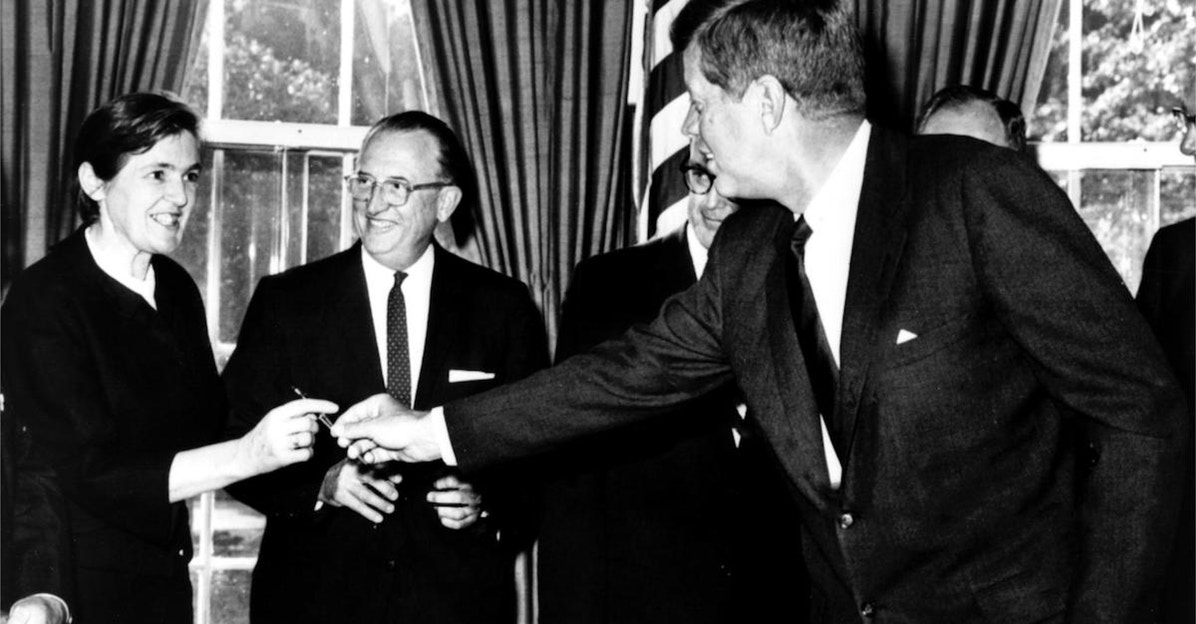
Dr. Frances Oldham Kelsey and President John F. Kennedy.
Dr. Frances Oldham Kelsey had only been with the Food and Drug Administration for about a month when she was tasked with reviewing a drug named Thalidomide for distribution in America.
Marketed as a sedative for pregnant women, thalidomide was already available in Canada, Germany, and several African countries.
It could have been a very simple approval. But for Kelsey, something didn't sit right. There were no tests showing thalidomide was safe for human use, particularly during pregnancy.
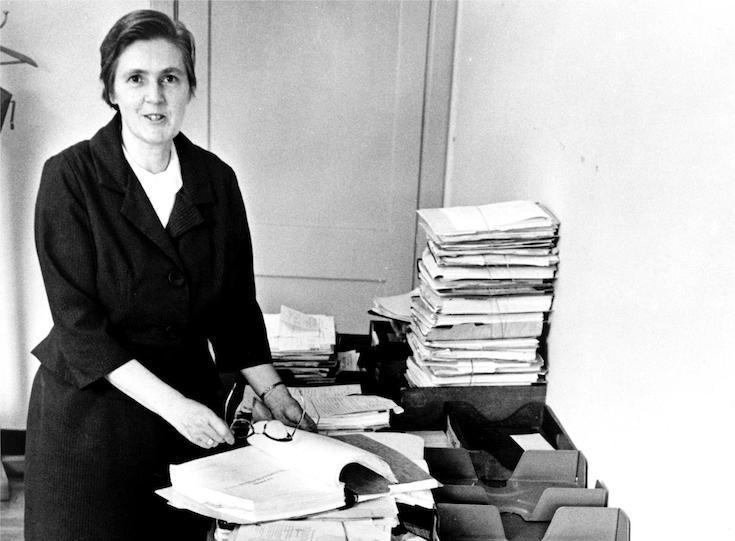
Kelsey in her office at the FDA in 1960.
Image by the U.S. Food and Drug Administration.
When pharmaceutical company Chemie Grünenthal released thalidomide in West Germany years earlier, they called it a "wonder drug" for pregnant women. They promised it would treat anxiety, insomnia, tension, and morning sickness and help pregnant women sleep.
What they didn't advertise were its side effects. Because it crosses the placental barrier between fetus and mother, thalidomide causes devastating—often fatal—physical defects. During the five years it was on the market, an estimated 10,000 babies globally were born with thalidomide-caused defects. Only about 60% lived past their first birthday.
In 1961, the health effects of thalidomide weren't well-known. Only a few studies in the U.K. and Germany were starting to connect the dots between babies born with physical defects and the medication their mothers had taken while pregnant.
At the outset, that wasn't what concerned Kelsey. She'd looked at the testimonials in the submission and found them "too glowing for the support in the way of clinical back up." She pressed the American manufacturer, Cincinnati's William S. Merrell Company, to share research on how their drug affected human patients. They refused. Instead, they complained to her superiors for holding up the approval. Still, she refused to back down.
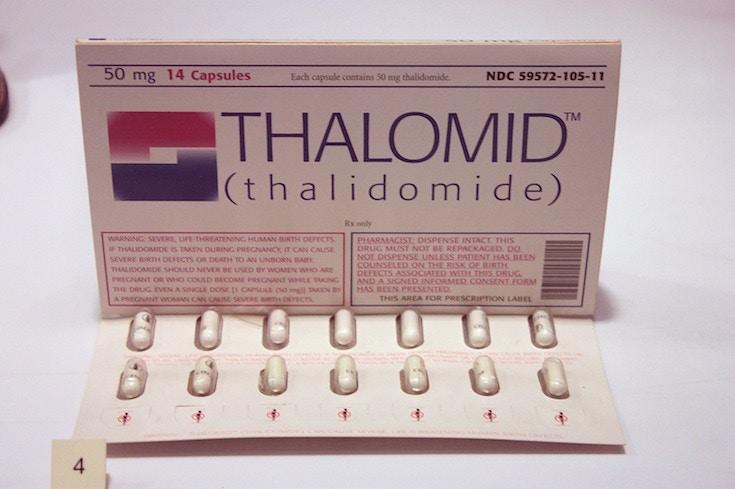
A sample pack of thalidomide sent to doctors in the U.K. While more than 10,000 babies worldwide were born with thalidomide-related birth defects, FDA historian John Swann credits Dr. Kelsey with limiting the number of American babies affected to just 17.
Image by Stephen C. Dickson/Wikimedia Commons.
Over the next year, the manufacturer would resubmit its application to sell thalidomide six times. Each time, Kelsey asked for more research. Each time, they refused.
By 1961, thousands of mothers were giving birth to babies with shocking and heartbreaking birth defects. Taking thalidomide early in their pregnancy was the one thing connecting them. The drug was quickly pulled from shelves, vanishing mostly by 1962.
Through dogged persistence, Kelsey and her team had prevented a national tragedy.
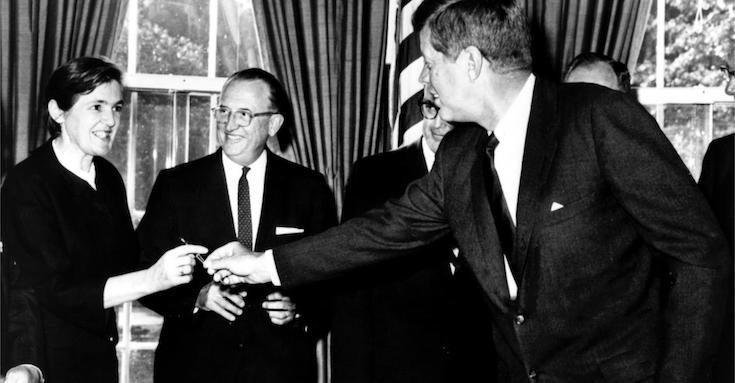
Kelsey joins President John F. Kennedy at the signing of a new bill expanding the authority of the FDA in 1962.
Image by the U.S. Food and Drug Administration.
In 1962, President John F. Kennedy honored Kelsey with the Federal Civilian Service Medal. He thanked her for her exceptional judgment and for preventing a major tragedy of birth deformities in the United States:
“I know that we are all most indebted to Dr. Kelsey. The relationship and the hopes that all of us have for our children, I think, indicate to Dr. Kelsey, I am sure, how important her work is and those who labor with her to protect our families. So, Doctor, I know you know how much the country appreciates what you have done."
But, she wasn't done yet. Later that year, the FDA approved new, tougher regulations for companies seeking drug approval, inspired in large part by Kelsey's work on thalidomide.
Reached via email, FDA historian John Swann said this about Kelsey's legacy: "[Her] actions also made abundantly clear to the nation the important public health role that drug regulation and FDA itself play in public health. The revelation of the global experience with that drug and America's close call indeed provided impetus to secure passage of a comprehensive drug regulation bill that had been more or less floundering during the time FDA was considering the application."
Kelsey continued to work for the FDA until 2005. She died in 2015, aged 101, just days after receiving the Order of Canada for her work on thalidomide.
Bureaucratic approval work is rarely thrilling and not often celebrated. That's a shame because it's so critical.
People like Kelsey, who place public health and safety above all else — including their career — deserve every ounce of our collective respect and admiration.
This story originally appeared nine years ago.


American portion sizes are colossal.
Tax shouldn't be a not-so-fun surprise at the end of your shopping trip.
A trip to the doctor shouldn't break the bank.
This totally isn't weird at all. Right?
It's a choice.
America loves extra sugar in savory foods.
Princess Odette Girl GIF by The Swan Princess
Rose GIF
sailor moon GIF
river phoenix 80s GIF 
All of this will be ours one day. Yay.
Elderly woman with white hair on phone, sharing a story about a dead person her child has never met.
Surprised elderly man in blue shirt against a yellow background.
Elderly woman in pink shirt using a smartphone on a garden swing.
TV for waking. TV for sleep.
Elderly man using a magnifying glass to read a piece of mail
Mom is totally humiliated after her kindergartner tells the teacher what she does for work
She was clearly mortified.
A mom is embarrassed by her child.
One of the great joys and stresses of parenting is that you never know what will come out of your child’s mouth. When you have young, inquisitive kids, they can say really inappropriate things to people without realizing they were being rude or possibly offensive. TikTok influencer Aurora McCausland (@auroramccausland), known for her DIY cleaning tips, recently told a funny story on the platform about how her son believes she makes a living. The problem was that she heard about it from her child's teacher.
Mom is embarrassed by her child
“The other day, I went and picked my five year old up from school and when I get to his classroom his teacher pulls me inside and says, ‘Hey, today he wanted to tell us about what Mommy does for work and said that Mommy makes videos in her bedroom but only when I'm [he’s] not at home,” McCausland recalled.
Given her body language while telling the story, McCausland was clearly mortified after hearing what her child said to his teacher. It makes it look like she may be posting videos to adult sites while her child is at school, which most people wouldn’t want their son’s teacher to know about.
The good news is that another teacher was there to clarify the young boy's comments by adding, “I think she makes TikTok videos.” The uncomfortable situation was a great invitation to chat with her son about what she does for a living. “So I have to have a conversation with my son about how he tells people what I do for work,” she finished her video.
The funny video went viral, earning over 1.7 million views on TikTok, and inspired many people to share the times when their children had funny ways of explaining their careers. The commenters were a great reminder to parents everywhere that if your child says something embarrassing, it's ok, just about everyone has been through it.
Moms share their most embarrassing moments
A lot of parents spoke up in the comments to show McCausland that she's not the only one to feel embarrassed in front of her child's teacher.
"My son told everyone that we were homeless (because we don’t own our home, we rent)," KBR wrote.
"I work in ortho.. my daughter told her teacher I steal people's knees bc she heard me talking to my husband about a knee replacement," Aingeal wrote.
"My son told a teacher we were living in our car over the summer. Camping. We went camping," Kera wrote.
"In kinder, my son thought Red Bull was alcohol and told his teacher I liked to have beer on the way to school," Ashley wrote.
My niece told her teacher her mom and dad work at the wh*re house. They work at the courthouse," Ellis wrote.
"My husband works as a table games dealer at a casino. Kindergartener, 'Daddy's a Dealer!' We now start every school year clearly stating he works at the casino," CMAC
"My son said we lived in a crack house…There’s a tiny chip in the wall from the doorknob," KNWerner wrote.
"My dad is a hospice chaplain and officiates a lot of funerals. My son and nephew were asked by their preschool teacher if their papa was retired or had a job. They told her his job was to kill people," Tiffyd wrote.
"My son said "my dad left me and I'm all alone" to a random person at the zoo. My husband was just at work," Shelby.
"I am now in my 70s. In my gradeschool, during the McCarthy era, I told my teacher my dad was a communist. He was an economist," Crackerbelly wrote.
"In Kindergarten, my daughter told her teacher that mommy drinks and drives all the time. Coffee. From Starbucks," Jessica wrote.
"Well I once told my kindergarden teacher a man climbs over our fence to visit my mom when her husband is not home... It was a handy man who came to fix gates when they were stuck," Annie wrote.
Ultimately, McCausland’s story is a fun reminder of how children see things through their own unique lens and, with total innocence, can say some of the funniest things. It’s also a great warning to parents everywhere: if you aren’t clear with your kids about what you do for a living, you may be setting yourself up for a very embarrassing misunderstanding. So, even if you think they know what you do ask them as see what they say, you could save yourself from a lot of embarrassment.
This article originally appeared last year and has been updated.