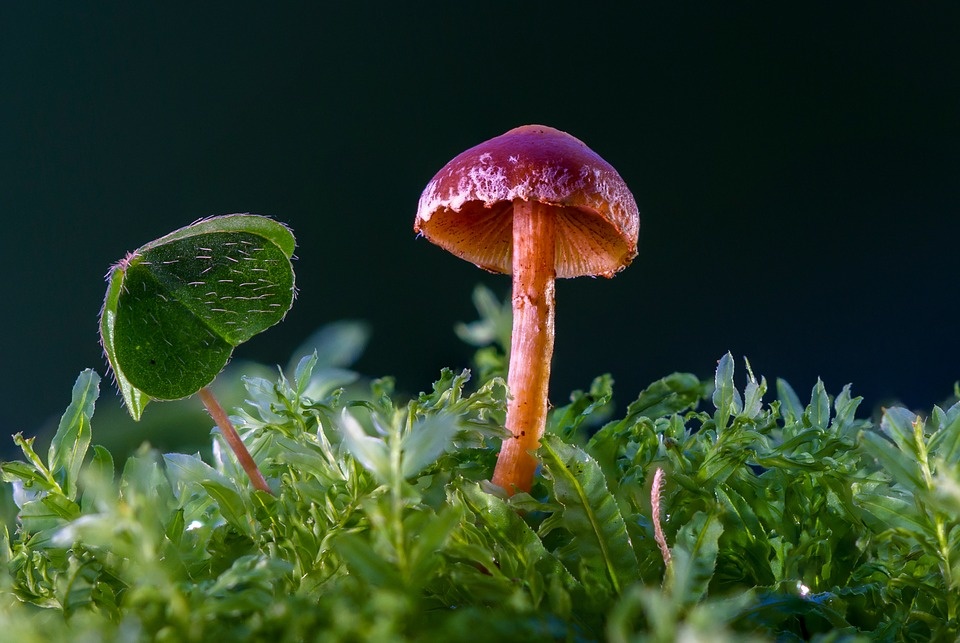
Scientists discovered a mushroom that eats plastic, and believe it could clean our landfills.
Plastic waste is one of the biggest environmental issues of our time. And while a straw ban is not the way we’re going to solve it — here’s why – people everywhere are looking for ways to reduce plastic use and mitigate the effects of waste. From handing out plastic bags with embarrassing labels to…
Plastic waste is one of the biggest environmental issues of our time. And while a straw ban is not the way we’re going to solve it — here’s why – people everywhere are looking for ways to reduce plastic use and mitigate the effects of waste.
Add one more strange and awesome plastic-killing discover to the list: A rare mushroom that feasts on plastic the same way you or I would when we go to that $5 buffet at Cici’s. (I have been only once and I’m still thinking about it, even though just the thoughts are bad for my blood pressure.)
According to reports, the mushroom’s plastic-devouring properties were first discovered in 2011, when a team of Yale undergraduates and their professor traveled to Ecuador for a research trip. They found the mushroom — Pestalotiopsis microspora — in the amazon and were astounded to find that the fungus not only subsists on polyurethane (it’s the first plant to sustain itself only on plastic), but could do so without oxygen.
That means it could be planted at the bottom of landfills and happily eat its fill of plastic for eons to come! (Just like us at Cici’s pizza!)

IRAQ-SOCIETY-POVERTY AFP/Getty Images
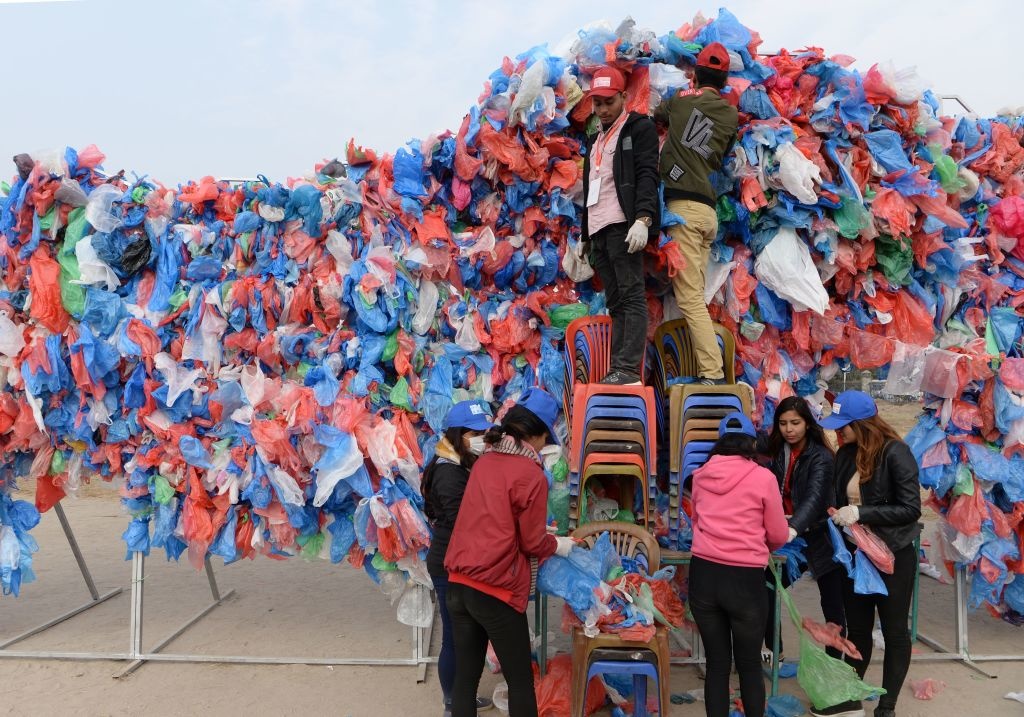
Despite our best efforts at increasing conservation and reducing waste, the U.S. continues to produce more plastic waste each year, while other recent studies suggest that recycling of plastic waste is actually declining.
The amount of plastic waste that we’re producing is estimated to rise 3.8% each year, with an estimated 40 million tons of plastic waste expected to be generated in 2019 alone by American companies and consumers. National Geographic says that over the past 60 years, we’ve created an estimated 8.3 billion metric tons of plastic waste. An astonishing 83.7% of that waste is expected to end up in landfills. Anything we can do to put a dent into the damage we’re creating could make a world of difference for us and the planet.
NEPAL-ENVIRONMENT-RECORD AFP/Getty Images
Will these mushrooms be the end to our plastic problems? More research is needed to tell. Until then, we can all help keep landfills cleaner by avoiding single-use plastics in our lives.

From Pakistan to Tanzania, the most effective education solutions are community-led. Here’s how local leaders, in partnership with Malala Fund and supported by Pura, are mobilizing entire communities.
When asked to describe what Tanzania smells like, Grace Isekore closes her eyes and breathes in deep. For a moment, she’s somewhere else entirely. Tanzania is a rich tapestry of sights and scents, from the smell of sea mist that permeates the coastline to the earthy cardamom and cloves she cooks with in her kitchen. But when Grace emerges from her reverie, her answer is unexpected.
“Tanzania smells like peace,” she says, her eyes still closed. “I see a beautiful country where we are free to move, free to speak. And there is peace within the community.”
For Grace, that sense of peace isn’t just something she smells; it’s something she works toward every day. As a project coordinator with Pastoral Women’s Council (PWC), a women-led organization that empowers pastoralist communities in northern Tanzania, she has seen firsthand how girls flourish when they have the opportunity to attend school. Like scent, education not only connects girls to their own culture, but also helps broaden their horizons, realizing new possibilities for themselves and others. That transformation reshapes entire communities and ripples outward, with the potential to change countries and transform the world for the better.
Different scents, different approaches, and communities driving change
Spices in Tanzania. Captured by James Roh for Pura
For Grace and others around the world, education is freedom, as well as a pathway to a stronger community. Rooted in that shared belief, Pura, a home fragrance company, was inspired to build on their four-year partnership with Malala Fund to create something truly unique: a fragrance collection that connects people through scent to communities in Tanzania, Nigeria, Pakistan, and Brazil, where barriers to girls’ education are among the highest.
Using ingredients from each region, the new Pura x Malala Fund Collection uses scent to transport people to these regions directly. “Future in Bloom,” for example, invokes Pakistan’s lush valleys through notes of jasmine, cedarwood, and mango; while Tanzania’s fragrance, “Heart on Fire,” evokes the spirit and joyfulness of the girls who live there through cardamom, lemon, and green tea.
The new Collection honors the work Malala Fund does every day, partnering with locally-led organizations in these four countries to ensure every girl can access and complete 12 years of education. Each scent celebrates the joy, tenacity, and courage of the women and girls driving change on the ground, while also augmenting Pura’s annual grant to Malala Fund by donating eight percent of net revenue from the Pura x Malala Fund Collection to Malala Fund directly.
Just as each country’s scent is unique, so too are their needs related to education. But with support from Malala Fund and Pura, local leaders are coming up with creative ways to mobilize entire communities (parents, teachers, elders, and the students themselves, in their pursuit of solutions, understanding that educating girls helps everyone thrive. Here’s how their efforts are creating real, durable impact in Tanzania and Pakistan, and creating a ripple effect that changes the world for the better.
Parent-teacher associations help Maasai girls and their communities in Tanzania problem-solve
A girl’s school in Tanzania. Captured by James Roh for Pura
Northern Tanzania, Grace’s home, is home to pastoralist communities like the Maasai, a nomadic people who have moved with the seasons to nurture the land and care for their livestock for centuries. The nomadic nature of this lifestyle creates significant and unique barriers to girls’ education. Longstanding gender roles have enabled Maasai to survive in the harsh environment and have placed great value on both women and men. Over time, as nomadic life has been threatened by the privatization of land and stationary education models have been implemented, the reality of pastoralist livelihood has shifted and introduced new complexities. Now, the sheer distance to schools is both a practical challenge and one that often comes with danger from the landscape, predators, and potential exposure to assault along the journey. Girls shoulder the responsibility of household chores and there is often cultural pressure around early marriage – both leading to boys’ education being prioritized over girls’.
“There are very, very good [pastoralist] cultural practices, which are passed from generation to generation,” says Janet Kimori, an English teacher at Lekule Girls Secondary School in Longido, Tanzania. But when cultural practices act as educational barriers, “you have to sit down and look for where you are going to assist. As a school, as an individual, the school administration—all of us will chip in and know how we are going to deal with this problem.”
PWC works to ensure girls are able to exercise their right to an education while also preserving pastoralist culture. One successful approach, the organization found, has been the formation of Parent Teacher Associations (PTAs), created with help from Malala Fund. In PTA meetings, students, parents, teachers, elders, and government officials meet, discuss educational barriers, and come up with community-led solutions that preserve and honor their culture while advancing educational outcomes.
PTA meeting in Tanzania. Captured by James Roh for Pura
One recent PTA meeting highlights how these community-led solutions are often the most effective. At Lekule Girls Secondary School, the lack of fresh water forces girls to walk long distances to collect water for the school’s kitchen during the school day, and these long journeys not only disrupt class time but can leave girls vulnerable to sexual assault in isolated areas. Through facilitated discussion, PTA members landed on a solution: installing a borehole to pipe in fresh water to the school. Reliable access to water creates a better learning environment for the girls, but it also benefits the community at large, as local governments are then more likely to invest in health clinics and other community resources nearby.
With a solution in place, the PTA was then able to discuss ideas and map out a course of action. The women would raise money for the cost of the borehole, while the men would recruit workers to dig the hole and lay the pipe. Together, they would ask government officials to match their investment.
The benefits of PTA meetings within the pastoralist communities are undeniable. “The girls are talking and addressing issues in a confident way, and parents feel they are part of the resource team to solve challenges happening at school,” Grace says. One unexpected benefit: The larger cultural impact these PTA meetings have created. Thanks to the success of PTAs within pastoralist communities, the models are now being endorsed on a national level, and schools across Tanzania are starting to use them to solve problems in their own communities. When a community creates opportunities for girls to learn, everyone benefits.
Safe spaces in rural Pakistan help students and their parents connect, then drive change
Safe space for girls meeting in Pakistan. Captured by Insiya Syed.
A continent away in Pakistan, the country’s northernmost region of Gilgit-Baltistan seems like a land untouched by time. The region’s looming mountains, snow-capped peaks, lush valleys and crystalline lakes draw nature lovers and landscape photographers from around the world, but living among this kind of breathtaking scenery has its drawbacks. Schools in the region are few and far between, and the area’s harsh climate often makes roads inaccessible for travel. Poverty and gender-based discrimination are additional obstacles, making school even further out of reach, and girls are affected disproportionately. Going up against these barriers requires a persistent, quiet strength that’s found in the women who live there and reflected in Pakistan’s signature scent.
Saheli Circles are how local leaders in Gilgit-Baltistan are bridging the gap between girls and education. An Urdu term for “female friend,” Saheli Circles are after-school safe spaces where girls explore subjects like art and climate change, while also developing skills that help them manage emotions, set goals, and build positive relationships. Girls study in groups, visit the library, play sports, and tackle filmmaking and photography projects, all designed to develop self confidence and teach the girls how to advocate for issues that matter to them. But the work doesn’t stop there.
“What we’re trying to achieve here will only be impactful if it trickles down to the home environment and the school environment,” says Marvi Sumro, founder and program director of Innovate, Educate, and Inspire Pakistan (IEI), the local organization that developed the Saheli Circles model and partnered with Malala Fund in 2021 to make it a reality. Ever since, Saheli Circles have grown to involve teachers, elders, and parents to encourage relationship building that’s essential for young girls and adolescents. “Our spaces can give mothers and daughters an opportunity to interact a little differently—do an art activity, or have a cup of tea together, or some good conversation,” Marvi says.
The relationship building is what makes the biggest positive impact throughout the community. Recently, one Saheli Circle was able to bring together parents, teachers, and administrators to advocate for better education at their local school, and together they convinced the department of education to hire a science teacher. Another Saheli Circle organized a fund where members of the community can contribute monthly to pay for uniforms, books, and other school expenses for the girls in their village, eliminating those small, hidden costs that are often a barrier to education for many. A third Saheli Circle was able to produce a short film about how gender-based household chores can take away valuable study time from girls, leaving them at a disadvantage. “The girls put the film together and showed it to the mothers, and the response from the mothers was just beautiful,” Marvi says.
Girls smiling in Pakistan. Captured by Insiya Syed.
The education and relationship building that the girls receive in Saheli Circles connects them to larger opportunities and economic freedom that are not possible in their hometown. “For girls in Gilgit-Baltistan, education is extremely important because of the fact that we’re so far away from where the economy is, where the opportunity is. Education becomes this bridge for us, for our girls, to access all the opportunity and economy that exists in [larger cities].”
From rural Tanzania to remote Pakistan, local organizations prove every day that prioritizing girls’ education benefits everyone. Communities that lift up girls are able to secure resources like clean water and well-staffed schools, as well as build stronger relationships.
These outcomes are only possible because of the women and girls who work tirelessly in these regions to overcome barriers and drive progress. The Pura x Malala Fund Collection is a way to honor them, celebrate their achievements, and unite people the world over around a shared belief that education is freedom. Like scent, that belief can build, travel, and has the possibility to transform the world.
Experience the Pura x Malala Fund Collection here, and connect with the stories of real girls leading change across the globe.
Most of us learn about the Earth’s shifting tectonic plates by middle school. But in Marie Tharp’s time, this fact we now take for granted was a groundbreaking, radical concept…and one that had to overcome gender bias.
In 1957, Tharp, a geologist and oceanographic cartographer, and her colleague Bruce Heezenhad published the first map of the Atlantic. Tharp endured considerable challenges due to sexism. For one thing, women weren’t allowed on the ships that collected the seafloor data to make the maps in the first place. So Tharp spent hours at a desk translating thousands of sonar readings from those ships that wouldn’t take her.
Her hand-drawn maps eventually revealed that the seafloor was covered in canyons, ridges, and mountains…all of which suggested that at some point, pieces of the Earth had moved.
This was important because the previous mainstream view was that the ocean floor was flat and motionless. However, Tharp’s findings supported Alfred Wegener highly controversial “continental drift theory,” which first suggested that the present-day continents once fit together as a supercontinent, aka Pangaea, in 1912.
Of course, we now know Pangea to be a real thing, but not long ago, this idea was considered heresy. And so when Tharp reintroduced it through her findings, Heezen dismissed it as “girl talk,” or an “old wives’ tale,” depending on where you look. Either way, the context reads pretty clear.
Heezen would come around in time, but the duo would also have to sway the rest of the scientific community. Keep in mind, the supposed peaks and valleys were, at this point, only conjecture. However, in 1959, when Jacques Cousteau, determined to prove Tharp wrong, lowered his underwater camera with 16-millimeter film into the middle of the ocean, and a valley was indeed there…it became fairly evident that she was right.
Though it was primarily Tharp’s groundbreaking findings that paved the way for our new understanding, she was still seen as “merely a technician,” and therefore Heezen took the lion’s share of the credit as they continued their work together, which eventually included mapping all of the world’s oceans. She wouldn’t even be allowed to set foot on a research cruise until 1968.
But proving her tenacity, Tharp was nevertheless able to make a life-changing scientific contribution in spite of it all, a) because she was resourceful, and b) because she believed in the importance of her work. As she herself said,
“I had a blank canvas to fill with extraordinary possibilities, a fascinating jigsaw puzzle to piece together. It was a once-in-a-lifetime — a once-in-the-history-of-the-world-opportunity for anyone, but especially for a woman in the 1940s.”
In time, Tharp would get some recognition. In 1997, the Library of Congress named her one of the greatest cartographers of the 20th century. And in 2023, National Geographic awarded her the highly prestigious Hubbard Medal.
And of course, every time we look at a map, we witness a bit of her signature. Still, one can’t help but wonder what other women from history secretly shaped the way we view the world today, and the pains they took to do so.
One of the greatest philosophical, scientific, and religious questions that humankind has ever asked is: Why is there something instead of nothing? Why do we have a universe, or possibly multiple universes, when there could just be a big nothing and no one or thing to contemplate its lack of existence?
To add another layer to this incredible mystery is the question of what nothing is. We know what something is; we see matter around us and can measure energy, but as humans, we’ve never been able to experience true nothingness, so it feels impossible to comprehend. That’s why we should all be thankful for astrophysicist and science communicator, Neil deGrasse Tyson. He created a video that takes us step by step through how we get from something to nothing in under a minute.
Step 1: Life on Earth
“Is this nothing?” Tyson asks, waving his hand. “No, it’s air. Let’s go with there’s no air.”
Step 2: Outside our atmosphere
“No, there’s still a few particles floating there between the planets, so it’s not quite nothing.”
Step 3: Space
“How about between the stars? Less, but there’s still something there. Between the galaxies? Less, but there’s still just a few particles per cubic meter that lurk there.”
Step 4: Pure vacuum of space
“There’s something called virtual particles that pop in and out of existence. Quantum physics tells us this. So there’s still something there.”
Step 5: True nothing
“To get a true nothing, you have to go where there’s not even space or time. But if laws of physics still apply, then there’s still something there. So you have to go to not only where there’s no matter and no space time, but where there are no laws at all. Behold, a true nothing.”
Tyson explained his concept of “nothing” in a StarTalk episode with his co-host, Chuck Nice.
If that explanation didn’t quite pull you into the realm of understanding, Sean Carroll, a theoretical physicist and cosmologist, did his best to describe it to Vice.
“In quantum field theory, which we think is our best way of describing the universe that we have right now, space is kind of interesting,” Carroll explained. “Even if it’s as empty as it can be, there are still quantum mechanical [properties]—they’re just in a zero-energy state not doing anything. But you could probe the vacuum, as particle physics does, and discover its properties.
“Empty space is a very interesting place in modern physics; there’s a lot going on, whereas, if it were nothing, there would be nothing going on,” he said. “It’s probably better to think of nothing as the absence of even space and time, rather than space and time without anything in them.”
Now that you probably have a good idea of what nothing is, we’re back to the big question: Why is there something instead of nothing? Tyson and Carroll discuss the biggest question in the universe in the section below.
How do you explain the concept of a fourth dimension to humans who are only able to see in 3-D? Physical space can be measured in height, width, and depth. What is there beyond or in addition to those three dimensions? How can we understand the existence of a dimension we cannot picture?
Thankfully, we had Carl Sagan, one of the greatest science communicators of his time, to help us visualize a fourth dimension. Perhaps best known for his research into extraterrestrial life, Sagan was among the first to demonstrate that life could have existed on Mars. Sagan possessed a unique gift for demystifying complex scientific concepts, making them accessible and thrilling for the general public. He could be described as a scientific Mister Rogers: friendly, a wonderful storyteller, and able to distill difficult lessons into their simplest form.
In 1980, on Episode 10 of the groundbreaking PBS show “Cosmos,” Sagan embarked on a mission to explain the seemingly impossible fourth dimension. It’s a hypnotic, entertaining, and incredibly enlightening watch:
Many of us have commonly heard of time being considered the fourth dimension. That’s not so hard to understand — in order to locate an object in the universe, you’d need to know three dimensions of its spatial location and also the time during which it exists.
But there is also a more theoretical and harder to understand place, where all four dimensions are spatial. It is nearly impossible for any of us to comprehend… without the help of a gifted teacher.
What’s excellent about Sagan’s explanation is that he uses simple and relatable objects: an apple and a Tesseract, or hypercube.
“In discussing the large-scale structure of the cosmos, astronomers sometimes say that space is curved. Or that the universe is finite but unbound,” Sagan begins. “Whatever are they talking about?”
Yeah, this guy gets it.
Sagan then explains how a two-dimensional being living in a flat world would perceive a three-dimensional object like an apple.
Sagan used an apple to help explain the fourth dimension. Photo credit: Canva
“Imagine we live in this ‘Flatland’/2-D plane with no concept of ‘up’ or ‘down.’ Then along comes a 3-D object like an apple. We do not even notice it until it crosses our plane of existence — and even then, we have no idea what the apple is,” Sagan explains. “We see only a fragment as it passes through our plane. There is no way we can comprehend the 3-D quality/dimension of the apple, because it is beyond our understanding. We only have the evidence of what has passed through our plane.”
To further demonstrate, Sagan stamps the apple into an inkpad and then onto the surface in front of him, which represents Flatland and all of its inhabitants. Inside Flatland, the apple exists only as its points of contact on the paper; or four small dots. He adds that as the apple passes through the 2-dimensional Flatland, its cross-section changes. So someone living in that plane of existence would experience the apple as an ever-shifting and rearranging set of shapes or objects. Wild!
Sagan then related this two-dimensional experience of the third dimension to how we might try to understand the fourth. To do so, he used the Tesseract, a four-dimensional cube, to demonstrate how difficult it is for us to perceive or visualize dimensions beyond our own three.
A hypercube is used tou00a0representu00a0four dimensions. Photo credit: Canva
Sagan explains that the tesseract is a cube expanded into a 4th dimension, but “I cannot show you a tesseract because I, and you, are trapped in three dimensions.” But what he can do is show us a 3-dimensional rendering of one. Just like a cube can be drawn and approximated (or cast a shadow) onto a piece of paper, a 4-dimensional tesseract can be imperfectly represented in 3-dimensional space. Still following?
At this point, Sagan is asking the viewer to expand their minds to understand the fourth dimension metaphorically. Though we cannot see it or even properly visualize it, that doesn’t mean that the things we can see can’t offer clues and lessons about the fourth dimension.
Studying 4-dimensional space can help us understand the universe around us. Just because we see and experience only three dimensions doesn’t mean that’s all that exists. It’s critical for physicists and mathematicians to be able to understand and map these theoretical spaces to better comprehend things we otherwise can not explain. Remember the ever-changing, rearranging set of shapes as the apple passes through Flatland?
Sagan’s demonstration of the fourth dimension isn’t just a wonderful explanation of a scientific idea that many of us find difficult to comprehend; it’s also a great example of how to teach complex ideas by combining clear explanations, everyday concepts everyone can understand, and brilliant storytelling.
Our love for the ocean runs deep. Does yours? Enter here!
This Valentine’s Day, we’re bringing back our favorite giveaway with Ocean Wise. You have the chance to win the ultimate ocean-friendly date. Our recommendation? Celebrate love for all your people this Valentine’s Day! Treat your mom friends to a relaxing spa trip, take your best friend to an incredible concert, or enjoy a beach adventure with your sibling! Whether you’re savoring a romantic seafood dinner or enjoying a movie night in, your next date could be on us!
Here’s how to enter:
Go to upworthy.com/oceandate and complete the quick form for a chance to win – it’s as easy as that.
P.S. If you follow @oceanwise or donate after entering, you’ll get extra entries!
She’s up before the sun and still going at bedtime. She’s the calendar keeper, the lunch packer, the one who remembers everything so no one else has to. Moms are always creating magic for us. This Valentine’s Day, we’re all in for her. Win an eco-friendly spa day near you, plus a stash of All In snack bars—because she deserves a treat that’s as real as she is. Good for her, kinder to the ocean. That’s the kind of love we can all get behind.
Special thanks to our friends at All In who are all in on helping moms!
Grab your favorite person and get some much-needed ocean time. Did you know research on “blue spaces” suggests that being near water is linked with better mental health and well-being, including feeling calmer and less stressed? We’ll treat you to a beach adventure like a surfing or sailing class, plus ocean-friendly bags from GOT Bag and blankets from Sand Cloud so your day by the water feels good for you and a little gentler on the ocean too.
Special thanks to our friends at GOT Bag. They make saving the ocean look stylish and fun!
Love nights in as much as you love a date night out? We’ve got you. Have friends over for a movie night or make it a cozy night in with your favorite person. You’ll get a Disney+ and Hulu subscription so you can watch Nat Geo ocean content, plus a curated list of ocean-friendly documentaries and a movie-night basket of snacks. Easy, comfy, and you’ll probably come out of it loving the ocean even more.
Soak up the sun and catch a full weekend of live music at BeachLife Festival in Redondo Beach, May 1–3, 2026, featuring Duran Duran, The Offspring, James Taylor and His All-Star Band, The Chainsmokers, My Morning Jacket, Slightly Stoopid, and Sheryl Crow. The perfect date to bring your favorite person on!
We also love that BeachLife puts real energy into protecting the coastline it’s built on by spotlighting ocean and beach-focused nonprofit partners and hosting community events like beach cleanups.
Date includes two (2) three-day GA tickets. Does not include accommodation, travel, or flights.
Stay in and cook something delicious with someone you love. We’ll hook you up with sustainable seafood ingredients and some additional goodies for a dinner for two, so you can eat well and feel good knowing your meal supports healthier oceans and more responsible fishing.
Giveaway ends 2/15/26 at 11:59pm PT. Winners will be selected at random and contacted via email from the Upworthy. No purchase necessary. Open to residents of the U.S. and specific Canadian provinces that have reached age of majority in their state/province/territory of residence at the time. Please see terms and conditions for specific instructions. Giveaway not affiliated with Instagram. More details at upworthy.com/oceandate
Our love for the ocean runs deep. Does yours? Enter here!
This Valentine’s Day, we’re teaming up with Ocean Wise to give you the chance to win the ultimate ocean-friendly date. Whether you’re savoring a romantic seafood dinner, catching waves with surf lessons, or grooving to a concert by the beach, your next date could be on us!
Here’s how to enter:
Go to ocean.org/date and complete the quick form for a chance to win – it’s as easy as that.
P.s. If you follow @oceanwise or donate after entering, you’ll get extra entries!
Here are the incredible dates:
1. Staycation + Surf Lesson
Hang ten on the ultimate ocean date! Whether you’re beginners or seasoned surfers, a cozy stay by the ocean and surf lessons will have you riding the waves and making unforgettable memories together.
2. A Year of Netflix
Get cozy and explore the wonders of the ocean right from your couch! Whether you’re diving into breathtaking documentaries or finally watching My Octopus Teacher, enjoy a full year of streaming on us.
3. BeachLife Festival Tickets
Soak up the sun and enjoy Lenny Kravitz, Sublime, Alanis Morissette, and more at BeachLife Festival May 2-4, 2025. Celebrate your love for music and sea at the LA’s Premier Beach Music Festival!
4. Private Cooking Lesson with Michelin-starred Chef
Learn how to make a delicious meal with Matthew Kammerer who has earned a Michelin green star due to his commitment to sustainability in addition to two Michelin stars for his restaurant – Harbor House Inn.
5. Dinner for Two at Wrench and Rodent
Sustainable seafood isn’t just delicious, it’s an excellent way to combat overfishing. Enjoy dinner for two at the incredible Wrench and Rodent, courtesy of Chef Davin Waite in San Diego, California. Wow your date with both a delicious meal and the knowledge you’re supporting a healthy, thriving ocean!
Giveaway ends 2/11/25 at 11:59pm PT. Winners will be selected at random and contacted via email from the Upworthy. No purchase necessary. Open to residents of the U.S. and specific Canadian provinces that have reached age of majority in their state/province/territory of residence at the time. Please see terms and conditions for specific instructions. Giveaway not affiliated with Instagram. More details at ocean.org/date
Does the number 23.5 mean anything to you? It sounds random, but it’s a relatively famous number that refers to the degree Earth tilts on its axis as it rotates around the sun. The fact that the Earth is not standing “straight up,” so to speak, is responsible for a number of fascinating phenomenon in how we experience the sun’s light and warmth.
When our respective portions of the Earth are tilted toward the sun, we receive more heat and longer daylight hours. But some areas of the globe are situated in such a way that Earth’s tilt can cause much more dramatic swings. The Arctic, famously, has a “Midnight Sun” where the sun does not fully set for around two months in the summer. The effect can also be experienced to a lesser degree in lower portions of the Northern hemisphere, including Alaska.
One woman recently documented her experience living through North Pole, Alaska’s “darkest day of the year,” which falls on December 21.
The Winter Solstice has the Northern hemisphere away from the sun, so North Pole, Alaska (not the true North Pole, as in, where Santa Claus lives) receives only a small window of sunlight.
Though it's not the true North Pole, North Pole, Alaska has fun with the whole Santa thing. By Dylan Avery/Wikimedia Commons
Emily, who goes by FBX Foodie on TikTok, shared a video on December 21, 2025 where she begins by standing outside in the pitch black at 7:30 a.m., or about the time the sun should be risen or well on its way in much of the rest of the world.
The self-described “Florida girl,” who recently moved to Alaska with her husband who is stationed there on military duty, has been sharing her journey in acclimating to a very different climate. And that’s putting it mildly. The couple is currently a year into a four-year assignment.
Not only is the sky pitch black, but the temperatures are frigid. In the morning, when she began filming, the temperature was around -40 degrees Fahrenheit. By 8:40, nothing has changed. Everything is still dark and extremely cold.
About an hour later, a crack of light is just barely visible. “This is kind of what I call blue hour,” she says. “It’s not pitch black outside but it’s not necessarily daylight either. We still have about an hour and a half until sunrise.”
By 10:36, the sun is creeping over the horizon, like the early dawn hours anywhere else. Just a few short hours later at 1:25 p.m., the sun is visible in the sky!
But just as soon as it appears, hovering low and orange like a sunset, it’s already on its way down. Shortly before 5 p.m., the day is “over” and pitch black returns.
Though many people have heard of Alaska’s strange solstices, over five million viewers were stunned to see just how short the day really was in North Pole, Alaska.
“i would be so depressed,” one commenter wrote.
“I would have absolutely zero motivation,” added another.
“Why are you outside?” someone asked, justly.
“I just wouldn’t get out of bed. A heated blanket would hate to see me coming,” one person joked.
Other viewers noted that the conditions seemed prime for sleep and relaxation. If you’re someone who needs complete darkness for a good night’s sleep, you’d love it in North Pole, Alaska.
In a series of follow-up videos, Emily answered some of the many questions she got after her video went massively viral.
“Why would anyone want to live there?” Emily says that, though she doesn’t exactly live there by choice herself, a lot of people who don’t mind the cold really love Alaska’s wide open spaces and small communities, along with virtually no traffic and a much slower way of life. You have to put up with some wonky winters and maybe a little too much sunlight in the summer, but for many, it’s well worth it. There’s also a lot of natural beauty, with Alaska being one of the best places in the world to see the Northern Lights and home to some of the best hiking and adventuring around.
“How do you keep your house warm?” Emily shares that her house has a normal thermostat like you’d find anywhere else, but that her home is heated with oil instead of natural gas. “It’s about $3.75 to $4 a gallon and we’re burning through about six gallons a day in this really extreme temperature.”
“Does society function normally in the dark?” The short answer? Yes. “We don’t work around the sun, which would be pretty limiting in the winter.” Emily says most businesses and schools are still open even in the extreme cold and snow. She says school didn’t even close when her town got over 10 inches of snow overnight.
It’s really hard for people in the “lower 48” to imagine what daily life must be like during the winter with extremely limited daylight hours. People who live in Alaska, of course, have found ways to adapt to the extreme conditions.
Some parts of Alaska are in near-compete darkness for about two months in the winter, while the sun rarely and barely sets during the summer.
For starters, buildings and cities are designed to fit the extreme conditions. Insulation is a top-priority so residents can survive -40 degree temperatures, and pipes are buried and insulated as much as possible to keep from freezing. Air conditioners, strangely, are key, too: Even though Alaskan summers don’t get that hot, the heavily-insulated buildings and the low angle of the sun can heat up indoor environments in a hurry.
Blackout curtains are a must in the summer for sleeping, but otherwise, Alaskan-based climatologist Dr. Brian Brettschneider tells Fox Weather that residents absolutely love the constant sunlight. “Imagine going fishing at midnight, or playing basketball at 11 p.m., or a hiking traverse through the middle of the night? The only complaints you’ll hear are about it not lasting long enough.”
The winter is more challenging. Vitamin D supplements and sun lamps help some residents keep their spirits and energy up in the darkness, but Alaskans report that winter is often a time for slower living and “hibernation.”
Living in northern Alaska might not be everyone’s cup of tea, but whether you’re born there, stationed there, or decide to move there by choice, there’s a lot of adventure and beauty to be found in the frigid environment.
I will admit that I hardly ever watch the news on television, especially not for the weather. It’s just so much easier to pick up my phone and check Google or The Weather Channel. I just want to know how warm it’s going to be or how likely it is to rain. These days, I can find that out in about 10 seconds and go about my day.
But when there’s potential danger—hurricanes, storms that might knock out the power of topple over trees, tornado warnings, or threats of ice and snow—my trusty local meteorologist or weatherman is always there. All of that said, I’ve never once considered that I might not be able to get my weather forecast from either source, at least not accurately. It’s 2025—our weather modeling should be better than ever, state of the art, right?
John Morales, a meteorologist and hurricane specialist with NBC6 in South Florida, was reporting on an upcoming storm when he suddenly shifted gears, right in the middle of the broadcast.
Meteorologists play an important role in our communities. Giphy
Morales explains that in his 34 years of presenting the weather, he’s always been able to confidently tell his viewers when a hurricane might hit, or when it might turn away. He’s always been able to stand behind his data, modeling, and forecast in order to help protect the people of South Florida.
“I am here to tell you that I am not sure I can do that this year.”
Why? “Because of the cuts, the gutting, the sledgehammer attack on science in general.”
Morales then pulled up a graphic instead of his usual weather map. It laid out some stark realities about severe understaffing of the National Weather Service, and the National Oceanic and Atmospheric Administration. Between brutal layoffs, employees accepting the recent DOGE buyout, and straight-up resignations, the agencies responsible for collecting weather data have lost hundreds and hundreds of valuable experts.
He also explained that due to federal government budget cuts, there’s been a sizable decrease in weather balloon launches across the country. Weather balloons are instruments that take crucial measurements of the upper atmosphere and send data that helps with forecasting. With less data available, and lower quality data, Morales say that “the quality of forecasts is becoming degraded.”
That’s a pretty scary thought, especially in a place like South Florida. What do you do when your local meteorologist can’t predict what a powerful hurricane will do next?
“This is a multi-generational impact on science in this country,” Morales warns.
Watch his passionate plea here:
BREAKING: A Florida meteorologist just went on air and said he can’t accurately report the weather anymore, because Trump’s DOGE cuts gutted the satellite data he relies on.
We’re not just defunding science, we’re sabotaging public safety.
Almost nine million people viewed the powerful clip on X. It was reshared over 26,000 times. Morales’ message is definitely getting the attention it deserves.
It’s not just the National Weather Service that’s bleeding. In the name of efficiency, The White House has slashed budgets at the CDC, the National Institutes of Health, and more. Trimming the federal budget sounds well and good until you realize that we won’t be making any major cancer breakthroughs any time soon without funding the research. And we won’t be able to protect people from hurricanes and tornadoes without complete weather data.
(And yes, even the Weather app on your iPhone needs a database to pull from.)
Meanwhile, we’re spending $1 trillion—yes, trillion— per year on our military. This is the anti-science, anti-expert sentiment Morales is talking about. It’s been building for years and is just now coming to a head in the worst way.
We still need meteorologists and weather experts like Morales. We still need scientists.
The impact of these cuts is already being felt as hurricane and flooding season hits. John Morales continues to advocate for a science-based approach to weather and public safety. And he’s not alone.
My public comment ahead of the @CityofMiami officially adopting the Science-based Tracking and Operational Resilience for Miami (STORM) initiative, affirming a commitment to science-based weather forecasting as the foundation for public safety—including advocating for NOAA & NWS. pic.twitter.com/xEAeWMlEil
ChatGPT can pull weather data from Google and tell you if there’s going to be a thunderstorm, but can it tell you when the data behind that forecast is incomplete or unreliable? That’s the reality we’re facing right now, and we might not know the forecast isn’t reliable until it’s too late in some cases.
TV weathermen who live in our communities and can put crucial context behind the weather and help keep us safe still matter. Not only that, but they are ambassadors for science, and they still have a big platform in many communities around the country. Morales is making sure he makes the most of his.
This article originally appeared in June. It has been updated.
Photo credit: via Carl Sagan Planetary Society/Wikimedia Commons and John Finkelstein/Pexels – Carl Sagan used a sliced apple to perfectly explain the fourth dimension.
The concept of the fourth dimension seems beyond human comprehension. As three-dimensional beings, we are unable to see beyond a physical object’s height, width and depth. What else could there be? Even if you understand the concept, it is almost impossible to picture it in your mind, which is bound by the limits and realities of the physical world around us.
Enter Carl Sagan, revered as one of the greatest science communicators of his time. Perhaps best known for his research into extraterrestrial life, he was one of the first people to demonstrate that life could have existed on Mars. Sagan possessed a unique gift for demystifying complex scientific concepts, making them accessible and thrilling for the general public. If you never had the pleasure of watching him on television, you could imagine him as something of a Scientific Mister Rogers. Friendly, a wonderful storyteller, and always able to distill difficult lessons into their simplest form.
In 1980, on Episode 10 of the groundbreaking PBS show “Cosmos,” Sagan embarked on a mission to explain the seemingly impossible fourth dimension.
Many of us have commonly heard of time being considered the fourth dimension. That’s not so hard to understand — in order to locate an object in the universe, you’d need to know three dimensions of its spatial location and also the time during which it exists.
But there is also a more theoretical and harder to understand place, where all four dimensions are spatial. It is nearly impossible for any of us to comprehend… without the help of a gifted teacher.
What’s excellent about Sagan’s explanation is that he uses simple and relatable objects: an apple and a Tesseract, or a hypercube.
Sagan explains that if an apple existed in a 2-dimensional space, anyone living in this Giphy
“In discussing the large scale structure of the cosmos, astronomers sometimes say that space is curved. Or that the universe is finite but unbound,” Sagan begins. “Whatever are they talking about?”
Yeah, this guy gets it.
Sagan then goes on to explain how a two-dimensional being living in a flat world would perceive a three-dimensional object like an apple.
Watch his full explanation here. It’s hypnotic and entertaining and incredibly enlightening.
“Imagine we live in this ‘Fllatland’/2-D plane with no concept of ‘up’ or ‘down.’ Then along comes a 3-D object like an apple. We do not even notice it until it crosses our plane of existence — and even then, we have no idea what the apple is,” Sagan explains. “We see only a fragment as it passes through our plane. There is no way we can comprehend the 3-D quality/dimension of the apple, because it is more than we can understand. We only have the evidence of what has passed through our plane.”
To further demonstrate, Sagan stamps the apple into an inkpad and then onto the surface in front of him, which represents Flatland and all of its inhabitants. Inside Flatland, the apple exists only as its points of contact on the paper; or four small dots. He adds that as the apple passes through the 2-dimensional Flatland, its cross-section changes. So someone living in that plane of existence would experience the apple as an ever-shifting and rearranging set of shapes or objects. Wild!
Sagan then related this two-dimensional experience of the third dimension to how we might try to understand the fourth. To do so, he used the Tesseract, a four-dimensional cube, to demonstrate how difficult it is for us to perceive or visualize dimensions beyond our own three.
A tesseract can not exist in 3-dimensional space, but it can be approximated the same way a cube can be drawn on paper. Giphy
Sagan explains that the tesseract is a cube expanded into a 4th dimension, but “I cannot show you a tesseract because I, and you, are trapped in three dimensions.” But what he can do is show us a 3-dimensional rendering of one. Just like a cube can be drawn and approximated (or cast a shadow) onto a piece of paper, a 4-dimensional tesseract can be imperfectly represented in 3-dimensional space. Still following?
At this point, Sagan is asking the viewer to expand their minds to understand the fourth dimension metaphorically. Though we cannot see it or even properly visualize it, that doesn’t mean that the things we can see can’t offer clues and lessons about the fourth dimension.
Studying 4-dimensional space can help in our understanding of the universe around us. Just because we see and experience only three dimensions doesn’t mean that’s all that exists. It’s critical for physicists and mathematicians to be able to understand and map these theoretical spaces to better comprehend things we otherwise can not explain. Remember the ever-changing, rearranging set of shapes as the apple passes through Flatland?
Sagan’s demonstration of the fourth dimension isn’t just a wonderful explanation of a scientific idea that many of us find difficult to comprehend; it’s also a great example of how to teach complex ideas by combining clear explanations, everyday concepts everyone can understand, and brilliant storytelling.
This article originally appeared last year. It has been updated.