In Partnership With

Progressive Insurance® donated 96 vehicles to veterans and their families as part of its ongoing commitment to driving progress on the road

Progressive has honored nearly 1,100 veterans since the inception of its Keys to Progress program in 2013.

Array
Photo credit: ArrayFormer medic and single mom Leah Moore and her children being honored during the 2024 Keys to Progress event.


In 2023, Leah Moore was struggling. A single mom and former medic in the Texas Air National Guard, Leah had no family support where she lived in Seattle, WA, which made raising her two girls and working full-time a significant challenge. When her only car broke down, Leah found herself struggling more than ever.

But in 2024, Leah’s burden became a little lighter. Moore is now one of many veterans that have been honored during this year’s Keys to Progress event, an annual giveaway that took place in over 60 cities across the country. Along with Moore, close to 100 other veterans and their families recieved the keys to free, reliable transportation as a thank you for their military service.

Providing reliable transportation to deserving veterans who’ve protected our country

According to the US Department of Transportation, approximately 40 percent of veterans live in rural areas where affordable transportation options are limited. Limited transportation can greatly affect a veteran’s quality of life, since reliable transportation is necessary for work, medical care, and other services.

Gail Nicholson, a veteran who served in the United States Army during the Persian Gulf Crisis from 1993 – 1997, knows this challenge personally. Gail relied on public transportation as she supported her family since the COVID-19 pandemic when her mother fell extremely ill. As a senior citizen, traveling by bus, with schedules and lines that are not always accessible, it has not always been easy.

With veterans like Gail Nicholson in mind, Progressive founded the Keys to Progress event in 2013, hoping to alleviate some of these common struggles that veterans face every day. Now, Gail will be able to care for her family and travel freely without the need for public transit.
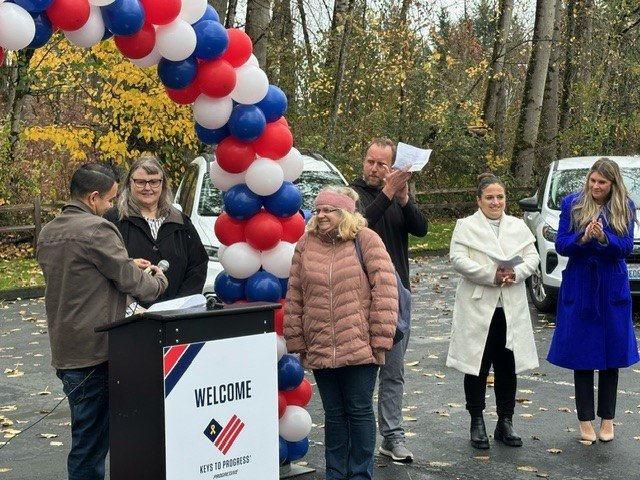
Veteran Gail Nicholson at the 2024 Keys to Progress event.

How the dream of independence becomes a reality

There’s no doubt that access to a car can make anyone’s life easier—but it also comes with additional expenses that require additional financial commitment. To help with this, multiple organizations have come together with Progressive to make Keys to Progress possible.

First, local charities and Veracity Research Co. Investigations (VRC), a veteran-owned and operated company, help to identify deserving veterans in each region. Once the recipients are chosen, Insurance Auto Auctions, Inc. (IAA) provides a Powertrain 12-month protection plan for all donated vehicles, while 1-800-Charity Cars donates resources to help with vehicle titling and registration. Enterprise, a rental car company, pays for the insurance for each donated vehicle for the first six months, and Progressive writes the insurance policies funded by Enterprise. Finally, the gently used vehicles are donated through Charity Cars.

The result is a well-deserved gift that enables each veteran to get back on the road and move ahead in life as easily as possible.

Supporting veterans on the road and beyond

Sometimes too, a veteran needs an assist in getting their small business off and running as well. Through Keys to Progress, Progressive has also donated three tractor trailers to worthy recipients.

Lt. Colonel Rose a 30-year U.S. Marine Corps veteran, was the 2022 recipient of a commercial through the Keys to Progress program. He shared, “Since being selected as the 2022 Keys to Progress recipient, the vehicle has exceeded all expectations of being an owner operator. Myself, including so many others, have been blessed by this magnificent machine. This blessing has catapulted my business forward, the donation of operating costs has played a significant part in minor repair costs along with being able to forgo a truck payment.”

Lt. Colonel Rose has been able to grow his trucking business to a second truck and he is working to purchase a third due to the revenue made from being a Keys to Progress recipient. He has also taken his earnings to donate to various charities and is inspired by showing his appreciation and patriotism for the United States.

But Keys to Progress is truly a passion project, and one that has impacted many deserving veterans. Collectively, Progressive has been able to donate vehicles to more than 1,100 military families, in addition to gifting three fully-loaded commercial trucks to veteran truck drivers and 28 commercial vehicles to select veteran organizations.
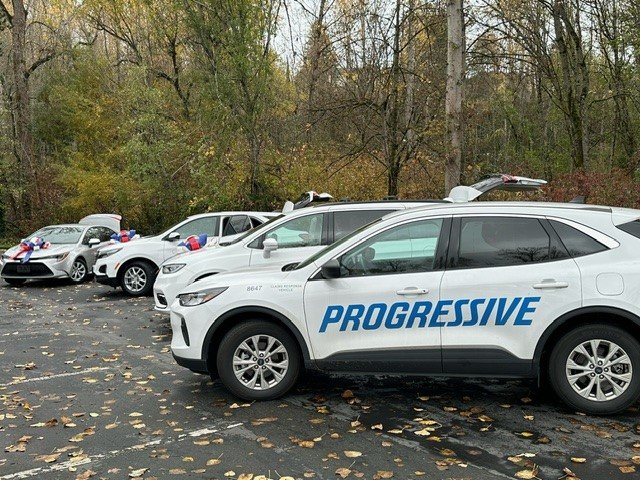
Cars at Progressive's annual Keys to Progress event.

“Our Keys to Progress initiative is a wonderful example of Progressive’s purpose to help people move forward and live fully,” said Tricia Griffith, President and Chief Executive Officer of Progressive. “We’re proud to be celebrating our 12th year of supporting veterans and will present almost 100 well-deserving veterans and their families with keys to a vehicle that will provide them reliable transportation to get on the road and move forward in life.”

Whether it’s for veterans like Leah or Gail, Keys to Progress is continuing to showcase its commitment to driving progress on the road and providing transportation for veterans, military-related organizations, and veteran-owned small business owners across the country for years to come.

Whether it’s for veterans like Leah, Gail, or Lt. Colonel Rose, Keys to Progress is continuing to showcase its commitment to driving progress for veterans, military-related organizations, and veteran-owned small business owners across the country for years to come.

  • The Bee Gees’ perfect harmonies on Johnny Carson in 1973 left him completely speechless
    Photo credit: The Tonight Show Starring Johnny Carson/YouTubeThe Bee Gees perform on "The Tonight Show" in 1973.

    The Bee Gees were one of the most popular pop groups in the world from the late ‘60s to the late ‘70s. In the early years, they had big hits such as “How Can You Mend a Broken Heart,” “I Started a Joke,” and “To Love Somebody.” In the late ‘70s, they found a new sound, disco music and made massive hits for the dance floor, including “Staying Alive” and “More Than a Woman.”

    However, between those booming Bee Gee eras, their career seemed to be on the way down. By 1973, their most recent album, “Life in a Tin Can,” and single, “Saw a New Morning,” had flopped, and they began to play smaller clubs. But that didn’t mean they couldn’t win people over with their incredible harmonies. Case in point was their March 23, 1973 performance on “The Tonight Show Starring Johnny Carson.”

    Carson introduced the band by touting its history as songwriters. “My next guests have had quite a career. Their compositions have been recorded by people like Frank Sinatra, Elvis Presley, Andy Williams, Glen Campbell, Tom Jones and hundreds of others,” Carson said.

    The band opened their set on stage performing “Wouldn’t I Be Someone” and “Saw A New Morning” and then sat down for a chat with Carson, discussing why they don’t like playing large arenas and how they got started performing together as children. After the break, they returned with an acoustic guitar and performed their first number 1 hit, “Massachusetts,” from 1967, with Robin Gibb on lead with his brothers Barry and Maurice chiming in perfect harmony. 

    If you look closely in the background, Maurice is having fun goofing off when he’s not on vocal duties. At the end of the performance, Carson appears to be a bit choked up as he adjusts his tie.

    “Massachusetts” was written about the great migration of young people to San Franciso in 1967, as the hippie movement began to take off in the mid-to-late ‘60s. Interestingly, the Bee Gees had never been to the state.

    Tried to hitch a ride to San Francisco

    Gotta do the things I wanna do

    And the lights all went out in Massachusetts

    They brought me back to see my way with you

    “There are two different memories, Robin remembers us doing it in a boat going around New York City. And I remember us checking in at the St. Regis with Robert, going to the suite, and while the bags were being brought in we were so high on being in New York, that’s how ‘Massachusetts’ began,” Barry recalled the song’s creation in the “Horizontal” liner notes. “I think we were strumming basically the whole thing, and then I think we went on a boat round New York. I don’t know if we finished it, but I think that’s where the memories collide. Everybody wrote it. All three of us were there when the song was born.”

    The song was initially written by the band for The Seekers, but they were unsuccessful in getting it to the band, so they recorded it themselves.

    The Bee Gees would have a career turnaround in 1975 when they experimented with a new, more soulful sound with the song “Jive Talkin.” This became a big hit and propelled them into the world of disco, where they would become one of the era’s most popular acts.

    The Bee Gees’ historic career ended when Maurice passed away in 2003 at age 53. Robin followed in 2009 at age 62. Barry, 79, is the final surviving member of the band.

    This article originally appeared two years ago. It has been updated.

  • Employee says goodbye to his coworkers with an over-the-top ABBA performance
    Photo credit: Mati Baran (used with permission)Mati Baran says goodbye with an ABBA lip-sync.

    Anyone who has ever had a job has fantasized about going out in style on their last day. Some dream of telling off their superiors; others hope their coworkers will open up and tell them how much they’ll be missed.

    Mati Baran said goodbye in the most original way possible by delivering an over-the-top lip-sync performance, complete with video accompaniment, to “The Winner Takes It All” by ABBA.

    The performance was fitting for Baran. When he’s not working as a graphic designer, he performs as Rabba Cadabra at drag shows and lip-syncing competitions in the London area. The video was a huge hit on TikTok, earning more than 4 million views.

    The video begins with Baran standing in front of a large office monitor, while another version of himself sings the ABBA tune on the screen. Hilarity ensues as Baran begins interacting with the recording, staging a tug-of-war for the audience’s attention. The two Barans even come to blows, slapping each other across the face before eventually reconciling. “This is amazing,” one coworker shouts in the video. “This is so good!” another adds.

    The performance was unforgettable

    Baran’s coworkers were blown away by his performance.

    “They were ecstatic. I couldn’t have asked for a louder audience, to the point where I was getting worried they couldn’t even hear the music,” Baran told Upworthy. “Even the surrounding workplaces situated next to us came to watch because of the noise they were making. The whole day was quite emotional for my closest friends at work and me, and I was surprised to see that some of them even started crying during the bridge of the song. I’m always happy when silly things somehow bring deeper emotions in people.”

    Commenters on TikTok loved the video, too.

    “I’m sorry, my dear, but you’re not leaving, shantay, you stay!” KatKat wrote. Others said Baran was the perfect personality hire. “Personality hire award goes to:” Olenka wrote. “Personality hire final boss,” Em added.

    The ABBA song was a great choice for his goodbye

    Baran said that ABBA was the perfect choice for the emotional moment.

    “I knew I wanted something dramatic and a bit over the top emotionally,” he said. “This song just came to mind one morning, and right away I knew it had to be it. It just felt right, and everyone loves ABBA!”

    The song’s opening lyrics were perfect for the moment:

    I don’t wanna talk
    About things we’ve gone through
    Though it’s hurting me
    Now, it’s history

    I’ve played all my cards
    And that’s what you’ve done too
    Nothing more to say
    No more ace to play

    In a world where workplace goodbyes can be awkward and easily forgotten, Baran’s performance ensured his coworkers will remember him forever. It shows that with a bit of courage and attitude, a sad goodbye can become an unforgettable celebration.

  • Māori singer wows all four judges on ‘The Voice,’ then she teaches them how to do the haka
    Photo credit: Talent Snacks/YoutubeAunty Ora teaches the haka on The Voice Australia
    ,

    Māori singer wows all four judges on ‘The Voice,’ then she teaches them how to do the haka

    Moments like this show how culture can be shared with care and enthusiasm.

    Back in 2017, Māori singer Ora Taukamo, known as “Aunty Ora,” wowed judges on The Voice: Australia with her rendition of Adele’s “One and Only,” somehow making it even more soulful than the original. 

    It was then that judge Delta Goodrem asked Taukamo what she did outside of singing.

    Taukamo answered, “I teach the haka.”

    Intrigued, judge Kelly Rowland asked, “Can I learn the haka?” Taukamo giggled while saying, “Sure!” Then, Rowland, Goodrem, and the two other Voice judges, Boy George and Joe Jonas, stepped up on stage for an impromptu lesson. 

    The group put their hands on their hips, bent their legs into a squat position, and began stomping on their right foot in unison while hitting both hands on their thighs. As their percussion began setting, Taukamo began leading them through a chant. 

    The moment was cool enough on its own, but made even more heartening by the way it instilled pride among fellow New Zealanders. 

    “You make me feel proud to be a Kiwi you lovely woman!”

    “I aroha ahau ki taua haka.  (I loved that haka.)  Really nice how the panel joined in. Beautiful voice.”

    “Taahua… making Aotearoa proud.”

    “Adore you !!! Aroha (Luv) your whanau (family- all of the 5 million) in Aotearoa New Zealand.”

    Taukamo would eventually end up going home on the show after singing these showstoppers: “Circle of Life” from The Lion King,  “One Moment in Time” by Whitney Houston, a ”Love Me Tender” cover by Norah Jones,  “Open Arms” by Journey, “All of Me” by John Legend, “I Believe I Can Fly” by R. Kelly, a “With A Little Help From My Friends” cover by Joe Cocker, “Goodbye Yellow Brick Road” by Elton John, and “Total Eclipse Of The Heart” by Bonnie Tyler.

    Aside from her powerhouse vocals and her impressive haka teaching abilities, Taukamo is remembered for her infectiously positive energy, which che clearly infuses into her craft in order to lift others’ spirits up. This can clearly be seen on her Facebook bio, where she writes, “Your voice is a tool to help heal others.🎙️Sing from your heart at all times and just be yourself, most of all be natural.”

    That philosophy came through in that brief, joyful exchange on stage.

    The haka is more than choreography. It carries history, identity, and connection, and Taukamo shared it in a way that welcomed others while honoring where it comes from. Watching the judges laugh while trying to follow her lead created a sense of togetherness that reached far beyond the studio audience.

    moari, the voice, the voice australia
    Four different colored figurines on a globe Photo credit: Canva

    Moments like this show how culture can be shared with care and enthusiasm. A few minutes of music and movement turned into something people across the world could feel a part of. Taukamo may not have taken home the top prize, but in this way, her impact was all the more meaningful. She left behind a performance that people still talk about, one that celebrates voice in every sense of the word.

  • 93-year-old Gene Kranz shares how he felt watching the Artemis II mission
    Photo credit: NASA & Christopher MichelGene Kranz at Mission Control in 1965 (left) and in 2022 (right).
    ,

    93-year-old Gene Kranz shares how he felt watching the Artemis II mission

    Kranz was played by Ed Harris in the 1995 film “Apollo 13.”

    In April 1970, a year after Apollo 11 put the first man on the Moon, three astronauts set off to complete NASA’s third lunar landing. Instead, two days after the Apollo 13 launch, the mission became one of simple survival. An explosion on the spacecraft caused critical damage, forcing the crew and everyone at Mission Control to problem-solve in real time.

    As lead flight director, Gene Kranz was in charge of the Apollo 13 mission. (You may remember actor Ed Harris portraying Kranz in the 1995 film Apollo 13.) His leadership helped avert disaster, bringing the astronauts home safely. In addition to other programs, Kranz served as a flight director for seven Apollo missions, including Apollo 11.

    Now, at 93 years old, he has watched humanity return to the Moon. In an interview with WTVG-TV, Kranz shared how he felt witnessing the Artemis II mission more than five decades after the Apollo missions he helped oversee.

    “It took me back, made me young again,” Kranz said when asked about seeing the new images of the Moon. “I’m 93 right now, and I was in my thirties, 34, when we landed on the Moon. And it’s like starting all over again. And I just wish I’d talked to the NASA interns, the new people coming in…We must have about—the last session was about three weeks ago—we had about 60 of them, and I looked at these kids, and I was jealous. Anything I’ve ever done, I would trade them to be in their position.”

    Kranz said that looking at images of the Moon makes him think of the astronauts and controllers he worked with, as well as the material they brought back.

    “And [I] just say, ‘Thank God we had a mission,’” he said.

    Gene Kranz working in the Mission Control Center in Houston in 1965. Photo credit: NASA

    Now we’re “back on track,” Kranz said, as Artemis program takes us to the Moon to build a habitat. “It’s going to be a new era in space exploration.”

    Kranz said he’s “too proud to even describe” how he feels about NASA reaching this point.

    “You know, I came in as a young pup,” he said. “I was a fighter pilot—I did flight test. I was there in the very beginning. And all I can think of are the great people that I worked with that made all of this possible.”

    Kranz shared that he had written his high school thesis on how humans would land on the Moon. It was titled The Design and Possibilities of an Interplanetary Mission.

    Gene Kranz working at his flight director’s console in the Mission Operations Control Room, 1965. Photo credit: NASA

    “It is really strange to have written that description, written in that term paper—by the way, I got a 98—and be the person that actually took Neil Armstrong to the Moon for the first time,” he said. “I lived as an explorer. I lived with explorers.”

    Kranz also shared one of the downsides of the Apollo missions in the 1960s and ’70s: the quality of the photo and video technology of the time wasn’t equal to the task.

    “Now I see the imagery we have, and I said, ‘My God, if we had that image, we could have better directed the crew when they were on surface to go pick up that rocket, to go do this thing right on the line,’” he said. “I think we could have had a much better operation. But we did the best with what we had.”

    Indeed, they did—and not just when it came to images. When the fate of the Apollo 13 crew was up in the air (or, more accurately, out in space), Kranz famously declared, “Failure is not an option.” Not only did Apollo mission scientists do the best with what they had, but they also engineered ways to pull off one of the most harrowing feats in human history.

    How remarkable that this legendary leader in lunar exploration has lived to see a second round of Moon missions, and what a delight it is to hear him share his reaction.

  • Dermatologist explains why you absolutely must wash new clothes before wearing them
    Photo credit: CancaDermatologist explains why you absolutely must wash new clothes before wearing them
    ,

    Dermatologist explains why you absolutely must wash new clothes before wearing them

    Only 22% of Americans say they always wash new clothes before wearing them.

    It is not unheard of for someone to grab something off the rack to wear immediately after purchasing. In fact, this is a fairly common occurrence in the United States. But a dermatologist warns that this behavior could be damaging to your skin.

    Cleveland Clinic dermatologist Dr. Shilpi Khetarpal tells WDIV 4 that she recommends everyone wash their clothes before wearing them. “There’s a few reasons why. The first is that many bright colors can bleed onto skin or other fabrics before the first wash. So when you wash them at home first before wearing them, you’re preventing that from transferring onto your skin,” she tells the outlet.

    washing new clothes, new clothes, washing clothes, science, culture
    Two women shopping.
    Canva Photos

    Anyone who has purchased dark blue or black jeans knows just how annoying it is when the ink bleeds onto other clothing, furniture, and skin. This isn’t new information for most people, and those with very sensitive skin are likely more apt to pre-wash new clothes to avoid skin irritation. Those without hypersensitive skin may feel more inclined to keep yanking those tags off and stepping into unwashed new clothing.

    Khetarpal and other dermatologists say, not so fast. Skin irritation doesn’t only occur because someone has sensitive skin. Still, a recent survey conducted by Tommy John reveals that only 22% of Americans always wash new clothes before wearing them. Other things are going on in the construction and packaging of new clothing that might give others pause.

    According to Dr. Khetarpal, some manufacturers add formaldehyde and other chemicals to keep clothes from wrinkling or molding when shipping. There’s also the concern of fungus, bacteria, and other things lingering on clothing from people handling the items or trying them on.

    “You never know who tried on the garment before you bought it, so you don’t know about germs on their skin, nose, mouth. In fact, a few studies have been done looking at bacteria and viruses lingering on clothes after they have been tried on—fecal bacteria and nasal viruses were commonly found. Lice, scabies, and even bed bugs can also live on clothing for a few days,” Dr. Jami L. Miller, Associate Professor of Dermatology at Vanderbilt Health and Medical Director of the Dermatology Clinic at Vanderbilt Health One Hundred Oaks, tells Southern Living.

    washing new clothes, new clothes, washing clothes, science, culture
    Woman shopping for clothes.
    Canva Photos

    A 2014 study completed by Stockholm University in Sweden tested 31 different clothing items. The scientists found “Quinoline and ten quinoline derivatives were determined in 31 textile samples. The clothing samples, diverse in color, material, brand, country of manufacture, and price, and intended for a broad market, were purchased from different shops in Stockholm, Sweden. Quinoline, a possible human carcinogen, was found to be the most abundant compound present in almost all of the samples investigated.”

    Quinoline was classified as a “possible human carcinogen” in 2016 by the Environmental Protection Agency, linking it to “tumor-initiating activity on the skin” of female mice. The agency points out that while it is listed as a possible carcinogen for humans, it is used in medicine safely. One study shows the compound works well as an antiviral without the adverse effects mentioned above.

    washing new clothes, new clothes, washing clothes, science, culture
    Woman loading washing machine.
    Canva Photos

    While it all sounds very scary, Dr. David C. Gaston, Assistant Professor of Pathology, Microbiology, and Immunology at Vanderbilt Health, tells Southern Living, “The risk of obtaining a communicable disease from clothing in a retail store after being tried on by another person is vanishingly small and essentially non-existent if the clothing is new.”

    The scientific consensus is to wash new clothes just to be on the safe side, but if you don’t have sensitive skin, you’re most likely fine-ish.

  • In 1958, NASA recruited 11 Deaf men to test how zero gravity affects humans
    Photo credit: NASAThe Gallaudet Eleven volunteer for space research.
    ,

    In 1958, NASA recruited 11 Deaf men to test how zero gravity affects humans

    Their work helped build the incredible space missions that followed.

    We are constantly being reminded of Isaac Newton’s famous quote, “If I have seen further, it is by standing on the shoulders of giants.” Eleven such giants were recruited as volunteers from Gallaudet University (then Gallaudet College) in Washington, D.C. in 1958. Their task was to help researchers understand the effects of weightlessness on Deaf people who didn’t experience motion sickness.

    Deemed the Gallaudet Eleven, they helped pave the way for hundreds of space flights, including the most recent Artemis II. Ranging in age from 25 to 48 years, the eleven men included Harold Domich, Robert Greenmun, Barron Gulak, Raymond Harper, Jerald Jordan, Harry Larson, David Myers, Donald Peterson, Raymond Piper, Alvin Steele, and John Zakutney. Each and every one of them selflessly gave their time and their bodies to what would become monstrous breakthroughs in astrophysics.

    Houston had a problem

    Actor and Deaf activist, Nyle DiMarco, recently took to social media to share the historical tidbit, lest people forget. In an Instagram reel, he wrote,

    “Everyone’s talking about Artemis II. The first humans to travel to the moon in 50 years. Historic mission. But nobody’s talking about the Deaf men who made it possible.

    In the late 1950s, NASA had a problem. They needed to understand what weightlessness does to the human body. But every test subject kept getting violently motion sick.

    So they came to Gallaudet.

    Eleven Deaf men. Most of them had lost their hearing to spinal meningitis as children, which also damaged their vestibular system. Their inner ears couldn’t be overwhelmed. They were immune to motion sickness.

    NASA put them in centrifuges. Zero-gravity flights. A rotating room for twelve straight days. One experiment on a ferry in choppy Nova Scotia waters. The researchers got so seasick they had to cancel it. The Gallaudet Eleven? They were playing cards.

    Their bodies gave NASA the data it needed to send humans into space.

    No Gallaudet Eleven — no Mercury. No Mercury — no Apollo. No Apollo — no Artemis II.

    Sixty years later, four astronauts just flew 252,000 miles from Earth and came home safely. They stood on the shoulders of eleven Deaf men most people have never heard of. Now you know! #nasa #gallaudet11 #artemisii @nasa”

    The post has already received nearly 400,000 likes and over 6,000 comments. One Instagrammer writes, “Diversity in all its forms is what makes us great. And all of us working together is what helps us advance as a civilization! Thank you for sharing this and bringing visibility to this piece of history, and thank you Gallaudet 11 for your contribution.”

    The tests

    The official NASA website shared some of the tests in which the brave volunteers took part. “One test saw four subjects spend 12 straight days inside a 20-foot slow rotation room, which remained in a constant motion of ten revolutions per minute.”

    Then, of course, there were the zero-g flights. “In another scenario, subjects participated in a series of zero-g flights in the notorious ‘Vomit Comet’ aircraft to understand connections between body orientation and gravitational cues.”

    They even took the volunteers to Nova Scotia to test big waves. “Another experiment, conducted in a ferry off the coast of Nova Scotia, tested the subjects’ reactions to the choppy seas. While the test subjects played cards and enjoyed one another’s company, the researchers themselves were so overcome with seasickness that the experiment had to be canceled. The Gallaudet test subjects reported no adverse physical effects and, in fact, enjoyed the experience.”

    “We were young and adventurous”

    The test subjects themselves shared their experiences. Barron Gulak reminisced, “In retrospect, yes, it was scary…but at the same time we were young and adventurous.”

    On DiMarco’s identical Facebook post, Harry Larson’s child, “Moose” Larson, shared a photo and wrote, “They were recently recognized with a cool plaque at Gallaudet! My dad is one of them and, funny enough, never really talked about it.” A commenter responded, “I’ve worked with your dad a lot on this project during the museum exhibition several years ago. He’s been so wonderful, always willing to come to events. I’m so glad he’s sharing his story now.”

  • Gay man learning how to say goodbye ‘like a straight man’ is pure comedy gold
    Photo credit: Canva PhotosA gay man's 30-day challenge to learn how to do things "straight" is going super viral.

    It’s no secret that there are certain mannerisms and speech patterns we often associate with being gay. The phenomenon of so-called “gay mannerisms” and voice has actually been the subject of quite a bit of scientific research. One study from 2002 found that people were able to accurately predict the sexual orientation of a speaker just by hearing their voice about 62% of the time. Researchers theorize that some, but certainly not all, gay men may adopt more feminine mannerisms and voice patterns as a form of subconscious social signaling.

    It’s much more complicated than that, though. The way gay men speak and behave is as diverse and varied as the community itself: which is to say, very.

    But one more pressing question remains: If “gay mannerisms” can be categorized and studied, can those of the heterosexual male be quantified? And, more importantly, can they be learned?

    Comedic experiment ensues

    Content creator Kai Cameron was up to the challenge. The openly gay TikTok star recently launched a tongue-in-cheek 30-day challenge where he attempts to learn how to do and say things “like a straight man.”

    On Day 1, Cameron’s brother teaches him how to sit down like a straight man. On Day 4, they move onto answering the phone. Day 7 features more advanced material: entering a party the way a straight man would. Cameron learns to sway his hips less, talk in a deeper tone of voice, and suppress any hint of enthusiasm.

    On Day 11, Cameron was ready to tackle the simple but crucial task of saying “Goodbye,” to a friend. His instructor in the clip, this time actor and filmmaker Peter Falls, demonstrates a textbook, nonchalant “Alright, see ya later,” with a barely perceptible hand-gesture-wave-kind-of-thing. Straight guys will instantly recognize it and notice Falls’ impeccable form.

    The words come easily enough for Cameron, but he gets stuck on the hand movements. “Can you do the finger thing again?” he asks, before trying it with a dramatic wave. “That’s way too much,” Falls says.

    After a little more practice, though, Cameron’s mostly got it. He confidently walks forward, chest puffed out, body stiff, and drops his voice a few octaves before muttering “See ya, man,” with a small (for him) flick of the wrist.

    Close enough!

    Viewers find the videos hilarious but revealing

    Does the video series mine humor at the expense of people who exhibit “gay mannerisms?” On the contrary: thousands of commenters say that it’s rare to see such a brilliant dissection of the straight man.

    Many noticed that so much of the demeanor comes from the eyes:

    “U just have to lose the light in your eyes,” one commenter wrote.

    “I love how the light leaves your eyes everytime and then comes right back,” said another.

    “It’s the dead eyes when channeling straight man,” another echoed.

    Other viewers went even deeper and more philosophical:

    “No whimsy, no enthusiasm, nothing,” someone said.

    “Watching [your] content has taught me a lot about what it looks like from the outside to be a straight guy. Just beat up by life. Body language which clearly indicates no one cares about you, so you stay reserved,” one commenter noted.

    “I think some cultures have done a ton of damage by brainwashing boys and men into hiding vulnerability, sensitivity or even just being themselves. That takes a psychological toll. A lot of men don’t stay reserved because no one cares but because society (other men) teach them that tough men have to keep it all in. It is not healthy for you,” another said.

    A third summed it up: “Basically just act depressed while doing all things and you got it!

    The fascinating origins of voice, body language, and mannerisms

    Cameron’s social media video series is incredible comedy and entertainment, but it’s also a brilliant educational demonstration.

    “Straight voice” isn’t just the absence of the more feminine qualities of “gay voice.” It is, itself, a learned and socially constructed behavior.

    “When men enjoy doing things that are typically associated with women or femininity such as shopping, grooming their nails, giggling, etc., they are often quickly labeled as gay or soft and are negatively evaluated by many members of society,” Ayana Ali, a clinical social worker and therapist, told AskMen.

    Even many gay men feel self-conscious about their voice and mannerisms, and may even mask them to adopt more traditionally masculine qualities in certain situations.

    It’s an incredibly complex web of social conditioning, how we’re raised, biology, sociology, culture, gender norms, and more.

    But it’s never been more hilariously deconstructed than in Cameron’s 30-day challenge.

  • Married couple says the ‘3-Hour Night’ hack has totally improved their marriage
    Photo credit: @racheleehiggins/TikTokWant out of a relationship rut? The Three hour night might be the perfect solution.
    ,

    Married couple says the ‘3-Hour Night’ hack has totally improved their marriage

    “It’s been so fun and such…a game changer for how our evenings go.”

    Almost every long term relationship suffers from a rut eventually. That goes especially for married partners who become parents and have the added responsibility of raising kids. Maintaining a connection is hard enough in this busy, fast-paced world. Top it off with making sure kids are awake, dressed, entertained, well fed, oh yeah, and alive…and you best believe all you have energy for at the end of the day is sitting on the couch barely making it through one episode of your favorite show on Netflix.

    And yet, we know how important it is to maintain a connection with our spouses. Many of us just don’t know how to make that happen while juggling a million other things. According to one mom, a “three-hour night” could be just the thing to tick off multiple boxes on the to-do list while rekindling romance at the same time. Talk about the ultimate marriage hack.

    bored, couple, marriage hack, man ywaning, concerned woman
    A couple that has lost their spark. via Canva/Photos

    What is the 3-Hour Night marriage hack?

    The three-hour night was something that Rachel Higgins and her husband began incorporating into their lives back in early 2024. And so far, “it’s been so fun and such…a game changer for how our evenings go,” she says in a clip posted to TikTok.

    Before using the three-hour night, the evening would look a bit like this: their daughter would go to bed, they would lounge on the couch, scroll through social media, then fall asleep. Sound familiar?

    But with a three-hour night, Higgins and her husband divvy up the time before bed into three sections, each for a different focus. In the first hour, starting around 7 p.m., is what Higgins calls “productive time,” during which the couple sees to any household chores that might need to be done.

    @rachelleehiggins

    if you’re stuck in a rut with your evenings try this! i saw someone do something similar to this a while ago but can’t remember who! #marriage #1sttimeparents #newyearsgoals

    ♬ original sound – Rachel Higgins

    The hack put to into action

    “So, start with like a quick cleanup of the kitchen or just like things that accumulated throughout the day, and then we try to do something that either … has been being put off or cleaning the bathroom or like organizing the pantry or hall closet or something like, super random like sharpening the knives. Anything that’s productive for the household,” she explains.

    Next, the second hour is geared towards re-establishing a physical or emotional connection in their marriage. The phones go away, and they focus only on enjoying one another.

    “So, that could be things like showering together or ‘having fun’ together, playing a game together, or just like anything that’s gonna get you guys talking and connecting or like debriefing from the day or just like talking about what you’re doing and like the plans for tomorrow or like how work’s going or whatever. So, anything that’s gonna connect and strengthen and build your marriage,” Higgins says.

    Lastly, the final hour of the night is dedicated to anything Higgins and her husband individually want to do, any sort of personal recharge activity. Since this is a judgment-free time, Higgins states that “If you just want to lie on the couch and scroll your phone and watch TikToks or whatever, like watch YouTube videos,” it’s totally acceptable.

    But can you really do this every night?

    Higgins’ novel approach definitely interested viewers, who chimed in with their own questions. One major concern was how the heck this could be done every night. But even Higgins admits that she and her husband don’t succeed at having a three-hour night every night—they usually try for about 3-4 times a week. And honestly, even once a week could still probably be beneficial in building intimacy.

    happy coupe, couple in bed, young married couple, man with beard, smiling woman
    A happy couple in bed. Photo credit: Canva

    “Such a good idea. Good for us empty nesters too! The phone scrolling is outta control!” one commenter wrote. “This is really cool. The housework is equal. The emotional connection is equal and the self care is equal. No room for resentment,” another added. “We don’t have kids yet but I love this and want to do it because the nights slip away so fast!!” a commenter added.

    Others wondered how to have a three-hour night when things randomly popped up in their schedule, like when kids won’t magically go to sleep promptly at 7pm. Higgins shares that in these cases, they tend to just shorten each phase. The point being: these can and probably should be customizable, even fun, rather than yet another rigid chore.

    Making your relationship a priority

    Plus, a three-hour night (or whatever your version of a three-hour night may be) is a great way to remind yourself just how high a priority your relationship has in your life, no matter what else is going on at the time. Odds are you’ll probably find you do have more time for it than you previously thought.

    This article originally appeared two years ago. It has been updated.

Science

In 1958, NASA recruited 11 Deaf men to test how zero gravity affects humans

Identity

Gay man learning how to say goodbye ‘like a straight man’ is pure comedy gold

Family

Married couple says the ‘3-Hour Night’ hack has totally improved their marriage

Family

“He’s a baby genius”: 3-month-old stuns mom by perfectly repeating full sentences