A single door can open up a world of endless possibilities. For homeowners, the front door of their house is a gateway to financial stability, job security, and better health. Yet for many, that door remains closed. Due to the rising costs of housing, 1 in 3 people around the world wake up without the security of safe, affordable housing.
Since 1976, Habitat for Humanity has made it their mission to unlock and open the door to opportunity for families everywhere, and their efforts have paid off in a big way. Through their work over the past 50 years, more than 65 million people have gained access to new or improved housing, and the movement continues to gain momentum. Since 2011 alone, Habitat for Humanity has expanded access to affordable housing by a hundredfold.
A world where everyone has access to a decent home is becoming a reality, but there’s still much to do. As they celebrate 50 years of building, Habitat for Humanity is inviting people of all backgrounds and talents to be part of what comes next through Let’s Open the Door, a global campaign that builds on this momentum and encourages people everywhere to help expand access to safe, affordable housing for those who need it most. Here’s how the foundation to a better world starts with housing, and how everyone can pitch in to make it happen.
Volunteers raise a wall for the framework of a new home during the first day of building at Habitat for Humanity’s 2025 Carter Work Project.
Globally, almost 3 billion people, including 1 in 6 U.S. families, struggle with high costs and other challenges related to housing. A crisis in itself, this also creates larger problems that affect families and communities in unexpected ways. People who lack affordable, stable housing are also more likely to experience financial hardship in other areas of their lives, since a larger share of their income often goes toward rent, utilities, and frequent moves. They are also more likely to experience health problems due to chronic stress or environmental factors, such as mold. Housing insecurity also goes hand-in-hand with unstable employment, since people may need to move further from their jobs or switch jobs altogether to offset the cost of housing.
Affordable homeownership creates a stable foundation for families to thrive, reducing stress and increasing the likelihood for good health and stable employment. Habitat for Humanity builds and repairs homes with individual families, but it also strengthens entire communities as well. The MicroBuild® Initiative, for example, strengthens communities by increasing access to loans for low-income families seeking to build or repair their homes. Habitat ReStore locations provide affordable appliances and building materials to local communities, in addition to creating job and volunteer opportunities that support neighborhood growth.
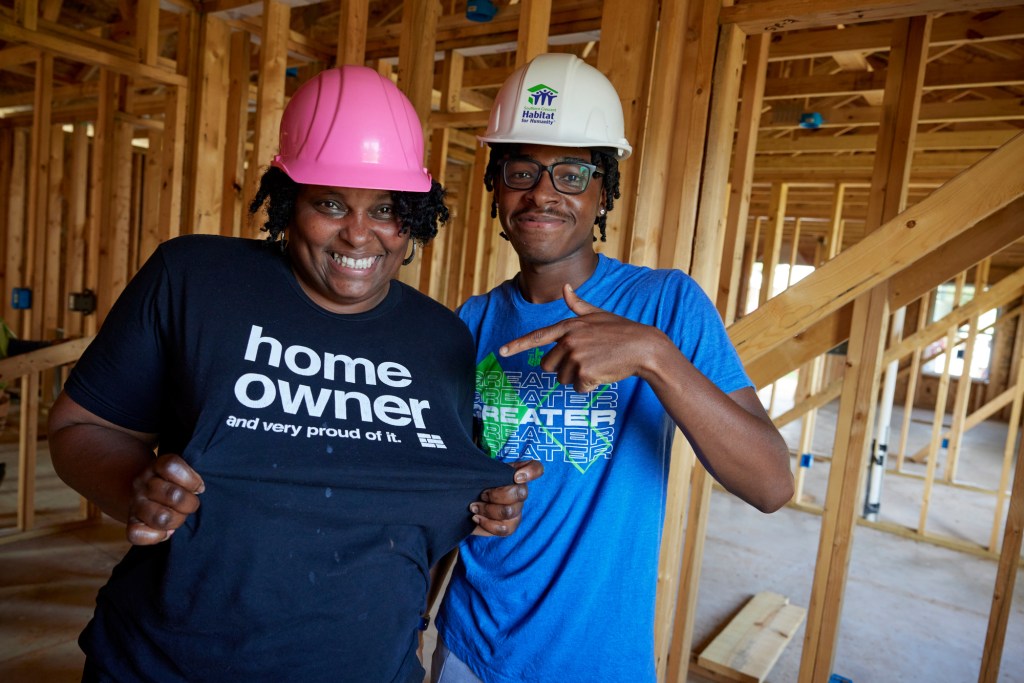
Marsha and her son pose for a photo while building their future home with Southern Crescent Habitat for Humanity in Georgia.
Everyone can play a part in the fight for housing equity and the pursuit of a better world. Over the past 50 years, Habitat for Humanity has become a leader in global housing thanks to an engaged network of volunteers—but you don’t need to be skilled with a hammer to make a meaningful impact. Building an equitable future means calling on a wide range of people and talents.
Here’s how you can get involved in the global housing movement:
Speaking up on social media about the growing housing crisis
Volunteering on a Habitat for Humanity build in your local community
Travel and build with Habitat in the U.S. or in one of 60+ countries where we work around the globe
Join the Let’s Open the Door movement and, when you donate, you can create your own personalized door
Every action, big and small, drives a global movement toward a better future. A safe home unlocks opportunity for families and communities alike, but it’s volunteers and other supporters, working together with a shared vision, who can open the door for everyone.
We’ve all been there: it’s 90 degrees outside, absolutely sweltering, and you’re walking home from a new smoothie shop less than a mile away from your apartment, and everything is melting. The smoothie in your right hand. The açaí bowl in your left. Your old, broken headphones slowly slip off your head as a song you’ve never heard before blares through the speakers. Your willpower is diminishing by the second, and no one is around to help you.
Okay, that might be a bit specific (and precisely what happened to me about an hour ago). Still, you’ve likely had a similar experience: an encounter that left you annoyed, frustrated, or feeling hopeless.
But what if I told you that, according to Mo Gawdat, a former Google executive who has spent the last 20 years researching the mechanics of happiness, you only need to endure that emotional roller coaster for precisely 90 seconds?
Meet the man behind the 90-second rule
It’s time to meet the man who is revolutionizing our understanding of our emotions by giving us all a science-backed way to hit the reset button on our worst days.
Mo Gawat isn’t your typical wellness guru peddling crystals and manifestation journals. This is a guy who spent years as Chief Business Officer at Google X, the company’s “Moonshot Factory,” where he pursued ambitious, high-risk but potentially world-changing projects that tackled large-scale global problems like climate change, healthcare, and communications. But his most profound discovery about human happiness stemmed from his darkest hour.
When Gawdat’s 21-year-old son Ali died from preventable medical negligence during what should have been a routine surgery in 2014, he faced a darkness that would define the rest of his career. A clear choice emerged. He could either let this grief consume him, or honor his son by dedicating his analytical mind to a path Ali had always encouraged him to pursue: spreading happiness to as many people as possible.
Seventeen days after losing his son, Gawdat sat down and began writing Solve for Happy: Engineer Your Path to Joy. Through this book, he uncovered a revolutionary truth: our emotions aren’t permanent. They have expiration dates.
The fascinating brain science behind your emotional meltdowns
Here’s where things get fascinating. When developing what would later be known as the “90-second rule,” Gawdat stumbled upon the findings of Harvard-trained neuroscientist Dr. Jill Bolte Taylor. Similarly, her research was also formed in the pressure cooker of an unexpected, dramatic life experience: the moment when she underwent a massive stroke.
As Dr. Taylor’s left brain hemisphere shut down, she gained unprecedented real-time insight into how emotions function in the body.
What she discovered is that when something triggers you, be it a spilled smoothie or a coworker’s passive-aggressive “per my last email” message, your amygdala (think of it as your brain’s overly cautious security guard) floods your system with stress hormones like cortisol and adrenaline. Your heart starts to race as if you’ve just spotted a bear and begun to run, your muscles tense up, and that instinctual fight-or-flight response surges through your body.
However, this chemical cascade has a built-in timer. As Dr. Taylor discovered, it takes approximately 90 seconds for these stress hormones to be flushed from your bloodstream. Meaning that, after that initial surge, the physical component of your emotional reaction is over.
But why doesn’t it feel like that? Why do we marinate in our emotions (anger, sadness, confusion, delusion) for hours, days, or more? That’s because, after those 90 seconds, we make a choice, usually without realizing it, to keep those emotions going by mentally rewinding and replaying the triggering event.
Why do we keep choosing emotional suffering?
“What happens is, you run the thought in your head again, and you renew your 90 seconds,” Gawdat explains. It’s like poking a bruise that’s formed on your knee, or hitting refresh on your personal stress response button. Every time you mentally revisit a stressful event, analyzing what you should have said, reimagining confrontations, and crafting the perfect comeback, you’re essentially retriggering that same potent chemical reaction that occurred in the first place.
So, while that 90-second episode of emotions ends quickly, we end up ruminating about what happened: over and over and over and over again.
This is more than a mere annoyance. Ift’s rewiring our brains in a bad way. Research shows that rumination doesn’t just prolong our bad moods, it intensifies them and can lead to anxiety and depression. We’re thinking ourselves into extended mental states simply by focusing too much on the past.
The three questions that reality-check your brain
What happens when you’ve successfully coasted through those initial 90 seconds but still feel like the world is out to get you? Gawdat developed a handy three-question reality check that serves as an emotional fact-checker for your brain:
Question 1: Is it true?
Gawdat claims that “90% of the things that make us unhappy are not even true.” Think about it: your partner seems distracted during dinner, and suddenly your brain spins an entire narrative about how they’ve fallen out of love with you. But how much of that is real? And what percentage of your little daydream can be chalked up to your brain being its usual dramatic self?
At best, our brains are excellent storytellers. The problem is that they’re prone to writing fiction and presenting it as truth.
So, the next time you find yourself spinning up a stressful “what if?” situation in your head, take a beat, and ask yourself a different question: “Is it true?”
Question 2: Can I take action?
If the answer to question one is “Yes, it is true,” then move on to Gawdat’s second question. Are there steps you can take?
If you have a real problem on your hands, then perfect! Channel that energy into solving it rather than drowning in it.
Question 3: Can I accept it and still create a better life despite it?
Here’s where things get tricky. If you can’t do anything about the situation, the final question before you becomes about “committed acceptance.” No, not passive resignation, but actively choosing to move forward and build something better despite the circumstances.
This can be difficult (remember, this process began with Gawdat searching for a way to make sense of his son’s death) but these questions aren’t about forcing toxic positivity or pretending like problems don’t exist. They help your brain make sense of what’s happened, distinguishing between productive and unproductive emotional energy.
Your brain: the overprotective parent
To understand how this works, it helps to think of your brain as an overprotective, hovering parent who sees danger everywhere. “Your brain isn’t your source of truth,” Gawdat explains. “It’s just a survival machine. A search party. It throws thoughts at you, hoping something will protect you. But that doesn’t mean any of them are true.”
Your mammalian brain evolved to keep you alive, not happy. When modern life presents you with stressful situations like traffic jams, work pressures, and particularly hot and evil temperatures, your ancient survival systems register these “threats” with the same emotional urgency as a saber-toothed tiger attack.
Putting the 90-second rule into practice
So, what does this really look like in real life knowing the science is only half the battle?
Step 1: Notice the surge
When you feel that familiar rush of anger, frustration, or anxiety, create a mental note. “Okay, this is a chemically induced wave of emotion,” you might say to yourself without judgment.
Step 2: Set a timer, literally
For the first 90 seconds, your job is to observe. Feel every emotion to its fullest: your heart racing, your muscles tensing, your breath shortening. Acknowledge these physical sensations without trying to fix or stop them.
Step 3: Breathe and wait
Deep breathing can help calm your nervous system after an onslaught of chemical reactions and prevent your brain from fueling the emotional fire mentally.
Step 4: Choose your response
When those 90 seconds pass, you have what Gawdat calls a “buffer,” a moment of clarity when you can decide what to do next.
Step 5: Apply the three questions
If you’re still upset after the initial wave, run through Gawdat’s reality-check framework.
The 90-second rule offers a unique perspective on relating to your vitally essential emotions. Emotions provide information about the environment and motivate us to take action. The 90-second rule helps us experience our emotions fully without letting them hijack our entire day or our entire life.
The happiness equation connection
This framework connects to Gawdat’s broader “happiness equation,” which posits that happiness equals life events minus expectations. Much of our suffering comes not from what happens to us, but from the gap between the triggering event and what we think should happen.
As Gawdat puts it, “Life doesn’t give a damn about you. It’s your choice how you react to every one of [life’s challenges].” Which may sound harsh, but when put into practice, can prove quite liberating.
The next time you feel yourself crashing out, remember: you have 90 seconds to feel as irrational as humanly possible. After that? You get to decide how to spend the rest of your day.
This article originally appeared one year ago. It has been updated.
Ohio mom Rose Grady (@nps.in.a.pod) shared her “Boomer grandparent” experience in a funny and relatable video. “Just a millennial mom watching her boomer parents bring three full loads of ‘treasures’ into her home,” she wrote in the overlay.
One mom’s viral video hit a nerve
Grady can be seen looking out the window of her home at her Boomer mom and dad carrying bags and boxes up her driveway after several visits. The distressed and contemplative look on Grady’s face is speaking to plenty of Millennial moms.
Grady captioned the video, “Today’s ‘treasure’ highlight was the mobile that hung in my nursery…”
The humorous video resonated with fellow Millennial parents. “Straight to the trash when they leave,” one viewer commented. Another added, “I always say ‘if you don’t want it in yours, we don’t want it in ours’ .”
Even more Millennial parents have shared and discussed their situations with Boomer grandparents buying their kids too much stuff on Reddit. “Both my mother and my MIL love buying and sending toys, books, clothes, etc. I don’t want to be ungrateful but we just don’t need it and don’t have the space. I have brought this up politely in ‘we are all out of drawers for that’ but it hasn’t slowed things down,” one explained. “I think part of the issue is that the grandparents live in different cities and vacation a lot. They don’t get to see our daughter much so they buy stuff instead.”
Another Millennial parent shared, “While the intention is very kind behind these, all the grandparents are very aware that we do not need, nor wish to receive these gifts in such an excessive volume – as it creates a daily struggle to store and accommodate in our home. I struggle to keep on top of tidying as it is, and this is a massive added challenge.”
How to talk to Boomer grandparents about gifts
Millennial mom struggles to organize her son’s room. Photo credit: Canva/fotostorm
So, why are Boomer grandparents excessively gifting? “Boomer grandparents may be the first grandparent generation to have accumulated the substantial discretionary funds that enables them to spend money on their grandchildren,” Sari Goodman, a Certified Parent Educator and founder of Parental Edge, tells Upworthy. “These grandparents probably grew up with grandparents who didn’t have that kind of money and so they may be excited to give their grandchildren the things they didn’t get.”
Goodman suggests that Millennial parents first discuss with them the “why” behind the gifting. “What comes before setting a boundary to limit over-the-top gift-giving is delving into the reasons grandparents are buying so much,” she explains. “Coming from a place of compassion and understanding makes it possible to come up with mutually beneficial solutions.”
She adds that another reason may be that Boomer grandparents live far away and want their grandchildren to feel a connection with them. “Set up a regular FaceTime or Zoom meeting. Rehearse with the kids so they have something to say and suggest a topic for the grandparents,” says Goodman. “Or send snail mail. Kids love getting mail. The grandparents can send postcards from where they live and explain some of the special sites.”
Finally, Goodman adds that for some grandparents, this may be the only way they know how to show their love. Millennial parents could ask if they would be open to other ideas. “Parents can set up an activity for grandparents and kids to do when they come over: a jigsaw puzzle, art activity, board game, magic tricks,” she says. “Arrange for the grandchildren to teach the grandparents something their phones can do or introduce them to an app they might like.”
This article originally appeared one year ago. It has been updated.
Nadia Dubceac is known to many in social media circles as a fitness guru with an edgy twist. Her dark hair, Gothic eye makeup, black fingernails, and often dark attire (even while working out) exemplify a traditional “goth chick,” with extra impressive muscles.
But don’t let her tough-looking exterior fool you. On a recent social media post, she shared a clip of herself with a tiny bee resting gently on her finger. “If you’ve been following my stories, you know I have a pet bee. Her name is Beebee. I call her Bee Bug.”
She explains how they met. “I found her almost exactly two months ago, lying on her back outside, probably dying. And I’ve seen a lot of videos of people reviving bees by giving them sugar and water. And I was like, ‘ya know what? Maybe she just needs a little sugar.’” She then adds, perhaps referring to a slight buzzing from the bee, “She’s getting zoomies.”
Dubceac then shares the story of how the two become fast friends. “So, long story short, I bring her inside. I had a bouquet of flowers that I put her in. I kind of just gave her sugar and water, thinking I’ll help replenish her, and she can go about her day and live a long, happy life.”
This whole time, the bee has been walking around her hand. We then see Beebee crawling into the circle made between her fingers and her thumb. “She’s doing her favorite activity right now,” Dubceac explains. “I make a little cave for her to burrow in and she loves it in here. She can be in here all day.”
Dubceac’s love of creatures made it feel impossible to leave Beebee to fend for herself. “Obviously, as an empath, there was no way I could put her back outside, knowing she’s unable to fly. So here we are. It’s been two months and she has been spoiled rotten.” We then get a shot of Beebee prancing through white flowers with bright yellow pollen at their centers. “She gets everything she wants. It has been really fun getting to know her little personality. I know it’s crazy, but I swear she has one!”
As for the logistics, they have a firm routine. “I feed her around 12 and then again once I come home from the gym. And then again while I’m having dinner. So she does have an internal clock. She knows.”
We then see her buzzing around a small habitat, not unlike a playpen. “She is a carpenter bee, so she obviously loves wood. I bought her a little wood house. She has a bonsai tree. She has this little mushroom that her godmother has given to her. And yes, she has a godmother.”
In a scary moment, Beebee jumps off Dubceac’s hand, but she finds her safely on the ground. “Please,” she says directly to her. “You’re so little and fragile. Stop doing that!” The video cuts to Dubceac’s cat, so she adds, “I obviously do buy her flowers, as long as they’re cat safe. And yes, I do have a cat. He knows not to mess with her and obviously they’re separated.”
She then addresses a thought many viewers might have, saying, “Now you may be wondering, what do I feed her?” She pulls out a square of pollen. “She eats a big, fat block of pollen. All of this just for her. I just wet a little piece so it can be nice and soft for her. And bees also need water, so that’s my way of keeping her hydrated.”
Having spent the last couple of months with Beebee, she notes, “I think bees are a lot more intelligent than we give them credit for. They recognize faces. She will reach for me when she wants to be held. Oftentimes, I’ll find her running around in panic until I pick her up. And she finds a nice, little cozy spot on my hand to take a little nap. And it’s the cutest thing ever. I think she’s actually pretty cozy right now.
My favorite thing she does? When she naps, she will put her little antennas go down. And it’s the cutest f—ing thing ever. She also loves a good nap on this window sill, especially when I lay the blanket down for her. Watching her groom is so fascinating. I have studied her entire routine. So yeah, that’s my little Beebee. She’s sending you the best energy ever.”
There were tens of thousands of supporters in the comment section on Instagram. One person writes, “Dear universe, when I die, please let me come back as an alt girl’s pet bee.”
Another shares their personal experience, writing, “During Covid lockdown, there was a carpenter bee that visited me every day for months. He would hang outside with me for hours! And when I went inside, he would hover in the windows, following me around the house. One day, he came by with a girlfriend and I hope they lived happily ever after!”
A few had understandable questions. One asked, “They have a four-week lifespan. How is it 2 months?” Dubceac answered, “Female carpenter bees live up to 3 years.” To this, another commenter answers, in part: “Thank you for taking such care of her!”
In a ThoughtCo “profile” piece on carpenter bees, entomology expert Debbie Hadley writes that they are “quite harmless and excellent pollinators.” She also adds this tidbit: “Carpenter bees practice buzz pollination, an active method of collecting pollen grains. When it lands on a flower, the bee uses its thoracic muscles to produce sound waves that shake the pollen loose.”
As to whether sugar, water, or sugar water is safe to give to bees, some experts claim it depends on the situation. Beevive.com suggests first checking to see if the bee can fly, as Dubceac did. Then, if possible, offer a flower solution first. “If the flower method fails, sugar water is needed. The RSPB (a conservation charity) suggests getting a small container or spoon and offering two tablespoons of granulated white sugar to one tablespoon of water.”
She wouldn’t be the first to keep a bee as a pet. According to Apis Cera, a company that makes beeswax candles, a woman from the United Kingdom once had a special bee friendship. On their website, they shared, “Fiona Presly, a library assistant from Inverness, rescued a buff-tailed, or large earth, bumblebee queen that had been born without wings and was struggling to survive.
Over the next few months, the two appeared to develop a special bond. Bee, as Presly named the insect, would even ‘cuddle’ and seemed to be ‘house-trained.’ Indeed, caring for the bumblebee has had a profound impact on how Presly thinks of insects.”
Bees are a vital part of our ecosystem. It probably goes without saying that we shouldn’t just capture them or remove them from their natural habitat. But should a bee get hurt, as Beebee did, providing them a safe place to live out their time can be a wonderfully kind and rewarding thing to do for the bee and their human.
The best flights are uneventful. Timely, smooth, and relaxing. Even a little boring. However, that’s not always in the cards.
A lot of things can happen in the air, including unforeseen medical emergencies. Thankfully, this one has a happy ending thanks to the help from two selfless strangers.
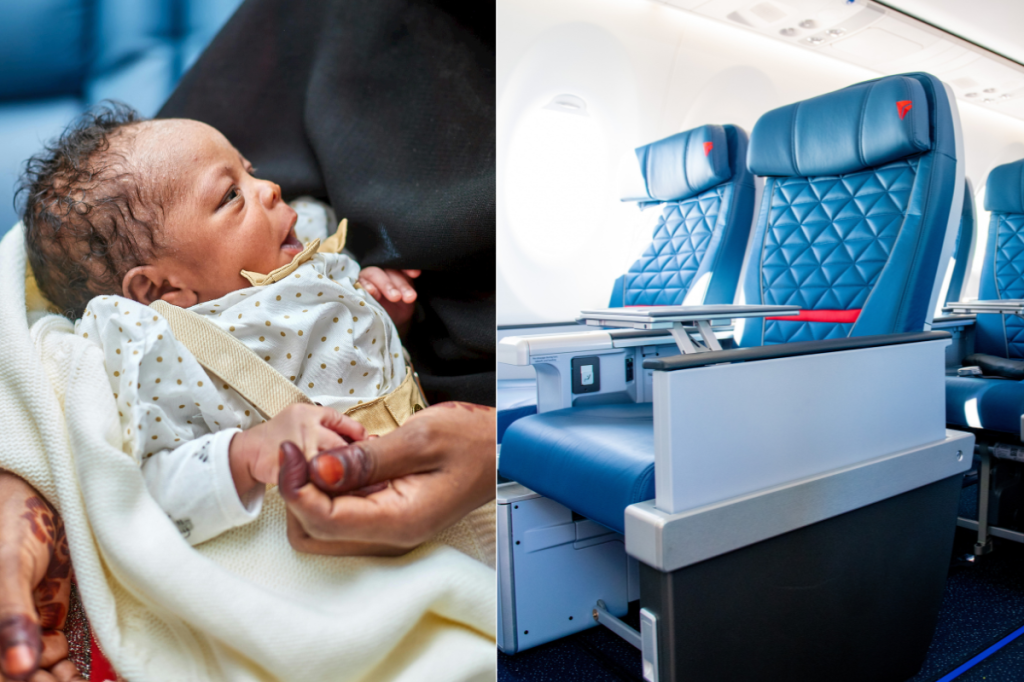
Woman on Delta flight unexpectedly goes into labor minutes before landing
Ashley Blair was pregnant and due in about two weeks, but really wanted to be with her mom in Oregon when the baby arrived. So, she hopped a Delta flight through Atlanta and was well on her way when things took an unexpected turn.
Pregnant mothers are generally discouraged from flying this late into a pregnancy, and some airlines may forbid them entirely. But life happens. Sometimes, travel is unavoidable, and in Blair’s case, she still had a few weeks left before she was supposed to go into labor, making the risk relatively low.
The baby had other ideas.
CNN reports that Blair went into labor when her Delta flight was about 30 minutes away from landing at Portland International.
Two hero paramedics step up to help
A paramedic is never truly off the clock. Even though Tina Fritz and Kaarin Powell, two friends and emergency workers, were flying home from vacation in the Dominican Republic, they’d already been called to action not long after the plane took off.
Fritz and Powell were attending to another passenger when flight attendants made an urgent announcement: Was there a doctor onboard?
They rushed to Blair’s side and, with the help of flight attendants, began shuffling passengers around to make enough room to deliver the baby. Unfortunately, there were no medical tools or sterile equipment available on the plane, and the baby was coming fast, so there was no time to lose.
150-some passengers, and the crew, all pitched in to help. Photo Credit: Edgar Zuniga Jr./Flickr
Passengers work together to help
Right as Blair was getting ready to start pushing, the pilots announced that the plane was about to begin its landing procedure. That usually means all passengers and crew must take their seats.
This was going to have to happen fast.
Fritz and Powell told flight attendants that they needed blankets, and lots of them. Passengers all over the plane passed theirs back so that Blair could be comfortable as she began pushing.
They also needed shoelaces, of all things. One to use as a tourniquet for an IV, and another to tie off the umbilical cord. That is, before they cut it with a butter knife, which was all that was available.
Truly an amazing MacGyver-like delivery. Just a few quick pushes and the baby was born. Some passengers barely even knew anything was happening outside of a few murmurs and folks standing up or moving around.
According to all reports, Blair and baby girl Brielle were healthy and stable when the plane arrived.
A beautiful irony in the teamwork
Airplanes and airports are notorious for bringing out the worst in humanity. Passengers berate flight attendants, fight over seats, and throw etiquette and human decency into the wind over the most minor inconveniences.
So, it’s amazing to see an example of 150-some odd strangers working together to tackle a true medical emergency. It wasn’t the smooth, convenient, and peaceful ride some passengers probably had in mind—but it’s one they won’t soon forget.
There’s a particular kind of magic that happens when professionals doing routine work get hit with a genuinely extraordinary situation. The instinct is usually one of two things: clinical efficiency or unexpected warmth. Sometimes, gloriously, both.
That’s exactly what happened on April 4, 2026, when Caribbean Airlines Flight BW005 was descending into John F. Kennedy International Airport from Kingston, Jamaica. One of the passengers, a heavily pregnant woman, went into labor. The pilot calmly radioed Kennedy Tower with the situation and requested a direct routing in. Air traffic control lined everything up: clearance to land on Runway 4R, ground crew briefed, medical personnel arranged at the gate.
Then, a few minutes after touchdown, ground control checked in.
An airplane pilot. talking to air traffic controller. Photo credit: Canva
“Caribbean five, ground.”
“Yes sir, go ahead.”
“Is it out yet?”
“Yes, sir.”
“All right. Tell her she’s got to name it Kennedy.”
“Ahh, Kennedy. Will do.”
“All right. Have a good day.”
That was it. The audio, which CBS Mornings shared on April 6, has been making the rounds online ever since, mostly because of the timing of the whole thing. A mother had just delivered a healthy baby on a Boeing 737 mid-descent. The pilot had just helped coordinate that situation while flying a plane. And the ground controller, having calmly walked the flight through one of the more unusual arrivals at JFK that week, decided the appropriate sign-off was a dad joke about naming the kid after the airport.
According to Caribbean Airlines, the flight never even formally declared an emergency. The crew handled it within standard procedures, and upon landing the mother and newborn were attended to by medical personnel and received the care they needed. Everyone was fine.
What’s stuck with people online isn’t really the medical drama, though. It’s the ground controller’s instinct to make a joke. There’s a version of this exchange that’s all clipped efficiency, and we’d never have heard about it. But this particular controller, in the middle of a shift at one of the busiest airspaces in the country, decided the moment called for a small human gesture. A pop of warmth on a frequency that’s usually nothing but headings and altitudes.
It’s nice to see that the people running our infrastructure are people. They’re listening, they’re paying attention, and once in a while they’re trying to give a stranger they’ll never meet a little something to remember the day by.
Whether the baby actually ends up named Kennedy is up to the family. But somewhere out there is a woman who can tell her child a true story that starts with “you were born on a plane, and the man on the radio who guided us in picked your name.”
They also have enough experience to take some pride in decisions that, in hindsight, were the right moves. The good news is that at 40 there is still plenty of time to learn from our successes and failures to set ourselves up for a great second half of life. These lessons are also valuable to the Gen Zers coming up who can avoid the pitfalls of the older generation.
The Reddit thread that hit a nerve
A Reddit user who has since deleted their profile asked millennials nearing 40 what their biggest mistakes were at this point in life and they received more than 2,200 responses. The biggest regrets these millennials have are being flippant about their health and not saving enough money when they were younger.
They also realized that the carefree days of youth are fleeting and impossible to get back. So they should have spent less time working and more time enjoying themselves. Many also lamented that they should have taken their education more seriously in their 20s so they have more opportunities now.
The responses to this thread are bittersweet. It’s tough hearing people come to grips with their regrets but the realizations are also opportunities to grow. Hopefully, some younger people will read this thread and take the advice to heart.
Here are 21 of the most powerful responses to the question: “Millennials of Reddit now nearing your 40s, what were your biggest mistakes at this point in life?”
On health and relationships
1. “Not taking care of my hearing, not even 35 and going deaf.” – Kusanagi8811
3. “Staying too long at a job in my 20s, just because it was safe and easy. When I finally got the motivation to leave, ended up with an almost 50% pay boost.” – Hrekires
4. “Thinking that I could and should put myself on the back burner for anything and anyone else.” – lenalilly227
5. “Smoking and not dealing with my sh** the right way.” – Allenrw3
6. “Pining after the wrong person.” – runikepisteme
7. “I turned 40 this year and just started liking who I am. Why the fuck did it take 40 years for self acceptance?” – guscallee
8. “Take care of your f***ing back. Lift with your knees. Sure it’s rad when you grab a fridge by yourself and lift it in the back of a moving truck unaided, but one day that shit is going to have consequences that won’t just magically go away by resting and ‘taking it easy’ for a week.” – GuyTallman
9. “I wish I spent more time with my dad while I had the chance.” – CharlieChooper
10. “I’m 37. I absolutely could have taken better care of my body, but I’m in relatively good health. I’m starting to realize how important it is to maintain my health. I do also think I drank far too much in my 20 and early 30’s. I’m trying to rectify that now, but it’s hard. So that I guess.” – dartastic
On work, money and missed opportunities
11. “I’m not sure if people have experienced the same but when I entered my 30s I became convinced I was rapidly running out of time. Rather than using that as motivation I let it paralyze me with indecision because I ‘couldn’t afford to make the wrong choice.’ Consequently, I’m now 39 and, though I’ve had great things happen in my 30s, I regret spending so much time worrying and so little time committing to a course of action.” – tomwaste
12. “Work to live, don’t live to work. You have half your working life after you turn 40 but only 20-25 years to really live it up before the responsibilities become heavy and your joints start to ache. Live life. Really LIVE it. Experience as much you can. Every sensation, sight, sound, touch. Be open. Be brave. Live your first few decades in the fast lane. You have the rest of your life to take it easy, when you have no choice.” – MrDundee666
13. “I should have paid more attention to my parents telling me to save money and less attention when they were teaching me about purity culture.” – Arkie_MTB
14. “If I could tell my 18 year old self one thing, it would be to save 10% of every paycheck I ever got.” – PutAForkInHim
15. “Thinking that I have time to do everything I want only to find myself loosing time, and the endless energy I used to have in order to purse them.” – ezZiioFTW
A man with a regrettable sunburn. Photo credit: Canva
16. “Not wearing sunscreen.” – blueboxreddress
17. “Not recognizing the importance of work/life balance earlier in life. My late teens, all 20’s, and early 30’s were spent pulling 60-100+hr weeks because I thought it was what was required to succeed. How wrong I was. Others stabbed me in the back and reaped the reward.” – [Deleted]
18. “When you get out of college, keep your friends. No matter how hard it is. Hold on to them.” – mpssss22
19.“Should have bought a home. We qualified 20 years ago for enough to buy a small 2 bedroom but I didn’t think we could afford it. That 2 bedroom would be worth nearly 3Xs and paid off by now. We pay nearly double in rent what our mortgage would have been. Gotta love the SF bay area cost of living.” -Thelazywitch
20. “Always ask for more pay. Starting, yearly, before leaving, whatever. Get that money.” – SensibleReply
What younger generations can take from this
Reading through these responses, one thing becomes clear: most of these regrets aren’t about big dramatic failures, they’re about the small, quiet choices that compound over time. The good news is that the same principle works in reverse. Small, quiet choices toward health, connection, and financial security add up, too.
This artice originally appeared five years ago. It has been updated.
The dog world shifted in 2022 as the sweet-faced, loveable Labrador Retriever was toppled as America’s favorite dog breed. The breed best known for having a heart of gold was replaced by the smaller, more urban-friendly French Bulldog.
According to the American Kennel Club, for 31 years, the Labrador Retriever was America’s favorite dog until it was eclipsed in 2022 by the Frenchie. The rankings were based on nearly 716,500 dogs newly registered in 2022, of which about 1 in 7 were Frenchies. Around 108,000 French Bulldogs were recorded in the U.S. in 2022, surpassing Labrador Retrievers by over 21,000.
How the Frenchie took over America
The French Bulldog’s popularity has grown exponentially over the past decade. They were the #14 most popular breed in 2012, and since then, registrations have gone up 1,000%, bringing them to the top of the breed popularity rankings.
The AKC says that the American Hairless Terrier, Gordon Setter, Italian Greyhound and Anatolian Shepherd Dog also grew in popularity between 2021 and 2022. As of 2025, Frenchies are still America’s top dog three years running.
The French Bulldog was famous among America’s upper class around the turn of the 20th century but then fell out of favor. Their resurgence is partly based on several celebrities who have gone public with their Frenchie love. Leonardo DiCaprio, Megan Thee Stallion, Alexandra Ocasio-Cortez, Reese Witherspoon and Lady Gaga all own French Bulldogs.
The breed earned a lot of attention as show dogs in 2022 when a Frenchie named Winston took second place at the Westminster Kennel Club Dog Show and first in the National Dog Show.
Stars love them too
The breed made national news in early 2021 when Gaga’s dog walker was shot in the chest while walking two of her Frenchies in a dog heist. He recovered from his injuries, and the dogs were later returned.
They’ve also become popular because of their unique look and personalities.
“They’re comical, friendly, loving little dogs,” French BullDog Club of America spokesperson Patty Sosa told the AP. She said they are city-friendly with modest grooming needs and “they offer a lot in a small package.”
They are also popular with people who live in apartments. According to the AKC, Frenchies don’t bark much and do not require a lot of outdoor exercise.
The French Bulldog stands out among other breeds because it looks like a miniature bulldog but has large, expressive bat-like ears that are its trademark feature. However, their popularity isn’t without controversy. “French bulldogs can be a polarizing topic,” veterinarian Dr. Carrie Stefaniak told the AP.
The downside of having a Frenchie
French Bulldogs have been bred to have abnormally large heads, which means that large litters usually need to be delivered by C-section, an expensive procedure that can be dangerous for the mother. They are also prone to multiple health problems, including skin, ear, and eye infections. Their flat face means they often suffer from respiratory problems and heat intolerance, and Frenchies are also more prone to spine deformations and nerve pain as they age.
While they’re friendly, they can also be stubborn and may require more training than the average dog. Overall, however, the AKC says that French Bulldogs are good for families with children due to their laid back, social nature and lack of aggression.
Here are the AKC’s top ten most popular dog breeds for 2022.
1 French Bulldogs
2 Labrador Retrievers
3 Golden Retrievers
4 German Shepherd Dogs
5 Poodles
6 Bulldogs
7 Rottweilers
8 Beagles
9 Dachshunds
10 German Shorthaired Pointers
Part of the reason the 2022 list was so noteworthy was the change at the top, as these lists don’t tend to change much year to year. In fact, the 2025 Most Popular Dog Breed list looks very similar to 2022, with only minor movement. The biggest change was the Dachshund moving up to #5, nudging the Poodle out of the top five for the first time in years. Beagles came in at #6, Rottweilers at #7, German Shepherd Dogs at #8, German Shorthaired Pointers at #9, and Bulldogs at #10.
So congratulations, Frenchies for keeping your top dog spot for the fourth year in a row.
This article originally appeared three years ago. It has been updated.