
For some, the idea of changing things we don’t like about ourselves seems insurmountable. Perhaps this is because we think we need to make giant, bold leaps for reinvention. In reality, we don’t actually need huge moves to make changes. A neuroscience expert explains there are tiny daily actions we can take in order to slowly but surely change who we are.
In a clip posted to Instagram, neuroscience expert Tina Levinson (@rewiredmanifor online) discusses ways in which we can slowly change whatever version of ourselves we’d like to improve. As she sits in a pink sweater with two small dogs biting on sticks in her lap, a chyron appears which reads: “If I wanted to become an unrecognizable version of myself six months from now, these are the five things I’d practice every day.”
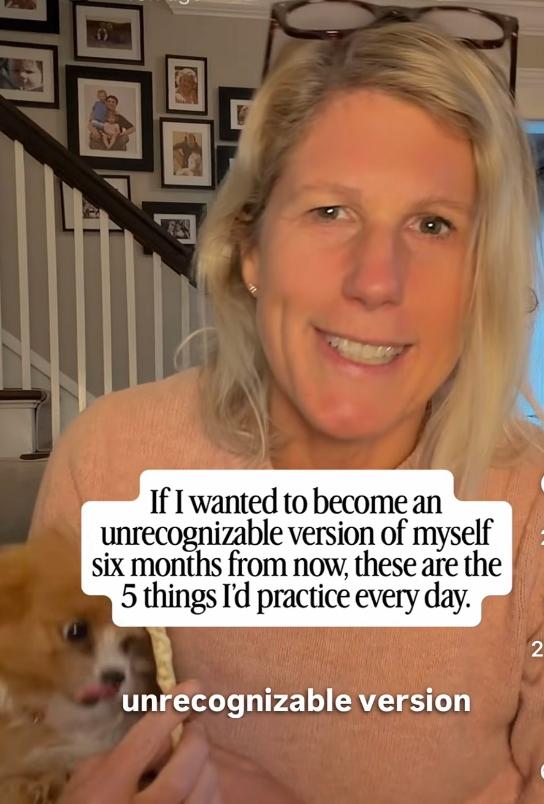
She adds, “I say this as a neuroscience coach who had to use these exact practices to rebuild my own life. And none of them are big. Because this is what I think we get completely wrong about becoming a different person. We focus on the giant transformation, when your brain is actually changing in these tiny, almost boring moments throughout the day.”
Question just one thought
First she suggests to “question just one thought.” She explains, “Because your brain hands you predictions all day long disguised as facts, right? ‘I can’t do this. This is gonna go badly. They’re gonna judge me.’ And instead of immediately believing it, I’d ask, ‘Do I actually know that?’ That one question creates a tiny gap between what your brain predicts and what you choose to do.”
Regulate before responding
For her second lifehack, Levinson suggests truly regulating one’s self before responding to a situation, comment or even thought. “This one is huge. Because trying to make a different decision from the exact same dysregulated state is freaking hard. Take three psychological sighs. A deep inhale and another sip at the top…and a long exhale. Take a walk around the block, whatever works for you. Just change the state and then make the decision.”
Do one thing that the ‘old version’ of you would not do
She explains the importance of this, as she claims, “this is where identity starts changing.” She gives examples. “Say no, ask for the thing, post the video, stop explaining yourself. Your brain needs evidence and you can tell yourself you’re becoming more confident all day long, but doing the scary thing gives your brain receipts.”
Look for what ‘is’ working
“Because your brain,” she says, “is constantly deciding what information deserves your attention. So if you spend all day long asking what’s wrong, congratulations! Your brain will become incredibly efficient at answering you. So I would train it to notice something else.”
Keep one promise to yourself every single day
Levinson makes it clear that for this tip, one shouldn’t over promise. “Not ten,” she says. “Just one. Because imagine giving your brain 180 straight days of evidence that says when I say I’m going to do something, I do it. So who are you after six months of that?”
She winds down by reiterating how these tiny changes add up. “This is the part that I wish more people understood about changing their lives. You don’t become a different person and then start behaving differently. You start practicing different thoughts, different responses, different behaviors. And eventually your brain goes, ‘okay, this is who we are now.’ That is neuroplasticity. And that is how you create the life that you actually want.”
Cognitive behavioral therapy
Her ideas are similar to concepts found in cognitive behavioral therapy (CBT). In a recent article for Psychology Today, Seth J. Gillihan, PhD, reminds readers that this concept isn’t exactly new. “At least since the time of Greek philosopher Epictetus nearly 2000 years ago, we’ve known that ‘People are not disturbed by things but by the view they take of them.’ Is that idea any different from 20th-century cognitive therapy?”
He continues, “Long before Emerson said to ‘Always do what you are afraid to do,’ humans have known that the best way to overcome our fears is to face them. The history of mindfulness goes back thousands of years to Buddhism and Hinduism, a long time before it was popularized as a non-religious Western practice.”