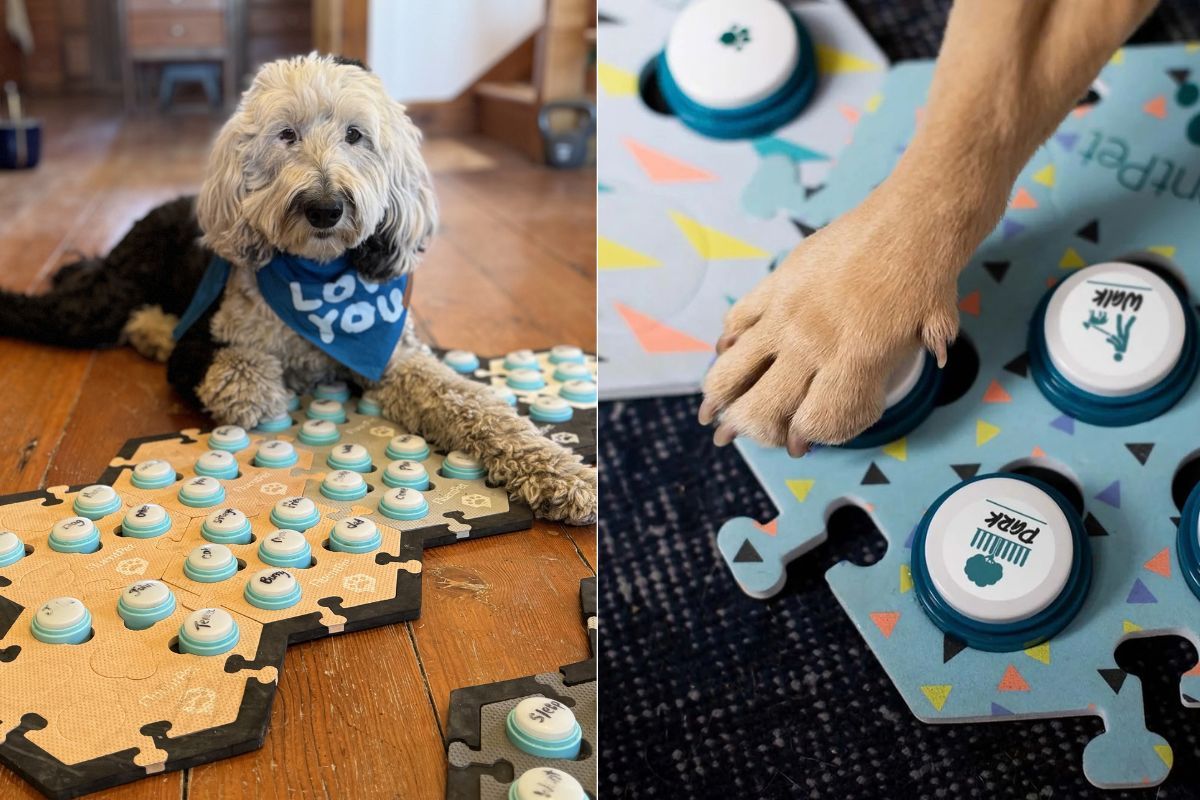
Alexis Devine of Washington has built a massive social following of over eight million, but the fans don’t really belong to her. They belong to her pets, namely her dog Bunny, who entertains them with incredible, hilarious feats of intelligence that regularly go viral to the tune of tens of millions of views.
Bunny’s most famous feat? Using “talking buttons” to ask for what she wants and, sometimes, to ask much bigger questions.
In one famous viral video, Bunny uses her buttons to tell Alexis: “Mad. Ouch. Stranger. Paw.” She then walks over and hands Alexis her paw, allowing Alexis to discover a sharp foxtail sticking out of it. The interspecies communication on display in the video blew people’s minds.
In another video, Bunny asks something a little more philosophical: “Why forget?” After Alexis explains the limits of short- and long-term memory, as best she can, Bunny, seemingly satisfied, responds, “Thank you.”
You have to see it in action to truly believe it.
Talking buttons for pets are now in millions of households
Many viewers might not realize it, but the buttons Alexis and Bunny use aren’t custom-built or exclusive to master trainers.
Anyone can buy them from companies like FluentPet, which sells starter kits and instructions. Alexis says she had almost no experience training animals before she started using buttons with Bunny around the start of the pandemic. All she knew was that she wanted to have a lot of trust and communication with her dog.
“My goal before bringing Bunny home was to have this sort of Lassie-esque relationship. I wanted the best communication possible and the closest relationship,” Alexis tells Upworthy. “And so I figured I’d give buttons a shot.”
Bunny started with just one button: “Outside.” Alexis would press the button herself every time she took Bunny out. Alexis noted that, after a few weeks of repetition, Bunny started pressing the button on her own to request to go outside.
From there, the pair began adding more buttons.
“Once Bunny understood that she could control outcomes in her world by pressing the buttons, every time I put down a new button, she would very quickly explore it and try to understand what it meant.”
As of today, FluentPet buttons are in over two million households, and the company is digesting the data from over 50 million button presses. It’s an incredible amount of real-world data that simply didn’t exist a few years ago, and it’s telling us a lot about how our pets think and communicate.
Alexis and scientific experts are clear: the buttons don’t really allow animals to talk, per se, and they’re not mastering human speech. But the data and the real people trying the buttons show that this is far from just a social media gimmick.
Why talking buttons are all the rage
What’s fascinating is why the buttons are becoming so popular.
Most people won’t grow a millions-strong social media empire like Alexis has, and the training involved requires far too much repetition and consistency just to teach your dog to ask for treats—a simple novelty.
Alexis says the people she’s spoken to about talking buttons are craving a much deeper understanding of their pets. It comes from deep love and empathy.
“One of the really really beautiful things… a lot of people when they fill out our survey after purchasing, as to why they wanted buttons, is so that their learners could tell them when and, specifically, where they’re in pain.”
She says, evolutionarily, animals are adapted to hide or minimize their pain so they don’t appear vulnerable. “But now they can tell us, cats are saying ‘potty ouch’ and then they go to the vet and they’ve got a bladder infection. … There was one dog that was saying ‘bone ouch’ for weeks and he wasn’t finishing his bones and the guardians couldn’t figure out why. They took him to the vet and he had jaw cancer. They caught it early enough that he’s totally fine.”
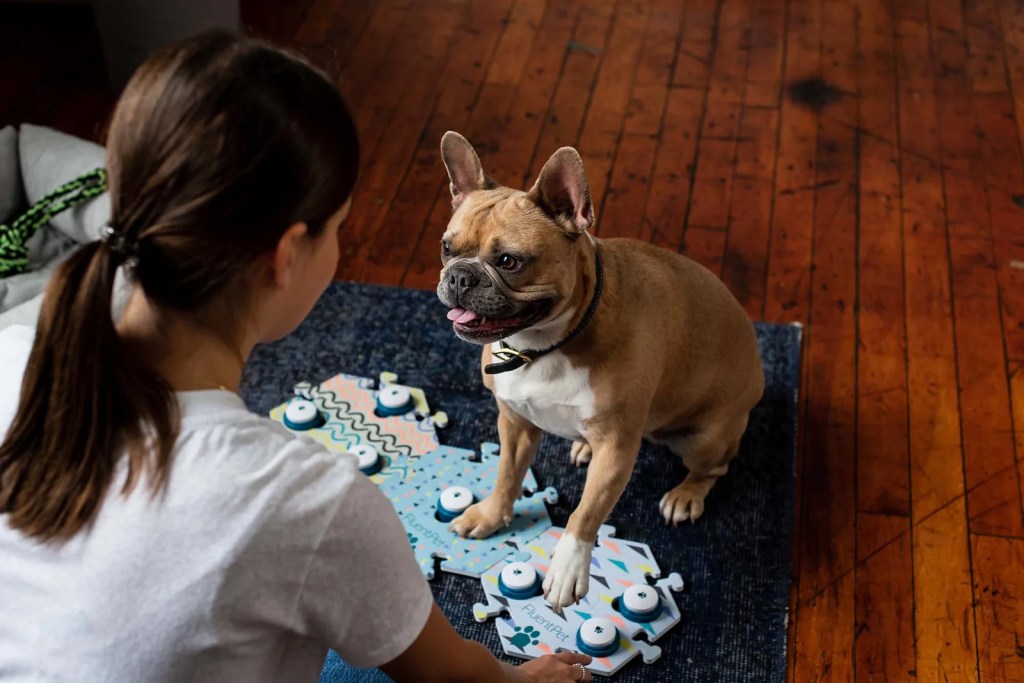
The buttons are a tool that fosters incredible relationship-building and closeness between humans and pets.
One Reddit user who taught their dog how to use buttons writes, “She seemed generally calmer. Her behaviours like constantly licking her feet (which I thought were due to sensitive paw pads) stopped. She is more sociable with my family. She barks less during the day. She sleeps better. She gets more exercise since I gave her the tools to ask for the activity she wanted.”
For her part, Alexis says giving Bunny the choice and agency to communicate what she wants—even if she doesn’t always get it—has undoubtedly brought them closer and led to a higher quality of life.
What the science says about talking buttons for pets
People have tested early versions of talking buttons for pets for decades. Before that, even scientists have been fascinated by whether animals could understand human language.
Famously, in the early 1900s, a horse named Clever Hans gained wide acclaim for being able to read, spell, and perform arithmetic. Later, researchers discovered that he was responding to extremely subtle, involuntary cues from his trainer. Skepticism about animal-human communication has persisted ever since.
But recent research from UC San Diego surprisingly indicates that dogs who use talking buttons show responses and behaviors that go far beyond responding only to cues from their owners.
Federico Rossano, an associate professor in cognitive science at UCSD, makes an apt analogy that sums up what he’s observed in his study of over 10,000 participants: “It’s like a child telling you that they’re hungry versus just crying. And I think being able to communicate your needs and what you want, I think it’s very powerful.”
Today, Bunny uses over 100 different talking buttons, and Alexis says one of the biggest lightbulb moments in their journey was watching Bunny learn to combine multiple words and concepts on her own.
“She started to experiment by putting them together herself. And she’ll put them together in novel ways. In other words, in ways that I haven’t modeled, which seems to be something beyond pure conditioning, which is really interesting.”
She says Bunny experiments with button combinations and orders to see what will happen, “like a toddler babbling.” It’s not always intentional speech as we think of it, but she still learns from the outcome.
Crucially, buttons don’t replace other forms of communication. They aren’t a lazy shortcut that lets us avoid paying attention to our pets. Alexis says they force us to really listen to our pets in different ways, including what they say through the buttons.
That part is crucial because some other research is more skeptical about what we’re seeing on social media. There are questions about how well the dogs can actually hear the words coming out of talking buttons, and whether they might be learning the button-pressing behaviors based on spatial location instead of processing the language they hear. Alexis isn’t sure it matters.
“I think a lot of people are really interested in the ‘Is this language?’ question. But to me, dogs communicate beautifully without buttons all the time. They’ve got their own systems of communication, non-verbally, vocally, gesturally. And so when we put those in combination, as long as her body and the buttons are saying the same thing, then there’s meaningful communication going on,” Alexis says of Bunny. “So if she presses the button for ‘outside’ and then walks to the door, that’s meaningful communication to me.”
Two-way communication is the future of being a pet parent
It’s amazing to see how much has changed in just over a decade. For much of the early 2000s, the biggest name in dog training was Caesar Millan, of The Dog Whisperer fame. He believed owners needed to “dominate their dog,” and his training methods relied heavily on alpha-male wolf theories. He famously put affection and comfort last on his list of things dogs need, with exercise and discipline coming first. This broad approach to training obedient dogs dominated the zeitgeist for years: many believed a dog would not be calm and happy without firmly knowing its owner was the Alpha.
Critics eventually hit back, saying Millan’s methods were based on bad science at best, and were cruel at worst.
When asked what she thinks of obedience training for dogs, Alexis said that once she and Bunny became well-versed in using the buttons, obedience became a bit of a moot point. She doesn’t need to cue Bunny and tell her what to do. Instead, she listens and figures out how to support her dog rather than commanding her.
“I think dogs are communicating so much, so much of the time. And, so much of the time, we misunderstand them or don’t listen in a way that helps them. ‘My dog is barking. Be quiet.’ Like, no, your dog has a reason to be barking. Maybe they’re anxious. Maybe they’re excited. Maybe they’re trying to tell you something.”
Talking button technology is relatively new, especially for regular people who want to try it. And while it’s unlikely that dogs, or any other animals, will be fluently speaking English any time soon, that doesn’t mean that the future isn’t incredibly exciting and beautiful:
“I think what we’re starting to see is a shift towards more balanced relationships. Not ‘the owner and the pet’ but the guardian… we move through the world as partners,” Alexis says. “We try and understand them versus control them.”