When blizzards line up to rip through the Northeast, schools close, flights are canceled, and people even board up their houses. Though missions and homeless shelters do what they can to provide safety to those who have no homes to go to, thousands of people still have to weather the cold outside.
At Carnegie Mellon University’s 2015 Impact-a-Thon, students were challenged to provide a temporary low-cost shelter for homeless people during the winter.
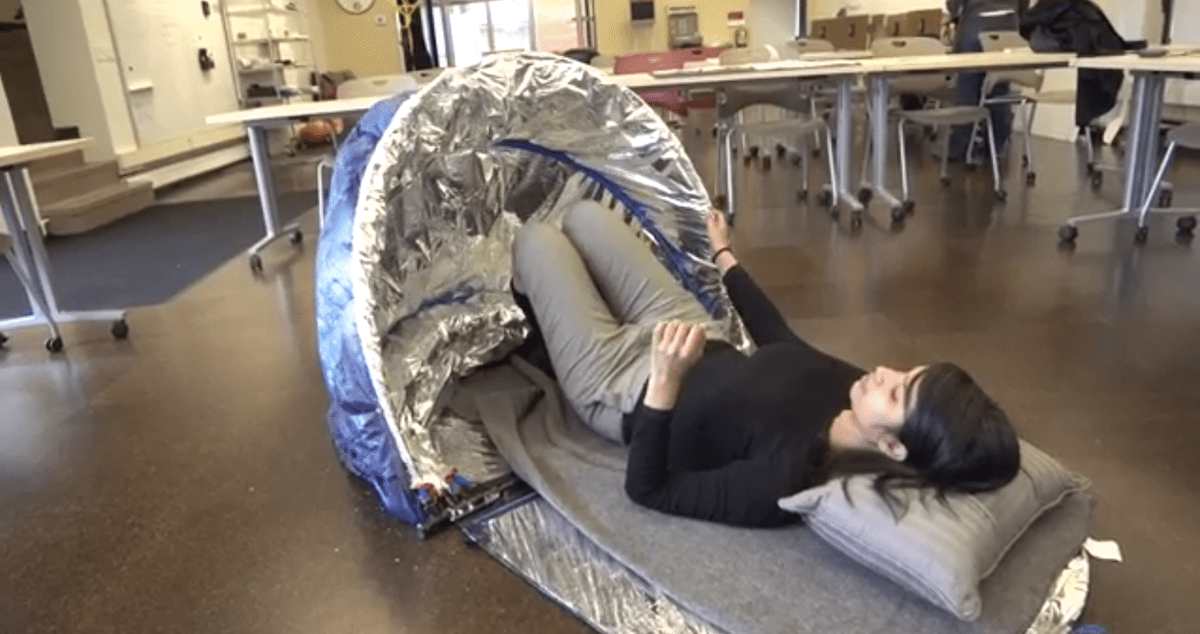
One team of students came up with the “Satellite Shelter,” an insulated sleeping bag that converts into a tented structure. The students used mylar, a reflective material frequently used in greenhouses and space blankets, and wool blankets to ensure the shelter would keep anyone in it safe from the cold.
“We wanted to make sure it was super-portable and durable so that it’s easy to carry,” said student Linh Thi Do, who worked on the project. “We have wheels on it so it’s easy to move from place to place.”
Solutions like this one are handy in an emergency. Perhaps, however, other cities should take note of the city of New Orleans’ success in providing long-term housing solutions for its homeless veterans. The only perfect solution to homelessness is giving people permanent homes to go to at night.
A Somali refugee and current resident of Minneapolis, the multimedia artist and activist draws on her lived experiences to create work that explores trauma, displacement, and resilience. But like so many of the guests on Freedom to Thrive, an award-winning podcast produced by the National Immigration Law Center (NILC), Mansour doesn’t want to focus only on trauma; she also wants to celebrate the unexpected beauty she’s found during difficult experiences.
“One of the beautiful things about tragedies is that it activates hearts, and courageous people are born,” she says. For example, Mansour has noticed more Minnesotans than ever are reaching out to help the vulnerable, after the anti-immigrant crackdowns carried out by the Department of Homeland Security. “They are bringing food, they’re bringing extra clothes, they’re walking with people, and it’s just really beautiful.”
Hector Flores, co-founder of the Las Cafeteras and host of Freedom to Thrive, agrees with her. A child of immigrants himself, he has also seen how hope and hardship often live side by side.
Flores comes from a family with mixed status and is highly aware of the challenges immigrants and refugees in his community face, and how they’re affected by people’s misconceptions. “People want to know about trauma all the time, but we’re more than just undocumented,” he says. “We’re artists, singers, creatives … there’s so much richness in the culture.”
At its core, Flores’ comment is exactly what the Freedom to Thrive podcast is all about: Celebrating immigrants as complex, dynamic individuals, and challenging the dominant narrative that too often reduces them to symbols of hardship.
Launched in 2024, Freedom to Thrive explores heritage, resilience, community, and the ways art and comedy can spark social change. Now in its second season, the podcast continues to feature conversations with immigrants, policymakers, artists, musicians, activists, and more. Recent guests have included comedian Mo Amer, Grammy Award-winning singer Lila Downs, and Pulitzer Prize-winning author Viet Thanh Nguyen.
Where the first season focused on individual stories of identity and belonging, Flores says his goal for season two, where he joins as host, is to “take it to the next level” — using storytelling to highlight “the fact that we’re more similar than different.”
One recent podcast episode drives this point home. In December, Flores interviewed Bryan Andrews, a rising country music star and rural Missouri native who frequently uses his platform to speak about issues affecting immigrant families. At the heart of his message and his songwriting, Andrews says, is the idea that small-town Americans and the rest of the country, including immigrants, have more in common than they realize.
“It doesn’t matter where you’re from,” Andrews says on the podcast. “We’re all trying to make a living and we’re tired of getting railroaded by corporate greed or by politicians who don’t care.”
Rural Americans, Andrews says, are often stereotyped as racist and misogynistic but “the overwhelming majority of people in my home town have love in their hearts.” Media stereotypes often amplify differences and divide, he says, but at the end of the day, “we’re all in this together.”
Flores, who was raised in a working-class immigrant neighborhood in East Los Angeles, had similar thoughts. He says he often sees its residents stereotyped as wealthy, consumerist, and status obsessed. “That exists, but that’s not my life, that’s not my community,” he says. Like small-town Americans, people in the city “just want to work hard and take care of their families. We all want the same thing.”
Although the podcast tackles some heavy issues, each episode’s ultimate focus is how personal and collective struggles can be healed through art, driving home a message of hope and resilience:
Mansour’s episode about her experiences in Minnesota is just one of many examples. Flores asks her,
“What gives you hope for the people creating a home here?”
“The love I feel from other Minnesotans. It is trumping any hate we’re experiencing,” she replies.
CTA: Stream all episodes now on the Freedom to ThriveYouTube channel or the website,here.
The podcast has been nominated for a Webby in the “Belonging & Inclusion” category. You can vote for it to win until Thursday, April 16!
This article is part of Upworthy’s “The Threads Between U.S.” series that highlights what we have in common thanks to the generous support from the Levis Strauss Foundation, whose grantmaking is committed to creating a culture of belonging.
When Jorge Alvarez arrived at Rutgers University as a first-generation college student, he couldn’t find anyone who looked like him, a Latino man, talking openly about mental health. “I felt very lost,” he later said. So he decided to be that change. He revived the Active Minds chapter at Rutgers and built it into the largest student-run mental health organization on campus, with an intentional focus on creating space for Black and Brown students. He took that same energy online, building a community of over 115,000 TikTok followers through educational content on mental health, generational trauma, and cultural identity.
That trajectory led him, in 2022, to the White House, one of just 30 young advocates invited to the first-ever Mental Health Youth Action Forum, where he joined a conversation with Dr. Jill Biden, Selena Gomez, and Surgeon General Dr. Vivek Murthy to make the case for culturally relevant mental health care. He returned again in 2024.
To champion MentalHealthAction, #FLOTUS Dr. Jill Biden, SelenaGomez, and Surgeon General Dr. #VivekMurthy teamed up with @mtv to amplify the voices of youth activists and chart the path forward. @dometipongo spoke to Gomez about why it’s “OK not to be OK” and more. Head to mentalhealthishealth.us
Today, Alvarez is being recognized by Engage for Good as its first-ever Emerging Leader of the Year.
Now in its 24th year, the Halo Awards have long recognized the best corporate-nonprofit partnerships in the country. This year, for the first time, the organization is also recognizing the people behind the work: a pioneer who built the field before it had a name, a leader who has made it sharper and more responsive, and a younger voice who is pushing it somewhere new.
The Pioneer: Carol Cone
In 1983, a small shoe company called Rockport had a problem: nobody knew who they were. Carol Cone had an idea. Link the brand to something bigger than footwear — the emerging walking-for-health movement — and make the company a genuine champion of it. Rockport grew from a $20 million unknown into a $150 million brand. More importantly, Cone had stumbled onto something she would spend the next forty years proving: that a company’s values, done right, are a business strategy.She’s now known as the Mother of Cause Marketing, and the résumé backs it up. Cone founded the nation’s first cause marketing consultancy in 1980, produced more than 30 research reports that helped turn the field into a discipline, and has executed more than 250 purpose programs for some of the world’s leading companies. She’s directed $5 billion toward social causes through initiatives like the American Heart Association’s Go Red for Women, the Avon Breast Cancer Crusade, and Aflac’s My Special Aflac Duck. She wrote the book — literally, Breakthrough Nonprofit Branding — hosts the Purpose 360 podcast, now more than 220 episodes in, and has mentored over 1,000 people coming up in the field.
Engage for Good is honoring her with its Lifetime Achievement Award. “She didn’t just contribute to this space,” said EFG CEO Muneer Panjwani. “She defined and legitimized it.”
The Collaborator: Karen Little
What sets Karen Little apart isn’t just what she’s built, it’s how she builds it. The head of Rapid Response at PayPal is known across the social impact sector for bringing people together in moments when most organizations are still figuring out what to do.
When wildfires tore through Los Angeles in January 2025, Little didn’t wait for the smoke to clear. She activated PayPal’s financial tools, nonprofit partnerships, and giving infrastructure, moving resources to the organizations that needed them while the crisis was still unfolding. She has since helped write the playbook on strategic disaster philanthropy — the kind other companies can actually follow.
Her instinct for convening shows up elsewhere too. Little founded the Bay Area Social Impact Gathering, which started as a dozen peers talking over drinks and has since grown into a network of more than 250 professionals spanning corporate, nonprofit, and foundation sectors.
“Her balance between strategy and humanity is what sets her leadership apart,” said Panjwani. She is the inaugural recipient of EFG’s Impact Leader of the Year Award.
The Next Generation: Jorge Alvarez
Back at Active Minds, Alvarez has built that same personal conviction into a career. As Senior Manager of Corporate Partnerships & Engagement, he’s helped raise $6M+ for youth mental health and guided the A.S.K. campaign to reach more than 28 million people. He serves on the board of Youth MOVE National and was recognized as a 2023 Young Innovator in Behavioral Health.
“Youth and young adults are eager to lead,” he said when he received the award. “They just need organizations and allies to listen.”
What Comes Next
Carol Cone built the foundation. Karen Little is strengthening it. And Jorge Alvarez is one of the people who will decide what gets built on top of it. That’s what this year’s Halo Awards are really about, not just celebrating what the corporate social impact field has accomplished, but taking stock of who’s carrying it forward.
“Together, they represent a field that is evolving, deepening, and rising to meet a more complex moment,” said Panjwani.All three will be recognized at the Halo Awards Gala during the Engage for Good 2026 Conference, April 21–24 in Palm Springs.
We are constantly being reminded of Isaac Newton’s famous quote, “If I have seen further, it is by standing on the shoulders of giants.” Eleven such giants were recruited as volunteers from Gallaudet University (then Gallaudet College) in Washington, D.C. in 1958. Their task was to help researchers understand the effects of weightlessness on Deaf people who didn’t experience motion sickness.
Deemed the Gallaudet Eleven, they helped pave the way for hundreds of space flights, including the most recent Artemis II. Ranging in age from 25 to 48 years, the eleven men included Harold Domich, Robert Greenmun, Barron Gulak, Raymond Harper, Jerald Jordan, Harry Larson, David Myers, Donald Peterson, Raymond Piper, Alvin Steele, and John Zakutney. Each and every one of them selflessly gave their time and their bodies to what would become monstrous breakthroughs in astrophysics.
Houston had a problem
Actor and Deaf activist, Nyle DiMarco, recently took to social media to share the historical tidbit, lest people forget. In an Instagram reel, he wrote,
“Everyone’s talking about Artemis II. The first humans to travel to the moon in 50 years. Historic mission. But nobody’s talking about the Deaf men who made it possible.
In the late 1950s, NASA had a problem. They needed to understand what weightlessness does to the human body. But every test subject kept getting violently motion sick.
So they came to Gallaudet.
Eleven Deaf men. Most of them had lost their hearing to spinal meningitis as children, which also damaged their vestibular system. Their inner ears couldn’t be overwhelmed. They were immune to motion sickness.
NASA put them in centrifuges. Zero-gravity flights. A rotating room for twelve straight days. One experiment on a ferry in choppy Nova Scotia waters. The researchers got so seasick they had to cancel it. The Gallaudet Eleven? They were playing cards.
Their bodies gave NASA the data it needed to send humans into space.
No Gallaudet Eleven — no Mercury. No Mercury — no Apollo. No Apollo — no Artemis II.
Sixty years later, four astronauts just flew 252,000 miles from Earth and came home safely. They stood on the shoulders of eleven Deaf men most people have never heard of. Now you know! #nasa #gallaudet11 #artemisii @nasa”
The post has already received nearly 400,000 likes and over 6,000 comments. One Instagrammer writes, “Diversity in all its forms is what makes us great. And all of us working together is what helps us advance as a civilization! Thank you for sharing this and bringing visibility to this piece of history, and thank you Gallaudet 11 for your contribution.”
The tests
The official NASA website shared some of the tests in which the brave volunteers took part. “One test saw four subjects spend 12 straight days inside a 20-foot slow rotation room, which remained in a constant motion of ten revolutions per minute.”
Then, of course, there were the zero-g flights. “In another scenario, subjects participated in a series of zero-g flights in the notorious ‘Vomit Comet’ aircraft to understand connections between body orientation and gravitational cues.”
They even took the volunteers to Nova Scotia to test big waves. “Another experiment, conducted in a ferry off the coast of Nova Scotia, tested the subjects’ reactions to the choppy seas. While the test subjects played cards and enjoyed one another’s company, the researchers themselves were so overcome with seasickness that the experiment had to be canceled. The Gallaudet test subjects reported no adverse physical effects and, in fact, enjoyed the experience.”
The test subjects themselves shared their experiences. Barron Gulak reminisced, “In retrospect, yes, it was scary…but at the same time we were young and adventurous.”
On DiMarco’s identical Facebook post, Harry Larson’s child, “Moose” Larson, shared a photo and wrote, “They were recently recognized with a cool plaque at Gallaudet! My dad is one of them and, funny enough, never really talked about it.” A commenter responded, “I’ve worked with your dad a lot on this project during the museum exhibition several years ago. He’s been so wonderful, always willing to come to events. I’m so glad he’s sharing his story now.”
It’s a parent’s worst nightmare: Taking your child to the doctor and receiving a life-changing diagnosis. It only adds to the heartbreak when they find out there may be no effective treatment at all, and that all they can do is hope for the best.
Few diagnoses strike fear in the heart of parents and doctors more than a cancer called diffuse intrinsic pontine glioma, or DIPG. Primarily found in children, DIPG is a highly aggressive brain tumor that is uniformly fatal, with less than 10 percent of children surviving longer than two years after diagnosis. The tumors grow fast and on extremely vital areas like the spine and brain stem, making them exceptionally hard to remove. Though young patients have been treated with radiation, chemotherapy, and surgeries, no one had ever been cured of the fatal cancer.
But for the first time ever, a 13-year-old boy from Belgium named Lucas Jemeljanova has beaten the odds.
Various brain scans. Photo credit:
Diagnosed with DIPG at age six, Lucas’ doctor Jacques Grill told Lucas’ parents, Cedric and Olesja, that he was unlikely to live very long. Instead of giving up hope, Cedric and Olesja flew Lucas to France to participate in a clinical trial called BIOMEDE, which tested new potential drugs against DIPG.
Lucas was randomly assigned a medication called everolimus in the clinical trial, a chemotherapy drug that works by blocking a protein called mTOR. mTOR helps cancer cells divide and grow new blood vessels, while everolimus decreases blood supply to the tumor cells and stops cancer cells from reproducing. Everolimus, a tablet that’s taken once per day, has been approved in the UK and the US to treat cancers in the breast, kidneys, stomach, pancreas, and others—but until the BIOMEDE clinical trial, it had never before been used to treat DIPG.
Lucas Jemeljanova poses with his mother. Photo credit: Lesja Jemeljanova via Facebook
Though doctors weren’t sure how Lucas would react to the medication, it quickly became clear that the results were good.
“Over a series of MRI scans, I watched as the tumor completely disappeared,” Grill said in an interview. Even more remarkably, the tumor has not returned since. Lucas, who is now thirteen, is considered officially cured of DIPG.
Even after the tumor was gone, Grill, who is the head of the Brain Tumor Program in the Department of Child and Teenage Oncology at Gustave Roussy cancer research hospital in Paris, was reluctant to stop Lucas’ treatments. Until about a year and a half ago, Lucas was still taking everolimus once every day.
“I didn’t know when to stop, or how, because there was no other reference in the world,” Grill said.
While Lucas is the only one in the clinical trial whose tumor has completely disappeared, seven other children have been considered “long responders” to everolimus, meaning their tumors have not progressed for more than three years after starting treatment.
Lucas with his mother. Photo credit: Lesja Jemeljanova via Facebook
So why did everolimus work so well for Lucas? Doctors think that an extremely rare genetic mutation in Lucas’ tumor “made its cells far more sensitive to the drug,” Grill said, while the drug worked well in other children because of the “biological peculiarities” of their tumors.
While everolimus is by no means a cure, the trial has provided real hope for parents and families of children diagnosed with DIPG. Doctors must now work to better understand why Lucas’ tumor responded so well to the drug and how they can replicate those results in tumor “organoids”—artificially-grown cells that resemble an organ. After that, said Marie-Anne Debily, a researcher in the BIOMEDE trial, “the next step will be to find a drug that works as well on tumor cells.”
A more recent clinical trial tested a new immunotherapy treatment on young DIPG patients and showed promising results. Many of the patients’ tumors shrank and several participants saw functional improvements in their symptoms and day-to-day lives. But only one of the 11 patients has seen success that rivals Lucas’ — a young man identified only as Drew, who has been thriving tumor-free for over four years after receiving treatment.
Once considered a definitive death sentence, there is real hope for the first time. But there’s much more research and work to be done. Until then, however, Lucas’ doctors are thrilled.
“Lucas’ case offers real hope,” said Debily.
Lucas with his parents and sister. Photo credit: Lesja Jemeljanova via Facebook
This article originally appeared two years ago. It has been updated.
A young man named He Tongxue from HTX Studio, a team of DIY innovators from Hangzhou, China, wanted to be able to “see music.” He had just started learning piano and felt like the visible dimension was missing. There are plenty of computer programs that create digital visual effects with music, of course. But the goal was to make music visible in real life.
It took the studio three years, four prototypes, and endless tests to come up with just the right combination of elements. They wanted something that would rise from the piano and light up when the keys were pressed.
“Our first thought was smoke,” he said. They figured they could line up smoke machines that would be triggered by the piano keys and use lasers to light up the smoke as it rises.
The studio built a prototype, and at first, it looked pretty cool. But after playing the piano for a few minutes, the cool factor wore off. He later described it as “a disaster.”
“The smoke drifts everywhere,” he said. “You can’t tell which light matches which note. It feels like a genie is coming out. And after a while, it feels like someone is barbecuing inside the piano.”
They wanted the smoke to rise in chunks, like solid musical notes, instead of spreading out. That led them to the idea of vortex rings. Essentially, they could make smoke rings that would give the visible “notes” more structure.
A second prototype was made to test out this idea. And it did look really cool…at first. The vortex rings worked, but there was too much extraneous smoke that eventually built up and made it hard to see the rings. The contraptions that made the rings were also too large to make separate ones for all 88 keys of the piano, and making them smaller rendered them unusable.
Back to the drawing board again.
Since a vortex ring is essentially rotating fluid, they shifted to different fluids: water and paint. They created yet another piano prototype that would shoot paint vortex rings into water. Yet again, cool at first, but soon the water simply clouded up as the paint rings dissipated. They tried using oil paints, which wouldn’t dissolve in water, but that also disappointed. Oil paint didn’t form rings, but rather broke apart into small spheres in the water.
However, the spheres gave them the idea of simply using droplets. They created a piano that would push up a droplet of colored glycerin into the water tank with each note played. Lights would illuminate them.
The idea was solid, but the execution left something to be desired. The beauty of the lit-up droplets didn’t extend throughout the tank. The droplets drifted, and attempts to rein them in with glass tubes ruined the magical effect.
“By this point, the project had dragged on for two years,” he said. “We had tried everything we could think of. I honestly didn’t know what I was to do. We’ve abandoned projects before. But never one that consumed this much time, energy, and effort from almost everyone in the studio.”
Then disaster struck. One night, the glass tank shattered under the water pressure, destroying the entire system.
Watch the full story here:
“If the universe was telling me to stop, this felt like the sign,” he said. But in the midst of significant setbacks and creeping self-doubt, the idea of turning to nature arose. What if they used bioluminescent algae, which light up all on their own?
“Around the world, you can see this blue glow in coastal waters,” he said. “It’s caused by a reaction between luciferin and luciferase when the algae are stimulated. We didn’t spray algae into water. We filled the entire tank with them, then disturbed them with bubbles so they would glow all the way to the surface.”
He and his studio mates did it. No AI. No digital effects. Real-life, 3D visible music with an assist from nature. They named it the Blue Tears Piano.
Here’s German pianist Oskar Roman Jezior playing “Golden Hour” on it:
Between clothing, outerwear,handbags, and cushion covers, most of us have no shortage of zippers in our households. They’re so ubiquitous that we probably don’t give them much thought (until one of them stops working properly, of course).
But zippers are surprisingly fascinating, from their storied history to their truly genius design. Veritasium created a video explaining how zippers work, how they were invented, and why so many have the letters “YKK” on them, which you can watch here:
Host Gregor Čavlović starts us off with a remarkable fact: “We’ve made more zippers than there are stars in the Milky Way.” Wow. But how did we get here?
It all began with a not-so-great inventor who knew how to sell an idea
In the late 1800s, American engineer Whitcomb Judson decided that fastening buttons and hooks one by one was entirely too tedious. He came up with a zipper-like device for shoes that would automatically connect hook-and-eye fasteners. He received a patent, but the device didn’t work very well. Still, he didn’t let that minor detail deter him.
“In 1893 at the Chicago World’s Fair, he presented this fastening device as the next big thing, claiming that in no time at all, this would replace buttons and laces,” says Čavlović. “And not just on shoes, but on all sorts of garments. A few wealthy investors actually believed it. So with their backing, the Universal Fastener Company was born.”
Whitcomb Judson’s clasp locker device was a precursor to the modern zipper. Photo credit: Images in the public domain
But it would take another decade for a usable zipper-like product to come from Judson’s company. They had made an automatic fastener for women’s skirts, but even that was a bust. The device jammed constantly and couldn’t be washed with the garment, meaning it had to be removed before each wash and sewn back in afterward. The company struggled to retain customers and fell into debt.
How a manager’s “gorgeous” daughter played a major role in the invention of the modern zipper
In 1906, 25-year-old Swedish engineer Gideon Sundback joined Judson’s floundering company. Sundback may or may not have had a particular affinity for fasteners, but he did have an affinity for Elvira, the “absolutely drop-dead gorgeous” daughter of one of the company’s managers.
Sundback took the job to get closer to Elvira, and it worked. They fell in love and married, and in the meantime, Sundback made minor improvements to Judson’s fastener design. Tragically, Elvira fell ill and died soon after giving birth to their daughter. Sundback was devastated.
To deal with his grief, he threw himself into his work. He eventually tossed Judson’s fastener idea completely and came up with a “separable fastener” design of his own. Patented in 1914, Sundback’s design is nearly identical to zippers today.
Gideon Sundback and his zipper patent. Photo credit: Images in the public domain
How a zipper (aka “the hookless hooker”) actually works
Sundback’s design was fairly simple, but ingenious—so ingenious, in fact, that manufacturing capabilities at the time were no match for it. He also had to design the machinery to produce the zipper.
(You really have to watch the video to see how the machine was designed and how a zipper works. The folks at Veritasium even created a large-scale model to make the mechanism easier to see.)
Finally, the Universal Fastener Company had created a commercially viable product. They initially called it a “hookless hooker,” which, thankfully, lasted only a blip. They ultimately went with a less eyebrow-raising name: the “hookless fastener.”
The word “zipper” actually came from B.F. Goodrich Company (yes, the tire company), after it used the fastener in rubber boots it manufactured. It called them Zipper boots, after the “zip” sound they made when used. The boots were a hit, and the name stuck—eventually becoming the common term for the hookless fastener.
What’s the deal with “YKK” being on so many zipper pulls?
If you check the zippers in your home, there’s a good chance you’ll find the letters “YKK” on many of the pull tabs. Why?
YKK stands for Yoshida Kōgyō Kabushikikaisha, the Japanese company that manufactures more zippers than any other in the world—close to 10 billion each year. YKK is the undisputed G.O.A.T. of zippers.
That story began in 1933 with Tadao Yoshida, a salesman in Japan whose company had gone under. He found a pile of unsold zippers among the company’s leftover inventory, bought them, and started his own zipper business.
His goal was to make zippers that never failed. That foresight into how frustrating an unreliable zipper is for a consumer proved invaluable. After some setbacks that could have ended his business ambitions, Yoshida became the leading manufacturer of zippers in the world. And he kept on honing the quality and efficiency of the manufacturing process, eventually bringing every part of the process in-house.
Yoshida had created a zipper juggernaut. Today, YKK makes over 7,000 types of zippers and dominates the global zipper market. It also operates under an endearing philosophy referred to as “The Cycle of Goodness,” which basically boils down to: “No one prospers without rendering benefit to others.”
Who knew the basic zipper had such a fascinating history?
You can follow Veritasium on YouTube for more fascinating insights into innovation and ideas.
Artificial intelligence promises to completely upend just about every facet of modern life, from how we work to education, medical care, and the design and manufacture of everyday goods. On a deeper level, it will also change how we see ourselves as humans, placing greater value on the uniquely human skills that no computer can replicate, no matter how powerful the server.
One person who knows a great deal about that is Jensen Huang, the president and CEO of NVIDIA, a company that designs and manufactures chips for accelerated computing and AI data centers. Fortune has named Huang one of the world’s best CEOs for his leadership and innovation.
Recently, he appeared on the A Bit Personal podcast with Jodi Shelton, who posed a big question: “Who is the smartest person you’ve ever met?”
At first, the question sounds like a softball. Of course, Huang might be expected to name someone with exceptional technical talent or a keen eye for design and engineering. He could even point to an important scientist or a tech leader, such as Steve Jobs. Instead, Huang argues that the most intelligent people today are those whose skills can’t be duplicated by AI.
“I know what people are thinking, the definition of smart is somebody who’s intelligent solves [technical] problems,” Huang responded. “But I find that’s a commodity and we’re not about to prove that artificial intelligence is able to handle that part easiest, right?”
He added that software engineers were once widely seen as the most intelligent, but AI is now challenging that idea.
Huang says truly intelligent people know the “unknowables”
“I think long term … and my personal definition of smart is someone who sits at that intersection of being technically astute but [has] human empathy,” Huang said. “And having the ability to infer the unspoken around the corners. The unknowables. People who are able to see around corners are truly, truly smart. To be able to preempt problems before they show up, just because you feel the vibe. And the vibe came from a combination of data analysis, first principle life experience, wisdom, sensing other people, that vibe. That’s smart. I think it’s gonna be the future definition of smart, and that person might actually score horribly on the SAT.”
The podcast’s Instagram post received hundreds of comments. “This is a very smart answer to make everyone sound like they have a chance of being smartest person,” one popular commenter wrote. Another joked, “Bro knows he’s the smartest person he’s ever met.”
Ultimately, as we enter the AI era, it’s becoming clear that the edge humans have isn’t processing power, but the skills that make us most human: empathy, perception, wisdom, emotional intelligence, and the ability to read the room at both micro and macro levels. Huang understands that true human intelligence, something that can’t be created in a data center, is, for now, still the most valuable asset of all.
Have you ever wondered why text shows up backwards in a mirror? It’s confusing to our brains because it doesn’t seem like anything else is flipped like that. If we turn our head, it doesn’t move the opposite direction in the mirror. Or does it? After all, right-handed you is actually left-handed you in the mirror. Right? (Wait, is that right?)
Mirrors can be confusing despite not being very complicated. A mirror image is simply a reflection of what’s in front of it. But when someone else is looking at us head on, they don’t see text in reverse, so why don’t we see what other people see when we see ourselves in a mirror?
(If you think this is a super stupid question with a super obvious answer, congratulations. Pat yourself on the back and scootch along so the folks who don’t fully grasp the physics of mirrors can enjoy a demonstration that makes it a little easier to understand.)
“Why do mirrors reverse text?” asks the creator behind @humanteneleven on YouTube. “You might think it’s just a property of mirrors—they flip things from left to right—but that’s not true.” He then picks up a metal arrow to show that it points the same direction in the mirror as it does in real life. So why is the text flipped when the arrow isn’t?
He then holds up a book to show how the text on the book cover appears backwards, just like the shirt. But when he holds up a Ziploc bag with the word “HELLO” written on it, the word shows up properly.
Why? How?
It’s because he had to flip the book over to see the cover text in the mirror. The baggy, on the other hand, he could just hold up and see the letters through the transparent plastic, just as we see them in real life. If he flips the baggy over like he did the book, the text shows up backwards in the mirror, just like it does in real life.
“So it’s actually not the mirror that’s flipping anything from left to right,” he says. “It’s the human.”
People appreciated the simple, straightforward explanation and demonstrations.
“One of the most insightful demonstrations I’ve seen. It’s simple and explains the phenomenon. Well done!”
Mirrors (and vision) are very weird and you probably don’t understand how they work and that’s ok. Like, most people have no idea why mirrors seem to reverse text but do not flip you upside down.
Anyway, imagine laser beams coming from the observer’s eyes. It’s like that. But… https://t.co/Q8NLxy6mvx
“While I’ve heard this explanation many times before, I’ve only recently seen it demonstrated with text-on-transparency, which is what really makes it click. Great video!”
“Love these sorts of demonstrations. It’s a bit of a complicated one, but I love seeing how different people’s minds work when explaining simple things like this. My kid explains it with “left is on the left, right is on the right, things aren’t flipped, they are mirrored” but it’s true that you are the one who flips things and I’ve never thought of it that way before.”
“Oh my God, I haven’t understood explanations from physics videos about why mirrors flip but this, gosh this helps.”
Mirrors have been hilariously befuddling people in other videos as they try to figure out how the mirror “knows” what’s behind a barrier placed in front of objects.
Is this something all of us should probably have learned in high school? Yes. Do all of us remember everything we learned in high school? No. Does the scientific explanation make perfect sense to everyone even if it’s explained in detail? Um, no.
Like the reversed text question, having a simplified explanation that doesn’t fully get into the nitty gritty physics and geometry of how mirrors work is helpful for some folks.
For those who want a bit more scientific substance to their explanations, this next video does a good job of giving a bit more detail while still keeping the explanation simple. It even uses a visual diagram to explain:
And for those who say, “This is so basic! How do people not understand this?” here’s a video that really does get into the nitty gritty physics and geometry of how mirrors work, diving into ray and wave optics, photons, wave functions, probability, and quantum mechanics. It’s only 12 minutes, and it manages to entertain while explaining, but it certainly blows the notion that understanding mirrors is super simple.
As one commenter wrote, “I thought I understood mirrors. I understand mirrors even less now. And that’s a compliment.”
Question: If the average American eats 8 pounds of strawberries a year, and an average strawberry farm yields approximately 20,000 pounds of berries per acre, how many people could a 200-acre strawberry field yielding 4 million pounds of strawberries feed?
Don’t worry, you don’t have to do the math. The answer is 500,000 people. But what if that same 4-million-pound crop, providing enough strawberries for half a million people, could be grown on just one acre instead of 200? It’s possible. You just have to go—or rather grow—up, up, up.
Indoor vertical farm company Plenty Unlimited knows a lot about growing up. In fact, it’s their entire business model. Instead of the sprawling fields that traditional farming methods require, “vertical farms” have a much smaller land footprint, utilizing proprietary towers for growing. Plenty has used vertical farming methods to grow greens such as lettuce, kale, spinach and more for years, but now it boasts a vertical berry farm that can yield a whopping 4 million pounds of strawberries on a little less than an acre.
Growing indoors means not being at the mercy of weather or climate unpredictability (barring a storm taking out your building), which is wise in the era of climate change. Unlike a traditional greenhouse, which still uses the sun for light, Plenty’s indoor vertical farms make use of the latest technology and research on light, pinpointing the wavelengths plants need from the sun to thrive and recreating them with LED lights. Plenty farms also don’t use soil, as what plants really need are water and nutrients, which can be provided without soil (and with a lot less water than soil requires). Being able to carefully control water and nutrients means you can more easily control the size, taste and uniformity of the berries you’re growing.
If that sounds like a lot of control, it is, and that idea might freak people out. But when a highly controlled environment means not having to use pesticides and using up to 90% less water than traditional farming, it starts to sound like a solid, sustainable farming innovation.
Plenty even uses AI in its strawberry farm, according to its website:
“Every element of the Plenty Richmond Farm–including temperature, light and humidity–is precisely controlled through proprietary software to create the perfect environment for the strawberry plants to thrive. The farm uses AI to analyze more than 10 million data points each day across its 12 grow rooms, adapting each grow room’s environment to the evolving needs of the plants – creating the perfect environment for Driscoll’s proprietary plants to thrive and optimizing the strawberries’ flavor, texture and size.”
Plenty even has its own patent-pending method of pollinating the strawberry flowers that doesn’t require bees. Just the fact that this enormous crop of strawberries will be coming from Virginia is notable, since the vast majority of strawberries in the U.S. are grown in California.
Is Plenty’s model the farm of the future? Perhaps it’s one option, at least — though there are major questions about whether the vertical farming method is truly economically sustainable in the long run. Though Plenty had been growing diverse crops, the company completed a chapter 11 reorganization in the spring of 2025, narrowing the focus of its vertical farming model to strawberries.
“This emergence is the start of a new, focused era for Plenty,” said Dan Malech, Plenty’s Interim CEO. “Our technology has the power to make fresh food accessible to everyone. To accelerate our impact, we are laser focused on strawberries. We’re expanding the growing capacity in the Plenty Richmond farm and pursuing opportunities to bring Plenty’s vertical strawberry farming technology to new locations through farm sales – something Plenty is uniquely positioned to offer based on its proprietary technology.”
Strawberries are a wildlyu00a0popular fruit. Giphy
Plenty is not the only vertical farm company out there, which is great. The more we grapple with the impact of climate change and outdated, unsustainable farming practices, the more innovative ideas we’ll need to feed the masses. If they can get four million pounds of strawberries out of an acre of land, what else is possible?
This article originally appeared in February. It has been updated.