Music is meant to be heard and not seen, right? Sure, we can watch musicians play instruments, and we can see music notation on paper. But that’s not the same as seeing music itself.
A young man named He Tongxue from HTX Studio, a team of DIY innovators from Hangzhou, China, wanted to be able to “see music.” He had just started learning piano and felt like the visible dimension was missing. There are plenty of computer programs that create digital visual effects with music, of course. But the goal was to make music visible in real life.
It took the studio three years, four prototypes, and endless tests to come up with just the right combination of elements. They wanted something that would rise from the piano and light up when the keys were pressed.
Their first idea went up in smoke
“Our first thought was smoke,” he said. They figured they could line up smoke machines that would be triggered by the piano keys and use lasers to light up the smoke as it rises.
The studio built a prototype, and at first, it looked pretty cool. But after playing the piano for a few minutes, the cool factor wore off. He later described it as “a disaster.”
“The smoke drifts everywhere,” he said. “You can’t tell which light matches which note. It feels like a genie is coming out. And after a while, it feels like someone is barbecuing inside the piano.”
They wanted the smoke to rise in chunks, like solid musical notes, instead of spreading out. That led them to the idea of vortex rings. Essentially, they could make smoke rings that would give the visible “notes” more structure.

A second prototype was made to test out this idea. And it did look really cool…at first. The vortex rings worked, but there was too much extraneous smoke that eventually built up and made it hard to see the rings. The contraptions that made the rings were also too large to make separate ones for all 88 keys of the piano, and making them smaller rendered them unusable.
Back to the drawing board again.
From smoke rings to paint and water
Since a vortex ring is essentially rotating fluid, they shifted to different fluids: water and paint. They created yet another piano prototype that would shoot paint vortex rings into water. Yet again, cool at first, but soon the water simply clouded up as the paint rings dissipated. They tried using oil paints, which wouldn’t dissolve in water, but that also disappointed. Oil paint didn’t form rings, but rather broke apart into small spheres in the water.

However, the spheres gave them the idea of simply using droplets. They created a piano that would push up a droplet of colored glycerin into the water tank with each note played. Lights would illuminate them.
The idea was solid, but the execution left something to be desired. The beauty of the lit-up droplets didn’t extend throughout the tank. The droplets drifted, and attempts to rein them in with glass tubes ruined the magical effect.
“By this point, the project had dragged on for two years,” he said. “We had tried everything we could think of. I honestly didn’t know what I was to do. We’ve abandoned projects before. But never one that consumed this much time, energy, and effort from almost everyone in the studio.”
Then disaster struck. One night, the glass tank shattered under the water pressure, destroying the entire system.
Watch the full story here:
Then nature gave them the answer
“If the universe was telling me to stop, this felt like the sign,” he said. But in the midst of significant setbacks and creeping self-doubt, the idea of turning to nature arose. What if they used bioluminescent algae, which light up all on their own?
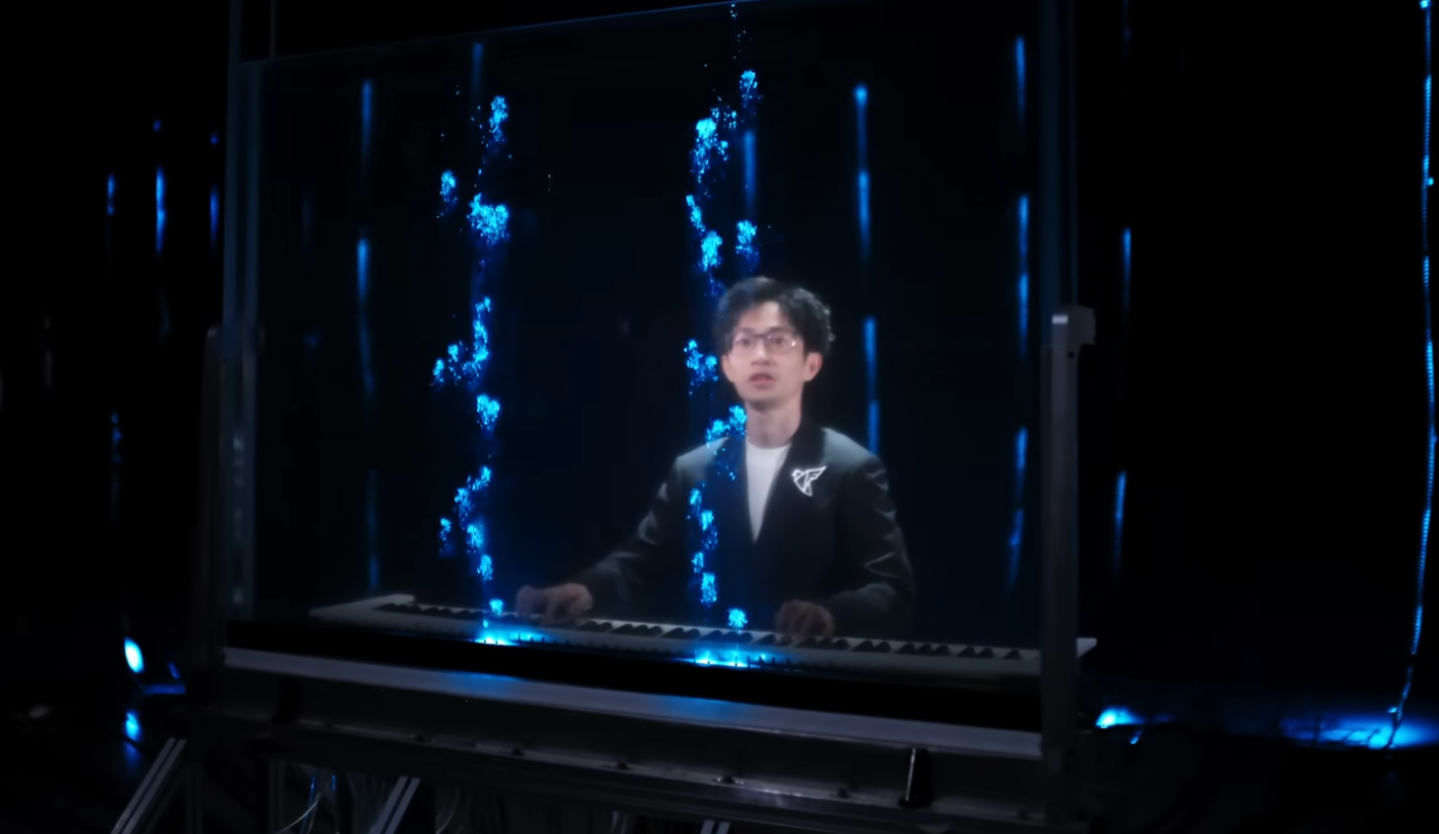
“Around the world, you can see this blue glow in coastal waters,” he said. “It’s caused by a reaction between luciferin and luciferase when the algae are stimulated. We didn’t spray algae into water. We filled the entire tank with them, then disturbed them with bubbles so they would glow all the way to the surface.”
He and his studio mates did it. No AI. No digital effects. Real-life, 3D visible music with an assist from nature. They named it the Blue Tears Piano.
Here’s German pianist Oskar Roman Jezior playing “Golden Hour” on it:
You can follow HTX Studio on YouTube for more incredible innovations.
Sometimes the answer was already glowing
At the end of the day, what makes this story land isn’t just the science, it’s the sheer stubbornness behind it. Two years into a project that kept failing in increasingly spectacular ways, most people would have called it a lesson learned and moved on. He Tongxue and his team didn’t. They kept chasing an image they couldn’t quite build, through a shattered tank and a whole lot of ruined water, until the answer turned out to be something nature had been doing quietly in coastal waters the entire time.
That’s really the quiet magic of the Blue Tears Piano. It’s not AI, and it’s not a screen. It’s real light, made by living things, responding to real music in real time. Sometimes the most impressive innovation isn’t inventing something new at all. It’s noticing what was already there and finding a way to let it shine.
This article originally appeared in April. It has been updated.