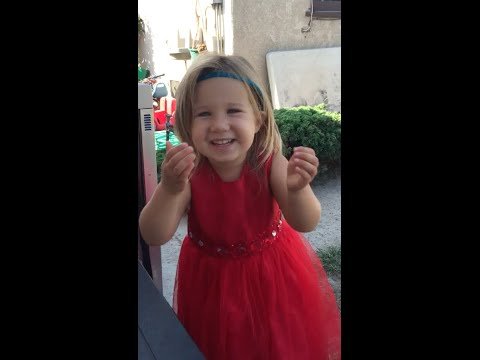
Flower girl expertly schools her dad on not embarrassing her when she walks down the aisle

This little girl has “future CEO” written all over her.

little girl in a red dress gesturing with her hands
Dad got a lesson from his young daughter in wedding etiquette.Photo credit: The Lomelino Family/YouTube

Some kids are natural born leaders, and one adorable flower girl is a prime example.

A video created by the Lomelino Family and shared by weddingz.in on Instagram shows a little girl in a fancy red dress talking to her dad about the wedding in which she’s to be a flower girl. Clearly, she has done her homework and put a lot of thought into how her role is supposed to go—as well as anticipated where it might go awry.

For instance, she tells her dad he can’t call her name when she’s walking down the aisle. Obviously, Dad’s got a reputation. And when he asks if he can call out, “Princess!” instead, she full-on womansplains weddings to him, complete with a classic patient-but-exasperated brushing bangs away from her face move.


For real, this kid will be running a company someday. Watch:

But that video is only a highlight reel. The original video shared by the Lomelino Family on YouTube in 2015 includes a bit more footage, including the little cherub telling her father he doesn’t understand weddings. At all. Watch:

The comments sum up her precociousness perfectly:

Baby girl is going to be a CEO. I know leadership skills when I see them!

Her saying ‘Dad’ with her hand mannerism around her face looks like she mimicking her mom while correcting her Dad! ??? This will never get old. Bless her heart!

“’Dad, we’re professionals and we will be walking down the aisle doing professional things.’”

I love her boardroom explaining hand gestures! ??? She is trying to sell her idea to dad, who lacks the veteran flower girl experience of this little cutie ??? Her patience is humbling ❤️❤️❤️?”

The little girl is now a high schooler, and unsurprisingly, she says she’s “interested in business stuff.” Get it, girl. You were clearly born for it.


  • Teachers share the tell-tale signs they know a parent truly cares about their kid
    Teachers share insights on the signs parents truly care about their kids.Photo credit: Image via Canva
    , ,

    Teachers share the tell-tale signs they know a parent truly cares about their kid

    “When the child speaks, the adult listens. When the adult speaks, the child listens.”

    Few people spend more time with kids than teachers. From the classroom to the playground, teachers have deep and intuitive insight into what their students’ relationships are like with their parents, and many teachers can tell when parents are invested and truly care about their kids.

    In a Reddit forum, member @allsfairinwar posed the question: “Teachers of Reddit: What are some small, subtle ways you can tell a child’s parent really cares about them?”

    Teachers from all education levels shared their insight. From elementary teachers to high school teachers, these educators offered their firsthand experience with students that informed them about their relationship with parents at home. These are their most powerful observations.

    art, kids art, child painting, kids art project, finger paint
    Hit It Bang Bang GIF by Eddie & Laura Burton Realty Group Giphy

    “When the parent stops and actually looks at their kid’s art/work/listens about their day before heading home. I know everyone gets busy but damn don’t shove the art your kid is proud of right in their bag without first looking at it. We do the same piece of art for a week. They spent 2 hours on that, spare 2 minutes to show them their effort is worth something to you.” —@Worldly_Might_3183

    “When the child speaks, the adult listens. When the adult speaks, the child listens.” —@homerbartbob

    “When the parents are familiar with the child’s friends and talk to their child’s friends, I know they’re listening to their child talk about their day at school. Or when parents let slip that they got a full recap of something I said or that happened at school. I know they are having conversations with their child at home, and paying attention.” —@Pinkrivrdolphn

    minecraft, minecreaft gif, minecraft meme, minecraft kids, minecraft movie

    Games GIF Giphy

    “When the kid is happy/quick to tell their parents about things. Not just serious or important things, but just random bullsh*t. Do I care about Minecraft? Not really. Do I care that my kid cares about Minecraft? Very much. Lay it on me kid. Spare no detail.” —@IJourden

    “They let their kids fail and experience natural consequences. Good parents are preparing their children to be adults, and part of that is learning responsibility and accountability. Let your kids make mistakes and learn from them!” —@oboe_you_didnt

    “You can tell a lot about home life based on students behavior the week leading up to a break. If they are happy/excited/giddy/endearingly obnoxious I know they are going somewhere safe to someone who cares. The students who don’t have that are often increasingly anxious/angry/withdrawn/acting out.” —@pulchritudinousprout

    hug, greeting, hugs, greet, reunited

    Monsters Inc Hug GIF Giphy

    “The moment that a parent greets the child at the end of the day is very telling. Some parents clearly want to know all about their child’s day and connect with them, some don’t.” —@Smug010

    “When I make positive contact home and the parent speaks glowingly about their own kid. It’s great to hear.” —@outtodryclt

    “A few years back, I heard a parent ask their kid if they found someone to be kind to today. That made a real impact on me. Now I try to remind my own kids to ‘find someone to be kind to’ if I’m doing drop off and/or ask ‘Who were you kind to today?’ after school.” —@AspiringFicWriter

    “When a student asks for help, they actually need the help. They are not doing it just to get your attention.”—@Typical_Importance65

    cute kid, well groomed, kid hair, clean clothes, kid cared for

    Dance Marathon Reaction GIF by Children’s Miracle Network Hospitals Giphy

    “It doesn’t always mean everything is perfect at home, but a child who is well-groomed is always a good sign. That doesn’t always mean the most fashionable clothes or perfect hair, just that the child is clean, their clothes are clean and appropriate for the weather. Also when a child knows how to celebrate their own wins and isn’t afraid of making a mistake or being wrong- that shows that their parents have modeled good emotional regulation.” —@itscornelectric

    “They get them services when they’re struggling. I work with kids with disabilities and the learning outcomes/experience of school (and by extension, the greater world) for kids who have their needs met is far different to those who don’t. The number of parents who respond to a teacher saying ‘I think it might be worth John seeing an OT/a speech therapist/ getting his eyes checked’ with something along the lines of ‘f*ck you, what would you know?’ Is astounding. The parents who make appointments, share information from specialists with the school, and are proactive about their children’s abilities or disabilities – their kids see such improvements.” —@prison_industrial_co

    “They ask thoughtful questions. Even something that seems routine to adults like, ‘How is/was your day?’ I’m in elementary, and it’s appropriate for kids to talk mostly about themselves. Kids who ask thoughtful questions are doing so because it’s consistently modeled. It’s also not very common (again, age appropriate egocentrism) so it stands out.” —@mundane-mondays

    read, reading, kid reading, kids read, reading with kids

    Read Book Club GIF Giphy

    “When you know they’re being exposed to reading at home. Maybe they can read at a higher level or they’re mastering their sight words. For students with learning disabilities, the kids are trying their hardest to read, using context clues, using pictures and making up a story, or even making different voices for characters. When I was in a low functioning Autistic support room, this one little boy couldn’t form words, but he made noises is different voices and used dramatic face expressions on each page to represent characters talking.” —@Mediocre-Bee-9262

    “Accountability. A good parent knows that their kids isn’t perfect and if the kid does something wrong (like hitting or bullying other kids) they don’t look for excuses, or for how the other kid provoked that behavior, but helps their kid understand why their behavior was hurtful.” —@SadlyNotDannyDeVito

    This article originally appeared last year. It has been updated.

  • Parents go viral for ‘secret’ praise technique. Science confirm it’s certifiably genius.
    Namwila Mulwanda and her partner Zephi practice gentle parenting. Photo credit: Credit: Instagram @namwilamulwanda
    , ,

    Parents go viral for ‘secret’ praise technique. Science confirm it’s certifiably genius.

    “I promise that if you do this in front of your child, their confidence will skyrocket!”

    There are so many conflicting ideas about building self-confidence in children. Is there a right way? Could praise be harmful? Should everyone receive a gold star? As with many things in life, sometimes the best solution is the simplest one—hiding in plain sight, or just out of it.

    Namwila Mulwanda and her partner Zephi practice “gentle-parenting” with their daughter, Nhyara. Shared in a video on Instagram, one of their techniques is talking about Nhyara when she’s within earshot but out of sight. These aren’t your typical behind-closed-doors parent conversations—no venting about daily frustrations or sharing complaints they’d never say to her face. Instead, they create intentional moments of celebration, offering genuine praise and heartfelt affirmation.

    In a viral Instagram post that’s garnered over one million likes, Mulwanda writes, “POV: You talk behind your child’s back so they can hear you.” Self-described as a “passionate mother, content creator, and small business owner,” Mulwanda naturally overflows with ideas: she writes a Substack, She Who Blooms, which is about “blooming in our own time, in our own way.” She also runs Rooted, a shop where she “carefully curates products that embody the essence of growth, empowerment, and staying rooted in one’s true self.”

    In the video, Mulwanda and her partner sit in a quiet corner, chatting about their daughter Nhyara while occasionally peeking around to see if she’s listening—which she is. With her within earshot but not directly part of the conversation, they discuss their daughter:

    “I’m just so proud of her and the things she does,” her mom starts.

    “She works on her reading, like that difficult word that she took the time to really sound out,” adds her dad. They go on to applaud her independence (“She’s always telling me, ‘Daddy, I want to brush my teeth on my own,’” says Zephi), before concluding that she’s amazing.

    “She’s amazing,” says Mulwanda. “So, so, so amazing,” Zephi responds.

    People in the comments were obviously here for it. Parents shared their own versions of this technique, including one who wrote, “As a solo mom, I pretend to make phone calls to a family member and do this.”

    Another parent shared a powerful example:

    “My son used to be scared of climbing down the stairs. So, my husband said loudly, ‘He’s very brave! He has shown a lot of courage lately.’ The next day, when we tried carrying him down the stairs, he said, ‘Nope, I have a lot of courage in me.’”

    Others reflected on their own childhoods. One commenter wrote, “No exaggeration, I’d be an entirely different person had my parents been like this with me.”

    “Stop, I was just thinking last night, ‘When I have kids, I’m going to have loud conversations with my future husband about how much I love our children and how proud I am of them,’” another enthusiastically shared.

    child, hiding, parenting, conversations, praise
    Children believe that conversations between adults are more u201cauthenticu201d and honest. Photo credit: Canva

    Research indicates that indirect praise has a stronger psychological impact than direct praise, particularly in young children.

    “This is such a powerful way of reinforcing positive behavior,” explains parenting influencer Cara Nicole, who also went viral for her unique approach to parenting. “There’s something special about overhearing others talk about you—you know they’re being genuine because they’re not saying it directly to you.”

    This effectiveness stems from children’s innate understanding that conversations between adults tend to be more honest than parent-child interactions. From an early age, children recognize that direct conversations with parents often have an intentional, behavior-shaping purpose. In contrast, overheard praise feels authentic and spontaneous, rather than an attempt to influence the child’s self-image.

    These techniques work best when praise focuses on effort and process rather than innate qualities. Take Nhyara’s dad’s comment: “She works on her reading, like that difficult word that she took the time to really sound out.”

    Yet, it’s crucial to keep praise realistic and measured. Avoid overzealous claims about future achievements, like acing every spelling test for the rest of her life. Children have keen intuition; if they sense insincerity, the strategy can backfire, damaging their trust in parents. Similarly, over-inflated praise—like declaring “incredible” performance for average effort—can burden children with unrealistic expectations.

    Keep it simple. A casual remark like, “I noticed how carefully Maya put away her toys without being asked. That was so nice. It really helped keep the house clean.”

    https://youtube.com/watch?v=jI502h-1WkY%3Fsi%3DmQdZF4eD1wz9SYZX%26controls%3D0

    The viral response to Mulwanda’s video demonstrates the power of gentle parenting combined with thoughtful, specific praise. It’s heartening to see modern parents sharing their diverse approaches to showing their children love. For many commenters who didn’t experience this kind of upbringing, these conversations offer a path to healing. As Mulwanda eloquently states in her pinned comment:

    “To those of you who only heard negative as a child, you were never the problem. You were a child, and you didn’t deserve the experience you had. Your presence on this earth is a blessing, and the fact that you show up every single day is proof of just how amazing you are. You are brave, you are beautiful (you too, boys), and you deserve the world and more.
    If any of you feel emotions rising up, close your eyes, hug your inner child, and remind them that you’re there.” Namwila Mulwanda


    This article originally appeared last year. It has been updated.

  • Dad shares how he raises his 2-year-old daughter while working on a cruise ship
    Ben Featherstone and his family.Photo credit: @benfeatherstone_/TikTok

    Raising a child on a cruise ship might not be the most conventional parenting choice, but it certainly comes with a view.

    Just ask Ben Featherstone, who, in between singing sets aboard the MSC Virtuosa, lives with his wife and their two-year-old daughter, Piper. He documents their adventure along the way for his growing social media audience.

    This globetrotting lifestyle wasn’t necessarily something Featherstone originally envisioned. In fact, when he first learned he was going to become a dad, he assumed his cruise ship performing days were behind him. The cruise line he worked for at the time didn’t allow family members to stay onboard, and understandably, fatherhood seemed incompatible with months at sea.

    On a whim, he auditioned for a different cruise line. When the contract offer came through, it included an unexpected twist: immediate family members were allowed to stay onboard for up to four weeks at a time. Suddenly, what felt like an ending became a brand-new beginning.

    So, Featherstone and his wife decided to give it a go. Their current routine looks a little something like this: every other month, he performs for three days while at sea. During the remaining days of that stretch, the family explores whichever port they’ve docked in—whether that’s a sun-soaked Mediterranean town or a bustling European city. After those weeks onboard, Piper and her mom, who thankfully has flexibility in her own work schedule, return to London for four weeks. Then the cycle repeats.

    “Little did I know this [audition] would lead me to create a whole new lifestyle,” Featherstone shared in a video clip.

    And for little Piper, life is anything but dull. When she’s not toddling through charming cobblestone streets in a new country, she’s taking full advantage of the ship’s amenities. There are water parks, splash zones, live entertainment, and seemingly endless holiday-themed festivities throughout the year. She also attends the ship’s baby club, where she socializes and plays with other children her age from all over the world. In many ways, the ship has become its own tiny, ever-changing village.

    In one particularly heart-melting moment shared online, Featherstone’s castmates serenade Piper for her second birthday as crew members gather to celebrate. The video captures how this unconventional life still manages to create a sense of community. Though constantly on the move, Piper is surrounded by familiar faces who cheer her milestones and help create memories that will last a lifetime.

    @benfeatherstone_

    The cast really are her extended family whilst we’re on the ship 🫰 #cruiselife #cruisetok #performer #backstage #fyp

    ♬ original sound – Ally Rendall

    “What an amazing life!” one viewer commented. It’s kind of hard not to agree.

    Of course, the lifestyle isn’t without its challenges. As Featherstone candidly told People, “raising a 2-year-old is quite hard either way.”

    Parenting doesn’t suddenly become effortless just because there’s an ocean view. There are still tantrums, sleep schedules, and picky eating to contend with, plus the logistical puzzle of traveling with a toddler. During the four weeks when Piper and her mom return to London, Featherstone deeply feels their absence.

    Still, for this family, the trade-offs feel worth it. Instead of choosing between career and parenthood, they’ve found a creative way to blend both—proving that sometimes the most custom-made paths lead to the richest experiences.

  • Grandma offers wake-up call for grandparents who can’t stop buying the grandkids presents
    Gift giving should feel good for the giver and the receiver. But around the holidays, it can be a major cause of stress. Photo credit: @morethangrand/TikTok
    , , ,

    Grandma offers wake-up call for grandparents who can’t stop buying the grandkids presents

    She’s got the perfect solution for what to do when you just can’t pass up a great deal at the store.

    Parents and grandparents find themselves at odds frequently. It could be a disagreement over how much screen time the kids get, battles over grandma giving them too many sweets, or arguments around how often grandma and grandpa should be babysitting. Conflict in their relationships is almost a given, and navigating disagreements in a healthy, productive way is key for the relationship to evolve and grow.

    One huge source of that conflict comes in the form of… stuff! All parents can relate to the sense of dread they feel at the sight of the grandparents arriving for a visit with a trunk-full of of presents. Toys, furniture, costumes, decor, you name it. And that’s just on a regular Tuesday. Around the holidays, it can get even worse. It’s not that they don’t want their kids getting gifts, it’s just all too much, especially when you live in a home with a finite amount of storage.

    DeeDee Moore, a grandma behind the website More Than Grand, recently shared on the her TikTok account that “too much stuff” given from grandparents to their grandkids is one of the main sources of holiday frustration for parents.


    gift guide for grandparents, christmas gifts, in law at christmas, grandparents, parents, kids, family, love
    Moore says experience gifts, and spending quality time, are better options than trunk-loads of presents. Photo by Christian Bowen on Unsplash

    “75% of the parents that we surveyed wished grandparents would respect their wishes about gifts,” she explained, noting that while there are myriad reasons why this would be the case, the most common one (and incidentally the one most “waved off” by the grandparents) is the lack of physical space to accommodate.

    Now, you might be thinking: How much harm can it really do to give a kid a new card game or a baby doll? Certainly those don’t take up that much room. But when Moore breaks down the math, it’s a bit hard to deny.

    “Say your grandson has four other grandparents and four aunts and uncles. Each of these people get him one gift for a second birthday. That’s already nine gifts plus something for mom and dad. We’re up to 10,” she said.

    “If all of those grandparents buy him three things, and two of the aunts get him a little extra something, that’s 22 presents for a 2 year old who would be just as happy with a box.”

    Add in gifts from friends, and random gift-dumps from grandma when she’s been on a hot-streak at the thrift store, and you’ve got a serious storage problem on your hands.

    @morethangrand

    Gifts should be a joy for both the giver and recipient, but at this time of year, they can end up being a source of conflict. Watch for a tip on how to channel your grandparent generosity! For more ways to navigate hotspots during upcoming holidays, make sure you are on our email list! Go to my bio to sign up! #grandparents #grandparent #CommunicationTips #GrandparentsLove #AdultChildren #NewGrandparent #newgrandma#newgrandparents #newgrandma #Grandparenting #grannytok #HealthyBoundaries #Boomer #EffectiveCommunication #GentleGrandparenting

    ♬ original sound – MoreThanGrand

    Yikes, gotta admit that’s a lot. And that’s not counting the additional problems too much gift-giving can incite listed on the More Than Grand website, which included:

    • Undermining the parent’s values that they are trying to instill to their children
    • Damaging a child’s ability to use their imagination
    • Normalizing overconsumption
    • Teaching children to associate seeing grandma or grandpa with getting a gift, rather than focusing on the actual relationship
    (Here’s another one: Too many gifts steals Mom and Dad’s thunder! Parents often put a lot of thought into picking out presents they know their kids will love, only for them to get buried in the avalanche of surprise presents.)

    These are all good points, and yet, what to do with all those good intentions and a desire to spoil some precious little nugget? Luckily, Moore has the perfect fix.

    “While your grandchildren are faced with getting too many gifts, many children are in the opposite situation. Take some of the things you bought to Toys for Tots or another organization that provides gifts for less fortunate families.”

    This allows folks to step into the “true spirit of giving,” Moore concluded.

    Viewers by and large seemed to agree, though many also noted how powerful experiential or future-building gifts could be, even if they’re not as cute as toys or as fun to open.


    @morethangrand

    How often do we hear “it takes a village to raise a child’? Grandparents can be that village, but it can be hard to show up the way today’s parents need. We created a digital grandparenting course that will teach you everything you need to know to be the village for your grandchild’s parents. It’s called New Grandparent Essentials, and you can find a link in my profile! It’s the best investment you can make in your family as you become a grandparent! #grandparents #grandparent #CommunicationTips #GrandparentsLove #AdultChildren #NewGrandparent #newgrandparents #newgrandma #Grandparenting #grannytok #HealthyBoundaries #Boomer #EffectiveCommunication #GentleGrandparenting

    ♬ original sound – MoreThanGrand

    “My in-laws opened up a college fund for both my kids. Instead of stuff they put more money in the account. I’m so grateful!” one person wrote.

    Another added, “I am giving experiences and putting money in an account for future needs (college, 1st house, starting business, etc).”

    In the vein, here are two other tips grandparents can use for intentional gift-giving…

    First and foremost: open up a discussion with the parents. See if they need help with a big ticket item, find out which hobby or sport the child is interested in, ask what’s a definite “no.” this can save a lot of headaches for everyone.

    “The gifts should surprise the grandkids, not their parents,” as one commenter wrote on the video.

    Second: prioritize memories over stuff. A trip to the zoo, an education membership, a ticket for two to the movies…these are often the gifts that truly keep on giving.

    And grandparents, don’t forget: just because you’re honoring boundaries, it doesn’t mean you have to pass up that sweet little something you see in the aisles. After all, shopping is fun, and it’s even better when you find a great deal or a cool discovery. But it can easily go to a little one who could really use it.

    For even more tip on all things grandparenting, give More Than Grand a follow here.

    This article originally appeared last year. It has been updated.

  • ‘Millennial Parenting Whisperer’ shares the most important moment to have with your child
    A mom talking to her son and Dr. Becky Kennedy.Photo credit: Canva and Business Wire

    Parents spend 18 years raising their children (and sometimes more), so it’s hard to pinpoint the exact moment that matters most in their upbringing. Is it helping them with homework when they’re struggling? Inspiring them to get back up after failure? Or is it the example you set when interacting with loved ones?

    According to Dr. Becky Kennedy, dubbed the “Millennial Parenting Whisperer,” the most important moment comes after you’ve messed up as a parent.

    Kennedy, known online as “Dr. Becky,” is a clinical psychologist and the founder and CEO of Good Inside, a parent-coaching platform designed to “help you solve current challenges and get ahead of future ones.”

    dr. becky, dr. rebecca kennedy, world economic forum, psychology, families
    Dr. Becky Kennedy. Photo credit: World Economic Forum/Flickr

    On a recent episode of What Now? With Trevor Noah, Dr. Becky shared why repairing relationships is the most important thing a parent can do. Even though she is one of America’s most popular family psychologists, she often falls short of perfection and loses her cool, just like any parent. But these moments of imperfection matter because they allow her to grow with her child—and that’s invaluable.

    “I mean it with such honesty that my kids don’t have some Dr. Becky person as a mom,” she said. “I also mean equally that I wouldn’t wish that upon anyone. I mean, we learn the most in our relationships when people take responsibility for their behavior, when people repair. I wouldn’t want to deprive my kids of that opportunity, and that’s such [an important] part of healthy relationships.”

    Why repair is so important in relationships

    “After all, there’s almost nothing within our interpersonal relationships that can have as much impact as repair,” Dr. Becky said in a 2023 TED Talk. “Repair is the act of going back to a moment of disconnection. Taking responsibility for your behavior and acknowledging the impact it had on another. And I want to differentiate a repair from an apology, because when an apology often looks to shut a conversation down, ‘Hey, I’m sorry I yelled. Can we move on now?’ A good repair opens one up.”

    Dr. Becky shares how to repair a relationship with a child

    “I often think about three elements: name what happened, take responsibility, state what you would do differently the next time. It could come together like this:

    ‘Hey. I keep thinking about what happened the other night in the kitchen. I’m sorry I yelled. I’m sure that felt scary. And it wasn’t your fault. I’m working on staying calm, even when I’m frustrated.’

    A 15-second intervention can have a lifelong impact.”

    Dr. Becky’s advice should be uplifting to parents everywhere because no one is perfect—not even Dr. Becky—and we will all lose our cool at times. But when it happens, it gives us the opportunity to teach our kids the most important interpersonal skill: how to repair a relationship that has ruptured.

    When we learn how to repair our relationships, we can ensure they won’t fail at the first sign of trouble. Instead, stronger relationships have the potential to stand the test of time.

  • 5 ‘core’ childhood memories your kid will cherish forever, according to a psychologist
    A psychologist breaks down the 5 types of core memories your kid will cherish foreverPhoto credit: Canva

    There’s a popular trend where parents often share they are creating “core memories” for their children on social media posts, whether it’s planning an elaborate vacation or creating an extra-special holiday moment. While it’s important for parents to want their kids to have happy childhoods, sometimes it feels presumptuous when they believe they can manufacture a core memory. Especially when a child’s inner world is so different than an adult’s.

    The concept of “core memories” was made mainstream in 2015 thanks to Disney’s Inside Out. In it, “core memories” are born from moments and experiences that majorly shape a part of the main character, Riley’s, personality. The experience(s) can be grand or benign; the point is these moments are ultimately forming Riley into the person she is. Seems pretty hard to manufacture such a moment, but parents are certainly trying.

    core memories, creating core memories, parenting, kids, psychologist, child psychology, psychologist
    A media4.giphy.com

    Carol Kim, a mother of three and licensed Marriage and family Therapist, known as Parenting.Resilience on Instagram, recently shared the “5 Things Kids Will Remember from Their Childhood” on her page. The fascinating insight is that none of the entries had to do with extravagant vacations, over-the-top birthday parties, or Christmas gifts that kids could only dream about.

    According to Kim, the five things that kids will remember all revolve around their parents’ presence and support. “Notice how creating good memories doesn’t require expensive toys or lavish family trips. Your presence is the most valuable present you can give to your child,” Kim wrote in the post’s caption.


    1. Quality time together

    “Taking some time to focus only on your child is very special. Playing games, reading books, or just talking can create strong, happy memories. These moments show your child that you are present with them.”

    2. Words of encouragement

    “Encouraging words can greatly impact your child during both good times and tough times. Kids often seek approval from their parents and your positive words can be a strong motivator and source of comfort…. It can help kids believe in themselves, giving them the confidence to take on new challenges and keep going when things get tough.”

    3. Family traditions

    “It creates a feeling of stability and togetherness … Family traditions make children feel like they belong and are part of a larger story, deepening their sense of security and understanding of family identity and values.”


    core memories, creating core memories, parenting, kids, psychologist, child psychology, psychologist
    Even the simplest tradition speaks volumes. Photo credit: Canva

    4. Acts of kindness

    “Seeing and doing kind things leaves a strong impression on children. It shows them the importance of being kind and caring. They remember how good it feels to help others and to see their parents helping too.”

    5. Comfort during tough times

    “Knowing they can rely on you during tough times makes them feel secure and build trust. … Comforting them when they’re struggling shows them they are loved no matter what, helping them feel emotionally secure and strong.”

    Kim’s strategies are all beautiful ways to be present in our children’s lives and to communicate our support. However, these seemingly simple behaviors can be challenging for some parents who are dealing with issues stemming from their pasts.

    “If you find barriers to providing these things, it’s important to reflect on why,” Kim writes in the post. “There could be several reasons, such as parenting in isolation (we’re not meant to parent alone), feeling overstimulated, dealing with past trauma, or struggling with mental health. Recognizing these challenges is the first step to addressing them and finding support.”

    This article originally appeared last year.

  • Georgia police department shared a  warning about kids bringing adult drinks to school. Only problem is it wasn’t real.
    A lunch box with a Cutwater can inside.Photo credit: City of South Fulton Police Department/Facebook

    It’s getting harder to distinguish adult drinks from kids’ drinks these days. In recent years, adult beverage makers have created new versions of traditionally “soft“ drinks and made them “hard,” whether it’s seltzer, kombucha, soda, lemonade, or juice boxes. So, it’s easy to be fooled when reaching into the back of the fridge for a kids’ drink and finding a Cutwater 11% ABV Lemon Drop Martini instead.

    Recently, the South Fulton Police Department in Georgia shared a post about a Cutwater Lemon Drop Martini can in a lunch box. For the uninitiated, Cutwater drinks have double, and sometimes triple, the alcohol content of the average can of beer. With sweet flavors like Tiki Rum Mai Tai, Strawberry Margarita, and Rum Mojito, some mistake them for kids’ drinks.

    To call attention to the problem, the South Fulton Police Department posted a pretty hilarious warning on Facebook, urging parents to watch what their kids bring to school:

    “Say Twin…🧃

    Before you send them babies off to school…
    🗣️CHECK. THE. LUNCHBOX.

    That is NOT Capri Sun.
    That is NOT Apple Juice.
    That is a whole ‘Parent had a long night’ starter pack.

    Now little Johnny done pulled up to 3rd period talking about: ‘Who want fruit snacks?’ knowing good and well he got a Lemon Drop Martini in the zipper pocket.

    🗣️ TIGHTEN UP TWIN!

    We know mornings can be hectic…
    But your child shouldn’t be the only one in the cafeteria with a beverage that requires an ID.

    Quick Parent Checklist:
    • Homework ✅
    • Lunch packed ✅
    • Alcoholic beverages ❌❌❌

    If it says 12% ABV… it does NOT belong next to a PB&J.

    Check the lunchbox before the school resource officers gotta do inventory at recess.”

    ‘Say Twin’ has become a local catchphrase

    The department’s use of “Say Twin” in its messaging has been a hit with locals. “‘Hey twin!’ It’s a term of endearment that’s here that has just taken off, especially in Atlanta,” South Fulton Mayor Carmalitha Gumbs told Atlanta News First. “It’s bringing light to real issues that we’re facing in our community. We’re meeting residents where they are, so they can actually get it.”

    The police department clarifies “confusion” around the story

    After the story went viral, media outlets began poking around and asking South Fulton schools about the incident to find out where it happened. However, it didn’t. After the initial post, the South Fulton Police Department admitted the story wasn’t true.

    It posted a clarification in the comments:

    “Important: This did NOT happen in the City of South Fulton or in Fulton County Schools.

    We’re sharing this because media outlets have started contacting local schools asking where it happened, and we don’t want any confusion in our community.

    The real takeaway here is awareness. Across the country, there’s growing concern about alcoholic drinks being packaged to look like non-alcoholic ones and even being placed near them in stores, which can lead to honest mix-ups.

    Friendly reminder to:

    • Double-check lunchboxes and backpacks
    • Keep alcohol stored safely and out of reach
    • Talk with kids about only drinking what a trusted adult gives them

      We appreciate y’all helping us spread awareness and keep our community safe 💙

    Was the update a clever backtrack after getting caught creating a fake story? Or was the original post a playful way to educate parents about a real problem the department never expected to be taken seriously? That’s for the people of South Fulton to decide.

    The post inspired some hilarious comments

    Even though the story was later proven false, the comments on the post are still pretty hilarious.

    “Idk about y’all, but those 12% ABV be hitting pretty hard with that Smuckers Uncrustable on a hot summer’s day on the lake,” one person wrote.

    “That kid was trying to get a little turnt at school today,” another added.

    Some folks in the comments thought the drink may have been for the kid’s teacher. One joked, “… it was really sent for the teacher as a peace offering.”

    Kids mistaking adult beverages for soft drinks is a real problem

    A teacher in the San Antonio, Texas, area made a big mistake last summer, proving South Fulton’s warning wasn’t entirely unwarranted. The educator accidentally handed out Hard Mountain Dew drinks to students on the last day of seventh grade. One child went to the hospital after ingesting a Hard Mountain Dew Baja Blast Pineapple. The student drank nearly half a can and felt disoriented while at school.

    “He says it tasted a little different,” Aaron Corso, the boy’s father, shared with KENS 5 News. “But he didn’t think too much of it. Because he doesn’t drink too much soda. He hardly drinks soda at all.” 

    This story from Texas and the warning out of Georgia are reminders to parents everywhere to be mindful of where they store alcoholic beverages, especially those that resemble soft drinks.

  • Hero Mom repeatedly runs into burning house to save her 6 kids from devastating fire
    A person looks on as a fire consumes a housePhoto credit: Canva

    On the morning of September 3, 2019, Emma Schols woke up in her home in Edsbyn, Sweden, to the sound of her two youngest sons calling out. The television room downstairs was on fire.

    What happened in the next few minutes is almost impossible to read without holding your breath.

    Emma sprinted downstairs barefoot and found her boys trapped in the playroom, surrounded by flames. She threw herself over them, took the fire on her own back, and shoved them out the front door. Then she locked it behind her from the inside, so they couldn’t follow her back in, per Goalcast.

    motherhood, survival, courage, house fire, human resilience
    A house burning down. Photo credit: Canva

    She had four more children upstairs.

    The staircase was already burning. With every step she climbed, the heat was eating through her feet. “For each step I thought that ‘this is not possible,’” she later recalled, “but then I thought that it must go for four of my children who are still up there. It was so hot that the soles of the feet start to drop from the feet. They just hang like threads.”

    Upstairs, her 9-year-old daughter Nellie had already jumped from the balcony to get help. Her 11-year-old son William had found a ladder and was helping his siblings down. Emma fought through the smoke to reach the last room, where she found her baby daughter Mollie standing in her crib, terrified and crying. Emma had assumed Mollie might not still be alive. “I was so terribly tired but could see through the smoke how Mollie stood there in her crib and cried and was terrified,” she said, per Bright Vibes. “Then I suddenly got such an enormous force and managed to get to my feet and lift her up.”

    All six children got out without serious injury. Emma did not.

    By the time she collapsed outside, burns covered 93% of her body. Doctors put her on a ventilator, where she remained for three weeks, hovering between life and death. Medical staff noted that it is uncommon for people to survive even 90% burns. She endured more than 20 surgeries and months of rehabilitation. When she finally came out of unconsciousness, her first words were not about her own pain or her skin or the surgeries ahead. She asked: “Are my children alive?”

    According to EuroWeekly News, when asked later why she kept going back in, she didn’t describe it as heroism. “If I gave birth to six children,” she told reporters, “I will get all six out.”

    Recovery was long and uneven in ways that went beyond the physical. After six weeks in hospital, the children came to visit. Her youngest, Mollie, didn’t recognize her. “She did not want to come to me,” Emma said. “Which I can understand with all appliances and hoses. I looked completely different.” That moment, she has said, was one of the hardest parts of the entire ordeal.

    In December 2020, Sweden honored her at the Svenska Hjältar Gala, a nationally televised awards ceremony, where she was named Lifesaver of the Year. Her eldest son William addressed the audience and moved the room to tears: “Sometimes I think I will never see Mum again. But now we see Mum almost every day and that makes me happy.”

    Six years on, Emma is living back in Edsbyn in a rebuilt home with her family. She has written a memoir about the fire and its aftermath, titled “I Carry My Scars with Pride” (published in Swedish in 2022 with journalist Frida Funemyr), and has taken up marathon running. She has spoken publicly about her recovery to help others who face severe trauma, and her message has stayed consistent throughout. “I feel an enormous gratitude for every day we get to be together as a family,” she told the Svenska Hjältar audience.

    The scars are visible. So is everything else.

    This article originally appeared last year.

Education

A teacher asked students to draw a square with 3 lines. How the kids approached it was fascinating.

People Skills

Body language expert explains how the winner of ‘The Traitors’ spotted liars and how to do it yourself

Videos

12 years ago, this unassuming couple went viral for the greatest gas station karaoke performance ever

Life Hacks

17 life hacks that work so well it’s stunning that more people don’t know them