upworthy
Add Upworthy to your Google News feed.
Google News Button
Equality

Ever wonder how kids with autism see the world? That's all it may take to understand them.

Ever wonder how kids with autism see the world? That's all it may take to understand them.

This article originally appeared on 02.19.16


At one of the worst points, she was banging her head on the floor and the walls of her bedroom, raging and crying.

And I was doing the same because I just didn't know what else to do anymore.

Something had triggered a full-on, pupil-dilated tantrum for my then-3-year-old, Emma, complete with hair-pulling and biting — both herself and me.


That's Emma around age 3. That sweet kid having a meltdown? HEARTBREAKING, let me tell you. All photos by Tana Totsch-Kimsey, used with permission.

Feeling just as helpless as I had the last dozen times this happened, I ticked down a mental checklist: Weird food? Wrong clothes? Too hot? Loud sounds? Missing toy? She fitfully stripped down to nothing, finally signaling to me that yes, it was the jammies. She curled up next to me (me, still sobbing) and promptly fell asleep, quiet and stark naked with brilliantly red-purple bruises blooming on her arms.

This is autism. Or one form of it anyway. It has many, many ways of showing itself.

It can be both good and bad. I'll get to the good.

Fully known as autism spectrum disorder, it's a neurodevelopmental quirk that results in various shades of social and behavioral issues. One of the most common challenges across the spectrum is communicating with others; people with autism struggle with the give-and-take flow of conversation, understanding how to interact with others, and processing their own or other people's feelings. They may even seem lost in their own world or unable to express their thoughts or emotions either verbally or nonverbally.

"Lost in their own world" often looks like this. We took over 100 pictures on family picture day, and this was the only useable one.

I have a non-autistic child, too. She's five years older than Emma, and I remember my biggest frustration as a brand-new parent was that I just wished she could tell me what she needed. And it wasn't long before she did: "Mama" quickly became "I have this?" and "Don't like that" and "I can do it myself" and — now — "Oh-em-gee, Mom, get out of my room, please, GOD, ugh!" She's 10; it's fun. She cracks jokes, she rails against gender biases, and she's lined up for honors classes.

But when Emma came along next with an incessant buzz of energy — ripping pages from books presumably for the feel of it, climbing and jumping off tall things presumably for the thrill of it, eating rocks and grass (and just about anything really) presumably for the taste of it — and all of it without being able to tell me anything at all about what she needed ... it took me a long while to understand that autism is not me being terrible at parenting.

What I learned is that Emma calls for a different kind of parenting altogether.


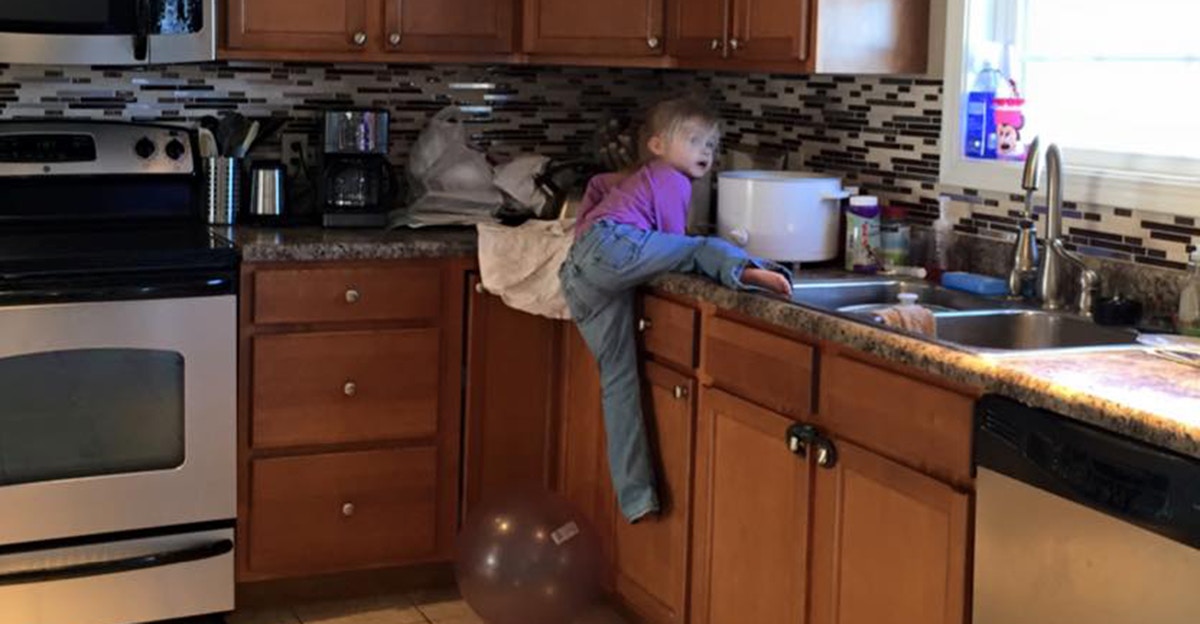
A typical day at home for us includes peanut butter smearing, cabinet scaling, mud eating, and paper ripping. It's a little exhausting sometimes.

Progress actually happened when I let go of what was "wrong" with Emma and started figuring out what to do about it.

Emma was nearly 4 years old by the time she was given an official autism diagnosis. But when the panel of specialists finally handed over their "findings" of autism spectrum disorder after a particularly awful six-hour doctor appointment, I distinctly felt at that point (and still do) that I could not have cared less what they wanted to call it.

The moment of the diagnosis wasn't a big deal to me because it didn't really change anything. By then, Emma was already in speech and occupational therapy and going to preschool, and all of that was helping some. But the autism label did eventually lead us to a kind of therapy we hadn't heard about before.

It's called applied behavior analysis — ABA for short — and that has brought a lot of change.

Some doctors explain ABA as a reward system for when a child does something right, but it's much more than that.

Behavioral scholars and autism experts date ABA treatments back to at least 1968, when a group of university researchers wrote in an introduction for the Journal of Applied Behavior Analysis that ABA interventions could benefit individuals and society.

The treatment is highly individualized, with analysts measuring specific behaviors for each patient, crafting trials to change variables in controlled environments for each patient, and evaluating outcomes for each patient. It's used for both children and adults who have intellectual or developmental issues, and it can help them gain skills in language, socialization, and attention as well as in more educational areas, like reading and math.

And this kid is gonna need more skills than taking selfies ... although she's quite amazing at them, IMO.

ABA is complex stuff. But put super simply, it's empathy on an ultimate level.

It involves patiently observing and trying to understand what a person — often one who can't fully communicate (or even necessarily process the things going on in the world) — feels and thinks.

ABA is putting yourself in that person's place, realizing what is motivating them, and then tinkering with those behaviors using positive encouragement and reinforcement. These are "rewards" of a kind, but not necessarily tangible ones; Emma's greatest motivators are hugs and kisses, high-fives, and tickles.

And wagon rides. And a mom deciding that chewing on a piece of grass to satisfy a sensory need is not so terrible in the big picture.

Even though ABA isn't a new treatment, it's gaining attention recently because of how life-changing the empathetic perspective can be. Agencies like the Centers for Disease Control and Prevention and the National Institute of Mental Health (and several autism-research organizations) recognize ABA as an effective treatment for autism. Plus, access to ABA experts is expanding: Clinics with extensive ABA support and research existed mainly in larger cities for many years, but now services are being offered in places all over the country.

For me, an intensified effort to understand Emma through ABA, and to help her understand her world, changed everything.

She's almost 6 years old now, and these days, she charms just about everyone she meets. She's still mischievous and daring, but she also runs into a room and gives out hugs to everyone there. (Even strangers! It's actually really awkward sometimes.)

Seems like a small thing, but she sings about how Old MacDonald has a cow that moos. (You should hear "Do You Wanna Build a Snowman" ... adorbs!)

She can pick out her own jammies and a book to be read and a toy to keep her hands busy and the perfect spot to cuddle while she winds herself down to sleep. She giggles and beeps noses and plays chase with the dog and likes to announce, "Happy Tuesday!" She's even learning to read and write, which blows my mind when I think of those long nights spent banging heads on floors.

Emma still has autistic-meltdown fits, of course, but I get it now.

Even I have moments where I just can't even. It's really not that hard for any parent or person to relate to that. What's great, though, is that I've noticed how people outside the ABA therapy world — teachers and family and even total strangers — use the therapy, sometimes without even realizing it.

They change how they do things to adapt to what it must seem like from Emma's perspective, and that's how they end up really connecting with her. I find myself, too, exercising those empathy muscles with people other than Emma, and it makes me wonder sometimes:

What if we all did?
Pop Culture

All In: 5 Ways This Week

From the silly to the sentimental, there are so many ways people like to go “all in” on something. Here are our five favorite examples we found this week across the internet.

5 ways people are going "All In" this week
True

When you hear the words “all in,” what do you think? You might picture a Dancing with the Stars trend gone viral or maybe bridesmaids who fully supportive of the bride's favorite movie (and recreates an iconic scene). Whatever you picture, the idea is the same: Someone who does something with 100 percent total commitment. Going “all in” means giving your all—going completely over the top, no second guessing, no holding back. Just full-throttle enthusiasm, with some flair and creativity thrown in. And when people go “all in,” something truly special usually happens as a result.


The internet abounds with examples of people giving it their all—whatever it is. In this roundup, we’ve found the very best examples of people going “all in”—moments where passion, creativity, and commitment take center stage. Some are sentimental, some are silly, but all of them are a reminder that giving 100 percent is truly the only way to leave a mark on this world. Get ready: These folks didn’t just show up, they went all in.


1. An Iconic "snow-coaster"

One thing about going all in - it can be crazy and childish at times. That’s something that makes going all in special, connecting with that side of you that takes things less seriously in order to have some fun. Shira Goldstone and her husband took to that mindset when it started snowing in their backyard. Shira’s husband picked up planks of wood (and whatever other tools are required) and within the same night, in the falling snow, built a “snow-coaster” for the two of them to play on.

2. A Truck That's Feeding It's Community

You already know our friends at All In—they’ve got some seriously tasty snacks that are not only healthy and affordable (scroll to the bottom of this article to see how you can snag a free bar), they help fund food banks, gardens, community fridges, meal programs, and other amazing things

For Giving Tuesday, All In teamed up with Fresh Truck, a weekly mobile market that brings fresh and affordable produce to neighborhoods in the Boston area. Fresh truck hosts weekly markets, pop-up events, and an online storefront, all to help strengthen communities who need it the most. They’re going all in on local nutrition and food access, and we’re here for it.


3. All In on Madam Morrible

I’m always all in on a good TikTok trend. This week, I’m going to share with you a classic that has come out of the Wicked franchise and the incredible actress Michelle Yeoh.

Michelle, who plays Madame Morrible in the Wicked movies, is an outstanding actress. She’s known for iconic films like Everything, Everywhere, All At Once, as well as Crazy Rich Asians and Star Trek. But her legacy might be this one quote, which she’s said in interviews countless times, and now people can’t stop making videos with the phrase “Madame Morrible, M.M…flip it around, W.W. Wicked Witch!”

You might have to take a look at how people are going all in yourself, the sound has taken off with already 14.3K videos, and the variations are unstoppable...defying all odds and maybe even...defying gravity?

4. Spotify Wrapped: All in on "Coconut Mall"

TikTok · Ale

www.tiktok.com

There’s nothing better than finding a song that hits just right and gets you feeling productive. For some people, it’s lofi beats. For others, it’s orchestra music. For TikTok user @aleinmotion, it was the “coconut mall” song from the Mario Kart racing soundtrack. Ale never realized how much she listened to the song until it became #1 on her Spotify Wrapped. Sometimes you’ll be surprised by what you love most, and I’m thinking this is one of those moments for Ale.

5. A Family Prank Everyone Enjoys

This girl said her boyfriend had an ugly hat, so her family decided to go all in on supporting him instead. This is when love and humor come together, a perfect prank that actually made the boyfriends day…and taught his girlfriend that nothing is really that serious! They even got the daughter her very own hat as well, and she looked happy to wear it!

As someone who grew up with a dad who always wore floppy hats to protect him from the sun, I understand the embarrassment. Maybe it’s time I go all in and show my support with a matching hat and white long sleeve sun shirt!

Snag your free (!!) snack bar here while this deal lasts. Simply sign up with your phone number, pick up your favorite flavor of an All In bar at Sprouts, and then text a picture of your receipt through Aisle. They’ll Venmo or PayPal you back for the cost of one bar. Enjoy!

Autumn de Forest, art, kids, artists, painting, Pope
Autumn de Forest

Autumn de Forest stands before a sign with her name on it

When Autumn de Forest was five years old, she picked up a paintbrush for the first time. It wasn't long before she was ready to show the world what she could do.

After a year of practice, the then-six-year-old asked her father if he could get her a booth at a local art-in-the-park program. "People would come up to the booth, and they would talk to my father, and they'd say, 'This is great!'" she said. "Apparently they thought it was Take Your Daughter to Work Day."


Almost everyone thought the artwork was her father's. When they found out that tiny Autumn was the artist, people couldn't believe their eyes.

art, kids, art genius, kid genius Autumn created this piece when she was just 5 years old.Autumn de Forest

Soon, Autumn rose to national fame

When Autumn was eight, she was featured on the Discovery Health Channel. There was a slew of media attention in the years that followed. There was Disney. There was The Today Show. There was Wendy Williams. She was called a child genius, a prodigy, and an expert painter.

- YouTube www.youtube.com

Suddenly, Autumn de Forest was everywhere.

But not everyone was so accepting of the young artist and her work. Some people in the art world had...questions. Sure, she was good for a kid. But was her art actually good? Others wondered if the whole thing might be an elaborate hoax.

Autumn ignored her critics and kept painting.

By age 14, she developed a startlingly organized daily routine that went far beyond a 9 to 5

Somehow, as the focus on her age began to wear off, Autumn's work ethic and art only grow stronger. She said that most days, she'd wake up in her parents' Las Vegas home at 7:30 a.m. After breakfast, she'd break out her supplies for a one- or two-hour painting session. From there, she dove into her school work. Most brick-and-mortar schools can't accommodate her travel schedule, so she did the majority of her schooling online.

Before dinner, it was back into the studio.

"That session can last much longer, that can be three or four hours when I really get into it," she said. "Then I probably have dinner and go to bed."

kids, painting, artistic genius, paintings, kid artists Autumn de Forest paints Autumn de Forest

The results speak for themselves

Her work has been displayed in galleries and exhibitions all over the world.

kids, painting, artistic genius, paintings, kid artists An Autumn de Forest paintingAutumn de Forest

Autumn held a public demonstration before a showing at The Butler Institute of American Art.

assets.rebelmouse.io

In 2015, Autumn received the International Giuseppe Sciacca Award in Painting and Art.

The award took her to the Vatican for a private showing of her artwork with Pope Francis.

Autumn de Forest, the Pope, Pope Francis, painting, art Autumn de Forest stands with the Pope who looks at one of her paintings Autumn de Forest

At 16, she also worked with the President's Committee on the Arts and the Humanities, headed up by former First Lady Michelle Obama.

As part of the program, de Forest traveled to underprivileged schools around the country and led painting workshops. Oh, and if you're looking for some hard numbers to attach to Autumn's talent, she's got those, too.

Her paintings raked in over $7 million at auctions by the time she was a teenager—fetching as much as $25,000 each—much of which has gone directly to charities and disaster relief funds.

Now 24, Autumn continues to be represented by Park West Gallery, the world's largest art dealer, and is keeping busy with her craft and philanthropy.

- YouTube youtu.be

The transition from child prodigy to respected artist has certainly kept her busy. In 2017, the Monthaven Arts and Cultural Center in Hendersonville, Tennessee hosted a major solo exhibition for de Forest titled "Her White Room: The Art of Autumn de Forest."

That same year, de Forest was listed as one of Teen Vogue's "21 Under 21." In her profile she was praised for her talent as well as her commitment to art education.

"In dis­advantaged schools, they consider the arts an extracur­ricular activity," she told Teen Vogue. "It's devastating, as there could be child prodigies in these schools, but they don't know that they have this God-­given gift because they're not given the opportunity because there's nearly no art programs in schools."

In 2018, de Forest was featured in the music video for the song "Youth" by best-selling recording artists Shawn Mendes and Khalid. The video highlights exceptional young people working to change the world, including de Forest, Emma González, and Elias and Zion Phoenix.

The video has over 88 million views on YouTube.

And of course, de Forest continues to share her absolutely incredible artwork on Instagram and in shows and exhibitions around the globe.

The Autumn de Forest Foundation helps her keep track of the kids she's met throughout the years and to continue to help them with their art careers

A portion of the foundation's money goes to a 529 account set up for the students while 10% goes to them directly.

"A lot of these kids that I work with, they're not very old, they're in second grade, third grade, fourth grade. Maybe in 10 years, they may only have four or five thousand dollars but that could be the difference between them going to college or not," Autumn told Teen Vogue.

Autumn's incredible rise in the art world is an astonishing feat for someone so young, but that accomplishment is easily matched by her generosity and commitment to helping develop tomorrow's prodigies as well.

De Forest's latest solo exhibition debuted in late August of this year, and ran through mi September at the Park West Soho Gallery. She now resides in Los Angeles according to her profile on the networking site, dot.cards.

For more information, visit her website.

This article originally appeared nine years ago. It has been updated.

money, tech, teaching money to kids, tech boundaries for kids, parenting, parenting tips, kids and screens
@growingwithleong/TikTok, used with permission

Dad Leong Hiew came up with a brilliant set of ground rules for tech and money that both kids and parents can benefit from.

Australia-based dad Leong Hiew shared that his sons are approaching the age where they're ready to start dealing with little bits of pocket money here and there. Wanting to start them off on the right foot, he sat down to write some appropriate ground rules for healthy money management.

That's when he realized not only that the rules he had already jotted down for technology and screen use applied perfectly, but also that they were guidelines adults could benefit from as well.


So he combined them into one set. And parents are begging to grab this document. Reading them, it's easy to see why.

Rule #1: Money and tech are TOOLS to help us grow

…and therefore, can't make you happy. Being kind, working hard, and spending time with those you love, on the other hand, can.

money, tech, teaching money to kids, tech boundaries for kids, parenting, parenting tips, kids and screens A joyful family playing outdoors.Photo credit: Canva

Rule #2: Do important things first

Eating and sleeping well, playing outside, spending time as a family, and completing homework and chores always take precedence. "No exceptions," he says.

Rule #3: Learn small before doing big

"We practice spending $2 before we try to spend $20. We try playing with small apps before we jump on big platforms. We learn by biting off what we can chew," said Hiew.

money, tech, teaching money to kids, tech boundaries for kids, parenting, parenting tips, kids and screens Child counting coins with an abacus and jar nearby on a table.Photo credit: Canva

Rule #4: If we show healthy signs, we get more; if we have warning signs, we get less

For both technology and money: if it leads to hiding or sneaking, throwing tantrums when we don't have them, or thinking about nothing else, then "it all goes away."

Rule #4: Mistakes are OK. Hiding them is not.

Hiew argues that talking openly about mistakes helps us learn from them. Both kids and adults prove that they're trustworthy, and thus, earn more privileges.

Rule #5: Our job is to be ourselves

Hiew explained that a kid's job is to be a kid, not to solve a parent's money problems, and vice versa. This one was a little more money-oriented, but easy to see how it could be applied to tech use, especially if certain platforms are forcing kids to lose their innocence a bit too quickly.

And perhaps the sweetest part of all comes at the very bottom statement of the document: "Daddy loves you, and I am here to help you learn and grow! If you are not sure, talk to Daddy, and Daddy will listen and help you learn what to do."

Hiew concluded by reiterating how much children thrive on routine and structure, saying, "it grounds them and gives them an environment where they are safe and they can trust." And even as an adult, he said that the rules helped remind him of the importance of "concentrating on myself."

@growingwithleong Gratitude 458: Household Rules for Money & Tech. I share with you my household rules for money and tech. Do they resonate with you? — Series intro: Everyday I find a moment of gratitude, to cherish my life and the world, and help me initiate positive action. This series is a record for my kids… Boys, this is what Daddy is grateful today. Did you find something to grateful for too?
♬ original sound - Leong’s Growth Journal 🇦🇺

People were totally onboard with these rules, and applauded Hiew for putting them together in such a concise and effective way.

"I am a wealth planner…[and] I am confident that many of my clients would have had easier paths if someone instilled them in them at an early age."

"I like that money and tech are tools that really sat with me."

"As a parent, a therapist, and a sober adult, I want to tell you I found this to be perhaps the greatest understanding of parenting and self reflection on what's important in life that I've ever seen."

With this framework, families can all get aligned with what really matters. And if you, like many viewers of this video, are jonesing for your own copy, Hiew graciously made a free downloadable, editable document, found here.

Community

Frugal people share 15 "fancy" home hacks that feel bougie while still saving them money

"It feels fancy and Greek-goddess-y, while also using less hot water!"

frugal, frugal living, frugal home, frugal house, frugal money saving tips

Frugal people share money saving home tips.

Being frugal can sometimes feel anything but luxurious. Saving money usually means cutting back or giving up on the "finer" things.

But frugal people have found ways to still cut back on household spending while making their homes feel like five-star hotels. And bonus: their frugal "little luxuries" can have even bigger payoffs than saving money—they have big mental health benefits.


“Little luxuries can trigger the release of feel-good neurotransmitters, improving overall mood,” Robert Cuyler, PhD, Chief Clinical Officer at Freespira, explained to VeryWell Mind. "Physically, little luxuries that promote relaxation and well-being can lead to lower blood pressure, improved sleep quality, reduced muscle tension, and a strengthened immune system due to decreased stress levels."

- YouTube www.youtube.com

To save money around the house while still feeling fancy, these are 15 frugal home hacks.

"My grandfather in law has motion sensor lights in every room in his home. He got me some for my apartment back in the day, and man oh man. I felt like a KING every time I walked in and the lights just popped on. My energy bill was also noticeably smaller. Still not sure why they changed to walled sized bills... Also, as an eco conscious human, I was glad to be saving energy. Finally, I found it to be more hygienic and less stressful when not having to worry about touching lights when cooking or whatever. Still swear by automated illumination to this day." - KVNTRY

"Wait til you hear about pressure-based light switches. I put one in the door jamb of my pantry so when you open the door, the light immediately kicks on. Close it again, and it shuts off. It’s glorious." - Stone_The_Rock

"Cloth napkins. We haven’t bought paper napkins in years, and the cloth ones are so much nicer anyway." - SmileFirstThenSpeak

"Carrying everything on trays. I might be overdosing on Downton Abbey, but having trays of various sizes readily available is nicer and easier." - Heel_Worker982

@hellobrownlow

welcome to Frugal Living Essentials! we're talking about all the little things that add up to being super frugal in your day to day life. #frugalliving #frugalmom #singleincomefamily #livebelowyourmeans #frugal

"Changing my toilet seats out to the easy to slide off versions so you clean everything more thoroughly without fighting crevices is a game changer." - mycofirsttime

"An led bulb that I programmed to do sunrise/sunset wakeup and sleep routines. Silicone trays to put skincare products on." - Okiedonutdokie

"Auto sensor soap and water dispenser for the kitchen so I don't have to clean the faucets when I might have gotten raw meat juices on them." - SilentRaindrops

"I bought a big pack of white washcloths for general use and I keep a stack neatly folded in half on the bathroom counter. Feels hotel-core and 'prepared' for little effort." - infieldmitt

"Having indoor plants - especially the ones that have low light needs and are easy to propagate. My pothos plant is the gift that keeps on giving since its cuttings have allowed me to have greenery in every room of my place. I’ve gotten all my plants frugally - cuttings from friends, inherited plants from moving neighbors, rescued plants from work, and occasional purchases from places like Aldi or Trader Joe’s. I’m lucky to have a southeast facing room and all of my plants thrive in there. I feel so freaking fancy sitting among my plants, reading a book with my dog by my side." - onlythegoodstuff44

"Bathroom fan switch with choice of how many minutes you want it to run. No more worrying about it running when we're asleep or outside the house." - fishfishbirdbirdcat

- YouTube www.youtube.com

"I put a pretty vintage pitcher in my shower that I fill up with hot water to use while I have the water turned off. It feels fancy and Greek-goddess-y, while also using less hot water!" - laurasaurus5

"My door catchers and door stops. For the room doors that are almost always open, I installed magnetic door catchers on the baseboard. This holds the doors in place, creating clean lines in the rooms and predictably large openings. I also had two 5 lbs kettle bells which I spray painted chrome and use as door stops at my front and back doors. They are easy to place, look good, and securely hold heavy exterior doors open. I love them." - AvivaStrom

"We got a robot vacuum mop. For the price of one month of having a cleaner come in to do my floors, I can have someone other than me vacuum and mop daily! Yay for Mr. Clean! Such a cheerful helper! It feels a little like having staff. 🧐" - mystery_biscotti

"Purchased a French door from Lowes and replaced my sliding glass door. It made the room 'pop'. They have doors in every price range via their catalog from a modest expense to very expensive. I absolutely hate sliding glass doors." - texasusa

"Get one of those shower curtain rods that's curved outward. Total game changer." - CurnanBarbarian

Music

Gen X icon Tori Amos brain farted a song on stage. Her recovery has menopausal women rolling.

She stopped cold mid-performance, then had a perfect improvised response.

tori amos, live concert, menopause, women, aging
Justin Higuchi from Los Angeles, CA, USA (Wikimedia Commons)

Tori Amos is still a voice for Gen X women.

When Tori Amos launched her debut solo album Little Earthquakes in 1992, she became an icon to a whole generation of angsty Gen X teens and young adults. At age 62, the singer-songwriter is still known for her flaming red hair, passionate piano playing, and unique voice. Fans still go see her live to hear her perform classics like "Silent All These Years," "Crucify," "Cornflake Girl," and more.

Now, Amos is making a name for herself as a "menopausal queen" after she brain farted one of her own songs live on stage. She's been performing for decades and writes her own songs, so forgetting a lyric or chord is pretty unexpected. But in the middle of a concert, after singing, "Not tonight, Josephine"—the opening line of her song "Josephine"—she stopped abruptly, looked at the audience, and whisper-dropped an f-bomb.


The audience laughed out loud. Then Amos picked right back up with a whole new song, improvised on the spot, about her menopausal brain:

"It was bound to happen, it was bound to happen, somewhere in my menopausal mind…as long as I know a couple things, like this is what it is, and this is what it is [indicating the microphones], we'll get there eventually. It was bound to happen in my menopausal mind, but at least I can laugh this time."

The audience, undoubtedly filled with menopausal and perimenopausal fans, cheered wildly.

The woman who shared the video, @thegarbagemom on Instagram, wrote:

"Tori Amos having a full blown brain-fog moment and just rolling with it? GEN X ICON QUEEN BEHAVIOR👑

THANK YOU @toriamos for continuing to be a siren voice for our generation. 🩷 I loved her as a teen and love her even more now!

Her music was the soundtrack to our girlhood revolution, and now she’s still here (!!!) still showing up for us and telling the truth, even when her brain is foggy, even when her body is changing.

- YouTube www.youtube.com

It feels like watching our entire generation grow up together.

This is why Perimenopause-a-Palooza matters (and will happen!) Because artists like Tori didn’t just shape our youth, they’re shaping this chapter too. 💯

We deserve a place where our stories, our humor, our rage and our power in mid-life are seen and heard. This chapter of our life needs a stage too!!"

Amos has been a graceful aging advocate for years now. In 2012, she told CNN journalist Brooke Baldwin, "As you get older, you just have to step into your grace ... The youngsters don’t have what you bring, which is an awareness, a knowledge. Please, just hold your head up high. You can’t be 27 and be a great queen.”

She also spoke about menopause at another concert, saying the worst thing about it was forgetting things. However, she added that there were great things about it, too, telling young women that they'll "understand what fire is" when they're 50. "Just you wait," she said.

from toriamos

Gen Xers are loving how Amos went from being the voice of our girlhood to the voice of our womanhood without skipping a beat. Those angsty youngsters still live somewhere in us, and it's all the more comforting to have Tori Amos nailing our feelings at this stage of life, too.

7 ways to have a blast at holiday parties even if you're an introvert who can't stand holiday parties

Woman in a black and white polka dot sleeveless dress standing beside a green Christmas tree.

There has long been a notion that introverts (or people who get drained easily by people or events) just want to stay home. This isn't true! And as the holidays approach and schedules begin to fill up, there are super healthy ways to navigate the season with grace…and have fun while doing it.

In fact, with a little pre-planning and boundary-setting (which is helpful regardless of how you give and receive energy), it's time for introverts to put their party gear on and enjoy life on their terms.


So often, many of us get stuck in a narrative. "Oh, I'm not as talkative as Jane, I guess I don't belong." Or "Dave really likes to do the limbo and I don't." But how boring would the world be if there were only "Janes" and "Daves"? The limbo line would be never-ending!

stefflon don dance GIF by LuisFonsi Giphy

Many experts, alongside everyday people, have offered advice on how to reframe what fun looks like and help guide everyone toward a good time.

1. RETHINK YOUR NERVES

This tactic is often used by entertainers. When, say, a comedian or musician is about to step onto the stage, sometimes the butterflies can feel overwhelming. But once someone has learned to control their nerves or at least become fully aware of them, they can use those nerves to their advantage for an even better performance.

In a piece for Good Housekeeping, Lauren Laverne suggests, "Accept your nerves. Trying to stamp down anxiety makes it worse. Instead, do what everyone in showbiz does and let it be your fuel. It's okay to feel wound up when something matters. If you can, reimagine those fizzy feelings as potential excitement and a sense of possibility."

Polly Campbell, in an article for Psychology Today, has similar advice: "Reinterpret the signals you’re getting from your body. When I walk into a social gathering—even one with good friends—I have some anxiety. It makes me nervous. My heart beats a little faster in the base of my throat, I feel the tension in my shoulders, sometimes my palms sweat, and I become super alert. Stress? Maybe. But it's really just my body preparing me to be successful at the event. It's priming me to be alert and energized. Reinterpreting those physical signs as excitement and curiosity can change how we experience stress and remind us that physical changes mean our body is responding naturally."

2. DON'T CATASTROPHIZE

It's difficult, when our minds start spinning anxiety in a blender, not to think of the worst-case scenario. But Laverne puts it nicely when adding, "Instead of disaster scenarios, add other possibilities into the mix. Your worst case is possible but highly unlikely, as is your dream result. Infinitely more probable is that your event will land happily in the middle of the two."

parties, holidays, introverts, extroverts, fun People at a party give a toast. Photo by Al Elmes on Unsplash

3. SET BOUNDARIES

Over on Reddit, in a thread tackling this very subject, many suggested approaching the party in terms of when you go. That way, everyone can enjoy themselves, each in their own way.

One Redditor suggests to "Go early enough that everyone's still sober(!), then stay for one or two drinks before leaving after a couple of hours (and/or everyone starts getting too drunk to be worth socialising with anyway). You've done your obligation by showing up, without feeling pressure to stick around as it gets more chaotic." That seems fair.

Similarly, this commenter says, "Only go / stay for as long as it’s enjoyable at all for you. Get some free food, try and soak in the atmosphere of Christmasy-ness. Then leave."

4. LET GO OF EXPECTATIONS

This one can be super helpful. Sometimes we write out what the whole event will be in our heads before we even step into the shower to get ready. If you drop those expectations, you might find yourself surprised by the outcome.

Campbell wisely shares, "The things that make the festive events so much fun and memorable are the unexpected things that happen, the crazy stuff people say, the new friends you make, and the great meal you enjoy even when Grandma brings the weird Jell-O mold. When you drop the expectations about how things should be—how people should act, how the food should be, what kind of environment you want—things get easier and much more interesting."

5. BE INQUISITIVE

If shyness, introversion, or just plain nerves make you anxious about talking to people you hardly know (or don't know at all) flip the script. Ask them questions. Laverne puts it bluntly but clearly: "Worried about chatting to strangers? Ask questions! It sounds obvious, but everyone loves talking about themselves, and they like people who are interested. It’s the quickest way to make friends and – bonus if you’re shy – means that the spotlight is elsewhere rather than on you."

party, introvert, extrovert, Vince Vaughn, fun Vince Vaughn enjoys the party. Giphy Vince Vaughn Party GIF

6. GIVE YOURSELF GRACE

Campbell shares the notion that the Golden Rule always applies and that, on some level, what you put out is what you get back. She advises, "Be generous to others. Even the extroverts among us get worn out, have bad days, have a hard time connecting with strangers, or deal with difficult family members. The best way through is to be generous with all whom you encounter. This means offering to get a drink if you are going to the bar, showing interest in others, smiling, and being patient and appreciative. There isn't much kindness that doesn't improve."

7. GO INTENTIONALLY

Perhaps the most important thing to remember when you're attending an event is that it is designed to be fun. No one is actively hoping you have a bad time. So if you go in with an intention, whatever that might be, try to stick to it.

Campbell also shares, "The second you decide to attend a festive affair, commit to enjoying it. If you are going to your child’s choir concert, intend to soak up the good music and relax. Headed to your spouse’s office party? Intend to talk to one of the people you have heard so much about. Joining a family gathering, intend to experience gratitude for whatever appears in those crazy, chaotic affairs. Knowing what kind of experience you truly want to have will help you create it and make it better for those you are sharing the time with too."