The numbers are stacked against young men when it comes to finding love on dating apps. They outnumber women 2 to 1 on the platforms, making the competition pretty tough. A new study finds that they’ll make things even harder for themselves if they admit to listening to the “Joe Rogan Experience” podcast in their profiles.
A new poll by Change Research surveyed 1,033 registered voters between 18 and 34 to ask about their political leanings and dating preferences. It discovered that women’s biggest red flag when looking for a relationship is a date revealing they’re a MAGA Republican, with 76% of women saying it’s a turnoff. The second biggest red flag for women is people who “have no hobbies” (66%), and the third is those who say “All Lives Matter” (60%).
Fifty-five percent of women say it’s a big turnoff for potential partners to listen to the Rogan podcast. They also have a problem with people who “refuse” to see the “Barbie” movie (53%).
When it comes to men between the ages of 18 and 34, the biggest turn-off is people who identify as “communist” (64%), and they also have problems with those who have no hobbies (60%) as well as MAGA Republicans (59%).
Other turnoffs for men include being interested in astrology (41%) and saying “All Lives Matter” (41%).
Interestingly, people with no hobbies are a big red flag to people of both men and women. The common assumption is that people with no real hobbies or interests will rely on their partners to bring fun into their lives. Also, a lack of hobbies can mean a person lacks passion and may not have many personal goals.
When it comes to having too many hobbies, both men and women agree that it isn’t a big problem. The poll found that only 8% of women believe that having too many hobbies is a red flag and 6% of men agreed.
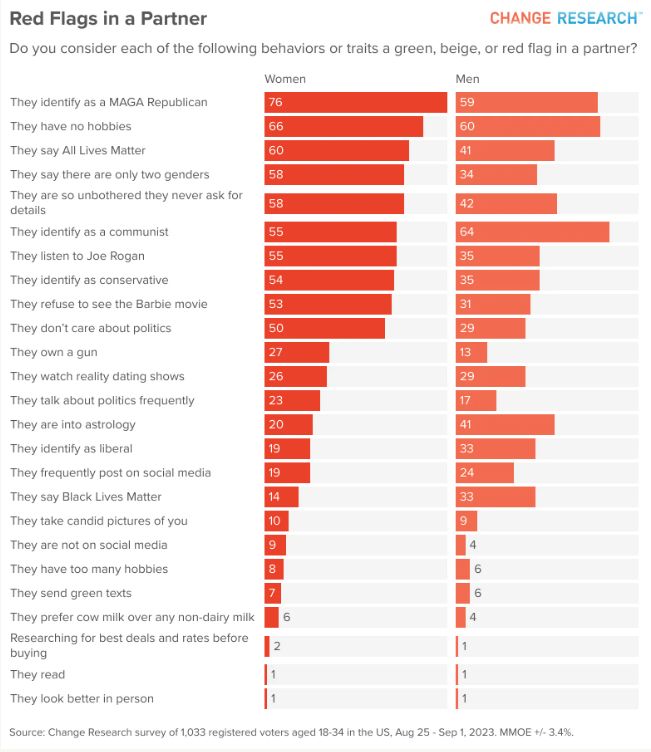
Red flags in relationships graphic. via<a href="https://changeresearch.com/"> Change Research</a>
When it comes to green flags in a relationship, both men and women overwhelmingly agreed that they are very interested in potential partners who read. Ninety-five percent of women and 91% of men saw reading as a green flag. So, if you’re crafting an online dating profile, you may want to show some photos of you reading a book or list some of the books you’ve read recently.
They also agree that they are interested in people who research the best deals and rates before buying things. Eighty-eight percent of women listed being a smart consumer as a green flag, and men were close behind at 85%. Men (63%) and women (51%) also agreed it’s a green flag when someone looks better in person than in photos online.
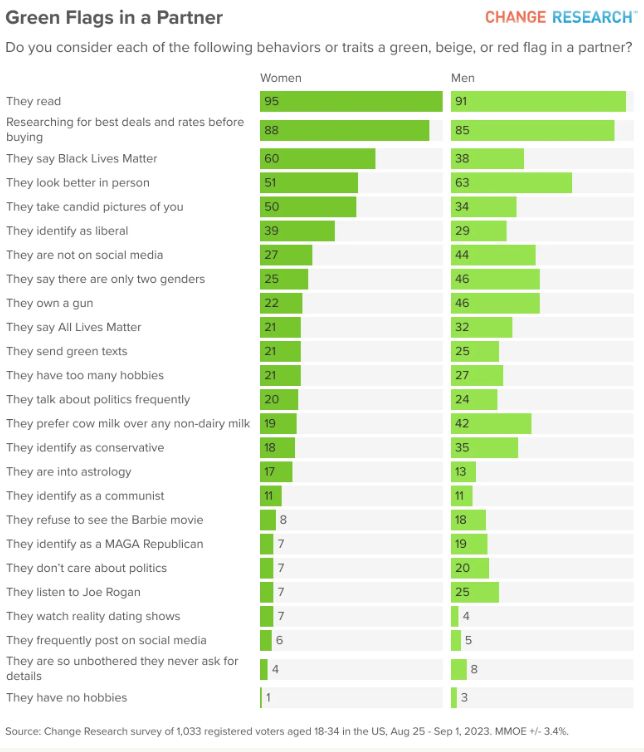
Green flags in relationships graphic. via <a href="https://changeresearch.com/">Change Research</a>
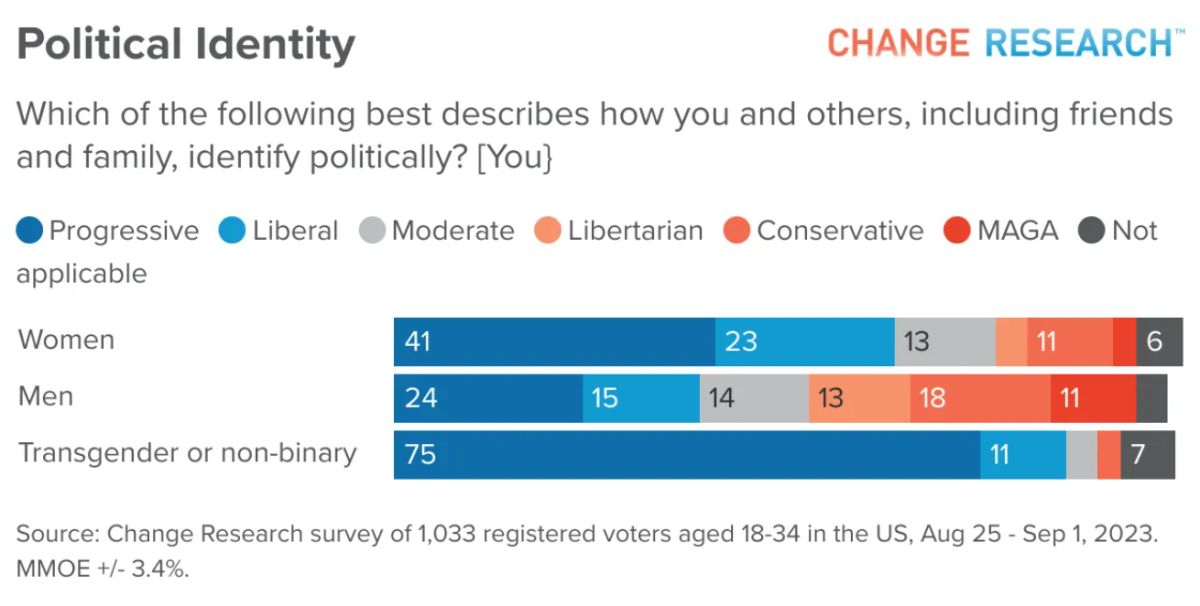
Those of you looking to be in the dating pool during the upcoming presidential election should know there is a discrepancy between the genders regarding political affiliation among the 18 to 34 crowd. Although most people in this age range are moderate to liberal politically, there is a significant difference between genders.
In March 2023, after months of preparation and paperwork, Anita Omary arrived in the United States from her native Afghanistan to build a better life. Once she arrived in Connecticut, however, the experience was anything but easy.
“When I first arrived, everything felt so strange—the weather, the environment, the people,” Omary recalled. Omary had not only left behind her extended family and friends in Afghanistan, she left her career managing child protective cases and supporting refugee communities behind as well. Even more challenging, Anita was five months pregnant at the time, and because her husband was unable to obtain a travel visa, she found herself having to navigate a new language, a different culture, and an unfamiliar country entirely on her own.
“I went through a period of deep disappointment and depression, where I wasn’t able to do much for myself,” Omary said.
Then something incredible happened: Omary met a woman who would become her close friend, offering support that would change her experience as a refugee—and ultimately the trajectory of her entire life.
Understanding the journey
Like Anita Omary, tens of thousands of people come to the United States each year seeking safety from war, political violence, religious persecution, and other threats. Yet escaping danger, unfortunately, is only the first challenge. Once here, immigrant and refugee families must deal with the loss of displacement, while at the same time facing language barriers, adapting to a new culture, and sometimes even facing social stigma and anti-immigrant biases.
Welcoming immigrant and refugee neighbors strengthens the nation and benefits everyone—and according to Anita Omary, small, simple acts of human kindness can make the greatest difference in helping them feel safe, valued, and truly at home.
A warm welcome
Dee and Omary's son, Osman
Anita Omary was receiving prenatal checkups at a woman’s health center in West Haven when she met Dee, a nurse.
“She immediately recognized that I was new, and that I was struggling,” Omary said. “From that moment on, she became my support system.”
Dee started checking in on Omary throughout her pregnancy, both inside the clinic and out.
“She would call me and ask am I okay, am I eating, am I healthy,” Omary said. “She helped me with things I didn’t even realize I needed, like getting an air conditioner for my small, hot room.”
Soon, Dee was helping Omary apply for jobs and taking her on driving lessons every weekend. With her help, Omary landed a job, passed her road test on the first attempt, and even enrolled at the University of New Haven to pursue her master’s degree. Dee and Omary became like family. After Omary’s son, Osman, was born, Dee spent five days in the hospital at her side, bringing her halal food and brushing her hair in the same way Omary’s mother used to. When Omary’s postpartum pain became too great for her to lift Osman’s car seat, Dee accompanied her to his doctor’s appointments and carried the baby for her.
“Her support truly changed my life,” Omary said. “Her motivation, compassion, and support gave me hope. It gave me a sense of stability and confidence. I didn’t feel alone, because of her.”
More than that, the experience gave Omary a new resolve to help other people.
“That experience has deeply shaped the way I give back,” she said. “I want to be that source of encouragement and support for others that my friend was for me.”
Extending the welcome
Omary and Dee at the Martin Luther King, Jr. Vision Awards ceremony at the University of New Haven.
Omary is now flourishing. She currently works as a career development specialist as she continues her Master’s degree. She also, as a member of the Refugee Storytellers Collective, helps advocate for refugee and immigrant families by connecting them with resources—and teaches local communities how to best welcome newcomers.
“Welcoming new families today has many challenges,” Omary said. “One major barrier is access to English classes. Many newcomers, especially those who have just arrived, often put their names on long wait lists and for months there are no available spots.” For women with children, the lack of available childcare makes attending English classes, or working outside the home, especially difficult.
Omary stresses that sometimes small, everyday acts of kindness can make the biggest difference to immigrant and refugee families.
“Welcome is not about big gestures, but about small, consistent acts of care that remind you that you belong,” Omary said. Receiving a compliment on her dress or her son from a stranger in the grocery store was incredibly uplifting during her early days as a newcomer, and Omary remembers how even the smallest gestures of kindness gave her hope that she could thrive and build a new life here.
“I built my new life, but I didn’t do it alone,” Omary said. “Community and kindness were my greatest strengths.”
Are you in? Click here to join the Refugee Advocacy Lab and sign the #WeWillWelcome pledge and complete one small act of welcome in your community. Together, with small, meaningful steps, we can build communities where everyone feels safe.
This article is part of Upworthy’s “The Threads Between U.S.” series that highlights what we have in common thanks to the generous support from the Levi Strauss Foundation, whose grantmaking is committed to creating a culture of belonging.
Twelve years ago, this unassuming couple went viral for the greatest gas station karaoke performance ever. – Photo credit: Monifa Sims (used with permission)
When Will and Monifa Sims stopped to get gas in Burbank, California, in 2013, they had no idea they were about to become a viral sensation. What began as a little “go-with-the-flow” singing on the spot at a gas station altered their lives forever.
Here’s what happened: Will began pumping gas when suddenly actor Tim Stack (playing newscaster Jack Rafferty) appeared on a tiny TV above pump 16. What Will didn’t know was that this was one of The Tonight Show with Jay Leno’s pranks, where a fake newscast appears. The fake newscaster then asks a gas station patron to perform some type of wacky stunt or sing their favorite karaoke song. In exchange, they’re told they’ll get free gas.
The setup
After Will hummed a few bars of a song to himself, Stack suddenly addressed him. “You at pump 16 in Burbank. You’ve got a real nice singing voice.” It took Will a few seconds to understand what was happening, but he soon laughed and expressed gratitude. Stack continued, “Do you do that professionally?” Will answered, “No, just karaoke.”
It was then that Stack made him a proposition: “Guess what? We’ll pay for your gasoline. How ’bout a little karaoke from you?”
Will was totally game. He didn’t hesitate for a second. “Okay! What you want?” It was determined that Will was an “eighties kid,” so he liked Bon Jovi. They decided “Livin’ on a Prayer” was the way to go, and Stack asked, “Do you need the words?” Will answered emphatically, “No, I know ’em, baby.”
He started singing the 1986 hit with all his might. “Tommy used to work on the docks / Union’s been on strike / it’s tough / So tough.” He went on, nailing every note, even hitting the falsetto parts in the chorus. “Ooooh, we’re halfway there / Oh, oh! Livin’ on a prayer…” We then heard another voice on the “TV” note, “The girl in the front seat is just dying.”
Will finished strong and asked, “How was that?” Stack asked if it was his wife in the car, and Will didn’t miss the opportunity to ask if she should show off her skills as well. “Want to do it as a duet?” Monifa wasn’t quite ready, so Stack continued complimenting Will while he improvised, “Oh, oh! Livin’ on a tank of gas! Livin’…for…the…gas…whoa!”
Other customers at the station began gathering to see where the “pumpcast” was set up. Perhaps they’ll get lucky too. But it was Monifa who Stack and the gang had their sights on. And somehow, they convinced her.
“‘Sweet Dreams’ by the Eurythmics!” she says boldly. Stack gets the words up on his laptop, shows them to the camera, and away she goes. “Sweet dreams are made of these / Who am I to disagree / I travel the world and the seven seas / Everybody’s looking for something…” Like her husband, she is 100 percent on key and outstanding. Will chimes in every once in a while (especially on the “Hold your head up / Keep your head up” part), and they finish perfectly.
It’s then that Stack informs them enthusiastically, “You’re gonna be on Jay Leno on The Tonight Show.” Now what started out as an unusually awesome day just got even better. They both scream with delight, “Oh yeah! Tell Bon Jovi I love him!”
The pair did joyously make it onto The Tonight Show, wherein Leno admits, “It almost seems like a plant. We had no idea these people would come to the tank.” Monifa jokes there’s no way she could have known ahead of time, because she’d have prepared. “I wouldn’t have looked like that! That wasn’t my best look after working out.”
Leno asked how long the couple had been married. They answered, “Twelve years this year!” They then shouted out their daughter in the audience. Of course, the appearance wouldn’t have been complete without a song. This time, they got an entire band backing their duet rendition of “Livin’ on a Prayer.” Once again, it was absolute perfection.
People are loving the viral revival
The original clip is making the rounds once more, and, as one might imagine, social media is loving it.
On YouTube, it continues to spark joy. “I come back to this video every so often for the past few years…always puts a smile on my face,” one person wrote. “This couple is so cool and down to earth…not bad singers either.”
One fan on Facebook wrote, “This couple will be retired, 90 years of age, re-watching this beautiful clip on some new platform. This is LOVE right there.”
Where are they now?
That prediction seems to be true so far. Upworthy had the chance to chat with Monifa, who gave us a bit more information about that fateful day.
“It happened in Burbank, California, where, believe it or not, lots of good things used to happen like this, so it was not uncommon at all,” she said. She shared that it was a no-brainer to take the challenge. “We’re always up for a good time, so a good time paired with a free tank of gas was easy.”
She said the virality of it was surprising:
“We were absolutely shocked about how viral it went and still continues to be. That was made 12 years ago. It was on the cusp of YouTube becoming really big. There was no Instagram or TikTok. Once it was over, we went home and didn’t even think twice about it until The Tonight Show reached out to us about how funny they thought it was. I always say editing really helped it to be funny, but obviously, you can only edit what you have.”
As for where they are now? Still happily together and working.
“I am a host on QVC. Will is bicoastal (works in LA a few months of the year, so he travels back and forth). Most exciting? Right now, we are in our year of 25! We are celebrating 25 years of marriage in July, but we have been celebrating all year long. We started off the year with an amazing trip to Phuket, Thailand, and Bali! We will be celebrating more this year with friends and family as well.”
They’re creating more consistent content and trying to grow their brand. “I wrote a cookbook,” Monifa shares, referring to Life in Full Flavor. And as for their karaoke songs? “They really have not changed, but we sing a little bit of everything to keep it spicy!”
What makes a ‘good person’ is hard to quantify, but sometimes, you just know it when you see it. But that’s the problem, you can’t always see it. Have you ever met somebody new and wondered if they were a good person with a mischievous streak or a bad person who can turn on the charm and behave occasionally? Determining someone’s true moral character is important, especially if you start dating them or have a business relationship. It is crucial to get to the core of who they are and know whether they can be trusted.
Popular TikTok philosopher and Substack writer Juan de Medeiros recently shared a great way to determine whether someone is good or bad. His rubric for judging someone’s moral character comes from a quote commonly attributed to Johann Wolfgang von Goethe, a German poet, playwright, novelist, and intellectual known for works like Faust and The Sorrows of Young Werther.
How can you tell if someone is a good or a bad person?
“Here’s a pretty good indicator that somebody is a bad person and vice versa, how you can spot a good one. And this goes back to a simple rule, a moral aphorism by Goethe in which he writes, ‘Never trust someone who is unkind to those who can do nothing for him,’” de Medeiros shared in a TikTok video with over 45,000 views.
“Never trust someone who is unkind to those who can do nothing for him.” —Johann Wolfgang von Goethe
De Medeiros then provided real-world ways to determine whether the person you have questions about is good or bad. “A bad person is unfriendly to strangers, to the elderly, to children, to service staff, to anybody they’re not trying to impress,” he said. At the same time, the good person treats people equally, no matter what they can do for him. They’re good for goodness sake, not to get anything out of it.
“A good person carries grace within them and shares it freely with abundance. A good person treats other people as they would like to be treated as well. And it doesn’t matter who you are, it doesn’t matter what your status is, they will treat you and see you as their equal,” de Medeiros said.
an instant green flag was when my current bf took me to a restaurant n the waiter brought us our food but had clearly forgotten about his drink and bc he didn't want her to feel bad he went "hey sorry I forgot earlier but could I also have a glass of water with my *drink name*?"
Goethe’s quote echoes the common red/green flag test that many people have on dates. Sure, it’s important if your date is courteous and treats you well on the date, but you really want to watch how they interact with the server. The rule is often called “The Waiter Rule,” outlined by William Swanson. Swanson, the former chairman and CEO of Raytheon Company, wrote in his book, 33 Unwritten Rules of Management, “A person who is nice to you but rude to the waiter—or to others—is not a nice person.” Boxer Muhammad Ali is also known for saying something similar: “I don’t trust anyone who’s nice to me but rude to the waiter. Because they would treat me the same way if I were in that position.”
'I don't trust anyone who's nice to me but rude to the waiter. Because they would treat me the same way if I were in that position.'
— The Loneliest Sport (@LoneliestSport) April 5, 2023
Rudeness toward the waitstaff also indicates that the person isn’t very smart. It’s not wise to be rude to someone who is in charge of your meal for the night.
Conversely, a good person is kind to others without looking for anything in return because they want to spread joy and believe that others deserve respect. You are what you do, not what you think or believe, and when someone treats others with goodness, it’s a clear indicator of the type of person they are.
In the end, we are all a mixed bag of behaviors and attitudes, and even the most perfect of us has a devil on their shoulder telling them that it’s okay to occasionally get into a bit of mischief. However, when it comes down to determining someone’s core character, how they treat those who can do nothing for them says everything.
This article originally appeared last year. It has been updated.
Generation X (those born between 1965-1980) grew up eating classic Americana meals. During the 1970s, comfort meals like tuna casserole and salmon roquettes were popular meals.
Gen X also grew up eating some pretty unhinged (but all the more yummy) sandwiches. These meals are steeped in childhood nostalgia.
And to this day, Gen Xers are still fond of their favorite dishes they grew up eating. Together, they discussed on Reddit their most-loved home-cooked dishes that they still whip up, starting with sloppy joes.
Here are 17 iconic Gen X comfort meals to keep in mind the next time you make dinner:
“Breakfast. We will have a ‘breakfast for dinner’ at least a couple times a month. Yum!” – fadeanddecayed, KddKc
“Pizza bread! My mom would cut Italian bread into pieces, put butter and garlic salt on them, then pour some spaghetti sauce on them, cover with mozzarella cheese, and broil for like ten or fifteen minutes. Super easy and quick to make and so tasty. I’m sure my mom loved that I was so into something that took roughly zero effort for her to make.” – hornybutired
“Grilled cheese and soup.” – reincarnateme
“Meat loaf. I use 2 pounds ground beef, replace bread crumbs with minute rice, add 1 pkg beef soup flavoring, chop an entire onion for it, and mix BBQ sauce into mixture. Oh, important: do not overmix! Place all ingredients into bowl, then mix quickly 10 or 12 swirls of a large spoon. Grease loaf pan, carefully place mixture in, pat down & bake about an hour. (Extra info: for even better flavor, mix the night before, pat into loaf pan, cover with plastic, put into fridge overnight. Remove from fridge about an hour before baking. BE SURE TO REMOVE PLASTIC WRAP! [Esp. If in Pyrex glass loaf pan])” – jehardt, AbbyM1968
“White guy tacos.” – najing_ftw
“Skillet dinner. Kielbasa, bell pepper, onion, spuds in a cast iron pan. One dish. Easy peasy.” – UnimportantOutcome67
“Chicken pot pie or chicken ala king.” – sattersnaps
“Fried catfish, greens, and red beans and rice.” – User Unknown
“Shepherds pie, technically cottage pie if it’s ground beef. Homemade enchiladas, usually made as a layered casserole instead because I don’t have time to roll them. Pork chops with mashed potatoes and veggies.” – XerTrekker
“Fried rice with chicken or pork leftovers.” – AlternativeResort181
“Hot hamburgers: hamburger patty open face on Texas toast thickness bread, cover with fries then cover that with brown gravy. Wife’s variation is hamburger patty over rice with brown gravy.” – EnricoMatassaEsq
“Stuffed peppers. I make it much more easily by cooking it all in one large frying pan ‘deconstructed’. Sauté onions garlic and ground beef, add cut up peppers, tomatoes or tomato sauce, sometimes a little spinach, then add separately cooked rice, salt and pepper and serve. It comes together pretty quickly and tastes just as good as stuffing and baking peppers in the oven.” – Affectionate-Map2583
“Macaroni and cheese with cut up hot dogs. Seriously, that’s what I ate tonight.” – Dazzling-Walrus9673
“Homemade Stroganoff casserole. Ridiculously easy to make. Ingredients:
1.25-1.5 lbs. Ground Beef 1 each of large white onion, green pepper, and red pepper 1 can mushroom pieces, drained and rinsed 12 oz. Bag of wide egg noodles 1 can cream of mushroom soup 16 oz. Sour cream Worcestershire Sauce Louisiana Hot Sauce White or Black Pepper Panko bread crumbs
To Make: Preheat oven to 360 degrees. Worcestershire, hot sauce, garlic powder, and pepper are all to taste, depending on how much flavor and punch you want it to have. Cook noodles per instructions. Drain. Peel and slice onion (not diced), core and cut peppers into strips Brown meat, onions and peppers along with liberal amount of Worcestershire; garlic, pepper, and hot sauce. Add mushrooms. Cook until meat is fully brown, onions are translucent and peppers are tender. Drain. Combine drained meat, etc. with whole can of soup, half of the sour cream. Gradually add noodles into the mix. Add sour cream as needed to maintain consistency. Add Worcestershire, hot sauce, and pepper to taste. Dump into large, deep Corning dish or whatever. Cover too with bread crumbs. Cover and bake for forty minutes.” – CynfullyDelicious
This article originally appeared last year. It has been updated.
Visiting different states within America can sometimes feel like traveling to a completely different country, given the significant cultural differences and accents. Visiting parts of Louisiana may make you feel like you require a translator to navigate your vacation, as people often speak Creole or Cajun—both of which have very thick, unique accents. Southern Mississippi also has a mishmash of accents that range from Cajun to a non-distinct regional accent.
But one thing North Carolina has in common with states like Texas, Mississippi, and Louisiana is that they all have a range of southern colloquialisms that translate fine between southern states. It’s when those creative southern phrases make their way above the Mason-Dixon Line that causes some confusion. Many southerners who travel north for work, pleasure, or relocation adapt quickly to not using uniquely southern phrases after experiencing looks of bewildered confusion.
Oftentimes, southerners don’t even know where their beloved and well-used phrases originated or why. As far as a Google search pulls up, there’s never been a child born in the world who has ever been small enough to be “knee high to a grasshopper,” but that’s not going to stop PawPaw from saying it. People who are used to hearing the sometimes outrageous phrases simply interpret them themselves and add them to their own lexicon for future use.
General Southern expressions to keep in your pocket
1. “You don’t believe fat meat is greasy.”
This is an expression often used when someone is intent on not listening to advice. It essentially means they won’t believe it until they see or experience it themselves. We all know someone who has to learn lessons the hard way, and this is the saying that conveys that message without sounding harsh.
A phrase like this is used a lot by elders. It just adds a little dramatic flair when they’re making plans. In a conversation, it would go like this: “So, I’ll see you next Sunday at the potluck, right?” There may be a pause for emphasis along with a fist perched on their hip before responding, “The Lord willing and the creek don’t rise.” Just know they’ll be there as long as they wake up in the morning and there’s no natural disaster preventing them from getting there.
3. “There’s more than one way to skin a cat.”
This particular one is a phrase my husband uses often. It is often said by men doing manual labor, whether it’s at work or around the house. If someone is trying something that isn’t working, they have to come up with a better idea of how to make it work. If the original person pushes back on trying it a different way, that’s when you’ll hear, “There’s more than one way to skin a cat.” To date, no one has skinned a cat to prove a point, that I’m aware of, but there’s debate on its origin. It’s believed to come from a phrase used in the mid-1600s in England, “There’s more than one way to kill a dog than hanging.”
Eventually, it got changed to the cat idiom southerners say today, though some suggest the phrase came from when women’s coats were made from cat fur…(that’s information you can’t unlearn). Either way, as someone who has lived in the south for more than 20 years, you can rest assured that the only people skinning cats down here are taxidermists with the pet owner’s permission. Just know they’re saying there’s more than one way to get the job done.
4. “Don’t pee on my leg and tell me it’s raining.”
This is just a fancy way of telling someone not to lie to you.
5. “Well, you look rode hard and put up wet.”
Honestly, if someone says this to you, you’re looking mighty bad. This means not only do you look exhausted, but you also look disheveled, and maybe even ill. When people say this, it’s not meant to be rude. They’re typically genuinely concerned about your well-being, whether it be that you appear to need a break or you need to rest and get some soup in your belly.
6. “P*ss or get off the pot” and “Fish or cut bait.”
These two phrases mean the exact same thing. They’re calling out someone’s lack of progress and can be applied to all sorts of situations. It means to do what you’re supposed to be doing or get out of the way so someone else can do the job you won’t. By the time someone says this, they’re a little annoyed, so it’s best to go ahead and “pee or get off the pot” before they move you over and do it themselves.
7. “Well, butter my butt and call me a biscuit.”
You can stick this in the same category as, “Well, I’ll be a monkey’s uncle.” It’s meant to convey genuine surprise and delight in information they’ve just received or upon seeing someone they haven’t seen in a while and weren’t expecting. It’s a fun one to say, even outside of the South, due to the humorous element.
8. “I’ve got a hitch in my giddy-up”
You’ve got a limp due to hurting yourself somehow, or you’re feeling under the weather in some way that’s slowing you down.
9. “Why, bless your little pea-pickin’ heart.”
Ouch! You’ve just been insulted, and they wanted to make sure you knew. “Bless your heart” on its own can be said in a condescending way or a genuine, “I’m so sorry you’re going through this” way. Using tone and context clues can help you decipher the difference. But when they add “little pea-pickin” right in the middle of the phrase, go grab some ointment because that was meant to sting.
10. “I’m going to snatch her baldheaded.”
Whoever is the target of that comment should probably avoid being around the person making it. See also, “I’m going to jerk a knot in her tail.” When it’s an adult directing the comment at another adult, it could simply mean they’re going to have a verbal confrontation. But, depending on the person, it could also mean physical confrontation because that is not off the table in Southern culture. If it’s a parent directing the expression towards their child, then it usually means that the child is going to get into trouble.
11. “Pull your dress down, everyone can see Christmas.”
This feels self-explanatory, but it’s something you might hear a friend say to another friend to address a wardrobe malfunction. You may also hear a parent telling their young daughter a version of this as they’re learning how to properly sit in a dress. Also see, “Pull down that skirt! We can see clear to the promised land.”
12. “They fell out of the ugly tree and hit every branch on the way down.”
Also in the vein of calling someone unattractive, one might say, “He’s so ugly he could make paint peel.”
13. “Pants are so tight you can see his thoughts.”
Those are some really tight pants.
14. “She’s just as loony as a Betsy Bug.”
Until today, I had no idea what a Betsy Bug was, but apparently it’s a type of beetle that eats decomposing wood. There doesn’t seem to be an explanation for what makes the beetle loony, though.
15. “Well, aren’t you as bright as a box of black crayons.”
Have you ever seen a bright black crayon? If southerners are good at one thing, it’s insults.
16. “That boy’s so dumb he’d throw himself on the ground and miss.”
See also: “He ain’t got the good sense God gave a mule,” and, “If he had an idea, it would die of loneliness.”
Bonus sayings you don’t want to miss
Clearly, southerners have a way with words, but there are a few more that can be fun to pull out for a party trick. A favorite is, “That really burns my biscuits,” but a close second is, “I’m fuller than a tick on a dog’s behind.” If you want to get around the ears of nosey children while having a chat about an adult encounter, some people in the south will say, “He took me to church,” “I was singing opera,” or “We stayed in and played the piano.”
Whenever you decide to pull out any of these phrases, just make sure it’s not one that’ll make someone “madder than a wet hen,” and you’ll be golden.
We’re all probably familiar with the term “mansplaining,” when a man explains something to a woman in a condescending or patronizing way. Often, this takes the form of a man explaining a subject to a woman who already knows it at an expert level. The female neuroscientist who was told by a man that she should read a research paper she actually wrote comes to mind.
Often, mansplaining can show up in small interactions that minimize or infantilize a woman’s knowledge and expertise. It can be a man spouting off facts because he thinks it makes him seem interesting, or giving unsolicited fitness advice at the gym in a poorly disguised flirting attempt. But sometimes the irony at play is just too much to bear. Frankly, it’s often delicious.
In 2024, some next-level mansplaining was caught in the wild. Georgia Ball, a professional golfer and coach who’s racked up over 3 million likes on TikTok for all her tips and tricks of the sport, was minding her own business while practicing a swing change at the driving range.
People practicing on the driving range.via Canva/Photos
A man tries to give a female PGA pro golf tips
It takes all of two seconds on Google to see that when it comes to incorporating a swing change, golfers need to swing slower, at 50-75% their normal speed…which is what Ball was doing. And this is what prompted some man to insert his “advice.”
In the clip, we hear the man say “What you are doing there … you shouldn’t be doing that.” Exhibiting the patience of a nun, Ball simply tells him that she’s going through a swing change. But her attempts at reason are unfortunately interrupted, multiple times, when the man repeatedly assures her that, since he’s been playing golf for 20 years, he knows what he’s talking about.
He then insists, repeatedly cutting her off, that she’s going too slow on her swing and should be following through. Cue Ball’s incredulous look to the camera.
Watch the whole, cringe-inducing interaction here:
Hoping to appease him, Ball finally gives a hearty swing, writing “I knew I had to make this a good one” on the onscreen text. As the ball sails through the air, the man says, “See how much better that was?” completely taking credit for her swing. Which is hilarious because she didn’t change a thing she was doing.
Poor Ball then tries to tell him that even the “best players in the world” slow down their swing when going through a swing change. And she’d know. Not only is she a golf coach, but she’s also a certified PGA professional. “No, I understand what you’re saying, but I’ve been playing golf for 20 years,” the man repeats. At this point, Ball is just “trying to keep it together.”
A group of people playing golf, via Canva/Photos
People in the comments couldn’t handle the mansplaining
Sure, this guy might not have known who Ball was, but it’s pretty evident that the last thing she needed was this guy’s “advice.” And thus, the “mansplaining” jokes commenced in the comments section.
Here’s a small sampling:
“As a guy, this is the first time I’ve ever seen ‘mansplaining’ happen.”
“The way he took credit for your next swing.”
“But did you consider that he’s been playing golf for 20 years?”
“*implement nothing he says* ‘See how much better that was’ HAHAHAHAH.”
“My hope is that he comes across this video and it keeps him up at night.”
Others couldn’t help but praise Ball for keeping her cool.
“He doesn’t even give you a chance to explain, just forces his opinion and advice onto you. Goon on you for staying calm and polite,” one person wrote. Of course, others felt Ball was being “too nice” to the man. One even exclaimed, “there’s no reason to be so polite!”
Ball told BBC that it wouldn’t be in her nature to shut the man down harshly, even if that’s what he deserved. “I wouldn’t interrupt and say that,” she says. “I suppose it’s just the humble side of me.”
Perhaps worst of all, this kind of behavior is pretty common, especially for female athletes. A fellow female golfer even commented, “So glad you posted this because it is my BIGGEST frustration when I’m at the driving range. Unfortunately, men always feel the need to comment on my swing or want to coach me. Guys take note: Please don’t.”
On the bright side: as annoying as it is that Ball had to endure that (not to mention what it says about the very real b.s. that women in general have to put up with on the regular), she laughed it off and just went on about her life being awesome at what she does. Just like the other smart, capable women of the world. It’s almost like…maybe women don’t need advice, so much as they need
Ball isn’t holding onto any grudges over the incident
“I have a lot of interaction with males and females every single day [on the course]. And I’d say it’s mostly always positive,” she says. “I’m just glad I can look back at it now and laugh about it because the majority of people and golfers are all just out to help each other.”
Even though her time on the golf tee with the mansplainer was uncomfortable, the reaction to her discomfort has been positive. “The reaction has been so positive,” she told the BBC. “All the support, the comments, the messages, it’s just been so good. And I’m just so grateful for everything that’s come through.”
This article originally appeared two years ago. It has been updated.
Generation Z has its own slang that older generations, like Gen X and Millennials, have needed a literal translator to understand. However, thanks to social media, Gen Z’s slang has caught on in recent years.Most recently, a charming 77-year-old is using it to inspire younger generations to learn about art and art history. You may…
Most recently, a charming 77-year-old is using it to inspire younger generations to learn about art and art history. You may recognize Alison Luchs, curator of Early European Sculpture and deputy head of Sculpture and Decorative Arts at the National Gallery of Art in Washington, D.C., from your FYP (For You Page).
Her delightful art history videos are blowing up on social media where she has been showing off her apt use of Gen Z slang. Luchs introduces new pieces of art to viewers and describes them with quintessential Gen Z slang terms, like “bussin,’” “money maxxing,” and more.
In an interview with Good Morning America, Sydni Myers, the National Gallery of Art’s social media manager, explained that the museum wanted to hop on the Gen Z slang trend that other museums and libraries had been spoofing. She offered a funny explanation of how the videos came together with the collaboration of Gen Z and Millennial employees.
“A bunch of Gen Zers and Millennials just shouting out different words at each other,” Myers told Good Morning America.
As the idea gained traction, there was only one woman Myers wanted to star in the videos: Alison Luchs. Myers explained Luchs was “kind of a legend” at the museum and added that she has an “otherworldly cool presence.”
The museum dropped Luchs’ first iconic video on December 18, 2025. Immediately, it became a massive hit as she described the history of a clay dish by Orazio Pompei titled “Dish with an allegorical subject” to viewers.
“”Chat, peep this bussin’ clay dish from the 16th century,” she says in the video as she steps forward with some assistance from a National Gallery of Art intern. Luchs described the dish to viewers, noting, “Look how bro glazed it. He went goblin mode with all these colors. High key tough materials to work with. But he ate, and that glow still slaps 500 years later.”
Luchs told Good Morning America about the success of her viral social media videos.
A second video created by Luchs and the National Gallery of Art’s social media team was released on January 13, 2026, and it was another banger for the museum.
When asked what her favorite Gen Z slang term was of the ones she’s used, she replied, “My absolute favorite is ‘the glow still slaps after 500 years.’ That should be a motto for our collection, at least the collections I work with.”
While the museum plans to release more content with Luchs, viewers react
Viewers absolutely adore Luchs, and she has seen the heartfelt comments from them. “I have [seen the comments] and they’re wonderful. They’re so touching,” Luchs told Good Morning America.
Here’s what they had to say:
“We don’t see any crumbs on that dish. That must mean she ate. 💅”
“I’m so incredibly impressed, both by the plate and her delivery.”
There is a particular kind of frustration that comes with being told how to mow your own lawn. Not whether the grass is too long, not whether the edges need trimming, but the specific direction your lawnmower needs to travel. For the man behind the TikTok account @rootedlawnco, that was apparently the line.His HOA had…
There is a particular kind of frustration that comes with being told how to mow your own lawn. Not whether the grass is too long, not whether the edges need trimming, but the specific direction your lawnmower needs to travel. For the man behind the TikTok account @rootedlawnco, that was apparently the line.
His HOA had instructed him to mow only in straight lines. So he did. Sort of.
In a video that has been bouncing around TikTok with the caption “Take that HOA,” he methodically mows his lawn in long, flowing, perfectly symmetrical waves. The result is gorgeous: a sea of alternating light and dark grass bands that roll across the yard like something off a golf course or a baseball field. He even varies the cut depth on alternating passes to give it a color shift, which makes the whole thing pop even more from a distance. The text overlay on the video reads, “When HOA tells you only straight lines.” His face, for what it’s worth, is extremely unbothered.
The comments landed exactly where you’d expect. “Tell them you have astigmatism and this is straight,” wrote @nowherenothin. @spiderlover74 added, “No way they’re trying to control the direction you mow your lawn.” One commenter, @caffeinatedpossum, offered a legal-ish read on the situation: “HOAs have legal rights to control the aesthetic of your grass, but there’s no legal standard for them to control cutting patterns as the cutting pattern is semantic.” (That’s one interpretation, though HOA rules vary widely by state and governing documents, so your mileage may vary on that one.)
The broader frustration behind the video is real and well documented. A survey conducted by Rocket Mortgage found that 57% of HOA homeowners dislike having one, and more than 3 in 10 feel their HOA has too much power. A separate YouGov poll found that most Americans actually oppose HOA rules specifically around landscaping, with more people against those restrictions than in favor of them. And yet, 38% of HOA residents think their HOA is too restrictive, with rules about yard signs, fences, and landscaping among the most contested.
It’s worth saying that HOAs were not invented to tell people which direction to push their lawnmower. The idea was originally to maintain shared spaces and protect property values. But there’s a gap between that intention and the reality of a board with the authority to regulate the pattern of someone’s grass, and that gap is where videos like this one get millions of views.
In yet another video, he openly disregards the HOA’s rules against using sand to level his yard: “POV: When the HOA says no sand, but you did it anyway…”
Yep, the HOA will be all over me for this one! Got a bumpy lawn? Check out my 4 part mini series on You Tube and learn all you need to know in under 10 minutes. Mowing is super enjoyable but mowing a smooth lawn is literally the best thing! I need to do this to my back lawn pretty badly. Maybe this Fall I will. #level#leveling#bumpy#Lawn#diy#lawntips#compost#sand#topsoil#smooth#HOA
There is something deeply satisfying about a response that is simultaneously fully compliant and completely defiant. He did not fight the rule. He did not post an angry letter or file a complaint. He just made something beautiful out of the constraint, posted it to TikTok, and let the rest of us enjoy it.
The lawn looks incredible, for the record.
You can follow @rootedlawnco on TikTok for more content on home decor and lifestyle.
Generational labels have become cultural identifiers. These include Baby Boomers, Gen X, Millennials, Gen Z and Gen Alpha. And each of these generations is defined by its unique characteristics, personalities and experiences that set them apart from other generations. But in-between these generational categories are “microgenerations”, who straddle the generation before and after them. For…
Generational labels have become cultural identifiers. These include Baby Boomers, Gen X, Millennials, Gen Z and Gen Alpha. And each of these generations is defined by its unique characteristics, personalities and experiences that set them apart from other generations.
But in-between these generational categories are “microgenerations”, who straddle the generation before and after them. For example, “Xennial” is the microgeneration name for those who fall on the cusp of Gen X and Millennials.
And there is also a microgeneration between Baby Boomers and Gen X called Generation Jones, which is made up of people born from 1954 to 1965. But what exactly differentiates Gen Jones from the Boomers and Gen Xers that flank it?
What is Generation Jones?
“Generation Jones” was coined by writer, television producer and social commentator Jonathan Pontell to describe the decade of Americans who grew up in the ’60s and ’70s. As Pontell wrote of Gen Jonesers in Politico:
“We fill the space between Woodstock and Lollapalooza, between the Paris student riots and the anti-globalisation protests, and between Dylan going electric and Nirvana going unplugged. Jonesers have a unique identity separate from Boomers and GenXers. An avalanche of attitudinal and behavioural data corroborates this distinction.”
Pontell describes Jonesers as “practical idealists” who were “forged in the fires of social upheaval while too young to play a part.” They are the younger siblings of the boomer civil rights and anti-war activists who grew up witnessing and being moved by the passion of those movements but were met with a fatigued culture by the time they themselves came of age. Sometimes, they’re described as the cool older siblings of Gen X. Unlike their older boomer counterparts, most Jonesers were not raised by WWII veteran fathers and were too young to be drafted into Vietnam, leaving them in between on military experience.
How did Generation Jones get its name?
A Generation Jones teenager poses in her room. Image via Wikmediau00a0Commons
Gen Jones gets its name from the competitive “keeping up with the Joneses” spirit that spawned during their populous birth years, but also from the term “jonesin’,” meaning an intense craving, that they coined—a drug reference but also a reflection of the yearning to make a difference that their “unrequited idealism” left them with. According to Pontell, their competitiveness and identity as a “generation aching to act” may make Jonesers particularly effective leaders:
“What makes us Jonesers also makes us uniquely positioned to bring about a new era in international affairs. Our practical idealism was created by witnessing the often unrealistic idealism of the 1960s. And we weren’t engaged in that era’s ideological battles; we were children playing with toys while boomers argued over issues. Our non-ideological pragmatism allows us to resolve intra-boomer skirmishes and to bridge that volatile Boomer-GenXer divide. We can lead.”
However, generations aren’t just calculated by birth year but by a person’s cultural reality. Some on the cusp may find themselves identifying more with one generation than the other, such as being culturally more Gen X than boomer. And, of course, not everyone fits into whatever generality they happened to be born into, so stereotyping someone based on their birth year isn’t a wise practice. Knowing about these microgenerational differences, however, can help us understand certain sociological realities better as well as help people feel like they have a “home” in the generational discourse.
As many Gen Jonesers have commented, it’s nice to “find your people” when you haven’t felt like you’ve fit into the generation you fall into by age. Perhaps in our fast-paced, ever-shifting, interconnected world where culture shifts so swiftly, we need to break generations into 10 year increments instead of 20 to 30 to give everyone a generation that better suits their sensibilities.
This article originally appeared two years ago. It has been updated.