Have you ever gone down an Internet rabbit hole? You start researching one thing, then two hours later, find yourself reading about something entirely different? For example, you could have begun with quantum physics only to somehow find yourself engrossed in an e-book about medieval falconry.
Philosopher Perry Zurn and neuroscientist Dani S. Bassett found that people have different approaches to information seeking. Their research shows that these patterns aren’t random, but represent distinct styles of curiosity. This is how we build knowledge, connect ideas, and experience the world.
After analyzing the browsing habits of nearly 500,000 Wikipedia users across 50 countries, Zurn and Bassett identified three archetypal curiosity styles: the Hunter, the Busybody, and the Dancer.
Identifying the curiosity style that suits you best can foster mental flexibility—the type associated with greater happiness and resilience.
Curiosity research through the years
Curiosity has fascinated psychologists for decades. In the 1960s, pioneering researcher Daniel Berlyne drew a crucial distinction between two types of curiosity: Perceptual and Epistemic.
Perceptual curiosity drives us to explore new stimuli. It’s the impulse that compels a child to reach for a shiny object or an adult to pause at the sight of an unusual cloud formation.

On the other hand, Epistemic curiosity propels us to gain knowledge and understanding. For example, a person might take photos of strange clouds, then identify them in an article about the “ten basic cloud classifications.” In this way, we seek information that moves beyond immediate sensory experiences to build a deeper comprehension.
In 2020, psychologist Todd Kashdan expanded our scientific understanding of curiosity through a five-dimensional study that examined its impact on emotional well-being.
His research revealed that joyous exploration—the pleasurable experience of discovering something new—consistently correlates with positive mental health outcomes. Meanwhile, deprivation sensitivity (which stems from an anxious drive to fill gaps in knowledge) carries a complicated emotional tenor, mixing tension and discomfort with the satisfaction of uncovering the truth.
These frameworks, put forward by Berlyne and Kashdan, set the stage for Zurn and Bassett’s groundbreaking research on curiosity styles.
Meet the styles
The Hunter: focused and goal-driven
Motivated by a specific mission, Hunters find answers by following a targeted path. Think of them as detectives on a case. When they set out on the quest for information, they stay on the trail. They do not wander. Paying close attention to related topics, they methodically build a tight, constrained network of knowledge.

For the Hunter, finding the correct answer isn’t pleasurable—it’s a relief.
Imagine a Hunter wants to understand how photosynthesis works. Their curiosity becomes a focused exposition. They read articles, check books out from the library, watch YouTube videos, and listen to podcasts until they’ve finally satisfied their desire to learn. They solve the puzzle.
This laser-focused approach to learning is why you’ll commonly find Hunters in STEM fields—science, technology, engineering, and math. These disciplines value precision, logic, and systematic understanding, which come naturally to them.
The Busybody: curious about everything
Busybodies are curious explorers who trace zigzagging routes through a wide range of unrelated topics. They’re the quintessential “rabbit hole” adventurers. They gather scattered bits of information across diverse subjects. For the Busybody, learning does not require a fixed plan or a desired conclusion.

A Busybody might begin by reading about the French Revolution. Flipping through the pages, something captures their attention—a detail, a name, an illustration—then they find themselves deep-diving into Japanese tea ceremonies, exploring the nuances of Persian poetry, or delving into the rich history of chocolate. All in one sitting.
This curiosity style creates loose, intricate networks of knowledge that connect fields such as the arts, culture, food, philosophy, and the humanities. Busybodies aren’t driven by the need to solve a problem or complete a task. Instead, they follow their pure interests and enjoy the simple joy of learning.
The Dancer: a creative synthesizer
The Dancer’s mind does not walk from one idea to the next. It pirouettes. Dancers are the creative synthesizers who take imaginative leaps between seemingly unrelated ideas. They combine existing concepts in new, exciting ways.

Unlike the Busybody, whose intellectual pursuits can feel random, Dancers intentionally seek to break established norms. They create radically discontinuous knowledge paths: the foundation of creative and interdisciplinary thinking.
Think of someone who applies philosophy paradigms to their astronomy thesis, or an artist who champions the parallels between musical composition and architectural design. Dancers don’t passively collect information like stamps in a book. They actively transform it.
The Wikipedia study
To explore modern curiosity styles, Zurn and Bassett teamed up with communications scientist David Lydon-Staley. Their first study tracked 149 participants in Philadelphia who browsed Wikipedia for 15 minutes daily over three weeks.
Next, they expanded their research. The team analyzed the browsing patterns of nearly half a million users of the Wikipedia mobile app across 50 countries and 14 languages. For each person, they mapped a “knowledge network” to see which articles they visited and how the topics related to one another.
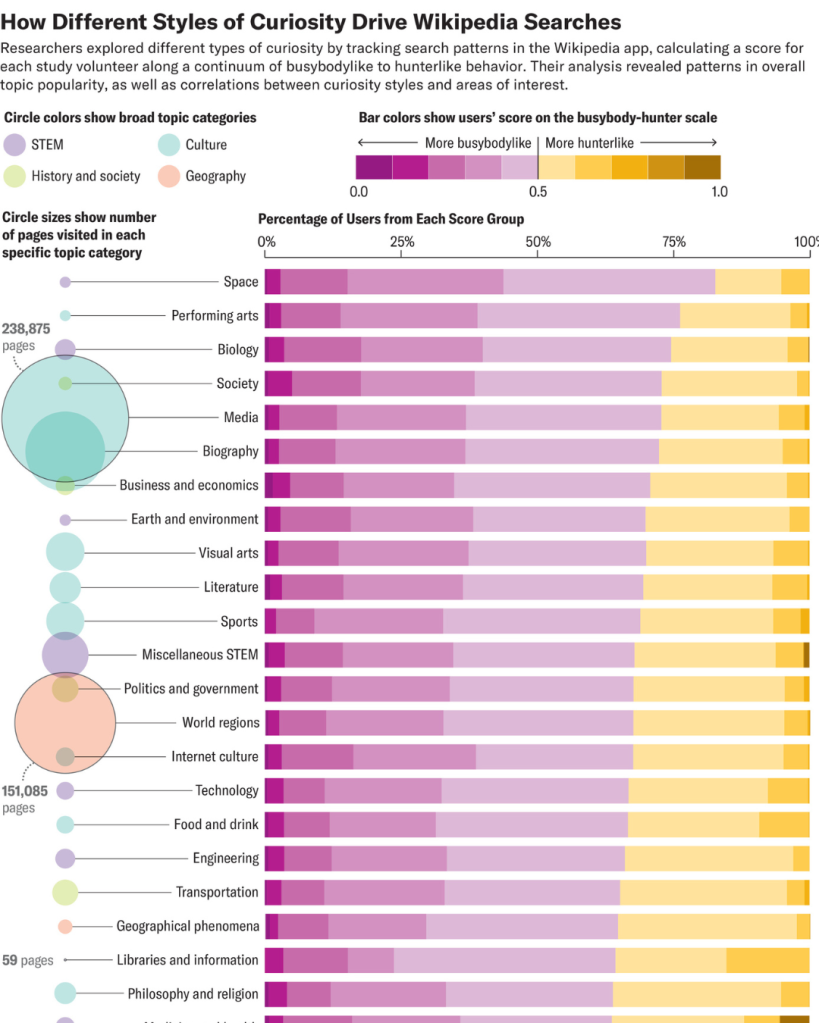
The patterns were clear as three groups emerged. In one, readers formed right clusters of closely related articles. Others built expansive networks covering a wide range of topics. A third group made creative leaps, linking distant knowledge in unexpected ways.
Respectively, these groups formed the basis for Zurn and Bassett’s curiosity archetypes: Hunters, Busybodies, and Dancers.
Curiosity and mental health: the Hunter’s paradox
The study revealed a surprising link between curiosity styles and mental health. Participants who browsed Wikipedia in a focused, goal-oriented manner—the Hunters—reported higher levels of depression and anxiety compared to those who browsed more freely.
This finding is consistent with Kashdan’s research on deprivation curiosity. To assuage the uncomfortable feeling of not knowing, the search itself can become stressful. The relief from finding the answer doesn’t bring joy. It just eases the tension.
Conversely, the exploratory nature associated with the other two curiosity styles—the Dancer and the Busybody—can have a protective effect. With these styles, curiosity stems from genuine interest and a sense of wonder, allowing them to engage in a discovery process that feels positive, open, and less pressured.
By focusing less on outcomes and more on the process, we may find ourselves embracing the possibility of unexpected results.
How to cultivate your curiosity
Your curiosity style isn’t set in stone. Zurn explains that curiosity is a practice. We can learn to strengthen different styles, as we see fit.
For Hunters looking to expand their horizons, set aside time for aimless exploration. While researching your next project, allow yourself to click on an unexpected link—even just one. No matter how trivial or off-topic it may look, see where it takes you.
For the curious but scattered Busybodies, experiment with the “three-click” rule. When you start reading something interesting, commit to exploring at least three related articles before moving on to a new topic. This will build a deeper understanding of specific areas.
For aspiring Dancers, search for connections between incongruent fields. Ask yourself, “How is this similar to something unrelated that I know?” Push past the obvious answers. Allow space for weird, strange, and offbeat ties and relationships to come forward. You could start with “Connections,” a game by The New York Times.

Remember, all three styles of curiosity serve different purposes. As Bassett emphasizes, each plays an important role. Hunters are society’s experts, people who have mastered a domain and can solve hyper-specific problems. Busybodies fuel the engines of serendipity, amassing a wide range of knowledge that can lead to unexpected insights and creative reframing. Dancers are our original thinkers and innovators, breaking patterns and discovering new, unexplored intellectual terrain.
With great mental flexibility, one can use all three styles and switch between them as needed.
Your curiosity matters
Understanding your curiosity style is more than an intellectual exercise. It’s deeply personal. The way you seek and connect information shapes how you learn. It impacts your mental health. Curiosity lies at the foundation of making connections: between ideas, people, and the inner and outer worlds we’re always trying to make sense of.
The next time you find yourself deep in a rabbit hole, reflect on the path you took to get there. Are you searching for clear answers? Collecting ideas as they pique your interest? Or are you exploring the connections between nonlinear subjects?
Keep going. Your curiosity is worth cultivating.