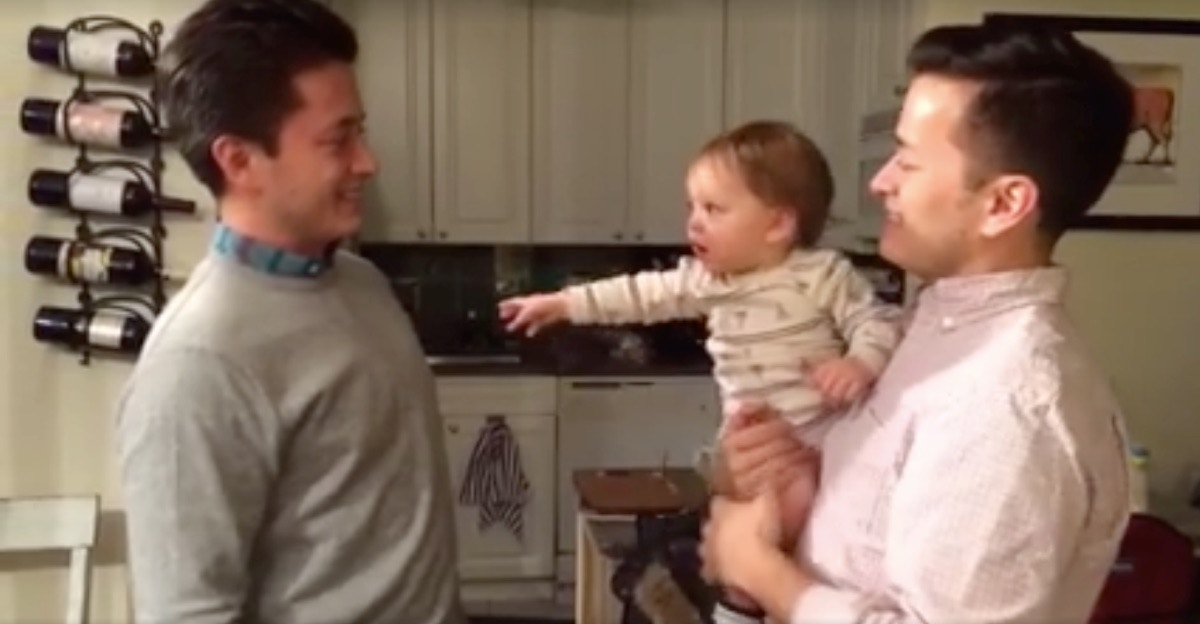
Adult twins interacting with babies is pretty hilarious.
I know firsthand because I am a dad and a twin. On my list of regrets as a dad, I’ll place “not rolling video when our babies interacted with me and my identical twin” near the top of the list.
Thankfully, a dad shot some footage of his young son meeting his twin, and our lives are better because of it.
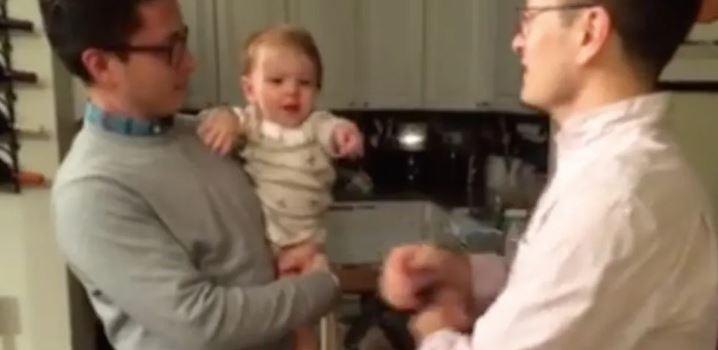
Stephen, Reed, and Stephen's twin, Michael. Images from <a href="https://www.facebook.com/ratpo/videos/vb.4400226/10100117476767455/?type=2&theater">Stephen Ratpojanakul's Facebook page</a>.
Stephen Ratpojanakul (he’s in the sweater … I think) is a dad to a baby boy named Reed. Stephen also has a twin brother named Michael. When baby Reed got confused figuring out who was who, I almost expected this dude to make a cameo appearance:
First, they both wore glasses.

Which is which? YouTube<a href="https://www.youtube.com/watch?v=y2004Xaz2HU">https://www.youtube.com/watch?v=y2004Xaz2HU</a>
Finally, they took the glasses off. Baby Reed returned to the previous station.
True story: Parenting will crush you if you don’t bring your sense of humor along.
Parents know how mentally and physically exhausting the job can be. It’s also a job where many of us spend an inordinate amount of time second-guessing ourselves for the decisions we make.
The immense power of laughter is a great way to relax, boost our immune systems, and relieve stress. Sometimes, we laugh to keep from crying. And other times, we just laugh because our kids are absolutely hilarious.
Judging by the laughter and giggles, it’s easy to tell that the twins truly love this little boy — and it’s heartwarming to see all three of them enjoying some good times together.
All it takes is a smile for parents to know “you’ve got this.”
The video is going viral — and don’t be surprised if this becomes a twin trend.
With almost 34 twins per 1,000 live births in the U.S. today, there are more genetic lookalikes in the U.S. than ever before. Be warned, tiny babies — somewhere there are some adult twins plotting to have some innocent fun at your expense.
Without further ado, here’s the video:
– YouTube
This article was written by Doyin Richards andoriginally appeared nine years ago.

In March 2023, after months of preparation and paperwork, Anita Omary arrived in the United States from her native Afghanistan to build a better life. Once she arrived in Connecticut, however, the experience was anything but easy.
“When I first arrived, everything felt so strange—the weather, the environment, the people,” Omary recalled. Omary had not only left behind her extended family and friends in Afghanistan, she left her career managing child protective cases and supporting refugee communities behind as well. Even more challenging, Anita was five months pregnant at the time, and because her husband was unable to obtain a travel visa, she found herself having to navigate a new language, a different culture, and an unfamiliar country entirely on her own.
“I went through a period of deep disappointment and depression, where I wasn’t able to do much for myself,” Omary said.
Then something incredible happened: Omary met a woman who would become her close friend, offering support that would change her experience as a refugee—and ultimately the trajectory of her entire life.
Understanding the journey
Like Anita Omary, tens of thousands of people come to the United States each year seeking safety from war, political violence, religious persecution, and other threats. Yet escaping danger, unfortunately, is only the first challenge. Once here, immigrant and refugee families must deal with the loss of displacement, while at the same time facing language barriers, adapting to a new culture, and sometimes even facing social stigma and anti-immigrant biases.
Welcoming immigrant and refugee neighbors strengthens the nation and benefits everyone—and according to Anita Omary, small, simple acts of human kindness can make the greatest difference in helping them feel safe, valued, and truly at home.
A warm welcome
Dee and Omary's son, Osman
Anita Omary was receiving prenatal checkups at a woman’s health center in West Haven when she met Dee, a nurse.
“She immediately recognized that I was new, and that I was struggling,” Omary said. “From that moment on, she became my support system.”
Dee started checking in on Omary throughout her pregnancy, both inside the clinic and out.
“She would call me and ask am I okay, am I eating, am I healthy,” Omary said. “She helped me with things I didn’t even realize I needed, like getting an air conditioner for my small, hot room.”
Soon, Dee was helping Omary apply for jobs and taking her on driving lessons every weekend. With her help, Omary landed a job, passed her road test on the first attempt, and even enrolled at the University of New Haven to pursue her master’s degree. Dee and Omary became like family. After Omary’s son, Osman, was born, Dee spent five days in the hospital at her side, bringing her halal food and brushing her hair in the same way Omary’s mother used to. When Omary’s postpartum pain became too great for her to lift Osman’s car seat, Dee accompanied her to his doctor’s appointments and carried the baby for her.
“Her support truly changed my life,” Omary said. “Her motivation, compassion, and support gave me hope. It gave me a sense of stability and confidence. I didn’t feel alone, because of her.”
More than that, the experience gave Omary a new resolve to help other people.
“That experience has deeply shaped the way I give back,” she said. “I want to be that source of encouragement and support for others that my friend was for me.”
Extending the welcome
Omary and Dee at the Martin Luther King, Jr. Vision Awards ceremony at the University of New Haven.
Omary is now flourishing. She currently works as a career development specialist as she continues her Master’s degree. She also, as a member of the Refugee Storytellers Collective, helps advocate for refugee and immigrant families by connecting them with resources—and teaches local communities how to best welcome newcomers.
“Welcoming new families today has many challenges,” Omary said. “One major barrier is access to English classes. Many newcomers, especially those who have just arrived, often put their names on long wait lists and for months there are no available spots.” For women with children, the lack of available childcare makes attending English classes, or working outside the home, especially difficult.
Omary stresses that sometimes small, everyday acts of kindness can make the biggest difference to immigrant and refugee families.
“Welcome is not about big gestures, but about small, consistent acts of care that remind you that you belong,” Omary said. Receiving a compliment on her dress or her son from a stranger in the grocery store was incredibly uplifting during her early days as a newcomer, and Omary remembers how even the smallest gestures of kindness gave her hope that she could thrive and build a new life here.
“I built my new life, but I didn’t do it alone,” Omary said. “Community and kindness were my greatest strengths.”
Are you in? Click here to join the Refugee Advocacy Lab and sign the #WeWillWelcome pledge and complete one small act of welcome in your community. Together, with small, meaningful steps, we can build communities where everyone feels safe.
This article is part of Upworthy’s “The Threads Between U.S.” series that highlights what we have in common thanks to the generous support from the Levi Strauss Foundation, whose grantmaking is committed to creating a culture of belonging.
What happened in the next few minutes is almost impossible to read without holding your breath.
Emma sprinted downstairs barefoot and found her boys trapped in the playroom, surrounded by flames. She threw herself over them, took the fire on her own back, and shoved them out the front door. Then she locked it behind her from the inside, so they couldn’t follow her back in, per Goalcast.
The staircase was already burning. With every step she climbed, the heat was eating through her feet. “For each step I thought that ‘this is not possible,’” she later recalled, “but then I thought that it must go for four of my children who are still up there. It was so hot that the soles of the feet start to drop from the feet. They just hang like threads.”
Upstairs, her 9-year-old daughter Nellie had already jumped from the balcony to get help. Her 11-year-old son William had found a ladder and was helping his siblings down. Emma fought through the smoke to reach the last room, where she found her baby daughter Mollie standing in her crib, terrified and crying. Emma had assumed Mollie might not still be alive. “I was so terribly tired but could see through the smoke how Mollie stood there in her crib and cried and was terrified,” she said, per Bright Vibes. “Then I suddenly got such an enormous force and managed to get to my feet and lift her up.”
All six children got out without serious injury. Emma did not.
By the time she collapsed outside, burns covered 93% of her body. Doctors put her on a ventilator, where she remained for three weeks, hovering between life and death. Medical staff noted that it is uncommon for people to survive even 90% burns. She endured more than 20 surgeries and months of rehabilitation. When she finally came out of unconsciousness, her first words were not about her own pain or her skin or the surgeries ahead. She asked: “Are my children alive?”
According to EuroWeekly News, when asked later why she kept going back in, she didn’t describe it as heroism. “If I gave birth to six children,” she told reporters, “I will get all six out.”
Recovery was long and uneven in ways that went beyond the physical. After six weeks in hospital, the children came to visit. Her youngest, Mollie, didn’t recognize her. “She did not want to come to me,” Emma said. “Which I can understand with all appliances and hoses. I looked completely different.” That moment, she has said, was one of the hardest parts of the entire ordeal.
In December 2020, Sweden honored her at the Svenska Hjältar Gala, a nationally televised awards ceremony, where she was named Lifesaver of the Year. Her eldest son William addressed the audience and moved the room to tears: “Sometimes I think I will never see Mum again. But now we see Mum almost every day and that makes me happy.”
Six years on, Emma is living back in Edsbyn in a rebuilt home with her family. She has written a memoir about the fire and its aftermath, titled “I Carry My Scars with Pride” (published in Swedish in 2022 with journalist Frida Funemyr), and has taken up marathon running. She has spoken publicly about her recovery to help others who face severe trauma, and her message has stayed consistent throughout. “I feel an enormous gratitude for every day we get to be together as a family,” she told the Svenska Hjältar audience.
About a decade ago, the first classes for dads who wanted to learn to braid their daughters’ hair began to pop up in the mainstream. Traditionally, in many households, moms have been the default hair-doers. After all, they’re the experts with a lifetime of experience styling and braiding their own hair or practicing on their friends.
But this setup was problematic for a few reasons. For starters, as the modern generation of dads began wanting to get more hands-on with childcare responsibilities, many of them found they were hopelessly lost when it came to the morning hair routine. Classes began to pop up all over the country offering practical training for dads who wanted to learn the basic rope braid or French braid.
Over the years, these courses have only grown more popular. Now, the movement is about so much more than the physical task of styling hair, or even rebelling against old-fashioned, restrictive ideas of masculinity.
One group of dads recently experienced this firsthand after attending a “Pints and Ponytails” event.
More and more dads have been learning to braid hair over the last decade or so. Photo credit: Canva
Mathew Carter and Lawrence Price, who run the popular podcast Secret Life of Dads, set up the event with instructors from Braid Maidens. They filled out the guest list with their network of fellow dads and supplied beers and mannequins for all.
The guys had a terrific time. They quickly mastered the practical skills they needed to dive headfirst into the morning and nighttime routines with their daughters. In an Instagram post sharing the experience, Carter and Price wrote that in the course of just a few hours they went from “barely being able to do a ponytail to [perfecting] the Elsa by the end of the class.”
Elsa, of Frozen fame, is legendary for her signature Dutch braid that many little girls want to emulate.
After the dads went home and began implementing their newfound skills, they realized that the event was so much more than a “cute” dismissal of old-fashioned masculinity.
For starters, dads getting involved in doing girls’ hair takes an enormous load off mom’s shoulders. In households with multiple girls, a mom can spend hours getting everyone’s hair just so. Often, kids demand specific styles, but moms also know that sending their girls off to school with messy bedhead will (unfairly) reflect poorly on them socially. There’s a lot of pressure tied to this daily task. Having a tag-team partner to pitch in is incredibly valuable.
One attendee wrote that it was “wonderful to meet so many fellow girl dads who wanted to share more of the unpaid emotional labour at home.”
Even more importantly, the dads say that after the event, doing their daughters’ hair revealed incredible moments they never even knew they were missing out on.
“What’s going on in that room is something much deeper,” Carter and Price wrote in a follow-up post over footage of the men practicing on mannequins. “Learning to braid my daughter’s hair changed what is often seen as just a task … into a moment of connection. That’s when she gets to tell me about her day. That’s when she shares with me things that are happening in her life. And it’s a time that happens at the beginning of each day that I just get to be with her and listen and ask questions and connect. And that has opened the aperture of love between me and my daughter.”
Even modern, hands-on, engaged, and well-meaning fathers sometimes have difficulty connecting with their daughters as they get older.
There are many reasons for this phenomenon. It’s well-studied and was recently documented in The Atlantic article, “The Father-Daughter Divide.”
Meanwhile, Kimberley Benton of Oak City Psychology wrote, “Many men have difficulty connecting with their children on an emotional level because their dads didn’t know how. It’s no ones fault, we just aren’t very good at teaching men about connecting with others.”
Providing, supporting, and being physically present in our kids’ lives is only part of the equation. Being emotionally present requires carving out quiet one-on-one time where discussion can flow freely and honestly. Kids need to feel they have the time and space to open up—something that only gets more difficult for them as they become teenagers.
Many dads never realize that those crucial minutes spent sitting together and styling hair are the perfect opportunity to connect. If you can get good enough to make your daughter look just like Elsa, that’s gravy.
Many parents are taught or conditioned to fear their children’s teenage years. It’s the season of life when your sweet angel turns into a moody rebel with an attitude problem, or so say the parents who came before us and lived to tell the tale.
Mom Jacqueline Skirvin was no different. For years, she had taken pride in having a close, loving, healthy relationship with her daughter, Preslea. But other parents in her orbit kept warning her that would all change. “Just wait,” they would say.
In a recent Instagram post, Skirvin shared the hard-fought results of all that waiting. She revealed five things that truly surprised her when those teenage years finally came:
“I waited for attitude. Instead, I get car rides where she tells me everything.”
“I waited for walls. Instead, I get to know her best friend’s life almost as well as I know hers.”
“I waited for distance. Instead, I’m the first person she facetimes when something really good happens.”
“I waited for rebellion. Instead, I get to watch her fall too hard, too fast… and hold her when it doesn’t last.”
“I waited for drama. Instead, I became the call when the group chat turns mean and she needs to feel safe.”
“It’s not perfect,” Skirvin admits in the caption of her post, but those bright slivers of connection let her know she still has a good relationship with her daughter through all the ups and downs.
The post struck a huge chord with fellow parents of teenagers
Some found hope in Skirvin’s optimistic message, while others lamented that they hadn’t been so lucky in their own families. In the end, the discussion was full of terrific advice.
Several commenters were thrilled to help bust the myth that parenting a teenager inherently has to be a nightmare:
“My DREAM. My daughter is so cool I can’t wait to know her at every stage of her life.”
“Teenagers aren’t hard to love at all, if you give them the foundations they need to fly. They’re actually very cool people”
Others were convinced that dreading teenagehood has become a self-fulfilling prophecy:
“We need MOREEEE of this energy for us girl moms!!! I have two daughters who are toddlers right now, and I am constantly told how horrible they will be as teenagers. It’s makes me so sad.”
Some cautioned that, yes, being the parent of a teenager can be beautiful, but we shouldn’t gloss over the hard parts:
“My eldest is 15 and youngest 13. I [get] this too BUT im also the one who gets the sharp edge of her tongue initially when shes overwhelmed and cant manage her emotions, I get the look before I get the hugs and details… I get both sides whilst she figures out her head and her heart. on balance im honoured to be trusted with both sides, the good, the bad and the ugly as I am the safety net where love without boundaries exist”
Raising a teenager has its ups and downs. Photo credit: Canva
To the parents in the comments struggling through a difficult relationship with their teens, the overwhelming response was, poetically, “Just wait.”
“She will come around. She will have to grow up first but in time. It is so hard.”
“I’m 32 and a mom of 2 and I have never been closer to my Mom. There is still time”
Experts admit that living with teenagers can be a humongous challenge
But they say a few things that can help are drawing strong boundaries about how you’ll be treated (not tolerating disrespect, insults, etc.) and giving your child plenty of space to work through their complex emotional responses and develop their own identity, which often involves at least a small amount of healthy rebellion.
The key to Skirvin’s story is not that she forced connection and closeness with her teenage daughter, but rather that she stayed present enough to capture those opportunities when they presented themselves at unexpected times. For Skirvin, “waiting” for the teenage years to come was extremely good practice that served her well for the challenge ahead.
When the holidays roll around, it’s time for families to decide where they will meet to celebrate. For the most part, parents with younger kids dread packing their bags and traveling to a family member’s house where things aren’t set up for young children. You fumble around setting up the pack ‘n plays, can’t find your bottle brush, and freak out because the electrical sockets aren’t child-proof.
However, many grandparents aren’t keen on enduring the mental and physical strain of traveling at an older age. So, who’s right? Grandma Jan, founder of Grandma Camp and a TikTok influencer who shares fun ideas for grandparents and grandkids, argued that parents should pack up their kids and visit Grandma.
“Okay, so, here’s the debate: families say, ‘Grandma, why don’t you come visit us?’ But let’s be honest, Grandma’s house is where the traditions are, the cookies are, and all of the toys are,” Grandma Jan begins. “But if grandma is driving, flying, hauling all the gifts, and packing up her car to come see you, maybe it’s time to flip the script. When did it become normal for Grandma to pack up all her stuff and come see you? Should the kids pile into the car, bring all their toys, and just go visit grandma? Bring all that love and chaos to her?”
So she asked her followers: “Should grandmas be the one on the road or should families pick everything up and drive to her?” Just about everyone in the comments said that grandparents should have to travel to see their grandchildren.
“Nope. I want Christmas morning in pajamas with my family. I want my traditions. My parents and in-laws (the grandparents) got all of this how they wanted. It’s my turn now,” Maggie wrote. “Gramma is retired and now has a shit ton of time. Kids and parents have a very finite amount of time off in the holidays that they do not want to spend on the road,” Mrs. Wright added.
Some grandparents also checked in to disagree with Grandma Jan. “Why would I put that on my kids and grandkids? It’s so hard traveling with kids, not to mention expensive to fly for more than one person,” Populustultus wrote. “What a weird way to think about that. Why wouldn’t you help your kids create magic in their home? Signed a grandma,” LifestylebyKat added.
The response inspired Grandma Jan to release a follow-up video clarifying her opinion. She admits she came up with the idea after seeing older people having a hard time getting through the airport. “[I saw] older grandparents struggling their way through airports carrying their own heavy bags while managing a walker or a plane or a wheelchair, struggling through all on their own with no one to assist,” Grandma Jan said. “And as an occupational therapist, that actually broke my heart. For younger, healthier grandparents, travel can be fun, but for the older generation, it can be quite a struggle.”
Ultimately, Grandma Jan didn’t intend to put anyone out; she just wanted to have a conversation about what’s best for families as a whole. “And Grandma Camp by Grandma Jan is about having those conversations, not making rules. And at the end of the day, it’s about connection, not distance,” she concluded her video.
This article originally appeared last year. It has been updated.
You’re at the playground. Your toddler is shrieking with joy near the swings. You sit down on a bench, and another parent sits beside you. They look tired—but it’s the good kind of tired, the kind that comes from loving someone tiny and full of energy. You want to say something…but what? Should you ask how old their kid is? Or whether they’ve figured out how to get ketchup stains out of everything yet?
You say nothing, and pull out your phone instead. They do the same. Five minutes later, you leave without saying a word and feel more alone than ever.
Sound familiar? You’re not alone. A staggering 62% of new parents report feeling lonely or isolated at least some of the time, according to new research from the National Childbirth Trust (NCT). Nearly nine out of ten parents feel overwhelmed, and almost a quarter say they lack a strong support system.
Modern parenthood wasn’t meant to feel this way. For many, it does.
In response, English Heritage, the charity that manages over 400 historic sites across England, has introduced a simple, beautiful idea to help. They’re called “bonding benches.”
A bench that works for you
Here’s how it works: bonding benches are being installed at castles, abbeys, and gardens—places where families tend to gather. They’re strategically placed near playgrounds and open grasslands, as well as other spots where parents take a moment for themselves while their kids burn off energy. But these are not ordinary benches.
Each bench has a small slider that you can switch between two settings: “up for a chat” or “craving quiet.”
A young girl demonstrates the “up for a chat” function on a bonding bench. Photo credit: English Heritage
That’s it. No apps, no awkward eye contact, just a small piece of plastic that shows other parents how you’re feeling in that moment—and whether you’re open to talking.
Emma Fernandes Lopes, assistant operations director at English Heritage, explains the reasoning behind it:
“As parents, we are hardwired to prioritize our children’s wellbeing. We bring them out to wonderful places like English Heritage sites to explore the outdoors and expand their horizons. But we often forget that the key to children’s wellbeing is actually found in whether their parents feel happy and supported.”
She continues, “Modern parenthood can be a really isolating experience. Many parents live a long way away from their extended families and have no support network to lean back on, and it’s often a real challenge to make friends who hold the same values and interests.”
The benches were launched in February 2026, ahead of the United Kingdom’s half-term holidays. They are now available at popular sites including Kenilworth Castle, Bolsover Castle, Wroxeter Roman City, and Witley Court and Gardens.
Why this matters more than you realize
The statistics behind this initiative are eye-opening. The NCT’s research, which surveyed 2,000 new and expectant parents across the UK, found that 87% feel overwhelmed at least some of the time. More than one in five (23%) did not have a positive feeding experience. And 23% said they lacked a strong support system.
But what makes parental loneliness so insidious? The shame that accompanies it.
People experiencing loneliness often shame themselves for it. Photo credit: Canva
Research from the UK government’s loneliness stigma assessment found that people experiencing loneliness often feel embarrassed or worry they’ll be judged if they admit it. Parents, in particular, fear being labeled as “bad” or “inadequate” if they reach out for help. As a result, they don’t. They withdraw instead, which only deepens their feelings of isolation.
For mothers and fathers who have moved away from family, whose friends don’t have children yet, or who feel out of step with the current parenting culture around them, the loneliness can feel overwhelming.
More than just a bench
English Heritage is expanding beyond benches. The charity has partnered with the NCT to bring their popular “Walk and Talks” to selected sites—free, volunteer-led walks designed for parents with strollers, slings, and young children. These walks are taking place at Audley End, Kenwood, Marble Hill, Wrest Park, and Kenilworth Castle, with plans to add more locations.
Families can also pick up an “Adventurer’s Checklist” at any site, a free list of 25 fun activities for young children. Imagine splashing in puddles, spotting signs of animal life, and making silly sounds in echoing places. The tasks are meant to encourage interaction among families who might not usually connect.
Depending on the site, there are also playgroups, chatty cafes, and children’s crafting sessions. All are created to give parents low-pressure ways to connect.
The secret: Low-pressure connection
The genius of bonding benches lies in what they don’t do.
They don’t pressure you to start conversations. They don’t expect you to “put yourself out there”—a vague and somewhat intimidating phrase for many. Bonding benches invite parents to sit and honestly assess whether they have the energy to talk or would rather enjoy five minutes of silence while their kid digs a hole with their bare hands.
Bonding benches are low-pressure ways to connect with other parents. Photo credit: English Heritage
That simple permission matters. It’s not that adults don’t want to make friends; they do. But there’s a common fear of rejection. We dread the small talk and worry we’ll seem eager, needy, or weird.
The slider eases all that pressure. If someone sits next to you and moves their marker to “up for a chat,” they’re giving you the go-ahead. You don’t have to guess or act. Just say hi.
But if you need quiet, you can signal that too without feeling guilty or apologizing.
We were never supposed to parent by ourselves. Photo credit: English Heritage
But in the Western world, we’ve narrowed caregiving to just one or two exhausted adults. Parenting has become a private matter, yet we still wonder why parents are tired, lonely, and overwhelmed.
English Heritage’s initiative won’t fix that structural problem. But it’s a meaningful step in the right direction. It reminds parents that connection is still possible, even in small moments. It sends a message: reaching out to others doesn’t make you weak—and you’re not the only one craving closeness.
What happens next?
The bonding benches are now live, and early feedback has been positive. Parents on social media have praised them, calling the benches “brilliant,” “exactly what we need,” and “such a simple but powerful idea.”
However, the true test will be whether they can make a lasting impact, measured by parents using them, conversations taking place, and friendships forming.
Another important question: will other organizations develop their own versions of the bonding bench? If a historic charity that manages medieval castles can recognize that modern families are struggling—and take action—the hope is that others will do the same.
If you’re in England and want to find your nearest English Heritage site with a bonding bench, visit its website. If you’d like to volunteer as an NCT Walk & Talk leader, you can find out more on its website.
Next time you’re at the playground, find the bench. Feeling brave? Move that marker to “up for a chat.” You might be surprised who also slides theirs up.
Since the dawn of time, it’s been believed that parents, especially mothers, have a mysterious intuition: a deep-seated gut feeling when something is wrong with their child. Interestingly, according to a recent study out of the University of Oulu in Finland, that intuition appears to be real. Parents who believed their child had a serious illness, even before consulting a doctor, were correct 91% of the time.
To determine how accurate a parent’s assessment of their child was, administrators gave 36-item questionnaires to parents of 2,375 patients who had been admitted to Oulu University Hospital. They found that more than nine out of 10 parents of seriously ill children knew something was wrong even before taking the assessment.
Parents can determine a serious health issue with their kid 91% of the time
“Parental concern is an important warning sign,” Dr. Hilla Pöyry, a pediatrician, said in a statement. “If a parent is worried about their suddenly ill child’s condition, the child must have the opportunity to be assessed by a doctor. A worried parent should not be left alone to make a remote assessment of their child’s condition.”
Researchers believe this study is important given the increasing use of artificial intelligence and digital tools in hospitals. It affirms the idea that a parent’s intuition has value, even in a world dominated by technology.
“Our results show that such tools require careful validation, and they do not yet replace the assessment of a healthcare professional,” Pöyry added. “Although a parent may not always be able to describe the child’s symptoms in detail or accurately, they recognise a serious illness very well when asked a simple concern-based question.”
A mom and two kids at the hospital. Photo credit: Canva
Why do parents have an intuitive sense of their child’s health?
Susan Albers, a psychologist at Cleveland Clinic, said that a mother’s special bond with her child is the result of both nature and nurture. On the nature side, the two share a chemical bond: when a mother spends time with her child, oxytocin is released in the brain. On the nurture side, mothers spend thousands of hours with their child, allowing them to pick up on tiny patterns that others wouldn’t notice.
“A mother’s intuition is a very real phenomenon,” Albers said. “It is described as a gut level of awareness of what is happening with your child, whether it is what they need, what they are feeling, or if they are in danger based on no information or explanation.”
The findings should give parents confidence that when they think something isn’t right with their child, there’s a good chance they’re correct. It’s also a strong reason to seek a second opinion when a doctor may not agree with a parent’s assessment. The study gives doctors something extra to consider when a parent brings a child into the office. In short, there’s a good chance something really is wrong, even if it isn’t immediately apparent.
The final medal count for the 2026 Olympic Winter Games is in, and there’s a clear winner. Of the 29 countries to win at least one medal, Norway took home the most hardware overall with 41 medals. This included 18 gold medals, the most of any country. It’s a resounding victory over the United States, which came in second place with 33 medals.
High-performing Olympic nations are often famous (or infamous) for their aggressive training tactics. China, for example, has been said to “ruthlessly select and train competitors from an early age—with children as young as four being enlisted to train for the team.”
Nearly everyone hoping for Olympic greatness has to start training at a young age. Norway, however, takes a different approach with its youth sports culture. Instead of winning, it’s all about fun. The country does a few things differently that are counterintuitive to a hyper-competitive, gold-at-any-cost mindset.
Per CNN, “Until the age of 12 in Norway, nobody in youth sports is allowed to keep score, and there are no league standings either.”
Compare that to many American youth sports leagues, which generally begin keeping score around the age of seven. Keeping score in kids’ leagues is often a source of great controversy. Proponents argue that it teaches children sportsmanship, how to lose with grace, and how to cope with disappointment. However, critics say the emphasis on winning sucks the fun out of the sport and prematurely ratchets up pressure many kids just aren’t ready for.
No early specialization
You’d think the best path to becoming a great alpine skier would be to focus rigorously on the sport as early as possible. Coaches in Norway disagree.
Instead, they believe true talent is revealed not in early childhood but in the teen years. Kids growing up in Norway try many different sports before deciding which one they’re best suited to focus on.
Participation trophies for all
Yes, the dreaded participation trophy was once decried as the thing that made Millennials soft. But it seems to be working out OK for the Norwegians. If one kid gets a trophy in Norway, everyone gets one.
And the guidelines don’t end there. Norway isn’t big on travel leagues, preferring to keep kids in local leagues as long as possible, and it caps the cost of youth sports instead of letting them balloon out of control. The entire youth sports ecosystem is run by the government and not-for-profit organizations. Leagues also mandate equal playing time for kids at younger ages to ensure everyone has fun and gets an opportunity. It’s all summed up beautifully by the slogan, “Joy of Sport for All.”
It sounds counterintuitive, but it works for them. And 2026 was no outlier. The Norwegians often excel in the Winter Olympics and have won four straight games. They’re not too shabby in the Summer Games, either. Though the country is naturally better suited to snow sports like skiing, Norway regularly nabs top results in summer sports like weightlifting, beach volleyball, and track and field. Per capita, its performance in the Summer Games is especially impressive.
Norway’s model is not perfectly replicable in every country. The U.S., for example, features decentralized and privately run sports leagues. It would be nearly impossible to get them all to operate in the same way and discard decades of success. It’s also debatable whether we would even want to, because the U.S., it turns out, is also quite good at sports.
But it’s fascinating to watch a country operate in ways that seem almost completely antithetical to high-level competition and still achieve elite results.
Not only does Norway bring home Olympic medals, but its kids also have some of the highest sports participation rates in the world. They’re also generally fit, healthy, and extremely happy. It’s no wonder the country is considered one of the best places in the world to raise kids.
February has been a busy month for holidays in 2026. There’s not only Groundhog Day, Valentine’s Day, and Presidents’ Day, but it’s also Black History Month, and Chinese New Year, Lent, and Ramadan all coincide this month. (This is so rare that it likely won’t happen again in our lifetime!) And as a mom’s video shows, that may be causing some mix-ups for the youngest among us.
Sonny Reign shared her four-year-old’s meltdown over wanting to celebrate Ramadan, calling it “precious.” She said she wouldn’t normally record her child when she’s in distress, but this is one instance where it feels perfectly warranted. As their family is not Muslim, Reign told her daughter that she didn’t know how to celebrate Ramadan, but would look into it. However, the kiddo insisted she already knew how it was done.
Wouldn’t normally record when she’s in distress, but this was so precious. She just wants to celebrate Ramadan with her friends. Also I’m sorry, a REAL dragon? That can’t be right- somethings gone lost in the kindergarten translation right?
“We eat rice at night, and we stay up late! That’s how we celebrate Ramadan,” the girl said before adding, “And you also look at real dragons.”
Real dragons?Ramadan is the Muslim fasting period in which no food or drink is consumed between sunrise and sunset, so the eating rice at night and the staying up late parts made sense. The real dragons were a bit of a headscratcher, though.
It appears Reign’s daughter was conflating Ramadan with Chinese New Year or Lunar New Year, and adding a bit of four-year-old imagination to the mix as well. Celebrations of Chinese New Year often include dragon costumes or other dragon imagery, and, since Chinese New Year coincided with the start of Ramadan this year, the confusion is understandable.
People in the comments found the whole exchange delightful:
“No , we’re not gonna fact check her….we are now her followers and plan to eat rice at night, stay up late and look at real dragons. It has been ordained!!!”
“As a Muslim I approve her understanding of Ramadan.”
“Idk about the dragon part maybe I haven’t unlocked that level of Muslim yet.”
“As a Muslim I wanna celebrate Ramadan this way too. I’ve been doing it wrong my whole life.”
“As an Arab, I also want to eat rice at night and look at real dragons.”
“I’m a Malaysian Muslim who is fasting, with Chinese neighbours. I do, in fact, eat rice at night and stay up late to watch dragons with them. Their Chinese New Year’s fireworks are craaaaaazyyyyyyy.”
“This child is absolutely adorable she wants to celebrate Ramadan and the Chinese New Year. She has aunties worldwide.❤️”
“It’s a confusing time to be a preschooler. Black History Month, Chinese New Year, Lent, Ramadan. Plus Valentine’s Day and 100th day of school. February is busyyyy.”
“My son tried to take a day off school for Eid and we’re Catholic.”
Kudos to Mama Reign for her expert handling of the situation. It’s not always easy to respond appropriately when your child is upset. However, honoring her desire to celebrate Ramadan while also making it clear that she didn’t yet know how to do that was solid. Keeping it together when the “real dragons” came in was also some top-notch self-control.
chinese new year, first night of ramadan and mardi gras all on the day omg?
Most likely, Reign’s daughter had been learning about the various holidays and how to celebrate them at school. At four years old, trying to keep the overlapping holidays in our multicultural world straight is genuinely challenging! Still, what an adorable reminder of how far we’ve come to see one another’s cultural and religious traditions as something to celebrate.
(Especially when there are real dragons involved, of course.)