Long-acting, reversible contraception methods like IUDs have become extremely popular in the United States and beyond. Just a few decades ago, only about 2% of women relied on them. In recent years, that figure has risen to around 17%, accounting for millions of women.
The rising popularity makes sense. IUDs can be convenient, highly effective, and can even make a woman’s period far less painful or stop it altogether. There’s just one problem: getting an IUD inserted hurts. For some people, it hurts a lot.
The pain from getting an IUD can range from mild discomfort for some people to excruciating pain for others. What’s frustrating is that medical providers haven’t historically listened to patients who say the procedure is severely painful. A 2013 study found that the average patient rated the pain of insertion at 64.8 out of 100, while providers estimated it at just 35.3—a big disconnect.
For years, women struggling in the aftermath of the procedure have been told the same infuriating refrain: “Just take ibuprofen.”
Artist brings women’s frustration to life
Emily Kampa recently debuted a striking piece of artwork built around this common source of dismissed pain among women.
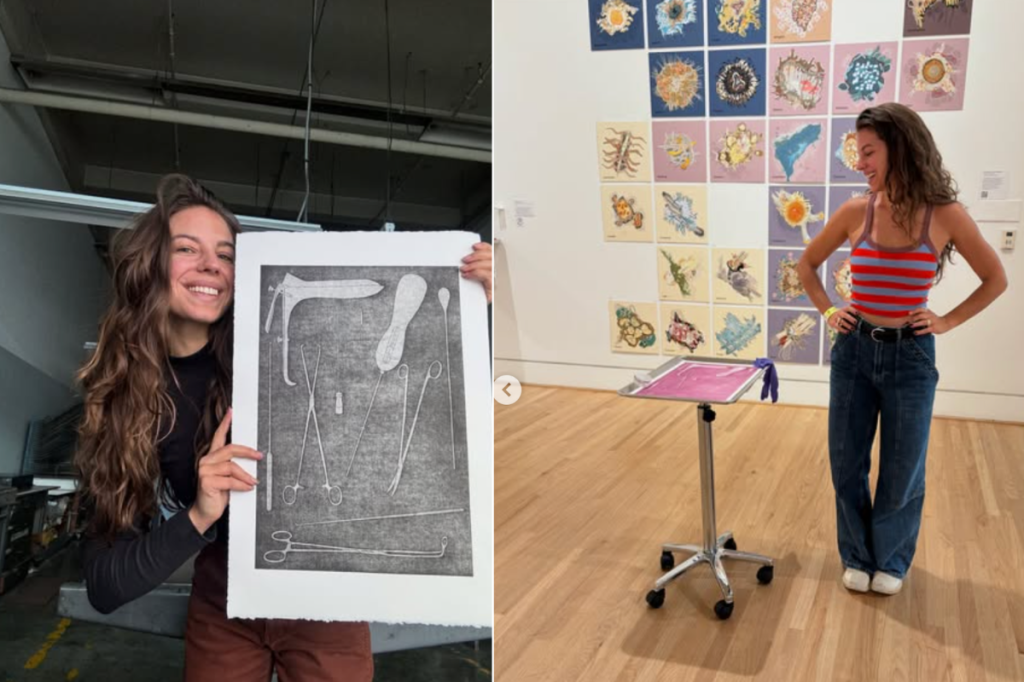
The display, aptly titled “Just Take Ibuprofen,” boldly shows the actual medical instruments used in an IUD insertion in all of their horrific glory. Kampa listed them on her Instagram:
- Speculum: 6.95” nose length
- Single toothed tenaculum: 10”
- Paracervical block (& needle): 6”
- IUD insertion tube: 11”
- MT cervix-holding clamp: 11”
- OS finder: 8”
- Cotton swab: 8”
- IUD string scissors: 9.8”
- Hook for IUD removal: 10”
- IUD: 1.25”
After hours of research and planning, Kampa etched the instruments onto a copper plate, each one rendered life-size.
For the in-person installation at the Triton Museum of Art, Kampa placed the display on a real medical cart, with a surgical glove loosely dangling off the corner.
She wrote that she wanted viewers to experience the tools the same way she did when she first saw them at her OB-GYN’s office.
“‘Wait why are there scissors? Why is that q-tip SO large?!’” she recalled thinking. “That image stuck with me long after my own IUD experience and was the spark for this project.”
The art evokes a visceral reaction in viewers. It’s hard not to feel that taking a few Advil is a woefully inadequate response to the pain caused by these long, sharp instruments.
Artwork goes viral
Photos of the display have been posted and reposted across social media, racking up thousands of likes and comments wherever they appear. Many women flocked directly to Kampa’s Instagram account to thank her for speaking out through her art:
“Thank you for this because I thought I was over reacting when I got physically sick. I [was] literally on the verge of vomiting and passing out. Cramps for days.”
“I never connected to an image so much in my life. … For the first two years (and still for a few days every month), felt like I had barbed wire inside me. I went to the doc after the first two weeks of pain and the nurses there said … the pain was normal for the first year.”
“Ibuprofen my a**! Too many of us have been gaslit, dismissed, ignored, traumatized, and even killed by medical professionals. Thank you for capturing this all-too-true experience and sharing your process”
“My cervix is shuddering. This is ART from experience”
Conversations like this spark needed change
Art has the power to elevate messages in unique and memorable ways. Thanks to women and artists like Kampa who have spoken out over the years, the culture of IUD pain management is steadily changing for the better.
In 2024, the Centers for Disease Control and Prevention updated its guidelines for IUD pain management to include local anesthetics and pre-procedure counseling.
A year later, the American College of Obstetricians and Gynecologists (ACOG) followed suit and released updated guidance on pain management for procedures like IUD insertions.
“Systemic racism and bias as to how pain is experienced and who experiences it also has, unfortunately, influenced pain management considerations,” said Dr. Christopher M. Zahn, chief of clinical practice and health equity and quality at ACOG.
The new guidance recommends local anesthetics for the procedure, as well as “comprehensive pain management counseling” for patients, including offering the option of sedation or general anesthesia when possible.
These are big and necessary steps forward. Perhaps the most powerful part of this shifting conversation and culture, however, is that more women are being heard and their pain is finally being taken seriously.