
No one wants to be unhappy or unhealthy at any age. But as we get older, health and happiness arguably play an outsized role in our quality of life. Sketchy health habits we may have gotten away with when we were younger catch up to us later in life. And what once made us feel happy may no longer be an option as we age.
So how do we stay both happy and healthy throughout our lives?
Dr. Arthur C. Brooks, a social scientist at Harvard University and a leading researcher on happiness, has studied this question. Thanks largely to the 85-year-long Harvard Study of Adult Development, the longest-running study on happiness, we can better understand which qualities and habits are associated with being both happy and healthy as people age.
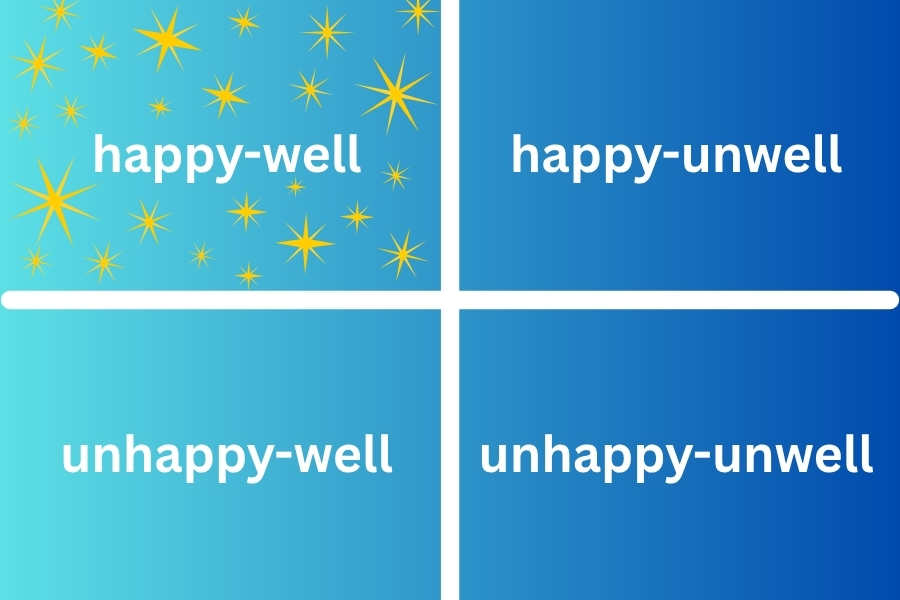
Measuring health and happiness basically separates people into four quadrants. In an interview with Dr. Rhonda Patrick, Brooks shared that people who fall into the happy-healthy (or happy-well) quadrant tend to share seven habits in common.
The 4 physical habits behind happiness
The first four have to do with our physical health and are ones that most of us might guess.
“Diet, exercise, smoking, and drinking,” Brooks said, adding that happy-well people are “very moderate” when it comes to substance use. “None of them were addicts, or if they had trouble with it, they quit,” he said.
Brooks shared that he smoked into his 20s and, even then, knew it was stupid. “But I still think about it every day,” he said. “I do. I love nicotine. I got addicted to it when I was 13 and quit when I was 26. And it was a relationship for me, right? But the whole point is no, because lifelong smokers have a 7 in 10 chance of dying from a smoking-related illness, and that is an unhappy way to go. You’re not going to be healthy and you’re not going to be happy dying of emphysema.”
As far as diet goes, Brooks said the happy-healthy people eat a “normal, healthy” diet. And for exercise, it’s really about moderation and the obvious things like walking and staying active.
“If you don’t exercise at all, you’re not happy and well,” he said. “And if you’re an exercise maniac, you actually will do some mechanical ill to your body, but actually you’re probably not happy and some compensation is going on.”
The 3 psychological habits that matter
The other three habits aren’t quite as obvious.
“No. 1 is continuing to learn,” Brooks said. “And people who are life-long learners, they are healthier and they are happier. That’s usually a lot of reading, but curiosity is how that comes about. It’s just really really important.”
The next is having a technique for dealing with setbacks.
“You’ve got to get good at it,” he said. “You need skill at dealing with life’s problems. And if you don’t get good at it, you’re going to be bad when things actually crop up. And so maybe you’re good at therapy. Maybe you’re good at prayer, maybe you’re good at meditation. Maybe you’re really good at journaling. But all the happy and well people have their way to deal with it and they’re highly skilled in doing it.”
And the seventh habit, which Brooks calls “the biggie,” is simply love. “People who have the best lives, who are happy and well when they’re older, they have a strong marriage and/or close friendships,” he said. “That’s it. There’s no substitute for love. Happiness is love, full stop.”
Brooks shared other thoughts about the value in boredom and the pitfalls of social comparison in this segment, but the whole interview is filled with fascinating insights into what makes people happy and healthy.
You can watch the full Found My Fitness episode featuring Dr. Arthur C. Brooks here:
None of this is really that complicated
At the end of the day, Brooks’ research doesn’t point to some secret formula. It points to moderation, curiosity, resilience, and love, four things that sound almost too simple to matter, until you notice how few people actually manage all four consistently over a lifetime. Nobody’s suggesting perfection. The happy, healthy people in this study weren’t flawless. They just quit the things that were quietly killing them, stayed curious, got good at coping when life got hard, and let the people they loved matter more than almost anything else.
That’s really the whole takeaway. You don’t need a radical life overhaul to end up happy and well at 80. You need to start moving in that direction now, one moderate, curious, connected day at a time.
This article originally appeared in April. It has been updated.