Who doesn’t love a good brain teaser? A teacher and content creator in India named Raviraj Master likes to challenge his students with all kinds of riddles, puzzles, and logic problems. His goal? To push their critical thinking skills. He shares the challenges on YouTube, where they rack up millions of views from people who love to put their brains to the test.
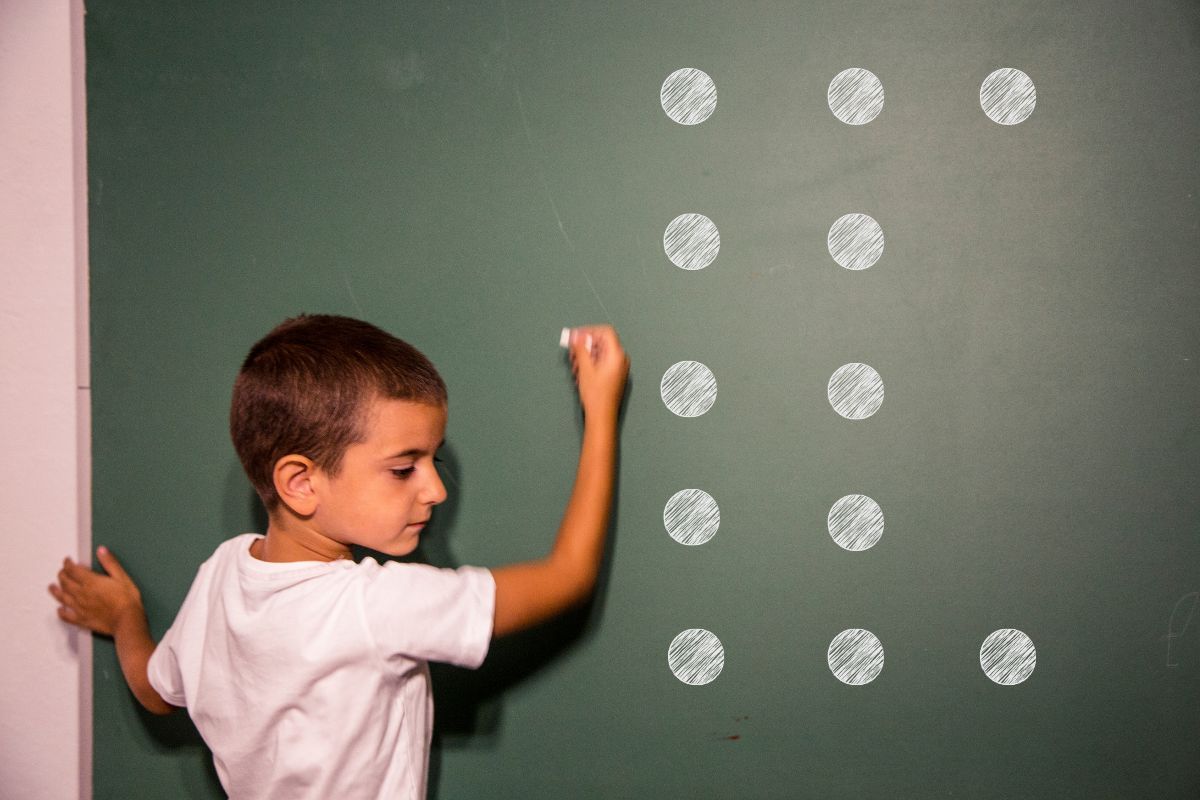
In one recent video, the challenge was simple: Students were handed a piece of chalk and asked to connect 12 dots on a chalkboard with a single unbroken line.
The layout of the dots, however, proved to be a problem for many. While almost every student could connect 11 dots, that stubborn 12th dot always seemed impossible to reach.
That is, until one student figured out the secret and solved the puzzle.
Students combat rules vs perceived limitations
We don’t know the exact wording of the instructions the students received, but from context we can understand the rules of the game. Many of us have tried similar brain teasers in the past.
Diagonal lines are not allowed. The line must not break or curve and must go from one dot to the next, without touching any dot twice.
However, the final student in the video makes a stunning realization: There’s no rule that says that the two dots on the top and bottom of the puzzle—quite far away from each other—can’t be connected.
It’s implied because of their distance from each other, but connecting them doesn’t violate any of the explicit rules of the game. So the successful student, realizing this, takes a completely different approach than the others.
This is what allows him to become the only one in class to solve the puzzle.

The puzzle demonstrates the concept of ‘functional fixedness’
It’s extremely easy for people to get locked into seeing things in only one way. The most obvious example is in the everyday objects we encounter.
For example, we might spend time searching for a screwdriver, not realizing that the dime in our pocket is the perfect size to tighten a screw. Or more broadly, we might struggle to see any other way of going about our daily routine until someone explains a better way. It’s a concept known as functional fixedness in psychology.
Learning to defeat functional fixedness is massively important in how we go about solving problems and how we flex our creativity. When we get stuck in believing there is only one way to do things, or we buy into perceived limitations that don’t actually exist, we hinder our brain’s full power.
These kids will benefit greatly from learning these lessons at such a young age. Some of the history lessons and science facts may fade away, but learning how to think critically, solve problems in unique ways, and use their creativity to solve seemingly unsolvable problems is a lesson that will stick with them forever.