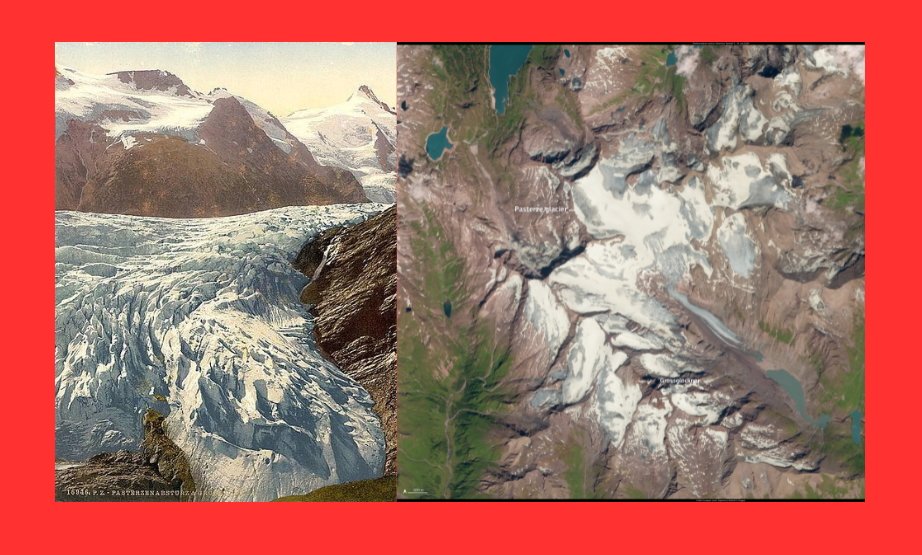
The Pasterze Glacier in a 1900 postcard and in March 2025 – Photo credit: Credit: Wikicommons and Credit: European Union, Copernicus Sentinel-2 imagery
125 years ago, the Pasterze glacier in the Austria’s Eastern Alps was postcard perfect: Snowy peaks. Windswept valleys. Ruddy-cheeked mountain children in lederhosen playing “Edelweiss” on the flugelhorn.
But a lot has changed since 1900. Much of it has changed for the better. We’ve eradicated smallpox, Hitler is dead, and the song “Billie Jean” exists now. On the downside, the Earth has gotten hotter. A lot hotter. From June 2023 to May 2024 each month was the hottest ever recorded in the planet’s history. July 2023 was the planet’s hottest month — ever. Unsurprisingly, man-made climate change has wreaked havoc on the planet’s glaciers — including the Pasterze, which is Austria’s largest. Just how much havoc are we talking about? Well, this is how the Pasterze Glacier looked in a 1900 postcard:
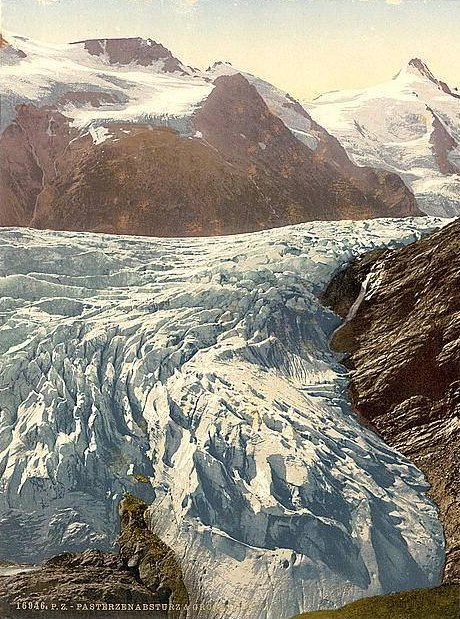
The Pasterze Glacier in a 1900 postcard Image via Wikicommons
And this is how it looks now in March 2025:
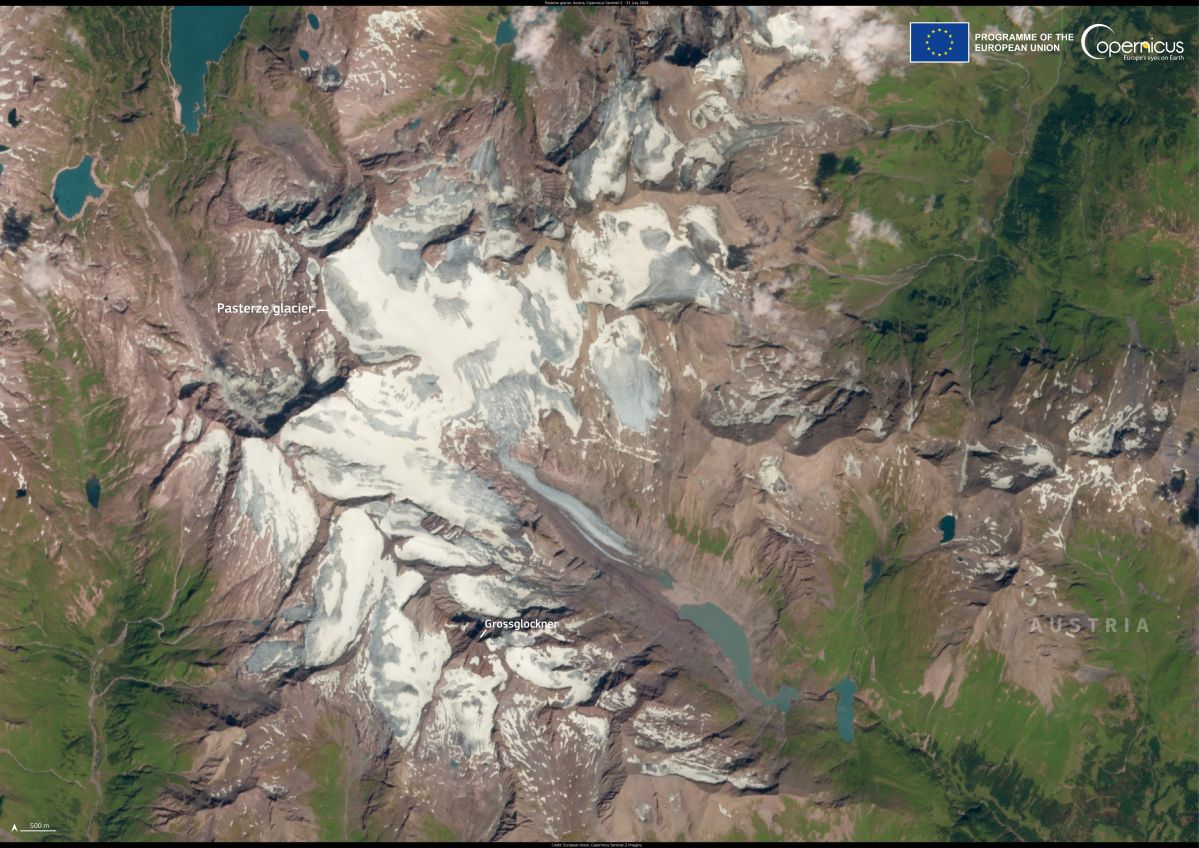
What's left of the Pasterze Glacier European Union, Copernicus Sentinel-2u00a0imagery
First measured in 1851, the glacier lost half of its mass between that year and 2008. A marker placed in 1985 shows where the edge of the glacier reached just 40 years ago. You can still see the ice sheet, but just barely, way off in the distance. In between is … a big, muddy lake. The view from the glacial foot marker from 1995 — 10 years later — isn’t much more encouraging. Even in just one year, 2015, the glacier lost an astounding amount of mass — 177 feet, by some estimates.
Overall, it is estimated that the glacier has retracted by 980 feet since the park first opened in 1963.
Ice continues to melt daily, and while the dripping makes for a good photo, it’s unfortunate news for planet Earth. Glacial melting is one of the three primary causes of sea-level rise. Pasterze is still technically the largest glacier in Austria and the Eastern Alps at approximately 6.2 miles. And even in its reduced form, Pasterze remains a significant tourist destination.
According to a European Environment Agency report, the average temperature in the Alps has increased 2 degrees Celsius in the last 100 years — double the global average. It’s not unreasonable to assume that that’s why this mountain hut has been abandoned by the flugelhorn-playing children who once probably lived in it.
Is there anything we can do to stop the Pasterze Glacier from disappearing?
There are efforts underway to save Pasterze and other significant glaciers. However, Gerhard Lieb, the co-leader of the Austrian Alpine Club described the glacier’s retreat as “unstoppable” with predictions that it and Austraia’s other major glaciers will be gone in as little as 45 years. It would take decades of meaningful counter climate change initiatives, with even the existing ones being too slow for meaningful action, “and the time is up,” Lieb said. “That means nothing can be done anymore.”
This article originally appeared 10 years ago. It has been updated with new information.

In a small village in Pwani, a district on Tanzania’s coast, a massive dance party is coming to a close. For the past two hours, locals have paraded through the village streets, singing and beating ngombe drums; now, in a large clearing, a woman named Sheilla motions for everyone to sit facing a large projector screen. A film premiere is about to begin.
It’s an unusual way to kick off a film about gender bias, inequality, early marriage, and other barriers that prevent girls from accessing education in Tanzania. But in Pwani and beyond, local organizations supported by Malala Fund and funded by Pura are finding creative, culturally relevant ways like this one to capture people’s interest.
The film ends and Sheilla, the Communications and Partnership Lead for Media for Development and Advocacy (MEDEA), stands in front of the crowd once again, asking the audience to reflect: What did you think about the film? How did it relate to your own experience? What can we learn?
Sheilla explains that, once the community sees the film, “It brings out conversations within themselves, reflective conversations.” The resonance and immediate action create a ripple effect of change.
MEDEA Screening Audience in Tanzania. Captured by James Roh for Pura
Across Tanzania, gender-based violence often forces adolescent girls out of the classroom. This and other barriers — including child marriage, poverty, conflict, and discrimination — prevent girls from completing their education around the world.
Sheilla and her team are using film and radio programs to address the challenges girls face in their communities. MEDEA’s ultimate goal is to affirm education as a fundamental right for everyone, and to ensure that every member of a community understands how girls’ education contributes to a stronger whole and how to be an ally for their sisters, daughters, granddaughters, friends, nieces, and girlfriends.
Sheilla’s story is one of many that inspired Heart on Fire, a new fragrance from the Pura x Malala Fund Collection that blends the warm, earthy spices of Tanzania with a playful, joyful twist. Here’s how Pura is using scent as a tool to connect the world and inspire action.
A partnership focused on local impact, on a global mission
Pura, a fragrance company that recognizes education as both freedom and a human right, has partnered with Malala Fund since 2022. In order to defend every girl’s right to access and complete 12 years of education, Malala Fund partners with local organizations in countries where the educational barriers are the greatest. They invest in locally-led solutions because they know that those who are closest to the problems are best equipped to solve and build durable solutions, like MEDEA, which works with communities to challenge discrimination against girls and change beliefs about their education.
But local initiatives can thrive and scale more powerfully with global support, which is why Pura is using their own superpower, the power of scent, to connect people around the world with the women and girls in these local communities.
The Pura x Malala Fund Collection incorporates ingredients naturally found in Tanzania, Nigeria, Pakistan, and Brazil: countries where Malala Fund operates to address systemic education barriers. Eight percent of net revenue from the Pura x Malala Fund Collection will be donated to Malala Fund directly, but beyond financial support, the Collection is also a love letter to each unique community, blending notes like lemon, jasmine, cedarwood, and clove to transport people, ignite their senses, and help them draw inspiration and hope from the global movement for girls’ education. Through scent, people can connect to the courage, joy, and tenacity of girls and local leaders, all while uniting in a shared commitment to education: the belief that supporting girls’ rights in one community benefits all of us, everywhere.
You’ve already met Sheilla. Now see how Naiara and Mama Habiba are building unique solutions to ensure every girl can learn freely and dare to dream.
Naiara Leite is reimagining what’s possible in Brazil
Julia with Odara in Brazil. Captured by Luisa Dorr for Pura
In Brazil, where pear trees and coconut plantations cover the Northeastern Coast, girls like ten-year-old Julia experience a different kind of educational barrier than girls in Tanzania. Too often, racial discrimination contributes to high dropout rates among Black, quilombola and Indigenous girls in the country.
“In the logic of Brazilian society, Black people don’t need to study,” says Naiara Leite, Executive Coordinator of Odara, a women-led organization and Malala Fund partner. Bahia, the state where Odara is based, was once one of the largest slave-receiving territories in the Americas, and because of that history, deeply-ingrained, anti-Black prejudice is still widespread. “Our role and the image constructed around us is one of manual labor,” Naiara says.
But education can change that. In 2020, with assistance from a Malala Fund grant, Odara launched its first initiative for improving school completion rates among Black, quilombola, and Indigenous girls: “Ayomidê Odara”. The young girls mentored under the program, including Julia, are known as the Ayomidês. And like the Pura x Malala Fund Collection’s Brazil: Breath of Courage scent, the Ayomidês are fierce, determined, and bursting with energy.
Ayomidês with Odara in Brazil. Captured by Luisa Dorr for Pura
Ayomidês take part in weekly educational sessions where they explore subjects like education and ethnic-racial relations. The girls are encouraged to find their own voices by producing Instagram lives, social media videos, and by participating in public panels. Already, the Ayomidês are rewriting the narrative on what’s possible for Afro-Brazilian girls to achieve. One of the earliest Ayomidês, a young woman named Debora, is now a communications intern. Another former Ayomidê, Francine, works at UNICEF, helping train the next generation of adolescent leaders. And Julia has already set her sights on becoming a math teacher or a model.
“These are generations of Black women who did not have access to a school,” Naiara says. “These are generations of Black women robbed daily of their dreams. And we’re telling them that they could be the generation in their family to write a new story.”
Mama Habiba is reframing the conversation in Nigeria
Centre for Girls' Education, Nigeria. Captured by James Roh for Pura
In Mama Habiba’s home country of Nigeria, the scents of starfruit, ylang ylang and pineapple, all incorporated into the Pura x Malala Collection’s “Nigeria: Hope for Tomorrow,” can be found throughout the vibrant markets. Like these native scents, Mama Habiba says that the Nigerian girls are also bright and passionate, but too often they are forced to leave school long before their potential fully blooms.
“Some of these schools are very far, and there is an issue of quality, too,” Mama Habiba says. “Most parents find out when their children are in school, the girls are not learning. So why allow them to continue?”
When girls drop out of secondary school, marriage is often the alternative. In Nigeria, one in three girls is married before the age of 18. When this happens, girls are unable to fulfill their potential, and their families and communities lose out on the social, health and economic benefits.
Completing secondary school delays marriage, and according to UNESCO, educated girls become women who raise healthier children, lift their families out of poverty and contribute to more peaceful, resilient communities.
Centre for Girls’ Education, Nigeria. Captured by James Roh for Pura
To encourage young girls to stay in school, the Centre for Girls’ Education, a nonprofit in Nigeria founded by Mama Habiba and supported by Malala Fund and Pura, has pioneered an initiative that’s similar to the Ayomidê workshops in Brazil: safe spaces. Here, girls meet regularly to learn literacy, numeracy, and other issues like reproductive health. These safe spaces also provide an opportunity for the girls to role-play and learn to advocate for themselves, develop their self-image, and practice conversations with others about their values, education being one of them. In safe spaces, Mama Habiba says, girls start to understand “who she is, and that she is a girl who has value. She has the right to negotiate with her parents on what she really feels or wants.”
“When girls are educated, they can unlock so many opportunities,” Mama Habiba says. “It will help the economy of the country. It will boost so many opportunities for the country. If they are given the opportunity, I think the sky is not the limit. It is the starting point for every girl.”
From parades, film screenings to safe spaces and educational programs, girls and local leaders are working hard to strengthen the quality, safety and accessibility of education and overcome systemic challenges. They are encouraging courageous behavior and reminding us all that education is freedom.
Experience the Pura x Malala Fund Collection here, and connect with the stories of real girls leading change across the globe.
One hundred twenty-five years ago, the Pasterze Glacier in Austria’s Eastern Alps was postcard perfect: Snowy peaks. Windswept valleys. Ruddy-cheeked mountain children in lederhosen playing “Edelweiss” on the flugelhorn.
Unsurprisingly, man-made climate change has wreaked havoc on the planet’s glaciers—including the Pasterze, which is Austria’s largest. Just how much havoc are we talking about? Well, this is how the Pasterze Glacier looked in a 1900 postcard:
First measured in 1851, the glacier lost half of its mass between 1856 (when it first began receding) and the early 2000s. A marker placed in 1985 shows where the edge of the glacier reached just 40 years ago. You can still see the ice sheet, but just barely, way off in the distance. In between is…a big, muddy lake. The view from the glacial foot marker from 1995—just 10 years later—isn’t much more encouraging. Even in just one year, 2015, the glacier lost an astounding amount of mass—177 feet, by some estimates.
Overall, it is estimated that the glacier has retracted by 980 feet since the park first opened in 1963.
Ice continues to melt daily, and while the dripping makes for a good photo, it’s unfortunate news for planet Earth. Glacial melting is one of the three primary causes of sea-level rise. Pasterze is still technically the largest glacier in Austria and the Eastern Alps at approximately 6.2 miles. And even in its reduced form, Pasterze remains a significant tourist destination.
According CREA Mont-Blanc, a research center for Alpine Ecosystems, the average temperature in the Alps has increased two degrees Celsius in the last 100 years—double the global average. It’s not unreasonable to assume that that’s why this mountain hut has been abandoned by the flugelhorn-playing children who once probably lived in it.
Is there anything we can do to stop the Pasterze Glacier from disappearing?
There are efforts underway to save Pasterze and other significant glaciers. However, Gerhard Lieb, the co-leader of the Austrian Alpine Club described the glacier’s retreat as “unstoppable” with predictions that it and Austria’s other major glaciers will be gone in as little as 45 years. It would take decades of meaningful counter climate change initiatives, with even the existing ones being too slow for meaningful action, “and the time is up,” Lieb said. “That means nothing can be done anymore.”
This article originally appeared 10 years ago. It has been updated with new information.

Land ice: We got a lot of it. Considering the two largest ice sheets on earth — the one on Antarctica and the one on Greenland — extend more than 6 million square miles combined … yeah, we’re talkin’ a lot of ice. But what if it was all just … gone? Not like gone gone, but melted?
If all of earth’s land ice melted, it would be nothing short of disastrous. And that’s putting it lightly. This video by Business Insider Science (seen below) depicts exactly what our coastlines would look like if all the land ice melted. And spoiler alert: It isn’t great. Lots of European cities like, Brussels and Venice, would be basically underwater.
I bring up the topic not just for funsies, of course, but because the maps are real possibilities.
California coast line at sunset Canva
How? Climate change.
As we continue to burn fossil fuels for energy and emit carbon into our atmosphere, the planet gets warmer and warmer. And that, ladies and gentlemen, means melted ice.
A 2015 study published by researchers in the U.S., U.K., and Germany found that if we don’t change our ways, there’s definitely enough fossil fuel resources available for us to completely melt the Antarctic ice sheet.
Basically, the self-inflicted disaster you see above is certainly within the realm of possibility.
And in the U.S., we’d watch places like Houston, San Francisco, and New York City — not to mention the entire state of Florida — slowly disappear into the sea.
Business Insider based these visuals off National Geographic’s estimation that sea levels will rise 216 feet (!) if all of earth’s land ice melted into our oceans.
There’s even a tool where you can take a detailed look at how your community could be affected by rising seas, for better or worse.
Although … looking at these maps, it’s hard to imagine “for better” is a likely outcome for many of us.
Much of America’s most populated regions would be severely affected by rising sea levels, as you’ll notice exploring the map, created by Alex Tingle using data provided by NASA.
Take, for instance, the West Coast. (Goodbye, San Fran!)
“This would not happen overnight, but the mind-boggling point is that our actions today are changing the face of planet Earth as we know it and will continue to do so for tens of thousands of years to come,” said lead author of the study Ricarda Winkelmann, of the Potsdam Institute for Climate Impact Research.
If we want to stop this from happening,” she says, “we need to keep coal, gas, and oil in the ground.”
The good news? Most of our coastlines are still intact! And they can stay that way, too — if we act now.
While world leaders have made pledges and set goals since this article first appeared, the crisis remains. You can help get the point across to them, too.
Check out Business Insider’s video below:
This article originally appeared eleven years ago.
When Adam Met walks onstage with his brothers, Jack and Ryan, as AJR, he’s usually met with thousands of fans screaming the words to every song. The multi-platinum band is known for infectious hooks and arena-sized sing-alongs, with songs like “Bang!,” “World’s Smallest Violin,” and “Way Less Sad,” but Met’s life goes far beyond the stage.
He’s an adjunct professor at Columbia University, has a doctorate in international human rights law and sustainable development, is a nonprofit founder, and is now the author of Amplify. This national bestseller connects lessons from the music industry to lessons in activism. His specialty? Showing people how to turn fandom into movements, and how joy is the spark for both.
“When I roll out of bed, I say to myself, ‘What is actually going to bring me joy today?’ And then I focus on those things,” Met explained. “I don’t feel like I have to be doing any of the things that I’m doing … but I’m doing all of them because I love them and they make me happy.”
“I love using the academic side of my brain as much as the creative side of my brain as much as the fun side of my brain.”
— Adam Met
Building movements like building a fanbase
Met sees clear parallels between his career in music and his work as a climate activist. Whether it’s rolling out an album or launching a campaign, the process is the same: find your audience, welcome them in, and build a community where they feel safe and valued.
At AJR shows, the band’s goal is to make a packed arena feel like a one-on-one conversation. That intimacy translates into activism, too.
Instead of picturing engagement as a ladder people climb alone, Met uses what he calls the “hurricane model.” In this version, newcomers are pulled immediately to the center, given tools and encouragement, and then spiral outward to bring in more people.
“That’s how a fan base gets built. That’s how a social movement builds,” he said. “And as we’re thinking about the climate movement, we need more and more of that.”
Conversations that surprise
Adam Met at the Time100 NEXT event. Photo by Kevin Mazur/Getty Images for TIME
One of the book’s most memorable chapters comes from Met’s sit-down with conservative commentator Glenn Beck.
“I so vehemently disagree with him on so many issues,” Met admitted. They spoke for nearly four hours, disagreeing for most of it, until they found one small but powerful area of agreement. It taught Adam something he’s carried into every part of his work: real bridges can form if you’re patient enough to look for common ground.
“If you take the time with people and end up finding something small to connect over, you can then build that bridge.”
— Adam Met
What one person can do right now
When asked about the small personal choices we’re told to make, like paper straws, Met was blunt.
“The first thing I would do is go back to plastic straws. Paper straws are not really going to have any sort of impact. And also, they are terrible,” he said with a grin.
Instead, Met pushes people toward systemic impact.
“Literally put into Google when is my next local election,” he urged. “Your vote is thousands of times more powerful at the local level than it is at the national level.”
“Your vote is thousands of times more powerful at the local level than it is at the national level.”
— Adam Met
Local boards decide how neighborhoods are zoned, where highways get built, and even where petrochemical plants go. And in many cases, those races are decided by a handful of votes.
Combating climate anxiety with small wins
Met knows many young people feel overwhelmed by the climate crisis. His answer? Look for quick, local victories that remind you that change is possible.
“Finding something that will take you a couple of days to get done and seeing that success and feeling that success … is the best way,” he said. Whether it’s pushing for a stop sign on your street or rallying neighbors to petition city hall, those wins fight back against the sense of helplessness.
From blueprint to revolution
Met unveiled the Neo-Industrial Revolution, a declaration handed out during Climate Week and available online. It calls for a rebrand of how we talk about climate change, shifting from distant concepts like “1.5 degrees” to urgent, relatable changes in transportation, energy, food, and housing.
“It starts with the language,” Met explained. “We need a new lexicon … and we need to make it personal and revolutionary.”
Where the music and movement meet
Even as he juggles tours, lectures, and writing, Met sees music as his proving ground. AJR’s live shows often feature a section where the brothers break down how a song was made, layering one instrument after another until the crowd realizes what track it is. That sense of discovery, suspense, and eventual release, is the same energy that he brings to activism.
“It’s the storytelling and that build that keeps people engaged,” he said.
And for fans, that engagement is real. At one AJR concert, a 12-year-old who started out nervous and quiet was on his feet by the time the band played “Way Less Sad.” Met wants activism to feel the same way—moving people from timid curiosity to bold participation.
That’s what Amplify and the Neo-Industrial Revolution are all about: giving people the tools to move from the back row to the front lines.
Adam Met’s book, Amplify, is out now. You can explore the Neo-Industrial Revolution at neoindustrialrevolution.org. And most importantly, check when your next local election is, and make your voice heard.
Land ice: We got a lot of it. Considering the two largest ice sheets on earth — the one on Antarctica and the one on Greenland — extend more than 6 million square miles combined … yeah, we’re talkin’ a lot of ice. But what if it was all just … gone? Not like gone gone, but melted?
If all of earth’s land ice melted, it would be nothing short of disastrous. And that’s putting it lightly. This video by Business Insider Science (seen below) depicts exactly what our coastlines would look like if all the land ice melted. And spoiler alert: It isn’t great. Lots of European cities like, Brussels and Venice, would be basically underwater.
I bring up the topic not just for funsies, of course, but because the maps are real possibilities.
How? Climate change.
As we continue to burn fossil fuels for energy and emit carbon into our atmosphere, the planet gets warmer and warmer. And that, ladies and gentlemen, means melted ice.
A study published this past September by researchers in the U.S., U.K., and Germany found that if we don’t change our ways, there’s definitely enough fossil fuel resources available for us to completely melt the Antarctic ice sheet.
Basically, the self-inflicted disaster you see above is certainly within the realm of possibility.
In Africa and the Middle East? Dakar, Accra, Jeddah — gone.
Millions of people in Asia, in cities like Mumbai, Beijing, and Tokyo, would be uprooted and have to move inland.
South America would say goodbye to cities like Rio de Janeiro and Buenos Aires.
And in the U.S., we’d watch places like Houston, San Francisco, and New York City — not to mention the entire state of Florida — slowly disappear into the sea.
Business Insider based these visuals off National Geographic’s estimation that sea levels will rise 216 feet (!) if all of earth’s land ice melted into our oceans.
There’s even a tool where you can take a detailed look at how your community could be affected by rising seas, for better or worse.
Although … looking at these maps, it’s hard to imagine “for better” is a likely outcome for many of us.
Much of America’s most populated regions would be severely affected by rising sea levels, as you’ll notice exploring the map, created by Alex Tingle using data provided by NASA.
Take, for instance, the West Coast. (Goodbye, San Fran!)
Or the East Coast. (See ya, Philly!)
And the Gulf Coast. (RIP, Bourbon Street!)
“This would not happen overnight, but the mind-boggling point is that our actions today are changing the face of planet Earth as we know it and will continue to do so for tens of thousands of years to come,” said lead author of the study Ricarda Winkelmann, of the Potsdam Institute for Climate Impact Research.
If we want to stop this from happening,” she says, “we need to keep coal, gas, and oil in the ground.”
The good news? Most of our coastlines are still intact! And they can stay that way, too — if we act now.
Switch to electric, use less water, recycle everything: in a time when fighting climate change seems insurmountable, an incredible solution is re-emerging from the ancient past—and it’s making major waves on TikTok. The ahupuaʻa system, Hawai’i’s approach to land management before the once-sovereign nation was colonized, is shocking the world as people discover its incredible potential to revolutionize sustainability—and potentially solve our modern climate crisis.
You cannot convince me we are more technologically advanced when ancient societies used nature as their technology and balanced themselves for thousands of years. VC: Hyperspective on IG. #landback#foodsoverignty#indigenous#wisdom#tiktok#fyp
Meet Benjamin Kaimipono (@ben_jamin_witu), a Native Hawaiian (Kanaka ‘Ōiwi) TikTok creator whose videos—some original, some reposts—about Native Hawaiian life, practices, and history are creating a vitally important tapestry of a culture erased. One of the videos, a repost from @hyperspective on Instagram, (a boutique creative agency in Honolulu) depicts a simulated version of the Hawaiian ahupua’a system with the caption: “You cannot convince me we are more technologically advanced when ancient societies used nature as their technology and balanced themselves for thousands of years.”
The responses are filled with pride, respect, and wonder. One commenter wrote, “This is why land back is crucial today with global warming at an all-time high! Indigenous peoples are in tune with the land and know better than anyone else how to take care of it ✊ .” Others appreciated Kaimipono’s sharing of Native Hawaiian knowledge, with one person writing: “This… is the proper use of the ‘āina. live and learn and always Aloha ‘Āina. Proud to be Hawaiian. Ha’aheo au. ” (According to Lāna’i Culture & Heritage Center, “’āina” is generally translated as “land” but directly means “that which feeds”; “Ha’aheo au” means “I am proud.”)
Another wrote:
“Hawaiians understood what it meant to live righteously off the land, and we’re centuries ahead of their time with resource management. There’s connection to the land is a key value. That’s why native cultures always knew how to be sustainable with the resources they had, and didn’t overuse or destroy it.”
The ahupua’a system, which thrived in Hawai’i for nearly a millennium between 1000 CE to 1848, wasn’t just smart—it was mathematic, geologic, and climatic genius. Picture this: 725 perfectly organized sections across eight islands. Each land parcel averages 5,678 and works in perfect harmony with nature. It was symbiosis at its finest: each ahupua’a operated like a self-contained utopia, combining forests, crops, and fishing zones, demonstrating a master class in resource management. This way, Hawaiians were able harness the power of the ecosystems around them while both supporting the 800,000 people living on the islands (and growing) and maintaining the land’s integrity.
“…as you may already have surmised, the ahupua‘a means much more. The ahupua‘a embodies a unique relationship between the Hawaiian people and the land as well as the practical and rational approaches applied to insure the sustainability of the natural environment from overexploitation, pollution, and extinction.”
This could get very scientific very fast, but here’s the simple version: ahupua’a were wedge-shaped land units that spanned from the mountains (mauka) down through the cultivated lowlands (mala) to the sea (makai). This way, each unit, each slice, had everything they needed to survive: forests to harvest wood from and collect bird feathers; irrigated agricultural terraces (lo’i) where they mostly grew taro, and dryland farms used to cultivate sweet potato (’uala), coconuts (niu), breadfruit (’ulu), and bananas (mai’a), just to name a few. Each ahupua’a also contained a coastal and marine area, where Hawaiians could fish and produce salt.
The leadership structure was also pure brilliance: each ahupua’a had its own chief (ali’i), overseer (konohiki), and priests (kahuna) who worked together, overseeing the administration of their land and ensuring that resources were used efficiently and sustainably. But perfection on this scale takes more than just good delegation; the ahupua’a leadership also incorporated important Native Hawaiian values like respect (aloha), cooperation (laulima), and stewardship (mālama) to ensure that everything remained balanced (pono). According to the North Shore Sustainable Communities Plan, here’s what made it all work:
When resources ran low, they immediately stopped harvesting to preserve resources.
They closed certain fishing areas seasonally so fish populations could bounce back.
Inter-ahupua’a trade was commonplace, so residents felt connected, and the system kept strong.
Ahupua'a was a brilliant, sustainable practice. Thorsten
“The Hawaiians believed that the land, the sea, the clouds and all of nature had a certain interconnectedness, which is why they used all of the resources around them to reach the desired balance in life.” – Nation of Hawaii
As we watch our food systems fall apart, coastlines disappear, and farmlands struggle, remember: it doesn’t have to be this way. Modern urban planners could take a page out of the ancient Native Hawaiian’s book, as they construct our future cities, structures, and systems. No one is asking for a 180 total rehaul or a return to 1848. But there are small things we can do. In Hawai’i, they’ve already brought a few of these principles back to life. They’re restoring traditional fishponds, reconnecting forests with their corresponding coastal areas, and empowering local communities to steward their own resources. This is a real, sustainable way forward. Or, as the BBC said: “The ahupuaʻa system of land development, in practice for more than 1,000 years, has the potential to show the world a new path to sustainability.” Are you ready to be a part of that change?
In a world driven by speed, efficiency, and immediate results, it’s easy to forget that lasting change is built on trust. Real impact doesn’t come from rushing toward an end goal or measuring success through lofty metrics. It comes from falling in love with the problem, building a community around it, and sharing a vision for lasting transformation.
Pura, the smart home fragrance company that marries premium fragrance with innovative technology, recently launched its inaugural impact collection with K Farmer Dutjahn Foundation (KFDF) and Dutjahn Sandalwood Oils (DSO). The Pura x Dutjahn partnership began with a clear purpose: to source a sacred ingredient directly from its origin while honoring the land and the people who’ve cared for it. Our goal wasn’t simply to find sandalwood — it was to find a community and an ingredient that embody exceptional land stewardship, ethical harvesting, and transformative, community-led impact. After careful research and over three years of development, we saw an opportunity to secure a premium, luxurious ingredient while supporting a regenerative supply chain that invests in Indigenous-led education, economic opportunity, and land stewardship.
Over the past several years, we’ve walked alongside Martu, an Indigenous tribe from the vast Western Australian desert. Martu are one of the oldest living cultures in the world, with a history spanning 60,000 years. As nomadic hunter-gatherers, they have unparalleled ecological knowledge, passed down through generations, making them the traditional custodians of the land. Their approach to sandalwood harvesting isn’t driven by market demand but by a deep respect for seasonal rhythms, land health, and cultural law. Their work adapts to the environment—whether it’s “sorry time,” when mourning pauses activities, or the harsh desert conditions that make travel and communication difficult. Martu operate on Martu time, a deliberate rhythm shaped by millennia of experience, far removed from the rapid-swipe, hyper-productive pace of Western systems.
Martu’s ecological knowledge isn’t documented in baseline reports. It’s lived, carried in stories, and practiced with rigor and respect for the changing needs of the ecosystems. True partnership means unlearning the typical approach. It means standing beside—not in front—and recognizing that the wisdom and leadership we need already exist within these communities. Our role isn’t to define the work, but to support it, protect it, and learn from it.
Tonight, as I spoke with Chairman Clinton Farmer and the KFDF team about our focus for this piece, I learned that Clinton’s truck had broken down (again), leaving him to “limp” back to town from the desert at low speeds for hours and hours. He had been awake since 3:00 a.m. This is a common and costly setback, one that disrupts the harvest, demands days of driving, and brings real financial and emotional strain. These barriers are relentless and persistent, part of the harsh reality Clinton and his community face daily. It’s easy for outsiders, detached from the reality on the ground, to impose rules, regulations, and demands from afar. Rather than continuing to impose, we need to truly partner with communities — equipping them with the resources to operate sustainably, avoid burnout, and protect the very land they love and care for. All while they endeavor to share these incredible, sacred ingredients with the world and build an economic engine for their people.
There is much to learn, but we are here to listen, adapt, and stay the course. The future we need will not be built in quarterly cycles. It will be built in trust, over time, together.
To learn more about the partnership and fragrances, visit Pura x Dutjahn.
It’s easy to tell if mold is growing in your bathroom: you notice the black stuff growing on the caulk that lines your bathtub or near the bottom of the hot and cold water handles on your sink. But have you ever seen a ring of pink slime accumulating around your sink drain or on the bottom of your shower curtain? Most people think it’s mold, but it’s actually something worse.
U.K.-based surgeon Dr. Karan Rajan explained the pink slime phenomenon in a TikTok video that’s received over 640,000 views. “You’ve seen this pink slime lurking in your bathroom, it’s not mold, it’s bacteria,” Dr. Rajan says. “Specifically one called Serratia marcescens. And it vomits hot pink all over your bathroom.”
Yes, that’s not soap that has turned a bubble-gum color on the bottom of your shower curtain or Pepto Bismol that didn’t go down the drain. It’s bacteria vomit.
The interesting thing about this bacteria is that the products you use to clean your body in the shower or wash your hands in the sink are what it loves to eat. Pink slime feeds on fat and mineral deposits from soap scum and shampoo.
If you’ve found some pink slime in your home before, you know it’s much grosser than you originally thought. But is it dangerous? “[To] the average person, it’s pretty harmless, even if you come into contact with it, but you still wanna avoid getting in your eyes or open wounds,” Dr. Raja warns. “However, it can cause gut, urine, or chest infections in those who are immunocompromised.”
“OMG this reappears in our tub every few weeks. I was wondering what it was!?” someone wrote in the comments on the TikTok post. “I always wondered. The pink slime and my bleach bottle are in a constant battle,” another added.
The bigger problem of pink slime is that it may be a symptom of a more significant issue. “If your home has enough damp for pink slime to consistently develop, you could actually be growing other things as well, like actual household molds, which could be causing respiratory issues or allergies,” Dr. Rajan says.
Here is how to clean and sanitize your bathroom of pink slime, thanks to This Old House.
Wear safety glasses, a mask, and gloves
Combine 2 tablespoons of dish soap with one quarter cup of baking soda
Apply the mixture to the bacteria and scrub thoroughly with a nylon brush
Rinse away the loosened bacteria
Spray the affected area with 1:1 warm water and bleach solution
Let sit for ten minutes, then scrub again
Dry with a microfiber towel
How to prevent pink slime from growing in your bathroom
How do you keep pink slime from growing in your home in the first place? The key is to keep your bathroom dry. “The first rule of Pink Slime Club is to keep the bacteria forming in the first place. By curbing its growth, you’ll be preventing other dangerous molds from forming,” Dr. Rajan says. “Keep your shower dry and well-ventilated, put on an exhaust fan or open a window after showering to keep humidity levels low, and regularly clean and disinfect your bathroom. It’s filthier than you think.”
Land ice: We got a lot of it. Considering the two largest ice sheets on earth — the one on Antarctica and the one on Greenland — extend more than 6 million square miles combined … yeah, we’re talkin’ a lot of ice. But what if it was all just … gone? Not like gone gone, but melted?
If all of earth’s land ice melted, it would be nothing short of disastrous. And that’s putting it lightly. This video by Business Insider Science (seen below) depicts exactly what our coastlines would look like if all the land ice melted. And spoiler alert: It isn’t great. Lots of European cities like, Brussels and Venice, would be basically underwater.
In Africa and the Middle East? Dakar, Accra, Jeddah — gone.
Millions of people in Asia, in cities like Mumbai, Beijing, and Tokyo, would be uprooted and have to move inland.
South America would say goodbye to cities like Rio de Janeiro and Buenos Aires.
And in the U.S., we’d watch places like Houston, San Francisco, and New York City — not to mention the entire state of Florida — slowly disappear into the sea.
Business Insider based these visuals off National Geographic’s estimation that sea levels will rise 216 feet (!) if all of earth’s land ice melted into our oceans.
There’s even a tool where you can take a detailed look at how your community could be affected by rising seas, for better or worse.
Although … looking at these maps, it’s hard to imagine “for better” is a likely outcome for many of us.
Much of America’s most populated regions would be severely affected by rising sea levels, as you’ll notice exploring the map, created by Alex Tingle using data provided by NASA.
Take, for instance, the West Coast. (Goodbye, San Fran!)
Or the East Coast. (See ya, Philly!)
And the Gulf Coast. (RIP, Bourbon Street!)
I bring up the topic not just for funsies, of course, but because the maps above are real possibilities.
How? Climate change.
As we continue to burn fossil fuels for energy and emit carbon into our atmosphere, the planet gets warmer and warmer. And that, ladies and gentlemen, means melted ice.
A study published this past September by researchers in the U.S., U.K., and Germany found that if we don’t change our ways, there’s definitely enough fossil fuel resources available for us to completely melt the Antarctic ice sheet.
Basically, the self-inflicted disaster you see above is certainly within the realm of possibility.
“This would not happen overnight, but the mind-boggling point is that our actions today are changing the face of planet Earth as we know it and will continue to do so for tens of thousands of years to come,” said lead author of the study Ricarda Winkelmann, of the Potsdam Institute for Climate Impact Research.
If we want to stop this from happening,” she says, “we need to keep coal, gas, and oil in the ground.”
The good news? Most of our coastlines are still intact! And they can stay that way, too — if we act now.