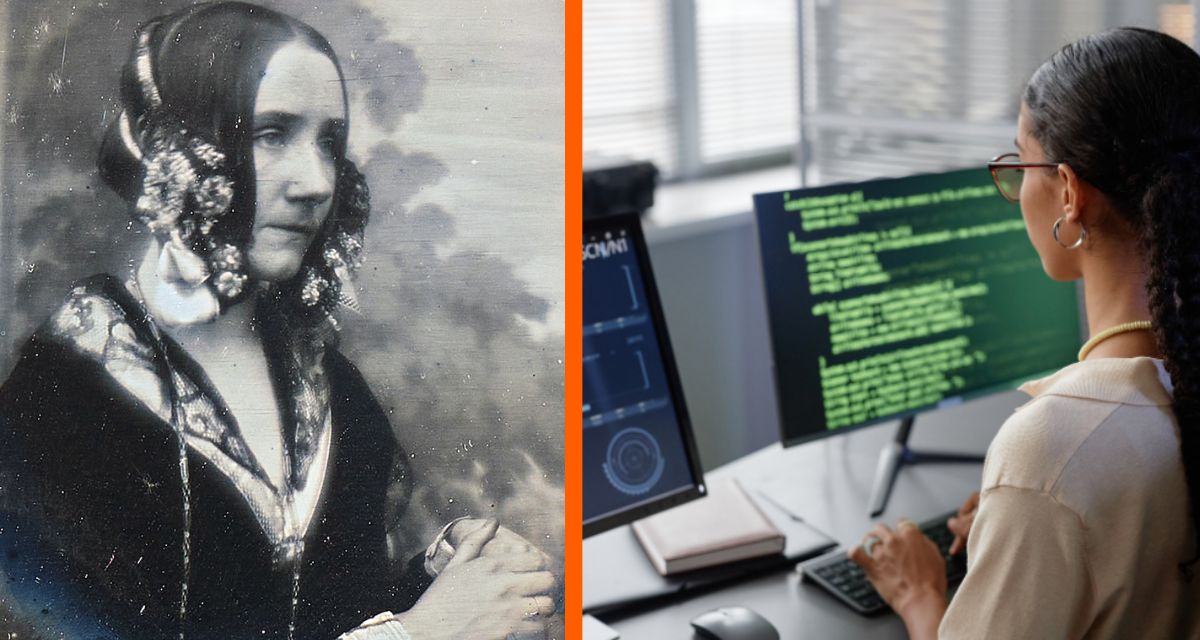
Computer science has come a long way. The very first electronic digital computer is credited to physicist and mathematician John Vincent Atanasoff and his graduate student Clifford Berry, who built the life-changing technology at Iowa State University from 1939 to 1942.
And while the computer as we know it today evolved years later, the groundwork for it all began in the 19th century with one woman: Ada Lovelace.
Lovelace is credited as the first computer programmer. Her work involved writing detailed instructions to be programmed into first automatic digital computer, known as the ‘Analytical Engine’, created by her mentor and “father of computers” Charles Babbage.
Besides being a brilliant mathematician, she was also the daughter of British poet and “She Walks in Beauty” author, Lord Byron.
Who was Ada Lovelace?
Born Augusta Ada Byron in London in December 1815, she was the daughter of Lord Byron (George Gordon Byron) and his wife Anne Isabella Byron. Her parents separated shortly after her birth, and she was raised by her mother—who had a background in mathematics.
Lovelace never met her father, who died in Greece when she was just 8 years old. She followed in her mother’s footsteps, receiving an education focused on math and science early on.
At 17, she met Cambridge professor and mathematician Charles Babbage, who she would collaborate on with his invention called the Analytical Engine—a general-purpose computing machine known as the “first computer”.
The first computer programmer
Between 1842 and 1843, Lovelace wrote the first computer program for Babbage’s Analytical Engine concept. Although never completed, it evolved from another calculating machine he invented called the Difference Machine that was commissioned by the British government specifically for mathematical computing.
However, the Analytical Engine went a step further than basic computation: like modern computers, it had the potential to mill information and store memory via a program. Lovelace is credited with explaining exactly how a computer could follow “a sequence of instructions”.
Lovelace wrote:
“Supposing, for instance, that the fundamental relations of pitched sounds in the science of harmony and of musical composition were susceptible of such expression and adaptations, the engine might compose elaborate and scientific pieces of music of any degree of complexity or extent.”
She also understood the limitations computers had, an ahead-of-her-time observation that she also wrote about:
“The Analytical Engine has no pretensions whatever to originate anything. It can do whatever we know how to order it to perform. It can follow analysis, but it has no power of anticipating any analytical revelations or truths. Its province is to assist us in making available what we are already acquainted with.”
Lovelace’s life cut short
Outside of her professional accomplishments, Lovelace was married to William King, the future Earl of Lovelace, when she was 19. The couple would go on to have three children.
Her health was described as “fragile” her entire life. It worsened after the births of her children, and she struggled with a number of health issues including breathing and digestive problems, as well as rheumatic attacks.
At 36, Lovelace passed away from uterine cancer. Unfortunately, the brutal treatment of bloodletting was a common treatment at the time, which may have contributed to her early death.