It’s hard to believe now, but communicating via the written word used to be a gigantic deal. Long before texting, social media, quick emails, or even short postcards, one of the only ways people could communicate across space and time was by writing long letters.
The 18th century is considered by some to be the peak of the Golden Age of letter writing. It was a key element of education for people wealthy enough to receive one, and it was incredibly important: business was conducted via handwritten letters, love was declared, and new introductions were made.
It was crucial, then, to choose your words extremely carefully. This was especially true in and around the Victorian Era in England, roughly between 1820 and 1914.
Victorian-era translations of everyday sayings
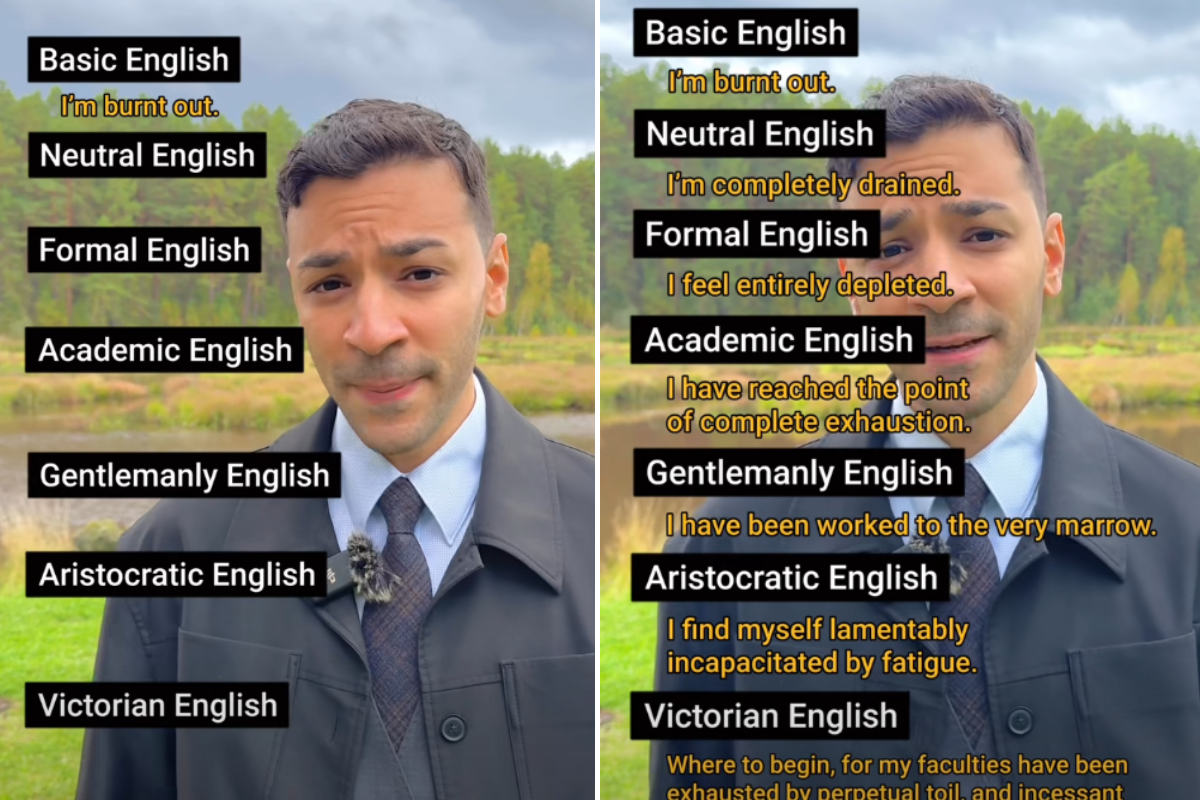
An English teacher from the United Kingdom has been delighting followers with Victorian-era translations of everyday sayings.
Abram Elenin runs Berber English, where he says, “I help professionals master British English… and communicate more effectively.”
He also likes to have a little fun with his work as a linguistics expert and accent coach. In a wildly popular series of Instagram Reels, he performs “tiered” translations of common phrases, transforming them into increasingly formal variations. Victorian English is usually the final resting point and comedic punchline.
In one popular video, “I’m burnt out” becomes “I’m entirely depleted” in formal English, and “I have been worked to the very marrow” in gentlemanly English.
But Victorian English, the age of beautiful if long-winded novels like Great Expectations and Jane Eyre, takes the cake: “Where to begin, for my faculties have been exhausted by perpetual toil, and incessant application has so stripped me of vitality that I am scarcely able to summon the strength requisite for the smallest effort.”
In another Reel, “I’m poor” becomes “I find myself in a precarious financial position,” and finally:
“It is with no small measure of affliction that I acknowledge my fortunes to be sadly diminished, my purse exhausted, and my station reduced to one of grievous penury, such that I find myself abandoned to the stern tutelage of want, the harshest master to which mankind is ever subject.”
It just sounds so much better that way. Can’t you just hear Moira Rose from Schitt’s Creek saying that?
Elenin’s videos have reached millions of viewers worldwide, helping them gain a greater appreciation for Victorian-era English and language more broadly.
“‘My faculties have been exhausted by perpetual toil’ goes hard,” one Facebook commenter notes.
“Gonna use Victorian for my essays now,” someone says on Instagram.
“I just love listening to you saying these things,” adds another.
A few brave commenters tried writing their own Victorian-style passages, but it’s really a job best left to the pros, like Elenin.
Why the language died out
This gorgeous, verbose style of language unfortunately faded as literacy rates climbed and the written word became more commonplace.
However, letter writing was still commonly practiced until the telephone became a major part of everyday life in the early 1900s.
Early phonograph recordings from the late 1800s offer some of our only glimpses into what people in the Victorian era actually sounded like. Though their conversations are less flowery and long-winded than their writing, they still stand in stark contrast to casual conversation today.
While it’s a little sad for those who appreciate language that this kind of prose is mostly extinct, there is some good news: letter writing is making a comeback. As people grow weary of screens and impersonal digital communication, the trusty pen and paper are experiencing a much-needed revival.
Maybe now is the perfect time to brush up on your Victorian English, or at least take some inspiration from the way they could make anything sound interesting or profound.

In a small village in Pwani, a district on Tanzania’s coast, a massive dance party is coming to a close. For the past two hours, locals have paraded through the village streets, singing and beating ngombe drums; now, in a large clearing, a woman named Sheilla motions for everyone to sit facing a large projector screen. A film premiere is about to begin.
It’s an unusual way to kick off a film about gender bias, inequality, early marriage, and other barriers that prevent girls from accessing education in Tanzania. But in Pwani and beyond, local organizations supported by Malala Fund and funded by Pura are finding creative, culturally relevant ways like this one to capture people’s interest.
The film ends and Sheilla, the Communications and Partnership Lead for Media for Development and Advocacy (MEDEA), stands in front of the crowd once again, asking the audience to reflect: What did you think about the film? How did it relate to your own experience? What can we learn?
Sheilla explains that, once the community sees the film, “It brings out conversations within themselves, reflective conversations.” The resonance and immediate action create a ripple effect of change.
MEDEA Screening Audience in Tanzania. Captured by James Roh for Pura
Across Tanzania, gender-based violence often forces adolescent girls out of the classroom. This and other barriers — including child marriage, poverty, conflict, and discrimination — prevent girls from completing their education around the world.
Sheilla and her team are using film and radio programs to address the challenges girls face in their communities. MEDEA’s ultimate goal is to affirm education as a fundamental right for everyone, and to ensure that every member of a community understands how girls’ education contributes to a stronger whole and how to be an ally for their sisters, daughters, granddaughters, friends, nieces, and girlfriends.
Sheilla’s story is one of many that inspired Heart on Fire, a new fragrance from the Pura x Malala Fund Collection that blends the warm, earthy spices of Tanzania with a playful, joyful twist. Here’s how Pura is using scent as a tool to connect the world and inspire action.
A partnership focused on local impact, on a global mission
Pura, a fragrance company that recognizes education as both freedom and a human right, has partnered with Malala Fund since 2022. In order to defend every girl’s right to access and complete 12 years of education, Malala Fund partners with local organizations in countries where the educational barriers are the greatest. They invest in locally-led solutions because they know that those who are closest to the problems are best equipped to solve and build durable solutions, like MEDEA, which works with communities to challenge discrimination against girls and change beliefs about their education.
But local initiatives can thrive and scale more powerfully with global support, which is why Pura is using their own superpower, the power of scent, to connect people around the world with the women and girls in these local communities.
The Pura x Malala Fund Collection incorporates ingredients naturally found in Tanzania, Nigeria, Pakistan, and Brazil: countries where Malala Fund operates to address systemic education barriers. Eight percent of net revenue from the Pura x Malala Fund Collection will be donated to Malala Fund directly, but beyond financial support, the Collection is also a love letter to each unique community, blending notes like lemon, jasmine, cedarwood, and clove to transport people, ignite their senses, and help them draw inspiration and hope from the global movement for girls’ education. Through scent, people can connect to the courage, joy, and tenacity of girls and local leaders, all while uniting in a shared commitment to education: the belief that supporting girls’ rights in one community benefits all of us, everywhere.
You’ve already met Sheilla. Now see how Naiara and Mama Habiba are building unique solutions to ensure every girl can learn freely and dare to dream.
Naiara Leite is reimagining what’s possible in Brazil
Julia with Odara in Brazil. Captured by Luisa Dorr for Pura
In Brazil, where pear trees and coconut plantations cover the Northeastern Coast, girls like ten-year-old Julia experience a different kind of educational barrier than girls in Tanzania. Too often, racial discrimination contributes to high dropout rates among Black, quilombola and Indigenous girls in the country.
“In the logic of Brazilian society, Black people don’t need to study,” says Naiara Leite, Executive Coordinator of Odara, a women-led organization and Malala Fund partner. Bahia, the state where Odara is based, was once one of the largest slave-receiving territories in the Americas, and because of that history, deeply-ingrained, anti-Black prejudice is still widespread. “Our role and the image constructed around us is one of manual labor,” Naiara says.
But education can change that. In 2020, with assistance from a Malala Fund grant, Odara launched its first initiative for improving school completion rates among Black, quilombola, and Indigenous girls: “Ayomidê Odara”. The young girls mentored under the program, including Julia, are known as the Ayomidês. And like the Pura x Malala Fund Collection’s Brazil: Breath of Courage scent, the Ayomidês are fierce, determined, and bursting with energy.
Ayomidês with Odara in Brazil. Captured by Luisa Dorr for Pura
Ayomidês take part in weekly educational sessions where they explore subjects like education and ethnic-racial relations. The girls are encouraged to find their own voices by producing Instagram lives, social media videos, and by participating in public panels. Already, the Ayomidês are rewriting the narrative on what’s possible for Afro-Brazilian girls to achieve. One of the earliest Ayomidês, a young woman named Debora, is now a communications intern. Another former Ayomidê, Francine, works at UNICEF, helping train the next generation of adolescent leaders. And Julia has already set her sights on becoming a math teacher or a model.
“These are generations of Black women who did not have access to a school,” Naiara says. “These are generations of Black women robbed daily of their dreams. And we’re telling them that they could be the generation in their family to write a new story.”
Mama Habiba is reframing the conversation in Nigeria
Centre for Girls' Education, Nigeria. Captured by James Roh for Pura
In Mama Habiba’s home country of Nigeria, the scents of starfruit, ylang ylang and pineapple, all incorporated into the Pura x Malala Collection’s “Nigeria: Hope for Tomorrow,” can be found throughout the vibrant markets. Like these native scents, Mama Habiba says that the Nigerian girls are also bright and passionate, but too often they are forced to leave school long before their potential fully blooms.
“Some of these schools are very far, and there is an issue of quality, too,” Mama Habiba says. “Most parents find out when their children are in school, the girls are not learning. So why allow them to continue?”
When girls drop out of secondary school, marriage is often the alternative. In Nigeria, one in three girls is married before the age of 18. When this happens, girls are unable to fulfill their potential, and their families and communities lose out on the social, health and economic benefits.
Completing secondary school delays marriage, and according to UNESCO, educated girls become women who raise healthier children, lift their families out of poverty and contribute to more peaceful, resilient communities.
Centre for Girls’ Education, Nigeria. Captured by James Roh for Pura
To encourage young girls to stay in school, the Centre for Girls’ Education, a nonprofit in Nigeria founded by Mama Habiba and supported by Malala Fund and Pura, has pioneered an initiative that’s similar to the Ayomidê workshops in Brazil: safe spaces. Here, girls meet regularly to learn literacy, numeracy, and other issues like reproductive health. These safe spaces also provide an opportunity for the girls to role-play and learn to advocate for themselves, develop their self-image, and practice conversations with others about their values, education being one of them. In safe spaces, Mama Habiba says, girls start to understand “who she is, and that she is a girl who has value. She has the right to negotiate with her parents on what she really feels or wants.”
“When girls are educated, they can unlock so many opportunities,” Mama Habiba says. “It will help the economy of the country. It will boost so many opportunities for the country. If they are given the opportunity, I think the sky is not the limit. It is the starting point for every girl.”
From parades, film screenings to safe spaces and educational programs, girls and local leaders are working hard to strengthen the quality, safety and accessibility of education and overcome systemic challenges. They are encouraging courageous behavior and reminding us all that education is freedom.
Experience the Pura x Malala Fund Collection here, and connect with the stories of real girls leading change across the globe.
Job interviews can be equal parts anxiety-inducing and exciting. A new opportunity, and possibly a different future, can await. Then, after the interview, you check your inbox: “We regret to inform you…” “Unfortunately, while your qualifications were impressive…” “We’ve decided to go in another direction at this time.” Rejection after an interview can feel defeating. However, there are ways (and reasons) to feel like you’ve won anyway.
Several career experts and job search professionals spoke to Upworthy to share their advice on managing the emotions that come with job rejection. They also offered tips and data to boost your confidence and help you return to the job search feeling like a winner. Here are five of their recommendations.
1. Feel the feelings
“Give yourself permission to feel how you feel,” said career coach Dante Rosh. “If you’re feeling rejected, feel rejected. Acknowledge the feeling, but don’t allow yourself to sit in it too long. Put a timer on your pity party. This may sound like, ‘I’m going to feel bad for the rest of today, but tomorrow is a new day and I’m going to continue my search.’”
“Rejection after a job interview can be challenging, but the most important thing you can do is protect your mindset,” said Jasmine Escalera, a career expert for LiveCareer. “Take a moment to pause, breathe, and step away instead of rushing right back into applications. So many candidates push through without processing it, but giving yourself that space supports your mental and emotional health. And when you do that, you come back stronger, more grounded, and more resilient for the remainder of your search.”
2. Know that you aren’t alone, and that there will likely be many rejections before a “yes”
Ellen Raim, a former chief human resources officer turned career advisor, said the job market is difficult. She shared data showing that it can take 50 applications to get a job interview and 200 interviews to land a job. She encouraged new job seekers to keep going.
“In today’s market looking for a job is like being in sales. Good salespeople know they won’t close every deal,” said Raim. “On the hard days, remember: every effort you have made counts; you’re closer than you were yesterday. You have a great product. You will make the sale; keep going.”
“Rejection has a finite time frame,” said Lacey Kaelani, CEO of job search engine Metaintro. “According to our data, the average number of applications received for any position is in the approximate excess of over 250. Reaching the interview stage could mean that an applicant is in the top 2% of all applications. That in itself is a win.”
You can still land jobs at companies who have rejected you in the job search. If you went through their hiring process, that means you have good skills and are compatible with the team, just the timing or role wasn’t quite right. So many of my clients land jobs at companies who once rejected them by using Job Shopping strategies. You can do this too! Don’t let these relationships go to waste. Follow for more! #jobsearch#jobtips#hiring#business#worklife#careercoach#jobmarket
3. Reframe and redirect negative thoughts and rumination
“Reframe your negative thoughts,” said Rosh. “While we can’t always control what thoughts pop into our heads, we can control the power and energy we give them. Instead of accepting ‘I’m unhireable’ as fact, try reframing it. ‘My mind is telling me I’m unhireable and I’m working on not buying into that.’”
Peter Franks, a former executive search firm headhunter who’s currently the editor at No Latency, said to focus on the facts of the situation rather than ruminate on the rejection.
“As humans, we’re naturally competitive and want to succeed,” said Franks. “Being rejected hurts our pride but it’s worth remembering that only one person can win any recruitment process. If you apply for a role and get invited for an interview, you’ve already beaten 80%+ of the market. If you make it to the second or third interview, you’ve probably surpassed 90% of the candidate pool.”
In short, if you don’t get a job offer after a third interview, you didn’t lose 0-1—you won 2-1. This reframing could lead to a 3-0 win in the future.
4. Write down what went right and what you learned
Lucas Botzen, a human resources manager and CEO of Rivermate, recommended writing down three moments in which candidates felt confident, thoughtful, or had a strong rapport with the interviewer. Botzen said this shifts the focus from what could have gone wrong to what went right. He also recommended keeping a log after every interview.
“Write a skills success log for each interview,” Botzen said. “This is a log that should record not only what worked but also what [the interviewee] learned about themselves and their skills.”
Writing down what you did right helps you see the wins you’ve achieved and offset any feelings of loss.
5. Send a thank-you note to the interviewer for your own confidence
“After being rejected for a job, the best thing you can do is send the hiring manager a brief thank you note with a question about how you can improve your resume or skills to ‘hopefully’ land a job at that company one day,” said Kaelani. “You might end up receiving an answer that provides insight.”
While this advice is typically recommended as a courtesy, it’s not just about professionalism. It also allows you to get the last word.
“By sending a thank you note to the interviewer in which you reference an idea that you discussed during the interview, you are taking control of the situation,” added Botzen. “This gives you a sense of power and professionalism, even if the company decided to go in another direction.”
Rejection is common. While it hurts, these insights can help job seekers feel better, knowing that landing a job is not a question of “if,” but “when.”
The word “girl” evokes the thought of a female child, while “boy” conjures the thought of a male child. This is true for most people, regardless of their country of origin. But according to Harvard University linguist Sunn m’Cheaux, the word “girl” was originally considered gender-neutral.
What sparked the revelation was a video showing a woman calling her male friend “girl” during a conversation. The short, seemingly amusing clip sparked a firestorm of comments from men who found the unintentional gaffe insulting. Some men viewed the term as emasculating, while women claimed it was gender-neutral.
Sunn m’Cheaux originally added his voice by pointing out that when women use the term with men, it reflects a closeness in the friendship.
“Quick FYI: If you’re in a conversation with a Black woman who inadvertently calls you ‘girl,’ do not get offended. She is not ‘emasculating you’—she’s comfortable with you,” the language expert says in a TikTok video, as women in the comments agree.
After seeing comments saying that women simply didn’t know the etymology of the word, m’Cheaux jumped back in to break things down. The confusion, he explains, is that the once gender-neutral term became gendered, losing its original meaning. In a follow-up video posted to his social media pages, he explains the etymology of “girl” for naysayers.
“The good news is, if you think that most of the women and girls who inadvertently call y’all ‘girl’ don’t actually know the etymology of the word ‘girl,’ you’re probably right,” the linguist says. “Most English speakers don’t know the etymology of the word ‘girl.’ But see, that’s where the bad news comes in for you. You see, the word ‘girl’ was originally gender-neutral. That’s right. For centuries, the word ‘girl’ simply meant a child of either sex.”
He further explains that male children were called “knave girls,” distinguishing them from female children. The word “boy,” on the other hand, originally meant servant. This gender-neutral usage didn’t stop with “girl”—he adds that “man” was also used for both sexes.
“To distinguish a human female from a human male, that would be a ‘wifman’ for a female,” m’Cheaux explains. “Later, the term ‘wife’ would mean the companion of a man, but you actually didn’t originally have to be the companion of a man to be a ‘wife.’”
In the video, he also addresses the terms “midwife” and “gossip,” explaining how they became associated with women. He impressed viewers with the impromptu etymology lesson.
One person writes, “I feel like I just attended a really great lecture and I should probably rewatch and take notes! So much info!”
Another says, “Oh, how I love these etymology breakdowns!!! So much fun learning how words/language evolve! But I’ont think anybody does this as well as you do.”
“You’ll have to start charging for these seminars. That was at least one credit’s worth of knowledge!” Someone else chimes in.
“I love this! May I use this in my class when we talk of pronouns and how they have evolved?” an eager professor shares. “Some of my future journalists are battling they/them conundrums outside our Emerson bubble. I’d love to add this to the conversation.”
“Sir, you make my brain hurt in the best possible way. Appreciate you,” another person notes.
If this sounds familiar, you’re not alone. Introverts make up one-third to one-half of the population, but our conversation norms—both online and off—are designed for extroverts.
Susan Cain, author of the bestselling book Quiet: The Power of Introverts in a World That Can’t Stop Talking, calls this phenomenon the “New Groupthink.” It’s a culture that favors constant collaboration and rapid-fire replies over stillness and deep thought. We live in a world that measures contribution by the number of messages sent, and it’s easy to feel like you’re falling behind when you go silent.
But what if this isn’t about falling behind? What if silence is just a different way of engaging? If you’ve ever wondered why you go quiet in group chats, consider these 10 signs you might be an introvert.
Unlike their extroverted counterparts, introverts take time to think about their responses before firing off a text. Photo credit: Canva
As Cain describes in her book, introverts “listen more than they talk, think before they speak, and often feel as if they express themselves better in writing than in conversation.”
In a group chat setting, this internal processing means you might mentally prepare a response, revise it, overthink the timing (can’t be too quick or too slow, right?), and then decide the conversation has already moved on without you. The perfect response you crafted vanishes before you hit send.
2. Surface-level banter drains you
For introverts, not all conversations are created equal. You might find endless small talk, quick memes, and emoji reactions tiresome, and yearn for messages with more substance. That’s because introverts crave depth—a meaningful exchange that explores an idea, a feeling, or a genuine problem.
How would you react in this situation? I already interact too much with some of my coworkers on a daily basis so please leave me out the group chat. Thanks #groupchat#introverts#workgossip
Research published in the Journal of Personality and Social Psychology found that serious conversations are more enjoyable than people expect, yet we consistently underestimate others’ interest in them. For introverts, this inclination toward depth isn’t a personality quirk—it’s a fundamental part of how they communicate.
3. You observe everything
If you’re quiet in the group chat, it doesn’t mean you’re not paying attention. Introverts are sharp readers of context: they notice shifts in tone, track emotional undercurrents, and pick up on what’s not being said as much as what is. This ability to observe and accurately synthesize group dynamics is one of the most underappreciated traits in online communication.
Introverts are sharp readers of context—everything that’s not being said. Photo credit: Canva
Psychologist Daniel Goleman found that empathy is a core component of emotional intelligence, and that quiet people often exhibit greater empathy because they listen more deeply. So while you may not be contributing messages to the group chat, you’re still playing an active role—picking up on subtle cues, like a shift in someone’s tone.
4. Group chats drain your social battery
Group chats require a lot of mental and social energy as you process multiple conversations, competing personalities, shifting group dynamics, and implicit social cues all at once. That’s an enormous cognitive load, especially compared to one-on-one conversations, where your focus can be directed toward a single person without all the noise.
If you feel overwhelmed, muting the chat might not be a bad idea. You need to manage—and maintain—your energy well.
5. You refuse to break the silence with noise
You won’t send a message just to be seen. While some group chat members are happy to drop a fire emoji or send an “lol” to stay visible, introverts tend to hold back unless they have something substantial to contribute. They’re committed to authentic communication.
Blake Griffin Edwards, a licensed marriage and family therapist, explains it this way: “Introverts must think it out before they are able to talk it out very well.”
As a result, your communication style is built on intention rather than impulse. You may send fewer messages, but when you do, they’re more meaningful.
6. Group chats can feel overwhelming, even for good writers
Here’s a paradox many introverts recognize: writing often feels more natural than speaking. Text removes the social pressure of real-time performance, giving you space to choose your words carefully. Yet despite being text-based, group chats can still trigger overstimulation.
The problem lies with pace. A group chat doesn’t move at the same speed as a thoughtful email chain or a journal entry. It’s fast and unpredictable—like a live conversation—which creates the same timing pressures introverts face in verbal group settings. Hans Eysenck’s foundational theory of introversion suggests that introverts have a higher baseline level of cortical arousal, meaning they reach sensory overload faster than extroverts when external stimulation—like a flood of notifications—keeps escalating.
7. You tune into how others are feeling
You’re not just reading the words in a thread—you’re reading between the lines. As an introvert, you probably notice delicate emotional shifts, like a person’s messages becoming shorter, a joke that falls flat, or silence from someone who’s usually chatty. This emotional sensitivity is a strength, but it can also make group chats feel more burdensome than expected.
Emotional sensitivity can feel like a burden in group chats. Photo credit: Canva
In The Mirror, Katie Oborn observed that introverts “pick up on unspoken emotions and subtle shifts in conversation and tone.” That level of awareness means introverts are often the first to notice when something is off.
8. You don’t bend to the pressure to perform
Group chats carry an implicit social pressure: respond quickly, be entertaining, stay visible. For emotionally independent introverts, that pressure can feel crushing. People who resist the pull to perform in group settings often have a strong internal compass about what matters to them and why. They won’t chime in for the sake of it, and they won’t be dragged into drama just because the group demands a response.
9. Constant notifications break your focus
For introverts, great thinking often happens when you’re alone. There’s research to support this: studies consistently link solitude to improved emotional regulation, creativity, and decision-making. When a group chat keeps pinging you—interrupting a reading session, the workday, or a quiet moment—it fragments the kind of deep focus and flow state introverts depend on.
Studies from Microsoft Research confirm that instant message notifications slow task performance and make it more likely you’ll lose your train of thought. For introverts, who need more time to process information, these interruptions can be even more costly. The “ping” of a phone notification can disrupt deep focus.
Scroll through your messages, and you might notice a pattern—either in yourself or in your introverted friends. Long periods of silence often lead to a single, valuable message that adds meaning to the conversation. That’s what strategic participation looks like: waiting for the right moment, then contributing something meaningful.
Embracing your strength
For introverts, hanging back and staying quiet in a group chat isn’t withdrawal. It’s a form of meaningful participation that favors observation, thoughtful processing, and intentional engagement over simply making noise.
If you recognize these signs in yourself and want to start engaging more on your own terms, these small shifts can help:
Try preparing your thoughts before or at the start of a lively group conversation.
Remember, writing is your natural way in. A thoughtfully crafted message at the right moment can carry more weight than a dozen impulsive replies.
Feel free to set notification boundaries without guilt.
When you’re ready to chime in, trust your timing and insight.
As Susan Cain reminds us, being the loudest in the chat doesn’t mean having the best ideas. The quietest voice may actually be paying the closest attention—and when their words are shared deliberately, they can shift the entire conversation.
Many people are looking to improve their public speaking skills, whether for work or to feel more comfortable in social situations. While taking classes and getting advice from speech coaches can help, some people have difficulty finding either the money or the time to access professional help. But one speech expert believes you can significantly improve your verbal communication skills just by using your phone.
In a YouTube video, communication professional and speaker Vinh Giang offers a daily exercise that can help improve public speaking: sending voice messages instead of texts. Giang notes that one benefit of texting is being able to review a message before sending it to fix potential communication issues or miscues—and argues that you can do the same with voice messages.
Recording a voice message lets you hear yourself in a low-stakes situation, with the option to re-record again and again if necessary. Each time you listen back, you can pick up on your volume, speed, clarity, and word choice and be more mindful in the next one. You’ll be able to see (well, technically hear) where you’re lacking and what to improve, whether that means fixing an issue right away or identifying exactly what you need to work on in your speech.
Speech professionals agree voice notes help improve speaking abilities
Other professionals in public speaking and speech therapy spoke to Upworthy about voice messages and how they can help people improve their speaking skills.
“In the speech therapy world, the process of using voice messaging to improve public speaking would be considered a method called self-monitoring through biofeedback,” said speech pathology expert Ryann Sutera. “Rehearsing running speech through the use of recordings can help assess intelligibility, rate of speech, and word choice.”
“Using voice memos as a low-stakes tactic to improve communication and public speaking skills is something we find helps prep our clients for media opportunities,” said public relations director Lauren Guess. “Most of our clients are on the go, and sending a voice memo back in response to the reporter’s question is a great practice for creating usable, digestible sound bites.”
Guess said voice messages not only help communication with media outlets, but also help refine clients’ public speaking skills and sharpen their talking points.
“We prefer this approach because we find it quickly strengthens confidence in speaking on their subject matter and enhances their ability to nail their key messages, compared to submitting quotes via email or text,” Guess said.
Whether you want to improve your public speaking for professional reasons, like giving a presentation at work or running for political office, or to get better at conversations and connecting with friends, it might be worth recording a voice note instead of talking through your fingertips.