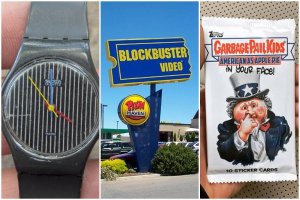
Our vernacular is always changing. Every generation has its own slang words, from Xennials to Millennials and Gen Z.
In 2025, Dictionary.com deemed ’67’ as the word of the year, the Oxford University Press claimed the word of the year was “rage bait,” and Merriam-Webster claimed it was “slop.”
The phrase that started it all
In an interview with the BBC, host Kate Colin offered an example of words that have disappeared in English when she opened a segment for the broadcasting network with this greeting: “Good morrow! I beseech thee, whence comest thou?” (Translation: “Good morning. Where do you come from?”)
Colin noted that this phrase was “Old English” used hundreds of years ago, and a great example of “disappearing words.” Colin’s co-host Jackie Dalton added, “Yes, English is a language which is evolving all the time. So this mean there are new words continuously appearing, and older words are disappearing.”
In English, words are here today and will likely be gone tomorrow. Language lovers on Reddit shared their favorite old-fashioned words that have gone nearly “extinct” in English today (and many they wish would make a comeback).
26 disappearing words
“Overmorrow. It means ‘the day after tomorrow’.” – TheGloveMan
“I remember the word ‘grody’ from the 90s. It meant gross or yucky.” – Glittering_Age_5591
“Comely (meaning beautiful) and homely (meaning ugly).” – oddwithoutend, Suspicious_Art9118
“Rolodex. There was something great about those. My own was a desk model with a lockable closing cover. Something about the tangibleness, the physicality and the control. Having the different kinds of cards and card covers, hearing them click when you spun it. I was sad to let it go.” – Matsunosuperfan, BASerx8
“Bitchin’ (meaning excellent).” – fox3actual
“Yellow pages.” – Matsunosuperfan
“Forsooth.” – fingermagnets459
Merriam-Webster notes that the definition of forsooth is “in truth : indeed —often used to imply contempt or doubt; now usually used to evoke archaic speech.” It comes from Middle English and dates back to the 12th century.
“Lunting: walking while smoking a pipe.” – RainbowWarrior73
“Only a ‘square’ would remember things like that.” – EighthGreen
“‘Cattywampus’ also sometimes known as ‘catawampus’. A cool word that you don’t hear much anymore.” – Dead_Is_Better
“I use finagle and my high school students think I’m so weird. I’m 47. This word is normal.” – MLAheading
“Frippery, at least in American English (think it’s used in France for thrift shops?)” – KobayashiWaifu
Merriam-Webster notes that the definition of frippery is “finery, also an elegant or showy garment; something showy, frivolous, or nonessential.” Its origins are Old French and date back as far as 1568.
“Handsome (when describing a woman).” – Odd-Scheme6535, Popular-Solution7697
“I love the word ‘scrimshaw.’ I don’t hear it enough.” – nocatleftbehind420
“Maybe not extinct but it’s meaning completely obliterated: nonplussed.” – LeFreeke
“Oblige. Rarely hear it except in old westerns.” – ReadySetGO0
“Druthers.” – Embarrassed_Wrap8421
More words worth bringing back
“Bogart. Monopolizing something that’s meant to be shared.” – CoderJoe1
Merriam-Webster notes that “bumbershoot” is an American nickname for an umbrella that was first used in 1856.
“Ne’er-do-well. From the early 20th century, basically some who never-does -well, implying a slacker or underachiever. Although people never said it even when I was growing up, I still think it’s a cool word.” – fabgwenn
“Whippersnapper – a young and inexperienced person considered to be presumptuous or overconfident. I’ve heard people on TV say it, (maybe Dennis the Menace, or some other 50s show). I heard a 90 year old woman say it IRL and I laughed so hard.” – JazzFan1998
“Xeroxing a document.” – C-ute-Thulu
“Blatherskite.” – Biff_Bufflington
Merriam-Webster notes that the definition of “blatherskite” is “a person who blathers [talks foolishly at length] a lot; nonsense.” Its first known use dates back to 1650.
“I don’t seem to hear penultimate much anymore.” – TakeMetoLallybroch
“I’m quite fond of the word slubberdegullion, meaning ‘dirty scoundrel’. I use it frequently when I talk to my senior, who is a rather clean upstanding citizen. We laugh and then he tells me to get back to work.” – r-pics-sux
The words worth saving
Language will always keep moving, shedding old words as new ones take their place. But there’s something worth holding onto in phrases like “forsooth” and “bumbershoot,” even if they never make a real comeback. They’re small time capsules, reminders of how people talked, joked, and complained decades before smartphones and slang like “rage bait” took over. So the next time the perfect old word comes to mind, say it anyway. Someone might just steal it back into everyday use.
This article originally appeared in February. It has been updated.