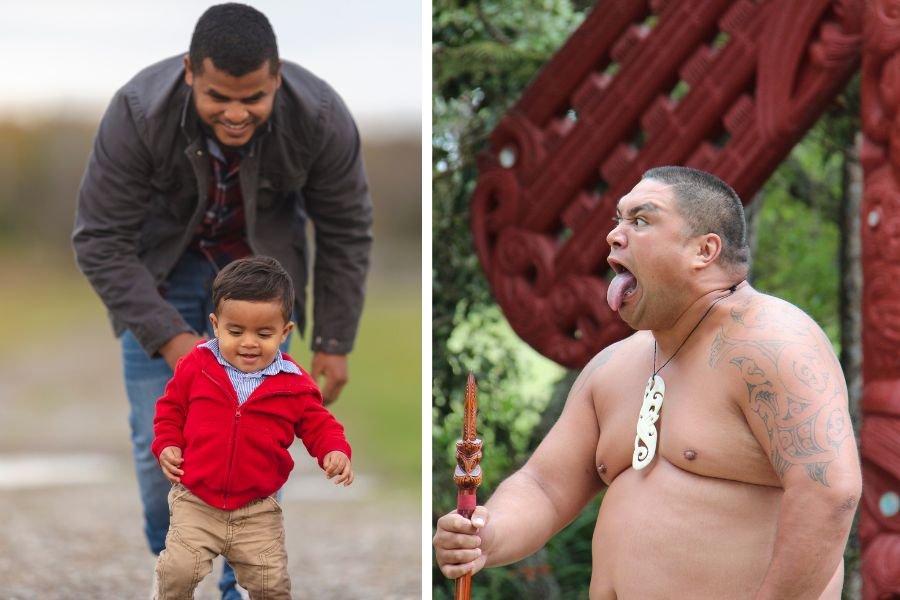
The haka is a Māori tradition that originated as a war dance. In recent years, people around the world have come to know and love the passionate performance. The emphatic, rhythmic gestures, wide eyes, and chanted words grace screens across multiple countries on a near daily basis, often bringing viewers to tears.
Having a window into such a rich culture can make people curious on how cultural traditions like the haka are passed down. Surely Māori babies aren’t born knowing this dance instinctively, nor is there a magic switch that flips when they reach a certain age. One family gave a little glimpse into how the culture is passed down from one generation to the next and it’s beyond adorable.
In late 2024, New Zealand wife and mum Hope Lawrence uploaded a video of her 18-month-old practicing the haka with his dad in the dining room, and the little guy is surprisingly good. In the video, the baby starts off with a stomp and grunt as his dad shows him the wero, which is the trembling hand often seen in the dance. As the dad walks back and forth starting the chant along with wero, the little one tries his best to mimic his dad.
Before too long the toddler is chanting along and copying the dad’s moves almost exactly, even if you can’t quite make out what the little guy is saying, his haka is still powerful. This isn’t the first time the baby has been caught doing the haka. Just a month before the adorable video, he was caught practicing his haka along with the New Zealand rugby team All Blacks on the family television. His tiny haka moves have taken social media by storm with over 53 million views, 7.1 million likes, and more than 53K comments.
People cannot get enough of his powerful little dance, with one person writing, “The Haka is so powerful but seeing this father teaching his baby is so much powerful. I am deeply moved.”
Another person thinks the dance is just the light people need to see right now, saying, “The world has never needed the haka more than it does now.”
Someone else noticed the confidence exuding from the toddler, noting, “The way y’all were in complete cadence together with the leg slap… he came in with confidence because of you, and y’all nailed it perfectly together.”
One viewer appreciates the peek into another culture, saying, “I LOVE THIS!!! if it wasn’t for tik tok I would’ve never been exposed to Māori culture. can’t tell you how many Haka performances I’ve watched. they make me feel so empowered.”
Appreciation of culture being passed down is a common theme among commenters with one saying, “This is truly beautiful to watch, not just because the father is keeping interaction and culture with child, but it’s keeping a beautiful culture present… some other cultures didn’t have this.”
Many people who watch the haka have a deeply emotional reaction they can’t explain even though they have no personal connection to the culture. The dance seems to speak to a part of humans that may be missing their ancestral connections, possibly awakening some dormant longing. There’s no real way to know for sure, but the amount of people who report being brought to tears every time the dance is performed is significant. This baby will surely keep his culture alive as he grows into adulthood, likely teaching his own child as his father taught him.
In a small village in Pwani, a district on Tanzania’s coast, a massive dance party is coming to a close. For the past two hours, locals have paraded through the village streets, singing and beating ngombe drums; now, in a large clearing, a woman named Sheilla motions for everyone to sit facing a large projector screen. A film premiere is about to begin.
It’s an unusual way to kick off a film about gender bias, inequality, early marriage, and other barriers that prevent girls from accessing education in Tanzania. But in Pwani and beyond, local organizations supported by Malala Fund and funded by Pura are finding creative, culturally relevant ways like this one to capture people’s interest.
The film ends and Sheilla, the Communications and Partnership Lead for Media for Development and Advocacy (MEDEA), stands in front of the crowd once again, asking the audience to reflect: What did you think about the film? How did it relate to your own experience? What can we learn?
Sheilla explains that, once the community sees the film, “It brings out conversations within themselves, reflective conversations.” The resonance and immediate action create a ripple effect of change.
MEDEA Screening Audience in Tanzania. Captured by James Roh for Pura
Across Tanzania, gender-based violence often forces adolescent girls out of the classroom. This and other barriers — including child marriage, poverty, conflict, and discrimination — prevent girls from completing their education around the world.
Sheilla and her team are using film and radio programs to address the challenges girls face in their communities. MEDEA’s ultimate goal is to affirm education as a fundamental right for everyone, and to ensure that every member of a community understands how girls’ education contributes to a stronger whole and how to be an ally for their sisters, daughters, granddaughters, friends, nieces, and girlfriends.
Sheilla’s story is one of many that inspired Heart on Fire, a new fragrance from the Pura x Malala Fund Collection that blends the warm, earthy spices of Tanzania with a playful, joyful twist. Here’s how Pura is using scent as a tool to connect the world and inspire action.
A partnership focused on local impact, on a global mission
Pura, a fragrance company that recognizes education as both freedom and a human right, has partnered with Malala Fund since 2022. In order to defend every girl’s right to access and complete 12 years of education, Malala Fund partners with local organizations in countries where the educational barriers are the greatest. They invest in locally-led solutions because they know that those who are closest to the problems are best equipped to solve and build durable solutions, like MEDEA, which works with communities to challenge discrimination against girls and change beliefs about their education.
But local initiatives can thrive and scale more powerfully with global support, which is why Pura is using their own superpower, the power of scent, to connect people around the world with the women and girls in these local communities.
The Pura x Malala Fund Collection incorporates ingredients naturally found in Tanzania, Nigeria, Pakistan, and Brazil: countries where Malala Fund operates to address systemic education barriers. Eight percent of net revenue from the Pura x Malala Fund Collection will be donated to Malala Fund directly, but beyond financial support, the Collection is also a love letter to each unique community, blending notes like lemon, jasmine, cedarwood, and clove to transport people, ignite their senses, and help them draw inspiration and hope from the global movement for girls’ education. Through scent, people can connect to the courage, joy, and tenacity of girls and local leaders, all while uniting in a shared commitment to education: the belief that supporting girls’ rights in one community benefits all of us, everywhere.
You’ve already met Sheilla. Now see how Naiara and Mama Habiba are building unique solutions to ensure every girl can learn freely and dare to dream.
Naiara Leite is reimagining what’s possible in Brazil
Julia with Odara in Brazil. Captured by Luisa Dorr for Pura
In Brazil, where pear trees and coconut plantations cover the Northeastern Coast, girls like ten-year-old Julia experience a different kind of educational barrier than girls in Tanzania. Too often, racial discrimination contributes to high dropout rates among Black, quilombola and Indigenous girls in the country.
“In the logic of Brazilian society, Black people don’t need to study,” says Naiara Leite, Executive Coordinator of Odara, a women-led organization and Malala Fund partner. Bahia, the state where Odara is based, was once one of the largest slave-receiving territories in the Americas, and because of that history, deeply-ingrained, anti-Black prejudice is still widespread. “Our role and the image constructed around us is one of manual labor,” Naiara says.
But education can change that. In 2020, with assistance from a Malala Fund grant, Odara launched its first initiative for improving school completion rates among Black, quilombola, and Indigenous girls: “Ayomidê Odara”. The young girls mentored under the program, including Julia, are known as the Ayomidês. And like the Pura x Malala Fund Collection’s Brazil: Breath of Courage scent, the Ayomidês are fierce, determined, and bursting with energy.
Ayomidês with Odara in Brazil. Captured by Luisa Dorr for Pura
Ayomidês take part in weekly educational sessions where they explore subjects like education and ethnic-racial relations. The girls are encouraged to find their own voices by producing Instagram lives, social media videos, and by participating in public panels. Already, the Ayomidês are rewriting the narrative on what’s possible for Afro-Brazilian girls to achieve. One of the earliest Ayomidês, a young woman named Debora, is now a communications intern. Another former Ayomidê, Francine, works at UNICEF, helping train the next generation of adolescent leaders. And Julia has already set her sights on becoming a math teacher or a model.
“These are generations of Black women who did not have access to a school,” Naiara says. “These are generations of Black women robbed daily of their dreams. And we’re telling them that they could be the generation in their family to write a new story.”
Mama Habiba is reframing the conversation in Nigeria
Centre for Girls' Education, Nigeria. Captured by James Roh for Pura
In Mama Habiba’s home country of Nigeria, the scents of starfruit, ylang ylang and pineapple, all incorporated into the Pura x Malala Collection’s “Nigeria: Hope for Tomorrow,” can be found throughout the vibrant markets. Like these native scents, Mama Habiba says that the Nigerian girls are also bright and passionate, but too often they are forced to leave school long before their potential fully blooms.
“Some of these schools are very far, and there is an issue of quality, too,” Mama Habiba says. “Most parents find out when their children are in school, the girls are not learning. So why allow them to continue?”
When girls drop out of secondary school, marriage is often the alternative. In Nigeria, one in three girls is married before the age of 18. When this happens, girls are unable to fulfill their potential, and their families and communities lose out on the social, health and economic benefits.
Completing secondary school delays marriage, and according to UNESCO, educated girls become women who raise healthier children, lift their families out of poverty and contribute to more peaceful, resilient communities.
Centre for Girls’ Education, Nigeria. Captured by James Roh for Pura
To encourage young girls to stay in school, the Centre for Girls’ Education, a nonprofit in Nigeria founded by Mama Habiba and supported by Malala Fund and Pura, has pioneered an initiative that’s similar to the Ayomidê workshops in Brazil: safe spaces. Here, girls meet regularly to learn literacy, numeracy, and other issues like reproductive health. These safe spaces also provide an opportunity for the girls to role-play and learn to advocate for themselves, develop their self-image, and practice conversations with others about their values, education being one of them. In safe spaces, Mama Habiba says, girls start to understand “who she is, and that she is a girl who has value. She has the right to negotiate with her parents on what she really feels or wants.”
“When girls are educated, they can unlock so many opportunities,” Mama Habiba says. “It will help the economy of the country. It will boost so many opportunities for the country. If they are given the opportunity, I think the sky is not the limit. It is the starting point for every girl.”
From parades, film screenings to safe spaces and educational programs, girls and local leaders are working hard to strengthen the quality, safety and accessibility of education and overcome systemic challenges. They are encouraging courageous behavior and reminding us all that education is freedom.
Experience the Pura x Malala Fund Collection here, and connect with the stories of real girls leading change across the globe.
A woman named Michelle Verdayo had come to the Providence Municipal Court to answer for four red light violations. She brought her 12-year-old son Arion, who is on the autism spectrum and has ADHD. Arion introduced himself the moment they arrived.
“I am Arion. A-R-I-O-N. I am 12 years old, I’m in the seventh grade.”
Caprio, already won over, asked what Arion wanted to do after school. The boy said he was still deciding, but that he definitely wanted to be successful. “It’s hard to decide,” he told the judge. “When you’re at that age, you don’t know what you wanna do. At some points you wanna do what you wanna do but you don’t want to disappoint your family in any way.” Caprio looked at him for a moment. “You are speaking with the maturity of an adult,” he said.
Then they pulled up the footage.
As Caprio walked through each violation, Arion watched alongside his mom, offering live commentary. Some of the red lights, he allowed, seemed fairly minor. Then came the clip of his mom nearly hitting another car. Arion gasped. “How dare you!?” The courtroom broke.
“You think you know your mom,” he said, shaking his head, “and she goes out and blatantly does that.”
Caprio turned to Michelle with a grin. “You are being chastised right now, and rightfully so. You’ve got a great kid.”
When Caprio asked about Arion’s autism, Michelle was candid. It had been hard, she said, especially with his father out of the picture. As she spoke, Arion stepped in, not to deflect but to reframe it entirely. He told Caprio that despite being teased, he had never seen his diagnosis as a problem.
“I’m proud to have my autism because it makes me who I am now.”
Caprio paused. “I am so impressed.”
He invited Arion up to the bench, shook his hand, and asked for his verdict. The boy picked up the gavel, brought it down, and announced: “Case dismissed.”
(L) 12-year-old Arion Verdayo speaks to the judge. (R) Judge Frank Caprio speaks during hearing. Photo course: Facebook | Caught In Providence
“You won your case,” Caprio told Michelle. “Your boy presented you well.” He closed by echoing something Arion had said earlier: “Just because you’re different doesn’t mean that you should be treated differently, because we’re all human beings.”
Judge Frank Caprio presided over the Providence Municipal Court for nearly four decades and built a YouTube following of close to three million subscribers through Caught in Providence. He died on August 20, 2025, at 88, after a battle with pancreatic cancer. He was remembered widely as the nicest judge in the world. It is not hard to see why.
Wayman, who was 74 when he died on February 21, had no known living relatives. After no family members came forward to claim his remains, officials at the Middle Tennessee State Veterans Cemetery listed him as an “unclaimed” veteran, a designation that applies to roughly 2,300 veterans per year across the country, according to Department of Veterans Affairs data. The Tennessee Department of Veterans Services put out a public Facebook invitation asking community members and veterans to attend Wayman’s 9 a.m. service and “ensure he receives the farewell he deserves.” Country singer John Rich amplified the post to his followers. Local news station WZTV covered the call the day before.
By the time the service began, the chapel was full. People stood along the walls. Others filled the hallway. More were still arriving outside as the ceremony started.
A spokesperson for the Tennessee Department of Veterans Services described the turnout as “absolutely amazing,” and said they had never seen anything like it. The Gallatin Police Department, 30 miles northeast of Nashville, sent representatives. Veterans groups, community members, and military personnel stood in rows as prayers were offered and full military honors were rendered.
Update from Middle Tennessee State Veterans Cemetery: :20 min after Sailor Lonnie D. Wayman’s celebration of life service.
We were told Lonnie didn’t have any immediate family, but middle Tennessee did right by him, this morning.
The VA representative who spoke at the service addressed the word that had appeared on Wayman’s paperwork. “When the paperwork for Lonnie Wayman came across my desk, it was marked as an unclaimed veteran,” he said. “But I say that’s incorrect. I say that’s a misnomer. Thanks to the support of the United States military, the good folks at Gupton Mortuary, and all the support I see here today, we are able to claim our honorable veterans and provide them the dignity and honor that they have earned.”
Hundreds of strangers have shown up for the funeral of a Tennessee veteran who died with no known relatives.
VA Chaplain Conard Donarski, who had met Wayman at the hospice before his death, presided over part of the service. A priest offered prayers. A naval honor guard folded an American flag and presented it over the casket. The service ended with a dove release at the cemetery’s flagpoles.
Journalist Cabot Phillips posted video from outside as the crowd continued to grow, writing: “Hundreds of strangers have shown up for the funeral of a Tennessee veteran who died with no known relatives. This is America.”
Wayman was laid to rest in section P of the Middle Tennessee State Veterans Cemetery. The site is open to visitors.
This article originally appeared earlier this year.
For roughly a decade, a reel-to-reel tape labeled “Beatles Early Demos” sat behind the cash register at Neptoon Records, a beloved independent record shop in Vancouver that Rob Frith has owned since 1981, Antique Reader reported. He assumed it was a bootleg. He never played it.
In March 2025, Frith brought the tape to the studio of his friend Larry Hennessey, who had the equipment to play it. When the tape started rolling, they both stopped what they were doing. The sound was clean, present, and immediate, not the murky quality of a copied bootleg but something far closer to the source. What they were hearing was a master-generation recording of the Beatles’ failed audition for Decca Records, taped on January 1, 1962, eight months before Ringo Starr even joined the band. “It was like the Beatles were in the room with us,” Frith said.
Decca had famously passed on signing the group that day, with executives reportedly telling their manager that guitar bands were on their way out. The 15-song tape (including early Lennon-McCartney originals like “Like Dreamers Do” and “Love Of The Loved”) had been considered lost in master form for decades. Bootleg copies had circulated since the late 1970s, but nothing with this clarity.
The Beatles wave to fans after arriving at Kennedy Airport February 7, 1964. Photo credit: Wikimedia Commons
When Frith posted a clip online, the reaction was immediate and international. A representative for Paul McCartney reached out. On September 18, Frith traveled to Los Angeles with his wife Vicki and their two sons, including Ben, who helps manage the store. McCartney invited them to lunch and to a rehearsal with his band. He greeted Frith’s wife by name. “I thought I saw her soul exit her body right about then,” Ben said.
Frith handed over the tape. McCartney signed albums and photographs in return, including black-and-white prints from the Beatles’ early years. For context on what Frith walked away from: a single reel of the same Decca audition tape, from the estate of Beatles manager Brian Epstein, sold at Sotheby’s in 2019 for £62,500 (roughly $81,000). Frith had been offered the chance to auction his. He declined.
“I told Paul, ‘You changed my life as far as music,’” Frith said. “‘Basically, that’s why I have a record store, because of the influence from you guys.’”
His son Ben had put it plainly before the meeting happened: “That tape would have sat in some millionaire or billionaire’s basement never to be looked at again.”
Frith came home with signed memorabilia, photographs from the visit, and what he described as “certainly the best 24 hours I can remember.” He also came home without the tape, which is exactly what he wanted.
“I got paid because I got to meet Paul McCartney,” he said. “So that was good enough for me.”
This article originally appeared earlier this year.
He spent 24 years driving past the apartment building where he found him, wondering. The answer turned out to be at his old police department the whole time.
He got the baby to the hospital. Then he went out and bought a teddy bear and brought it back, placing it in the crib. “Just a symbol to let everyone that walked past know that he was cared about,” he told TODAY. The official paperwork called the infant “Baby Boy Doe.” Eyster had his own name for him. “He was born a couple of days before Christmas and placed in a box — and in my mind, that box was a manger. So he became Baby Jesus.”
The boy was adopted, the records were sealed, and that was the last Eyster heard of him. He retired in 2019 after 47 years on the force, and the questions never went away. Every time he drove past that apartment complex, he thought about the baby. “I wondered, ‘What did he turn out to be?’ And God forbid, have I ever arrested him? Was he still alive?”
In March 2024, his phone rang. It was Officer Josh Morgan, a colleague from the department. Morgan had just responded to a domestic call at Park Jefferson Apartments with his rookie — and the rookie had mentioned something. “I was like, ‘I was abandoned as a baby here,’” Matthew Hegedus-Stewart later recalled. Morgan pulled the report. Eyster’s name was on it.
“I’m sitting here 23 years later and the phone rings,” Eyster said. “He goes, ‘You’re not going to believe this, but Baby Jesus is sitting next to me right now. He’s my rookie.’”
On March 22, 2024, the two men met for the first time since Hegedus-Stewart was two days old. They sat together and went through the old case file, including photographs of the infant in the hospital that Matthew and his family had never seen. Eyster looked at the young man across from him and said, “You’re a little bit bigger now.”
The coincidences stacked up in a way that made Eyster’s voice go quiet when he listed them. Matthew had been assigned to patrol the same beat as the apartment complex where he was found. His daughter Aspen, now a toddler, was born on the same day he was legally adopted. And Matthew had become a police officer — working for the same department that found him on the worst night of his life.
“Full circle moment,” Hegedus-Stewart said. “That hit home.”
For Eyster, the timing carried a weight Matthew couldn’t have known. Just months before the phone call, Eyster’s only son Nick had died unexpectedly at 36 after accidentally overdosing on pain medication. “The timing couldn’t have been any better,” Eyster said. “It helped to fill a void that I’ve had to deal with.”
He had done one small thing — a teddy bear in a hospital crib, 24 years ago. “I see some mannerisms in Matt that remind me of my son,” he said. “He’s got the same grin, the same laugh, the same dark hair and stature.”
This article originally appeared earlier this year.
It was a Tuesday morning, and author and speaker Carlos Whittaker had just done something most married people have done a hundred times: dropped his wife off at the airport at 6:30 AM and driven home. By 7:30, he was on the porch with his coffee, already thinking about the day.
Then his phone buzzed. “I’m flying over you right now.”
What his home security camera captured next is the part that got the internet. Whittaker ran into the yard, phone in one hand, waving at the sky with everything he had, jumping, looking up, trying to make himself visible from 30,000 feet. The video, which he shared on Instagram, has the slightly blurry, slightly absurd quality of security footage, and that’s exactly what makes it land. He’s not performing for the camera. He didn’t know the camera was there.
Watching it back, Whittaker said he felt a flicker of embarrassment at first. “A grown man, running around like a 10-year-old.” But that feeling passed quickly. “That little boy is still in there,” he wrote. “And he’s not a problem. He’s a gift.”
An awe-struck boy looks up at the sky. Photo credit: Canva
The reaction he describes, that sudden, unguarded surge of wanting to connect with someone you love across an impossible distance, turns out to have real backing in psychology. Research published in Scientific Reports found that deliberate experiences of awe are linked to meaningful improvements in mental health, including reductions in stress and depressive symptoms and increases in overall wellbeing. The instinct Whittaker followed without thinking, running toward wonder instead of away from it, is something researchers say most adults suppress.
“We spend so much of our lives trying to act like we have it all together that we forget how to feel wonder in the small things,” he wrote. “Wonder isn’t childish. It’s sacred.”
An airplane flies over an excited man. Photo credit: Canva
The comments filled up fast with people who recognized themselves in the video. One wrote that her 19-year-old son is in aviation school and flies past the family home sometimes. “We all run out just like that,” she said, “and watch with awe as my baby flies through the air.” Another described texting a friend every time she drives past her office, both of them waving even though neither can see the other. “Little things like that are the best.”
The plane was gone in seconds. His wife couldn’t see him. None of that was the point.
This article originally appeared earlier this year.
The problem had been going on for a while. The kid would park in a no-parking zone right at the end of the driveway, which wasn’t just inconvenient, it caused the neighborhood snow removal truck to skip the driveway entirely during storms. The homeowner had talked to the kid about it directly, politely, more than once. Nothing changed. So when about 20 inches fell one Sunday and the plow truck bypassed his driveway again because of the illegally parked car, he grabbed his snowblower and made a decision.
At first, he wrote on Reddit, it was almost accidental, the wind was blowing in the wrong direction and some snow landed on the car naturally. Then he decided to stop fighting the wind. “I then said ‘screw it’ and just had the chute directed at their car at all times,” he wrote. By the time he finished clearing the street around his driveway, the car was buried. Driver’s side, passenger’s side, all the way up to the sidewalk. The plow coming back through the other way added to the effect.
The next morning, he went out for some cleanup and found the kid trying to shovel his way out. When the kid asked to borrow the snowblower, the answer was no. The kid’s mother came over later, threatening damage to the homeowner’s belongings. He told her to call the police and closed the door.
“I know she’s not going to call them,” he wrote, “as they were parked illegally, and they would probably give the kid a big fine for both the parking and being there in a storm.”
Parked car completely buried in snow. Photo credit: Canva
He wasn’t wrong to anticipate that dynamic. Boston has some of the most charged parking politics in the country, especially after a storm. The city officially permits residents to reserve shoveled street spots for up to 48 hours after a snow emergency ends, and as NPR reported in January, locals take that tradition seriously, sometimes very seriously. Parking in a spot someone worked to clear is considered, by a significant portion of the city, a matter of honor and consequence. Blocking a neighbor’s driveway outright is a different category entirely, and under Massachusetts law, it’s ticketable.
Reddit was largely on his side. “Maybe a little bit of a jerk for blowing the snow directly on the car,” one commenter acknowledged, “but it was also the car that caused you to be blocked in to begin with.”
This article originally appeared earlier this year.
The Spice Girls hold a dear place in the hearts of Millennials and older generations who lived through the 1990s. The five-member group, known for its “Girl Power” ethos, formed in 1994 and has remained relevant and beloved for its iconic fashion, talent, and fierce attitude.
Sadly, a much-anticipated 30th anniversary reunion for the group recently fell through. It was set to celebrate the Spice Girls’ debut single, “Wannabe,” which premiered in July 1996.
The song’s legendary music video featured all five members—Posh Spice (Victoria Beckham), Baby Spice (Emma Bunton), Scary Spice (Mel B), Ginger Spice (Geri Halliwell-Horner), and Sporty Spice (Mel C)—frolicking through London’s St. Pancras Renaissance Hotel.
The video is now going viral again for a dubbed spoof that fans are calling comedic gold.
On X, a series of videos featuring a mock voiceover of the original music video is blowing up. Shared by user @todocasibien, the clips replace the “Wannabe” track with shrill voices and stomping feet that imitate each Spice Girl as they face the camera.
Each one utters nonsensical phrases that seemingly match what they’re doing in the video. In one scene, Scary Spice begins the song’s famed line, “Yo, I’ll tell you what I want, what I really really want”—but instead of her voice, the dub cuts in, setting the silly tone for the rest of the clip.
Ginger Spice’s verse is up next: “So tell me what you want, what you really really want!” It quickly becomes clear that multiple voices are in play, and as the Spice Girls run to the next room, Ginger Spice’s cheeky butt grab of Baby Spice results in a hilarious dubbed comment.
“Haha, she touched my butt!” Baby Spice says, when in the original song she’s actually singing, “You gotta get with my friends!”
The girls move into a dining room scene, where Sporty Spice jumps onto a table and does a back handspring. A butler in the room is dubbed saying, “Don’t do that!” Added sounds of glasses and dishes breaking follow, ending with a perfectly timed scream.
The hilarity continues in another clip, striking a major funny bone with viewers.
Viewers respond
Many viewers shared the joy the videos brought them:
“The quick cutaway and clattering noises just before Sporty lands that backflip f*cking kills me.”
“This is the dumbest sh*t I’ve ever seen, but I am crying laughing!”
“Absolute tears running down my face. This is pure gold.”
“Contrary to what we were taught in the 90’s, if you wanna be my lover, please do not get with my friends.”
“The end killed me 💀.”
“Omg this is brilliant. The sound of dishes breaking on the table backflip …”
Fans of professional football club FC Barcelona may have noticed the team wearing a unique kit against Newcastle United during the Champions League round of 16 on March 18. The traditional blue-and-red striped jerseys were reworked with a standout typeface by Anna Vives, a fan and artist with Down syndrome.
FC Barcelona teamed up with Vives in honor of World Down Syndrome Day, which takes place on March 21. The team also secured a 7–2 victory over Newcastle United.
Before the matchup, FC Barcelona shared the news on X, including a photo of Vives’ design on player Lamine Yamal’s kit.
“A special jersey with a purpose, honoring International Down Syndrome Day and celebrating the talent of Anna Vives, an incredible artist with Down syndrome,” they shared.
Una camiseta especial con un propósito: dar visibilidad al Día Internacional del Síndrome de Down y celebrar el talento de Anna Vives, una artista increíble con síndrome de Down. ♾️ pic.twitter.com/R6Jbu183oc
In a press release, FC Barcelona noted that the collaboration with Vives was made possible through the FC Barcelona Foundation. It’s also the second time the two have teamed up.
“It is not the first time Barça have used Anna’s inclusive typeface,” the release stated. “The club previously supported the initiative during the 2013 Joan Gamper Trophy match against Santos, highlighting its commitment to raising the visibility of people who are too often overlooked.”
🚨 Barcelona are set to debut with a special kit for "World Down Syndrome Day" against Newcastle United in the Champions League this week.
The kit's typeface was been designed by Anna Vives, a talented young Catalan artist who has Down Syndrome.
On X, fans shared their praise for the collaboration with Vives:
“Precious and even more so for the cause it is, I want one.”
“I love it even more this way.”
“What a beautiful initiative, the t-shirt highlights talent and inclusion. Congratulations to Anna and the team.”
“The letters are super awesome.”
“An epic t-shirt for an epic match.”
“It’s a beautiful shirt, they have to wear it in all the Champions League matches.”
Who is Anna Vives?
In an interview with Pixartprinting, Vives’ brother Marc said her artistic journey began in 2011 after she lost her job at a local supermarket. He encouraged her to learn how to write on a computer, adding, “with no idea what she could do.” She was a fast learner and quickly became obsessed with typefaces.
This led her to create her own typeface, which combines lowercase and uppercase letters interchangeably and was first digitized in 2012.
She is currently showcasing her typeface around the world with a campaign called Visible-IN to promote visibility and social equality. Eight international soccer clubs will wear her typeface to mark World Down Syndrome Day, including four South American clubs, three European clubs, and one South African club.
World Down Syndrome Day has been part of the United Nations calendar since 2012. This year, it falls on March 21.
That it falls on the 21st is a meaningful nod to Down syndrome, also known as trisomy 21. The condition occurs when a person has an extra copy of chromosome 21—three instead of two.
According to Down Syndrome International, the day “calls everyone to action with a theme to ensure the human rights of people with Down syndrome and works with members to organize worldwide activities and discussions.”
This year’s theme centers on loneliness. The organization noted that “for many people with Down syndrome and other intellectual disabilities, loneliness is a more common and painful experience. Their families can feel lonely too, and feel cut off from support.”