How we humans spend our time might be one of the most historically significant questions we can explore. After all, what we do with our days says a lot about who we are, individually and collectively. And, hoo boy, has that changed a lot over the past few generations.
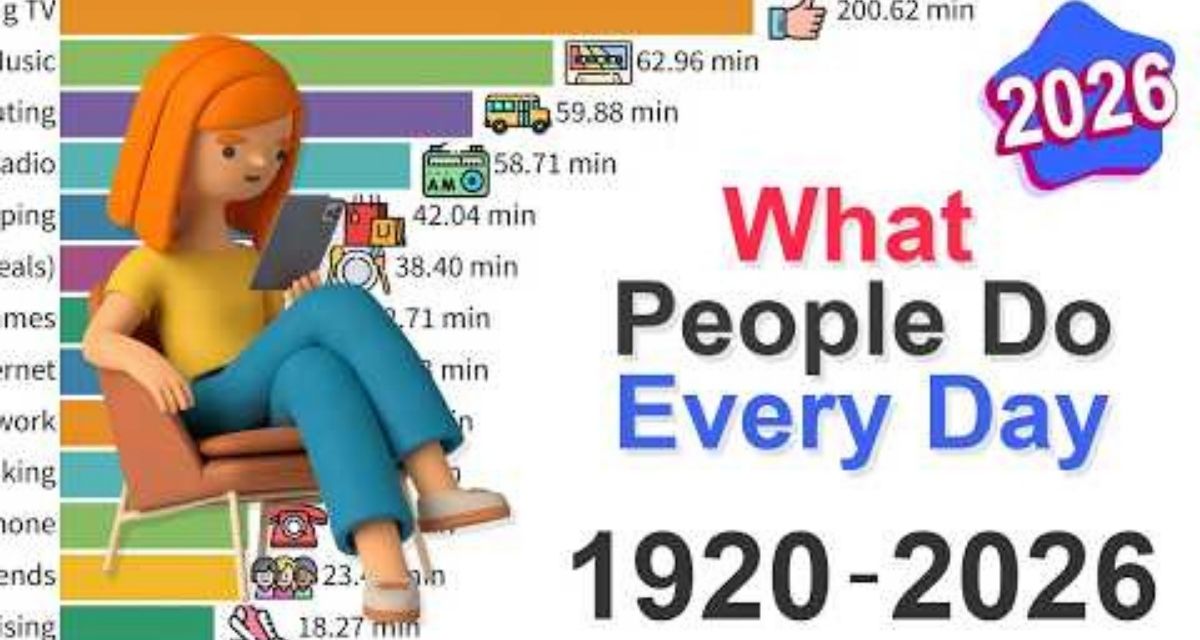
A bar chart race video from the YouTube channel Data is Beautiful illustrates the top 15 things people spent time on from 1920 to 2026. The charts exclude sleep, work, and other “activities with minimal variation,” with the goal of seeing what’s changed significantly over time. (If you’re wondering where the data came from, the creator, Sasha, shared a lengthy list of her sources and methodology in the video description.)
The biggest shifts in the last 106 years
In 1920, Housework, Cooking, Eating, and Meeting Friends took up the top four spots, followed by Doing Nothing and Reading Newspapers. Those activities (or lack thereof) continued to dominate the list through the 1920s, until radio became more popular. Listening to Radio shot to the top of the list through the 1930s and stayed at No. 1 through the ’40s.
Housework had another fleeting moment at the top just before television came along. Watching TV quickly dominated, grew, and stayed dominant from the ’50s all the way to the turn of the millennium. While Housework time diminished through those decades, not much else changed significantly until the 2000s, when Browsing the Internet began to climb.
Then came Streaming (Netflix/YouTube) and Scrolling Social Media, and you can guess how things went from there. By 2024, both had surpassed Watching TV. As of 2026, the top five things people spend time on outside of work and sleep are Streaming, Scrolling Social Media, Watching TV, Listening to Music, and Playing Games. We are nothing if not entertained.
What we’ve lost vs. what we’ve gained
One thing we’ve gained over the decades is leisure time, or, at least, we spend less time on chore-like tasks such as housework and cooking. And it seems we’ve chosen to spend that leisure time largely on what might best be classified as “entertainment.” Or perhaps more accurately, screen-based entertainment.
As one commenter put it, “This chart looks like the story of dopamine.”
The comments, in fact, are filled with people giving words to what this graphic shows:
“It’s emotional to see how we went from hanging out with people to just scrolling on the internet.”
“The fact that television dominated our lives for over 50 years is mind boggling.”
“So this is why it feels like we have so little time for these other valuable past times. The television box started the brain rot.”
“The seven top items of 2026 are essentially looking at screens, or consuming entertainment products, for a total of about 600 minutes per day.”
“I’m concerned at how ‘doing nothing’ just disappeared as a concept.”
“It’s funny, we spend most of our day distracting ourselves from our day.”
It’s easy to moralize about screens, but to be fair, not all screen usage is bad. For instance, we have greater access to arts through our screens than humans have ever had before. Most would agree that there’s a world of difference between watching the filmed stage production of Hamilton on Disney + and watching brain-rot video shorts autoplay on YouTube.
However, the bar chart visual showing the excessive amount of time people spend on screens is jarring and concerning. Few would argue that’s a good thing.
The push to return to ‘Boomer hobbies’
We don’t need an animated chart to know that screens and devices largely dominate our daily lives. We’re living it. We feel it. We can easily diagnose the problem. It’s the finding a remedy part that feels elusive.
“Use screens less” is the obvious answer, but obvious doesn’t mean easy. We’ve spent so many decades building the habit of being entertained, we need something specific to replace it with.
And that’s exactly what a lot of young people are doing with their “granny core” and “nonna maxxing” trends. People of all ages are looking at how people used to spend their time before screens overtook our lives and giving “Boomer hobbies” a go.
That means tactile, hands-on hobbies like knitting, crocheting, and breadmaking. It might mean writing letters by hand or learning how to garden. No one really wants to return to the days when housekeeping dominated their free time, but meeting up with friends, reading books (actual paper ones), and even just doing nothing seem more and more appealing the longer you look at these bar charts.
Isn’t it ironic how technology has improved our lives in so many ways, and yet the latest trends are all about the analog life? When so much of modern work life is dominated by screens, finding balance with screen-free hobbies and activities makes perfect sense.
It does make one wonder what the bar graphs in the next 20 years will look like, doesn’t it?
You can follow Data is Beautiful on YouTube for more.