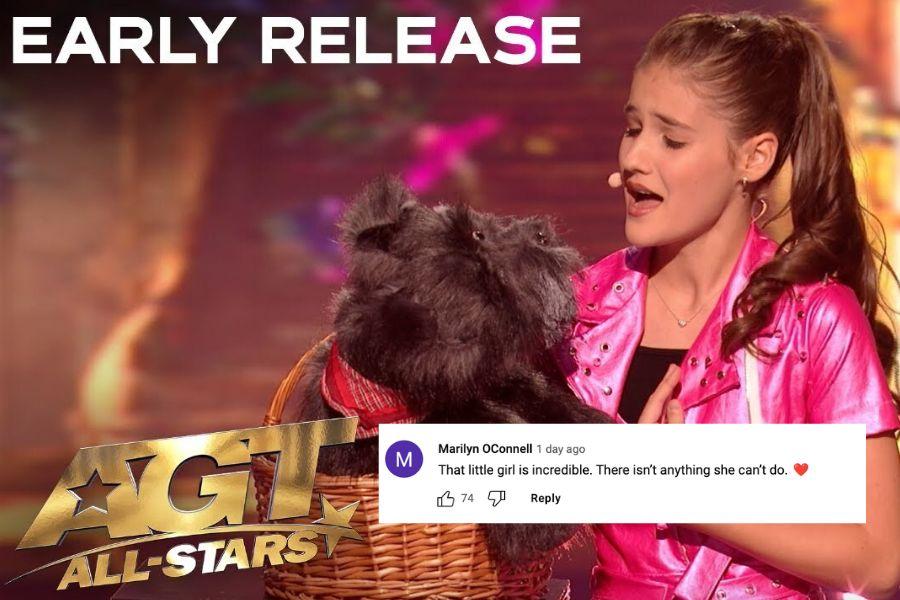
It’s not every day a ventriloquist act is so jaw-dropping that it has to be seen to be believed. But when it does happen, it’s usually on “America’s Got Talent.”
Ana-Maria Mărgean was only 11 years old when she first took to the stage on “Romania’s Got Talent” to show off her ventriloquism skills, an act inspired by videos of fellow ventriloquist and “America’s Got Talent” Season 2 champion Terry Fator.
Using puppets built for her by her parents, the young performer tirelessly spent her quarantine time in 2020 learning how to bring them to life, which led to her receiving a Golden Buzzer and eventually winning the entire series in Romania.
Mărgean is now 13 and a competitor on this season of “America’s Got Talent: All-Stars,” hoping to be crowned the winner and perform her own show in Vegas, just like her hero Fator.
The routine started with a hilarious bit between Mărgean and Waldo, her “rescue dog.” But it’s when she begins singing a bold and brassy version of Lesley Gore’s “You Don’t Own Me” that you know you’re witnessing something truly special.
Take a peek below. Holy moly, those high notes that Mărgean…er…I mean Waldo hit are fabulous.
The feedback from both the viewers and judges was unanimous awe.
“I mean, no wonder you won [RGT]. You are incredible, you are gorgeous, you can sing so beautifully…I love your furry friend, and it was funny, too! I love all the banter and the jokes,” applauded judge Heidi Klum.
Howie Mandel added, “I was laughing. And I cannot believe your story that you just started doing this during lockdown. Like, you don’t even have two years under your belt. That was amazing. The fact that this was something you looked up online, the fact that you were inspired by people you saw on America’s Got Talent—you are an AGT All-Star! The Superfans are gonna love you!”
Prior to her performance, Mărgean shared how winning “Romania’s Got Talent” completely changed her life, allowing her family to afford a brand new home. While her fate might still be up in the air for “AGT,” she’s already made huge strides and has racked up a lot of people rooting for her.
An Operation Smile volunteer reverses an oxygen mask so a child with a cleft condition can blow a bubble for the first time in Guadalajara, Mexico. (Operation Smile Photos)
For thousands of children born with cleft conditions, Operation Smile provides simple, playful tools—like bubbles—to strengthen the skills they need to speak and thrive.
While a bottle of bubbles might seem out of place in a hospital setting, you might be surprised to learn that, for thousands of children around the world born with cleft lip and palate, they can be a helpful tool in comprehensive cleft care. Lilia, who was born with cleft lip and palate in 2020, is one of the many patients who received this care.
As a toddler, Lilia underwent two surgeries to treat cleft lip and palate with Operation Smile’s surgical program in Puebla, Mexico. Because of Operation Smile’s comprehensive care, it wasn’t long before her personality transformed: Lilia went from a quiet and withdrawn toddler to an exuberant, curious explorer, babbling, expressing herself with a variety of sounds, and engaging with others like any child her age.
Lilia is now a healthy five-year-old, with the same cheerful attitude and boundless energy. Her progress is the result of care at every level, from surgery to speech therapy to ongoing support at home—but it’s also evidence that small, sustained interventions throughout it all can make a meaningful difference.
Lilia at age 1, before surgery, and at age 5, 4 years post-surgery
Cleft Conditions: A Global Problem
Since 1982, Operation Smile has provided cleft lip and cleft palate surgeries to more than 500,000 patients worldwide with the help of generous volunteers and donors. Cleft conditions are congenital conditions, meaning they are present at birth. With cleft lip and palate, the lip or the roof of the mouth do not form fully during fetal development. Cleft conditions put children at risk for malnutrition and poor weight gain, since their facial structure can make feeding challenging. But cleft conditions can have an enormous social impact as well: Common difficulties with speech can leave kids socially isolated and unable to meet the same developmental milestones as their peers.
Surgery is a vital step in treating cleft conditions, but it’s also just one part of a much larger solution. Organizations like Operation Smile emphasize the importance of multi-disciplinary teams that provide comprehensive, long-term care to patients across many years. This approach, which includes oral care, speech therapy, nutritional support, and psychosocial care, not only aids in physical recovery from surgery but also helps children develop the skills and confidence to eat easily, speak clearly, and engage in everyday life. This ensures that each patient receives the full range of support they need to thrive.
Marie, 11 months, with her mother at Operation Smile Madagascar before her cleft surgery (Operation Smile Photos)
A Playful (and Powerful) Solution
Throughout a patient’s care, simple tools like bubbles can play a meaningful role from start to finish.
Immediately before surgery, children are often in a new and unfamiliar environment far from home, some of them experiencing a hospital setting for the first time. When care providers or loved ones blow bubbles, it’s a simple yet effective technique: Not only are the children soothed and distracted, the bubbles also help create a sense of joy and playfulness that eases their anxiety.
Milagros Rojas, a volunteer speech therapist in Peru, using bubbles in a screening with a patient. (Operation Smile Photos)
In speech therapy, bubbles can take on an even more important role. Blowing bubbles requires controlled airflow, as well as the ability to form a rounded “O” shape with the lips, which are skills that children with cleft conditions may struggle to develop. Practicing these skills with bubbles allows children to gently strengthen their facial muscles, improve breath control, and support the motor skills needed for speech development. Beyond that, blowing bubbles can help kids connect with their parents or providers in a way that’s playful, comforting, and accessible even for very young patients.
Finally, bubbles often follow patients with cleft conditions home in the “smile bags” that each patient receives when the surgical procedure is finished. Smile bags, which help continue speech therapy outside of the hospital setting, can contain language enrichment booklets, a mirror, oxygen tubing, and bubbles. While regular practice with motor skills can help with physical recovery, small acts of play help as well, giving kids space to simply enjoy themselves and join in on what peers are able to do.
Bubbles at Home and Beyond
Today, because of Operation Smile’s dedication to comprehensive cleft care, Lilia is now able to make friends and speak clearly, all things that could have been difficult or impossible before. Instead of a childhood defined by limitation, Lilia—and others around the world—can look forward to a childhood filled with joy, learning, discovery, friends, and new possibilities.
CTA: Lilia’s life was changed for the better with the care she received through Operation Smile. Find out how you can make an impact in other children’s lives by visiting operationsmile.org today.
Mark Twain is often seen as the quintessential American novelist, having penned classics such as The Adventures of Tom Sawyer and Adventures of Huckleberry Finn. But he was also a popular travel writer who wrote six books about his adventures abroad. In 1867, he was sent by a newspaper to travel throughout Europe and the Holy Land via the Mediterranean Sea, resulting in the popular book The Innocents Abroad.
In 1880, Twain wrote an unofficial sequel to The Innocents Abroad called A Tramp Abroad, a fictionalized account of himself, his traveling companion “Harris,” and their attempt to walk through Europe. The book is both a travelogue from a time when it was rare for most Americans to travel to Europe and a satire of how clueless they can be when encountering new cultures.
Twain didn’t care much for European cuisine
One unforgettable passage in A Tramp Abroad has Twain critiquing European food and longing for his favorite comfort foods. He refers to European fare as unsatisfying, to say the least. “The number of dishes is sufficient, but then it is such a monotonous variety of UNSTRIKING dishes. It is an inane, dead-level of ‘fair-to-middling.’ There is nothing to ACCENT it,” Twain wrote.
In the book, he jokes that when he returns to the States, he will have a “modest” meal of his favorite foods prepared for him and will send his requests ahead of time so they are ready when he arrives. The menu contains 60 of his favorite American comfort foods.
Twain lists his favorite comfort foods
“It has now been many months, at the present writing, since I have had a nourishing meal, but I shall soon have one, a modest, private affair, all to myself,” Twain wrote. “I have selected a few dishes, and made out a little bill of fare, which will go home in the steamer that precedes me, and be hot when I arrive, as follows:
Early rose potatoes, roasted in the ashes, Southern style, served hot.
Sliced tomatoes, with sugar or vinegar. Stewed tomatoes.
Green corn, cut from the ear and served with butter and pepper.
Green corn, on the ear.
Hot corn-pone, with chitlings, Southern style.
Hot hoe-cake, Southern style.
Hot egg-bread, Southern style.
Hot light-bread, Southern style.
Buttermilk. Iced sweet milk.
Apple dumplings, with real cream.
Apple pie. Apple fritters.
Apple puffs, Southern style.
Peach cobbler, Southern style
Peach pie. American mince pie.
Pumpkin pie. Squash pie.
All sorts of American pastry.
Fresh American fruits of all sorts, including strawberries, which are not to be doled out as if they were jewelry, but in a more liberal way. Ice-water—not prepared in the ineffectual goblet, but in the sincere and capable refrigerator.”
Twain’s list of favorite foods is notable because he spent much of his life in different regions of the United States, including Hannibal, Missouri (his boyhood home), Hartford, Connecticut (his adult home), and Elmira, New York (his summer retreat).
His career as a writer also took him to places in the West, including San Francisco and Sacramento, California, as well as Carson City and Virginia City, Nevada. This led him to develop a taste for many regional cuisines, which he referenced specifically on his list. The oysters should be from San Francisco, and the black bass from Mississippi.
Some may recoil when they see a few items on his list, namely “’coon” (short for raccoon) and “’possum,” short for opossum. These days, most Americans would shudder at the idea of eating them for dinner, but in the 1800s, they were seen as delicacies. Both were commonly roasted or stewed and served with sweet potatoes.
Twain’s over-the-top menu is a fun look at the types of food that were popular in the late 1800s, and it’s also a charming example of how every region of the U.S. has its own specialty. Whether it’s fish in the Sierras or duck in Baltimore, Maryland, every place has its own flavor, and to a man who lived just about everywhere, they were all something to savor.
Let us not forget his arguably most well-known and beloved ’90s character, Rick O’Connell from the “Mummy” franchise. Between his quippy one-liners, Indiana Jones-like adventuring skills, and fabulous hair, what’s not to like? During a double feature of “The Mummy” and “The Mummy Returns” in London, moviegoers got the ultimate surprise when who should walk in but Brendan Fraser himself, completely decked out in Rick O’Connell attire. The brown leather jacket. The scarf. Everything.
“I am proud to stand before you tonight,” he told the audience. “This is a film that was made in Britain. You should know that! Even the second one, too. Be proud. Thank you for being here.”
He continued, “We didn’t know if it was a drama or a comedy or a straight-ahead action or romance, a horror picture, more action, all of the above. No idea until it tested in front of British audiences. Thank you for that.”
Fraser then asked the crowd if anyone hadn’t actually seen the movie yet, before shouting, “Outstanding!” when somebody raised their hand. He then quickly made a polite plug, encouraging people to go see “The Whale” before whisking himself away, saying, “I won’t take up any more of your time.”
Uh, yeah…I don’t think any time spent with Brendan Fraser is a waste. Do you?
At first glance, one might think that Jillian Lynch wore a traditional (read: expensive) dress to her wedding. After all, it did look glamorous on her. But this bride has a secret superpower: thrifting.
Lynch posted her bargain hunt on TikTok, sharing that she had been perusing thrift shops in Ohio for four days in a row, with the actual ceremony being only a month away. Lynch then displays an elegant ivory-colored Camila Coelho dress that fits her perfectly and still brand new with the tags on it, no less.
She found it at a thrift shop
You can find that exact same dress on Revolve for $220. Lynch bought it for only $3.75. The bride-to-be’s video quickly went viral, racking up 2.6 million views. People were floored that Lynch was able to find such a huge deal on a dress that seemed to be made just for her.
“Honestly, brides pay 1000s of dollars to look that good in a white slip dress like that, I think you’re rocking it & it’s perfect,” complimented one person.
OK, maybe it did cost her a little more than $3.75. In an interview with BusinessInsider, Lynch disclosed that she did make some customizations based on suggestions from the comments including ”elevating” the gown with non-adjustable shoulder straps, taking in the waist and adding a “demure” bit of lace to the front slit.
Altogether, those alterations totaled out to $110. Add to that some $8 shoes (also thrifted, of course) and Lynch still created an entire wedding look for only $113.75. That, ladies and gentlemen, is a steal.
Turns out, spending less might be the smarter move
According to a recent article in Brides, popular wedding planning site Zola predicts the average wedding cost is $36,000 for 2025. The numbers have been rising steadily over the last five years. Brides cites Brooke Ashivay, owner of Orange Blossom Special Events, who said that “comparing a 2019 wedding budget with one from 2024 at a similar venue and guest count, [we] observed an approximately 30 percent increase in costs,” likely due to increased demand after the worst of the COVID-19 pandemic. Not only that, but the average wedding dress now costs $2,000 according to The Knot. Weddings are supposed to be fun, celebratory and joyous, but it can be hard to feel any of those things when financial stress is involved. Who would want to start off a (hopefully) lifelong partnership that way? Save that money for the honeymoon, I say! Or the gas station!
She did keep one tradition, though
Still, Lynch didn’t say no to every wedding tradition. As she walked down the aisle in her gorgeous discounted gown, looking like a Grecian goddess, her father walked right alongside her. “I could see how much it meant to him, and it actually ended up meaning a lot to me,” she told Business Insider.
And perhaps most important of all, Lynch felt good in her own skin on her big day. “I don’t think I’ve ever felt that great in something. That’s what brides should feel on their wedding day, like they’re at their peak beautiful self. That’s exactly how I felt when I put it on.”
It doesn’t have to cost an arm and a leg to make lasting memories. And when you are able to show up for life’s big moments authentically, that feeling is priceless.
This article originally appeared four years ago. It has been updated.
The video—in which Goma showed up for a job interview at the BBC and was mistaken for, quite literally, another Guy (technology journalist Guy Kewney)—has gone viral time and time again, thanks in no small part to how well Goma handled the situation after being thrust into a live on-air interview.
Now, two decades after the wholesome snafu, Goma has decided to impart some wisdom about turning a potentially catastrophic moment into one of pure grace.
To be fair, Goma admits he wasn’t stoic the entire time
Speaking to This Morning, Goma said his initial thoughts were, “God help me. I’m lost completely.”
However, he remembered the words of his mother, who taught him to quietly fix a problem without embarrassing anyone.
“My mom always says to us, ‘If you notice something, your brother made a mistake anywhere, correct the mistake first before talking to the person,’” he said.
Not wanting to make anyone else feel uncomfortable, Goma held onto his composure. That was all the fuel he needed to carry on, answering the questions placed before him with such admirable self-possession that viewers still revisit the clip time and time again. Sure, it’s partly for a good laugh, but also because Goma’s chutzpah is undeniably inspiring.
The hidden Zen wisdom behind all this
Nearly all of us have experienced a situation where we felt unprepared, overwhelmed, or suddenly put on the spot (if you haven’t, your time is coming). Goma’s response offers a blueprint for surviving those moments with dignity intact. In similarly anxiety-inducing situations, we can direct our attention outside ourselves and aim to simply be of service in whatever way we can muster in the moment, rather than laser-focusing on what we’re experiencing internally. When that happens—when we forego our concept of “I,” as Buddhists say—what once felt insurmountable often suddenly shrinks to its proper size.
There’s also something to be said for the fact that Goma never appeared bitter about the misunderstanding that made him Internet-famous. Even not getting the job he originally came to interview for, which he shared was heartbreaking at the time, didn’t ultimately defeat his spirit. Over the years, he has retained his humor and warmth, which has only deepened people’s affection for him.
Life after becoming Internet-famous
According to Newstalk, Goma now works with people who have learning disabilities. It might not be the job he planned for all those years ago, but it sounds like he’s found work with purpose nonetheless. He also teamed up with Elliott Gotkine, the BBC producer who put him on the air, to release their story in book form as The Wrong Guy: The Inside Story of TV’s Greatest Cock-Up.
Though we may never find ourselves accidentally talking shop on live television, may we all handle our own unexpected blunders with that same humility and humor. Who’s to say what surprising blessings might come as a result?
When we talk about someone having a “terminal illness,” we generally mean an incurable, progressive disease that will eventually end someone’s life. Advanced cancer, end-stage heart disease, Alzheimer’s disease, Amyotrophic lateral sclerosis (ALS), and many other diseases are widely accepted as terminal in modern medicine.
Most medical institutions don’t include mental illnesses in that category either, for understandable ethical reasons. But as actor Martin Short shares from firsthand experience, viewing treatment-resistant mental illness as “terminal” can help families process the loss of a loved one to suicide.
In an interview with CBS Sunday Morning, Short compared losing his 42-year-old daughter, Katherine, to suicide in 2026 with losing his wife, Nancy, to cancer in 2010.
“You know, it’s been a nightmare for the family,” Short said when asked what he wanted to share about Katherine’s death. “But the understanding that mental health and cancer, like my wife, are both diseases. And sometimes with diseases, they are terminal. And my daughter fought for a long time with extreme mental health, borderline personality disorder, other things, and did the best she could until she couldn’t. So Nan’s last words to me were, ‘Martin, let me go.’ And she was just saying, ‘Dad, let me go.’”
Adding nuance to the “suicide is preventable” conversation
Short is speaking a hard truth that goes against the unequivocal messaging that suicide is preventable. As with so many human realities, conversations about mental health and suicide require nuance. Those who have seen a loved one through every available treatment, medication, therapy, and program, only to lose them to suicide after trying everything, play an important role in that conversation.
We understand that many deaths from cancer and heart disease are preventable, but not all are. While mental illness may not be directly comparable to those diseases, the reality is that some illnesses, both physical and mental, resist even the best and most effective treatments.
So glad this is going viral, someone I knew in college lost his mental health battle and his parents described it as a terminal illness at his memorial and it really opened my eyes and helped me accept mental illness. https://t.co/nTs5bJpPNn
As Sophia Laurenzi shared in her Time essay, “The Problem With Saying Suicide Is Preventable,” the blanket message that suicide can be prevented places an unfair burden on individuals and families.
Acknowledging the complex reality of suicide prevention
“Though well-intentioned, the truth is that not all suicides can be stopped, even with the best efforts,” Laurenzi wrote. “But right after my father’s death, everywhere I looked I read that suicide is preventable. This instilled an immediate, unconscious conviction in me of a double failure: my father, who had not done enough to save himself, and those of us who loved him most, who had not done enough, either. Collectively we could have deterred his death. But we did not.”
This feeling of failure and guilt prompted Laurenzi to dive deeply into suicide education and advocacy. That deep dive led her to the conclusion that while suicide prevention efforts are important, so is acknowledging the complex reality that a 100% success rate on that front is not currently possible.
“The crux of the issue with blanketing suicide as something that can be stopped is that it flattens one of the most confounding psychological, medical, and philosophical questions of being human into something simpler than its reality,” she wrote. “Perhaps one day we will be able to say that, with the right blueprint, suicide is preventable. But we do not have the knowledge, let alone the resources, to make that true now.”
“Maybe by sharing your pain, you will help other people’s pain”: After losing his daughter, Katherine, to suicide earlier this year, Martin Short told Tracy Smith about why he isn’t hiding his grief. pic.twitter.com/SQHvnEnt5u
To be clear, acknowledging that suicide isn’t always preventable is not the same as saying suicide is inevitable. Most suicides are preventable, and people should absolutely exhaust all preventative measures and possibilities. Knowing typical warning signs, having access to mental health treatment, limiting access to firearms and other highly lethal methods, and following other best practices are vital to giving someone the best chance of surviving a suicidal mental illness.
Keeping hope in the balance
Acknowledging that mental illness can be “terminal” also doesn’t mean that people shouldn’t have hope. Many illnesses that used to be terminal diagnoses—HIV, cholera, and more—are now totally survivable thanks to advances in medicine. Just because some people’s mental illness resists all known treatments now doesn’t mean we won’t find more effective treatments in the future. Most mental illnesses, even many serious ones, are currently treatable.
— Harborview Injury Prevention & Research Center (@HIPRC) November 18, 2020
But in some cases, for some people, having all the access in the world to resources, support, and treatment may not be enough. Just as doctors can exhaust all treatments for physical illnesses, people can also exhaust all treatments for mental illnesses. That doesn’t mean anyone should ever give up hope or stop trying. It means that families and friends who did everything they could, and who knew their loved one fought as long and hard as they were able to, can find peace in understanding that their loved one who died by suicide was dealing with a terminal, treatment-resistant illness that ultimately took their life.
Short shared that he’s gotten involved with Bring Change to Mind, an organization started by actress Glenn Close, which he said is “taking mental health out of the shadows.”
“Not being ashamed of it, not hiding from the word ‘suicide,’ but accepting that this can be the last stage of an illness,” said Short. “That’s my approach to this.”
In 1971, a year after the break-up of the Beatles, John Lennon released his most important piece of music, his single “Imagine.” The song is an appeal to humanity’s goodness and urges the listener to “join us” in visualizing a world without war, hunger, or greed.
The song provides a glimmer of hope in that if we can visualize a perfect world, then maybe one day it will be achievable. Over the past 50 years, the song has become a secular hymn that can conjure hope in the aftermath of the most tragic events. The song was played by Queen at Wembley Arena the night after Lennon was murdered in December 1980. Stevie Wonder sang it at the closing ceremonies of the 1996 Olympics to honor the lives of those lost at the Centennial Olympic Park bombing. Neil Young played it at the 9/11 Tribute to Heroes concert. And who could forget the infamous celebrity singalong to “Imagine” in 2020 barely a week into the initial COVID pandemic shutdown?
Why Julian Lennon vowed never to sing it
“Imagine” is widely seen as Lennon’s signature song that encapsulates his artistic persona, which is no small feat given the earth-shattering effect the songs he wrote with the Beatles have had on the world.
Given the song’s incredible power, Lennon’s son Julian vowed never to perform it in public. Julian has had success as a musician over the years, most notably with his 1984 hit, “Too Late for Goodbyes.” He’s also a philanthropist who has produced numerous documentaries.
The war in Ukraine pushed Julian to break his vow and he performed a beautiful rendition of “Imagine” as part of Global Citizen’s social media rally, “Stand Up For Ukraine” on April 8, 2022. The campaign worked to raise money for the war-torn country, a cause Julian still adamantly supports.
During the 2022 performance, Julian was accompanied by guitarist Nuno Bettencourt, who is best known as the lead guitarist of the Boston rock band Extreme and a longtime guitarist for Rihanna’s world tours.
“The War on Ukraine is an unimaginable tragedy… As a human, and as an artist, I felt compelled to respond in the most significant way I could,” Lennon wrote in the video’s description in 2022. “So today, for the first time ever, I publicly performed my Dad’s song, IMAGINE. Why now, after all these years? — I had always said, that the only time I would ever consider singing ‘IMAGINE’ would be if it was the ‘End of the World’…But also because his lyrics reflect our collective desire for peace worldwide.”
Watch:
Lennon went on to say he was influenced to sing the iconic song “because within this song, we’re transported to a space, where love and togetherness become our reality, if but for a moment in time… The song reflects the light at the end of the tunnel, that we are all hoping for…
“As a result of the ongoing murderous violence, millions of innocent families, have been forced to leave the comfort of their homes, to seek asylum elsewhere,” Lennon concluded his message. “I’m calling on world leaders and everyone who believes in the sentiment of IMAGINE, to stand up for refugees everywhere! Please advocate and donate from the heart. #StandUpForUkraine.”
Lennon’s decision to never play “Imagine” was a wonderful way to honor his father’s legacy by respecting the power of his song, but John would probably be proud if he knew that he sang it at a time when we all need to imagine “all the people living life in peace.”
Julian Lennon keeps his father’s legacy alive
Julian Lennon continues to advocate for those suffering in the world by raising awareness and offering help through his charity, The White Feather Foundation, which was established in 2007 and exists “for the Conservation of Life” and provides aid for the environment, the preservation of Indigenous cultures, and access to clean water, education, and health.
In 2023, The White Feather Foundation launched an emergency campaign alongside World Central Kitchen to feed those in need in response to the Israel-Hamas conflict. And in early 2025, Lennon and The White Feather Foundation donated a split $10,000 to MusiCares and FireAid in response to the Los Angeles wildfires.
Clearly in all that Lennon does to help the world and others, whether through his philanthropy or his music, he’s supporting the vision of “Imagine” and making his father proud.
This article originally appeared four years ago. It has been updated.
There is a grittiness that seems to be missing in today’s movies. A big reason is that actors look too perfect. Before the turn of the millennium, the screen was filled with actors whose faces had character: Walter Matthau’s nose, Jack Nicholson’s wild hairline, and Sylvester Stallone’s droopy eyes and bottom lip that pulled to the side. They looked like real people, and that made them much more relatable than today’s A-listers, such as Ryan Gosling, Ryan Reynolds, and Michael B. Jordan.
When it comes to female actors, the difference is less noticeable because women have always been held to more stringent beauty standards. But in the late ’80s, some of the biggest stars, including Meryl Streep, Sigourney Weaver, and Geena Davis, were all pretty, but their faces had character. Compare that to today’s actresses, such as Scarlett Johansson, Margot Robbie, and Zendaya.
Archer Green, a popular YouTuber who digs deep into why movies work, took a shot at explaining why actors look so different today in a video titled “Why Aren’t Actors Ugly Anymore?” In the video, he cites three major reasons why actors today lack the relatable physical characteristics that made pre-millennium screen legends so memorable.
1. Cosmetic surgery
“In an article from 2021, Raquel S. Benedict likens our body to an investment in which we have to maximize our value through looking good,” Green said. “We’re reduced to a collection of features like perfect skin or a strong jawline. The body is no longer the vehicle through which we experience joy and pleasure, but a status symbol that needs to be constantly presentable to the world.”
“For actors, this is taken to the extreme, especially for women. They can never age or show any imperfection. They need to be a bankable star, and a big part of this is looking good on camera. Pretty girls should always smile,” Green added.
He adds that actors these days all have perfectly straight, pearl-white teeth. He notes that earlier in his career, Tom Cruise had crooked front teeth, which made him look like a real person. Many actors today also have perfect hairlines, whereas actors such as Nicholson, Bill Murray, and Burt Reynolds had age-appropriate receding hairlines that made them look authentic.
They've not always had Hollywood smiles! From Tom Cruise to Celine Dion and Cheryl. dental experts weigh in on the work stars have had done to transform their teeth
Images from his time on the 80s movie. Tom Cruise's gnashers are far from straight before having dental work done. pic.twitter.com/5CiZXApxGm
“iPhone face. It’s hard to define, but I think it’s basically this kind of pristine look that most actors seem to have,” Green said. “It’s why some people look out of place in period pieces because they’ve got a modern haircut or their teeth are too wide. They’re striving for a kind of look that didn’t really exist before the 21st century.”
“And this speaks to a kind of aesthetic that many modern movies have,” Green said. “They’re perfectly lit, the set perfectly designed, the actors in perfectly clean clothes, but this kind of perfection just makes it all look boring.”
3. The industry is afraid to take risks
“If you look for it, you can find interesting-looking people in modern movies,” Green said. “But this whole change in how actors and, by extension, movies in general look is a natural result of an industry that’s afraid to take risks. Movies need to make money, so they minimize anything that could theoretically make the film less successful, but in the process, remove what makes it special.”
Ultimately, Hollywood is in the storytelling business, and one of the keys to making a story work is creating characters who are relatable and have, well, character. The movie business is in the depths of a six-year slump, and the cure for getting folks back into theaters may not be fear-based perfection, but putting people on screen who resemble the folks in the seats.
It’s no secret that even the most seemingly safe of public places can instantly turn dangerous for a woman. Is it fair? No. But is it common? Absolutely, to the point where more and more women are documenting moments of being stalked or harassed as a grim reminder to be aware of one’s surroundings.
One of the most common and frightening experiences many women can relate to is being followed by a strange man. It’s scary because it’s difficult to tell the difference between a random passerby who just happens to be walking in your direction and someone who has malicious intentions. At least, at first. But sadly, most women have learned how to pick up on the clues.
Lacie (@lacie_kraatz) is one of those women. In April of 2023, she was out on a run when she noticed a man in front of her displaying suspicious behavior.
Things got especially dicey when the man somehow got behind her. That’s when she pulled out her phone and started filming, partially to prove that it wasn’t just her imagination, and also out of fear for her safety.
“Hello. I’m just making this video so that women are a little more aware of them,” she begins in the video. “See this gentleman behind me? Yeah, this is what this video’s about.”
Here is exactly what happened on that run
According to Lacie, the two were initially running in opposite directions. But at some point after seeing her, the man stopped in the middle of the trail and waited for her to pass so that he could follow her path from behind.
“Now, I know what you’re thinking, ‘Why are you suspecting that he’s following you?’” Lacie continues. “Well, let me tell you. I was just walking like this, and I look up, and he’s in front of me, and he just keeps doing a ‘peek’ like this behind him, over and over again.”
Lacie added that at one point, she even made an illegal crossing when “do not walk” sign was still up in an attempt to put some distance between herself and the man. After looking over her shoulder, she noticed that the man was visibly “speeding” to keep up.
In case there is still any doubt, Lacie then begins to run to see if the man will follow suit. Sure enough, he does.
Luckily the man eventually seems to give up, though he still seems to be watching her from a distance. Lacie ends up safe back home, but she didn’t even accomplish what she set out to do that afternoon.
“I couldn’t even finish my run,” she concludes. “I only ran like a mile and a half. I wanted to do 3 miles, but no, creepy men just had to be creepy f****** men today.”
Women in the comments had plenty to say
Countless women empathized with Lacie in the comments section. Clearly, this was not a unique circumstance.
“What I do when I’m being followed is act feral,” yet another person shared. “Like I’ll bark and growl really loud and flail my arms around. If you look crazy, you’re doin’ it right.”
Another added, “Man, nothing pisses me off more than men who make me feel uncomfortable doing things that I NEED to do for my health and well-being.”
Others tried to give their own tips for handling the situation, from finding nearby police or fire stations to using a variety of running trails to simply notifying the first visible passerby of what’s happening and asking to stand with them.
And of course, the resounding advice was to use the public space, and modern-day technology, to one’s advantage.
As one person wrote, “Girls we have got to normalize turning around and yelling at people following us. Let them know you know, take pictures of them, scream, make a scene.”
What experts say you should do
Experts say the most important thing is to stay in a populated area as long as you’re being followed. If you can pop into a store, do it. And always let a trusted friend or loved one know where you are. Giving a family member access to Find My Phone or a similar tracking app could be a lifesaver.
It’d be nice if these kinds of unsettling interactions didn’t exist. But here we are.
Some estimates say around 75% of women have been followed by a stranger at some point in their lives; a shocking, tragic statistic. They’re also around four times as likely to be continuously stalked compared to men. It’s not fair that women and girls have to deal with this, and that they’re forced to develop a keen instinct for when danger is present.
At the very least, it’s good that women are speaking up more so that these situations are easier to spot early on and women can know how to navigate them in the safest way possible.
And as for Lacie, she went on to join the US Coast Guard and regularly posts updates about her life in the military. Safe to say she has no problem taking care of herself these days.
This article originally appeared three years ago. It has been updated.