upworthy
Add Upworthy to your Google News feed.
Google News Button
Joy

US players comforting Iranian opponents after their World Cup match is humanity at its best

The politically charged match ended with several beautiful displays of genuine human connection.

world cup soccer us iran hug

US and Iranian players embrace after World Cup match-up.

The lead-up to the 2022 World Cup match between the U.S. and Iran was filled with anticipation, as the teams battled for a spot in the final 16 and long-running tensions between the two nations on the political stage rose to the surface.

The Iranian team had some internal tensions of its own to deal with as players navigated the spotlight amid human rights protests in their home country and rigid expectations of their government. According to CNN, after refusing to sing the national anthem before its match against England on November 21, the Iranian team was reportedly called into a meeting with the Iranian Revolutionary Guard Corps and told that their families would face “violence and torture” if they did not sing the anthem or engaged in any other form of protest.

Hence, before the match against the U.S., the players were shown somberly singing the anthem. Then they got down to the business they were there for—trying to win (or at least tie) a soccer match to advance to the World Cup round of 16.

It was an exciting game, with the U.S. ultimately winning 1-0. But in the end, all of the intense competition and political tensions were superseded by some truly heartwarming acts of good sportsmanship and human kindness.


As the U.S. team celebrated victory and the Iranian team mourned defeat, it didn't take long for players from the two teams to embrace one another in comfort and solidarity. Videos and images of the opposing team members arm in arm, hugging and crying together, show how sports bring people together regardless of their background.

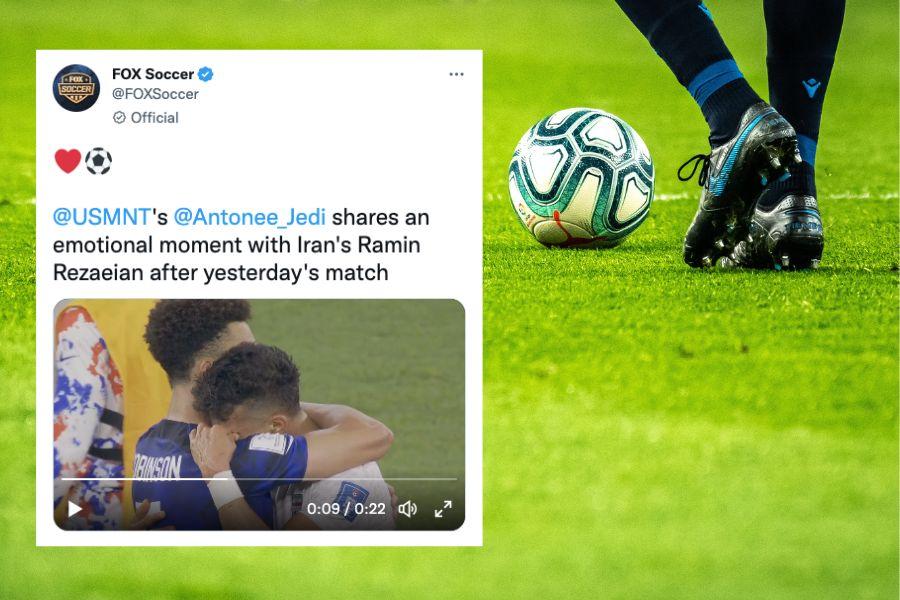
In one video, U.S. player Antonee Robinson is seen approaching a clearly distraught Ramin Rezaeian, pulling him into a hug and speaking into his ear as the Iranian player let his emotions out.

"If we were playing any team—if it was England, Wales or anyone who we would’ve knocked out that day—and I’d seen another player crying, I’d like to think that I’d go over and console them," Robinson told CBS News. "It didn’t really mean anything to me that the guy was Iranian—he was just someone that I’d just shared the pitch with in a really tough game.

"As a fellow human professional, someone who’s given everything the same way he has, it was just a moment of trying to console him and tell him he should be proud of what he’s done," he added.

After the loss, Iranian player Saeid Ezatolahi sat hunched over on the pitch, head in his hands as the tears flowed. Seconds later, U.S. players Josh Sargent and DeAndre Yedlin came to console him. Soon, fellow U.S. team members Tim Weah and Brenden Aaronson joined them, pulling Ezatolahi off the ground and embracing him with words of encouragement.

"I could feel the emotion from him on the ground," Aaronson told Fox Sports. "It’s tough, it’s a tough moment for a lot of things. You put your heart and soul and I think he had a great game too, and a great tournament from Iran. It’s hard to see that from a player. All you want to do is go and console them and tell them that everything is going to be OK. It’s just a human thing."

Weah told Fox Sports, "I think it’s more than just football. I think the United States and Iran have had so many issues politically and I just wanted to show that we are all human beings and we all love each other.

"I just wanted to spread peace and love and show him we come from different backgrounds, we grew up differently," he added. "He is still my family, he is still my brother and I love him the same way as the guys I grew up with."

Absolutely beautiful. When you strip away all the geopolitical stuff and the prejudices and conflicts between governments, we are simply one human family on this big flying rock, with far more in common than not. How wonderful to be reminded of our fundamental human connection on one of the world's biggest competitive stages.

boomer grandparents, boomer grandparent, millennial parents, millennial parent, grandkids
Image via Canva/PeopleImages

Boomer grandparents are excessively gifting their grandkids, and Millennial parents have had enough.

Millennial parents and Boomer grandparents don't always see eye to eye on parenting and grandparenting. Now, Millennial parents are uniting on a nightmare Boomer grandparenting trend that sees them "excessively gifting" their grandkids with tons of both new and old *unwanted* stuff during visits.

Ohio mom Rose Grady (@nps.in.a.pod) shared her "Boomer grandparent" experience in a funny and relatable video. "Just a millennial mom watching her boomer parents bring three full loads of 'treasures' into her home," she wrote in the overlay.


Grady can be seen looking out the window of her home at her Boomer mom and dad carrying bags and boxes up her driveway after several visits. The distressed and contemplative look on Grady's is speaking to plenty of Millennial moms.

@nps.in.a.pod

Today's "treasure" highlight was the mobile that hung in my nursery... #boomerparents #boomers #boomersbelike #millennialsoftiktok #millenialmom #motherdaughter

Grady captioned the video, "Today's 'treasure' highlight was the mobile that hung in my nursery..."

The humorous video resonated with with fellow Millennial parents. "Straight to the trash when they leave," one viewer commented. Another added, "I always say 'if you don’t want it in yours, we don’t want it in ours' 😂."

Even more Millennial parents have shared and discussed their situations with Boomer grandparents buying their kids too much stuff on Reddit. "Both my mother and my MIL love buying and sending toys, books, clothes, etc. I don't want to be ungrateful but we just don't need it and don't have the space. I have brought this up politely in 'we are all out of drawers for that' but it hasn't slowed things down," one explained. "I think part of the issue is that the grandparents live in different cities and vacation a lot. They don't get to see our daughter much so they buy stuff instead."

Another Millennial parent shared, "While the intention is very kind behind these, all the grandparents are very aware that we do not need, nor wish to receive these gifts in such an excessive volume - as it creates a daily struggle to store and accommodate in our home. I struggle to keep on top of tidying as it is, and this is a massive added challenge."

millennial parents, millennial parent, millennial mom, kids room, organize Millennial mom struggles to organize her son's room.Image via Canva/fotostorm

How to talk to Boomer grandparents about gifts

So, why are Boomer grandparents excessively gifting? "Boomer grandparents may be the first grandparent generation to have accumulated the substantial discretionary funds that enables them to spend money on their grandchildren," Sari Goodman, a Certified Parent Educator and founder of Parental Edge, tells Upworthy. "These grandparents probably grew up with grandparents who didn’t have that kind of money and so they may be excited to give their grandchildren the things they didn’t get."

Goodman suggests that Millennial parents first discuss with them the "why" behind the gifting. "What comes before setting a boundary to limit over-the-top gift-giving is delving into the reasons grandparents are buying so much," she explains. "Coming from a place of compassion and understanding makes it possible to come up with mutually beneficial solutions."

- YouTube www.youtube.com

She recommends that Millennial parents sit down with their Boomer parents to learn more. "Did they grow up without many toys and clothes and are fulfilling a dream? Ask them about the values they learned as children (hard work, perseverance, the power of delayed gratification) and how they can pass on these lessons to the grandchildren," she suggests.

She adds that another reason may be that Boomer grandparents live far away and want their grandchildren to feel a connection with them. "Set up a regular FaceTime or Zoom meeting. Rehearse with the kids so they have something to say and suggest a topic for the grandparents," says Goodman. "Or send snail mail. Kids love getting mail. The grandparents can send postcards from where they live and explain some of the special sites."

boomer grandparents, boomer grandparenting, video chat, video call, grandkids Boomer grandparents have a video call with grandkids.Image via Canva/Tima Miroshnichenko

Finally, Goodman adds that for some grandparents, this may be is the only way they know how to show their love. Millennial parents could ask if they would be open to other ideas. "Parents can set up an activity for grandparents and kids to do when they come over—a jigsaw puzzle, art activity, board game, magic tricks," she says. "Arrange for the grandchildren to teach the grandparents something their phones can do or introduce them to an app they might like."

This article originally appeared last September

period, punctuation, gen x, gen z, texting

Periods aren't aggressive. Full stop.

"Good morning." ... "Omg, why are you mad at me?"

Alright, let's make something clear here. As a Gen X mom of three Gen Z kids in their teens and 20s, there are many things I'm willing to concede and even celebrate when it comes to our generation gap. I love Gen Z's global consciousness, their openness about mental health, their focus on inclusivity, and their insistence on wearing comfortable shoes with formal wear. But there's one Gen Z feature that I simply cannot abide, and that is the ridiculous weaponization of basic punctuation.


"It freaks me out when you say 'yes period' in a text," my high schooler told me one day. "It feels so aggressive, like I feel like I'm in trouble or something." I stared at him incredulously as his 20-year-old sister laughed and then agreed with him. "It does! The period makes it feel like you're mad," she said.

Texting, periods, gen z, gen x, generation gap How can we see a period so differently?Photo credit: Annie Reneau

Ah yes, the period, literally the most benign punctuation mark of them all, is now "aggressive." I want to laugh, but I'm far too aware of the consequences of miscommunication. Far from being a mere generational quirk, this misinterpretation of normal punctuation in text messages as aggressive or angry could result in serious communication breakdowns. Talking by text is already hard enough, and now we're adding a layer of meaning that flies in the face of everything older folks have ever been taught about writing?

The kids are serious about this, though. According to Gen Zers, pretty much any time someone puts a period at the end of a text, it means they're mad or irritated, as if the period is being emphasized.

period, punctuation, texting, gen z, gen x "Period!" means period. An actual period means nothing.Giphy GIF by Sony Pictures Television

At the risk of sounding like a dinosaur, I'd like to point out that reading into periods in texts like this is silly. It's silly when the young folks do it with each other, but it's extra silly when they do it with adults who didn't grow up with texting and have ingrained grammatical habits that aren't easy to shake. (And frankly, some of us don't want to shake—I'm a former English teacher, for crying out loud. Might as well ask me to start misspelling words on purpose.)

In no reasonable world can "Yes." be automatically viewed as aggressive. It's just not. Neither is "Time to get off the computer." Neither is "Got it." Or "OK." or "Sure." I understand that texting conventions have evolved such that end punctuation isn't viewed as necessary, but when did we start assigning negative intentions to it? A period should not be read as anything more than a matter-of-fact, neutral-toned statement, since we have other tools for conveying tone in writing—capital letters, italics, bold, exclamation points. I mean, if I wanted to be aggressive, I'd text, "HEY—it's time to GET OFF the COMPUTER!" We also have a slew of emojis to convey tone. A period is and has always been neutral. That's literally the entire point of a period.

I'm even willing to give Gen Z an inch on the thumbs-up emoji (they think that's aggressive, too) only because emojis are new and their meanings are up for interpretation. But a period? Not budging. That little dot has been signaling the end of people's thoughts for centuries. Periods can and do sometimes affect tone in subtle ways—"No, I didn't," hits slightly differently than "No. I didn't."—but their basic inclusion at the end of a thought in no way signals aggression or anger, by text or otherwise. Not on Gen X's watch, at least. This is one generational hill I am willing to die on.

mic drop, period, texting, gen x, gen z Mic drop. Giphy Parks And Recreation Mic Drop GIF

These unwritten rules of texting seem to have been concocted by Gen Z, but when? And how? Who decides these things? Is there a group of powerful and influential young adults who put out a bat signal at some point, saying that periods are symbols of aggression? If the young folks want to play the reading-into-basic-punctuation game amongst themselves, unnecessarily making communication much more complicated for themselves, have at it. But please don't ascribe intent to us old fogies who've had "declarative statements end in periods" ingrained in us since elementary school.

Texting wasn't always like this. When texting first became a thing, using periods in them was pretty normal. As more and more people started dropping them (and capitalization—another deep English teacher wound), I held firm to their usage, mostly out of habit and feeling like my texts were incomplete without them. As my kids got old enough to text and informed me that periods are viewed by their age group as aggressive, I reconsidered. Should I stop using them, giving in to the tyranny of Gen Z's overthinking? Should I keep using them, embracing the fact that I'm old and set in my ways?

period, punctuation, gen x, gen z, texting A period is just a period. Period. Photo credit: Canva

Ultimately, I landed on sometimes using periods in texts and sometimes not—a compromise between my own rigid grammar rules and Gen Z's seemingly senseless texting rules. Except only using periods sometimes just confuses my kids even more, which is hilarious. Is Mom mad? Is she not? My daughter said she just has to remind herself who is texting, knowing that I—and most of my generation—simply don't use periods aggressively.

This is the way. I adore you, Gen Z, but you are perfectly capable of discerning who you're talking to, and I'm not giving up that useful little dot. Not now. Not ever. Period.

This article originally appeared in February. It has been updated.


the great depression; Florence Thompson; Mona Lisa of the Great Depression; Mona Lisa; the depression; depression era
Photo by Dorothea Lange via Library of Congress
The woman from the famous Great Depression photo didn't know about her fame for 40 years.

It's one of the most iconic and haunting photos of all time, up there with the likes of Hindenburg, The Falling Soldier, Burning Monk, Napalm Girl, and many others. It's called simply Migrant Mother, and it paints a better picture of the time in which it was taken than any book or interview possibly could.

Nearly everyone across the globe knows Florence Owens Thompson's face from newspapers, magazines, and history books. The young, destitute mother was the face of The Great Depression, her worried, suntanned face looking absolutely defeated as several of her children took comfort by resting on her thin frame. Thompson put a human face and emotion behind the very real struggle of the era, but she wasn't even aware of her role in helping to bring awareness to the effects of the Great Depression on families.


It turns out that Dorothea Lange, the photographer responsible for capturing the worry-stricken mother in the now-famous photo, told Thompson that the photos wouldn't be published.

Of course, they subsequently were published in the San Francisco News. At the time the photo was taken, Thompson was supposedly only taking respite at the migrant campsite with her seven children after the family car broke down near the campsite. The photo was taken in March 1936 in Nipomo, California when Lange was concluding a month's long photography excursion documenting migrant farm labor.

the great depression; Florence Thompson; Mona Lisa of the Great Depression; Mona Lisa; the depression; depression era Worried mother and children during the Great Depression era. Photo by Dorthea Lange via Library of Congress

"Migrant worker" was a term that meant something quite different than it does today. It was primarily used in the 30s to describe poverty-stricken Americans who moved from town to town harvesting the crops for farmers.

The pay was abysmal and not enough to sustain a family, but harvesting was what Thompson knew as she was born and raised in "Indian Territory," (now Oklahoma) on a farm. Her father was Choctaw and her mother was white. After the death of her husband, Thompson supported her children the best way she knew how: working long hours in the field.

"I'd hit that cotton field before daylight and stay out there until it got so dark I couldn't see," Thompson told NBC in 1979 a few years before her death.

the great depression; Florence Thompson; Mona Lisa of the Great Depression; Mona Lisa; the depression; depression era A mother reflects with her children during the Great Depression. Photo by Dorthea Lange via Library of Congress

When talking about meeting Thompson, Lange wrote in her article titled "The Assignment I'll Never Forget: Migrant Mother," which appeared in Popular Photography, Feb. 1960, "I saw and approached the hungry and desperate mother, as if drawn by a magnet. I do not remember how I explained my presence or my camera to her, but I do remember she asked me no questions. I made five exposures, working closer and closer from the same direction. I did not ask her name or her history. She told me her age, that she was thirty-two. She said that they had been living on frozen vegetables from the surrounding fields, and birds that the children killed."

Lange goes on to surmise that Thompson cooperated because on some level she knew the photos would help, though from Thompson's account she had no idea the photos would make it to print. Without her knowledge, Thompson became known as "The Dustbowl Mona Lisa," which didn't translate into money in the poor family's pocket.

In fact, according to a history buff who goes by @baewatch86 on TikTok, Thompson didn't find out she was famous until 40 years later after a journalist tracked her down in 1978 to ask how she felt about being a famous face of the depression.

@baewatch86

Florence Thompson, American Motherhood. #fyppppppppppppppppppppppp #historytok #americanhistory #migrantmother #thegreatdepression #dorthealange #womenshistory

It turns out Thompson wished her photo had never been taken since she never received any funds for her likeness being used. Baewatch explains, "because Dorothea Lange's work was funded by the federal government this photo was considered public domain and therefore Mrs. Florence and her family are not entitled to the royalties."

While the photo didn't provide direct financial compensation for Thompson, the "virality" of it helped to feed migrant farm workers. "When these photos were published, it immediately caught people's attention. The federal government sent food and other resources to those migrant camps to help the people that were there that were starving, they needed resources and this is the catalyst. This photo was the catalyst to the government intercepting and providing aid to people," Baewatch shares.

- YouTube www.youtube.com

As for Lange, Migrant Mother was not her only influential photograph of the Great Depression. She captured many moving images of farmers who had been devastated by the Dust Bowl and were forced into a migrant lifestyle.

"Broke, baby sick, and car trouble!" is just one of her many incredible photos from the same year, 1937.

She also did tremendous work covering Japanese internment in the 1940s, and was eventually inducted into the International Photography Hall of Fame and Museum and the National Women's Hall of Fame.

the great depression; Florence Thompson; Mona Lisa of the Great Depression; Mona Lisa; the depression; depression era Families on the move suffered enormous hardships during The Great Depression.Photo by Dorthea Lange via Library of Congress

Thompson did find some semblance of financial comfort later in life when she married a man named George Thompson, who would be her third husband. In total, she had 10 children. When Thompson's health declined with age, people rallied around to help pay her medical bills citing the importance of the 1936 photo in their own lives. The "Migrant Mother" passed away in 1983, just over a week after her 80th birthday. She was buried in California.

"Florence Leona Thompson, Migrant Mother. A legend of the strength of American motherhood," her gravestone reads.

Family

Baby 'writes' heartbreaking pre-apology note to plane passengers on its first flight

"I made a deal to be on my best behaviour—but I can’t make any guarantees."

babies, baby, parenting, motherhood, moms, airplanes, flying, flight, travel, etiquette, public spaces, kindness

An excellent reminder to show kindness and patience.

The reality is that listening to a baby cry during a flight might be aggravating, but it’s nothing compared to the moans, groans, and eyerolls that the baby's parents must endure from other passengers when it happens. No matter what tips and tricks are used to try to soothe a little one’s temperament while 30,000 miles in the air, crying is almost inevitable. So, while having to ease their own child’s anxiety, moms and dads also must suffer being the pariah of the trip. What a nightmare.

Airplanes are a particularly tricky public space in which to take your children. First, unlike say, fine dining or the opera, flying with a baby isn't always optional. Sometimes, a certain level of travel is required in your life, and small children have to come along. Second, and probably worst of all, there is no escape from the airplane once you've boarded. No matter what happens, crying, puking, blowouts, or spills — you're stuck dealing with it, and the dirty looks, until the plane has landed.


This mom went above and beyond on her baby's first flight

Recently, one mom was apparently trying so hard to avoid upsetting her fellow flight members that she went above and beyond to essentially apologize ahead of time if her baby began to cry on its first flight. It was a gesture that, while thoughtful, really made folks feel for how stressed that poor mom must be.

In a clip posted to his TikTok, one of the passengers—Elliot—explained that the mom handed out small care packages to those nearby. “She’s already so busy and took the time to make these bags for everyone,” Elliot said, before panning the camera to reveal a Ziplock bag full of candy, along with a note that made him “want to cry.”

The note read: “It’s my first flight. I made a deal to be on my best behaviour—but I can’t make any guarantees. I might cry if I get scared or if my ears start to hurt. Here are some treats to make your flight enjoyable. Thank you for being patient with us. Have a great flight.” Elliot appeared choked up by the thoughtfulness on display as he examined the contents of the bags.


Like Elliot, those who watched the video felt some ambivalence at the well-intentioned act. Many felt remorse that she would feel the need to appease people in this way.

“This is so sweet but also … kind of breaks my heart that we live in a world in which parents feel the need to do that.”

“Because jerk people have shamed parents into believing that they need to apologize for their kids' absolutely normal behavior. What a gem of a mom.”

“You know that sweet mom worried about this trip so much.”

“That poor mom probably spent nights awake … nervous about that flight, thinking of ways to keep strangers happy.”

"That's a mom trying so hard."

"The fact she took up valuable carry on space for these treat bags"

"Always wondered if we don’t bring kids out in public how can they learn to act in public? thank you for being so sweet to this mom"

Then again, who wouldn't appreciate some free candy and a friendly note?!


People rallied around the mother in the comments

Many rallied behind the mom, arguing that making others feel more comfortable with her child being on board was in no way her responsibility.

“No mom should be apologizing. Adults can control their emotions … babies not …. Hugging this mom from a distance.”

“Dear new parents: no you don’t have to do this. Your babies have the right to exist. We all know babies cry. We know you try your best.”

Many commenters pointed out that a crying baby is far more stressful on the parent than other passengers. It's so easy to pop in your headphones and crank up your music or movie if someone else's baby is bothering you. Not so easy when you're the one responsible for soothing them!


The 'pre-apology' has become all the rage in recent years.

Passengers seem to universally find them adorable and fun. And some parents even enjoy the time and care it takes to make them. In a way, it can help ease the anxiety that naturally comes along with flying with a baby. It also creates a fun memory of that first flight.

But it's definitely not something any parent should feel like they have to do.

Etiquette expert Jo Hayes told What To Expect, "Airplane goodie bags are all well and good for the craft-inclined or if you’re just excited to commemorate your little one’s first flight, but it's not the expectation that all parents must do this. Heaven knows, parents have enough pressure on them as is."

@chelseaeclarke

the cutest lil flight package.. my jaw was on the floor so sweet 🥹 #babytok #travel #fyp

Why is air travel so hard for babies?

It's understandable for a new mother to be apprehensive about taking a baby on a flight. Air travel can be very stressful for a baby because changes in air pressure, dry cabin air, and overstimulation can make them incredibly uncomfortable. "Their eustachian tubes are still immature and narrow. This makes it harder for them to adjust during altitude shifts, leading to painful pressure buildup," Brian Clark, a Certified Registered Nurse Anesthetist, tells Miss Poppins.

Luckily, there are just as many stories of fellow passengers being completely compassionate towards parents with small children—from simply choosing to throw on their headphones during a tantrum (instead of throwing one themselves) to going out of their way to comfort a baby (and taking the load off a frazzled parent in the process). These little acts of kindness have a greater impact than we probably realize. Perhaps if we incorporated more of this “it takes a village” mindset, flying could be a little bit more pleasant for everyone involved.

This article originally appeared last year. It has been updated.

Pop Culture

In 1969, the Monkees appeared on The Johnny Cash Show and played a stunning, original country song

"Nine Times Blue" is a jaw dropping intersection of craftsmanship and pure talent.

the monkees, nume times blue, monkees live, monkees country, johnny cash show

The Monkees perform on "The Johnny Cash Show."

The great debate about The Monkees is whether they were a real band or just a group of actors thrown together for a TV show. The answer is yes. They were actors cast to play an American version of The Beatles, and many of their early songs were written by big-time professional songwriters such as Tommy Boyce, Bobby Hart, Neil Diamond, Carole King, and Gerry Goffin.

However, The Monkees would pick up their own instruments, play on the 1967 Headquarters album, and perform as a live band on sold-out tours. After a resurgence in the '80s, the band enjoyed a lucrative career as a legacy act, with various members continuing to perform as The Monkees until Michael Nesmith died in 2021. Nesmith, originally a country singer from Dallas, Texas, wrote several of The Monkees' hits, including "Mary, Mary," "Papa Gene's Blues," "The Girl I Knew Somewhere," and "Listen to the Band," and was a driving force in the group being taken seriously as musicians.


By the summer of 1969, The Monkees' TV series was off the air, and the affable Peter Tork had exited the group, citing exhaustion. The remaining three soldiered on, performing on The Johnny Cash Show to promote their latest album, Instant Replay. The band chose to perform "Nine Times Blue," a country song written by Nesmith that he had demoed at the time but wouldn't be released until he recorded it as a solo artist in 1970.

The performance is a wonderful reminder that The Monkees were great comedic actors and accomplished musicians. Davy Jones and Micky Dolenz do a fantastic job singing harmonies on the chorus, while Nesmith plays some nice fills on his Gibson acoustic.

- YouTube www.youtube.com

Later in the show, The Monkees joined Cash for a performance of his 1966 novelty song, "Everybody Loves a Nut," which perfectly suited the band's comedic sensibilities. Two weeks after the release, Cash scored one of his biggest hits with "A Boy Named Sue," recorded live at San Quentin prison.

A few months later, Nesmith left The Monkees to pursue a country-rock career, first with the seminal group The First National Band, which scored a Top 40 hit with "Joanne" from the album Magnetic South.

- YouTube www.youtube.com

Although Nesmith's country-rock albums of the '70s were moderately successful, he was still overshadowed, as a musician, by The Monkees' towering success and subsequent downfall. In the '70s, it wasn't easy for Nesmith to get the respect he was due as a country artist. But in the years leading up to his death in 2021, Nesmith's work was reappraised, and he was seen as a brilliant songwriter who anticipated the rise of alt-country.

The Monkees hold a complicated place in rock 'n' roll history. While some see them as a prefabricated band assembled to cash in on The Beatles' success, others recognize them as talented musicians brought together under bizarre circumstances who forged their own path and created something fresh and innovative, only earning proper respect years later.