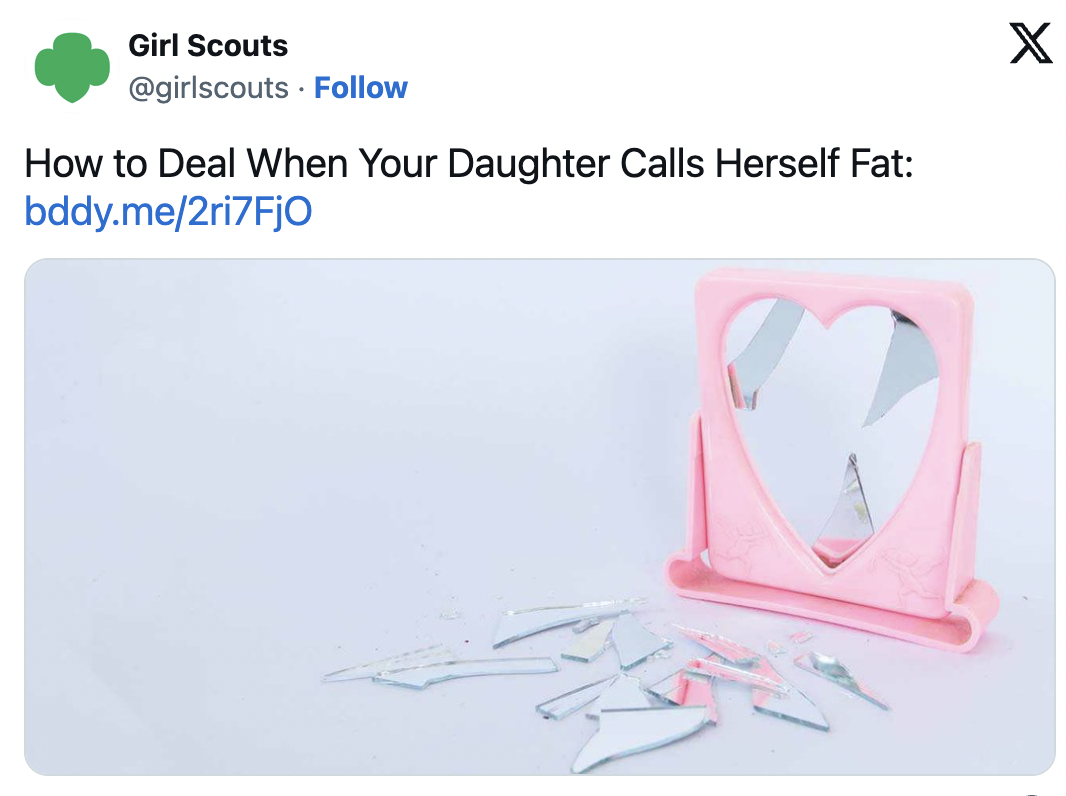
The Girl Scouts’ guide to help parents talk to their daughters about weight and body image is kind of amazing.
The guide, titled “Yes, Your Daughter Just Called Herself Fat,” written by Girl Scouts’ developmental psychologist, Andrea Bastiani Archibald, includes a step-by-step look at responding to your child should they come home one day from school saying, “I’m fat.”
First of all, it breaks down just how prevalent fat-shaming is in our culture:
“According to studies, a whopping 80 percent of 10-year-olds are afraid of being fat. Why? Because they’re constantly surrounded by both subtle and direct messages that curvier or heavier girls aren’t as well liked, aren’t as likely to succeed in business, and in general, aren’t going to have as much fun or happiness in their lives.”
Second of all, it explains why the knee-jerk response “You’re not fat. You’re beautiful!” that so many of us have actually isn’t helpful.
Honestly, this part is so good that I’m just going to include the whole thing (which in its own awesome way, features the only reference to “The Dress” that won’t make you want to scream):
“[I]f she really sees her body in a certain way, simply telling her to stop seeing it that way isn’t going to help much. Remember that infamous dress on social media a few years back that some people thought was blue and some thought was gold—and how frustrating it was when those who saw it differently insisted that you were seeing it wrong and tried to get you to see it their way? That’s kind of how your girl is going to feel when you tell her that her body simply isn’t the way she thinks it is.
…by essentially telling her that she’s not fat, she’s pretty, you’re reinforcing the idea that fatter, rounder, curvier or heavier bodies aren’t beautiful — which simply isn’t true. There are endless ways to be beautiful, and your daughter will grow up with a much healthier relationship to her body if you teach her that in a genuine way from a young age.”
This is such an important message that we don’t hear often enough. Calling someone fat isn’t bad because being fat is inherently bad, but it is bad to call someone fat as an insult because it implies that there’s something wrong with larger bodies.
Fat is just another type of body, and all types of bodies are OK.
The guide also features some great steps parents can take if their daughters feel negatively about their body fat.
1. Don’t assume you know where she’s coming from.
“A better approach is to pause for a moment and ask your daughter why she thinks she’s fat,” the guide advises. “Is it because her clothes are fitting differently than they used to or that a size she used to wear doesn’t feel comfortable anymore?”
Maybe her discomfort has to do more with the bodies of her classmates or what she’s seeing in the media. Or maybe she is fat, and really just needs you to tell her that’s OK too. Getting to the root of what’s causing body image issues is an important first step.
Again, the guide warns against those knee-jerk reactions: “If she says she thinks her legs are bigger or her tummy is rounder than those of her friends, those may actually be correct observations — and there’s nothing wrong with acknowledging that.”
2. Set a good example for her!
Kids pick things up from their parents all the time and internalize those messages even if parents aren’t trying to pass them on. This is just as much about setting a good example as anything else.
“Another reason your girl might call herself fat is because she’s heard you do the same to yourself,” reads the guide. “Your daughter listens to everything you say — and if you’re picking yourself apart in front of the mirror or complaining about your weight, there’s a good chance that she’ll follow in your self-disparaging footsteps.”
That means giving yourself a bit of a break too. Just as you don’t want her to have to try to live up to unrealistic beauty standards, remind yourself that you don’t have to either.
“Identify parts of your body that serve you well and make note of the things you really do love about the way you look,” says the guide. “Healthy habits like eating right and exercise are good for everyone and should be a daily part of your routine, but fixating on your body and how it could or should be different isn’t healthy for anyone.”
3. Pay attention to the kind of media she’s consuming and make sure she’s seeing a variety of body types being celebrated.
TV, movies, and advertising are chock-full of messages meant to instill shame around body appearance, especially in girls and women. A bit of emotional counterprograming can go a long way. For example, check out the upcoming children’s book “Glitter Stripes“; and for older girls, Hulu’s “My Mad Fat Diary,” Melissa McCarthy’s performance in “Ghostbusters,” and Chrissie Metz in “This Is Us,” and Lynn Champlin on “My Crazy Ex-Girlfriend” are great body-positive/fat-positive representations in the media.
Video of plus-size blogger posted on Girl Scouts Twitter page below:
The guide advises parents to “go the extra mile to compensate for some of the less-healthy messages your daughter may be getting from other sources” by exposing them to accomplished women of all shapes and sizes.
“She needs to know you don’t have to be a certain size or shape to make it big in life.”
This guide is just one of the many phenomenal parenting resources you can find on the Girl Scouts website.
Other topics include how to raise your children to be leaders, how to stand up to bullying, and how to be the best they can be in school. They’re all great in their own ways, but the body image article stands out especially.
Thanks to the Girl Scouts, parents can now feel equipped to handle this potentially difficult conversation.
This article originally appeared on 06.19.17