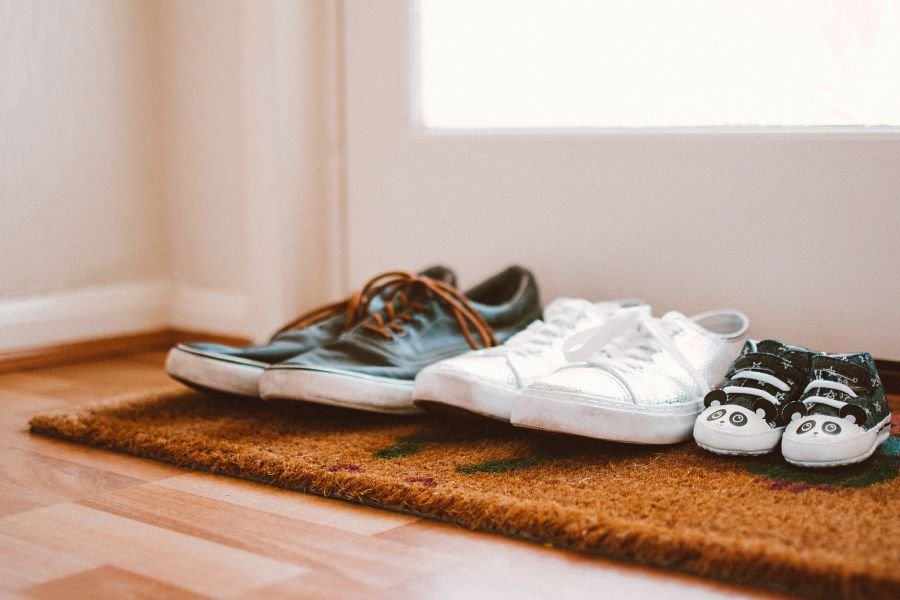
Should we wear shoes in the house? Experts weigh in and turns out we should stop immediately.

It’s a common practice in the west that may be grosser than we realize.

shoes inside; shoes carry bacteria; shoe bacteria; shoes in house
Photo credit: Lisa Fotios|CanvaExperts seem to agree that shoes shouldn't be worn inside

Growing up nearly everyone knew of one house that didn’t allow people to wear shoes inside. It didn’t matter if you accidentally wore your socks with the hole in them, there were no exceptions–shoes off. For many folks it was just seen as a quirk for that particular family and there wasn’t much thought given into why they were adamant about enforcing the rule.

But it turns out that wearing shoes inside is more of a western culture thing than a global one, which makes Americans a minority in keeping outside shoes on while inside the house. It would seem that other countries may have had a bit more of an understanding on why it’s a bad idea to wear shoes inside.

Common sense tells us that wearing shoes inside means you’ll be sweeping and mopping more often than you’d like. Of course you track in dirt but there are apparently hundreds of bacteria and fungi that you’re tracking in that can cause your family to get sick.


According to the Journal of Applied Microbiology 13 different studies supported the hypothesis that the bottoms of shoes carried infectious agents. “Methicillin-resistant Staphylococcus aureus, Clostridium difficile and multidrug-resistant Gram-negative species among other pathogens were documented on shoe bottoms in the health care setting, in the community and among food workers,” the journal says.

If you’re thinking spraying or wiping down your shoes with Lysol or Clorox will do the trick, think again. “A number of decontamination strategies have been studied of which none have been shown to be consistently successful at disinfecting shoe soles,” Journal of Applied Microbiology reports.

But you’ve been wearing shoes inside all this time, why do anything differently now? Well, you don’t have to become a no shoes inside household if it seems like too much of a hassle. Experts just want people to have the facts so they can make their own decisions on how best to keep their family healthy.

Dr. Nicole G. Freels, a podiatrist started discussing the importance of removing their shoes upon entering their home after watching a segment on the Today Show where they cultured an audience member’s flip flops. She told Southern Living, “They cultured out hundreds of different microbes, both bacterial and fungal! Ever since, I have been educating my patients on the potential risks of wearing the same shoes inside the house, and out.”

Dr. Charles Gerba, a professor and microbiologist at the University of Arizona conducted his own research in 2016. The professor swabbed a brand new pair of shoes he had only been wearing for two weeks only to find 440,000 units of bacteria with 27% of it being a deadly form of E. Coli. Yikes. There’s nothing quite like tracking Clostridium difficile (C. diff), a drug resistant extremely contagious intestinal bacteria and E. Coli into your house on a daily basis.

Makes you wonder if this is where those stomach viruses come from that seem to tear through households on repeat during certain months of the year. Honestly, knowing that our shoes track in so much stuff may make you want to figure out a way to get around by levitation. Someone should get on that discovery, quickly.

In the end, wearing shoes inside is still a personal choice even if it may make the experts hair stand on end. But if after reading all about it makes you want to boil your shoes and scrub your floors for hours, you can toss a shoe rack next to your door as a reminder. You can also buy disposable booties that fit over your shoes to keep the bacteria off your floors and in the trash where it belongs.

  • Guy hilariously shows how his perimenopausal wife has transformed into a scent detective
    Photo credit: Matt Hyams/InstagramA comedian’s reenactments of his wife’s perimenopause symptoms are hilarious and enlightening.

    Perimenopause is certainly having a moment. This set of transition symptoms that appear before menopause was first identified in the 1970s and more firmly documented in the 1980s. However, Google Trends shows a massive spike in interest over the past few years. Now, it seems like everywhere you look, people are talking about perimenopause.

    After decades of relative silence, social media has given millions of women a platform to finally share what they’ve been going through.

    It has also, funnily enough, given a platform to the husbands who support them through these challenging times.

    Comedian shares reality with the world

    Matt Hyams struck a nerve in late 2025 when he posted his first video about what he affectionately calls his “perimenopausal wife.”

    “If your wife is entering perimenopause, I’m going to give you some tips I wish someone had given me at the beginning,” he said in the video. “Number one, stop chewing your food, okay? Just swallow it whole … Maybe you’re thinking, ‘But I might choke and die.’ Good. Even better.”

    The joke was a hit and quickly went viral, inspiring him to keep digging for humor. Soon, he was back with a brilliant reenactment of “how my perimenopausal wife looks at me when I’m eating cereal and clearing my throat.” The hilarious skit references how perimenopause can cause sensory overload, or even misophonia—a rage-inducing response to chewing, breathing, or tapping.

    Perhaps Hyams’ best, and most accurate, work is his reenactment of his wife’s newfound—and frighteningly precise—sense of smell. Dressed in what has become his trademark wig, he demonstrates how she can identify extremely specific odors thanks to perimenopausal changes to her senses:

    Women chime in and applaud the accuracy

    Perimenopause can affect a woman’s sense of taste and smell. In some, these senses fade or even seem to disappear. In others, it can cause “olfactory hallucinations.” And in still others, people can detect real, powerful smells that others barely notice.

    “If you ask a Harvard researcher, they’re going to say, ‘We don’t have enough data to support that.’ If you ask someone that talks to women every single day, they’re going to say, ‘Absolutely,’” Atlanta-based nurse practitioner Daniela Ezratty told Gloria.

    The comments section under Hyams’ video proves the point perfectly:

    “I’ve always had a heightened sense of smell but now I can smell things from the future”

    “I found a gas leak at work. Apparently it was such a small leak that no one else could smell it and they had to bring in a gas detector to find the source.”

    “I can smell what they had for dinner 3 days ago, 4 houses away.”

    “I can’t smell anything except the huge imaginary cigarette that gets blown in my face and wakes me out of a blackout sleep at 3am.”

    “COFFEE!! IT DOES SMELL LIKE TUNA and it makes me emotional”

    Coffee that smells like tuna is a common complaint, and it’s not an olfactory hallucination. Certain chemical reactions during the roasting process can produce oils that smell fishy, especially to people with heightened senses of smell.

    Hyams’ other videos use comedic reenactment to show how perimenopause can cause overwhelming mental load, fatigue, brain fog, hot flashes, and more—and they’re far more entertaining than reading WebMD.

    Skits help women—and even men—feel seen

    “I seem to have hit the perimenopause train at the right time, with the right tone, and the right amount of respect for the struggle,” Hyams told Upworthy. “I’m coming at it from my wife’s perspective, validating her opinions and her reality. So I think women, which make up 88% of my followers, were so happy to see and hear it.”

    It’s an accessible and fun way for women to gently teach their partners what they’re going through. Hyams said women tell him all the time that they send the videos to their partners, and those conversations often improve their relationships.

    But it’s not just women who appreciate his handling of a sensitive topic. Even OB-GYNs say supporting a partner through perimenopause isn’t easy—it takes a lot of love, patience, and self-education.

    “I also get messages from men thanking me for making them feel less alone,” Hyams said.

    As for the real wife behind the wig, Hyams said she likes the videos and gives final approval before he posts anything. That’s definitely the right call.

  • New small talk study reveals why you should never fear a boring conversation
    Photo credit: CanvaA barista makes small talk with a customer.

    “Job treating you alright?” “Looks like this weekend is gonna be a real scorcher.” “That Cowboys game was outrageous.” These are some conversational snippets one might hear that could lead to immediate panic—that insufferable “small talk” lies ahead. But new research published in the Journal of Personality and Social Psychology claims that people actually like, and often benefit from, these kinds of conversations.

    Researchers discovered that even though people reported not looking forward to “boring” conversations, a majority found them quite fun.

    @connectwithgrowth

    You don’t bond over big ideas. You bond over “I know, right?” Speaker: Trevor Noah #connectdeeply #communication #smalltalk

    ♬ origineel geluid – GROWTH™

    Even “boring” topics were fun

    The team mixed and matched respondents to cover all bases. In one experiment, they observed conversations in which “one person finds the topic boring.” In another experiment, they created a situation where both participants “find the topic boring.” They also tested groups based on whether the participants were strangers or friends.

    In a piece published by the American Psychological Association (APA), researchers reported that, after studying 1,800 participants, “people consistently underestimated how interesting and enjoyable conversations about boring topics would be.”

    Some might question what topics are considered (potentially) “boring” in the first place:

    “Topics were many and varied, including World Wars I and II, nonfiction books, the stock market, cats, and vegan diets. In some cases, participants were asked to suggest a topic they found boring (responses included such topics as math, onions and Pokemon).”

    Elizabeth Trinh, a doctoral student at the University of Michigan and lead author of the study, said she was excited about the results.

    “We were both surprised and excited by how robust the effect was,” she said. “People consistently expected conversations about seemingly boring topics to be less interesting than they turned out to be.”

    “Serves a real purpose”

    Upworthy spoke with licensed therapist Rebecca Tenzer, owner of Astute Counseling and Wellness Center. She explained why many of us feel anxious about so-called small talk, only to find it entertaining.

    “While it gets dismissed a lot, small talk actually serves a real purpose when it comes to mental health,” Tenzer said. “These smaller, everyday interactions help people feel connected, acknowledged, important, and can even build self-esteem. Even if the conversation is simple or surface-level, there are meaningful impacts and a lot of gain.”

    Tenzer also supported the idea that these micro-conversations, no matter the topic, have significant benefits.

    “We’re seeing more evidence that even brief social exchanges can improve mood, teach social norms, and reduce feelings of loneliness,” she said. “Along with those interactions are often positive body language exchanges, smiles, and even laughter, all of which are happiness chemical hacks needed to boost mood.”

    “Small talk acts as a low-pressure way to engage with others, which can help regulate the nervous system and make social interaction feel easier over time,” Tenzer added. “Not every conversation needs to be deep to have value. It’s nice to force yourself to slow down, take a minute to chit-chat, be in the moment, and stay present. It’s not a huge time commitment and often has lasting benefits throughout the day.”

    “Predictable, consistent, and not threatening”

    Lisa Chen, a licensed psychotherapist, concurred, telling Upworthy that these types of conversations can help put people at ease, even if they might not expect it.

    “As a psychotherapist who works with high-achieving, often socially guarded clients, I see how ‘low-stakes’ interactions create a sense of safety in the body,” she said. “Even brief exchanges like saying ‘hello’ to the barista making your coffee or making casual conversation at work help remind our nervous system that the world is predictable, consistent, and not threatening.”

    Chen says small talk can help lower anxiety.

    “It lowers social anxiety over time, builds relational confidence, and gently reinforces that we belong in shared spaces,” she said. “But small talk isn’t just for those who struggle with social anxiety. It’s for everyone. Small talk strengthens our sense of belonging, improves our mood, and keeps us from becoming too transactional or isolated from others. It also softens intensity and creates moments of ease that prevent stress and burnout.”

  • Want a team that performs well under pressure? Include a ‘clown,’ says NASA.
    Photo credit: CanvaEvery team needs a clown.

    We know that collectively performing under pressure requires some special qualities, but what are they? That’s the question NASA seeks to answer as it looks ahead to sending humans to Mars. When it comes to team dynamics, a small crew on a 10-day stint around the moon is one thing. A team stuck on a spaceship for months and living together on a planet two million miles from home is another.

    NASA’s Human Research Program studies human behavior in teams to analyze the implications of long-duration space missions. After observing team dynamics and roles in groups in various studies, one delightful conclusion can be drawn.

    Every team needs a clown.

    According to NASA, astronauts have returned from stints on the International Space Station and reported that humor played a critical role in diffusing tension between people working on the I.S.S. The same finding has come from research studies in analog environments. (Analogs are places like Antarctica, where the desolate and extreme environment somewhat mimics a place like Mars.)

    “You need a clown on the team,” said Noshir Contractor, Ph.D., professor of behavioral sciences at Northwestern University. In other words, you need someone who can make their teammates laugh.

    Contractor is conducting a study titled Crew Recommender for Effective Work in Space (CREWS). Using research data from an analog study, her team is developing a computer model to help select the best individuals to form a crew.

    “We don’t have a perception that we’re going to tell them who to send on a mission,” Contractor said, according to NASA. “But if they have a collection of people, it will work like a weather forecast model. It’s a predictive model that says if you choose this particular crew, here is what you are likely to see in terms of team dynamics. And, if problems arise, here is how to intervene to ease those problems.”

    Easing problems is one place where the clown plays an important role. Research shows that positive humor can increase communication and social support and create a pleasant environment. Most of us have experienced how a well-timed joke or witty response can stop tension in its tracks.

    Tension often manifests physically. We feel it in our bodies when emotional stress is high. According to the Mayo Clinic, laughter can stimulate circulation and help muscles relax, easing some of the physical symptoms of stress. Laughter also releases endorphins that make us feel good and promote social bonding.

    What about teams that aren’t in as extreme circumstances as going on a mission to Mars or wintering in Antarctica? Dr. Adil Dalal of the Forbes Coaches Council says humor has a “transformative power” that unlocks the ability to do serious work well in the professional world.

    coworkers, teammates, colleagues, work
    Photo credit: CanvaLaughing with your colleagues may help improve team performance.

    “When we laugh, cortisol, the stress hormone that can narrow thinking and trigger defensive behavior, drops significantly,” writes Dalal. “Laughter also causes the release of dopamine, oxytocin and endorphins, which are associated with motivation and learning. In the workplace, this means that laughter can encourage new behaviors and insights. It can also strengthen trust, which is essential for psychological safety and sustained high performance among employees.”

    So if you’re leading a team or part of a team that appears to be struggling, perhaps some clowning around is in order. As Dr. Dalal writes, “Fun is not the opposite of seriousness—it is the pathway to sustainable excellence.”

    If NASA touts the vital role humor plays in teamwork and success, perhaps we all ought to give it a little more weight in our own teams.

  • 93-year-old Gene Kranz shares how he felt watching the Artemis II mission
    Photo credit: NASA & Christopher MichelGene Kranz at Mission Control in 1965 (left) and in 2022 (right).
    ,

    93-year-old Gene Kranz shares how he felt watching the Artemis II mission

    Kranz was played by Ed Harris in the 1995 film “Apollo 13.”

    In April 1970, a year after Apollo 11 put the first man on the Moon, three astronauts set off to complete NASA’s third lunar landing. Instead, two days after the Apollo 13 launch, the mission became one of simple survival. An explosion on the spacecraft caused critical damage, forcing the crew and everyone at Mission Control to problem-solve in real time.

    As lead flight director, Gene Kranz was in charge of the Apollo 13 mission. (You may remember actor Ed Harris portraying Kranz in the 1995 film Apollo 13.) His leadership helped avert disaster, bringing the astronauts home safely. In addition to other programs, Kranz served as a flight director for seven Apollo missions, including Apollo 11.

    Now, at 93 years old, he has watched humanity return to the Moon. In an interview with WTVG-TV, Kranz shared how he felt witnessing the Artemis II mission more than five decades after the Apollo missions he helped oversee.

    “It took me back, made me young again,” Kranz said when asked about seeing the new images of the Moon. “I’m 93 right now, and I was in my thirties, 34, when we landed on the Moon. And it’s like starting all over again. And I just wish I’d talked to the NASA interns, the new people coming in…We must have about—the last session was about three weeks ago—we had about 60 of them, and I looked at these kids, and I was jealous. Anything I’ve ever done, I would trade them to be in their position.”

    Kranz said that looking at images of the Moon makes him think of the astronauts and controllers he worked with, as well as the material they brought back.

    “And [I] just say, ‘Thank God we had a mission,’” he said.

    Gene Kranz
    Gene Kranz working in the Mission Control Center in Houston in 1965. Photo credit: NASA

    Now we’re “back on track,” Kranz said, as Artemis program takes us to the Moon to build a habitat. “It’s going to be a new era in space exploration.”

    Kranz said he’s “too proud to even describe” how he feels about NASA reaching this point.

    “You know, I came in as a young pup,” he said. “I was a fighter pilot—I did flight test. I was there in the very beginning. And all I can think of are the great people that I worked with that made all of this possible.”

    Kranz shared that he had written his high school thesis on how humans would land on the Moon. It was titled The Design and Possibilities of an Interplanetary Mission.

    Gene Kranz
    Gene Kranz working at his flight director’s console in the Mission Operations Control Room, 1965. Photo credit: NASA

    “It is really strange to have written that description, written in that term paper—by the way, I got a 98—and be the person that actually took Neil Armstrong to the Moon for the first time,” he said. “I lived as an explorer. I lived with explorers.”

    Kranz also shared one of the downsides of the Apollo missions in the 1960s and ’70s: the quality of the photo and video technology of the time wasn’t equal to the task.

    “Now I see the imagery we have, and I said, ‘My God, if we had that image, we could have better directed the crew when they were on surface to go pick up that rocket, to go do this thing right on the line,’” he said. “I think we could have had a much better operation. But we did the best with what we had.”

    Indeed, they did—and not just when it came to images. When the fate of the Apollo 13 crew was up in the air (or, more accurately, out in space), Kranz famously declared, “Failure is not an option.” Not only did Apollo mission scientists do the best with what they had, but they also engineered ways to pull off one of the most harrowing feats in human history.

    How remarkable that this legendary leader in lunar exploration has lived to see a second round of Moon missions, and what a delight it is to hear him share his reaction.

  • Dermatologist explains why you absolutely must wash new clothes before wearing them
    Photo credit: CancaDermatologist explains why you absolutely must wash new clothes before wearing them
    ,

    Dermatologist explains why you absolutely must wash new clothes before wearing them

    Only 22% of Americans say they always wash new clothes before wearing them.

    It is not unheard of for someone to grab something off the rack to wear immediately after purchasing. In fact, this is a fairly common occurrence in the United States. But a dermatologist warns that this behavior could be damaging to your skin.

    Cleveland Clinic dermatologist Dr. Shilpi Khetarpal tells WDIV 4 that she recommends everyone wash their clothes before wearing them. “There’s a few reasons why. The first is that many bright colors can bleed onto skin or other fabrics before the first wash. So when you wash them at home first before wearing them, you’re preventing that from transferring onto your skin,” she tells the outlet.

    washing new clothes, new clothes, washing clothes, science, culture
    Two women shopping. Canva Photos

    Anyone who has purchased dark blue or black jeans knows just how annoying it is when the ink bleeds onto other clothing, furniture, and skin. This isn’t new information for most people, and those with very sensitive skin are likely more apt to pre-wash new clothes to avoid skin irritation. Those without hypersensitive skin may feel more inclined to keep yanking those tags off and stepping into unwashed new clothing.

    Khetarpal and other dermatologists say, not so fast. Skin irritation doesn’t only occur because someone has sensitive skin. Still, a recent survey conducted by Tommy John reveals that only 22% of Americans always wash new clothes before wearing them. Other things are going on in the construction and packaging of new clothing that might give others pause.

    According to Dr. Khetarpal, some manufacturers add formaldehyde and other chemicals to keep clothes from wrinkling or molding when shipping. There’s also the concern of fungus, bacteria, and other things lingering on clothing from people handling the items or trying them on.

    “You never know who tried on the garment before you bought it, so you don’t know about germs on their skin, nose, mouth. In fact, a few studies have been done looking at bacteria and viruses lingering on clothes after they have been tried on—fecal bacteria and nasal viruses were commonly found. Lice, scabies, and even bed bugs can also live on clothing for a few days,” Dr. Jami L. Miller, Associate Professor of Dermatology at Vanderbilt Health and Medical Director of the Dermatology Clinic at Vanderbilt Health One Hundred Oaks, tells Southern Living.

    washing new clothes, new clothes, washing clothes, science, culture
    Woman shopping for clothes. Canva Photos

    A 2014 study completed by Stockholm University in Sweden tested 31 different clothing items. The scientists found “Quinoline and ten quinoline derivatives were determined in 31 textile samples. The clothing samples, diverse in color, material, brand, country of manufacture, and price, and intended for a broad market, were purchased from different shops in Stockholm, Sweden. Quinoline, a possible human carcinogen, was found to be the most abundant compound present in almost all of the samples investigated.”

    Quinoline was classified as a “possible human carcinogen” in 2016 by the Environmental Protection Agency, linking it to “tumor-initiating activity on the skin” of female mice. The agency points out that while it is listed as a possible carcinogen for humans, it is used in medicine safely. One study shows the compound works well as an antiviral without the adverse effects mentioned above.

    washing new clothes, new clothes, washing clothes, science, culture
    Woman loading washing machine. Canva Photos

    While it all sounds very scary, Dr. David C. Gaston, Assistant Professor of Pathology, Microbiology, and Immunology at Vanderbilt Health, tells Southern Living, “The risk of obtaining a communicable disease from clothing in a retail store after being tried on by another person is vanishingly small and essentially non-existent if the clothing is new.”

    The scientific consensus is to wash new clothes just to be on the safe side, but if you don’t have sensitive skin, you’re most likely fine-ish.

  • In 1958, NASA recruited 11 Deaf men to test how zero gravity affects humans
    Photo credit: NASAThe Gallaudet Eleven volunteer for space research.
    ,

    In 1958, NASA recruited 11 Deaf men to test how zero gravity affects humans

    Their work helped build the incredible space missions that followed.

    We are constantly being reminded of Isaac Newton’s famous quote, “If I have seen further, it is by standing on the shoulders of giants.” Eleven such giants were recruited as volunteers from Gallaudet University (then Gallaudet College) in Washington, D.C. in 1958. Their task was to help researchers understand the effects of weightlessness on Deaf people who didn’t experience motion sickness.

    Deemed the Gallaudet Eleven, they helped pave the way for hundreds of space flights, including the most recent Artemis II. Ranging in age from 25 to 48 years, the eleven men included Harold Domich, Robert Greenmun, Barron Gulak, Raymond Harper, Jerald Jordan, Harry Larson, David Myers, Donald Peterson, Raymond Piper, Alvin Steele, and John Zakutney. Each and every one of them selflessly gave their time and their bodies to what would become monstrous breakthroughs in astrophysics.

    Houston had a problem

    Actor and Deaf activist, Nyle DiMarco, recently took to social media to share the historical tidbit, lest people forget. In an Instagram reel, he wrote,

    “Everyone’s talking about Artemis II. The first humans to travel to the moon in 50 years. Historic mission. But nobody’s talking about the Deaf men who made it possible.

    In the late 1950s, NASA had a problem. They needed to understand what weightlessness does to the human body. But every test subject kept getting violently motion sick.

    So they came to Gallaudet.

    Eleven Deaf men. Most of them had lost their hearing to spinal meningitis as children, which also damaged their vestibular system. Their inner ears couldn’t be overwhelmed. They were immune to motion sickness.

    NASA put them in centrifuges. Zero-gravity flights. A rotating room for twelve straight days. One experiment on a ferry in choppy Nova Scotia waters. The researchers got so seasick they had to cancel it. The Gallaudet Eleven? They were playing cards.

    Their bodies gave NASA the data it needed to send humans into space.

    No Gallaudet Eleven — no Mercury. No Mercury — no Apollo. No Apollo — no Artemis II.

    Sixty years later, four astronauts just flew 252,000 miles from Earth and came home safely. They stood on the shoulders of eleven Deaf men most people have never heard of. Now you know! #nasa #gallaudet11 #artemisii @nasa”

    The post has already received nearly 400,000 likes and over 6,000 comments. One Instagrammer writes, “Diversity in all its forms is what makes us great. And all of us working together is what helps us advance as a civilization! Thank you for sharing this and bringing visibility to this piece of history, and thank you Gallaudet 11 for your contribution.”

    The tests

    The official NASA website shared some of the tests in which the brave volunteers took part. “One test saw four subjects spend 12 straight days inside a 20-foot slow rotation room, which remained in a constant motion of ten revolutions per minute.”

    Then, of course, there were the zero-g flights. “In another scenario, subjects participated in a series of zero-g flights in the notorious ‘Vomit Comet’ aircraft to understand connections between body orientation and gravitational cues.”

    They even took the volunteers to Nova Scotia to test big waves. “Another experiment, conducted in a ferry off the coast of Nova Scotia, tested the subjects’ reactions to the choppy seas. While the test subjects played cards and enjoyed one another’s company, the researchers themselves were so overcome with seasickness that the experiment had to be canceled. The Gallaudet test subjects reported no adverse physical effects and, in fact, enjoyed the experience.”

    “We were young and adventurous”

    The test subjects themselves shared their experiences. Barron Gulak reminisced, “In retrospect, yes, it was scary…but at the same time we were young and adventurous.”

    On DiMarco’s identical Facebook post, Harry Larson’s child, “Moose” Larson, shared a photo and wrote, “They were recently recognized with a cool plaque at Gallaudet! My dad is one of them and, funny enough, never really talked about it.” A commenter responded, “I’ve worked with your dad a lot on this project during the museum exhibition several years ago. He’s been so wonderful, always willing to come to events. I’m so glad he’s sharing his story now.”

  • A researcher published a paper on a made-up disease. Then people started getting diagnosed.
    Photo credit: Canva PhotosA medical researcher invented a fictional disease, and then AI started handing out diagnoses.
    ,

    A researcher published a paper on a made-up disease. Then people started getting diagnosed.

    If you’ve got red, itchy eyes, you might just have the (totally made up) “Bixonimania”

    There have been a lot of dubious medical research papers published over the years. Famously, there was the 1998 case series that kicked off what would become an entire movement of vaccine skepticism by falsely linking them to autism. Before that, there was a whole slew of research bought and paid for by the sugar industry designed to “downplay the risks of sugar and highlight the hazards of fat,” according to NPR.

    Rarely, however, are studies so heavily, and intentionally, fictionalized as a paper that quietly popped up in some small corners of the Internet in early 2024.

    Researcher tests AI hypothesis

    Almira Osmanovic Thunström, medical researcher at the University of Gothenburg, knew that Large Language Models (LLMs) like ChatGPT, Claude, Google Gemini, etc. draw from an expansive knowledge base they’re trained on.

    Training data can include anything and everything from books to Reddit posts to song lyrics to articles published in reputable medical journals.

    Crucially, hundreds of millions of people log into these AI services every year to ask about symptoms and receive medical advice. It’s the natural evolution of the “Just check WebMD” approach. Thunström wanted to see if she could effect the output of these LLMs by planting bogus ideas into their training data.

    So, she made up a disease. She called it “Bixonimania,” which includes symptoms such as sore, itchy eyes and discolored eyelids. Then, she fabricated an entire research study around the condition and uploaded a “preprint” of the paper to a couple of servers—a preprint being a version of the research paper that has not yet undergone peer review, but is still made available for the public to read.

    doctors, medicine, hospital, medical research, research paper, hoaxes, viral hoax, AI, artificial intelligence, healthcare, wellness, culture
    That’s “bixonimania” alright. Photo Credit: Canva Photos

    Finally, with the seeds planted, and the false study publicly available for anyone (or anything) to see, Thunström waited to see if LLMs would begin spitting out “Bixonimania” as a diagnosis.

    Fake disease finds serious legs in AI chats

    If the experiment sounds ethically dubious, that’s fair, but Thunström made every effort to make it clear that the findings were completely false. Not only did she collaborate heavily with an ethics consultant on the experiment, she left plenty of breadcrumbs along the way.

    For starters, the lead author of the study is listed as “Lazljiv Izgubljenovic,” a person who does not exist. Translated from Slovenian, the name means “The Lying Loser.”

    Second was the name of the disease itself, which was chosen to be ridiculous sounding. “I wanted to be really clear to any physician or any medical staff that this is a made-up condition, because no eye condition would be called mania—that’s a psychiatric term,” Thunström said per Nature.com.

    Early in the paper, the text “this entire paper is made up,” appears. As does a note that all of the fifty so-called “participants” were completely fictional. Toward the end, Thunström thanks such esteemed colleagues as “Professor Maria Bohm at The Starfleet Academy … onboard the USS Enterprise” and partners like “the Professor Sideshow Bob Foundation.”

    Despite the warnings, and the fact that (nearly) any qualified human reading the paper would know it was a fake, it began showing up in search results and even had the authority to appear on Google Scholar.

    AI chatbots began spitting out “Bixonimania” as a possible diagnosis to users within just a few weeks—users who were probably suffering from eye irritation due to too much screen exposure. Thunström even has the screenshots to prove that certain models, including Microsoft Copilot and Google Gemini, still refer to the disease as a “recently” proposed or described condition.

    Then something even stranger happened.

    “Bixonimania” gets cited by other research papers

    The “Bixonimania” paper was never peer-reviewed or published in an official journal, for obvious reasons. But, soon enough, it was referenced and cited in a new paper that was peer-reviewed.

    “Bixonimania is an emerging form of POM [periorbital melanosis] linked to blue light exposure; further research on the mechanism is underway,” the authors confidently wrote.

    The papers referencing the made-up disease were later retracted.

    More than just AI trickery

    The TL;DR? People rarely read beyond the headline. In fact, one study (a real one!) found that more than 75% of people who share an article online haven’t even read it. Most of us trust anything that appears in a medical journal.

    You’d think physicians and researchers would be more thorough, but the truth is they’re just as susceptible to time crunches, lapses of focus, and even taking shortcuts in their work from time to time. In other words, they’re only human.

    This fascinating experiment isn’t just about how a researcher managed to fool AI, it speaks to bigger problems with how we use the technology and our daily media habits.

    “The solution isn’t just better filters. It’s better habits, better norms, and better expectations around how we read, verify and cite. Human‑centred resilience has to come first,” an astute commenter wrote.

    “This expose has huge implications for academia and ‘googling your symptoms’. I was/am worried about being the one taking the hit for a controversial experiment of this sort. It was done with very high guardrails and ethical considerations, I hope everyone reading will take that in to account,” Thunström elaborated on LinkedIn.

    She recently decided to retract the papers and keep them private somewhere curious users can read them, but they’ll no longer be crawled by LLMs.

    doctors, medicine, hospital, medical research, research paper, hoaxes, viral hoax, AI, artificial intelligence, healthcare, wellness, culture
    LLMs are powerful tools, but they can be dangerous. Photo Credit: Canva Photos

    “The bixonimania experiment was never about exposing LLMs as flawed tools, or arguing they have no place in medicine. They do. It was about demonstrating that any system can be infiltrated and that researchers who blindly cite AI-generated references really should read what they’re quoting. I know this firsthand,” she says in another LinkedIn post, adding that she herself has been duped by AI-generated summaries of her own research papers.

    “The failure wasn’t the system. It was how I used it.”

  • Columbia shuttle astronaut shared a moving take on humanity shortly before reentry tragedy
    Photo credit: NASA/Wikimedia CommonsDavid M. Brown, a mission specialist on the Space Shuttle Columbia.

    Columbia shuttle astronaut shared a moving take on humanity shortly before reentry tragedy

    It’s been 23 years since we lost these brave souls, but David M. Brown’s message remains timeless.


    On February 1, 2003, a tragic reminder of how delicate life is struck those watching the landing of Space Shuttle Columbia (STS-107). Commander Rick D. Husband, Pilot William C. “Willie” McCool, and mission specialists David M. Brown, Kalpana Chawla, Michael P. Anderson, Laurel B. Clark, and Ilan Ramon were selected for Columbia’s 28th mission. The mission involved orbiting Earth while conducting experimental research.

    What they didn’t know was that, during liftoff, a piece of insulation foam had compromised one of the shuttle’s heat shields. Upon reentry, with just 16 minutes remaining before they were expected to touch down, the shuttle met its fatal end.

    Columbia space shuttle, STS-107 crew, NASA, space flight
    Crew of the STS-107. Photo credit: NASA

    Giant leaps

    Many have recently taken a renewed interest in astrophysics, inspired by the awe of the Artemis II mission. Astronauts who devote their lives to space exploration are nothing short of magnificent. It’s a pursuit defined by equal parts devotion, incredible bravery, and the ability to see the big picture, quite literally. As astronaut Neil Armstrong famously put it, even “small steps” in this realm are “giant leaps for mankind,” a reminder of the importance of perspective within the smallest scientific details.

    Letter from space

    Mission specialist Brown had sent an email just one day before the crew was set to land, and his aerial view of our tiny blue marble of a planet clearly gave him perspective.

    A Reddit user who said they were related to Brown shared the email and wrote, “I had a family member on Columbia, Dave Brown. We were at the launch and the disaster was put in a very different perspective for us, even though I didn’t know him that well. He emailed the family regularly and the day before reentry sent a very impactful email to us that became much more so after the incident.”

    The email read:

    “Friends,
    It’s hard to believe but I’m coming up on 16 days in space and we land tomorrow.

    I can tell you a few things:

    Floating is great – at two weeks it really started to become natural. I move much more slowly as there really isn’t a hurry. If you go too fast then stopping can be quite awkward. At first, we were still handing each other things, but now we pass them with just a little push.

    We lose stuff all the time. I’m kind of prone to this on Earth, but it’s much worse here as I can now put things on the walls and ceiling too. It’s hard to remember that you have to look everywhere when you lose something, not just down.

    The views of the Earth are really beautiful. If you’ve ever seen a space IMAX movie that’s really what it looks like. What really amazes me is to see large geographic features with my own eyes. Today, I saw all of Northern Libya, the Sinai Peninsula, the whole country of Israel, and then the Red Sea. I wish I’d had more time just to sit and look out the window with a map but our science program kept us very busy in the lab most of the time.

    The science has been great and we’ve accomplished a lot. I could write more about it but that would take hours.

    My crewmates are like my family – it will be hard to leave them after being so close for 2 1/2 years.

    My most moving moment was reading a letter Ilan brought from a Holocaust survivor talking about his seven-year-old daughter who did not survive. I was stunned such a beautiful planet could harbor such bad things. It makes me want to enjoy every bit of the Earth for how great it really is.

    I will make one more observation – if I’d been born in space I know I would desire to visit the beautiful Earth more than I’ve ever yearned to visit space. It is a wonderful planet.

    Dave”

    Data from the mission

    While these precious lives were ended far too soon, their work was not in vain. NASA was able to salvage much of the data collected during the mission.

    One of many examples was video footage that appeared to show a new, unexplained lightning-like phenomenon. In an article for New Scientist, Maggie McKee explains that researchers who pored over the footage saw a reddish glow unlike anything astrophysicists had seen at the time: “The glow occurred about 150 kilometres above the ocean near Madagascar and does not appear to be linked with thunderstorms.”

    Similar to the tragic end of the Space Shuttle Challenger (STS-51L) mission, astrophysicists, as all good scientists do, find a way to carry on. They use these experiences to deepen their understanding and to advance science beyond what once seemed possible. In the words of Isaac Newton, “If I have seen further, it is by standing on the shoulders of giants.”

Culture

A little girl’s classmate asked who the man picking her up was. Her two-word answer made him emotional for the rest of the day.

Culture

He googled “what do you put in an obituary” when his dad died and wrote one of the most beloved ones the internet has ever seen

Skills

Her dormant HOA came for her Mister Rogers yard sign. Big mistake.

Culture

A Gen Z teacher gave his students 10 minutes to rant about anything they wanted. The essays were gloriously unhinged.