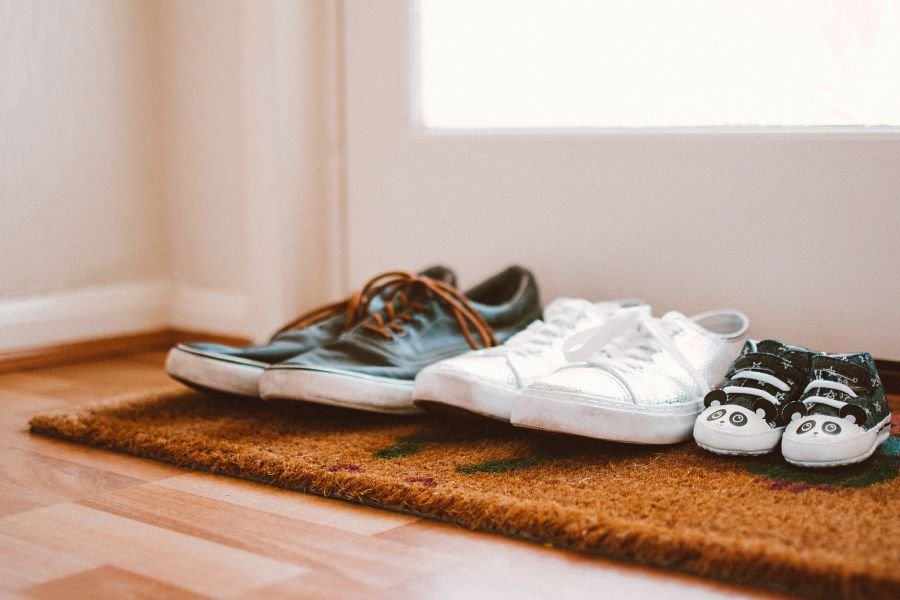
Growing up nearly everyone knew of one house that didn’t allow people to wear shoes inside. It didn’t matter if you accidentally wore your socks with the hole in them, there were no exceptions–shoes off. For many folks it was just seen as a quirk for that particular family and there wasn’t much thought given into why they were adamant about enforcing the rule.
But it turns out that wearing shoes inside is more of a western culture thing than a global one, which makes Americans a minority in keeping outside shoes on while inside the house. It would seem that other countries may have had a bit more of an understanding on why it’s a bad idea to wear shoes inside.
Common sense tells us that wearing shoes inside means you’ll be sweeping and mopping more often than you’d like. Of course you track in dirt but there are apparently hundreds of bacteria and fungi that you’re tracking in that can cause your family to get sick.
According to the Journal of Applied Microbiology 13 different studies supported the hypothesis that the bottoms of shoes carried infectious agents. “Methicillin-resistant Staphylococcus aureus, Clostridium difficile and multidrug-resistant Gram-negative species among other pathogens were documented on shoe bottoms in the health care setting, in the community and among food workers,” the journal says.
If you’re thinking spraying or wiping down your shoes with Lysol or Clorox will do the trick, think again. “A number of decontamination strategies have been studied of which none have been shown to be consistently successful at disinfecting shoe soles,” Journal of Applied Microbiology reports.
But you’ve been wearing shoes inside all this time, why do anything differently now? Well, you don’t have to become a no shoes inside household if it seems like too much of a hassle. Experts just want people to have the facts so they can make their own decisions on how best to keep their family healthy.
Dr. Nicole G. Freels, a podiatrist started discussing the importance of removing their shoes upon entering their home after watching a segment on the Today Show where they cultured an audience member’s flip flops. She told Southern Living, “They cultured out hundreds of different microbes, both bacterial and fungal! Ever since, I have been educating my patients on the potential risks of wearing the same shoes inside the house, and out.”
Dr. Charles Gerba, a professor and microbiologist at the University of Arizona conducted his own research in 2016. The professor swabbed a brand new pair of shoes he had only been wearing for two weeks only to find 440,000 units of bacteria with 27% of it being a deadly form of E. Coli. Yikes. There’s nothing quite like tracking Clostridium difficile (C. diff), a drug resistant extremely contagious intestinal bacteria and E. Coli into your house on a daily basis.
Makes you wonder if this is where those stomach viruses come from that seem to tear through households on repeat during certain months of the year. Honestly, knowing that our shoes track in so much stuff may make you want to figure out a way to get around by levitation. Someone should get on that discovery, quickly.
In the end, wearing shoes inside is still a personal choice even if it may make the experts hair stand on end. But if after reading all about it makes you want to boil your shoes and scrub your floors for hours, you can toss a shoe rack next to your door as a reminder. You can also buy disposable booties that fit over your shoes to keep the bacteria off your floors and in the trash where it belongs.

An Operation Smile volunteer reverses an oxygen mask so a child with a cleft condition can blow a bubble for the first time in Guadalajara, Mexico. (Operation Smile Photos)
For thousands of children born with cleft conditions, Operation Smile provides simple, playful tools—like bubbles—to strengthen the skills they need to speak and thrive.
While a bottle of bubbles might seem out of place in a hospital setting, you might be surprised to learn that, for thousands of children around the world born with cleft lip and palate, they can be a helpful tool in comprehensive cleft care. Lilia, who was born with cleft lip and palate in 2020, is one of the many patients who received this care.
As a toddler, Lilia underwent two surgeries to treat cleft lip and palate with Operation Smile’s surgical program in Puebla, Mexico. Because of Operation Smile’s comprehensive care, it wasn’t long before her personality transformed: Lilia went from a quiet and withdrawn toddler to an exuberant, curious explorer, babbling, expressing herself with a variety of sounds, and engaging with others like any child her age.
Lilia is now a healthy five-year-old, with the same cheerful attitude and boundless energy. Her progress is the result of care at every level, from surgery to speech therapy to ongoing support at home—but it’s also evidence that small, sustained interventions throughout it all can make a meaningful difference.
Lilia at age 1, before surgery, and at age 5, 4 years post-surgery
Cleft Conditions: A Global Problem
Since 1982, Operation Smile has provided cleft lip and cleft palate surgeries to more than 500,000 patients worldwide with the help of generous volunteers and donors. Cleft conditions are congenital conditions, meaning they are present at birth. With cleft lip and palate, the lip or the roof of the mouth do not form fully during fetal development. Cleft conditions put children at risk for malnutrition and poor weight gain, since their facial structure can make feeding challenging. But cleft conditions can have an enormous social impact as well: Common difficulties with speech can leave kids socially isolated and unable to meet the same developmental milestones as their peers.
Surgery is a vital step in treating cleft conditions, but it’s also just one part of a much larger solution. Organizations like Operation Smile emphasize the importance of multi-disciplinary teams that provide comprehensive, long-term care to patients across many years. This approach, which includes oral care, speech therapy, nutritional support, and psychosocial care, not only aids in physical recovery from surgery but also helps children develop the skills and confidence to eat easily, speak clearly, and engage in everyday life. This ensures that each patient receives the full range of support they need to thrive.
Marie, 11 months, with her mother at Operation Smile Madagascar before her cleft surgery (Operation Smile Photos)
A Playful (and Powerful) Solution
Throughout a patient’s care, simple tools like bubbles can play a meaningful role from start to finish.
Immediately before surgery, children are often in a new and unfamiliar environment far from home, some of them experiencing a hospital setting for the first time. When care providers or loved ones blow bubbles, it’s a simple yet effective technique: Not only are the children soothed and distracted, the bubbles also help create a sense of joy and playfulness that eases their anxiety.
Milagros Rojas, a volunteer speech therapist in Peru, using bubbles in a screening with a patient. (Operation Smile Photos)
In speech therapy, bubbles can take on an even more important role. Blowing bubbles requires controlled airflow, as well as the ability to form a rounded “O” shape with the lips, which are skills that children with cleft conditions may struggle to develop. Practicing these skills with bubbles allows children to gently strengthen their facial muscles, improve breath control, and support the motor skills needed for speech development. Beyond that, blowing bubbles can help kids connect with their parents or providers in a way that’s playful, comforting, and accessible even for very young patients.
Finally, bubbles often follow patients with cleft conditions home in the “smile bags” that each patient receives when the surgical procedure is finished. Smile bags, which help continue speech therapy outside of the hospital setting, can contain language enrichment booklets, a mirror, oxygen tubing, and bubbles. While regular practice with motor skills can help with physical recovery, small acts of play help as well, giving kids space to simply enjoy themselves and join in on what peers are able to do.
Bubbles at Home and Beyond
Today, because of Operation Smile’s dedication to comprehensive cleft care, Lilia is now able to make friends and speak clearly, all things that could have been difficult or impossible before. Instead of a childhood defined by limitation, Lilia—and others around the world—can look forward to a childhood filled with joy, learning, discovery, friends, and new possibilities.
CTA: Lilia’s life was changed for the better with the care she received through Operation Smile. Find out how you can make an impact in other children’s lives by visiting operationsmile.org today.
If there’s one thing individuals and Fortune 500 companies have in common, it’s the inability to resist a personality test. Employers have long used tests like the Myers-Briggs Type Indicator or the Enneagram to understand their employees better and build more compatible teams. And people in general seem strangely addicted to quizzes that categorize them by personality type.
It’s long been known that most personality tests aren’t scientifically sound, but that doesn’t stop people from taking them. Part of the reason is that those tests tell us something about ourselves as individuals while also making us feel like we’re part of a group identity. They seem to help us understand ourselves and one another better, and thus appear to “work.”
“Personality tests and profiles take advantage of a weird psychological tendency that also benefits everything from horoscopes to fortune tellers to Buzzfeed quizzes,” Leembruggen said. It’s called the Barnum effect.
“The Barnum effect was named after P.T. Barnum, the iconic and problematic showman known for his ability to captivate, and often manipulate, an audience,” she explained. “The Barnum effect is the phenomenon where if you give someone a personality test, they’re pretty likely to believe that the results are true and accurate, regardless of how hard the profile-maker actually tried. There’s something about taking the test itself that makes an audience more likely to believe the end result.”
Personality tests became popular after WWI, when someone developed an assessment to determine which soldiers might be prone to PTSD. In the decades that followed, personality profiles appeared in popular magazines and psychologists’ offices alike. But researcher and college professor Bertram Forer felt skeptical about their accuracy. He basically said the results weren’t any more specific than saying that a person has opposable thumbs.
Professor Forer’s 1949 personality test experiment
In 1949, he conducted an experiment to test his hypothesis. He gave his Intro to Psychology students a personality questionnaire. Then, he told them he’d analyze the results and create a unique personality profile for each student. When they got their results, they rated them for accuracy. Only one student rated their results below a 4 out of 5, indicating nearly all students felt their results reflected their personality. However, Forer had duped them. He had actually given every student the exact same analysis.
“Forer made a list of general, vaguely flattering, and universally relatable statements,” Leembruggen explained. “So, why did everyone believe that their list was so perfectly tailored to them? Well, that’s the Barnum effect.”
Essentially, most personality descriptors in personality profiles are fairly relatable to most people. And when you combine any sense of the trait being positive, most people will see themselves in it.
The SciShow video gives these statements as examples:
“You have an analytical mind, though you also might space out at times.”
“You pride yourself as an independent thinker, and don’t accept other people’s statements without good proof.”
“You love variety and tend to rebel against too many restrictions and limitations.”
“You don’t always reveal all of yourself to others.”
“You have a great desire for other people to like and admire you.”
Most people see themselves in some, if not all, of those statements because they’re vague enough to feel true.
However, 1949 was a long time ago. Haven’t psychologists gotten better at creating real personality profiles?
Many personality tests have binary categories of traits. (Photo credit: Canva)
How accurate is the Myers-Brigg Type Indicator, though?
One of the most popular personality tests of the past 50 years is the Myers-Briggs Type Indicator, or MBTI. This test splits people into 16 personality categories based on combinations of eight traits or preferences: Introversion/Extroversion, Sensing/Intuition, Thinking/Feeling, and Perceiving/Judging. Your “type” would be a combination of four letters, like INTP or ESFJ, with a corresponding description of that personality.
Many people have taken an MBTI test at work, but is it really accurate?
“When researchers want to see how well a certain assessment tool, test, or survey actually works, one thing they’ll do is have the same people take the same test multiple times,” Leembruggen said. “If they get the same score each time, we’d say that tool has good test-retest reliability. And in studies of MBTI where participants took the assessment multiple times, up to half or even more test takers received a different result for at least one of the four letters.”
Accurate or not, people love their Myers-Briggs. However, psychologists prefer a more recent personality indicator known as the Big Five Personality Trait model.
12 Things Everyone Should Know About Personality
1. Most psychologists agree that most personality variation can be captured with just a handful of higher-order traits. The most popular approach posits five traits, often known as the Big 5.
In the Big Five, people rank as low, medium, or high in five personality dimensions: extroversion, neuroticism, openness, conscientiousness, and agreeableness. (A more recent test known as HEXACO includes honesty-humility as a trait.)
“These tests, and newer variations that include subcategories of these five, do seem to show better test-retest reliability,” Leembruggen shared. “One major reason that newer tests based on the Big Five are more reliable is that they’re based on accumulating data from multiple long-term studies from the 1990s onwards. And they’re rooted in the principle that, if a personality trait exists in humans, languages will adopt words to describe it.”
However, she notes, most research only includes people from WEIRD countries: Western, Educated, Industrialized, Rich, and Democratic. That reality alone makes it hard to extrapolate universal personality traits or types.
The way personality tests are designed is inherently flawed
Finally, the nature of personality tests with multiple-choice answers, most of which only offer two options, is flawed.
“When you have to answer every question from a list of predetermined options, it’s called a forced-choice measure,” Leembruggen explained. “These tests are easy to administer and to grade, but the downside is that they’re really rigid and can flatten nuance, including how people’s personality traits can change due to the passage of time and other variables. We’ve all stared at a multiple-choice question and wished there was an option to check ‘other.’ So trying to make a questionnaire-style test that can accurately gauge anybody’s personality might be kind of impossible.”
That certainly won’t stop a lot of people from taking those tests, though. Accurate or not, there’s something about them that draws us in. Maybe it’s just fun to self-analyze. Maybe we yearn to know ourselves better, and those tests offer a structured and largely harmless way to do that—or at least to feel like we’re doing it.
Since the dawn of man, right-handedness has reigned supreme without much intel as to why. While our ape brethren also develop strong preferences toward one hand over another, there is generally an equal number of left- and right-handed individuals. Conversely, 90% of humans are right-handed. And now, scientists think they have discovered when this prevalence developed.
A new study led by researchers at the University of Oxford suggests that it went hand-in-hand (pardon the pun) with two other major evolutionary shifts: walking on two legs and developing much larger brains.
Thousands of primates helped narrow the possibilities
The research, published in PLOS Biology, analyzed data from 2,025 monkeys and apes representing 41 different primate species. All the evolutionary factors tested—tool use, diet, habitat, body size, social structure, brain size, movement patterns, etc.—seemed to match human data, leaving no real clues as to why our species decided to become almost exclusively right-handed.
However, that changed once researchers added brain size and the ratio between arm length and leg length to their analysis. Suddenly humans, with their larger brains and legs much longer than their arms (a hallmark trait of bipedal walking), stood out from an evolutionary standpoint.
These factors, along with other fossil records, help us imagine a timeline that looked something like this:
Human ancestors (Ardipithecus and Australopithecus, respectively) began walking upright, allowing one hand to become specialized over the other. At this point, there would likely be an equal number of left-handers to right-handers.
As our brains grow to incorporate more complex activities like using tools, communicating through a wide array of gestures, and participating in complex tasks like cooking and performing rituals, so too does our right-hand bias. In fact, the same 90% right-hand dominance is already present around 2.6 million years ago…before Homo sapiens and Neanderthals entered the scene.
One side of the brain might hold an important clue
That third factor (complex tasks) is particularly interesting. Sequentially organized behaviors, also known as hierarchical action, are often believed to be something managed by the brain’s left hemisphere. The left hemisphere also controls all the motor functions and movements on the right side of the body. That said, all three elements, along with the fact that humans learn by imitating their parents, likely played equally important roles in the evolutionary narrative.
Ancient “hobbits” added another intriguing clue
Backing this theory is the “hobbit” species discovered in Indonesia. This ancient humanoid species maintained smaller brains and the ability to climb while also walking. Conversely, it did not have nearly the same amount of right-hand dominance.
There are, of course, more mysteries to unravel. Why some of us are still left-handed, for instance. Or whether the limb preference of other animals suggests a similar evolutionary pattern. But, regardless, the study reminds us that even the most seemingly simple quirks that make us human actually tell an incomprehensibly vast story of how we came to be in the first place.
Many of us have walked into an old building and felt some kind of eeriness. Depending on your own personal beliefs, you might be inclined to attribute this feeling to the presence of something supernatural. But science has found another culprit that haunts our psyche in these places, and it’s not ghosts.
Researchers at MacEwan University in Edmonton, Canada, found that when people were exposed to infrasound, which is typically imperceptible to humans, they still experienced a rise in cortisol levels and irritation.
“In an old building, there is a good chance that infrasound is present, particularly in basements where aging pipes and ventilation systems produce low-frequency vibrations,” noted senior author Rodney Schmaltz.
Therefore, many people who notice a mood shift in a place regularly defined as “haunted” might attribute that agitation to something supernatural. In reality, the infrasound waves are to blame.
How the study worked
The study, published this year in Frontiers in Behavioral Neuroscience, randomly assigned 36 participants to one of four groups. Each group would listen to either “calming” meditative music or “unsettling” horror-themed ambient audio. Each group would also be near hidden speakers playing infrasound between 75 and 78 decibels, a range consistent with what mechanical systems commonly produce inside buildings. These speakers were turned off and on once throughout the study.
Each participant provided saliva samples immediately before the music started and again 20 minutes later, which were analyzed to measure cortisol, the hormone the body releases under stress.
Researchers found that, regardless of which type of music they heard, the participants showed a notable increase in salivary cortisol when exposed to infrasound.
And while anecdotal, participants in the infrasound condition rated themselves as more irritable, less interested afterward, and even described the music as noticeably sadder.
Interestingly, what people didn’t seem to feel when exposed to infrasound was anxiety or fear, but rather irritability, disinterest, and a low-grade emotional discomfort…all of which correlate to a spike in cortisol.
Infrasound in nature
The researcher explained that in the animal kingdom, some species (such as elephants) use it to communicate with one another over great distances. Others, like some birds, detect coming storms from infrasound.
Others still have an aversion to the discomfort it causes. Some fish have tiny stone-like organs in their inner ear that help them stay away from it and remain balanced and upright in the water.
Humans happen to have similar structures, and researchers theorize that this balance system, which connects to brain regions involved in emotion, may register infrasound without conscious awareness.
Still, given the small amount of study participants (as well as the lack of diversity, most were female undergrad students), no major conclusions can be drawn. So ghost hunters, fret not!
Whether you lean paranormal or skeptical, the science does confirm that humans are more sensitive to unseen forces than we realize, whether those forces come from vibrations in the environment or something we simply don’t yet understand. Either way, our minds and bodies seem capable of picking up signals long before we consciously recognize them.
Ever heard of “highway hypnosis”? If you never went over it in American Driver’s Ed, it’s the phenomenon during which we tend to zone out while driving on long, repetitive stretches of highway or on routes we’ve taken a thousand times. It’s that feeling of pulling into your driveway and having very little recollection of actually getting there.
Suffice it to say, going into pure autopilot mode on the road isn’t ideal. It’s not safe, and we tend to ignore important signage, like speed limits.
One high-traffic area in Wisconsin just debuted a new, eye-catching speed limit
The Outagamie County Recycling and Solid Waste facility in Appleton gets a lot of through-traffic. Big trucks, commercial haulers, and plenty of civilian cars make their way through the facility on any given day.
Keeping a low posted speed limit helps keep everyone safe. Usually, in places like this, you’d see speed limits of 15, 10, or even 5 miles per hour.
Outagamie County went in a slightly more offbeat direction: 17.3 mph. No, it’s not a typo. See for yourself:
The sign isn’t just for laughs. It’s not a temporary fixture meant to get a few likes on social media or encourage people to stop for photo ops.
Its purpose is far more important: to get people to pay attention. The unusual number causes people to do a double-take. Instead of eyes glazing over at yet another 15 mph limit, the 17.3 sticks out like a sore thumb and makes drivers’ brains perk up—and hopefully, their feet ease off the gas.
Kraig Van Groll, the site’s solid waste superintendent, said the sign is working, per Supercar Blondie:
“We’ve definitely seen positive engagement and behavior changes across the site. That includes residents using the site daily, people visiting on tours, and commercial users operating here regularly. If nothing else, it’s really opened the door for more conversations around overall site safety and awareness for all users of the site.”
Jordan Hiller, recycling and solid waste program coordinator, told WBAY-TV that the sign has caused a bit of an “uproar” on social media—in a good way. People get a kick out of it, and it has ultimately done its job: drawing more attention to road safety around the facility.
Not just Wisconsin: Odd speed limits are becoming more common
While major roads and highways will probably stick with nice, round speed limits, smaller areas—shopping centers, parking lots, private facilities—are turning more and more to eye-catching numbers like Outagamie’s 17.3.
A shopping center in Colorado Springs, Colorado, features an 8.2 mph speed limit:
Some areas are resorting to even more unusual and eye-popping methods, with speed limits that include fractions. This one was featured on Denver local news: a parking lot with an official posted speed of 6 and 7/8 mph:
Safety officials have all kinds of methods to try to keep distracted drivers focused
The science of being behind the wheel is fascinating and often studied. Tons of experiments and studies were conducted on how to get drivers to slow down in certain areas before we came up with radar signs that tell drivers their speed in real time, for example. That visual feedback has been shown to be effective at reducing speeds.
Roads in America are also full of speed bumps, rumble strips, and reflectors designed to break drivers’ autopilot patterns.
It’s part psychology and part neuroscience; a big reason we slip into autopilot mode, or highway hypnosis, has to do with the way our brain waves work. According to Radar Sign, “Shifting a driver from a Theta ‘autopilot’ state to a Beta ‘engaged’ state requires a trigger, identified by the Reticular Activator (RA), responsible for categorizing sensory input.”
Simply put, one of the best ways to keep drivers safe on the road is to present them with something unusual: an input that disrupts the expected pattern. It could be a radar sign, a strip in the road that causes your tires to gently buzz, or now, a speed limit sign so bizarre you can’t help but look twice.
Nearly everyone has suffered from the dreaded flu and can agree that the hacking coughs, achy bones, and sneezing are more than just a tad miserable. The silver lining, if there can be one, is that the flu (and colds in general) brings out some old remedies that some might find rather charming. Even better, some of them may actually work.
In a clip from the late 1950s on the BBC Archive Facebook page, a random assortment of men and women are asked for their personal “flu cures.” Their answers ranged from typical homespun ideas like hot tea and plenty of water to more curious alternative remedies. But many were eager to share their personal treatments and seemed sure of their effectiveness.
Shot on black-and-white film, British interviewers Fyfe Robertson and Alan Whicker ask people what they do or take when they have the flu. One woman answers, “Well I take Vitamin C and lemon, barley, and whiskey.” The next man agrees that he can “defy the virus” with whiskey and tea, but adds bacon, porridge, and eggs.
In fact, quite a few included whiskey in their flu routine. “I’m a great believer in whiskey,” one man proudly shares. “I’m like a Scotch man. I believe in a drop of whiskey, warm, and it sort of kills the germs.”
In keeping with the alcohol angle, another Brit answers, “A jolly good hot rum punch. And a jolly good sweat, and stop in bed until it’s all over.”
“Elderflower wine,” says an older woman. “If you take a good glassful tonight, and you go to bed, and you sweat it out, you know, and you’re alright in a day or two.”
Not everyone used alcohol in their remedies. One woman swaps the whiskey for water: “Rinse your inside out continually with boiled water. About four or five half-pint glasses a day, boiled water.”
But then things get interesting. A woman clad in an oversized sweater coat shares this trick: “Well my remedy for the flu is to get a small Spanish onion, chop it up finely, and put some brown sugar over it and a little vinegar. And then when it turns into a syrup, take a spoonful before you go to bed. It’s a very good remedy.”
A man, seemingly eager to share his mother’s recipe, steps in: “Well my mother recommends an old sweaty sock with salt right round your throat. A good pullover and a good hot water bottle. Sweat it out.”
Now things take a turn for the more unique. “There is a good cure in mustard and lard,” one woman says. “And you rub the two well together and get a good blend. I don’t know how to do it, but my father does.” After the interviewer asks if one should eat it or rub it on one’s chest, she clarifies: “Rub it on your chest, on the front and the back, and it’s a good cure.”
Just when it seemed that possibly “mustard and lard” were the most interesting answers, the woman next to her takes the cake: “Goose grease. You can rub that on your chest. You know, after you’ve been cooking the goose, then keep the grease and run it on your chest.”
This next idea is a bit complicated, but it also involves goose grease: “A large piece of brown paper and cut it to go under the arms and you warm it first, and get hot warm goose grease and then spread mustard over the brown paper first. Get warm goose grease, which most people have got in the house. You spread it over the mustard on the paper to avoid burning of the skin. And should inflammation be setting in, as the doctor says does sometimes, you boil the elderflower and give the patient a dose of elderflower water.”
Understandably, the reporter pushes back: “But then do you go to bed with this brown paper? Don’t you find it a bit messy?” She answers with a resounding yes, adding, “And the goose grease avoids it from burning.”
And just when it seems like someone is going back to a more popular cure, it takes a turn: “I take a nice big tumbler full of hot lemonade. Put in about three teaspoons full of rum. Two aspirin. Get into bed and cover myself well. Tie the stocking that I’ve been wearing around my feet. One of them around my throat with a safety pin, and stay in bed and sweat it out.”
Finally, a younger gentleman is asked his “best way to cure the flu.” His answer is rather philosophical: “Well, just think that you haven’t got it.” He adds a few other ideas about onions and then shocks the interviewer with this final thought: “I’ve still got it now, and I’m about.”
“You’ve got the flu now, have ya?” the interviewer asks. “Well in that case, I won’t keep you another minute.”
Reactions
Just this clip has 35,000 likes and over a thousand comments. And perhaps not super surprisingly, many Facebook users back up the remedy claims:
“After all, where do people think ‘medicine’ comes from? My Hungarian grandfather would eat raw garlic if he felt under the weather. Drank tea daily with a little red wine in it. Lived to be 101.”
“Whiskey and stinky socks are to men as goose grease and mustard are to women.”
“How Alan Wicker (sic) kept a straight face to these people being interviewed is amazing.”
Putting some of these cures to the test
Onions
According to the National Library of Medicine, onions do in fact contain antibacterial properties: “Onion skin possesses various health benefits due to its phenolic and antimicrobial components.”
Time published an entire piece called “Medicine: The Healing Onion,” where they discuss the roots of this theory:
“The onion, at one time or another, has been enthusiastically recommended as a remedy for colds in the head and worms in the intestines. For centuries, the onion’s medicinal value has been praised by witch doctors, old wives, and bartenders. Rome’s Pliny the Elder listed the onion as a cure for 28 diseases. Early New England settlers believed that the onion would prevent fits; Neapolitans of the Middle Ages thought it averted the evil eye. A 16th Century French surgeon, Ambroise Parè, used it instead of ointment to heal powder burns.”
While they have more recently found that the onion itself doesn’t create health benefits, cutting the onion actually does, according to Time:
“Food Chemist Edward F. Kohman has found that the active chemical agent in onions is a thioaldehyde, a close relative of the common antiseptic, formaldehyde. Chemist Kohman put raw onions through an ordinary household meat grinder, distilled the onion vapors, put them through a series of chemical tests. In a recent issue of Science, he reported finding about 1/20 of a gram of thioaldehyde in a pound of raw onions.
The germ-killing thioaldehyde, Kohman said last week, probably does not exist as such in the onion. More likely, it is produced by the complicated enzyme activity that goes on in the onion when it is cut. Cooking would eliminate it completely; a boiled onion is no more good for a cold than a boiled turnip. But chewing a raw onion might help a cold (it would undoubtedly prevent the spread of colds by keeping non-onion eaters away from the cold sufferer).”
“Although no clinical research supports their claims, advocates of wearing wet socks to bed to cure a cold are convinced that the practice is effective. Here’s their explanation: When your feet begin to cool, the blood vessels in your feet contract, sending good nutrients to your tissues and organs. Then, when your feet begin to warm up, the blood vessels dilate, which releases the toxins in the tissue. The technique most recommended includes two pairs of socks: one pair of thin cotton socks and one pair of heavy wool socks.”
And while they can’t claim it works completely, they note that many believe it does, which can be enough:
“There’s no scientific evidence that wearing wet socks to bed will cure your cold. But there’s anecdotal evidence. One explanation for people believing that it works could be the placebo effect.”
Whiskey and other alcohol
Since so many mentioned whiskey (and rum), we took a look at that claim too. Sad news: this one appears to be nothing but a myth.
Again, turning to Healthline, they take the claims step by step to debunk them. Some believe that because alcohol is a “disinfectant,” it should help kill viruses and bacteria:
“It’s true that alcohol is a key component of hand sanitizers, which help kill germs that you may pick up when you touch contaminated surfaces. However, alcohol is only effective as a topical disinfectant. In other words, it works on the surface of your skin, but not as a disinfectant when you drink it. This means alcohol doesn’t help kill cold viruses or other germs inside your body.”
In fact, though many believe it helps open up the sinuses, it’s not accurate.
“Alcohol is rumored to work as a decongestant, but actually, the reverse is true,” the Healthline article noted. “Small amounts of alcohol can cause vasodilation — a widening of blood vessels — which can worsen a runny nose or congestion. Medicines with pseudoephedrine will tighten blood vessels (vasoconstrict), which is why they can help relieve congestion.”
This doesn’t stop people from sharing their flu-fighting whiskey recipes. Perhaps these, too, create a placebo effect. At least they might be more fun than wet socks.
You get tickets to visit the local natural history museum, and you’re psyched to spend an afternoon learning about ancient artwork, the evolution of local species, and seeing lots and lots of dinosaur bones. However, after 30 minutes, you start to yawn, look for a bench to sit on, and realize you’re not exactly stoked to walk through the next long corridor to see the buffalo exhibit.
What happened? Are you really just fooling yourself when you say you’re into an afternoon of culture? No, not at all. The reason you got exhausted so quickly was first identified 110 years ago by Benjamin Ives Gilman, secretary of the Museum of Fine Arts, Boston, who called it “museum fatigue,” and it’s a real phenomenon. Gilman outlined it in a paper for The Scientific Monthly.
What is “museum fatigue”?
“‘Museum fatigue’ is an admitted evil, hitherto tacitly accepted as admitting only relief. May not a study of how it comes about suggest some means of prevention?” Gilman wrote. He introduced the topic in The Scientific Monthly through a series of photographs showing how people had to stand in uncomfortable positions to study artwork.
Even though a stroll through an art museum seems like a great way to relax on a weekend, it’s actually a physically and mentally exhausting experience.
1. Displays aren’t at eye level
Since Gilman’s original piece, curators have worked to place more exhibits at eye level for the average person. However, museums have become increasingly immersive, and patrons are often required to crane their necks upward to see bones suspended from the ceiling or lean in close to ancient hieroglyphs to see the details. This can create physical strain throughout the body.
A museum can be mentally draining because your brain, which uses up to 20% of the body’s metabolic energy, is busy soaking in new information. After 30 minutes, the brain can enter cognitive overload, where taking in new information becomes increasingly difficult. It’s like sitting through a college lecture where, toward the end, you just can’t retain any new information.
3. Repetition
If you walk into a room of art from a particular era, you may see the same themes repeated over and over again, whether it’s another depiction of war or another ancient statue of a woman carrying a large pot of water. After a while, it becomes harder to pay attention.
Museums are often dimly lit to help create a relaxing atmosphere and preserve the artwork. However, this lack of exposure to natural light can make people feel sleepy.
5. Hard flooring
Museum floors are designed to handle thousands of people walking through every day, so they are often made of marble, polished concrete, or dense hardwood. There is little to no shock absorption on these surfaces, so throughout your visit, your body receives countless micro-jolts through your skeletal system. After half an hour or so, this can turn walking through a cavernous museum into a slog.
Next time you plan to visit a museum, think of it as an intense mental and physical experience and plan your day accordingly. Understand that you may need to take a few breaks or split the experience into multiple visits to get the most out of it. Also, wear comfy shoes.
People cite convenience and taste in addition to perceived safety for reasons they prefer bottle to tap, but the fear factor surrounding tap water is still a driving force. It doesn’t help when emergencies like floods cause tap water contamination or when investigations reveal issues with lead pipes in some communities, but municipal water supplies are tested regularly, and in the vast majority of the U.S., you can safely grab a glass of water from a tap.
Now, a new study on nanoplastics found in three popular bottled water brands is throwing more data into the bottled vs. tap water choice.
What researchers actually found in those bottles
Researchers from Columbia University used new laser-guided technology to detect nanoplastics that had previously evaded detection due to their miniscule size.
The new technology can detect, count and analyze the chemical structure of nanoparticles, and they found seven different major types of plastic: polyamide, polypropylene, polyethylene, polymethyl methacrylate, polyvinyl chloride, polystyrene, and polyethylene terephthalate.
Columbia researchers found that bottled water contains hundreds of thousands of previously uncounted plastic particles—particles small enough to pass into the bloodstream and travel directly into our organs.https://t.co/NoC70dLakV
As opposed to microplastics, nanoplastics are too small to be seen by microscope. Their size is exactly why experts are concerned about them, as they are small enough to invade human cells and potentially disrupt cellular processes.
“Micro and nanoplastics have been found in the human placenta at this point. They’ve been found in human lung tissues. They’ve been found in human feces; they’ve been found in human blood,” study co-author Phoebe Stapleton, associate professor of pharmacology and toxicology at Rutgers University’s Ernest Mario School of Pharmacy, told CNN Health.
What this means for your health
We know that nanoplastics are making their way into our bodies. According to UCLA Health, there is some evidence that they may be negatively affecting our health.
“Studies conducted on animals and on cells in a lab suggest nanoplastics can impact a variety of organs and systems throughout the body,” a report by UCLA Health states. “Exposure to high quantities of nanoplastics may affect cell’s immune function and cause inflammation…There is even some evidence that by altering cell function, nanoplastics may increase the risk of some types of cancer.”
The UCLA Health report notes, however, that “very little research to date has looked specifically at humans.”
According to Dr. Sara Benedé of the Spanish National Research Council’s Institute of Food Science Research, it’s not just the plastics themselves that might cause damage, but what they may bring along with them.
“[Microparticles and nanoparticles] have the ability to bind all kinds of compounds when they come into contact with fluids, thus acting as carriers of all kinds of substances including environmental pollutants, toxins, antibiotics, or microorganisms,” Benedé told Medical News Today.
Where is this plastic in water coming from?
This study focused on bottled water, which is almost always packaged in plastic. The filters used to filter the water before bottling are also frequently made from plastic.
Is it possible that some of these nanoplastics were already present in the water from their original sources? Again, research is always evolving on this front, but microplastics have been detected in lakes, streams and other freshwater sources, so it’s not a big stretch to imagine that nanoplastics may be making their way into freshwater ecosystems as well.
A subsequent study from The Ohio State University also found that bottled water contains three times as many microplastics as tap water. Researchers there recommended drinking filtered tap water from a reusable metal bottle as the best way to reduce daily exposure.
As for exactly where all those nanoplastics are coming from, the research is still evolving.
“Based on other studies we expected most of the microplastics in bottled water would come from leakage of the plastic bottle itself, which is typically made of PET (polyethylene terephthalate) plastic,” lead author Naixin Qian, a doctoral student in chemistry at Columbia University, told CNN Health. “However, we found there’s actually many diverse types of plastics in a bottle of water, and that different plastic types have different size distributions. The PET particles were larger, while others were down to 200 nanometers, which is much, much smaller.”
Neil deGrasse Tyson—astrophysicist, director of the Hayden Planetarium, and host of the StarTalk podcast—is one of America’s most popular science communicators. He has worked tirelessly for more than four decades to improve scientific literacy and instill a greater sense of awe about the cosmos.
In his new book, Take Me to Your Leader, Tyson loosens his space tie a bit and has fun examining the possibility of aliens visiting Earth from scientific, historical, and pop-culture perspectives.
Upworthy spoke with Tyson about why he chose this moment to discuss aliens, how we should greet them if—or when!—they land, and how he hopes to broaden people’s perspectives through the alien narrative.
“The real transition for me was the high-ranking officials who came forth in Congress,” Tyson said. “Much of which landed in that two-hour, hour-and-fifty-minute documentary, Day of Disclosure. So it elevated once it hit that level. It was no longer the sleepy farmer in the back 40 reporting on a glowing object over his farm. It was no longer the drunken revelers coming out of the bar at 2 a.m. reporting on the glowing thing in the sky. Upon reaching that, I said, ‘All right, I can’t sit back any further. I have to write this book.’”
The turning point in the public discussion about aliens inspired Tyson to examine extraterrestrials from a practical, science-based perspective.
“It’s an attempt to anchor the conversation, to celebrate the imaginations that have created aliens in our pop culture, and to pose a set of questions for those who may have had a one-on-one encounter with aliens,” he said.
Who should represent humanity if aliens arrived on Earth?
What if aliens were to visit Earth, as his book’s title suggests, and demand, “Take me to your leader”? The Earth doesn’t have a singular leader to turn to, so who would Tyson anoint to make first contact with the alien delegation? His choice: former president Barack Obama.
Tyson says that Obama would be a great representative of Earth after a recent conversation the 44th president had with Stephen Colbert, in which he said he “would be a good emissary for the planet. I feel I have a diverse background, some experience in statecraft and diplomacy. I’m friendly. I actually think I can do a pretty good job.”
“He thinks he would be a good emissary for Earth, and that would be true,” Tyson shared. “First, he’s a nice guy, plus he’s smart, and he’s also scientifically literate. I think he sees his value there because a politician who’s also a diplomat would value that role if you’re meeting someone from another land, another place, another time.”
However, Tyson wouldn’t send Obama alone to greet the aliens. He said Obama would need a team of experts to greet the delegation, including a cryptographer, an astrophysicist, an engineer, and a mathematician, “because math is the language of the universe.”
Who would be the astrophysicist? Tyson, of course. “I’d be the astrophysicist just for good measure,” he joked. That’s no surprise, considering one of the first lines in his book is: “Ever since childhood I’ve wanted to be abducted by aliens.”
Tyson adds that it would be dangerous for humanity if we sent conspiracy theorists to meet our new friends.
“There are people who don’t think we went to the moon, people who think Earth is flat. And I say without hesitation to leave them behind on your first encounter with the alien,” he warned. “You’ve got to leave the best impression on them as you possibly can. So, you want humans to have a fighting chance to be respected by our new friends.”
Tyson challenges Hollywood’s conceptions of alien life
In Take Me to Your Leader, Tyson deconstructs the notion that if aliens were to visit Earth, they would be humanoid creatures, such as the bar patrons on Mos Eisley in Star Wars or the big-eyed “gray” aliens popularized by Whitley Strieber’s Communion series.
“I’d like to think of it as a force for Hollywood to up its game. That’s what [author] Andy Weir did with Project Hail Mary. His alien was crab-oid, not humanoid, and it was made of a material that resembled rocks, and they were really good engineers,” Tyson said. “So, Andy Weir tried to break that mold. And I would be happier if I saw more of that.”
See it and believe in it. Project Hail Mary, now available to rent or buy on Prime Video. pic.twitter.com/b0kz4nsaeE
Ultimately, Take Me to Your Leader is a lighthearted look at how aliens appear in American culture through movies and TV, conspiracy theories, sci-fi speculation, quasi-encounters, and our collective imaginations. Some may be disappointed that it doesn’t provide hard evidence of alien existence. But its real accomplishment is helping humans better understand themselves through imagining otherworldly beings.
“It is the summation of my life’s thinking and observing. Humans, what we believe, what we count as evidence, what convinces us. The universe is quite susceptible to people’s personal theories about things,” Tyson said. “A lot of the cultural references, it’s not because I am some deep anthropologist, although in a small way, we all are. My father was a sociologist, so I have some baptism in thinking about people and what makes us tick. So the referencing to aliens and our relationship with them and their relationship with us was pumped by these very factors.”