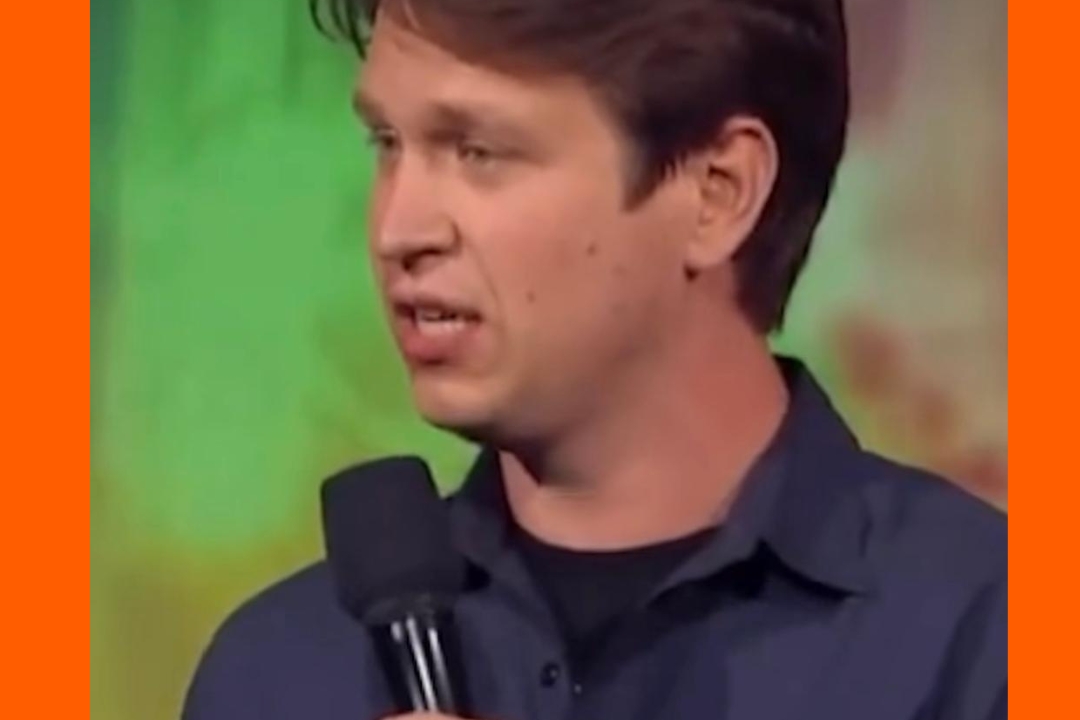
Comedian Pete Holmes isn’t just funny. He’s a deep thinker who digs so far beneath the crust of your average every day “observational” comic that he might just touch the lava. He takes an aerial view on everything from parenting to science to sex to faith, and all of the tiny minutia that comes with them. His rise as a beloved writer and stand-up has barreled through the atmosphere from tiny gigs to podcasts to TV shows.
Holmes and I have a mutual friend who put us in touch for this Upworthy interview. And although we had never met, I immediately felt like we were long lost friends upon answering his call. He was ready to break down not only the rules (or lack thereof) of comedy, but to deconstruct human thought and how the most sensitive people might navigate the world.
What especially stood out in this half hour chat beyond his quick wit, was his deep commitment to supporting other talented people. He seemingly laughs as easily as he makes others laugh, and that alone is a gift.
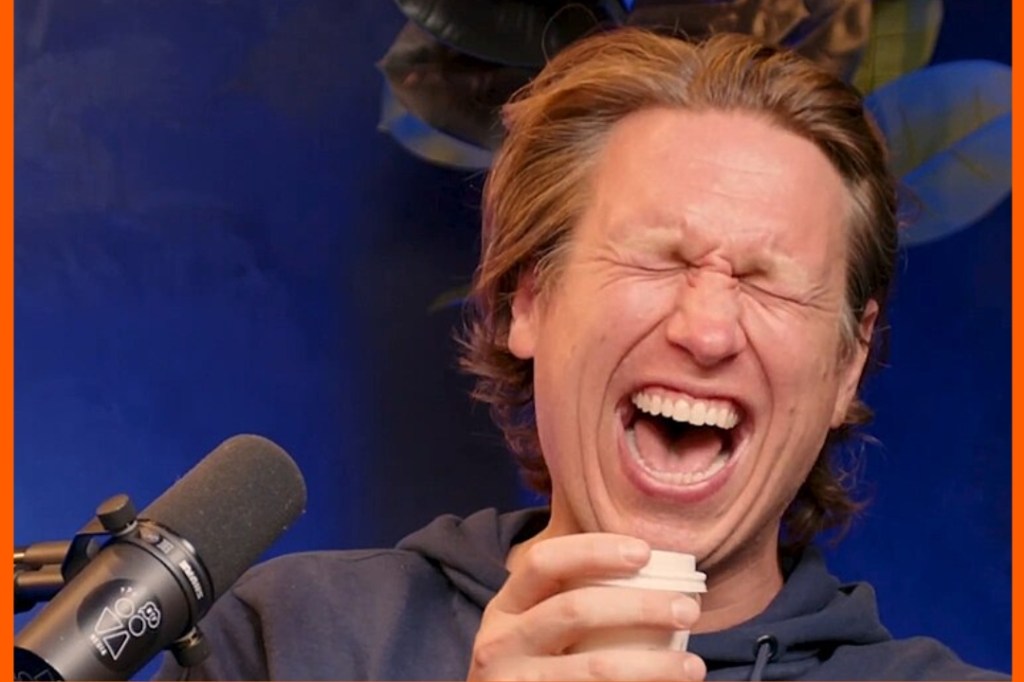
Upworthy: I must tell you there’s a podcast interview you did on You Made it Weird with Gareth Reynolds about Doritos where he did a Jay Leno impression. Do you remember this?
Holmes: “Of course!”
Upworthy: I legit look at this once a week when I’m having a bad day and need to laugh. Is there something that you come back to often when you’re in a bad mood and need to laugh?
Holmes: “Oh my God, first of all, I love Gareth so much. What a funny person! In fact, people come up and say, ‘I love your Doritos thing!’ Which is funny because I have a lot of jokes about Doritos, so I’m never sure what they mean.
To answer your question, what do I watch when I’m in a bad mood? I watch Nirvana the Band the Show. They just had their movie come out, and I think the whole second season is on YouTube.
I think Matt Johnson and Jay McCarrol are just two of the funniest people in the world, and I just watch clips from that show sort of endlessly if I’m looking to laugh. The ones that really get me are the ones that are a little bit over the line, and that’s what I like about them.
They’re just two friends finding fun together, and it just makes me so happy. So it’s not just the content, it’s the medium. It’s how they made it, and it really captures the feeling of two just free people, two people that realize that we’re in this weird reality, we’re in this weird world, and we’re only here for a little time. And one of the things we can do is be really funny and make each other laugh, and they just go at it with this innocence that I really admire.”
Upworthy: To that end, who would you say back in the day and now are your major influences as a comic?
Holmes: “I love that question. When I read the book SeinLanguage—which is I’m just so sure that Jerry Seinfeld regrets calling it. I don’t know him. I’m not basing that on anything that you don’t also have access to, just his comedy and his show. I’m just so sure that he is like, “Why did I call it SeinLanguage?“
But I read it because I didn’t really have control over our TV in our house. When a comedy special came out in book form, I could get the book and I could read it privately and re-read it. And he actually talks a bit about comedy theory in it as well. Anyway, I read this book and I just couldn’t believe that the kind of thoughts I was already having were not that different from the thoughts of a professional comedian.
I just didn’t feel like I had that tour de force, wild, loud guy Boston energy, if that makes sense. I felt way more in line with Jerry Seinfeld and Ellen and Ray Romano. These sort of like 7 p.m. show guys.
Okay, I don’t know if you’re old enough to remember, that was the fringe. In the ’90s, comedy was sort of for pirates. And a lot of my best friends are pirates. I’m just saying they hooked up late night, you know, freewheeling lunatics. And I just didn’t see myself up there. So Jerry Seinfeld once said about Robert Klein that he was the first comedian that he saw that was like, ‘Oh, it just seemed like me.’ And when I saw Seinfeld I was like, ‘Oh, this is like me, this is like a guy I know.’ So the book SeinLanguage and the fact that it was clean was really important to me.”
Upworthy: I read there was one point you had plans to be a youth pastor. Was that a real thing you were considering or just what your parents thought you would do?
Holmes: “No, it was my idea. You could look at it two ways: one, my parents were sort of detached in a way that you were like, ‘Shouldn’t you be more involved?’ Or you can be like they really were letting me find my own way, and I actually look at it more the latter.
It was as serious as when you’re in high school you want to be a teacher, you know what I mean? You just don’t know any other jobs. So I knew teachers that I admired, and I knew my youth pastor and my pastor that I admired. And this is a Steve Martin thing: he said, ‘Teachers are in show business.’ Pastors are too. And that doesn’t mean to say they’re phony or false. It just means if you’re up in front of a crowd holding their attention, you’re putting on a show. Teachers and pastors are doing something substantial, but they’re doing it in the style of a show.”
Upworthy: I saw a clip where you were talking about the idea of saying ‘Yes, thank you’ to the universe. It seems very Stoic. Are there other elements of that that help you in your daily life?
Holmes: “I would say that my understanding of ‘Yes, thank you’ has deepened a little bit. There’s a couple different altitudes you can look at that. One of them is just very basic—basic doesn’t mean bad—it’s just basic psychology. Meaning suffering comes from seeking and resisting. I know that’s sort of spiritual terminology, but it’s also psychological terminology. If you’re suffering, you’re by definition seeking a different experience.
And there’s pain or there’s discomfort, but suffering really comes from building a story. And anybody that has kids knows that that’s true. My daughter won’t go to bed, let’s say. And that really is, if we can pause and just be on a planet in outer space in these finite spaces, that is just so insignificant.
So when we’re resourced and with friends and rested and fed and all these things, we can see that. But often when your kid won’t go to bed, you’re not resourced and you start spinning out. People love talking about catastrophizing. You’re just making a story, and it’s never in your favor. You go, ‘She won’t go to sleep. Why is this happening to me?’ You start thinking about what you would be doing if she was asleep. ‘I can’t watch that show, I can’t relax. My whole life is just being a parent.’ None of that is really happening, your brain just sort of is torturing you.
It’s important to recognize that your brain doesn’t always have your best interest in mind. So giving it another path to take, which is ‘Yes, thank you.’ So the flight delayed is a good example, and just about the right temperature of spice for this exercise. You know it can be deeply upsetting when a flight is cancelled until you realize, you know, you don’t resist it, you just go with it, and you realize all you have to do is sit in your chair.”
Upworthy: Sometimes it just takes a little packaging, but just hearing you say that honestly reframed my thinking.
Holmes: “Me too! But it has to be simple. It can’t be like the Buddhists or whoever would say, ‘Don’t resist,’ right? That’s a little too conceptual. I want to get right to the phrase that’s easy to remember, that when you’re stressed you can go to it. To talk about the deepening of that, you can look at yourself. You are what’s aware of your experience, right? You haven’t always been this body, you haven’t always been this age, your name, your country. All of these are concepts that you sort of reinforce by thinking them over and over: ‘My name is Cecily. I live in America.’
All these are things. But what you really are is this space-like aware presence that encompasses your body, encompasses reality, your thoughts, your feelings, your emotions, your perceptions, right? So ‘Yes, thank you’ isn’t just a life hack. It’s actually your nature, meaning awareness or consciousness. This is almost over, by the way.”
Upworthy: Are you kidding? This is amazing. This is therapy.
Holmes: “Awareness is like a mirror, alright? So it’s like a mirror indiscriminately reflects what is in front of it. And you are like that. My voice is being recognized by you completely effortlessly. The feeling of your phone in your hand or your butt in your chair, all of that is just being registered completely defenseless. It just enters, it just comes in.
So thinking ‘Yes, thank you’ isn’t just a trick. It’s actually more in line with your nature. You do say yes to everything. I’m driving down the highway right now, every nanosecond this is just being embraced by my awareness. So when I can get my mind in line with my true nature, which is just free flowing, it’s spontaneous, it’s like jazz.
Like my daughter wouldn’t go upstairs two nights ago. She just wouldn’t even go upstairs to go to bed. And look, I can’t always do this, but in that moment I was able to go, ‘What is 10 minutes?’ And not 10 minutes where I’m trying to get her to go upstairs, 10 minutes where I just sit on the stairs with her, and now I’m looking at my stairs and I’ve never even seen them from that angle. I’m really just dropping the entire agenda. And I really think kids energetically can pick up on that. And I think grown-ups can pick up on that.
Like a good date that you’re on is somebody that’s just awake and aware and spontaneous. Why do we love spontaneity? Why do we love humor? Because it’s so alive and so accommodating and so fresh, right? You are alive, you’re accommodating, you are fresh. Those are aspects of you. I don’t mean you, Cecily, or me, Pete. I mean the thing that’s running the whole show. It’s ‘Yes’ to the whole thing. So when we get in tune with that ‘Yes,’ even when you’re miserable, even when you’re having a bad situation, a bad experience, if you can just sort of go with it.
You know the Stoics are like, ‘Control what you can control.’ You can get on another flight, and if you can’t, so they’re proactive, and I’m all about being proactive. But there is something about like, you know, a 40-minute delay where you don’t really need to look for another flight. You know what I mean? That’s really the right level for this practice.”
Upworthy: Do you find when you travel that you’re freer? I find I am when I’m out of my element and just going with the flow and not making a whole lot of plans.
Holmes: “Well, because when you’re home you have a lot more expectation for how things have gone. That’s why people like traveling, you know? And that’s an Eckhart Tolle thing. It’s like people like traveling because it forces them to be present. I would say when you’re being present, you’re actually being yourself. What you are is present, right? And everything else is mind activity.
Why does it feel so good to not think about anything? Why does it feel so good to just be? If you can stop the anxiety or the fear or the chattering thoughts, if you can just be still, it feels really good. That’s because the present moment and your true self, the nature of awareness, those are the same thing. People are just pointing to it using different words.
And when you travel, you are forced to go with the flow because you don’t even know what’s normal. ‘Oh, in Barcelona, they eat dinner at 10 o’clock.’ You’re completely out of control, so you surrender. And people are much more likely to say ‘Yes, thank you’ when they’re in Spain than they will at their home.”
Upworthy: Back to comedy, would you bill yourself as a ‘clean comic?’ And what are your thoughts on the concept of punching up or punching down?
Holmes: “I think a good entertainer should always be surprising, right? So like I think people that aren’t real fans of mine that just might come to a show, they might be surprised. There might be more swearing. There might be more sex stuff. But, to me, that’s sort of my job. I don’t want to just deliver what you’ve already seen.
Like my new special that just came out (Silly Silly Fun Boy) people have noticed that I’m swearing a little bit more in the beginning. And I’m like, yeah, it was the late Friday show and people weren’t there yet. There were huge sections of the crowd that were empty, and I’m filming a special, so I wasn’t asking. I was going out with a knife between my teeth like Predator. I was going out to insist that I do very well and that we get somewhere that we all want to be.
Other shows, the crowd—and by the way, the crowd was great—it was just kind of chunky up top. Other shows, you know, that’s not required. But I’m not doing a routine. It’s like what we were saying, I’m being present and fresh and alive for that crowd.
And to answer your question more directly… the hour that I’m touring now (which isn’t the hour that I just released) also has what I would call dirtier jokes. Meaning they’re not ugly, but they’re jokes that are sort of a little bit outrageous, I guess.”
Upworthy: So you feel like it’s not that you’re making a choice to be edgier? You’re just doing you.
Holmes: “Oh yeah, and that’s how material shows up too. I always liken it to if you’ve ever gotten an Amazon package on your doorstep and you don’t even remember what it is. That’s how the material shows up. I’m not trying to be a flashy artist like, ‘Oh I’m just the vessel.’ I’m just saying I’m living my life and certain things come up. I write them down, I perform them, people like them, and then you have about an hour and ten minutes of that and you have a show.
I’m not Marvel. I like Marvel, but I’m not Marvel thinking like, ‘Okay, we need a female-led 20-something that has…’ you know, like they’re trying to guess what people want and give it to them. They’re very good at that, but that’s not what I’m doing. I’m much more like a weather vane or a lightning rod. I’m just waiting to see what happens. But to finish my point: I’ll do these jokes—could be considered dirty, meaning I’m swearing, I’m talking about dicks, I’m talking about sex, whatever that might be. And then after the show, literally, this isn’t just something I’m making up, little old ladies will come up and tell me that they love how clean I am.”
Upworthy: The bar has changed, right? The line has moved.
Holmes: “Well, I think it’s the medium, going back to medium and message, right? I think it’s very possible that someone does what’s considered clean comedy, meaning they’re not talking about their penis, or sex, or about drugs, and they’re not swearing. They’re not saying the seven words, right? And that comedy can be toxic. It can be ugly. It can be encouraging really backwards thinking and harmful ideologies, right? By the way, I’ll defend someone’s right to be able to do that, I’m just saying what I see sometimes.
And then I think it’s quite possible to talk about your dick, talk about drugs, acknowledge the existence of sex, and say all of the seven words and do a joke that is really beautiful. In fact, I think that’s part of the message. I talk about this in the special. I am demonstrating to myself and to them: this is what it looks like to be ‘unembarrassingly’ human. I’m not ashamed. I don’t choose my thoughts. I don’t choose my feelings. I’m here to report on them and laugh at them, and thereby take away some of their power.
And that’s what you’re doing by laughing with me, you’re recognizing yourself in me and you’re laughing at yourself, and everybody leaves feeling a little bit lighter. Now did I say ‘f–k’? Yes, but if that’s your line in the sand, whether or not a comic says ‘f–k,’ that’s fine. That was me for the first 28 years of my life. It’s not my line anymore, and I’m happy to say that there are lots and lots of people that are nuanced, that are lovely, compassionate, generous, interesting, interested people that aren’t turned off by the full human experience.
By the way, I love clean comedy too. It’s just like I don’t think clean necessarily means it’s not going to be mean or ugly or somehow harmful, and I don’t think ugly means you swear. I think it’s completely what are you saying and how are you saying it? And I’m proud that even the jokes that I have that are about me letting myself down or making some sort of mistake, there’s something beautiful in the message. We can still laugh at that, and we can still not take ourselves too seriously, and we can get better.”
Upworthy: There are a lot of comics who have been punching down these days, and I’m hoping that becomes unpopular soon.
Holmes: “It’s always a pendulum, and it always goes back and forth. I will defend my fellow comedians whom I don’t agree with, their right to share their experience. That being said, it’s kind of like you wake up one day and every movie that’s in the theater is a horror movie, and you’re like, ‘When did this happen?’ And there can be a parallel there. Like Chris Fleming’s special was probably one of the best specials I’ve ever seen in my entire life, and it couldn’t have been more beautiful, but also deeply hilarious. So it’s not—nor has it ever only been—one thing.
Like look at pictures from 1972. It would look like everybody was a hippie. My dad was alive in 1972, he was not a hippie. These things get painted in these broad brushes, and you see certain trends in comedy, and it can start to feel like it’s been taken over by a certain perspective, but that’s not my experience. When we look at the bird’s-eye view, you’ll go, ‘Oh, every perspective was always being represented the whole time.’”
Upworthy: It’s an algorithm thing, you know?
Holmes: “I really feel like there’s room for everything. I don’t think there are any new groups. I don’t even think there are any really new perspectives. It’s just this constant fluctuation. But everybody was there the whole time. What it looked like, I can’t say, and nobody can. You can just live your life and make a difference where you can.”