Tags
More for You
-
The next generation of female leaders has arrived. Here’s how they’re making sure they (and every girl) get a chance to learn.
Malala Fund and their local partners, with support from Pura, help girls find their voice. The result: greater access to education and a better world.
Music, community and joy drive real change
In a small village in Pwani, a district on Tanzania’s coast, a massive dance party is coming to a close. For the past two hours, locals have paraded through the village streets, singing and beating ngombe drums; now, in a large clearing, a woman named Sheilla motions for everyone to sit facing a large projector screen. A film premiere is about to begin.
It’s an unusual way to kick off a film about gender bias, inequality, early marriage, and other barriers that prevent girls from accessing education in Tanzania. But in Pwani and beyond, local organizations supported by Malala Fund and funded by Pura are finding creative, culturally relevant ways like this one to capture people’s interest.
The film ends and Sheilla, the Communications and Partnership Lead for Media for Development and Advocacy (MEDEA), stands in front of the crowd once again, asking the audience to reflect: What did you think about the film? How did it relate to your own experience? What can we learn?
Sheilla explains that, once the community sees the film, “It brings out conversations within themselves, reflective conversations.” The resonance and immediate action create a ripple effect of change.

MEDEA Screening Audience in Tanzania. Captured by James Roh for Pura Across Tanzania, gender-based violence often forces adolescent girls out of the classroom. This and other barriers — including child marriage, poverty, conflict, and discrimination — prevent girls from completing their education around the world.
Sheilla and her team are using film and radio programs to address the challenges girls face in their communities. MEDEA’s ultimate goal is to affirm education as a fundamental right for everyone, and to ensure that every member of a community understands how girls’ education contributes to a stronger whole and how to be an ally for their sisters, daughters, granddaughters, friends, nieces, and girlfriends.
Sheilla’s story is one of many that inspired Heart on Fire, a new fragrance from the Pura x Malala Fund Collection that blends the warm, earthy spices of Tanzania with a playful, joyful twist. Here’s how Pura is using scent as a tool to connect the world and inspire action.
A partnership focused on local impact, on a global mission
Pura, a fragrance company that recognizes education as both freedom and a human right, has partnered with Malala Fund since 2022. In order to defend every girl’s right to access and complete 12 years of education, Malala Fund partners with local organizations in countries where the educational barriers are the greatest. They invest in locally-led solutions because they know that those who are closest to the problems are best equipped to solve and build durable solutions, like MEDEA, which works with communities to challenge discrimination against girls and change beliefs about their education.
But local initiatives can thrive and scale more powerfully with global support, which is why Pura is using their own superpower, the power of scent, to connect people around the world with the women and girls in these local communities.
The Pura x Malala Fund Collection incorporates ingredients naturally found in Tanzania, Nigeria, Pakistan, and Brazil: countries where Malala Fund operates to address systemic education barriers. Eight percent of net revenue from the Pura x Malala Fund Collection will be donated to Malala Fund directly, but beyond financial support, the Collection is also a love letter to each unique community, blending notes like lemon, jasmine, cedarwood, and clove to transport people, ignite their senses, and help them draw inspiration and hope from the global movement for girls’ education. Through scent, people can connect to the courage, joy, and tenacity of girls and local leaders, all while uniting in a shared commitment to education: the belief that supporting girls’ rights in one community benefits all of us, everywhere.
You’ve already met Sheilla. Now see how Naiara and Mama Habiba are building unique solutions to ensure every girl can learn freely and dare to dream.
Naiara Leite is reimagining what’s possible in Brazil
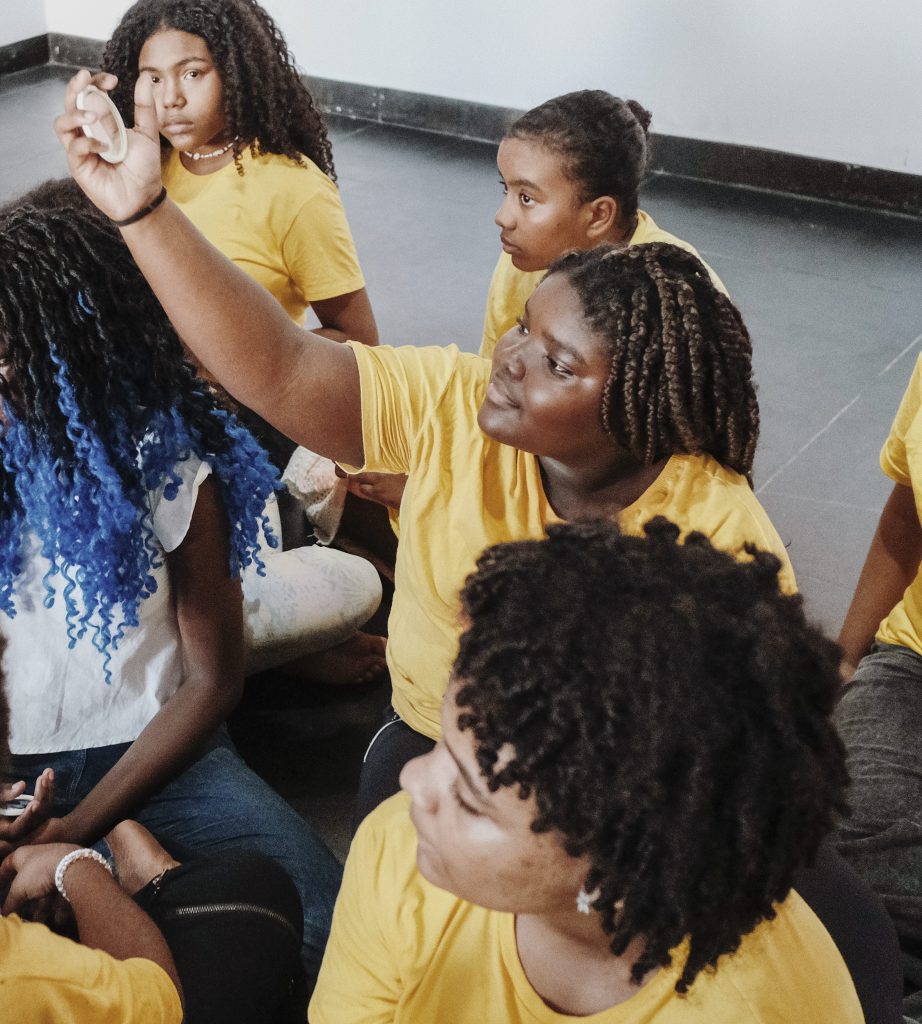
Julia with Odara in Brazil. Captured by Luisa Dorr for Pura In Brazil, where pear trees and coconut plantations cover the Northeastern Coast, girls like ten-year-old Julia experience a different kind of educational barrier than girls in Tanzania. Too often, racial discrimination contributes to high dropout rates among Black, quilombola and Indigenous girls in the country.
“In the logic of Brazilian society, Black people don’t need to study,” says Naiara Leite, Executive Coordinator of Odara, a women-led organization and Malala Fund partner. Bahia, the state where Odara is based, was once one of the largest slave-receiving territories in the Americas, and because of that history, deeply-ingrained, anti-Black prejudice is still widespread. “Our role and the image constructed around us is one of manual labor,” Naiara says.
But education can change that. In 2020, with assistance from a Malala Fund grant, Odara launched its first initiative for improving school completion rates among Black, quilombola, and Indigenous girls: “Ayomidê Odara”. The young girls mentored under the program, including Julia, are known as the Ayomidês. And like the Pura x Malala Fund Collection’s Brazil: Breath of Courage scent, the Ayomidês are fierce, determined, and bursting with energy.
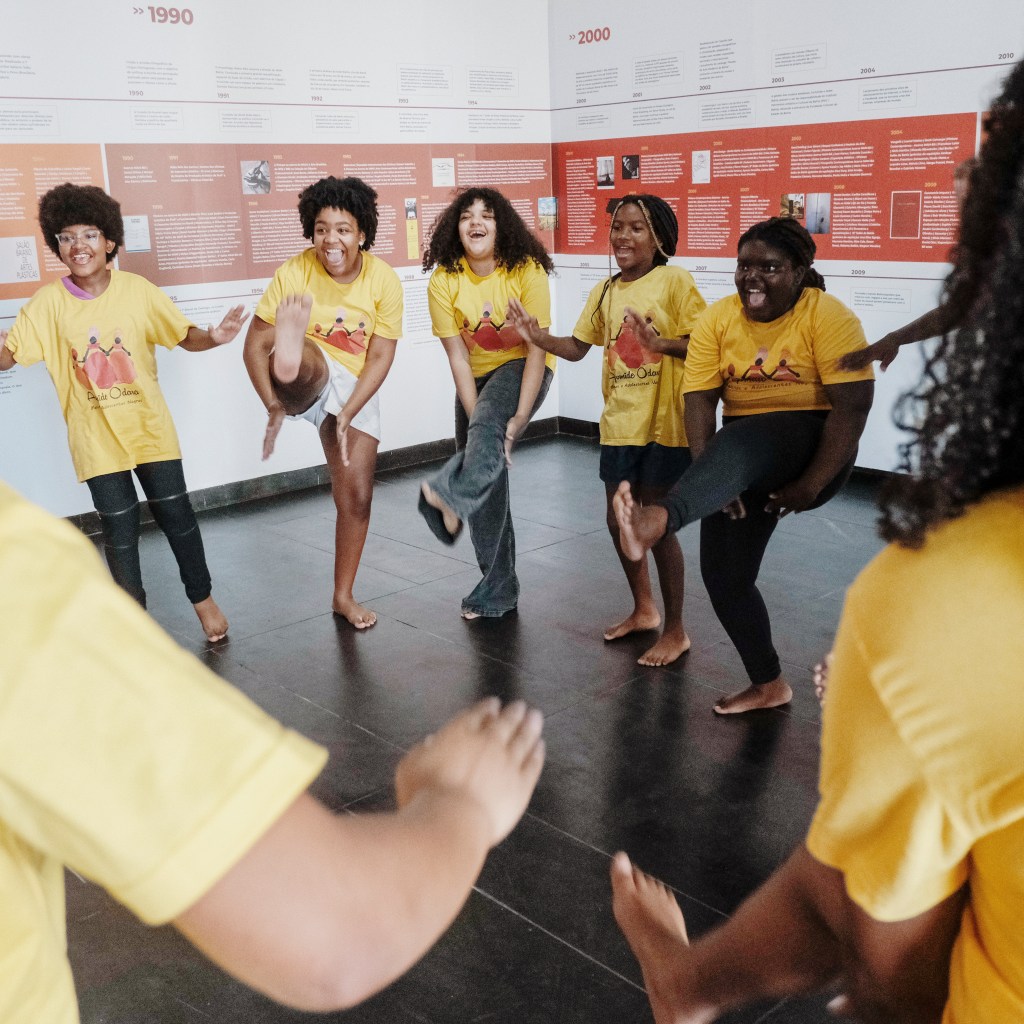
Ayomidês with Odara in Brazil. Captured by Luisa Dorr for Pura Ayomidês take part in weekly educational sessions where they explore subjects like education and ethnic-racial relations. The girls are encouraged to find their own voices by producing Instagram lives, social media videos, and by participating in public panels. Already, the Ayomidês are rewriting the narrative on what’s possible for Afro-Brazilian girls to achieve. One of the earliest Ayomidês, a young woman named Debora, is now a communications intern. Another former Ayomidê, Francine, works at UNICEF, helping train the next generation of adolescent leaders. And Julia has already set her sights on becoming a math teacher or a model.
“These are generations of Black women who did not have access to a school,” Naiara says. “These are generations of Black women robbed daily of their dreams. And we’re telling them that they could be the generation in their family to write a new story.”
Mama Habiba is reframing the conversation in Nigeria
Centre for Girls' Education, Nigeria. Captured by James Roh for Pura In Mama Habiba’s home country of Nigeria, the scents of starfruit, ylang ylang and pineapple, all incorporated into the Pura x Malala Collection’s “Nigeria: Hope for Tomorrow,” can be found throughout the vibrant markets. Like these native scents, Mama Habiba says that the Nigerian girls are also bright and passionate, but too often they are forced to leave school long before their potential fully blooms.
“Some of these schools are very far, and there is an issue of quality, too,” Mama Habiba says. “Most parents find out when their children are in school, the girls are not learning. So why allow them to continue?”
When girls drop out of secondary school, marriage is often the alternative. In Nigeria, one in three girls is married before the age of 18. When this happens, girls are unable to fulfill their potential, and their families and communities lose out on the social, health and economic benefits.
Completing secondary school delays marriage, and according to UNESCO, educated girls become women who raise healthier children, lift their families out of poverty and contribute to more peaceful, resilient communities.

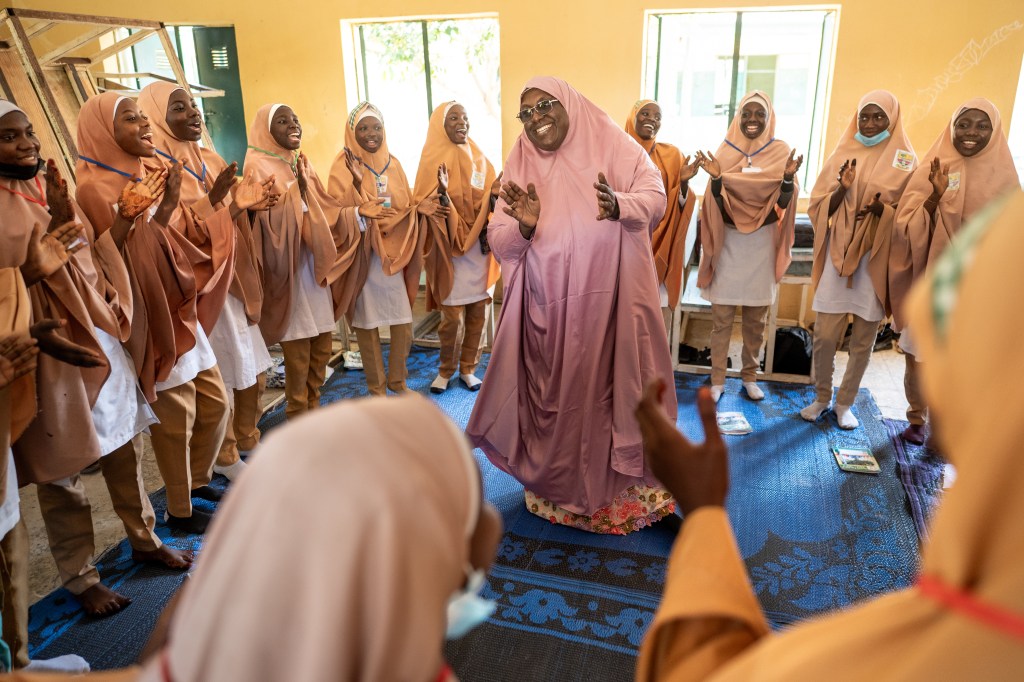
Centre for Girls’ Education, Nigeria. Captured by James Roh for Pura To encourage young girls to stay in school, the Centre for Girls’ Education, a nonprofit in Nigeria founded by Mama Habiba and supported by Malala Fund and Pura, has pioneered an initiative that’s similar to the Ayomidê workshops in Brazil: safe spaces. Here, girls meet regularly to learn literacy, numeracy, and other issues like reproductive health. These safe spaces also provide an opportunity for the girls to role-play and learn to advocate for themselves, develop their self-image, and practice conversations with others about their values, education being one of them. In safe spaces, Mama Habiba says, girls start to understand “who she is, and that she is a girl who has value. She has the right to negotiate with her parents on what she really feels or wants.”
“When girls are educated, they can unlock so many opportunities,” Mama Habiba says. “It will help the economy of the country. It will boost so many opportunities for the country. If they are given the opportunity, I think the sky is not the limit. It is the starting point for every girl.”
From parades, film screenings to safe spaces and educational programs, girls and local leaders are working hard to strengthen the quality, safety and accessibility of education and overcome systemic challenges. They are encouraging courageous behavior and reminding us all that education is freedom.
Experience the Pura x Malala Fund Collection here, and connect with the stories of real girls leading change across the globe.
-
Dad remakes AC/DC’s ‘Thunderstruck’ using only a year’s worth of baby’s recorded sounds
Prepare to be thunderstruck.
Few things bring as much joy to a parent’s heart as the adorable sounds their babies make. But back in 2024, when a dad with a vision, a camera and a year’s worth of footage used those sounds to recreate one of the most iconic rock songs ever…let’s just say joy alone doesn’t quite cover it.
In one of the most epically adorable and adorably epic song renditions ever, dad and video editor Matt MacMillan spliced together tiny snippets of his baby’s sounds to make AC/DC’s “Thunderstruck.” And it’s one of those things you just have to see to believe.
Below, enjoy little Ryan singing a jaw-droppingly awesome babyfied version of “Thunderstruck.” Nothing but awe and respect for a guy who takes a whole year to get just the right sounds at the right pitches and figures out to put them together to create this masterpiece:
Making a sneeze into a cymbal? Are you kidding me?
People have been understandably impressed, with the video getting over 11 million views.
“Ryan becomes the vocalist of AB/CD.”
“I need a cover in 17 years whenever he is an adult singing over the instrumentals lol”
“‘I recorded my son for a full year. I edited for the next 5′”
“The fact that he genuinely found clips that fit every note he need instead of just pitch shifting like most videos like this do really makes this stand out. Good job he’s adorable.”
“This dude had a kid just so he could make this song. What a Legend.”
“Other parents: ‘I want my child to create masterpieces.’ This guy: ‘my child IS the masterpiece.’”
“I’m a residential plumber and I’ve had an absolutely horrible day on a work shift that’s lasted 13 hours and even after crawling through human poop all day this made me smile laugh and giggle like a small baby.”
Believe it or not, it’s not autotuned or pitch-shifted. Those notes are all baby.
The real question is: How did he do it? This isn’t just some autotune trick. MacMillan really did it all manually, going through each video clip of Baby Ryan, organizing them by pitch and figuring out what notes they were.
Perhaps most impressively, he didn’t even know the notes of “Thunderstruck” to begin with and doesn’t really read music. He had to pluck the song out on the piano and then match those notes with his baby’s sounds.
As he wrote, “It took forever.” But he shared an inside look at how he did it here:
Seriously, doesn’t seeing how he did it make it even more impressive? Pure human creativity and perseverance on display. What a delightful gift Ryan will have for the rest of his life. Much better than a standard baby book.
Baby Ryan’s “Thunderstruck” was not MacMillan’s first foray into baby covers, either. He previously created a rendition of “Carol of the Bells” using Baby Ella’s sounds, and it is just as impressive (and adorable) as Baby Ryan’s. Here’s one to add to your holiday playlist:
Here’s to the humans who wow us with their ambitious, innovative projects that exist purely to bring a smile to people’s faces.
You can follow Matt MacMillan on YouTube.
This article originally appeared last year.
-
Dad shares the unique 7-point checklist his kids must finish before they get screen time
A psychiatrist and father of seven went viral for sharing the typed checklist his kids must complete before they’re allowed anywhere near a phone or tablet, and even plenty of adults are saying they need someone to do this for them.
We know too much screen time is not good for us. We also know that younger folks are particularly susceptible to screen addiction. Crucially, teachers and psychologists have been sounding the alarm about the effects of too much screen time on young people for years now. Reports flood in every year that more and more people in schools struggle to do anything without ChatGPT’s help, that they’re way behind in learning fundamental skills, that they’re disrespectful and lazy.
Every generation has been “concerned” about the one that comes directly after them, bemoaning that they don’t have the same values or that their brains are being rotted by Elvis, rock and roll, radio, or television. So some of the doom and gloom is probably overstated, but there’s truthfully never been anything quite like iPhones loaded up with TikTok and other forms of hyper-dopamine-fueled social media.
Still, it’s unlikely that a young person, or any person, really, can exist in modern society without some level of access to screens. So parents need to effectively help teens and tweens manage the habit and offset the dangers as much as humanly possible.

A young girl plays on the monkey bars. Photo credit: Canva Psychiatrist, author, and dad of seven Richard Wadsworth recently went viral after showing his own personal strategy for getting his kids to do something other than scrolling.
It could be the perfect solution for parents to not only break screen addiction, but instill some other healthy ritual as well.
In the clip, we first see Wadsworth’s tween son doing deltoid exercises with dumbbells. Which he apparently got up at 6:30 am to do. What could possibly incentivize practically anyone, let alone a preteen to wake up at the crack of dawn to lift weights? Was his dad forcing him to exercise?
No. Wadsworth went on to show a typed out list of various tasks that must be performed before his kids even think about setting eyes on a phone or tablet. The list included a short workout in the form of one mile on the treadmill or 20 minutes of another exercise.
Wadsworth explained that rather than enforcing strict rules, this method provides necessary structure without taking away choice.
“I’m not forcing my son to exercise every day, but I am setting rules and boundaries around his screen time,” he said. “He decided he wanted to have more time after school to play with his friend. And so in order to do that, he realized that he’d need to wake up a little bit earlier and exercise in the morning.”
In addition to exercise, the list included domestic chores like cleaning the bedroom and shared areas, finishing homework, doing laundry, preparing for the next day…and, perhaps most importantly…making sure the toilet is flushed. (Not cleaned, just flushed. Parents everywhere can relate.)
“We have all of their screens locked away. And if they want access to any of them, they need to come ask us and we’ll go through the list together. And they’re not getting their screens until the list is done,” Wadsworth continued.
He also drew a comparison between screen time and sugary sweets, noting how most parents probably wouldn’t routinely allow kids to eat dessert before a nutritious meal, but instead allow it to be a treat.
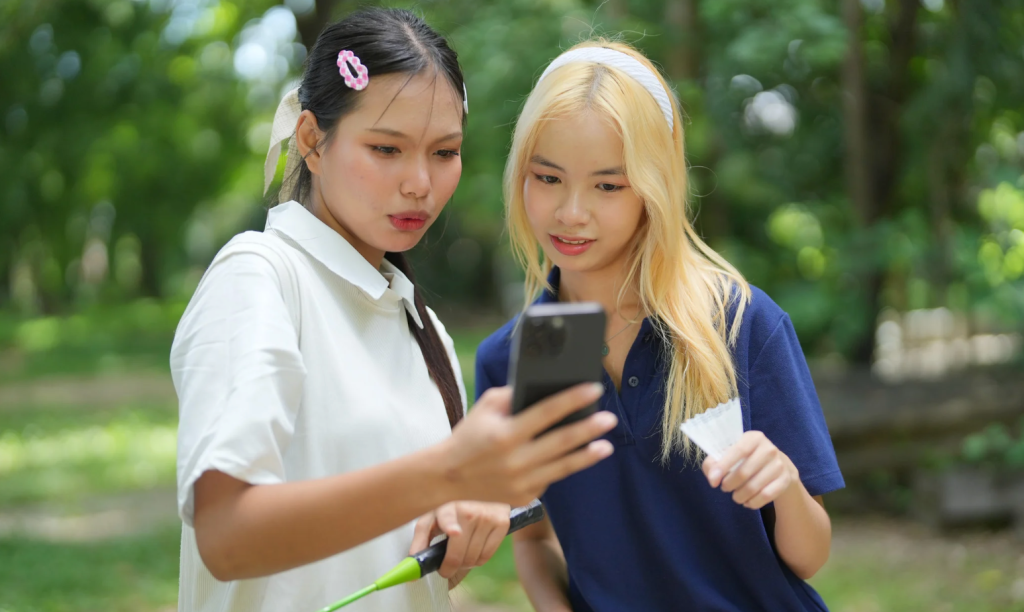
Two young women look at a cell phone. Photo credit: Canva “Just as you would hopefully have your kids eat dinner before they had their dessert, you should probably be having them do something positive…before they get on their screens.” Hence why he tries to get his kids to complete their list before going to the phone.
And in case you’re wondering how Wadsworth’s son feels about all this, he reported having “so much energy for school” feeling “so much better” since his dad introduced the to-do list.
Bottom line: kids need guidance from their parents. And Wadsworth recommends clear cut boundaries to help them develop good habits, “because if you don’t do it, nobody else is.”
Wadsworth’s parenting hack was well received, with quite a few grown adults saying they could benefit from this type of boundary-setting in their own life.
“Even I’m addicted to this screen. I have to tell myself to put it down all the time and I’m a grown adult. Kids definitely need this!” one user wrote.
Another added, “I need someone to do this for me (I’m 28).” To which Wadsworth replied, “we all need parents sometimes.”
“We implemented a similar plan, and I was surprised at how easy they took to it. It’s almost like kids need structure. What a concept!” another user remarked.
While the inclusion of exercise on the To-Do List might be controversial, the facts don’t lie. Most kids and teens aren’t getting enough daily physical activity. Kids don’t play outside or walk to school anymore, either. So if they’re not exercising, they’re probably not moving much at all. And that’s just as dangerous as too much TikTok.
Even with ongoing uncertainty around TikTok, social media isn’t going anywhere. The sooner parents can implement guidelines like these, the better equipped their kids will be at balancing tech savviness with tech dependence.
This article originally appeared last year. It has been updated.
-
People share ‘adult cheat codes’ that changed their lives. Most are surprisingly doable.
Sometimes the simplest life shifts are the most effective.
Sometime in the 2010s, the word “adulting” entered our cultural lexicon. Many people found it a useful umbrella term for the more challenging parts of adult life, from managing finances to juggling work-life balance to dealing with the piles of paperwork adulthood requires.
Adulting isn’t easy. But are there ways to make it easier? People on Reddit are sharing their favorite “adult cheat codes” that changed their lives, and most are surprisingly doable. Some are simple reminders of things we know but often forget. Others are one-line mindset shifts that make an outsized difference in how we navigate the world.
Here are some of the most popular responses:
Sleep and hydrate
Take care of your sleep needs and drink enough water. Yes, it’s basic. It’s literally the most basic of human needs, but a lot of people unfortunately neglect them. It’s remarkable how many other issues fall away when you start really focusing on the fundamentals of well-being.
“Sleep and drinking water. Funny how something so simple is linked to so many of your normal functions.” – RepresentativeStooj
Sleep is an underrated life hack. Photo credit: Canva “Being properly rested and hydrated is WILDLY underrated. I work with a guy who complains of constant headaches. One day he said they were really bad so I asked how much water he has drank today. He goes ‘none’ and I’m like, well dude…” – Dr_A_Mephesto
“Fixing my sleep schedule changed my life. I feel sooo much happier.” – salty_mate
“Life hack: address your most basic biological needs.” – flyingcircusdog
Just take the first tiny step
Sometimes adult life can feel overwhelming. When you add a mental health struggle or neurodivergent challenge, that overwhelm can feel paralyzing. That’s when the “one small thing” cheat code comes in. When everything feels too big, think small. Super small. Break it down as far as you can and just do the very first step. Any progress is still progress.
“If you are bed rotting and depressed to the point that you can’t get out of bed or do anything and dishes, laundry or whatever have piled up, do 1 chore today. Wash one dish. Put 3 pieces of clothing in the laundry hamper. Tomorrow wash 2 dishes. Keep going. Sweep one square yard of your floor, etc… It will give you a sense of accomplishment and may even lead you into a snowball effect where your place starts feeling cleaner and cleaner making you clean more. Sorry you are going through it, I have been there many times.” – MSPCSchertzer
“Surprised to find this, literally how my last three months have had to be handled. My idea became ‘Well, I let it get this way. If I at least leave today looking better than yesterday or before I do something productive (even if only a little bit) then eventually it will all get caught up!’ This worked for that slump incredibly well. Especially if you have some pretty hard-hitting ADHD, don’t tackle a project; just chip away around the house to where something looks better than when you started. Period. Any progress is good.” – Sir-Hamp
“After my dad passed away and I had a mountain of things to deal with that I was avoiding. I decided to do one thing every day. Might only be putting something in the mail or making a phone call. It didn’t take long and it was all done. I’ve done it with other things since then and it definitely works.” – Goldie1976
“Yep, applies to being overwhelmed by any project, tell yourself, I’m not trying to finish now, but let me just start one part, tiny as it may be. Lets your mind ‘off the hook’ and once you get going it also often snowballs as well.” – No_Gur4351
Stop obsessing about people obsessing over you
Do people ever think about you when you’re not around? Sure. Do they gossip about you? Perhaps. Do they think about or talk about you nearly as much as you think? Probably not. Most people are concerned with their own lives, not yours.
“Realizing most people aren’t thinking about you as much as you think. Takes away a lot of unnecessary pressure.” – AcanthisittaSea3279
“Everyone is so busy starring in their own mental movie that they barely have time to be a background extra in yours.” – ConstructionMany6315
“You wouldn’t care what people thought about you if you knew how rarely they did.” – DukeoftheRiver
“I saw a neat quote once… You spend your 20s worrying about what everyone thinks of you. You spend your 40s not caring what everyone thinks of you. You spend your 60s realizing no one thinks about you.” – RunawayRogue
Learn how to avoid committing
Some people automatically say “yes” to everything because they have a hard time saying “no.” While there’s value in learning to just say “no,” it’s helpful to have responses on hand that allow you some wiggle room.
“Saying ‘let me check my calendar’ instead of immediately saying yes. Buys you time to actually decide if you want to do something, and people respect it way more than making up excuses later.” – GroundbreakingMall54
“Similarly, if you have a partner: ‘Let me check with my partner’ functions the same. I usually say that in the same way too. See if she has anything going on, I do and forgot, or if she just doesn’t want me to go for some reason. and if I don’t want to go I can use either of the first 2 as an excuse. Would never throw her under the bus to avoid the responsibility of saying no.” – leonprimrose
“If you don’t want to do something, like someone invites you out for dinner, just say ‘sorry I have plans.’ Those plans may be to sit in your oodie eating icecream infront of the tv. But they are still plans. You dont have to tell people what your plans are.” – Grumpy_bugger“Always lead with ‘no’ or ‘I will need to check and get back with you.’ Your tendency is to be nice and say ‘yes’ and then you regret it. Say ‘no’ or ‘not sure.’ You can always check if the invite it still good if you want to go.” – MathiasAurelius
Be kind to your future self (procrastination hack)
Ah, procrastination. The habit that makes us our own worst enemy. Or rather, it makes our present self the enemy of our future self. When we shift our mindset to being kind to our future self instead of indulging the resistance of our present self, it becomes a little easier to Do The Thing Now.
“I saw a video where someone said that by putting something off because you don’t feel like doing it ‘now’, it will still be ‘now’ for your future self, so may as well get on with it the first time. It’s definitely helped me in terms of housework or menial day to day tasks. I’m procrastinating a lot less.” – youshewewumbo
“I view it as doing a favor for my future self. I don’t want to do the dishes, but I will so that tomorrow Future Me will see it and say ‘hey thanks Past Me! What a great guy.’” – Epicjay
“I often tell my wife, ‘If you do it now, later you will be grateful.’” – Recent_Weather2228
“Yep. That changed my thinking as well. Taking care of your future self is the only way to actually feel like your life is getting better and not harder.” – silverace00
Normalize not having an opinion
Social media has made it feel almost imperative to have an opinion on everything. But in reality, there’s a lot we don’t know, and uninformed opinions can exacerbate all kinds of societal problems. Normalizing the idea of saying “I don’t know” goes a long way toward a saner way of being.
“‘I don’t know enough about that to have an opinion yet.’ People respect this way more than a half-baked hot take, and it instantly kills 90% of arguments you were about to waste energy on. Took me way too long to learn that not every conversation needs me to have a stance.” – fan_ling
“Agreed. It’s also remarkable how much displays of humility short circuits the kind of people who argue online as a hobby.” – Thoth17
“People who don’t know how to say ‘I don’t know’ when asked a question are people that you can never trust.” – Dumbname25644
Sobriety
Many people report that giving up alcohol or other substances, even just for a while, has drastically improved their lives. While everyone’s experience differs on this front, research shows that cutting out alcohol can benefit sleep, mental health, and overall health, including reducing cancer and liver disease risk. There’s also a financial upside to consider.
“Completely quitting alcohol. Improved my life in so many ways, mentally and physically.” – hisokard
“A few years ago I fully quit drinking for about 2 years or so. I felt so much better in essentially all aspects, it was pretty amazing. I was drinking what society would probably consider a ‘normal’ amount on the day to day, with the occasional big night every now and then, especially when I was younger.
Now, I have the rare beer or glass of wine. What that 2-year sober period did was break a lot of habits: the ‘well the day is done, time for a beer,’ or a consistent glass of wine with dinner, or whatever.
Looking back, so much of my drinking was habitual and just not really necessary. Breaking the cycle of the habitual drinking has been amazing. I do appreciate a nice drink every now and then, but it’s almost always just a single drink: I don’t have any drive to have another.
I’d guess that if someone has a real problem with alcohol, going back and having a drink after being sober is a bad idea. But if you’re just stuck in a habit, the sober break is a great reset.” – bitzandbites

Many people find sobriety to be life-changing. Photo credit: Canva “I second that. I still drink but rarely, maybe one glass of wine or one beer in gatherings but that’s it. My life improved so much when i quit alcohol and weed 2 years ago.” – Hour-Ad6874
“Getting a Garmin watch really alerts you to how much alcohol ruins your sleep. So many metrics get thrown out of whack by just a couple of drinks!” – ProbablyStillMe
“I know a guy who got shredded in his late 40s from quitting alcohol, he felt better, exercised more consistently, and was already eating healthy so over the course of 2 years he just looked like a superhero.” – Realistic-Buy4975
See more responses on Reddit.
-
Why those epic ’80s wooden playgrounds suddenly disappeared
Why did we trade those wooden beauties for brightly colored plastic?
If you grew up in the ’80s or ’90s, you’re likely all too familiar with those all-wooden, castle-like playgrounds complete with drawbridges, child-sized tunnels, rope mazes, PVC pipe “walkie-talkies,” cool hideaway spaces, airport towers, and tire walls.
They were the perfect place to let your imagination run wild, whether you pretended to be knights, wizards, Vikings, or simply played freeze tag without ever touching the ground.
Nowadays, those castles are like a modern-day fairy tale: no longer made, rarely seen, and mostly remembered as relics of a bygone era. What happened?
History of wooden playgrounds
As a fun Instagram video by content creator Phil Edwards explains, part of what made wooden playgrounds special was that children had a major role in how they were created.
According to Edwards, Robert “Bob” Leathers, founder of Leathers and Associates, and his partner, Tom Rockwell, consulted children during the design process. Those playgrounds were then built by volunteer community members, such as parents, in a matter of days.
Personal memories
Interestingly, quite a few viewers shared personal memories of helping design their wooden playgrounds as children.
“My parents helped built the one for my elementary school…it was pure magic.”
“I participated as a child, and I clearly remember standing up as a kindergartener and saying, what if a slide came out of a dragon’s mouth. Years later, playing in the Orange CT playground, I realized the slide came out of a dragon’s mouth, rendered in wood. I almost didn’t believe my earlier memory. Could that wild idea from the mouth of a kindergartner have become a major feature of an actual playground?? What an amazing program. ❤️”
Castle Parks?
by u/Comfortable_Weight82 in grandrapids“I remember being at planning meeting at the Waverly community house. I remember my dad building. I remember sanding wood. And I have so many memories of playing on this playground for hours a day while my mom taught dance…It was the greatest sense of community.”
“Our very small southern NJ town had one of these – Pine Cone Zone. I still remember the planning team coming to our school. We all submitted our ideas and designs. They also had a naming contest. People could donate money and their names would be engraved on the fence posts. Still remember spending the day at the rec fields while our parents built it. Was such a big deal for our little community ❤️”
Why they stopped making wooden playgrounds
Unfortunately, a study in the early 2000s found that the type of wood used in these structures contained arsenic, and that children who played on them had significantly higher levels of the toxin on their skin. The findings raised concerns about the structures’ overall safety, and major playground manufacturers eventually stopped using this type of wood in favor of other materials.
And while this didn’t seem to influence their decline, several folks recalled the wooden playgrounds as having merciless splinters.
“The splinters were ruthless,” quipped one commenter.
Still, there weren’t any documented cases of “anything going wrong from these playgrounds,” Edwards noted. That’s why they weren’t forcibly torn down, and why you might still find some of the 1,600 that were built scattered across the country.
While their reign has ended, wooden playgrounds leave behind a wonderful legacy. As Edwards put it, they were built “by parents who wanted to share their love with their children” and make something “amazing.” Imagine what could be possible if there were more opportunities for that kind of thing.
-
Frugal people share 20 smart financial decisions that saved them $10,000 or more
“I’ve saved $12,744 since quitting drinking alcohol.”
Frugal people know that saving money is all about stacking small savings. Over time, making choices like cooking at home instead of eating out and turning down the thermostat can add up.
These small savings can snowball into thousands of dollars. But sometimes, seemingly small decisions can lead to the biggest financial payoffs.
On Reddit, people shared their “biggest frugal win” that saved them $10,000 or more. From negotiating medical bills to buying used cars to DIY projects, here’s some of their money-saving wisdom:
Medical savings
“I’m using a dental college for all oral care and have had all teeth removed, gum shaping, and there making my dentures this month. Traditional dentures or even immediate style ones wanted at least $30,000 with all the extractions etc. The school I’m going to? So far I’ve spent $3,600 out of the $4,100 they quoted me.” – UnderstandingFar5012
“Learned to negotiate medical bills after my appendectomy in 2019. hospital billed $28k, insurance ‘negotiated’ it down to $14k, and my share was still $6,200 after deductible. Called the billing department and asked for an itemized bill. They’d charged $47 for a single ibuprofen and $400 for ‘observation’ that was literally a nurse checking on me once. Got those removed. Then asked about their financial hardship / prompt pay discount — turns out if you offer to pay the remaining balance in full immediately, most hospitals will knock 30-40% off. Ended up paying $3,100 instead of $6,200. That one phone call taught me the entire medical billing system is built on the assumption that nobody will question the numbers.” – RichardDr
“This is for others rather than myself since insurance covered Lupron shots after I had breast cancer. A Redditor pointed out you can get it through Marc Cuban’s Cost Plus for $80.00, compared to the $2,000 a month that is often charged that’s a huge difference. Hopefully this info can help others.” – yappledapple
Transportation savings
“I checked my ego and bought a 16 year old Prius for $5500 in 2021. No issues and still getting 47 mpg.” – flowbee92
“Over the long haul, switching to an e-bike has saved me maintenance money, insurance costs, gasoline and everything else associated with the car. I’m in a city with tons of bike paths and I can get anywhere on an e-bike. I live by myself so grocery shopping is doable on an e-bike also.” – jarchack
Lifestyle savings
“I’ve saved $12,744 since quitting drinking alcohol.” – PucWalker
“I stopped drinking almost 4 years ago. I have a little day counter app that also does math for cost savings. 16.5k saved on alcohol alone, probably thousands of more on healthcare and drunken impulse shopping.” – Mission_Yoghurt_9653
“I quit smoking in 2000, I’ve probably saved over $40,000 by now just in to cost of cigarettes. I’m sure if you factor in the cost of health issues it’s a far greater savings.” – lindygrey
“Probably volunteering—if I want to go to any kind of expensive event, big or small, I just register to volunteer at it—conventions, theater, exercise classes, etc. Yes I have to work a little, but I usually get plenty of downtime to enjoy whatever I’m there for, plus sometimes free meals, too. I’ve been doing this for more than a decade and do it often enough that I’d guess I’ve hit $10k in savings.” – lesbadims
“39 year old woman: I’ve accepted aging.” – ashashbaby248
Utility savings
“Switching to prepaid cell service. Pay $30 a month now vs $150. For over a decade now that’s more than $10k.” – National-Practice705
“Paid off mortgage early by making small principal payments, saving 13 yrs of interest at 8%.” – licensed2jill
“We were needing a new roof and just before we signed the contract hurricane Ian hit so the insurance not only covered it, but we replaced the shingle roof with a reflective metal one that lowered not only our electric but also lowered our priemems.” – nomadnomor
“Installed my own solar panels for 23k instead of 60k.” – bk2947
“My wife and I lived in a camper for several years while we saved up to buy land and start building a house. We bought the camper for $5,000, spent a couple grand renovating it ourselves, and then rented a lot at an RV park for $300/Mo for about 2.5 years. This step alone saved us well over $10,000 for the duration of our stay there, and then we used our savings to buy a piece of land and move the camper there. At that point we were living completely rent free and eventually built our house. Now we’re homeowners in our early 30s with no mortgage.” – BertKektic
Shopping savings
“Easily furnishing practically my whole house with furniture, carpets, lighting, clothing and cleaning tools obtained for free over a couple years on my local Buy Nothing Facebook page.” – soldelmisol
“Gonna say books has been my most frugal win, especially with three people in a house who all each have their own large and unique collections. Between utilizing the library since I was a kid, trading books and buying them from thrift stores and second-hand bookstores, I have saved probably $20k or more at this point. It has also led to obviously less clutter from books in our home because we just borrow a bunch and only search for books or series we really love now for purchase.” – Mewpasaurus
Marriage savings
“Eloped.” – nc_bound
“I got a prenup for like $1000 many many years ago and I filed for divorce when I found she was cheating years later. That saved me a good chunk of money and I didn’t have to pay any of her bills or her 20k plus attorney fees.” – Choice-Newspaper3603
“Writing in to dispute a debt my first husband failed to have my name removed from. When he filed for bankruptcy, an account that he agreed in our divorce agreement to remove my name from decided it still had me as recourse. I disputed it, and they were forced to conclude I wasn’t liable. It was about 75k.” – thatcrazylady
-
College grads get real about how drastically job hunting has changed and what’s helping them survive
How to find work in the age of ghost jobs and AI screenings.
Looking for a job has never been easy, but it used to be simpler. In 2026, job hunting is more competitive, frustrating, and exhausting than perhaps ever before.
Recent college grads and people transitioning in their careers have been sounding off on social media about how different the career landscape is now versus just a few years ago, and what it takes to finally get hired.
AI screenings, and yikes, even interviews
More candidates than ever are being filtered out of consideration almost immediately. Not by recruiters, but by robots.
ATS (Applicant Tracking Systems) have become more advanced and more prominent. They can eliminate resumes based on keywords, experience or lack thereof, and plenty of other “red flags” set by employers. An estimated 99% of Fortune 500 companies use an ATS to screen applicants before they ever have human contact.
Then there are interviews conducted not by humans, but by virtual chatbots.
“I went through one, it was [extremely bizarre],” a Reddit user wrote. “It cuts you off at pauses to move on to its next question.”
To be fair, this overuse of technology goes both ways. With modern tools and AI, job seekers can churn out custom resumes and apply to hundreds of jobs with almost no effort. That creates huge backlogs for recruiters and more competition than ever for open positions.
“There are a lot more candidates, fewer jobs and it’s easier to apply than it ever has been so recruiters are overwhelmed and looking for the easiest ways to weed people out, whether that’s over relying on tools, only looking at the first few applicants or only taking people referred in,” a Reddit user noted.
Ghost jobs galore
“This is the worst job market I have experienced,” one Redditor lamented. “Most of the jobs don’t even really seem real.”
Ghost jobs are listings that get posted but never filled, and they’re everywhere these days. The same roles are posted and reposted again and again, and job seekers are noticing. A job seeker recently wrote on Reddit:
“I’ve noticed recruiters on LinkedIn posting the same job over and over, collecting 100+ applications and then remaking the same job. Word for word, exactly the same. I’ve seen the same 6 jobs ads at least 100 times in the past few months. I report these to LinkedIn, but they find ‘nothing reportable’ with this.”
Companies may post jobs they have no intention of filling in order to:
- Give the illusion of growth
- Collect data on the candidate pool and job market
- Develop a passive talent pipeline
Many ghost listings also pop up when companies plan to hire an internal candidate. Laws often require the job to be posted publicly for fairness, but that doesn’t mean those external candidates will be seriously considered.
It can be extremely frustrating for anyone who’s seriously looking.
Offshoring and remote work
You’re no longer just competing with job seekers from your area. With the rise of remote work, many companies are accepting candidates nationwide (or, in some cases, worldwide), opening up an incredibly deep and competitive candidate pool.
Worse, offshoring is sending many positions overseas, where workers are often more affordable—and it’s on the rise.
“Worked at a Fortune 500 company. Started there in 2019 and it was great, all US employees about 100 people in IT,” a Redditor shared. About six months ago, they wrote that their company had outsourced the majority of its work internationally and was planning to lay off 80% of its staff.
“I worked with people who were employed with this company for 25-30 years, many people retiring here as they paid very well,” the Redditor added. “That opportunity will no longer exist for the millennial generation and onward due to rampant offshoring and cost saving tactics.”
200+ applications is the norm
Brace yourself. It might take over 200 applications to land a single interview. Photo credit: Canva Depending on who you ask, it might take 50, 100, or even more than 750 job applications to get an interview or land a job. Regardless of the exact figure, that number has risen dramatically in recent years.
When you need to write a custom cover letter and tweak your resume for each application, it can be exhausting for job seekers.
One Reddit user recently shared a success story about finally landing a job as a Kroger grocery clerk—after submitting more than 500 applications.
“500 apps for a grocery clerk is insane,” read the top comment.
Rounds and rounds (and rounds and rounds) of interviews
One Redditor shared that they recently had to fill out a 172-question personality test with “weirdly invasive questions,” including ones about how they feel about their appearance. After that, they had to record a video introducing themselves.
All just for a chance at getting a real interview.
Experts agree that more companies now require far more extensive interview processes than in years past. These rounds can include homework, tests, personality assessments, intelligence quizzes, and several traditional interviews.
You need experience to get experience
This has been a conundrum for years: the entry-level job that requires five years of experience. But recent job seekers say it’s only gotten worse.
Entry-level jobs have become really hard to land—if they haven’t been replaced altogether by AI.
So is it all doom and gloom out there?
The process has become harder, more complex, and more competitive. That’s for sure. But people who have made it through successfully say there are a few strategies that can help.
What’s new that works, and what’s old that still works
LinkedIn is the place to be
Though not without its own issues, many people say LinkedIn is a good place to look for jobs because the listings are usually tied to a real person, like a recruiter. Putting a face to a job can go a long way. Job seekers say it’s more reliable than many aggregators, like Indeed and ZipRecruiter.
If you can apply via the company website, even better. In fact, much better. Just avoid Easy Apply at all costs.
Networking and referrals still work
This is harder than ever, but also more important than ever. Some estimates suggest that getting a referral from an employee makes you about seven times more likely to be hired than a job board candidate. It may not be the advice anyone wants to hear, but keeping your network “warm” is a must in this job market.
“I’ve had 2 interviews recently and the only reason is because I’ve reached out to the far limits of my network to find anything … it’s really the only way,” one Redditor suggested.
Just get employed
Traditional career paths are all but gone, and they’re not as stable as they once were. There’s no guarantee you’ll land an entry-level marketing job and stay in the industry for decades, working your way up. The most important thing is to take a job that pays your bills and worry about finding something better later.
In a Reddit thread, a user debated whether they made the right decision in turning down a decent but not great job offer. In the past, they might have been advised to hold out for a better long-term position, but modern job seekers overwhelmingly agreed that being employed was the best outcome. “This is called a transition job. Take it, and use your free time to find a different job. Get paid in the meantime,” one person wrote.
Job-hopping has traditionally been frowned upon, but younger people are finding, often the hard way, that the only way to get ahead—and earn a raise—is to leave for greener pastures. The BBC calls the stigma against job-hoppers “outdated.”
Above all, hang in there
The statistics aren’t on your side, and it may take over a year and hundreds of applications to find the right fit. It’s not just you. Finding community (through social media groups, friends, discussion boards, and more) can go a long way in helping you stay motivated.
-
A safe, stable home can change lives for the better. Here’s how Habitat for Humanity wants to make that possible for everyone.
Better health, better jobs, and a brighter future all start with access to a safe, affordable home.
A single door can open up a world of endless possibilities. For homeowners, the front door of their house is a gateway to financial stability, job security, and better health. Yet for many, that door remains closed. Due to the rising costs of housing, 1 in 3 people around the world wake up without the security of safe, affordable housing.
Since 1976, Habitat for Humanity has made it their mission to unlock and open the door to opportunity for families everywhere, and their efforts have paid off in a big way. Through their work over the past 50 years, more than 65 million people have gained access to new or improved housing, and the movement continues to gain momentum. Since 2011 alone, Habitat for Humanity has expanded access to affordable housing by a hundredfold.
A world where everyone has access to a decent home is becoming a reality, but there’s still much to do. As they celebrate 50 years of building, Habitat for Humanity is inviting people of all backgrounds and talents to be part of what comes next through Let’s Open the Door, a global campaign that builds on this momentum and encourages people everywhere to help expand access to safe, affordable housing for those who need it most. Here’s how the foundation to a better world starts with housing, and how everyone can pitch in to make it happen.

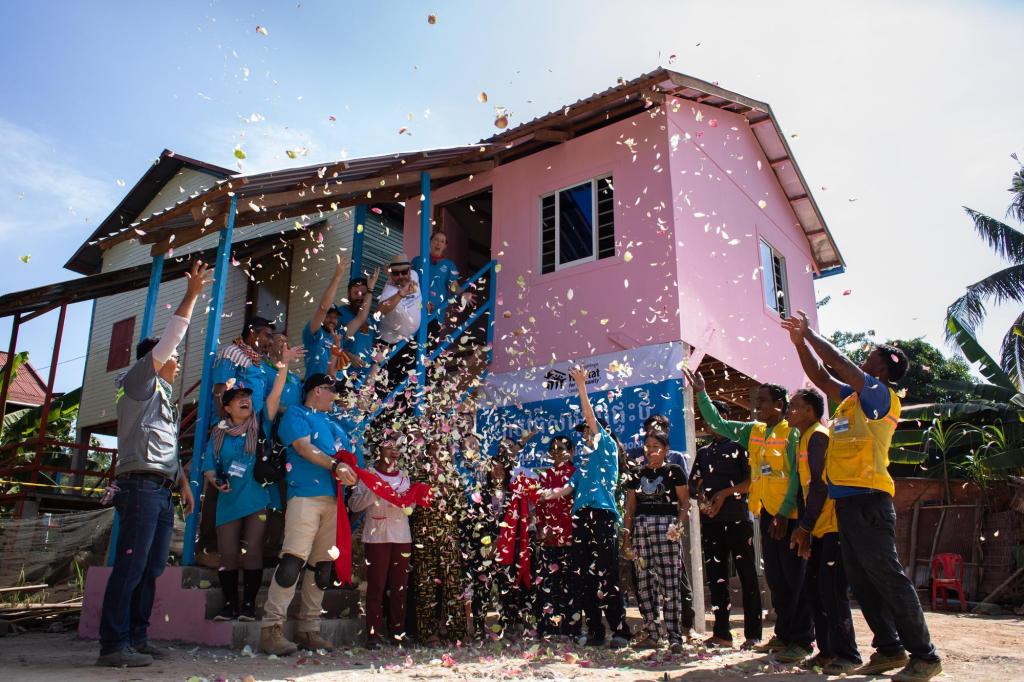
Volunteers raise a wall for the framework of a new home during the first day of building at Habitat for Humanity’s 2025 Carter Work Project. Globally, almost 3 billion people, including 1 in 6 U.S. families, struggle with high costs and other challenges related to housing. A crisis in itself, this also creates larger problems that affect families and communities in unexpected ways. People who lack affordable, stable housing are also more likely to experience financial hardship in other areas of their lives, since a larger share of their income often goes toward rent, utilities, and frequent moves. They are also more likely to experience health problems due to chronic stress or environmental factors, such as mold. Housing insecurity also goes hand-in-hand with unstable employment, since people may need to move further from their jobs or switch jobs altogether to offset the cost of housing.
Affordable homeownership creates a stable foundation for families to thrive, reducing stress and increasing the likelihood for good health and stable employment. Habitat for Humanity builds and repairs homes with individual families, but it also strengthens entire communities as well. The MicroBuild® Initiative, for example, strengthens communities by increasing access to loans for low-income families seeking to build or repair their homes. Habitat ReStore locations provide affordable appliances and building materials to local communities, in addition to creating job and volunteer opportunities that support neighborhood growth.
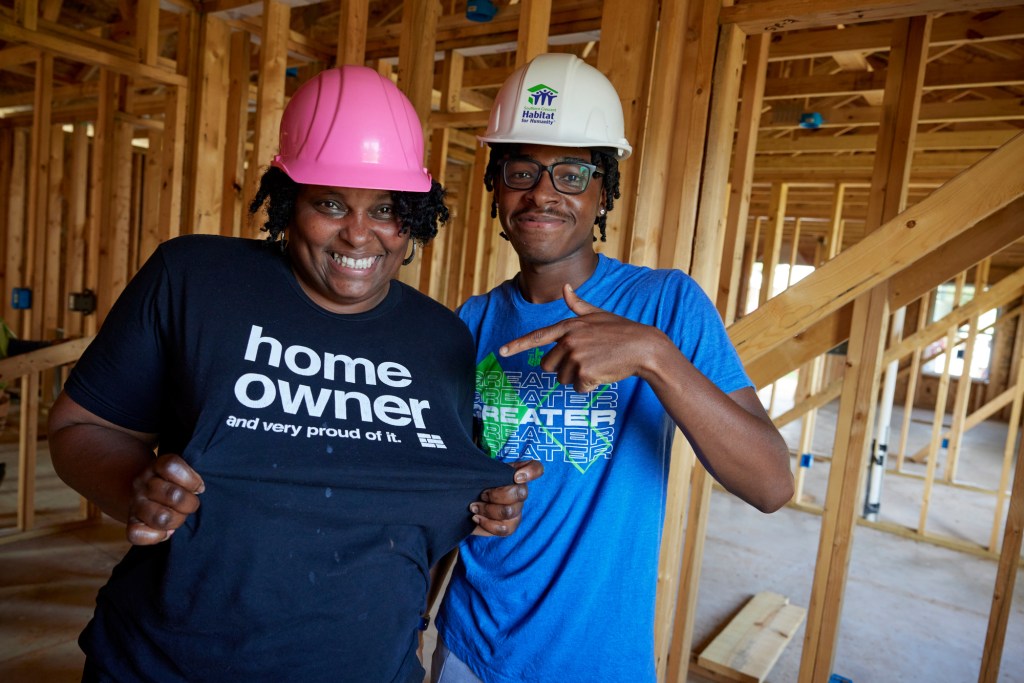
Marsha and her son pose for a photo while building their future home with Southern Crescent Habitat for Humanity in Georgia. Everyone can play a part in the fight for housing equity and the pursuit of a better world. Over the past 50 years, Habitat for Humanity has become a leader in global housing thanks to an engaged network of volunteers—but you don’t need to be skilled with a hammer to make a meaningful impact. Building an equitable future means calling on a wide range of people and talents.
Here’s how you can get involved in the global housing movement:- Speaking up on social media about the growing housing crisis
- Volunteering on a Habitat for Humanity build in your local community
- Travel and build with Habitat in the U.S. or in one of 60+ countries where we work around the globe
- Join the Let’s Open the Door movement and, when you donate, you can create your own personalized door
- Shop or donate at your local Habitat ReStore
Every action, big and small, drives a global movement toward a better future. A safe home unlocks opportunity for families and communities alike, but it’s volunteers and other supporters, working together with a shared vision, who can open the door for everyone.
Visit habitat.org/open-door to learn more and get involved today.
-
Tech expert explains why you ‘magically’ see ads for things you think about
Algorithms don’t need to hear your thoughts to predict them.
A number of years ago, people started to suspect their phones were listening to them. They’d “magically” see ads on Facebook or news websites for products they had barely mentioned in passing. Because our phones are always listening for “wake words” (like “OK Google” or “Hey Siri”), it was natural to grow suspicious that they were monitoring conversations and auctioning off that data to advertisers.
The truth is, your phone is not always listening and scanning your conversations for ad triggers. However, countless people have reported seeing ads for things they’ve merely thought about.
The reason this predictive advertising happens is fascinating, a little scary, and just a tad reassuring.
“I can’t be the only one noticing this”
Aakash Gupta writes about AI, tech, product growth, and more. He recently took on the challenge of explaining this freaky concept to a concerned Internet citizen.
“I get how the phone can target ads by hearing and seeing me, but how is it showing me ads based on my thoughts? I can’t be the only one noticing this,” an X user wrote.
Here’s Gupta’s explanation: It starts with a real-time auction every time you open an app or website that serves ads.
“Every time you open a website or app, a real-time bidding auction fires in under 100 milliseconds,” Gupta wrote on X. “Your GPS coordinates, browsing history, device fingerprint, age, gender, income bracket, and hundreds of inferred interest categories get packaged into a ‘bid request’ and broadcast to hundreds of companies simultaneously. One company wins the ad slot. All of them keep the data.”
Some estimates put the number of ads the average person sees in a given day between 4,000 and 10,000. In fact, most are almost invisible to us now. That’s why ad companies have to make them hyper-targeted.
Gupta explained that your data isn’t only collected when you use a website. Some apps on your phone may pull your location data thousands of times per day, creating a detailed map of pretty much everywhere you go.
So how does that lead to “telepathic” advertising? By figuring out what people who are almost exactly like you are interested in buying.
“The algorithm doesn’t hear your thoughts. It compares your behavioral fingerprint against millions of similar profiles and predicts your next interest before you’re consciously aware of it,” Gupta wrote. “It makes hundreds of predictions per day. You ignore the misses. The five hits feel like telepathy.”
Akash Muni, a software developer, explained it even more simply:
“You are not unique. There are 10,000 people with your exact age, location, income bracket, browsing history, purchase pattern and social graph. When those 10,000 people started searching for running shoes, you hadn’t yet. But you will.”
He said it’s called “predictive behavior modeling,” and that it has become eerily accurate.
Famous case
One famous case of this kind of modeling in advertising involved Target sending coupons for baby items to a pregnant teenager’s home. The only problem was that they identified her pregnancy so quickly that her parents didn’t even know yet.
The New York Times wrote, “[A Target statistician was] able to identify about 25 products that, when analyzed together, allowed him to assign each shopper a ‘pregnancy prediction’ score. More important, he could also estimate her due date to within a small window, so Target could send coupons timed to very specific stages of her pregnancy.”
Similar modeling is used in many ways, not just advertising. Some companies combine data on their employees with known trends and events (like layoffs or changes in HR policies) to predict when someone might quit or leave—even before they do.
When it happens on your phone in a fraction of a second, it can be pretty shocking. In fact, the accuracy can be so spooky that some people refuse to believe the modeling is “predictive” at all.
“Everyone is saying it just predicts.. now explain if I just happen to think about a random product which doesn’t basically interest me in any shape or form.. for example a conversation I just happened to have like 5 years ago.. and boom!.. here you go, ads flying in right after,” one X user wrote.
“Yes, yesterday I was thinking of the cafe I once hoped for, and in the morning the first ad I saw was that cafe’s ad. How is it possible?” wrote another.
As Gupta said, predictive modeling is wrong hundreds or thousands of times a day. But we don’t notice those ads for things we’re not interested in because we’re too focused on the ones that are frighteningly accurate.
It’s hard to accept that our thoughts and choices aren’t as unique as we’d like to think they are

Some people have trouble believing that phones aren’t psychic. Photo credit: Canva It turns out humans are actually pretty predictable. Much of what we do and think is driven by our environment and the systems we live in. Those environments and systems can be tracked and measured with incredible efficiency.
If there’s any solace to take in this relentless mining of our data, it’s that the whole system works because there are people out there just like us. There are countless others the same age, with similar family structures, interests, income brackets, and more. In another world, maybe we would all be friends!
In the meantime, we can thank them for turning us on to that awesome pair of running shoes we didn’t even know we needed.













Get stories worth sharing delivered to your inbox.
Advertisement