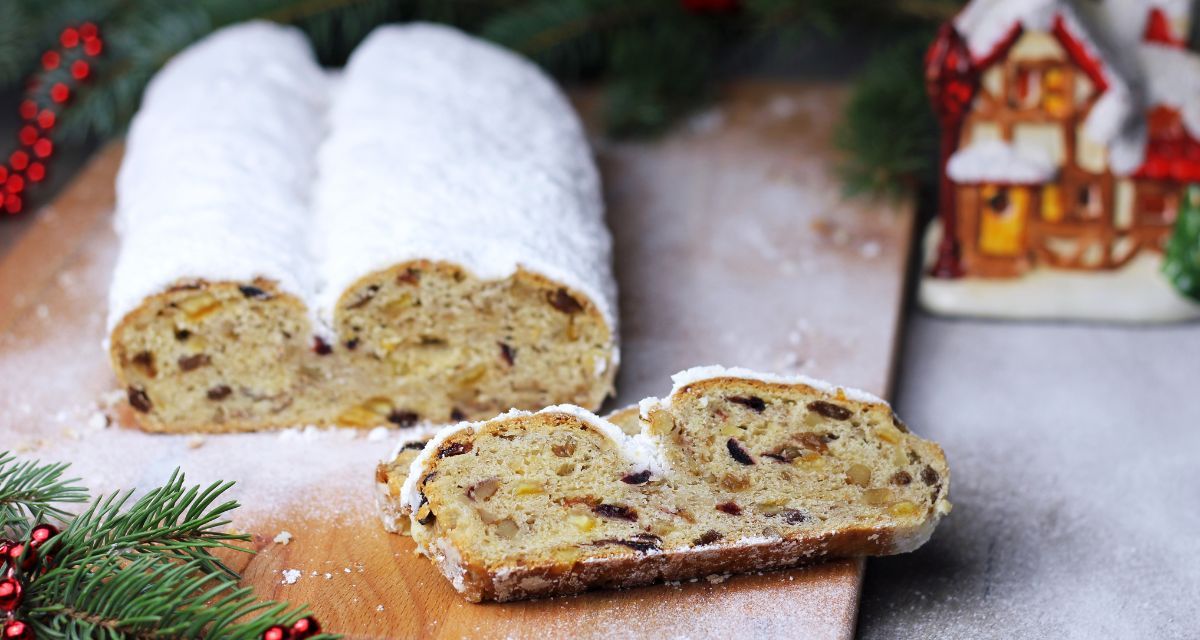
If you’ve never had stollen bread, picture a dense, sweet, doughy loaf filled with dried fruit, nuts, and occasionally a roll of sweet marzipan or almond paste, then flavored with warm spices, and covered in a generous layer of powdered sugar. With all those rich, festive flavors packed into one dish, it’s easy to see why stollen became well-loved Christmas treat.
But stollen wasn’t always such a decadent holiday dessert.
Sure, it’s been a German Christmas tradition for centuries, with the earliest documented mention dating to 1474 in Dresden. But at that time, the recipe was about as far from today’s version as you could imagine.
Bakers had to get creative during Advent
Stollen was originally a simple fasting bread, made only with flour, yeast, and water. That’s because Advent was a period of fasting in Catholic Germany. During which the Catholic Church restricted the use of ingredients including butter and milk. Bakers could use oil instead, but the resulting loaf was a pretty austere version of what would eventually become a Christmas favorite.
Still, people wanted something more indulgent. According to the traditional story, Saxon rulers Ernst and Albrecht decided to do something about it. By the late 15th century, they had asked the pope to lift the restriction on butter so bakers could make richer stollen during Advent.
Behold, a merciful Butterbrief
The pope initially refused, but the request eventually succeeded. Around 1490, Pope Innocent VIII issued a decree known as the Butterbrief, or “Butter Letter,” allowing bakers in Saxony to use butter in their stollen despite the church’s fasting rules.
There was, however, one small financial catch: the permission came with a requirement that bakers pay a fee to the church, although that requirement was later abolished.
With butter now allowed, stollen could begin its transformation into the decadent seasonal bread many of us know today. Over time, richer ingredients such as dried fruit, almonds, and spices became part of the bread, and it became increasingly associated with Christmas celebrations in Dresden. It even took on the name of “Christstollen” around 1530.
Then Dresden took stollen to a whole new level
And then, someone decided to make a really, really big one.
In 1730, Augustus the Strong, the Elector of Saxony and King of Poland, hosted a massive military festival in Dresden attended by roughly 24,000 people. For the celebration, he commissioned an enormous stollen.
About 100 bakers and their apprentices worked on the project, using thousands of eggs, hundreds of churns of milk, and roughly 2,000 pounds of flour. When it was finished, the stollen weighed about 1.8 tons. It was so enormous that a special oversized knife had to be used to cut it. This guy knew how to party.
The spectacle helped establish a tradition of enormous stollen that continues in Dresden today. Each year, the city holds a Stollen Festival featuring a giant version of the Christmas bread, which is paraded through the streets before being cut and sold to visitors.
The version available in stores during the holidays is obviously a little more manageable.
So, the next time you see a delicious stollen covered in that thick layer of powdered sugar, remember that this humble fasting food turned luxurious holiday treat is proof that if at first you’re told no, keep asking. Or the beauty of Christmas, or something like that.