Everyone in America wants the country to be a place where they’re safe from violence. But there’s a big difference in how people think we should achieve that goal. Some Americans think that tougher gun laws make it more difficult for people to commit heinous acts of violence. While others believe that people are safer when they have easy access to firearms to protect themselves.
A new study released by the Everytown for Gun Safety Support Fund has found a very strong connection between a state’s gun laws and its rate of gun deaths.
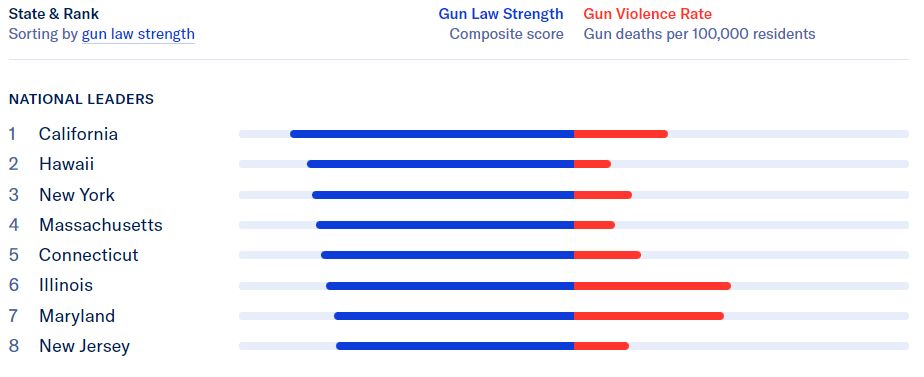
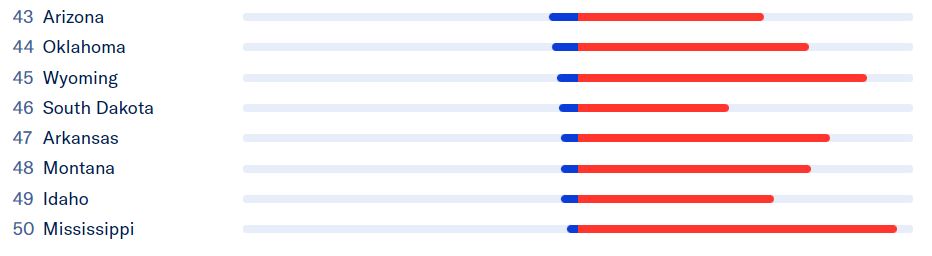
The analysis concludes that states with strong gun safety policies have lower rates of fatal shootings while states with weaker gun laws have higher rates of gun deaths, including homicides, suicides and accidental killings. Everytown for Gun Safety makes a pretty clear point by ranking states from strongest gun laws to weakest.
California has the strongest gun laws and some of the lowest rates of gun deaths per 100,000 residents, at 8.5. The national average is 13.6. Conversely, Mississippi has the weakest gun laws and the highest rate of gun deaths per 100,000 residents, 28.6.
California

Mississippi

“States with strong gun safety policies, such as background checks on all gun sales and extreme risk laws, have lower rates of gun violence while states with weaker gun laws, such as permitless gun carry and Stand Your Ground, have higher rates of gun violence,” Nick Suplina, senior vice president of law and policy at Everytown for Gun Safety Support Fund, told Upworthy.
Here are the top eight states when it comes to the strength of gun laws.
“Everytown’s Gun Law Rankings shows what we have been saying for years: gun laws save lives. There is a clear and direct tie between a state’s gun laws and its rate of gun deaths,” Suplina told Upworthy.
The evidence for strong gun safety laws appears to be overwhelming based on Everytown’s graph. But as any statistician will tell you, correlation doesn’t imply causation. In other words, just because states with tougher gun laws are safer doesn’t necessarily mean that strong gun laws are the sole reason that gun violence is lower.
The rankings also get a bit blurrier when one takes into account the fact that guns can move from state to state. Therefore, strong gun laws in one state can be affected by weaker laws in a neighboring state.
There is a whole host of factors that can influence the rate of gun violence in a given state, including socioeconomics, access to mental healthcare, education, social mobility and its citizens’ trust in institutions.

The debate over guns has been one of the most heated fights in America’s culture wars and it won’t be solved anytime soon. But we all want what’s best for the country and to come to some effective agreement on how to do so we have to start with the facts. Everytown for Gun Safety has made a very compelling argument for stronger gun control laws across the country; it’ll be interesting to see if its opponents can muster any counterarguments that come close.

A single door can open up a world of endless possibilities. For homeowners, the front door of their house is a gateway to financial stability, job security, and better health. Yet for many, that door remains closed. Due to the rising costs of housing, 1 in 3 people around the world wake up without the security of safe, affordable housing.
Since 1976, Habitat for Humanity has made it their mission to unlock and open the door to opportunity for families everywhere, and their efforts have paid off in a big way. Through their work over the past 50 years, more than 65 million people have gained access to new or improved housing, and the movement continues to gain momentum. Since 2011 alone, Habitat for Humanity has expanded access to affordable housing by a hundredfold.
A world where everyone has access to a decent home is becoming a reality, but there’s still much to do. As they celebrate 50 years of building, Habitat for Humanity is inviting people of all backgrounds and talents to be part of what comes next through Let’s Open the Door, a global campaign that builds on this momentum and encourages people everywhere to help expand access to safe, affordable housing for those who need it most. Here’s how the foundation to a better world starts with housing, and how everyone can pitch in to make it happen.
Volunteers raise a wall for the framework of a new home during the first day of building at Habitat for Humanity’s 2025 Carter Work Project.
Globally, almost 3 billion people, including 1 in 6 U.S. families, struggle with high costs and other challenges related to housing. A crisis in itself, this also creates larger problems that affect families and communities in unexpected ways. People who lack affordable, stable housing are also more likely to experience financial hardship in other areas of their lives, since a larger share of their income often goes toward rent, utilities, and frequent moves. They are also more likely to experience health problems due to chronic stress or environmental factors, such as mold. Housing insecurity also goes hand-in-hand with unstable employment, since people may need to move further from their jobs or switch jobs altogether to offset the cost of housing.
Affordable homeownership creates a stable foundation for families to thrive, reducing stress and increasing the likelihood for good health and stable employment. Habitat for Humanity builds and repairs homes with individual families, but it also strengthens entire communities as well. The MicroBuild® Initiative, for example, strengthens communities by increasing access to loans for low-income families seeking to build or repair their homes. Habitat ReStore locations provide affordable appliances and building materials to local communities, in addition to creating job and volunteer opportunities that support neighborhood growth.
Marsha and her son pose for a photo while building their future home with Southern Crescent Habitat for Humanity in Georgia.
Everyone can play a part in the fight for housing equity and the pursuit of a better world. Over the past 50 years, Habitat for Humanity has become a leader in global housing thanks to an engaged network of volunteers—but you don’t need to be skilled with a hammer to make a meaningful impact. Building an equitable future means calling on a wide range of people and talents.
Here’s how you can get involved in the global housing movement:
Speaking up on social media about the growing housing crisis
Volunteering on a Habitat for Humanity build in your local community
Travel and build with Habitat in the U.S. or in one of 60+ countries where we work around the globe
Join the Let’s Open the Door movement and, when you donate, you can create your own personalized door
Every action, big and small, drives a global movement toward a better future. A safe home unlocks opportunity for families and communities alike, but it’s volunteers and other supporters, working together with a shared vision, who can open the door for everyone.
Since childhood, Kenan Thompson has practiced his craft as a comedic actor and sketch performer. As an adult, he’s been making audiences laugh at Saturday Night Livesince 2003. During his tenure, he had been in drag lampooning Maya Angelou, Jennifer Hudson, and other Black women who were public figures. In 2013, he refused to portray a woman ever again on SNL. That line in the sand ended up launching many comedy careers.
At the time, out of the 16 SNL cast members, there were only two other persons of color: Black comedian and actor Jay Pharoah, and Iranian-born American actress, Nasim Pedrad. This meant that either Thompson or Pharoah would have to don a wig and a dress if the show was spoofing a Black woman celebrity. As the longest running cast member on SNL, Thompson felt comfortable to publicly state that he wouldn’t portray a woman ever again. Pharoah backed him up and even pitched potential Black women comedians and producers.
The audition that launched a new wave of comedians
The move forced the producers to conduct a search for at least one Black female cast member by January 2014. The search led to Sasheer Zamata, who joined the cast until 2017. Since then, she’s gone on to other opportunities as a stand-up comedian and actress. Some of her roles include movies such as 2021’s The Mitchells vs. the Machines and Marvel and Disney+’s 2024 series Agatha All Along.
Even though Zamata claimed the spot on SNL, many of her fellow auditioners were noticed for other comedy jobs. After Zamata’s casting had been announced, the runner-up, Amber Ruffin, was almost immediately staffed as a writer for Late Night with Seth Meyers. Ruffin still currently works as a writer on the show while also getting other opportunities. She wrote her own sitcom, hosted her own comedy talk show, and participates as a talking head on Have I Got News For You.
There was another future SNL all-star who wasn’t immediately cast, but hired on as a writer. However, she was promoted to a full cast member before the end of 2014. That person? Leslie Jones, who has since launched into film and television superstardom.
Many other household names were first noticed at the search
Even though they didn’t get the job, many other funny Black women broke out at that audition. Tiffany Haddish would get recurring roles in TV shows like The Carmichael Show and star in the ultra-popular film, Girls Trip. Nicole Byer would have several live-action and voice-over roles while also hosting reality shows like Nailed It. In fact, Byer co-hosts a podcast with Zamata called Best Friends.
It should be noted that these women likely would have found success without this SNL audition. Kenan Thompson would not and is not taking credit for their success. However, it is funny how refusing to wear a dress was one small push that created momentum in several different directions for so many talented people.
It’s 5:45 p.m. Your feet ache, the kids are hungry, and the idea of making dinner—again—feels like a personal attack. You open the fridge, close it again, and briefly consider disappearing into the couch.
That sense of dread? Women have wrestled with it for generations.
In the early 1960s, the “ideal” American housewife supposedly lived for her time in the kitchen. Magazines showed smiling women in crisp aprons, beaming over from‑scratch casseroles and perfect party spreads. Ads promised that the right oven or cake mix would make home life “joyful.”
Women have been held to impossible standards for generations. Canva
Behind those glossy pages, a lot of women felt exhausted, underappreciated, and quietly furious.
Into that pressure cooker walked Peg Bracken. With a martini in one hand and a can of cream of mushroom soup in the other, she did something radical for her time: she said, out loud, that she hated cooking. Then she wrote a cookbook for everyone who felt the same way.
Her 1960 bestseller, The I Hate to Cook Book, did not offer easy recipes. It gave women at the time something much more powerful: permission to stop pretending that dinner was the highlight of their day.
Who was Peg Bracken, really?
Before she became a household name, Peg Bracken worked as an ad copywriter in Portland, Oregon. That job gave her a front‑row seat to the way media sold the “happy homemaker” myth: a smiling woman who kept a spotless house, raised perfect children, and produced beautiful meals night after night.
Bracken knew women like that didn’t exist. And if they did, they probably needed a nap.
The cover of Peg Bracken’s I Hate to Cook Book. Amazon
At home, she struggled to balance marriage, motherhood, and an endless to-do list. The gap between what people told her she should feel about housework and what she felt—boredom, resentment, fatigue—grew too wide to ignore.
So, she started talking about it with her friends.
Over lunch with a group of working women she jokingly called “the Hags,” Bracken and her friends swapped what she later called “shabby little secrets.” They admitted they didn’t want to spend hours in the kitchen. They confessed that they relied on canned soup, frozen vegetables, and boxed mixes. They traded recipes that kept their households fed with the least possible effort.
Bracken collected the group’s favorite culinary shortcuts—and added her own, too—and wrapped everything up in her signature dry, self-aware humor. The result: a manuscript for The I Hate to Cook Book—a cookbook for women who felt tired of pretending that making dinner was the best part of their day.
Nope! They guessed wrong. A woman editor took a chance on Peg Bracken, and when the book was published in 1960, it sold more than three million copies. All those “happy homemakers”? A lot of them turned out to be Hags at heart.
Key contributions to culinary history
From the first line of her cookbook—“Some women, it is said, like to cook. This book is not for them,” Peg Bracken signaled to the world her intentions. She did not teach readers how to make the perfect soufflé. Instead, she tried to help women get through the week.
In an era when ‘serious’ cookbooks pushed fancy technique and fresh ingredients, Bracken leaned into convenience. Her recipes called for condensed soups, frozen and canned vegetables, bouillon cubes, and powdered mixes. Dishes like ‘Stayabed Stew’ and ‘Skid Road Stroganoff’ took about 15 minutes to prepare. After that, the oven did the work while you lay in bed with a book or a box of tissues.
While society equated womanhood with constant self-sacrifice, Bracken suggested another metric: Did everyone eat? Did you keep at least a shred of your sanity? If yes, then you are enough. That counted.
Most cookbooks published around this time sounded stern or reverent. Bracken’s writing sounded like a smart friend on the phone.
One famous instruction tells readers to let the dish cook “while you light a cigarette and stare sullenly at the sink.” Another recipe begins with a small shot of whiskey “for medicinal purposes.” She did not mock women who cooked for their families; she offered them comfort, support, and maybe a little laughter, when it seemed called for.
On the surface, women bought The I Hate to Cook Book for its recipes and advice. But beneath the cream-of-mushroom casseroles and Frito-laden specials lay an offer: to quietly challenge the idea that a woman’s highest calling meant crafting elaborate meals with a permanent smile.
Bracken rolled her eyes at the notion that adding an egg to a cake mix should satisfy a woman’s creative urge. She pointed instead to painting, writing, gardening, and studying as other ways women could use their minds. For women reading her at the kitchen table, that shift felt like a small revolution. Maybe nothing was ‘wrong’ with them.
A few years before The Feminine Mystique put words to ‘the problem that has no name,’ Bracken described a similar ache. She talked about the “dailiness” of cooking: the way the obligation hangs over a woman’s head from the moment she wakes up, the knowledge that no matter what else she does, dinner still looms.
While ads and advice columns told women to find joy in that work, Bracken boldly asked: What if you didn’t? What would happen if you admitted that housework often felt boring, thankless, and overrated?
What would happen if you admitted that housework often felt boring, thankless, and overrated? Canva
Not everyone welcomed that. Some traditional food writers and chefs dismissed Bracken’s canned‑soup cooking as an insult to ‘real’ food. At home, her husband’s “It stinks” line said plenty about how he felt watching his wife build a career—and a public persona—around not loving domesticity.
Even some women felt torn. Those who genuinely loved to cook sometimes heard her embrace of ‘good enough’ as a knock on their craft. Others feared that shortcuts would trigger judgment from neighbors or in‑laws.
But three million copies told a different story. The fight was never really about using canned soup versus scratch stock. It centered on who gets to define ‘good womanhood,’ and whether it was time for women themselves to redraw the lines.
Highlights from The I Hate to Cook Book
If you flip through The I Hate to Cook Book today, its recipes are clearly from a different time. Who makes celery-soup casseroles, or would want to eat processed mixes, anyway?
But underneath the midcentury pantry staples, there are themes and messages that still land even today. First, there’s the solidarity with women. Bracken writes as if she’s sitting at your kitchen table, not lecturing from a test kitchen. She assumes you’re tired, that you’re busy. She assumes that this—cooking a meal for your family every night—is not “the best part of your day” but work, and that you’d rather be doing anything else.
Second, she lowers the bar, deliberately. Again and again, she tells readers to stop torturing themselves with impossible standards. She advises against calculating the number of meals you’ll cook in a lifetime—“this only staggers the imagination and raises the blood pressure,” she jokes—and, instead, to take it day by day. One dinner at a time.
The “Stayabed Stew” is designed for days when you’re running on fumes, a dish that simmers in the oven while you stay in bed. It’s built around the promise that something hot and filling can appear with almost no effort from you.
“Hootenholler Whisky Cake” starts with pouring yourself a shot of whiskey. A small joke, yes, but also a reminder: you are allowed to tend to yourself in the middle of tending to everyone else.
For many, Bracken’s cookbook doubled as a survival manual. Canva
For readers who felt ambivalent or outright hostile toward cooking, Bracken’s book doubled as a survival manual. Simple recipes gave women options for dinner. Parsley and paprika did a lot of the heavy lifting. “Serviceable and done” became a valid and honorable goal. Taken together, these details sketch a woman who wasn’t trying to kill home cooking. She was simply carving a new path, one where feeding your family didn’t have to swallow your whole self.
That’s what makes Peg Bracken feel surprisingly modern. Her core insights were never actually about soup; they were about emotional relief. You don’t have to enjoy the labor on your plate just because someone told you it’s “supposed to be” your source of joy.
If the thought of making dinner tonight fills you with dread, Bracken’s legacy offers a small, compassionate shift. Maybe the “right” meal is the one that keeps you from crying into the cutting board. Maybe boxed mac and cheese or a rotisserie chicken on the counter is not a failure, but a wise use of the only energy you’ve got.
Dinner doesn’t have to be perfect. You don’t either.
Diet Coke is the new smoke break. Some people call it a “fridge cigarette,” a mid-afternoon burst of caffeine, carbonation, and flavor that gives stressed out and overworked adults a reason to live. OK, maybe that’s a little overdramatic. But people truly do love their Diet Coke and other Coke products.
Dentists and doctors might caution about too much of the stuff, but the data doesn’t lie. Soda, and Diet Coke in particular, is still extremely popular. It may even be at or near its all-time peak appeal.
And anyone who drinks the stuff regularly knows one thing to be true: McDonald’s has the best Coke products around. Bar none. But how?
McDonald’s franchise owner takes us behind-the-scenes
“Why is McDonald’s Coke better?”: This question has been asked and answered before, but never in such detail.
McDonald’s even addresses it on their own website, a sure sign that they’re asked about this constantly. In an FAQ blog post from 2021, they write that they pre-chill the syrup and filter the water before combining. That’s how they ensure the highest quality.
But, according to franchise owner “McFranchisee,” who posts behind-the-scenes secrets on X, it goes much deeper than that. They recently unfurled a brilliant and detailed thread on the exact science that makes McDonald’s Coke so dang delicious.
McDonald’s has a deep partnership with Coca-Cola
Ever wonder why @McDonalds Coke tastes BETTER than anywhere else?
It’s not in your head. McDonald’s goes above and beyond to make their drinks elite. They even have their own division at @CocaCola HQ – no one else does.
Simply put, one reason that McDonald’s Coke tastes so good is because the franchise gets serious special treatment thanks to a decades-old partnership.
McFranchisee writes, “McDonald’s goes above and beyond to make their drinks elite. They even have their own division at [Coca-Cola headquarters]—no one else does.”
A handshake deal in the ’50s solidified the partnership while both brands helped each other grow. One way McDonald’s gets the white glove treatment no other fast food chain gets? It’s Coca-Cola syrup is sometimes delivered in stainless steel tanks rather than the traditional plastic bags, which transfers less unwanted flavors into the syrup.
Special equipment that keeps everything cold
First up: THE EQUIPMENT. McDonald’s uses specialized equipment (Multiplex) to pre-chill not only your water but your syrup. You can see in this video that there is a 4 inch ice bank around the copper tubing. If you mix cold water with room temp syrup – you lose some carbonation &… pic.twitter.com/OFsS8gG6bt
Your average restaurant keeps the soda syrup stored at room temperature, only to then mix it with cold water to create the final product. Not at McDonald’s.
McFranchisee shares a video that shows the fast-food chain’s elaborate (and expensive) set up: copper tubing that carries the syrup is surrounded by a thick block of ice that cools it quickly before it mixes with water.
“If you mix cold water with room temp syrup – you lose some carbonation & bite. This is the heart beat of the Diet Coke you love.”
The owner adds that McDonald’s strives to keep both the syrups and carbonated cold water between 33 and 36 degrees Fahrenheit. that’s even colder than Coca-Cola’s official recommendation, and it’s a huge reason why the soda tastes so fresh and crispy.
Ultra-filtered water
Then there’s THE WATER. 💧 McDonald’s filters their water like crazy to remove any impurities. Why? Because water is a key ingredient in fountain drinks, and they make sure it’s as pure as possible for the cleanest, crispest flavor. When you wonder why your Coke doesn’t taste… pic.twitter.com/v0c9JoilrE
Before tap water even touches the so-carefully-cared-for Coca-Cola syrups at McDonald’s, it’s filtered using some of the best existing technology in the world.
McFranchisee explains that good filtration isn’t just about removing everything from tap water, though.
“When we filter the water, we want to make sure there are still minerals in the water. If you take all the minerals out, there’s nothing for the carbonation to attach to. In some instances, we have to add minerals to the water to get the correct carbonation.”
Anecdotally, customers say a cup of plain ice water from McDonald’s is some of the clearest and tastiest around. And speaking of ice…
Special slow-melting ice
Even the ICE is special. 🧊 McDonald’s uses non-porous ice, meaning it melts slower and doesn’t dilute your drink as fast. That’s why your soda still tastes great even when you’re halfway through the cup. I know people love to chew on pellet ice but it is absolutely the worst ice…
If you didn’t even know “non-porous ice” was a thing, you’re not alone. Ice made in traditional trays and automatic freezers freezes from all directions at once, trapping air pockets and impurities inside the cubes.
McDonald’s makes use of special, “directionally frozen” ice.
Clearly Frozen, who makes a non-porous home icemaker, writes, “The directional freezing process pushes dissolved air, minerals and other impurities – even bacteria – out of your ice. … Clear ice cubes also melt more slowly than cloudy ice, so they keep your drink ice cold with much less dilution!”
That’s why a McDonald’s Coke holds up so well on the drive home. The ice is specially engineered not to melt and dilute your drink.
Wide-mouth straw
Oh, and THE STRAW. Ever notice McDonald’s straws are wider than most? That’s intentional. The larger diameter lets more Coke hit your taste buds at once, delivering a bolder, more intense flavor experience.
The Coca-Cola drinking experience at McDonald’s wouldn’t be complete without just the right straw. McDonald’s straws, McFranchisee writes, are wider than most restaurants’.
That means more soda-per-sip, for more flavor, and also a bigger burst of carbonation in your mouth at once. It heightens the experience.
Finally, the partnership between McDonald’s and Coca-Cola means a Coke expert visits most restaurants every three months to re-calibrate everything and check the entire system.
If you’re a Coke or Diet Coke lover and you seem to find yourself drawn to McDonald’s beverages like a moth to a flame, you’re not imagining it. There’s a lot of extremely complex and expensive science involved in delivering the most delicious soda possible. Now if they can only get those pesky ice cream machines to stay online.
A beachgoer couldn’t be bothered by Prince Harry and Meghan Markle’s visit and the internet is absolutely obsessed with her: “The level of not giving a f* I dream of achieving.”
When Prince Harry and Meghan Markle visited Bondi Beach on April 17, they were surrounded by the usual circus: paparazzi, crowds, bodyguards in matching uniforms, the whole production. One woman lay on her mat in the middle of it all, scribbling in her notebook, wearing sunglasses, and apparently not giving a single thought to any of it.
A TikTok clip posted by News.com.au captured the moment as the Duke and Duchess of Sussex walked the beach during the final day of their Australian tour. Their entourage had to navigate around her. She did not look up. The royal couple’s eyes tracked her as they passed. She continued writing.
News.com.au summed it up in their caption: “One woman’s complete indifference is peak Bondi attitude.”
The internet agreed enthusiastically. “The level of not giving a f* I dream of achieving,” one commenter wrote. “Peak unbothered,” said another. “Well done to that lady for not giving a damn,” a Facebook commenter added.
The coda that made the story perfect: a TikTok commenter recognized the woman as her sister and revealed she thought the crowd had gathered around an actor.
Aerial view of Bondi Beach in Australia. Photo credit: Canva
The visit itself was a quieter affair than Harry and Meghan’s 2018 Australian tour, when they were still working royals and the reception was considerably more ceremonial.
This trip included stops to support volunteer first responders at the Bondi Surf Bathers’ Life Saving Club, a Masterchef Australia appearance, and promotion of Meghan’s As Ever lifestyle brand. The Guardian described it as less a royal tour than something else entirely. One woman on a beach mat seems to have agreed.
Robin Williams wrote a letter to the principal who expelled his 15-year-old co-star during Mrs. Doubtfire. The principal framed it. And still didn’t let her back in.
She’d been a 9th grader at a Canadian school when production started. With no internet to submit work digitally, she’d set up a system to mail her assignments back and forth. It worked … until it didn’t. A few months in, the school decided the arrangement wasn’t working for them, and Jakub was out.
At 15, she was devastated. Robin Williams noticed she was upset, and did what Robin Williams apparently just did: he wrote a letter to the principal asking them to support her education and her career.
Jakub shared the story during a Mrs. Doubtfire cast reunion on the Brotherly Love podcast, and the punchline is perfect: “The principal got the letter, framed the letter, put it up in the office, and didn’t ask me to come back.”
She got into the University of Virginia anyway. When she did, a teaching assistant handed back a statistics assignment with the note: “Dear Doubtfire Girl, you got a B-.”
What she also got, from her time on set with Williams, was something harder to grade. She described working with him as a crash course in presence and spontaneity, which was a total departure from the scripted rhythms she’d learned as a child actor. “We had always used a script, so I knew when it was my turn to speak, I could say my line. Then you go on set with Robin, and it’s like, who the f*ck knows what’s going to happen now?”
He also later wrote her a recommendation letter for college. The school never did ask her back. She turned out fine.
During a shift in late January, an elderly woman came through his checkout line and her card kept declining. The line grew restless. Cabahug walked around the register and paid her $80 grocery bill himself. Then he went back to work.
Another customer in line, a mom of four named Dani Dircks, watched the whole thing happen, as reported by WCCO. “I watched this cashier, knowing nothing about him, walk around, knowing nothing about that lady, and he didn’t care,” she said. “He didn’t care in that moment who she was, who she loved, who she voted for.”
A young cashier rings up an item at the store. Photo credit: Canva
Dircks wanted to do something. She learned Cabahug was saving for a car, planned to help his family buy a house after graduation, and intended to become a nurse. A leg injury had ended his volleyball career, and he’d redirected his ambitions toward healthcare. She started a GoFundMe. It has raised over $12,000 toward a $14,000 goal.
Cabahug didn’t pay $80 expecting anything back. He paid it because that’s apparently just who he is. The rest took care of itself.
Ever look at your parents’ high schoolyearbooks and think people looked so much older back then? All of the teenagers look like they’re in their mid-30s and the teachers who are 50 look like they’re 80. When we watch older movies, even those from the 1980s, the teenagers appear to be a lot older as well. Why is it that they looked so much older? Was life harder? Did people act more mature? Did they spend more time outdoors and less time playing video games? Is it their sense of fashion? Were they all smokers?
Educator Michael Stevens, who runs the super-popular Vsauce YouTube channel, explains the phenomenon in a video called, “Did people used to look older?” In it, he explains that people in the past appear a lot older due to retrospective aging.
What is retrospective aging?
This is how it works: when we see people in the past, they are wearing outdated styles that we associate with older people; therefore, we think they have aged rapidly. For example, a teenager in the 1950s may have been in fashion while wearing thick Buddy Holly-style glasses.
But as people age, they tend to cling to the fashion of their youth. So many people of that generation continued to wear the Buddy Holly-style glasses into their 50s. So when younger people see those glasses they see them as old people’s glasses and not a hip kid from the ’50s.
So in the photo from the ’50s, the teen appears to look a lot older because our perspective has been tainted by time.
But it isn’t all just an illusion. Stevens also points out that people did age faster back in the day due to differences in nutrition, lifestyle and medicine. In addition, he also does a deep dive on how a person’s name can affect their appearance, referencing the Dorian Gray effect, which theorizes that cultural stereotypes linked to a name come to be written on the faces of their bearers, as well as the name matching effect, in which people whose faces “match” their names tend to be better perceived.
Why do young people today look younger than previous generations?
It might be worth noting that, in addition to healthier lifestyle options, younger generations have more access to anti-aging procedures than ever before. “Tweakments,” like fillers and botox, are less expensive and more readily available than ever, not to mention every anti-aging cream, serum, and cleanser known to man. And many millennials and Gen Zers take advantage of that, whether prompted by selfie anxiety, a growing obsession with youth, or some other motivation.
Plus, millennial and Gen Z fashion often honors their inner child. Nostalgic cartoon tees, colorful prints, cutesy accessories, etc. Granted, under the retrospective aging theory, even those styles could one day look dated, but they are so youthful that it’s hard to imagine that being the case. That said, can’t wait to see a bunch of geezers sporting those broccoli haircuts.
This article originally appeared four years ago. It has been updated.
In 2000’s Miss Congeniality, Sandra Bullock’s character goes undercover as an FBI agent posing as a contestant in a beauty pageant. One of the film’s most memorable lines comes when the pageant host, portrayed by William Shatner, asks Miss Rhode Island to describe her “perfect date.”
Shatner’s character is beside himself when Miss Rhode Island, played by Heather Burns, describes her perfect calendar date instead of a romantic rendezvous. “I’d have to say April 25th because it’s not too hot, not too cold. All you need is a light jacket,” she responds.
Since the movie’s release, April 25 has become known in some circles as “Miss Congeniality Day,” a pop-culture holiday celebrating the amazing spring weather.
Does April 25 have the best weather of the year?
However, does April 25 really have the best weather of any day of the year? Is it the day when the Earth is at the perfect distance from the sun so it’s not too hot and not too cold? The meteorology team at WeatherBug, a people-first forecasting app, analyzed U.S. weather patterns from 2018 to the present day and found that, unfortunately for Miss Rhode Island, April 25 isn’t even close to the best day of the year.
The WeatherBug team discovered that October 8 is “The Perfect Date,” claiming that it “most consistently delivers the ideal combination of comfortable temperatures and minimal rainfall across the country.” October 8 is the strongest contender for the “Perfect Date” title because it consistently delivers the lowest amount of rainfall, just 0.0573 inches, and a comfortable average temperature of 66°F.
April 25 ranks 80th, with 0.1297 inches of rain and an average temperature of 60°F. Over the past eight years, the best day for weather in America was May 9, 2022. There was virtually no rain and an average temperature of 68°F nationwide.
“Through years of daily weather pattern monitoring and weighing precipitation amounts by population size through WeatherBug’s extensive database of active users, we’ve determined April 25th might hold a special place in pop culture, but the date actually ranks 80th measured against the 365 days of the year,” Brittney Gomez, a meteorologist at WeatherBug, said in a statement. “April 25th saw an average of 0.1297 inches of precipitation in the past 8 years, with an average temperature of 60°F. So, while it might not be the ‘perfect date,’ April 25th is still ‘light jacket’ friendly.”
What are the hottest and coldest days of the year?
The team also found that the hottest day of the year is July 14, reaching a nationwide average of 81°F, and that January 20 is the coldest, averaging just 33°F.
When most people hear that April 25 is the nicest day of the year, they probably take it at face value. It’s a nice spring day—who’s gonna challenge the idea? However, the opinion is coming from Miss Rhode Island, a woman who misunderstood a very basic question at a beauty pageant. While we all nodded our heads in agreement, we never considered the source of the information. So, good on WeatherBug for challenging the status quo and giving us a reason to look forward to early October.