upworthy
Add Upworthy to your Google News feed.
Google News Button
Nature

The 2021 World Nature Photography Award winners are stunning

Here are 13 of the best shots.

The 2021 World Nature Photography Award winners are stunning

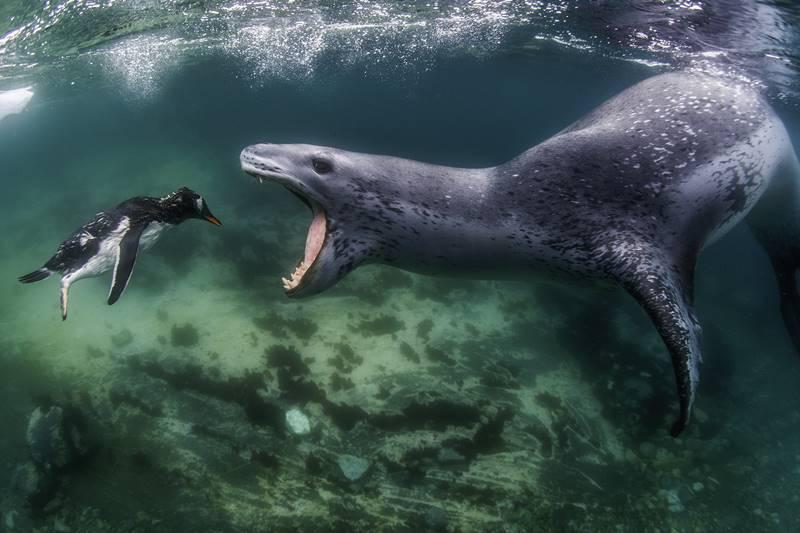
The World Nature Photography Awards announced the winners of its 2021 photo contest and Amos Nachoum from the United States won the top cash prize award of $1,000 for his image of a leopard seal about to capture a defenseless gentoo penguin. Three years later, the images are still unforgettable.

Getting the photo was no easy task. Nachoum had to wait for hours on the remote island of Plano, off the Antarctic Peninsula, for the right moment at low tide when the seals entered a lagoon to catch their prey. Unfortunately, the photo is one of the last moments of the young penguin’s life. “The terrified penguin tried to escape as the game continued. But soon, the end came,” Nachoum said in a statement.

Other winners include a remarkable shot of a humpback whale just outside New York City, a majestic photo of an orangutan in a river and an arctic fox braving the frozen tundra in Iceland.

The photographs are a wonderful example of the dedication and care taken by nature photographers, but they’re also a reminder of our duty to care for the environment.

“The World Nature Photography Awards were founded in the belief that we can all make small efforts to shape the future of our planet in a positive way and that photography can influence people to see the world from a different perspective and change their own habits for the good of the planet. 2021’s competition saw entries come in from 20 countries across 6 continents,” the World Nature Photography Awards said in a press release.

World Nature Photographer of the Year and Gold Winner in "Behavior - Mammals" — Amos Nachoum, USA

Amos Nachoum/World Nature Photography Awards

"For hours, I waited for the low tide to arrive along a shallow lagoon on a remote island off the Antarctic Peninsula. Like clockwork, the leopard seal arrived in the lagoon just before low tide. It put its head in the water and looked just like a rock sitting in the receding water. The young Gentoo penguins only dare to enter the water when it is shallow and when they got close enough to the seal, it turned its head at lightning speed, catching one of the penguins by its feet and taking it to deep water. Once the seal reached open water, I followed it and swam parallel to it, observing its actions. To my surprise, it let go of the penguin twice. Each time, the seal chased after the penguin again, as if it was enjoying the game. The terrified penguin tried to escape as the game continued. But soon, the end came."

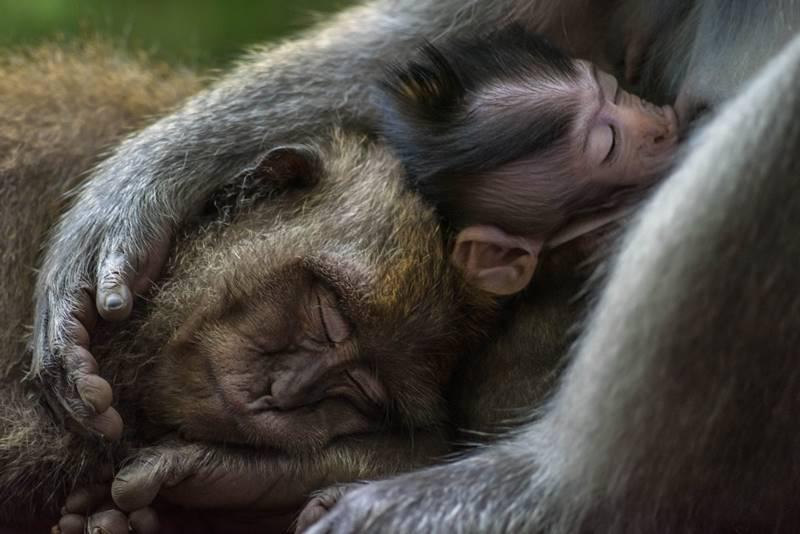
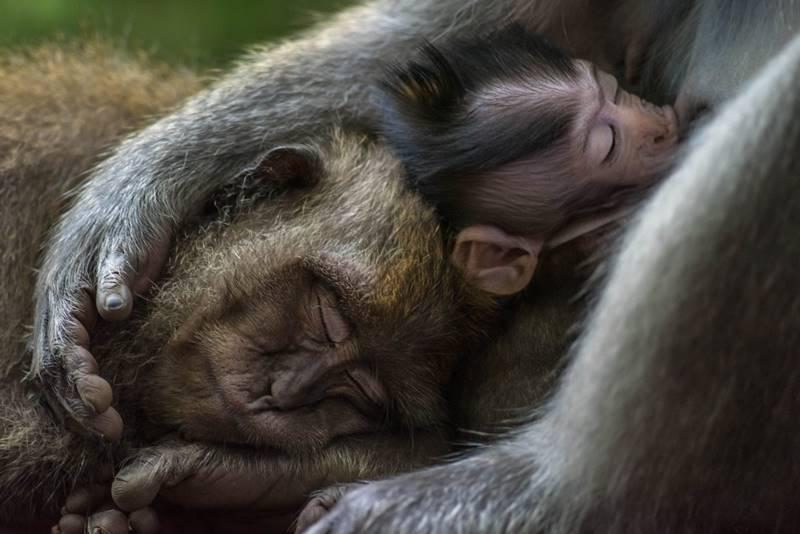
Gold Winner in "Animal Portraits" — Tom Vierus, Fiji

Tom Vierus/World Nature Photography Awards

"Long-tailed macaques enjoy the warmth of each other during a hot day in Bali, Indonesia. These animals show very similar behaviour to us humans including enjoying each other trusting company. The macaques are used to humans and are commonly found around temples where they tend to feed on food sacrifices by the locals."

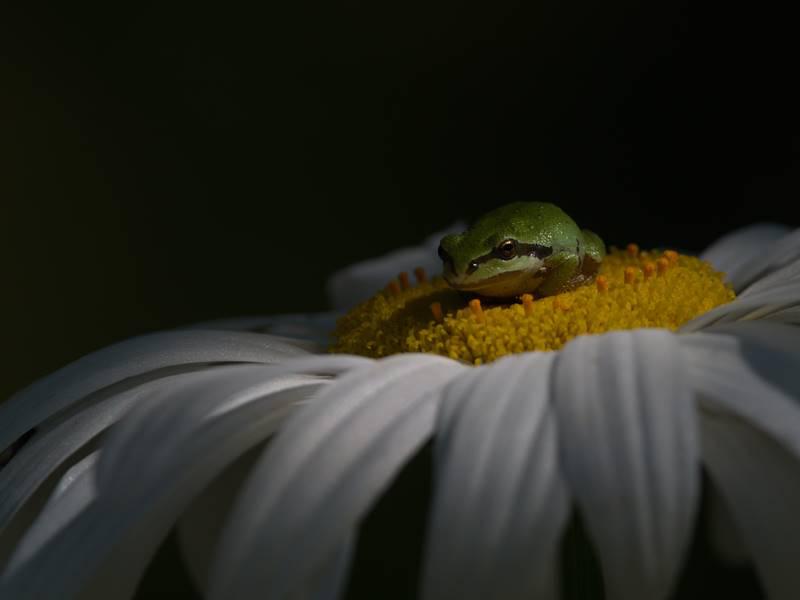
Gold Winner in "Behavior - Amphibians and Reptiles" — Shayne Kaye, Canada

Shayne Kaye/World Nature Photography Awards

"This shot came out of a 'nothing' outing to a local park. It was the middle of a sunny summer day with harsh light and little activity. After going out with low expectations, I came across this tiny Pacific Tree Frog on a flower. After waiting for it to move into a more photogenic position on the flower, and trying repeatedly to catch the mottled light through the tree’s leaves above it at exactly the right spot, I got exactly what I was hoping for. It proved to me that there’s really no bad time to head into nature with a camera!"

Gold Winner in "Behavior - Birds" — Ashok Behera, India

via Ashok Behera/World Nature Photography Awards

"A wildebeest’s eyes being gorged by an African vulture, keenly watched by an African fox for an opportunity to scavenge. Taken at Masai Mara, Kenya."

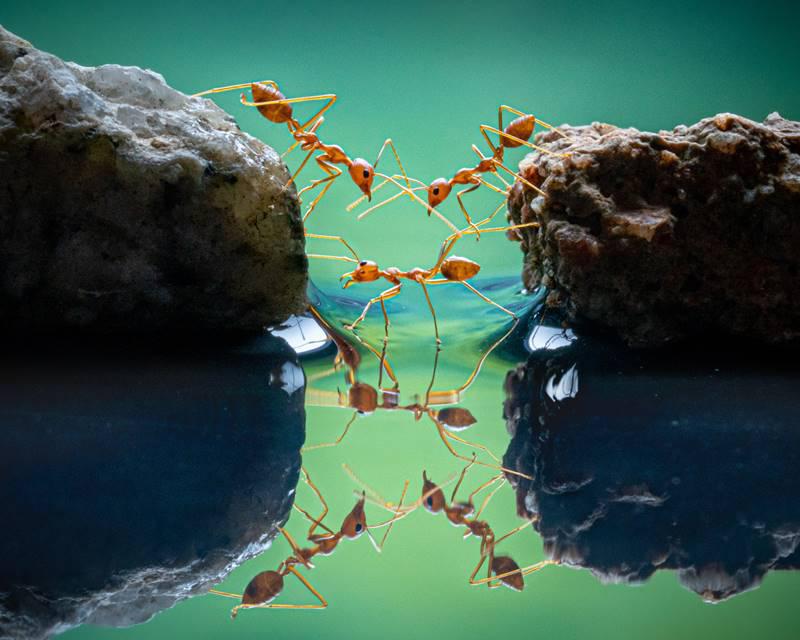
Gold Winner in "Behavior - Invertebrates" — Chin Leong Teo, Singapore

via Chin Leong Teo/World Nature Photography Awards

"The common red ant is ingenious at traversing terrain. When front scout ants encounter a water obstacle, they intuitively form an "ant-bridge" with their bodies, so that their ant-mates at the back of the party can cross."

Gold Winner in "Nature Art" — Federico Testi, Italy

Federico Testi/World Nature Photography Awards

"The natural creativity of San Quirico d'orcia, in Tuscany, Italy. Waves, shapes and tone created by light, in harmony with the universe."

Gold Winner in "People and Nature" — Sabrina Inderbitzi, Switzerland

Sabrina Inderbitzi/World Nature Photography Awards

"I crawled into this ice cave on the totally frozen Lake Baikal in Russia. First I didn't like the fact that the car and the people were in the middle of my picture, but then on a second view I found it just perfect."

Gold Winner in "Plants and Fungi" — Gautam Kamat Bambolkar, India

Gautam Kamat Bambolkar/World Nature Photography Awards

"Entrance to a room inside an abandoned house in Goa, India. It is fascinating how mother nature takes over from where man has left."

Gold Winner in "Urban Wildlife" — Matthijs Noome, USA

Matthijs Noome/World Nature Photography Awards

"Finally got the shot I wanted: a humpback's fluke with the New York City downtown skyline in the distance. As water quality measures and conservation efforts have started to show real results over the last years, humpback whales are becoming a common sight more and more in New York waters."

Gold Winner in "Planet Earth's Landscapes and Environments" — Sam Wilson, Australia

Sam Wilson/World Nature Photography Awards

"Travelling down random dirt roads can be so rewarding when you are greeted with scenes like this. Taken on South Island, New Zealand."

Gold Winner in "Black and White" — Vince Burton, United Kingdom

Vince Burton/World Nature Photography Awards

"A recent trip to Iceland where we were lucky to view and photograph the rare 'blue morph' Arctic fox. The weather conditions were extreme, but that didn't seem to bother the fox."

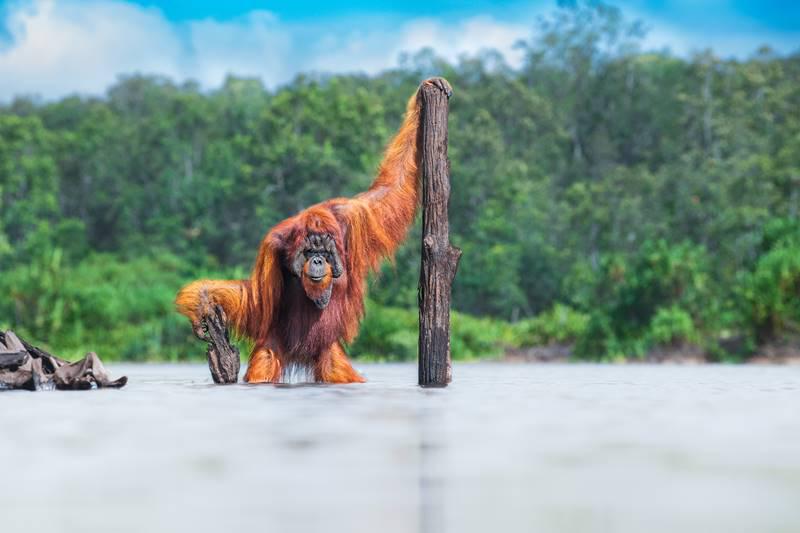
Gold Winner in "Animals in Their Habitat" — Thomas Vijayan, Canada

Thomas Vijayan/World Nature Photography Awards

"Mature male orangutans have large flappy cheek-pads, known as flanges, a throat sac used to make loud verbalisations called long calls. Once they reach maturity, they spend most of their time alone, about 90%. I was lucky enough to get this fully-grown, matured orangutan giving me the best pose possible."

Gold Winner in "Nature Photojournalism" — Alain Schroeder, Belgium

Alain Schroeder/World Nature Photography Awards

"Sibolangit, SOCP Quarantine Centre, North Sumatra, Indonesia. The whole SOCP team works together to prepare Brenda, an estimated 3-month-old female orangutan (she has no teeth yet), for surgery. A sedative is administered, the arm is shaved, her temperature is taken, while others hold her head or her hand out of compassion for the baby. During the three-hour procedure, Dr. Andreas Messikommer, a renowned orthopaedic surgeon invited from Switzerland, will place a pin and screws to secure the damaged humerus. Brenda was confiscated from a villager in Blang Pidie on the west coast of Aceh who was keeping her as a pet."


This article originally appeared three years ago.

kids, school, school days, school week, schedule, 4 day week
Unsplash

Many school districts are moving to a 4-day week, but there are pros and cons to the approach.

American kids have fewer school days than most other major countries as it is, which poses a big challenge for families with two working parents. In a system designed for the "classic" stay-at-home mom model, it's difficult for many modern families to cover childcare and fulfill their work obligations during the many, many holidays and extra days off American children receive in school.

Some school districts, in fact, are ready to take things one step further with even fewer instructional days: for better or for worse.


Whitney Independent School District in Texas recently made news when it decided to enact a four-day week heading into the 2025 school year. That makes it one of dozens of school districts in Texas to make the change and over 900 nationally.

The thought of having the kids home from school EVERY Friday or Monday makes many parents break out in stress hives, but this four-day school week movement isn't designed to give parents a headache. It's meant to lure teachers back to work.

Yes, teachers are leaving the profession in droves and young graduates don't seem eager to replace them. Why? For starters, the pay is bad—but that's just the beginning. Teachers are burnt out, undermined and criticized relentlessly, held hostage by standardized testing, and more. It can be a grueling, demoralizing, and thankless job. The love and passion they have for shaping the youth of tomorrow can only take you so far when you feel like you're constantly getting the short end of the stick.

School districts want to pay their teachers more, in theory, but their hands are often tied. So, they're getting creative to recruit the next generation of teachers into their schools—starting with an extra day off for planning, catch-up, or family time every week.

Teachers in four-day districts often love the new schedule. Kids love it (obviously). It's the parents who, as a whole, aren't super thrilled.

- YouTube www.youtube.com

So far, the data shows that the truncated schedule perk is working. In these districts, job applications for teachers are up, retirements are down, and teachers are reporting better mental well-being. That's great news!

But these positive developments may be coming at the price of the working parents in the communities. Most early adopters of the four-day week have been rural communities with a high prevalence of stay-at-home parents. As the idea starts to take hold in other parts of the country, it's getting more pushback. Discussions on Reddit, Facebook, and other social media platforms are overrun with debate on how this is all going to shake up. Some parents, to be fair, like the idea! If they stay-at-home or have a lot of flexibility, they see it as an opportunity for more family time. But many are feeling anxious. Here's what's got those parents worried:

The effect on students' achievement is still unclear.

The execution of the four-day week varies from district to district. Some schools extend the length of each of the four days, making the total instructional time the same. That makes for a really long day, and some teachers say the students are tired and more unruly by the late afternoon. Some districts are just going with less instruction time overall, which has parents concerned that their kids might fall behind.

A study of schools in Iowa that had reduced instructional days found that five-days-a-week students performed better, on average.

Four-day school weeks put parents in a childcare bind.

Having two working parents is becoming more common and necessary with the high cost of living. Of course—"school isn't daycare!" But it is the safe, reliable, and educational place we send our kids while we we work.

Families with money and resources may be able to enroll their kids in more academics, extracurriculars, sports, or childcare, but a lot of normal families won't be able to afford that cost. Some schools running a four-day week offer a paid childcare option for the day off, but that's an added expense and for families with multiple kids in the school system, it's just not possible.

kids, school, school days, school week, schedule, 4 day week In a 4-day model, kids often (but not always) receive less instructional time. Photo by Ivan Aleksic on Unsplash

This will inevitably end with some kids getting way more screentime.

With most parents still working five-day weeks, and the cost of extra activities or childcare too high, a lot of kids are going to end up sitting around on the couch with their iPad on those days off. Adding another several hours of it to a child's week seems less than ideal according to expert recommendations.

Of course there are other options other than paid childcare and iPads. There are play dates, there's getting help from family and friends. All of these options are an enormous amount of work to arrange for parents who are already at capacity.

Working four days is definitely a win for teachers that makes the job more appealing. But it doesn't address the systemic issues that are driving them to quit, retire early, or give up their dreams of teaching all together.

@5th_with_ms.y

Replying to @emory here are my thoughts on my 4day work week as a teacher✨ #foryou #fyp #fypシ #foryoupage #foryoupageofficiall #teachersoftiktokfyp #teachersoftiktok #teachertok #teachersbelike #teachertiktok #tik #tiktok #viralllllll #teachertoks #teaching #teacher #tok #viralvideo #teacherlife #viral #trendy #teacher #teaching #worklifebalance #worklife #publicschool #publiceducation #school #student

A Commissioner of Education from Missouri calls truncated schedules a "band-aid solution with diminishing returns." Having an extra planning day won't stop teachers from getting scapegoated by politicians or held to impossible curriculum standards, it won't keep them from having to buy their own supplies or deal with ever-worsening student behavior.

Some teachers and other experts have suggested having a modified five-day school week, where one of the days gets set aside as a teacher planning day while students are still on-site participating in clubs, music, art—you know, all the stuff that's been getting cut in recent years. Something like that could work in some places.

In any case, the debate over a shortened school week is not going away any time soon. More districts across the country are doing their research in preparation for potentially making the switch.

Many parents don't theoretically mind the idea of their busy kids having an extra day off to unwind, pursue hobbies, see friends, catch up on projects, or spend time as a family. They're also usually in favor of anything that takes pressure off of overworked teachers. But until we adopt a four-day work week as the standard, the four-day school week is always going to feel a little out of place.

This article originally appeared in February. It has been updated.

washer, washing machine setting, how to use washing machine, laundry, laundry tips
Image courtesy of @granolabarpan/Instagram (with permission)

Stay-at-home mom Catrina shares shock at learning what the 'heavy' setting on her washer means.

Knocking out loads of laundry is a feeling of accomplishment that is unmatched. Depending on what needs to be washed, washing machines offer a variety of settings for the ideal clean. But even the most seasoned laundry pros can admit that they don't fully understand how to use them properly.

One stay-at-home mom shared her funny and relatable washing machine mistake. Catrina (@granolabarpan) got the shock of a lifetime when she realized that she had been using the "heavy" setting on her washer wrong for years.


"POV: today years old when it clicks why my blankets are sopping wet!!! I thought HEAVY meant heavy items being washed," she wrote in the video's overlay.

"Heavy on my machine means heavily soiled," she went on to add in the comments. "I thought it meant the stuff I was putting in the machine was heavy in weight/pounds."

Some moms are also realizing this for the first time. "Ok.. so I am 66 years old learning this???!! I always thought that heavy meant weight also😂," one person commented. Another person wrote, "Well I was today years old when I learned what heavy meant too…😂"

Others expressed confusion with so many settings, and reminiscing on simpler times. "Wait a minute. 😂. I think I need to for once go and read the manual because I have been wondering about all of the options," another user wrote. And another chimed in, "I want my old $250 3 options hot/warm/cold on/off washer back. It didn’t die it rusted out but took 25yrs to do it. I had 5 kids, plus my ex in-laws living with me."

Washing machine settings, explained

Struggling to understand the settings on your washing machine? You're not alone.

"Knowing these settings helps avoid common laundry mistakes, such as using the heavy cycle for heavy fabric weight instead of heavy soil, which can lead to ineffective cleaning or damage over time," Vanessa Ruiz, a professional organizer at Sparkly Maid San Antonio, tells Upworthy.

These are five washing machine settings and how they work:

1. Normal/Regular Cycle
Ruiz explains that this is your typical setting for day-to-day loads such as t-shirts, jeans, sheets, and underwear.

"These laundry loads are typically washed in warm water and the setting is rinsed with medium spin speeds through agitation in order to properly clean moderately soiled garments," she says. "This cycle is safe enough to wash a variety of different fabric content with a somewhat dirty load."

2. Delicate/Gentle Cycle
Ruiz notes that the delicate cycle is created specifically for delicate fabrics—lingerie, silk, lace, or embellished clothing—that may become damaged in a normal or regular wash.

"This cycle will use moderate spin speeds through gentle agitation to thoroughly dry clean and not damage clothes too easily," says Ruiz. "This is the preferred cycle when laundry items that require extra care or are labeled 'delicate' or 'hand wash' need to be washed."

3. Heavy Duty Cycle
The heavy duty cycle is specifically for heavily soiled items like work clothes, kitchen towels, and bedding.

"This setting uses higher water temperatures, longer wash times, and powerful agitation to remove stubborn dirt and grime. It’s perfect for those tough laundry jobs, but not recommended for delicate fabrics," explains Ruiz.

- YouTube www.youtube.com

4. Bulky/Bedding Cycle
This cycle is often confused with "heavy."

"This cycle accommodates larger, heavier items that absorb a lot of water, such as comforters, pillows, and sleeping bags," says Ruiz. "It uses more water, medium spin speeds, and longer wash times to thoroughly clean bulky items without causing damage or imbalance."

5. Quick Wash
In a rush? This is the perfect setting to use.

"It is an accelerated wash cycle designed for small loads of lightly soiled clothes, usually lasting 15 to 40 minutes," says Ruiz. "It’s great for when you need clean clothes fast and can save energy compared to longer cycles."

This article originally appeared last year.

Pop Culture

In 1969, the Monkees appeared on The Johnny Cash Show and played a stunning, original country song

"Nine Times Blue" is a jaw dropping intersection of craftsmanship and pure talent.

the monkees, nume times blue, monkees live, monkees country, johnny cash show

The Monkees perform on "The Johnny Cash Show."

The great debate about The Monkees is whether they were a real band or just a group of actors thrown together for a TV show. The answer is yes. They were actors cast to play an American version of The Beatles, and many of their early songs were written by big-time professional songwriters such as Tommy Boyce, Bobby Hart, Neil Diamond, Carole King, and Gerry Goffin.

However, The Monkees would pick up their own instruments, play on the 1967 Headquarters album, and perform as a live band on sold-out tours. After a resurgence in the '80s, the band enjoyed a lucrative career as a legacy act, with various members continuing to perform as The Monkees until Michael Nesmith died in 2021. Nesmith, originally a country singer from Dallas, Texas, wrote several of The Monkees' hits, including "Mary, Mary," "Papa Gene's Blues," "The Girl I Knew Somewhere," and "Listen to the Band," and was a driving force in the group being taken seriously as musicians.


By the summer of 1969, The Monkees' TV series was off the air, and the affable Peter Tork had exited the group, citing exhaustion. The remaining three soldiered on, performing on The Johnny Cash Show to promote their latest album, Instant Replay. The band chose to perform "Nine Times Blue," a country song written by Nesmith that he had demoed at the time but wouldn't be released until he recorded it as a solo artist in 1970.

The performance is a wonderful reminder that The Monkees were great comedic actors and accomplished musicians. Davy Jones and Micky Dolenz do a fantastic job singing harmonies on the chorus, while Nesmith plays some nice fills on his Gibson acoustic.

- YouTube www.youtube.com

Later in the show, The Monkees joined Cash for a performance of his 1966 novelty song, "Everybody Loves a Nut," which perfectly suited the band's comedic sensibilities. Two weeks after the release, Cash scored one of his biggest hits with "A Boy Named Sue," recorded live at San Quentin prison.

A few months later, Nesmith left The Monkees to pursue a country-rock career, first with the seminal group The First National Band, which scored a Top 40 hit with "Joanne" from the album Magnetic South.

- YouTube www.youtube.com

Although Nesmith's country-rock albums of the '70s were moderately successful, he was still overshadowed, as a musician, by The Monkees' towering success and subsequent downfall. In the '70s, it wasn't easy for Nesmith to get the respect he was due as a country artist. But in the years leading up to his death in 2021, Nesmith's work was reappraised, and he was seen as a brilliant songwriter who anticipated the rise of alt-country.

The Monkees hold a complicated place in rock 'n' roll history. While some see them as a prefabricated band assembled to cash in on The Beatles' success, others recognize them as talented musicians brought together under bizarre circumstances who forged their own path and created something fresh and innovative, only earning proper respect years later.

phone, toilet, hemorrhoids, smartphone, tiktok, social media, toilet health

A man looking at his phone on the toilet.

Have you ever been scrolling through social media on your phone and then suddenly wondered where all the time went? You glance at the clock and wonder, “OMG, did I really just spend 30 minutes mindlessly scrolling on this app?” Well, after a new report published in PLOS ONE, you’ll think twice about getting lost doomscrolling while sitting on the toilet.

A team of researchers at Boston Medical Center found that people who scroll on their phones while pooping have a much higher chance of getting hemorrhoids. Hemorrhoids are swollen veins, akin to varicose veins, that are either internal or external. They can be painful, itchy, and sometimes bleed.


Looking at your smartphone on the toilet could cause hemorrhoids

“Smartphone use on the toilet was associated with a 46% increased risk of hemorrhoids,” the paper found after adjusting for sex, age, fiber intake, and exercise activity. To come to this grim conclusion, the researchers interviewed 125 patients at the medical center and asked them about their toilet habits, including whether they scrolled through their phone or not.

phone, toilet, hemorrhoids, smartphone, tiktok, social media, toilet health A woman looking at her phone on the toilet.via Canva/Photos

What the researchers found was that those who bring their phone into the bathroom spend more time on the toilet; therefore, increasing the likelihood of developing hemorrhoids. “Of all respondents, 83 (66%) used smartphones while on the toilet,” the study found. “Furthermore, smartphone users spent considerably more time on the toilet compared to non-smartphone users, with many spending more than five minutes on the toilet per visit.”

Of those who looked at the phone on the toilet, 37.3% said that they sat on the throne for six to fifteen minutes. Non-phone users sat longer than six minutes only 7.1% of the time. "The likely explanation is that prolonged sitting increases pressure in the veins around the rectum, which can contribute to hemorrhoids," Dr. Ernesto Gonzaga, a gastroenterologist from the Hospital of the University of Pennsylvania, told ABC News.

“When you’re sitting on an open toilet bowl, you have no pelvic floor support,” Dr. Trisha Pasricha, the study’s senior author and a gastroenterologist at Massachusetts General Hospital, told CNN. The study said that 54% of people who use the phone while pooping are reading the news, and 44% said they were scrolling through social media.

phone, toilet, hemorrhoids, smartphone, tiktok, social media, toilet health A man looking at his phone on the toilet.via Canva/Photos

The study was conducted on people 45 and over

The study was conducted on people aged 45 and older, a beneficial group to examine because some individuals in this age group don’t bring their phones to the bathroom. The study would have been much harder to conduct on younger people.

“It was helpful to have this (45 and older) group because there were people who didn’t use their smartphones on the toilet. So we had a comparison group,” Dr. Trisha Pasricha, the study’s senior author, told CNN. “Having a third of people not bringing their smartphones to the bathroom helped us understand what a baseline could look like, especially as I imagine the situation is more profound for younger individuals.”

If you’re afraid of developing hemorrhoids, the first step is to make sure that, if you take your phone with you to the bathroom, you stop scrolling when you’re done evacuating your bowels. You can also eat more high fiber foods, such as fruits and vegetables, and be sure to exhale while pushing and not strain. It’s also important to keep a healthy weight and to avoid sitting for too long, whether on a toilet or in your car. Hemorrhoids are a pain in the butt, and they’re not worth it, no matter how great the latest tea is on TikTok.

This article originally appeared last year

sleep, andrew huberman, sleep hacks, neuroscience, sleep tips, sleep advice, how to sleep

Andrew Huberman and a woman sleeping.

There is nothing worse than lying in your bed, with your mind racing, and you can’t fall asleep. The longer you lie in bed, the more anxious you get about falling asleep, which makes it even harder to catch some ZZZs. You've tried clearing your mind, but can’t. You’ve tried counting sheep but reached 100. What do you do now?

On a recent Real Time with Bill Maher, neuroscientist Andrew Huberman made an off-the-cuff remark about a sleep hack that he swears by, and it's based on brain research. Huberman is a Stanford University neuroscientist and tenured professor of neurobiology and ophthalmology. He's also the host of the popular podcast Huberman Lab, which focuses on health and science.


How to fall asleep fast

“In fact, if you wake up in the middle of the night and you're having trouble falling back asleep, try just doing some long, extended exhales. And get this, this sounds really weird, but it has a basis in physiology. Keep your eyes closed and just move your eyes from side to side behind your eyelids like this, back and forth,” Huberman told Maher as he moved his eyes from side to side as if he was surveying a vast landscape. “Do some long exhales. I can't promise, but I'm willing to wager like maybe one pinky, that within five minutes or so, you'll be back to sleep.”

- YouTube youtu.be

Andrew Huberman’s hack is based on neuroscience

Huberman explained the exercise in greater detail on Mark Bell's Power Project podcast. In his appearance, he discussed the interesting connection between our eyes and their connection to the amygdala, an almond-shaped part of the brain that controls our emotional response. “Eye movements of that sort actually do suppress the amygdala [to] make people feel calmer, less fearful,” Huberman said. He adds that when we are on a walk, we move our eyes from side to side, to analyze the terrain ahead of us, and the amygdala calms down.

- YouTube www.youtube.com

“But for most people who are sighted, moving your eyes from side to side for 10 to 30 seconds is going to calm you down," Huberman said. "And this makes really good sense because, from an evolutionary perspective, an adaptive perspective, we've always been confronted with interpersonal threats and animal to human threats. Forward movement is the way that you suppress the fear response."

Americans aren’t getting enough sleep

Huberman’s video is important because many Americans need to get more sleep. A 2022 Gallup poll found that only 32% of Americans said they got “excellent” or “very good” sleep; 35% described their sleep as “good”; and 33% said their sleep was “fair” or “poor.”

Sleep is essential to maintaining good health. Getting at least seven hours of sleep a night is great for your memory, focus, emotional regulation, appetite, muscle recovery, and tissue repair. It also reduces the risk of chronic conditions like heart disease and diabetes. It’s great that Huberman shares his hack, which few people would have come up with without a background in neuroscience, to improve their sleep. It’s also another exciting way to show just how interconnected the body is, from eyes to brain and beyond. Sweet dreams.

This article originally appeared last year.