Mom has TikTok viewers in stitches after revealing she got her son’s birthday wrong—for years

Sometimes, we have to just laugh at our failures. “Here’s a little story to allow all the moms of littles out there to maybe feel a little better about yourself,” Emily Vondy told her 1.3 million TikTok followers. In a TikTok video that has now garnered more than 500,000 views, Vondy shared perhaps one of…

Array
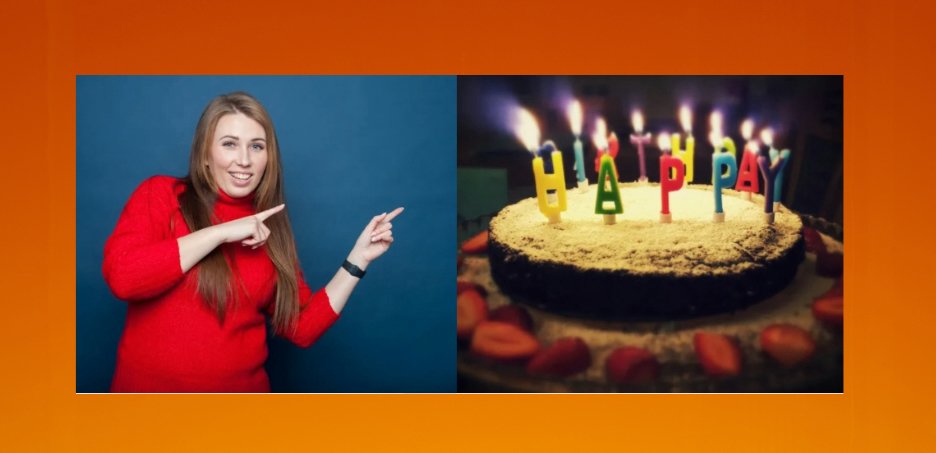
Photo credit: Images via UnsplashEmily Vondy's mom fail.

Sometimes, we have to just laugh at our failures.

“Here’s a little story to allow all the moms of littles out there to maybe feel a little better about yourself,” Emily Vondy told her 1.3 million TikTok followers.In a TikTok video that has now garnered more than 500,000 views, Vondy shared perhaps one of the most hilarious “mom fail” stories of all time: forgetting her son’s actual birthdate.


After a recent trip to the pediatrician, Vondy was ready to give her insurance company the ol’ what for, after being told her son’s birthday was February 25.

“Per my words: ‘my son’s birthday is the 26th. I’m his mother. I know his birthday,’” Vondy affirmed. Emphatically so.

@thevondyfam How’s your day going? #momfail #mombrain #parenting101 #sahm ♬ original sound – Emily Vondy

A quick scroll through Facebook to find the original birth date announcement proved the correct birthdate was, in fact, the 25th. Whoops.

“For two years I’ve been celebrating his birthday on the 26th!” exclaimed Vondy.

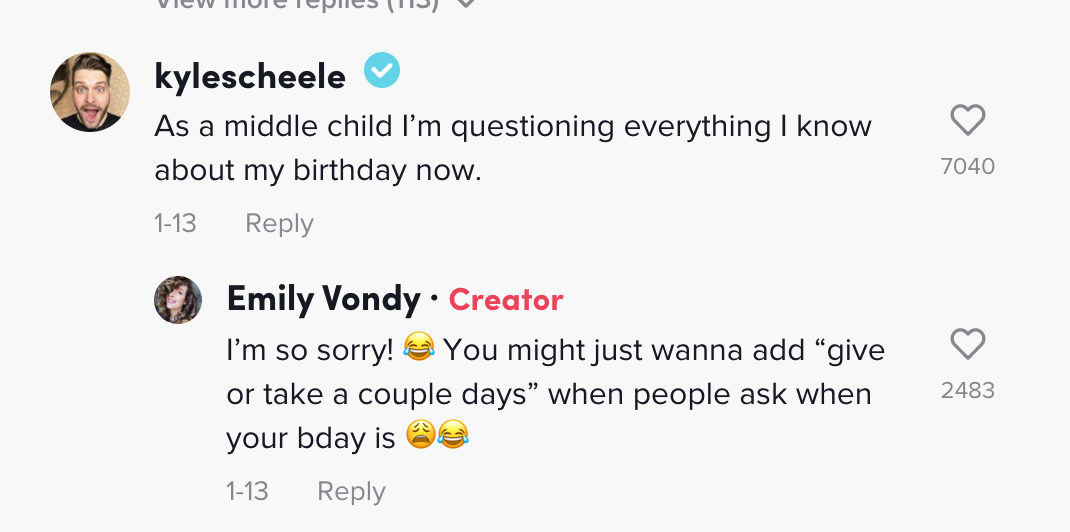
To make matters worse, Vondy revealed this was her middle child. My, my, how stereotypes manifest themselves.

She then shouted “I love my kids! They may not have their birthday celebration on the correct day but they celebrate it the next!” She then hilariously tried to sign off with a quick “Merry Christmas,” only to realize “Christmas is over!”

We get it, Vondy. What is time, anyway?

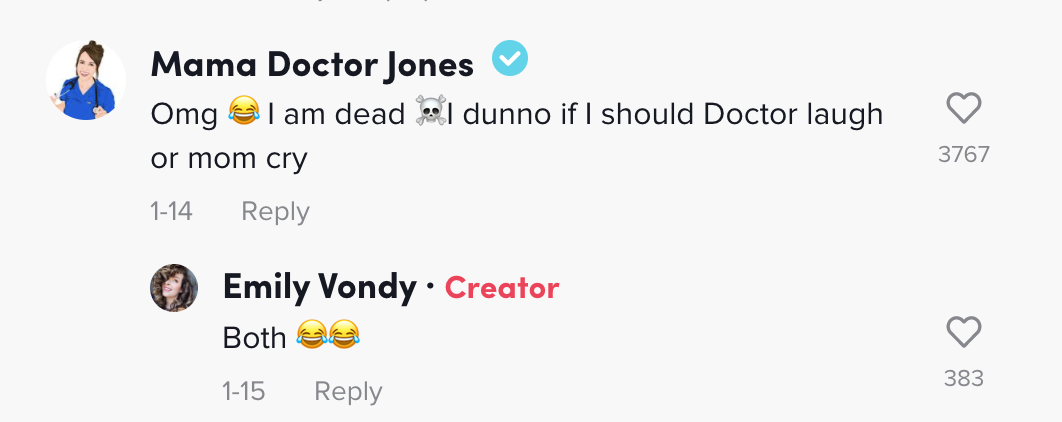
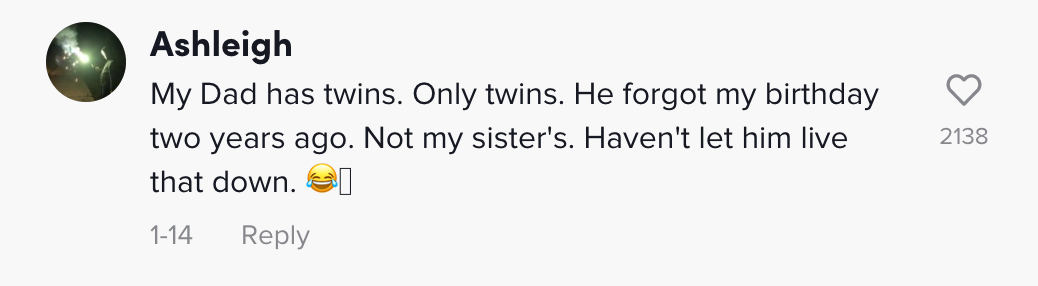
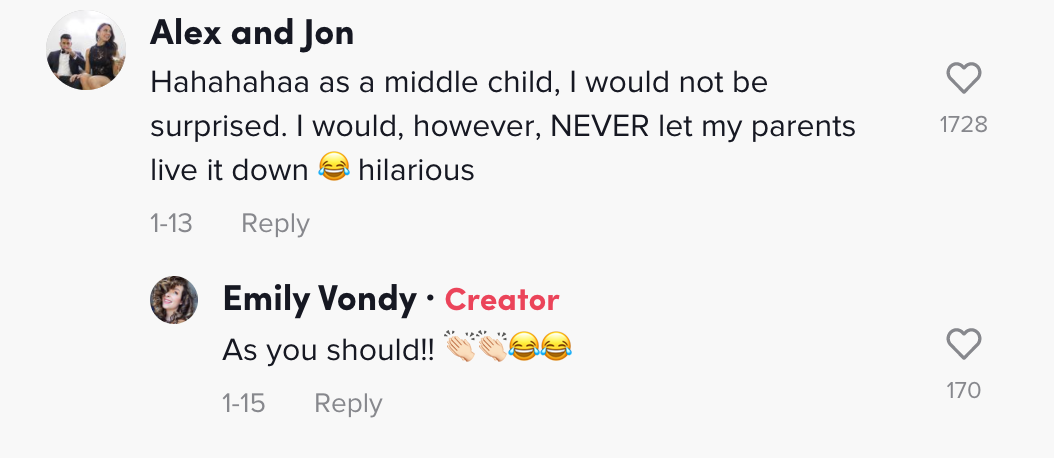
Parents and children alike delivered comments nearly as entertaining as the video itself:

If you enjoy Vondy’s ultra silly charm (that definitely gives off Amy Poehler vibes, no?), you’re in luck. Her channel is full of truly delightful videos that capture parenting life in a real, yet comical way.

I mean, just look at her music video promoting the meal delivery service Home Chef, complete with a “no prep two step.”

@thevondyfam #ad They had me at “oven ready” ? use code VONDY90 for $90 off. Link in Bio #hookedonhomechef ♬ original sound – Emily Vondy

Or her Target rap that no one asked for but everyone needs.

@thevondyfam My official application to be sponsored by target ? #momcontent #target #targetfinds #momcomedy ♬ original sound – Emily Vondy

Or eating a large pizza less than half an hour after giving birth.

@thevondyfam #answer to @Leo | IG: leocaballes THE BEST pizza I’ve ever eaten. #laboranddelivery #birthstory #birthcenterbirth ♬ original sound – Emily Vondy

Yes, mama. Treat yo’ self.

Now, if you’ll excuse me, I’m off to go check my birth certificate to see if I’ve been living a lie.


This article originally appeared on 1.25.22

  • Why Dwayne Johnson’s advice for new dads comes down to one simple thing: take off your shirt
    Photo credit: Harald Krichel via Wikimedia CommonsDwayne 'The Rock' Johnson at the 2025 Venice Film Festival.
    ,

    Why Dwayne Johnson’s advice for new dads comes down to one simple thing: take off your shirt

    “Take your shirt off. I need you to go skin to skin.” The Rock’s advice for new dads is simple, a little unexpected, and completely backed by science.

    When Canadian TV host Chris Van Vliet (@CVVClips) told Dwayne Johnson he was about to become a father for the first time and asked for advice, Johnson didn’t hesitate. He gave him a hug, told him his instincts were right, and then got specific.

    “Take your shirt off,” Johnson said. “I need you to go skin to skin.”

    Johnson explained that holding a newborn skin-to-skin right out of the womb builds what he described as an energetic and emotional anchor between parent and child. He’s not just talking theoretically. When his daughter Tiana was born in April 2018, he posted a photo to Instagram of himself cradling her against his bare chest, shirtless in the hospital, with a caption about how being her dad was the role he was most proud of. Days later, her mother Lauren Hashian shared her own photo doing the same.

    The practice Johnson is describing has a clinical name: kangaroo care. According to the Cleveland Clinic, skin-to-skin contact involves holding a newborn against a bare chest and has well-documented benefits for both the baby and the parent. For the baby, it helps regulate body temperature, stabilizes heart rate and breathing, supports early breastfeeding, and reduces stress. For the parent, it triggers hormonal responses that promote bonding and can reduce postpartum anxiety. The research backing it is extensive and the recommendation applies to both mothers and fathers.

    What Johnson is doing is essentially making the case for something pediatricians have been saying for years but that new dads don’t always hear directed specifically at them. Most kangaroo care conversations are aimed at mothers. Johnson’s version of the advice is pointed squarely at fathers, delivered by someone whose public identity is built on being the biggest, toughest person in the room — which probably makes it land differently.

    Van Vliet, for his part, went on to have a daughter. He hasn’t said whether he followed the advice. But the comment section on the video is full of fathers who either did and are glad they did, or didn’t and wish they had.

    “I got a bit teary-eyed during that,” one wrote. “I regret not doing the skin-to-skin with my son.”

  • He saw a driver put in $7 of gas and felt something click. By the time he left, several strangers were in tears.
    Photo credit: CanvaA man pumps gas; woman cries in her car.
    ,

    He saw a driver put in $7 of gas and felt something click. By the time he left, several strangers were in tears.

    He’s been doing this quietly every time he fills up. One night in Perth, someone caught it on camera.

    It was 10:30 at night at a BP station in Currambine, a suburb north of Perth, Australia. Monty Van Der Berg, 34, was waiting in line to fill up his tank when he noticed something about the car ahead of him. The driver had put in $7 worth of fuel and pulled away.

    That small detail stuck with him. He knew what $7 of gas means.

    When the next car pulled up beside him, he leaned over. “I hope you’re filling up,” he said, “because I’m going to pay for it.” Then he walked to the kiosk and kept going, paying for car after car until he’d spent around $340, as People reported on April 9.

    One woman pumping gas broke down crying. She’d just finished a brutal shift at work and was running on empty in every sense. The gesture hit her somewhere she wasn’t expecting. Another woman named Gerville gave an interview to 7NEWS afterward, still visibly moved. She works three jobs as a single mother. Someone quietly paying for her fuel at 10:30 on a Monday night was not something she had any framework for. “It was so nice to see other people light up,” Van Der Berg said afterward. “It was such a nice moment.”

    kindness, gas station, Perth, random acts of kindness, community
    Woman smiles at the gas station pump. Photo credit: Canva

    Van Der Berg owns a construction business now, but it wasn’t always that way. He said there were years when he was living paycheck to paycheck and a full tank wasn’t always possible. He knows what it feels like to pull up to a pump and do the math in your head. So now that he’s doing well, he has a rule: every time he fills up, he pays for at least one other person.

    He was clear that the $340 night wasn’t about the money or the attention. “That’s my one thing every time I fill up,” he said simply. He didn’t want praise for it. He just remembered what it was like, and he’s in a position to help, so he does.

    Gerville said she hopes to run into him again someday. She wants to pay him back.

    This random act of kindness at the pump reminds us of this viral classic from almost a decade ago:

  • NFL fan laughed so hard at kicker’s flub he had a seizure. Then doctors made a lifesaving catch.
    Photo credit: Atlanta Falcons/Wikimedia CommonsA man had such a big reaction to a kicker's missed kick that he went to the hospital, where doctors made a lifesaving discovery.
    ,

    NFL fan laughed so hard at kicker’s flub he had a seizure. Then doctors made a lifesaving catch.

    “I wholeheartedly believe I was in the right spot at the right time.”

    Football is a dangerous sport. From ACL tears to concussions, athletes risk it all from the moment they step foot on the field. An NFL career without at least one catastrophic injury is a rare exception.

    Watching it at home, however, is supposed to be relatively safe. One man’s story proves that isn’t always the case, especially when fans get a little over excited by a generational folly.

    Kicker’s flub causes fan to laugh way too hard

    Mark Toothaker of Kentucky was watching a game from the comfort of his home last season. The New York Giants were taking on the New England Patriots, and Giants’ kicker Younghoe Koo was lining up for a routine field goal.

    In inexplicable fashion, Koo missed. He didn’t just miss the field goal uprights, he missed the ball entirely, with the toes of his right foot slamming into the ground several inches away from the ball’s laces.

    Koo has been a good kicker throughout his career, but this was one of the worst misses of all time. Few analysts had seen anything like it before. The broadcasters were besides themselves. Unfortunately for Koo, the slow-motion, close-up videos of his blunder quickly became viral meme fodder.

    Toothaker was right there watching along with everyone else, but he didn’t get to enjoy the moment for long. He was laughing so hard after watching and rewatching the replay that he suddenly collapsed.

    “I’ve never felt anything like this in my life,” Toothaker told the AP. “I felt like I got electrocuted.”

    Toothaker had suffered a seizure. Further testing showed a surprising result.

    Toothaker’s wife, Malory, called paramedics and an ambulance quickly got him to the hospital. Doctors determined he had had a seizure—his first—but that’s not all.

    CT imaging revealed a large tumor on Toothaker’s brain: the source of the seizure. He’d suffered no symptoms at all until his intense laughter preceded the intense seizure.

    Seizures can have all kinds of fascinating triggers, including music, being startled, or even laughter. Some specific forms of epilepsy have precise triggers like a certain body part being touched or having your natural stride broken by someone stepping in front of you.

    It’s impossible to say if the laughter from Koo’s viral miss caused the seizure, but don’t tell that to Toothaker:

    “I wholeheartedly believe I was in the right spot at the right time, and he was the trigger for that happening. It was a miracle.”

    younghoe koo, giants, nfl, new york giants, nfl kicker, sports, athletes, sports stories, heroes, good luck, medical emergency, seizure, near death experience
    Mark Toothaker’s CT scan revealed the source of his seizure. Photo Credit: Canva Photos

    He says he thinks about what might have happened if the seizure had hit him while driving or out in public; how he could have died or accidentally hurt someone else.

    Instead, the tumor was identified and removed quickly. Doctors say it was benign, and Toothaker has no lasting damage from the seizure or the surgery to remove the mass.

    In medicine, luck is a matter of life and death

    Stanford Medicine writes about how many crucial medical discoveries were happy accidents, and how good fortune always plays a big role in whether people ultimately live or die:

    “We’d be fooling ourselves if we thought that we actually had that much control over the direction of medicine. Medicine is intractable and unpredictable, and luck plays a larger role than we’d like.”

    Some people might call Toothaker’s story a miracle. Others might just call it a case of fantastic luck that he happened to be watching and just so happened to find the NFL moment so dang funny.

    younghoe koo, giants, nfl, new york giants, nfl kicker, sports, athletes, sports stories, heroes, good luck, medical emergency, seizure, near death experience
    www.allproreels.com — Washington Football Team at Atlanta Falcons from Mercedes Benz Stadium, Atlanta, GA October 3rd, 2021 (All-Pro Reels Photography)

    Whatever it is, Toothaker says he’s grateful to Koo: “I know it wasn’t his best moment…For [Malory] and I to be belly-laughing at his expense, which I feel terrible about now, but it all worked out in the end, that for me it couldn’t have been a better moment.”

  • All 60 employees of Toledo restaurant win the ‘boss lottery’ with a free Caribbean cruise
    Photo credit: CanvaThe restaurant workers of The Standard went on an unforgettable trip.

    A good restaurant owner knows that it takes the entire team to ensure success. From the head chef creating the menu to the front of the house that cleans the floors, everyone plays an important part. With that in mind, The Standard Restaurant in Toledo, Ohio decided to treat the entire staff of over 60 people to a Caribbean cruise

    During the first week of January 2026, The Standard closed its doors so its workers could get on a flight and enjoy a three-day Royal Caribbean cruise to the Bahamas. The whole staff from cooks to servers enjoyed karaoke, basketball, the beach, scavenger hunts, and delicious group dinners. 

    Chef Jeff Dinnebeil and manager Megan Lingsweiler, the husband and wife owners of the restaurant, also provided holiday bonuses and ensured no lost wages so the employees could relax while they were away.

    For many employees of The Standard, this was the first time they’d ever had such a vacation.

    “At first, I was nervous because I’ve never been on a cruise. I’ve never been in a plane. I’ve never been anywhere, so it took me a minute,” cook Andrew “Duke” Jackson told The Toledo Blade. “I had never been in the ocean before, so that was the first for me. Chef kind of made me get in there. But once I got in there, it was everything.”

    “It was just such a unique experience getting to see 60 of your co-workers around the boat,” said server Allison Latta. “And some of these people, it was their first time flying, and it was their first time seeing the ocean.”

    The Standard’s high standards for work and play

    The Standard touts itself as an American bistro that serves meals during dinner hours. The food and service contribute to the dozens of positive Yelp reviews from Toledo residents. The owners are happy that the customers are happy, but wondered what they could do to make their employees happy, too.

    Grateful for their work, Dinnebeil and Lingsweiler wondered how to best thank their staff. When their family went on a cruise themselves, inspiration struck.

    “We made that decision on January first of 2025, on a boat that we were on with our kids. We followed through with it, and it was the best thing we’ve ever done,” said Dinnebeil. “Our staff is everything—they’re the blood, life, and the heart of that restaurant.”

    “This is what we live for,” said Lingsweiler. “We live to experience and to enjoy, and there’s no greater people than the ones that are working for us.”

    The staff was excited for the trip, but ultimately appreciative for the camaraderie and support that their employers gave them. Treating them as valued members of a team and as cared-for individuals motivated them to continue working at their best for The Standard.

    “Everybody went on there as employees, and, when we left and went back home, everybody was like family,” concluded Jackson.

    Other ‘boss lottery’ wins

    There are other employers like Dinnebeil and Lingsweiler who acknowledge their employees with generosity. The owner of a Chik-Fil-A restaurant in Pittsburgh gave employees expensive Christmas gifts ranging from a week’s worth of salary to a Toyota RAV4 car. The owner of a Baltimore commercial real estate company gave out $10 million in bonuses to his 198 employees. After his family-owned business in Louisiana was sold for $1.7 billion, the owner gave all 540 full-time employees an average of $443,000 per worker.

    It goes to show good bosses knows that success and cooperation are at their best when each employee is shown gratitude and shares in the rewards.

  • Why a common World War II experience made Americans choose toilet paper over bidets
    Photo credit: PhotosNormandie/Wikimedia Commons & CanvaAmerican soldiers in World War II and a bidet.
    ,

    Why a common World War II experience made Americans choose toilet paper over bidets

    We’ll probably switch to the metric system before bidets.

    The bidet dates back to 18th-century France and, by all accounts, is more hygienic than toilet paper and better for the environment. But, much like the metric system, Americans aren’t adapting to them anytime soon.

    In fact, a 2022 poll found that only 12% of Americans “know a lot about” bidets. Americans make up 4% of the world’s population but use 20% of its toilet paper, while 70% of the world doesn’t use toilet paper at all.

    When you look at the numbers, bidets are a much better option for the environment and for one’s pocketbook than toilet paper. According to The Process, Americans cut down 31 million trees each year for toilet paper, and it takes 37 gallons of water to produce a single roll, while each use of a bidet requires only one-eighth of a gallon.

    Bidets also do a better job of cleaning your rear end than a square of toilet paper.

    “The direct application of water for post-toilet cleansing removes residual fecal matter more effectively than toilet paper alone,” Dr. Farhan Malik, a health and wellness expert, told KTVX-TV. “This can help prevent skin irritation and inflammation in the genital area. The gentle, targeted spray of water also reduces excessive wiping and tugging, which can lead to discomfort.”

    Why haven’t Americans adopted the bidet?

    When Americans were stationed in France during World War II, many visited bordellos, a fact they probably didn’t want people back home to know. In the bordellos, sex workers and their clients used bidets to clean up before and after their encounters, so Americans came to associate bidets with naughtiness and illicit behavior. 

    toilet, bidet, bathroom
    A bidet beside a toilet. Photo credit: Mura.Ts/Unsplash

    “GIs visiting bordellos would often see bidets in the bathrooms, so they began to associate these basins with sex work,” Maria Teresa Hart writes in The Atlantic. “Given America’s puritanical past, it makes sense that, once back home, servicemen would feel squeamish about presenting these fixtures to their homeland.”

    Even before World War II, bidets were associated with contraception and abortion. “The presence of a bidet is regarded as almost a symbol of sin,” Norman Haire, a pioneering gynecologist and sexologist, said in 1936.

    Bidets make economic sense

    What’s interesting is that, even though Americans rejected bidets on moral grounds, that resistance hasn’t been overridden by economic common sense. Americans spend $11 billion on toilet paper every year, and the average person in the U.S. uses 141 rolls annually. A single bidet attachment can cost as little as a one-time fee of $35.

    toilet paper, toilet paper stash, bathroom
    A whole lot of toilet paper. Photo credit: Erik Mclean/Unsplash

    Bidets have been found to be better for your health, the environment, and your wallet, but Americans still won’t switch from paper to a little spritz of water. If the runs on TP during the COVID-19 pandemic didn’t inspire Americans to change their ways, maybe nothing will. 

    “Toilet paper is not a necessity. It is a cultural habit wearing the costume of a necessity. Seventy percent of the human population proves that every single day,” The Process reports. “A product most of the world has never needed became the first thing Americans panic-bought when crisis arrived. Not medicine. Not food. Toilet paper. That tells you something, not about cleanliness, but about how habits take root. They do not grow from logic. They grow from one small misunderstood moment, repeated across a generation, then another, until the habit feels like instinct.”

  • How women in fake beards made one of the most iconic scenes in ‘Lord of the Rings’ history
    Photo credit: Flomuk/YoutubeWomen getting made-up in fake beards to become LOTR warriors.
    ,

    How women in fake beards made one of the most iconic scenes in ‘Lord of the Rings’ history

    The beloved fantasy franchise features more females than you might think.

    The Lord of the Rings: The Two Towers is widely regarded as the most action-packed installment of the Lord of the Rings trilogy. The Battle of Helm’s Deep alone was a juggernaut of a fight scene, wherein thousands of Riders of Rohan (the good guys) go up against the forces of Saruman’s infantry of Uruk-hai, Orcs, and Dunlendings (the bad guys). 

    And of course, valiantly fighting in disguise as a Rider of Rohan, or the Rohirrim, in the third and final installment of Lord of the Rings (i.e. Return of the King) is Eowyn (played by Miranda Otto), one of the only three female leads in the trilogy. Funny to think that Eowyn wasn’t, in fact, the only cross-dressing female in this iconic movie moment…not by a long shot. 

    The real riders behind the army

    To capture the full size and scope of the battle, Peter Jackson needed extras. Lots of them. Extras who could not only ride a horse well (they’re not called riders for no reason), but who would also, ideally, own their own horse. That significantly narrowed the availability of viable performers. Surprisingly, an overwhelmingly larger number of women fit that bill than men. So, Jackson and his team created a bit of movie magic. They gave these female riders fake beards, and voila: an army of horseback riding men. 

    A BTS story that stuck

    Major LOTR nerds might remember this story being shared in the extensive behind-the-scenes footage that came with the DVD. In it, we see the female extras getting fit (one even jokes, “I am a girl! See?!”), as well as Viggo Mortensen, aka Aragorn, coyly admitting that he may or may not have had a crush on one with a strawberry blonde beard. 

    While this kind of bonus content is, in some ways, a thing of pop culture past, this story lives on online as part of LOTR lore, occasionally resurfacing from time to time to either shock those who were unaware, or give aficionados reason to brag, “Yeah, I already knew that.” Either way, it’s always an opportunity to find newfound appreciation. It also highlights how the best kind of filmmaking often relies on practical solutions that subtly reshape what audiences think they are seeing. 

    Expanding women’s presence in Middle-earth

    In subsequent adaptations of Tolkien’s work, there have been a few measures taken, for better or worse, to add more female representation to the mix. The Hobbit franchise, for example, invented Elven warrior Tauriel, played by Evangeline Lilly. Similarly, Rings of Power centers on a young Galadriel (Morfydd Clark), and also features dwarf royalty Princess Disa, played by Sophia Nomvete. 

    Both the Lord of the Rings books and movie series are highly regarded for the way they portray masculinity and male relationships. But as we see, both in obvious and not-so-obvious ways, the women in LOTR brought to life some of the story’s most defining moments. 

    And really, even more than that, this story speaks to the collaborative nature of filmmaking. As a new rendition of Lord of the Rings is currently being created—in a time when so many vitally human aspects of filmmaking seem to be at risk—one can only hope this element stays within its DNA. 

  • ‘Wheel of Fortune’ fan conducts wild 6-year study and finds bizarre pattern with male contestants
    Photo credit: Tom Sloan/WikipediaVanna White and Pat Sajak, circa 1982

    Sure, there are several hacks Wheel of Fortune players might use to increase their odds of success—calling out common letters, using “Express Wedges,” etc. But when it comes to keeping a marriage alive post-show, there’s really only one winning strategy: compliments.

    A very specific (and very committed) investigation

    Who’s to say what prompted a man named Joey to devote six years to watching “nearly 2,000 episodes” of the hit game show to see how many of its married male contestants were “kicked to the curb” after competing. But regardless, his findings were…surprising, to say the least.

    After examining episodes that aired between 2010 and 2019, Joey discovered that male game players who didn’t use “complimentary adjectives” (think “gorgeous,” “amazing,”  “fantastic”) to describe their wives during their introductions were far more likely—3x more likely, in fact—to get divorced within five years than their honey-tongued counterparts. 

    marriage, wheel of fortune, divorce
    Image of divorce papers Photo credit: Canva

    Apparently, 15% of the hubbies who forgot to attribute some kind of heavenly descriptor to their spouse got the boot, while only 5% of the complimentary group suffered the same fate. 

    Joey saw more or less the same gap among the 185 Wheel of Fortune winners who were married men. Seven percent of the praising fellas eventually got divorced, while 17% of the tightlipped ones saw their relationship disintegrate.

    The Internet reacts: “Peak use of free will”

    It wasn’t long before this wild study went viral online. People were shocked, yes, but mostly incredibly impressed by Joey’s “investigative journalism.” 

    “Peak use of free will. It’s people like this that got us out of caves and into the future.”

    “I can appreciate weird obsessive behaviors. Love this.”

    Fellow data nerds were particularly enamored. 

    “This is a data analyst with hyperfixation. So niche, and now will giggle when i listen to the men introductions. No one will get when i say, ‘divorced 5 years!’ and if they ask.. i’ll come back to this comment!”

    “As a data analytics student i’m obsessed with this and this just opened a whole world of opportunity for me and my spare time tysm.”

    One Wheel of Fortune insider even shared, “This is wild because the WoF casting people go out of their way to prep you to say something complimentary about your spouse. I remember trying to come up with something really unique to say about my husband, but the takeaway is that I knew I HAD to use some kind of complimentary adjective. So, not doing this means you actively worked against the coaching.”

    As for Wheel of Fortune itself, the show’s verified TikTok account could only muster, “Bruh” in the comments section, along with a “mind-blown” emoji. 

    Why compliments actually matter in relationships

    marriage, wheel of fortune, divorce
    A happy, smiling older couple Photo credit: Canva

    These findings, however seemingly niche, do reflect a larger bit of general relationship wisdom. According to renowned marriage specialist John Gottman, publicly complimenting your spouse is a powerful tool to build a “culture of appreciation”, which strengthens the relationship’s emotional foundation. It demonstrates fondness, admiration, and pride in your partner, contributing to the crucial 5:1 positive-to-negative interaction ratio needed for a healthy marriage.

    In other words, it might not guarantee a jackpot, but a few kind words can go a surprisingly long way. And unlike solving a puzzle on national TV, this move can be practiced every day.

  • Harvard linguist explains perfectly logical reason Boomers insist on using ellipses in texts
    Photo credit: CanvaAn older woman uses a tablet computer.
    ,

    Harvard linguist explains perfectly logical reason Boomers insist on using ellipses in texts

    If you’ve ever gotten a text from your mom or grandma full of “…” and had no idea what it meant, you’re not alone.

    One generation’s texting habit that baffles every generation is the Boomers‘ seemingly excessive use of ellipses. Do you have more to say, Aunt Judy, or did you just accidentally press the period key too many times? Maybe it’s for a dramatic pause or to put emphasis on a point? This is truly a mystery that leaves every generation below them confused about what is meant by the dreaded “dot dot dot.”

    Texting etiquette differs with every generation. Gen X and most Millennials use fairly proper grammar and punctuation throughout a text message exchange. Every new sentence starts with a capital letter, there are strategically placed Oxford commas to ensure there’s little room for misunderstandings, and sentences end with an appropriate punctuation mark.

    How each generation texts differently

    When it comes to Gen Z, they find that ending text messages with proper punctuation indicates that the person they’re texting is being passive-aggressive. They also text in shorthand and emojis that can feel a bit like you need a special decoder ring to decipher the messages. But texting in an encrypted way can be chalked up to youth, though the same can’t be said when it comes to Boomers. Or can it?

    Harvard linguist and author of the New York Times bestseller Algospeak, Adam Aleksic, breaks down why so many Boomers use ellipses when texting. It’s surprisingly not as complicated or dramatic as one may imagine. In a viral 2024 TikTok video, Aleksic explains his theory for the texting etiquette of Boomers.

    linguist; boomers; gen x; millennials; gen z; text etiquette; boomer texting; gen z slang

    Two generations connecting through their smartphones. Photo credit: Canva

    “You know how older people tend to use the ‘Boomer ellipses’ whenever they’re texting? There’s always a random ‘dot dot dot’ in the middle of their messages?” Aleksic asks. “Well, that’s because they grew up following different rules for informal communication. Nowadays, if you want to separate an idea, you just press enter and start a new line with a new thought, but it made less sense to do that for writing postcards or letters, where you had to save space, so people back in the day learned to separate thoughts by using ellipses.”

    The pay-per-text era that changed everything

    Aleksic explains that this is also true for when phones first started allowing text messaging. You were charged by the message, so ellipses made it more efficient to convey all the thoughts in one message instead of multiple ones. SMS texting also had a character limit, unlike current phones, where you can essentially write a novella in a single message without your phone automatically breaking it up.

    Today’s texting standards typically mean people separate their thoughts by sending multiple messages for separate thoughts, though that annoys some people. If separating thoughts means you’ll be sending no less than five texts in quick succession, it’s likely best to just space down to make the text longer, rather than bombarding an unsuspecting friend.

    Why the boomer ellipsis causes so much confusion

    When it comes down to it, younger generations have adapted to the new standard, embracing the unlimited text option, while Boomers haven’t. Due to this discrepancy in text etiquette, the ellipses used by Boomers throw people for a loop.

    “That means the Boomer ellipses became redundant, which is why they cause confusion today. They violate what we call ‘the maximum quantity;’ they add more information than necessary, so they appear to imply something more than the intended meaning. Most of the time, that comes off to younger people as hesitation, annoyance, or passive aggressiveness because that’s how we use the ellipses,” the linguist shares.

    So, no, your grandma isn’t mad at you or avoiding telling you something; according to Aleksic, she’s just trying to send you multiple messages in one. There’s no hidden emotion behind the ellipses for Boomers; it’s simply a habit left over from their younger years.

    This article originally appeared one year ago. It has been updated.

Parenting

Albert Einstein’s advice to his son is applicable wisdom for parents today raising resilient kids

Nutrition

Chicken noodle in, Frosted Flakes out. A new trend has people ditching cereal for soup.

Life Hacks

Happiness expert shares the ‘real science’ in placing a hand over your heart to lower anxiety

Identity

Why a common World War II experience made Americans choose toilet paper over bidets