Language is fascinating. The way humans have come up with literally thousands of languages to communicate with one another, the grammatical structures we’ve concocted, the fact that we learn our native tongues so naturally, and how powerful words can be are all testaments to how cool language is. But when you drill down even further, language gets even cooler, and in ways that most of us aren’t even aware of.
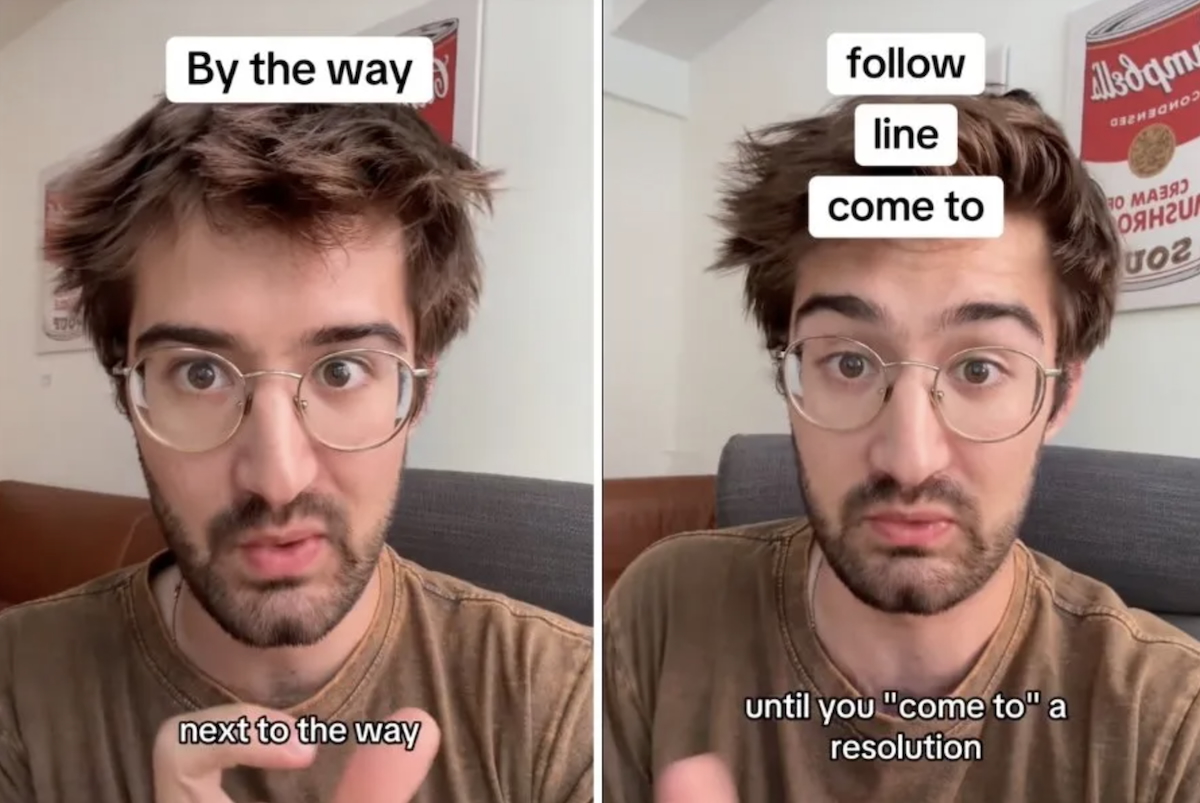
Linguist and self-professed “etymology nerd” Adam Aleksic shared a video on TikTok explaining how many common phrases we use for thinking directly reference walking. We often use metaphors in our speech, of course, but there are many that we likely don’t even recognize as metaphors.
Once you hear this, you can’t unhear it
He starts with “by the way,” which literally means being next to the way, or the path we’re supposed to be on. It indicates that we’re taking a mental detour from the path we were supposed to be on to introduce something unrelated. On the other hand, when we’re talking about something that is actually on the path we’re meant to be on, we say, “of course,” which literally means “of the path.”
“We use this metaphor all the time when we say, ‘you’re on track’ or ‘you’re way off,’ literally implying that you’re not where you should be on the ‘path’ of thinking,” Aleksic says, explaining that there’s a greater metaphor at play here that “thinking is walking.”
Once you see some examples, it becomes so clear. Our minds “race” or “wander,” our thoughts “stray,” and we “arrive” at conclusions.
“All this relies on physical motion, even though your mind is stationary,” says Aleksic. “But it’s from that idea (that thoughts can walk) that we can then go ahead and make statements about our own cognition. Like how I just used ‘from,’ originally a preposition for motion, and ‘go ahead’ to indicate continuation. Once you know thoughts can walk, you can ‘follow’ them down ‘a line of thinking’ until you ‘come to’ a resolution.”
Here are a few more you’ll recognize
Even a saying as common as “Way to go!” is a metaphor indicating that you are on the correct path.
Once you start thinking about it, it’s easy to come up with many more examples of how we conceptualize thinking as walking:
“Let’s circle back.”
“Walk me through your thinking.”
“I’m backtracking here.”
“The thought crossed my mind.”
“No way.”
“Let’s move on.”
Other languages do the same thing
Some commenters shared that their languages use similar metaphors:
“In Norwegian you can say ‘du er helt på bærtur’ when someone is way off, and it means that you are on a berry trip, specifically blueberry trip.”
“In Czech, you say btw as ‘mimochodem’, while mimo means outside and chodem means a step or a walk, so literally meaning by the walk.”
“En passant in french is the same way. It’s like ‘I passed near this thought’ while on my way to another thought.”
True to form, Aleksic even has a video commenting on comments:
There’s something to be said for “thinking is walking” even beyond the metaphorical way we describe our thoughts. Many of the world’s greatest thinkers were also obsessive walkers.
Science backs this up, too
In 2014, Marily Oppezzo and Daniel Schwartz of Stanford University conducted a foundational series of four experiments involving 176 college students and other adults to see if walking had any effect on different types of thinking. In one test, they had some people walk outside and others walk on a treadmill facing a blank wall to see if the environment made a difference.
On brainstorming tasks, it mostly didn’t. Wherever people walked, they came up with more creative ideas than those who sat or were pushed in a wheelchair, and creative output rose by an average of 60%. Participants consistently did better on tests of divergent thinking, such as thinking of alternate uses for common objects, and walking outside produced the most novel, high-quality analogies. The boost did not extend to convergent thinking, where there is a single right answer.

“Incorporating physical activity into our lives is not only beneficial for our hearts but our brains as well,” Oppezzo said. “This research suggests an easy and productive way to weave it into certain work activities.” Could we perhaps say, “walking is thinking” in addition to “thinking is walking”?
A 2021 study of Japanese young adults found that regular walking was associated with more original responses on alternate uses tests, which measure divergent thinking, though not with convergent thinking.
So it appears at least some types of thinking are enhanced by walking. A recent meta-analysis of 23 studies in PLOS ONE found a large effect on divergent thinking but no effect on convergent thinking. Which, of course, makes it all the more fun that we use so many walking metaphors to describe our thoughts.
You can follow Adam Aleksic for more on TikTok here or check out his book, Algospeak: How Social Media Is Transforming the Future of Language, here.
This article originally appeared last year. It has been updated.